
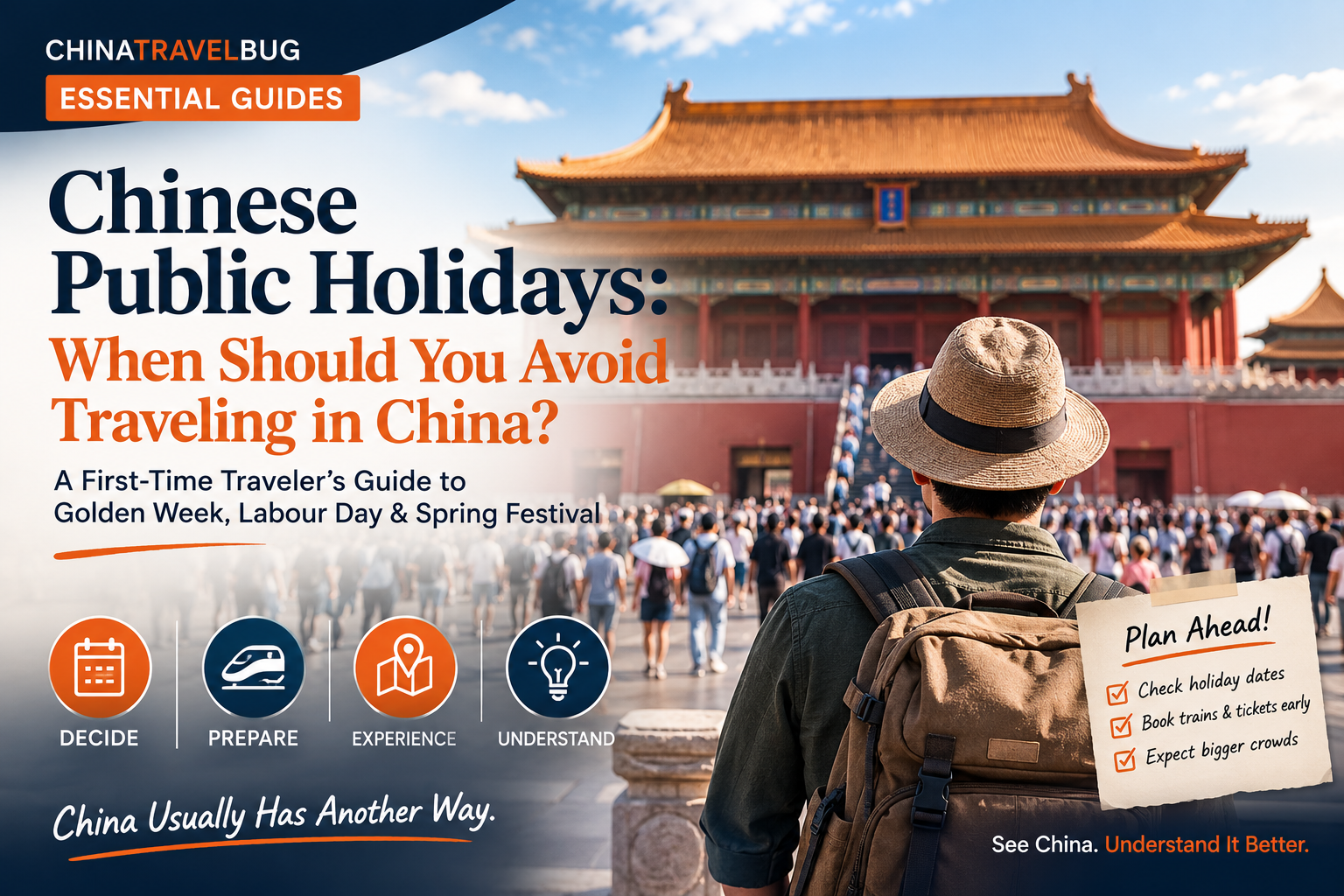
Dad & Elaine Learned Some of This the Hard Way 😂 Last verified: 28 August 2026 Chinese public holidays don’t mean you shouldn’t travel China. But at the wrong time, train tickets disappear, attractions fill up, hotels become more expensive, and carefully planned itineraries can suddenly fall apart. Dad & Elaine have experienced all of those. 😂 ⚡ Quick Answer For a first trip to China, if your dates are flexible, Dad would particularly try to avoid: 🔴 Spring Festival (春节, Chūnjié)🔴 National Day Golden Week (国庆节, Guóqìng Jié) Other public holidays—including Labour Day (劳动节, Láodòng Jié) and Mid-Autumn Festival (中秋节, Zhōngqiū Jié)—are more manageable, but book important trains, hotels and high-demand attractions early. And don’t forget Chinese school holidays. China’s 2026 Public Holidays Holiday Official 2026 break Dad’s advice New Year Jan 1–3 🟢 Manageable Spring Festival Feb 15–23 🔴 Avoid if flexible Qingming Festival Apr 4–6 🟠 Plan ahead Labour Day May 1–5 🟠 Expect crowds Dragon Boat Festival Jun 19–21 🟠 Plan ahead Mid-Autumn Festival Sep 25–27 🟠 Plan ahead National Day Oct 1–7 🔴 Avoid if flexible These are China’s official 2026 holiday arrangements. Official 2026 China public-holiday schedule — State Council ⚠️ Planning China in 2027? Chinese New Year falls on 6 February 2027. However, as of 28 August 2026, China’s State Council has not yet published the complete official 2027 public-holiday arrangement. That’s an important distinction. The festival date is predictable from the traditional calendar; the exact official days off and adjusted working days should not be guessed. If you’re considering China in late January or February 2027, check again before locking in your itinerary. 🌶️ 1. We Tried to Escape Xi’an Before Labour Day Dad knew Xi’an (西安, Xī’ān) would become crowded around May 1. So we planned to leave on April 30 for the much smaller city of Yuncheng (运城, Yùnchéng). Good strategy. Then we missed our train. 😂 Dad went to the railway counter looking for an alternative. There wasn’t a suitable train for us until May 2. So instead of avoiding Labour Day in Xi’an, we spent two unexpected extra nights there. Hotels were still available—but the prices we found were higher than normal. In our case, China Railway also allowed us to change our travel date with a relatively small additional charge. Dad’s lesson Immediately before a major holiday, don’t assume missing your train simply means catching the next one. The real problem may be availability, not price. 🌶️ 2. Mid-Autumn Festival Changed Our Beijing Tour On an earlier Beijing (北京, Běijīng) packaged tour, everything seemed arranged. Then our guide told us the itinerary had to be rearranged and cut short because she and the bus driver were going off for Mid-Autumn Festival. 😂 It wasn’t a disaster. But it taught us: Even an organized tour can operate differently during a Chinese public holiday. For shorter holidays, we wouldn’t necessarily change our travel dates—but we’d allow more flexibility. 🌶️ 3. School Holidays Count Too During our Shandong journey, we visited the Shandong Museum (山东博物馆, Shāndōng Bówùguǎn) in Jinan (济南, Jǐnán) during the summer school holidays. It was packed with schoolchildren and groups. And somehow… Elaine managed to get us in. 😂 The lesson: “Not a public holiday” does not mean “not crowded.” During Chinese school holidays, expect more families traveling and more pressure on popular museums and attractions. 🌶️ 4. Some Places Don’t Need a Holiday Then there’s the Forbidden City (故宫, Gùgōng). When we visited Beijing, we deliberately booked a local guided tour partly as a strategy to help secure entrance tickets. Our tickets were successfully arranged. But several travelers joined the tour later. By then, the guide couldn’t obtain Forbidden City entrance tickets for them. They had booked the tour. They had the guide. They still couldn’t enter the Forbidden City. That’s worth remembering: Booking a tour doesn’t magically create an entrance ticket after tickets are unavailable. Some blockbuster attractions require advance planning even when there is no public holiday. Dad’s China Crowd Rule 🔴 Avoid if your dates are flexible Spring Festival and National Day Golden Week. Spring Festival dates move each year with the traditional Chinese calendar. Always check your actual travel year. 🟠 Travel—but plan ahead Labour Day, Mid-Autumn Festival, Qingming Festival and Dragon Boat Festival. Expect more domestic travelers and pressure on trains, hotels and popular attractions. 🟡 Check school holidays too Especially for museums and family-oriented attractions. 🔵 Even on normal days Secure the trip-breakers first: 1. Important intercity trains2. High-demand attraction tickets3. Accommodation The noodle shop can wait. 😂 Already Caught in the Crowd? That’s what happened to us in Xi’an. Our approach: On Labour Day morning in Xi’an, we quickly saw how crowded things were and avoided charging straight into the busiest areas. Sometimes changing the itinerary is better than spending the whole day fighting it. China Usually Has Another Way. ChinaTravelBUG’s Take Don’t be frightened of Chinese public holidays. Respect them. For a first trip, we’d avoid Spring Festival and National Day Golden Week if we had complete flexibility. For most other holidays, we’d still go—but we’d book earlier and keep Plan B ready. And if Dad carefully arranges to escape Xi’an before Labour Day… don’t miss the April 30 train. 😂
How Much Does a Trip to China Cost?
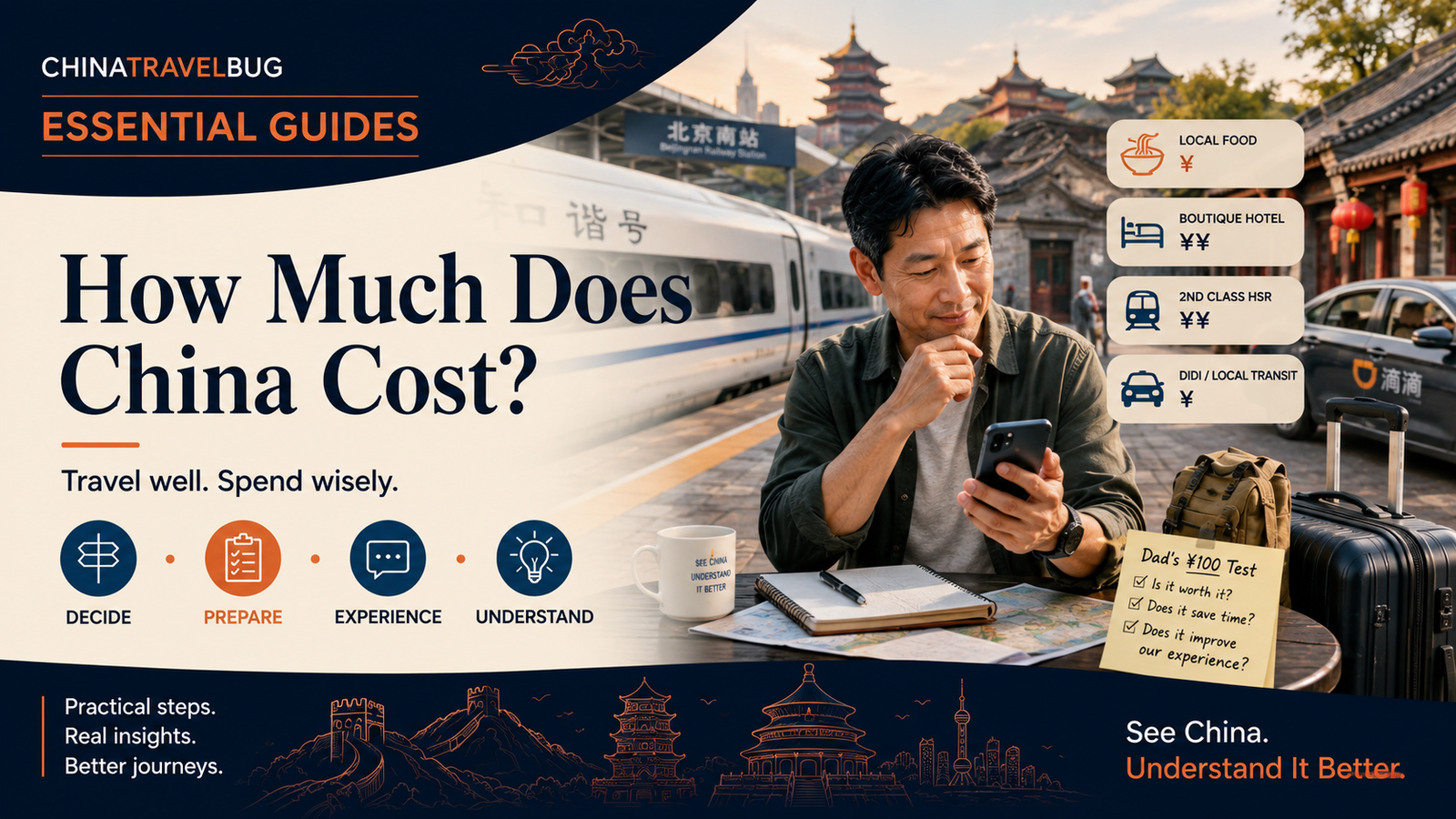
Dad’s Guide to Traveling China Well Without Wasting Money Last verified: 28 August 2026Firsthand examples come from Dad & Elaine’s travels. Current G/D train fares were checked on 28 August 2026. How expensive is China for a first-time traveler? Our answer is: it depends much more on how and where you travel than many online “¥X per day” budgets suggest. Dad travels in what Elaine calls budget mode. 😂 But we’re not backpackers. We choose comfortable hotels, eat well, take DiDi when useful and occasionally hire local guides. Our rule is simple: Don’t spend the least. Spend where it improves the journey. ⚡ What Did Things Actually Cost Us? Here are some examples from our travels: Expense Our experience Beijing boutique hotel near hutongs, 2023 ¥450–500/room/night Typical Beijing DiDi ride about ¥30–60 Nanchengxiang (南城香) local meals about ¥10–30/dish Xi’an local noodle/rice shops about ¥17–30/dish Simple local noodles in various cities from about ¥13–20 These are our firsthand examples, not fixed China-wide prices. Beijing generally felt more expensive than Xi’an (西安, Xī’ān). In some smaller cities we visited, everyday spending could feel roughly 40–50% lower than Beijing, depending on hotel, neighborhood and food choices. And even inside Beijing, there’s no single “Beijing price.” Eating in a central shopping mall can cost far more than eating where local families eat. 🍜 Want to Save Money? Eat Where Locals Eat One of the easiest ways to keep costs reasonable is also one of the nicest ways to experience China. In Beijing, we ate at Nanchengxiang (南城香, Nánchéngxiāng), where dishes during our trip could be around ¥10–30. In Xi’an, ordinary local noodle and rice shops could offer meals around ¥17–30. Across China, we’ve found simple noodle dishes starting around ¥13–20. We also noticed that beef and chicken dishes were often more expensive than pork dishes. You don’t need to eat badly to eat cheaply in China. You just don’t need to eat every meal in a tourist district or shopping mall. 🚄 What Does High-Speed Rail Cost? We checked these example second-class fares on G/D trains on 28 August 2026: Route Journey Fare shown Xi’an → Baoji (宝鸡) 55 min ¥56 Xi’an → Taiyuan (太原) 3h 17m ¥179 Beijing → Jinan (济南) 1h 22m ¥223 Beijing → Anyang (安阳) 2h 44m ¥252 Beijing → Xi’an 5h 57m ¥525 Shanghai → Beijing 5h 55m ¥626 These are examples, not guaranteed fares. Train, date, seat class and availability matter. But they illustrate something important: Going beyond Beijing or Xi’an doesn’t necessarily require a huge transport budget. For ¥56, for example, you can travel from Xi’an to Baoji—the gateway to another fascinating part of early Chinese history. Second Class, First Class — Or No Seat? 😂 For G/D trains, second class (二等座, èrděngzuò) is normally Dad’s choice. It’s comfortable and usually good value. We’ve traveled first class (一等座, yīděngzuò) too. It is noticeably more comfortable, but fares we’ve encountered can be around 60% higher than second class. That’s an example from our experience, not a universal pricing rule. Why did Budget Dad sometimes buy first class? Because second class was sold out. 😂 Our Shandong journey coincided with school holidays, and another Xi’an journey collided with the May 1 Labour Day (劳动节, Láodòng Jié) rush. Getting suitable train tickets became a scramble. Our advice: during busy periods, book as early as the applicable sales window allows. Sometimes paying more isn’t about luxury. It’s about getting on the train you need. 😳 Yes, China Has “No-Seat” Tickets We’ve experienced these too. 无座 (wúzuò) literally means “no seat.” You have a valid train ticket, but no assigned seat number. If there’s nowhere available to sit, you stand. On a modern G/D train, our standing experience wasn’t terribly cramped. But on our much slower conventional train between Yuncheng (运城, Yùnchéng) and Hancheng (韩城, Hánchéng), it could get very crowded. The conventional train was extremely cheap. But cheap doesn’t automatically mean good value. That’s why the fare examples above use second-class G/D seats, not the cheapest conventional or no-seat ticket we could find just to make China look cheaper. 🐞 Dad’s ¥100 Test Before spending another ¥100, Dad asks: What does this ¥100 buy us? A DiDi that saves an exhausted Elaine an hour? Worth considering. A better-located hotel that reduces commuting every day? Probably. A knowledgeable local guide who helps us understand what we’re seeing? Could be worth every yuan. First class when perfectly good second-class seats are available? Dad might prefer dinner. 😂 First class when second class has sold out and we need that train? Take the money. That’s our version of budget travel. The Biggest Budget Mistake: Too Many Cities China’s everyday costs can be surprisingly manageable. What adds up quickly is moving constantly. Every additional city means another: train/flight + station transfer + hotel change + local transport + lost travel time. So we think about costs in two groups: Living costs Hotel, food, Metro, DiDi and everyday spending. Moving costs High-speed rail, flights, long transfers and private vehicles. China itself doesn’t necessarily become expensive. Moving through too much China does. And racing through six cities instead of understanding three has another cost: you see more, but understand less. So How Much Should You Budget? Don’t start with somebody else’s arbitrary “¥800 per day.” Build your trip: This produces a much more realistic number than a generic China daily average. ChinaTravelBUG’s Take China can offer excellent value without uncomfortable budget travel. Dad’s formula is: Comfortable local hotel.Eat where locals eat.Second-class G/D train.Metro when convenient.DiDi when sensible.Guide when knowledge matters.Spend more when spending more changes the experience. Don’t make your China trip as cheap as possible. Make every yuan work for you. And don’t add another city just because the train only costs ¥56. 😂 See China. Understand It Better.