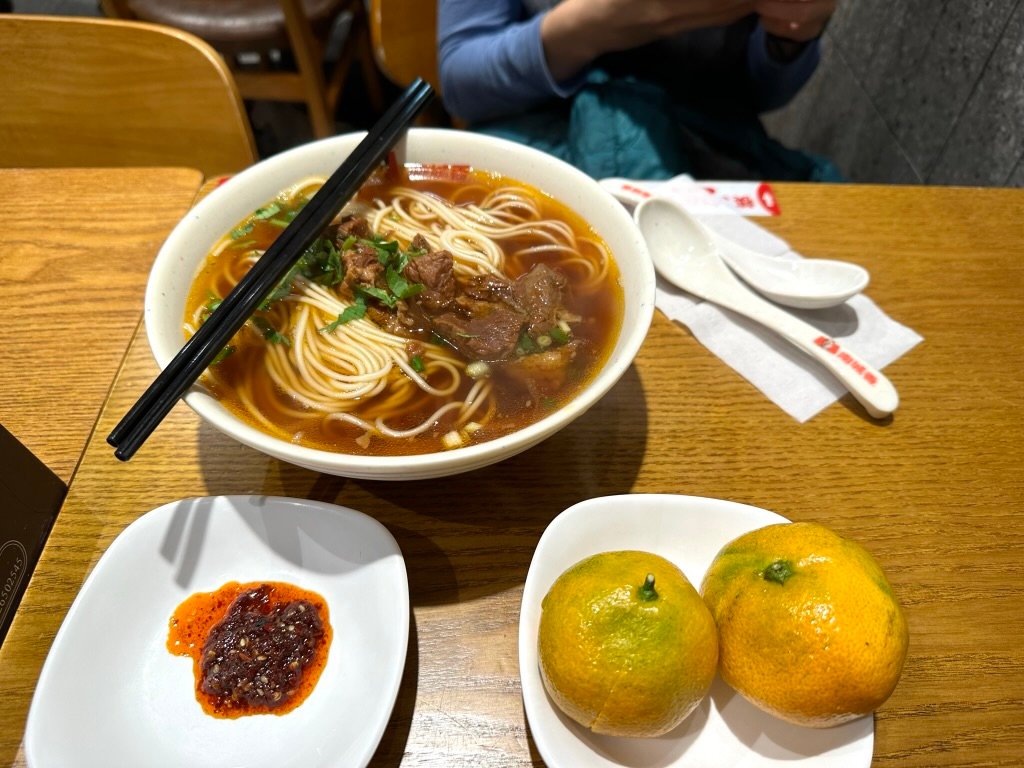
Planning your first trip to Beijing, China can feel exciting… and slightly scary.
After all, Beijing is not just another city.
It is China’s capital, a city with more than 20 million people, thousands of years of history, ancient imperial palaces, modern skyscrapers, huge roads and one of the busiest subway systems in the world.
Many first-time visitors planning their Beijing itinerary probably have the same questions:
“Is Beijing easy to travel independently?”
“Can foreigners use the Beijing subway?”
“Where should I stay in Beijing?”
“What food can I eat if I cannot take spicy food?”
“Should I visit Beijing attractions myself or join a day tour?”
We had exactly the same questions.
After several trips exploring Beijing, Elaine and I discovered something:
Beijing is actually much easier to travel than many people imagine.
You just need the right strategy.
Our father-and-daughter China travel style is simple:
Do it ourselves when it is easy. Get help when it saves time and energy.
Because travelling is not an exam.
Nobody gives you extra marks for suffering. 😂
Sometimes the smartest Beijing travel tip is knowing when NOT to make your life difficult.
During our Beijing trips, we explored many famous places to visit in Beijing:
The Forbidden City (故宫)
Tiananmen Square (天安门广场)
Qianmen Street (前门大街)
Wangfujing (王府井)
Local hutongs (胡同)
Museums, parks, shopping streets and neighbourhoods where ordinary Beijing people live.
Most of these places we explored ourselves.
But for some Beijing attractions outside the city — especially places like the Great Wall of China (长城) — we happily joined organised Beijing day tours.
Why?
Because our goal was not to prove we were expert travellers.
Our goal was simple:
Spend more time experiencing China.
Spend less time worrying about transport problems.
This is our practical Beijing travel guide based on our real experience:
? How we moved around Beijing using the subway
? What local Beijing food we enjoyed (including non-spicy choices!)
? How we chose which attractions to visit ourselves or with tours
? Where we stayed — from hutong atmosphere to budget-friendly areas
And yes…
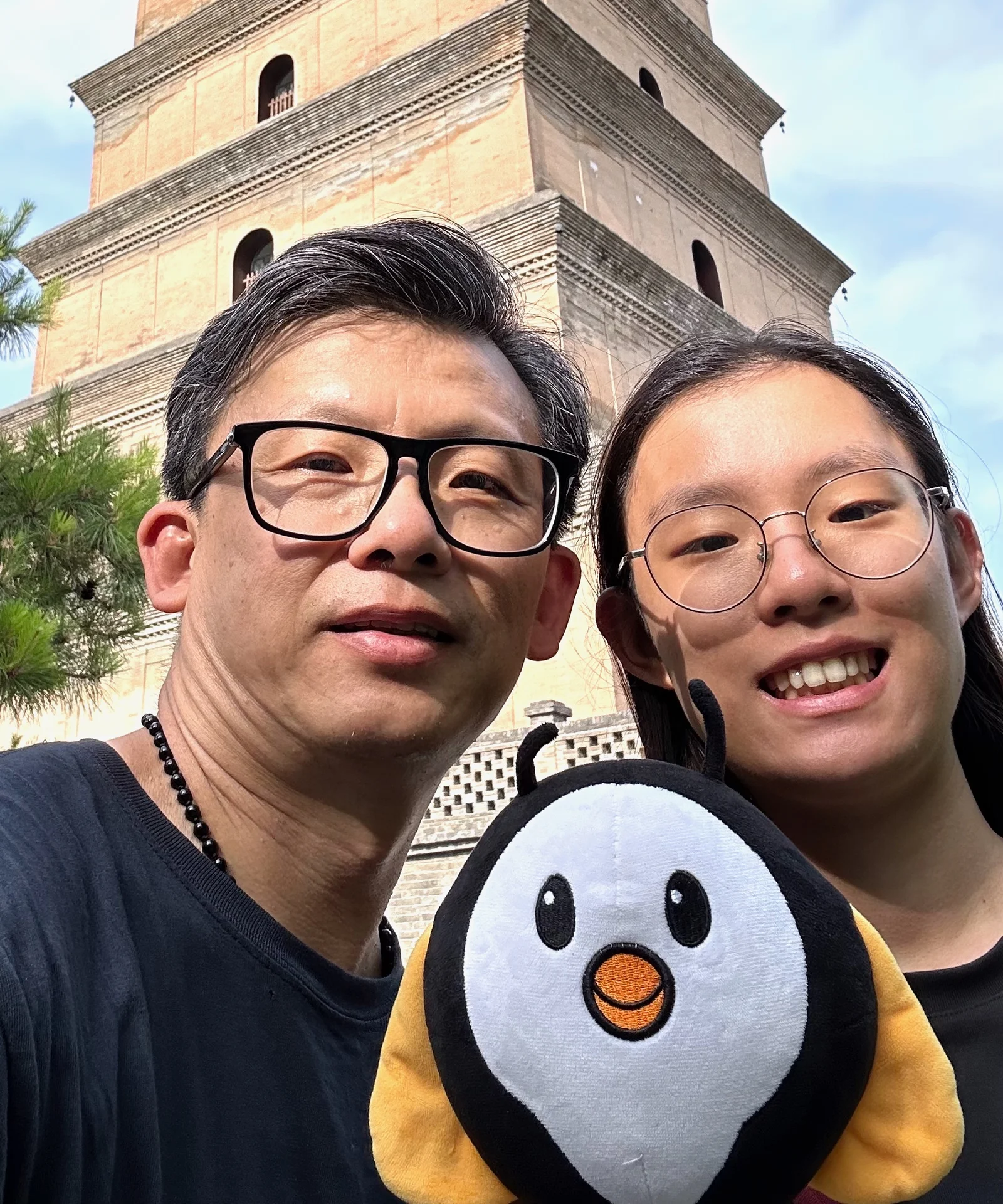
Our little travel companions Cheers 🐞 and Panda 🐼 tested Beijing too.
They survived the subway.
They survived our long walking days.
But strangely, they never helped carry the backpack.
Very suspicious. 😂
Let’s start underground — with the easiest way to unlock Beijing.
The Beijing Subway 北京地铁.
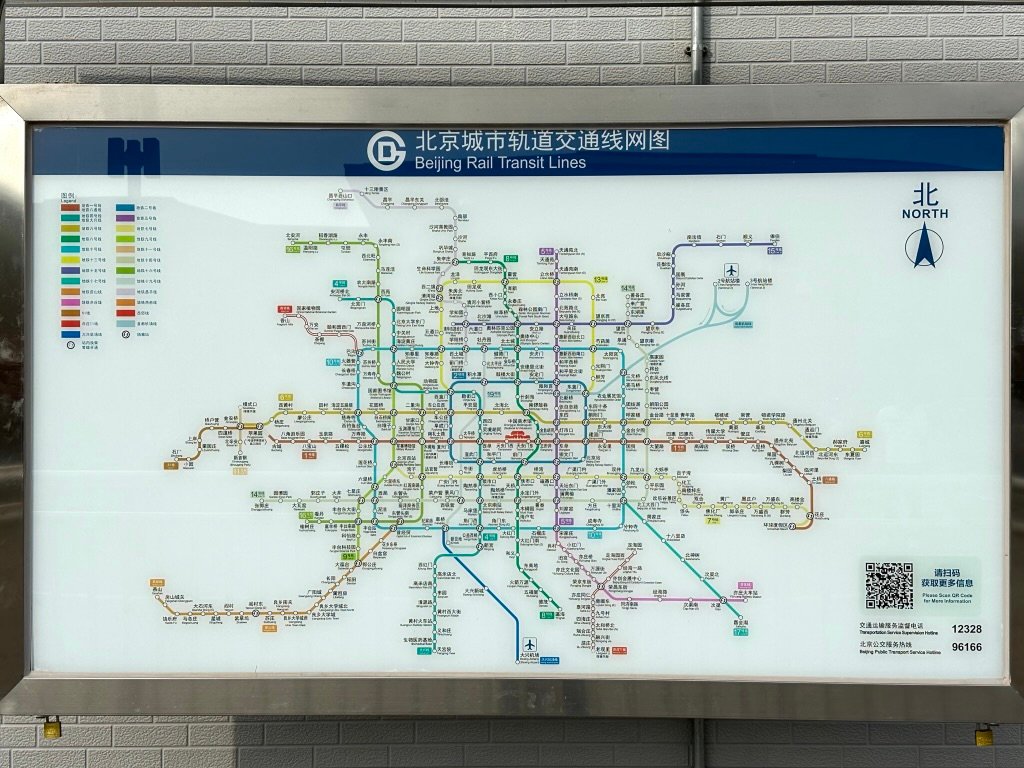
Getting Around Beijing: Why We Loved the Beijing Subway 北京地铁
Before our first Beijing trip, one of my biggest questions was simple:
“How do we move around such a huge city?”
Beijing is massive.
This is China’s capital city with wide avenues, countless neighbourhoods, famous historical sites and more places to visit than you can possibly finish in one trip.
Taking taxis everywhere?
Possible.
But Beijing traffic can be unpredictable.
Walking everywhere?
Good luck. 😂
After a few days, Elaine and I discovered our favourite way to explore Beijing:
The Beijing Subway (北京地铁 Běijīng Dìtiě).
Fast.
Affordable.
Clean.
And surprisingly easy even for first-time travellers visiting China.
The Moment Elaine Became the Subway Navigator
One funny thing about travelling with children:
Sometimes you start as the teacher…
and slowly become the student. 😂
At first, Dad was checking:
“Which line?”
“Which direction?”
“How many stops?”
After a while…
Dad: “Elaine, where are we going?”
Elaine: “Follow me.”
Dad: “Are you sure?”
Elaine: “Yes. We need Line 2, change there.”
Okay.
Apparently Dad had been promoted from travel planner…
to backpack carrier.
😂
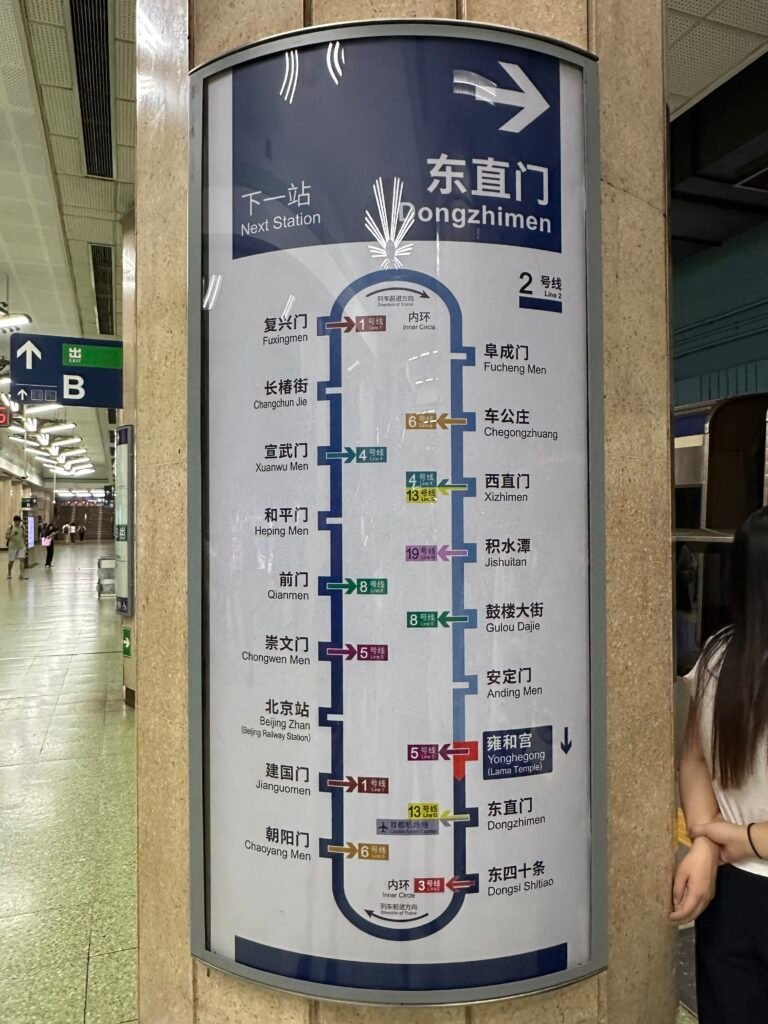
Beijing Subway Line 2 quietly preserves memories of the old city gates — even modern transport carries pieces of history.
Beijing Subway Line 2 — A Ride Around Old Beijing
One of my favourite discoveries was Beijing Subway Line 2.
At first glance, it looks like just another subway route.
But look carefully at the station names:
前门 Qianmen
建国门 Jianguomen
西直门 Xizhimen
东直门 Dongzhimen
安定门 Andingmen
Notice something?
Many stations end with the Chinese word:
门 (mén) — Gate
Why?
Because Line 2 roughly follows the route of Beijing’s old inner city walls.
Long before modern subway trains arrived, Beijing was a walled imperial capital.
The city had gates controlling movement into different parts of Beijing.
Today, many walls are gone.
The ancient gates have disappeared.
But their names survive underground.
Millions of people travel every day through a modern subway system while repeating names connected to Beijing’s history.
This is why we love travelling in China.
Sometimes you discover history inside a museum.
Sometimes you discover history…
while waiting for the next train.
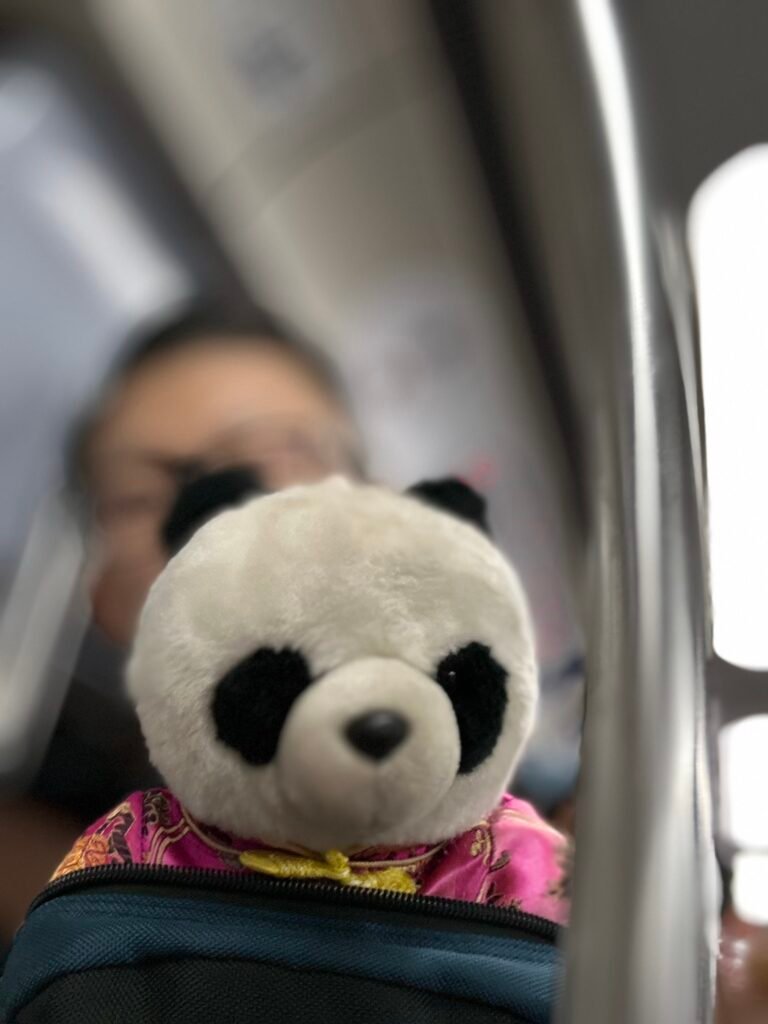
Our smallest ChinaTravelBug explorer approved Beijing Subway… although carrying luggage was apparently not part of Panda’s responsibility. 😂
Our Little Panda Tested Beijing Subway Too 🐼
Of course, our China travel team needed another important opinion.
Panda.
Our little travel companion followed us through Beijing:
Subway rides.
Long walking days.
Historical streets.
Museums.
Panda’s review?
Comfortable.
No complaints.
Although, just like Cheers …
Panda mysteriously avoided helping us carry anything.
Very suspicious behaviour from our smallest team members. 😂
Beijing Subway Tips for First-Time Visitors
A few practical tips from our experience:
✔ Choose accommodation near a subway station
✔ Avoid peak working hours if possible
✔ Use English station names — they are clearly displayed
✔ Look at the final station direction before boarding
✔ Don’t rush — Beijing rewards slower exploring
For travellers planning their first Beijing itinerary, learning the subway gives you freedom.
Suddenly Beijing changes from:
“This city is too big!”
to:
“Where shall we explore next?”
And that is when Beijing becomes fun.
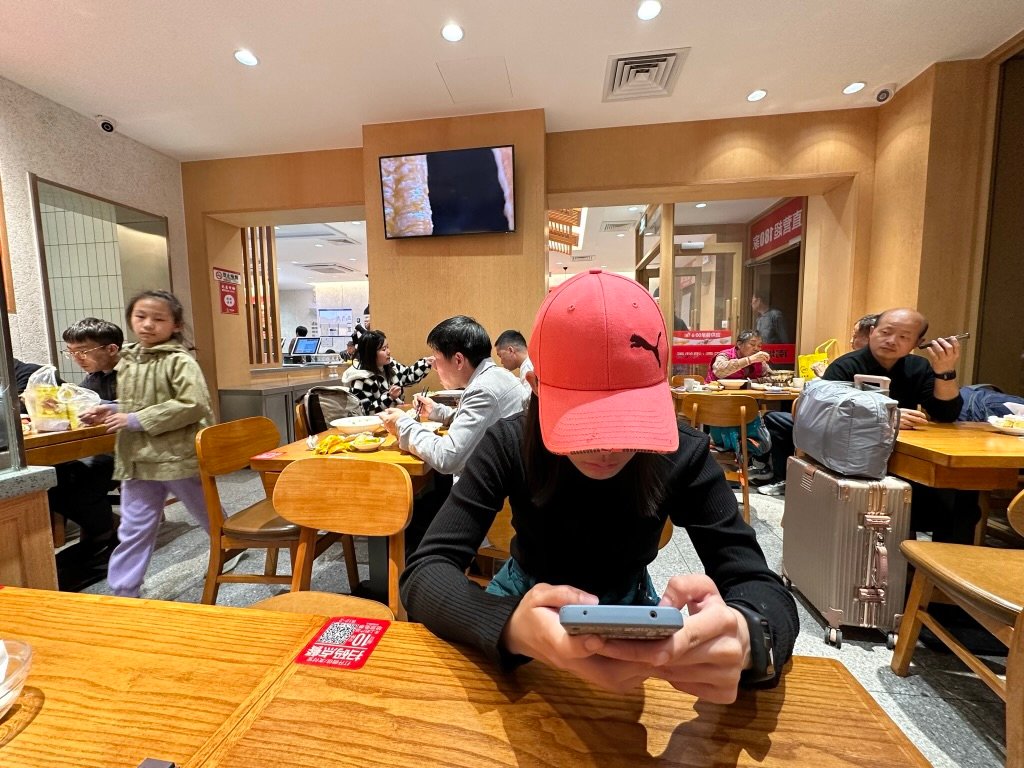
Eating in Beijing: Local Food, Simple Meals & Finding Our Comfort Zone
Many first-time travellers planning a trip to Beijing worry about food.
“Is everything spicy?”
“Will my children eat Chinese food every day?”
“Do we need to survive on fast food?”
After spending many days exploring Beijing with Elaine, we discovered something important:
Beijing food is actually very friendly for travellers.
Not every Chinese dish is spicy.
Not every meal needs to be adventurous.
Sometimes the best memories come from simple neighbourhood restaurants where local Beijing families eat every day.
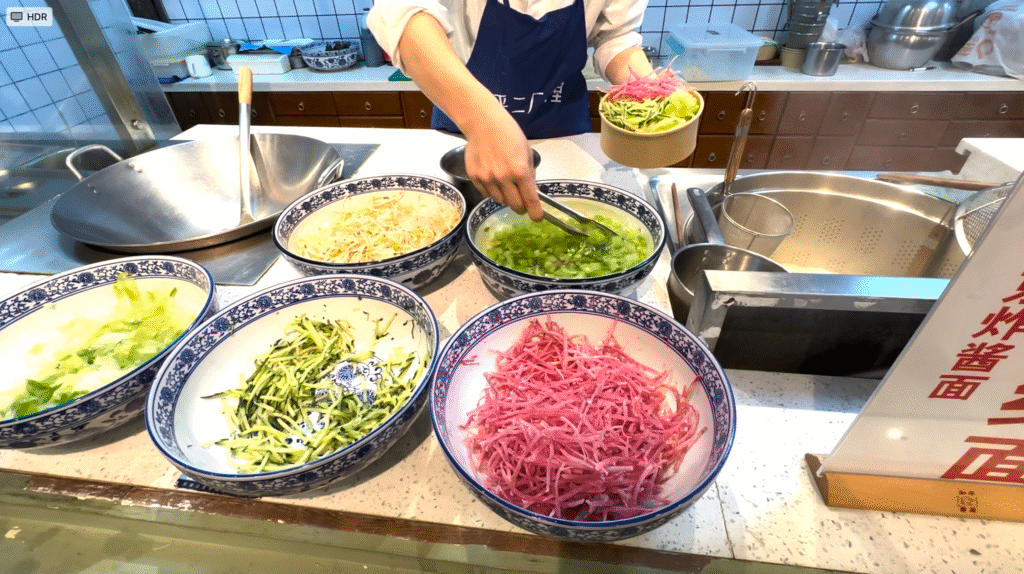
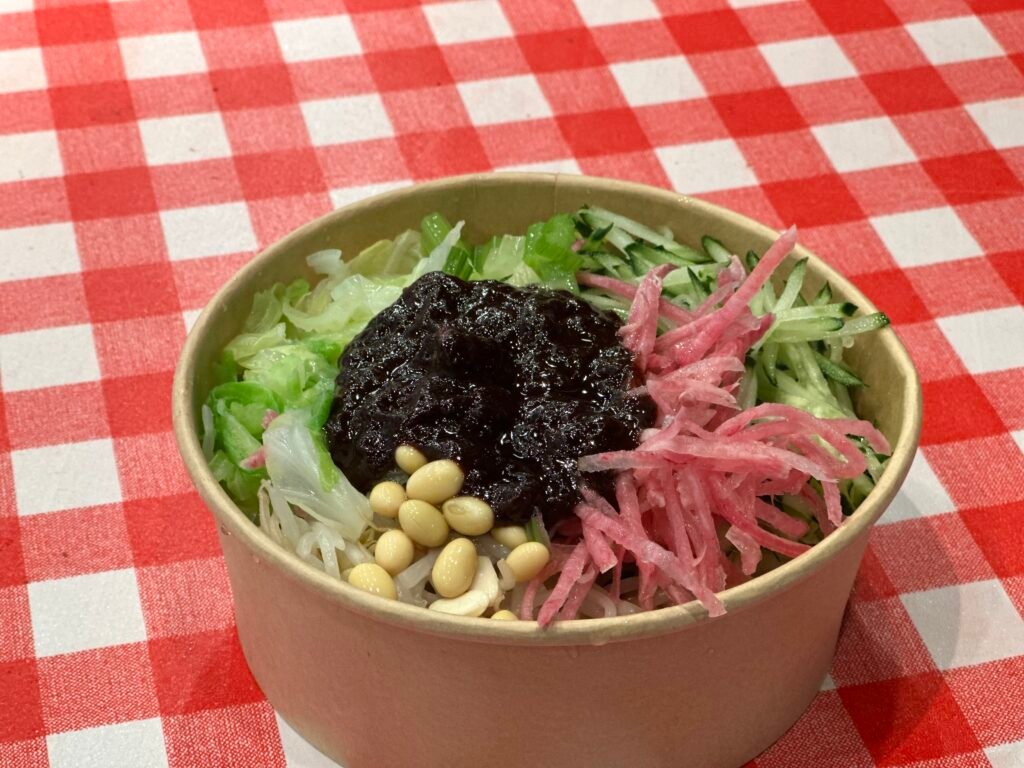
Beijing Zhajiangmian 炸酱面 — a local classic every visitor should try at least once. It may not become your favourite dish, but it gives you a taste of everyday northern China.
Trying Beijing’s Famous Zhajiangmian 炸酱面
Of course, when visiting Beijing, there are some local classics you should try.
One of them is:
Zhajiangmian 炸酱面 — Beijing’s famous “fried sauce noodles”.
The dish looks simple:
- handmade-style noodles
- crunchy vegetables
- soybean-based meat sauce (炸酱) mixed together before eating
It is one of Beijing’s most representative everyday dishes.
Unlike Sichuan food, it is not about chilli or strong spices.
It represents northern Chinese flavours:
simple, salty, hearty.
For us?
Worth trying.
Definitely part of experiencing Beijing.
But did it become Elaine’s favourite comfort food?
Not really. 😂
And that is part of travelling.
You don’t need to love every famous dish.
Sometimes you try something because it tells you a story about the place.
Our Real Beijing Comfort Food
After many days walking through museums, hutongs and historical sites, we slowly discovered what worked best for us.
Simple rice meals.
Hot soup.
Fresh vegetables.
Dumplings.
Noodles.
Food that warmed us after a long Beijing winter day.
Finding Our Comfort Food in Beijing: From Fast Food Rescue to Local Meals
Travelling in China with children changes over time.
When Elaine first visited Beijing when she was younger, food was actually one of Dad’s biggest challenges.
China had so many different regional cuisines and exciting dishes to discover, but convincing a young child after a long sightseeing day was another story.
Sometimes after walking through the Forbidden City, climbing the Great Wall, or spending hours exploring Beijing attractions…
Dad’s carefully planned “local food adventure” ended with:
“Can we just eat something familiar?” 😅
And yes…
Fast food became the emergency solution.
Sometimes travelling with children is not about winning every cultural battle.
Sometimes it is about keeping everyone happy enough for tomorrow’s adventure.
🐼 Panda: “Wait… you came all the way to Beijing… and ate fast food?”
🐧 Cheers: “Small Elaine needed energy first! History lessons work better when travellers are not hungry!”
🐼 Panda: “Fair point. Even explorers need a full stomach.”
But as Elaine grew older, travelling around Beijing became much easier for Dad.
She became more curious.
She became more adventurous.
And slowly, our China trips changed.
Instead of looking for familiar international food, we started looking for the simple meals that local people eat.
Not expensive restaurants.
Not tourist shows.
Just everyday Beijing life.
A warm bowl of noodles.
A simple rice meal.
A plate of dumplings.
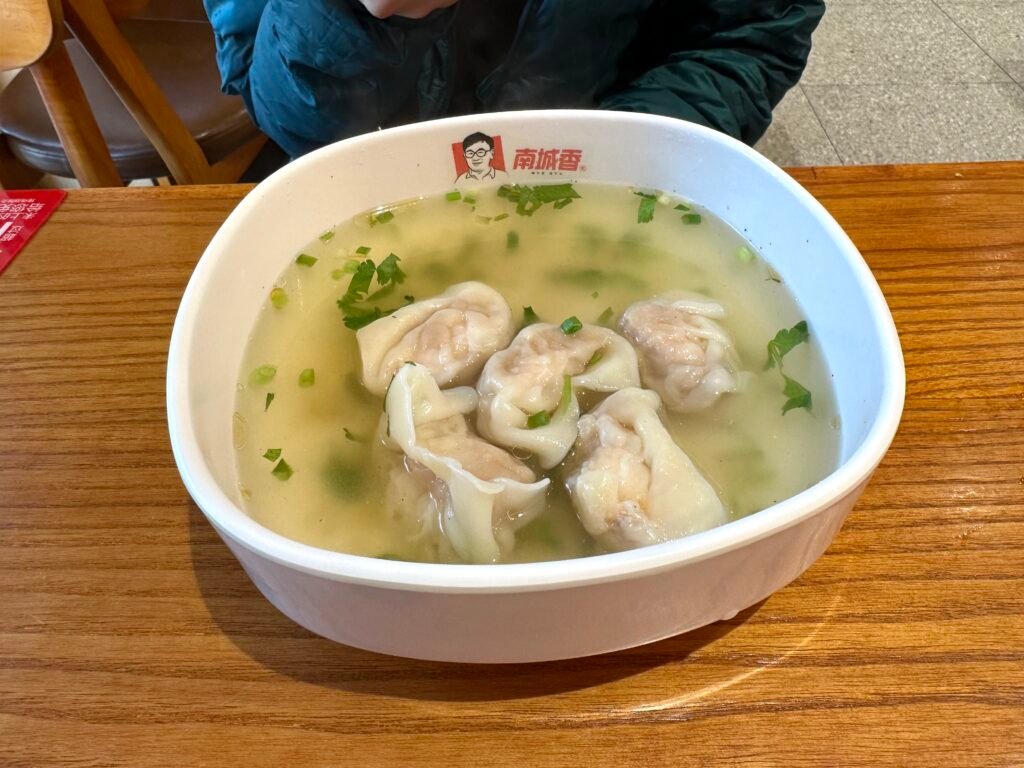
A Bowl of Dumplings 水饺 After a Long Beijing Day
One of our favourite comfort choices became something very simple:
dumplings — 水饺 (shuǐjiǎo).
After walking thousands of steps through Beijing’s museums, hutongs and historical streets, sitting down with a hot bowl of dumplings felt perfect.
No chilli.
No complicated flavours.
Just warm soup, soft dumplings, and a quiet moment to rest.
This is something many first-time visitors may not realise:
Chinese food does not always mean spicy food.
Northern Chinese cuisine, including many Beijing dishes, often focuses more on wheat-based foods:
- noodles 面条
- dumplings 饺子
- buns 包子
- pancakes 饼
For travellers who prefer milder flavours, Beijing can actually be one of the easiest cities in China to enjoy.
🐧 Cheers: “Elaine upgraded! From fast food explorer… to dumpling hunter!”
🐼 Panda: “Dad finally escaped the emergency burger plan.”
🐧 Cheers: “But Dad still remembers where all the backup restaurants are…”
🐼 Panda: “That’s called father survival skills.”
And maybe that is one of the joys of returning to China many times.
The city changes.
The traveller changes too.
The same Beijing that once felt challenging with a young child became a place where Elaine and Dad could sit together, enjoying a simple bowl of local food and planning the next day’s adventure.
Sometimes the best memories of China travel are not only found at famous landmarks.
Sometimes they are found across a small wooden table…
with a bowl of warm dumplings between you.
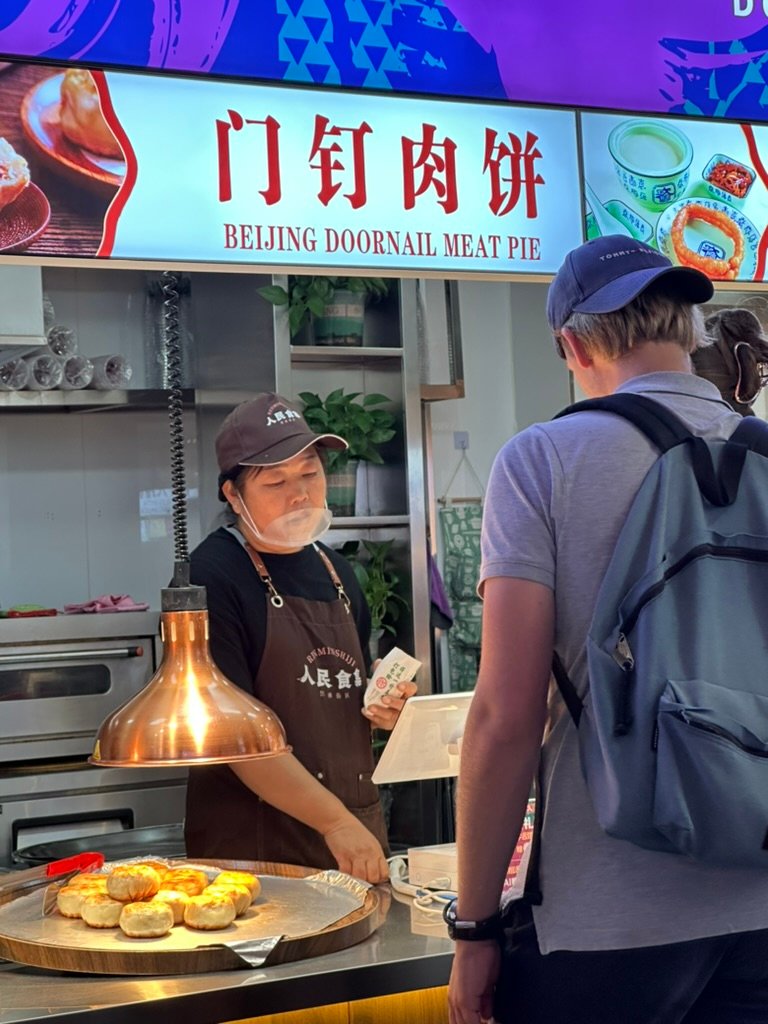
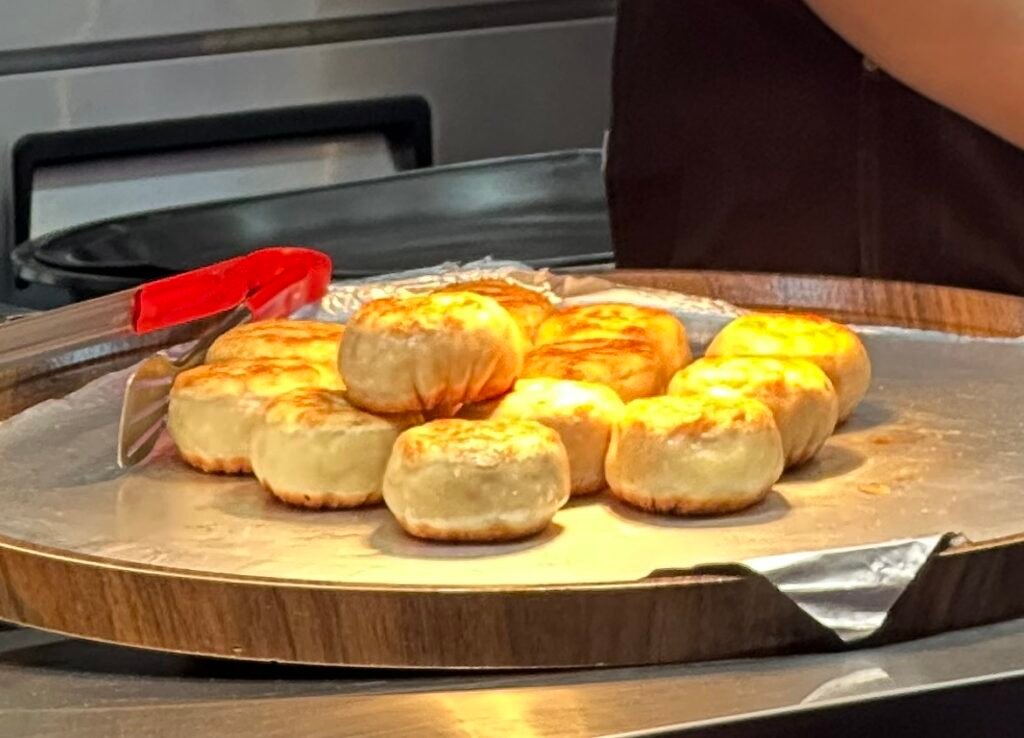
Trying 门钉肉饼 (Beijing Doornail Meat Pie) — a small local snack inspired by the traditional door studs of old Beijing gates.
Discovering Beijing Snacks: Small Bites Between Big Adventures
A Beijing trip is not only about famous restaurants.
Sometimes the most memorable food moments happen when you are walking between attractions, inside a shopping street, near a subway station, or exploring a local neighbourhood.
You see a small queue.
You smell something freshly cooked.
You become curious.
And you stop.
That is how we discovered many small Beijing snacks.
One simple example:
门钉肉饼 (Méndīng Ròubǐng) — Beijing Doornail Meat Pie.
The name sounds unusual, but it comes from its shape. These small round meat pies look like the large golden door studs (门钉) found on traditional Chinese palace gates.
And where do you see those famous doors?
Places like the Forbidden City (故宫).
A little Beijing snack suddenly connects back to Beijing’s imperial history.
Crispy outside.
Juicy inside.
Simple, filling, and easy for travellers to enjoy.
🐼 Panda: “Wait… Beijing people turned palace door decorations into food?”
🐧 Cheers: “That’s the fun part of travelling China. Even a small snack has a story!”
🐼 Panda: “So Elaine learned history by eating?”
🐧 Cheers: “Exactly. The tastiest kind of homework.”
For families visiting Beijing, don’t feel that every meal must be a famous restaurant.
Try the little snacks.
Follow the local crowd.
Sometimes a small bite on the street gives you another piece of Beijing’s story.
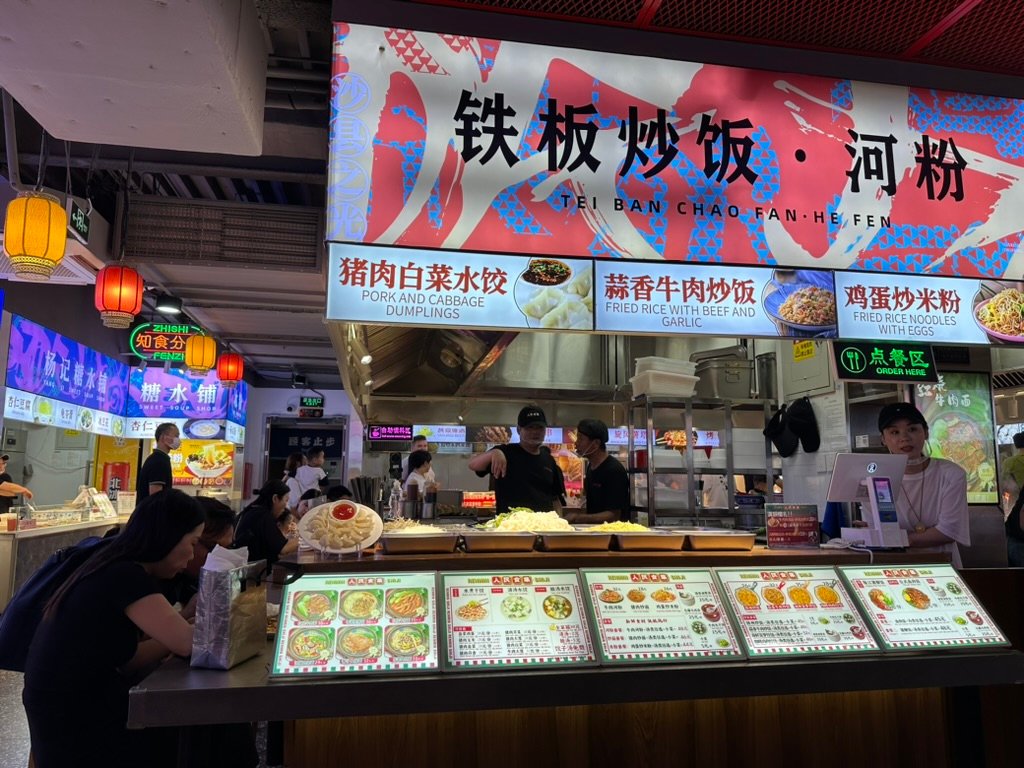
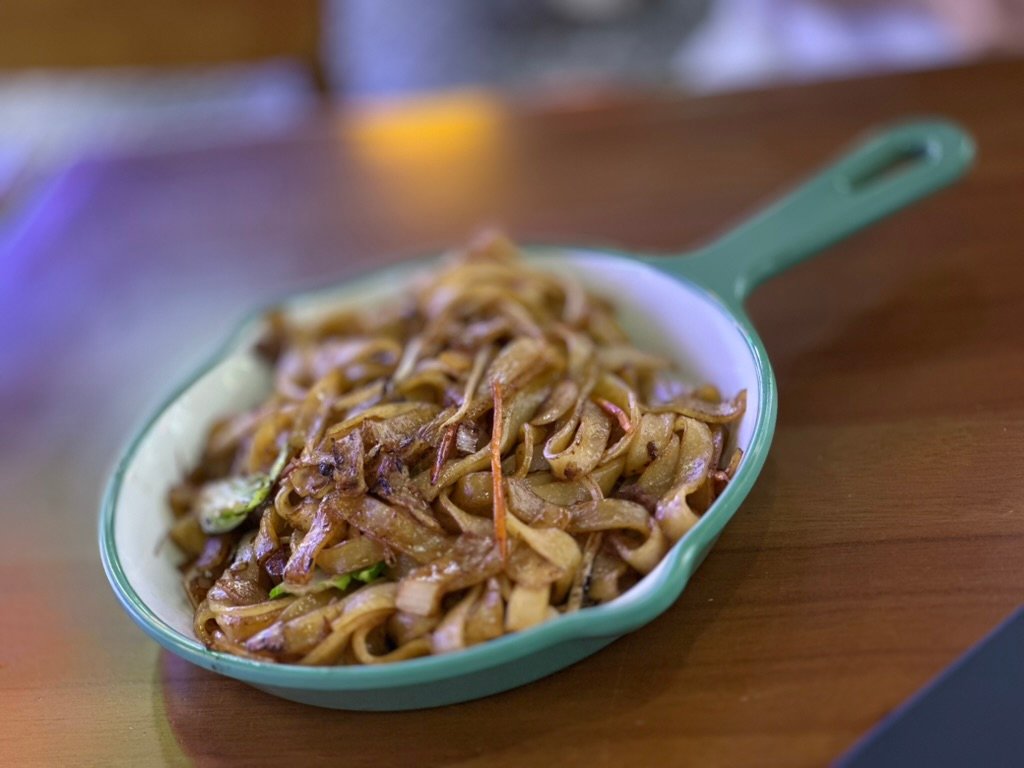
Modern Beijing food courts and casual restaurants often have picture menus and English translations. Simple dishes like dumplings, fried rice and noodles make China travel much easier for first-time visitors.
Don’t Worry About Spicy Food — Beijing Has Many Mild Options Too
One common misunderstanding among first-time visitors is:
“Is Chinese food always spicy?”
The answer is definitely no.
China is huge, and every region has very different flavours. In Beijing, because it is the capital city, you can find food from almost every part of China.
For travellers who prefer something simple and familiar, there are many non-spicy choices.
One easy option is the many casual restaurants serving rice, dumplings, noodles and stir-fried dishes, Southern China style of cooking.
The menus are often very visual, and sometimes even have English translations.
Some easy dishes to look for:
🥟 Dumplings & Noodles
猪肉白菜水饺 (Zhūròu Báicài Shuǐjiǎo)
Pork and Cabbage Dumplings
A very safe choice for many visitors.
Soft dumpling skin, minced pork filling, cabbage sweetness.
No chilli.
A comforting meal after a long day exploring Beijing.
🍚 Rice Meals
蒜香牛肉炒饭 (Suànxiāng Niúròu Chǎofàn)
Fried Rice with Beef and Garlic
A simple rice dish that many international travellers will find familiar.
Chinese fried rice is usually a good “first step” into local food.
🍜 Noodles
鸡蛋炒米粉 (Jīdàn Chǎo Mǐfěn)
Fried Rice Noodles with Eggs
A lighter noodle option.
Easy flavours, simple ingredients, and suitable if you want something less adventurous.
🐼 Panda: “So Beijing food is not only spicy hotpot?”
🐧 Cheers: “No! China has 1.4 billion people. They cannot all eat the same flavour!”
🐼 Panda: “Good news for travellers who cannot handle chilli.”
🐧 Cheers: “Exactly. Start simple… then slowly become more adventurous!”
One lesson Elaine and I learned after many China trips:
Don’t worry too much about finding food.
In big Chinese cities like Beijing, you can always find something that matches your comfort level.
Some days are for discovering new flavours.
Some days are for a simple bowl of rice or noodles before your next adventure.
Both are part of travelling China.
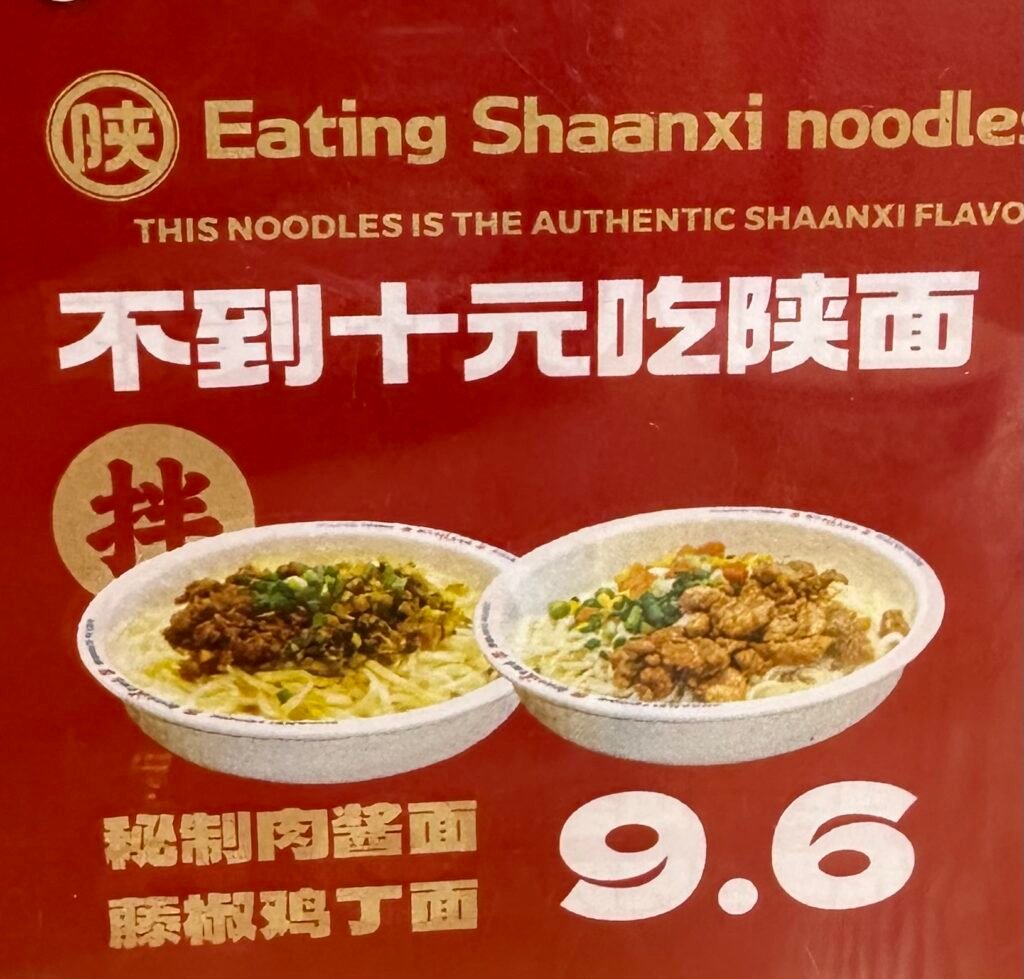
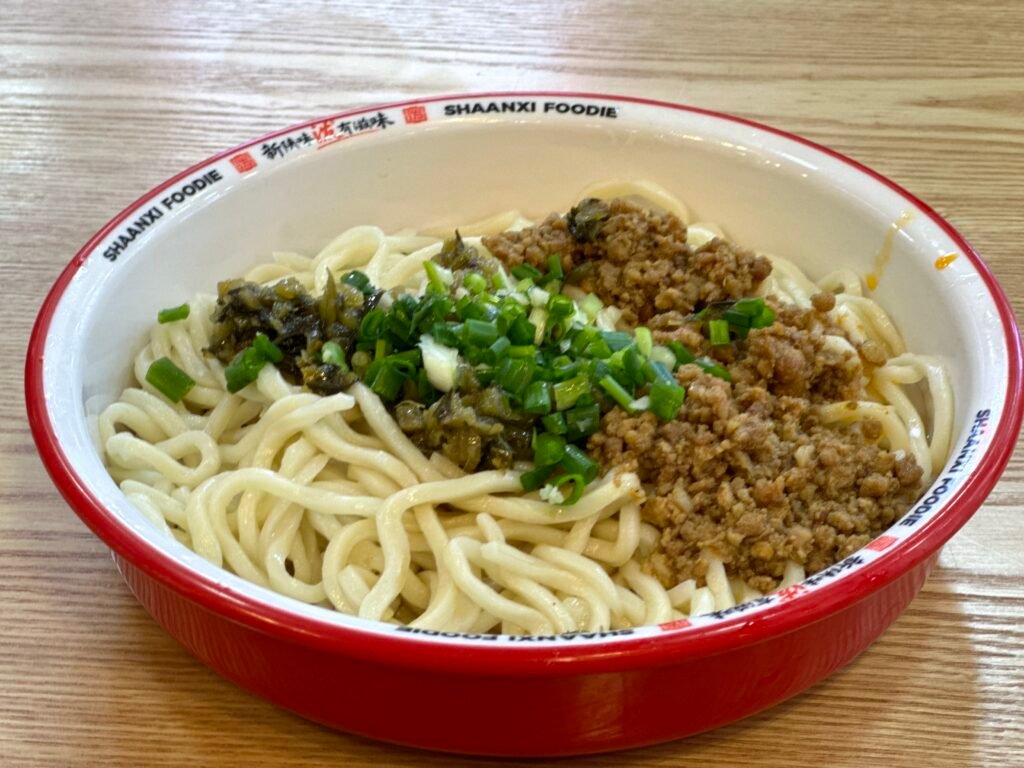
Finding Shaanxi noodles in Beijing — a reminder that China’s capital is also a meeting place of regional cultures. Try them here first… then travel to Xi’an for the real experience.
Taste Other Parts of China Without Leaving Beijing — Even Shaanxi Noodles!
One advantage of travelling in Beijing is that the city brings together flavours from across China.
You are not limited to only Beijing dishes.
Because Beijing has attracted people from every province for generations, you can easily find food from places such as Sichuan, Guangdong, Xinjiang — and one of our favourites, Shaanxi (陕西).
For Elaine and me, Shaanxi food always feels special because Xi’an (西安) has become one of our favourite cities in China.
So when we saw a Shaanxi noodle shop in Beijing, we had to try it.
On the menu:
秘制肉酱面 (Mìzhì Ròujiàng Miàn)
Secret Recipe Meat Sauce Noodles
藤椒鸡丁面 (Téngjiāo Jīdīng Miàn)
Chicken Noodles with Tengjiao Pepper
The noodles are thick, chewy and filling — very different from many southern Chinese noodle styles.
If you cannot take spicy food, simply ask:
“不要辣,谢谢” (Bù yào là, xièxiè)
“No chilli please, thank you.”
or
“少辣” (Shǎo là)
“Less spicy.”
Most restaurants are used to adjusting the flavour.
🐧 Cheers: “Wait… Shaanxi noodles? Aren’t we writing about Beijing?”
🐼 Panda: “That’s the fun part. In Beijing, you can taste many parts of China in one city!”
🐧 Cheers: “But… is it as good as Xi’an?”
🐼 Panda: “Careful question… Elaine may start defending Xi’an again.”
Elaine: “Xi’an one still wins.” 😄
Of course, eating Shaanxi noodles in Beijing cannot fully replace the experience of visiting Xi’an itself.
Nothing compares with walking through Xi’an’s ancient streets, exploring the old capital of Chang’an (长安), and eating local noodles where these food traditions were born.
But for first-time visitors planning a Beijing trip, trying regional food is a great introduction.
A simple bowl of noodles may become the beginning of your next China journey.
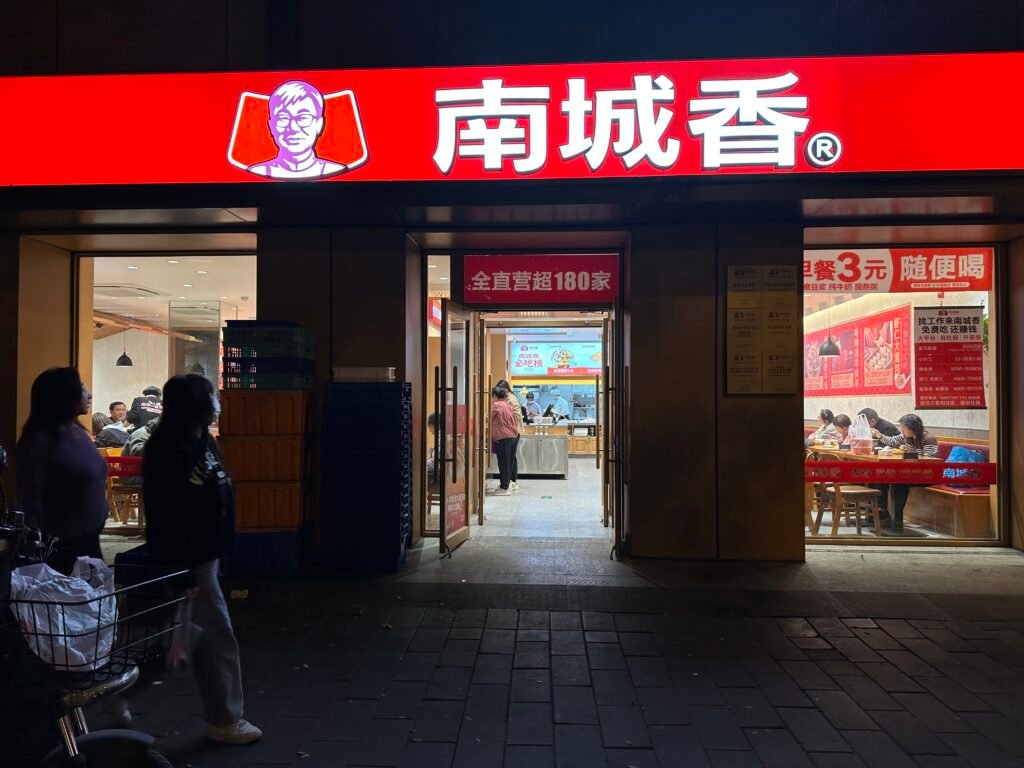
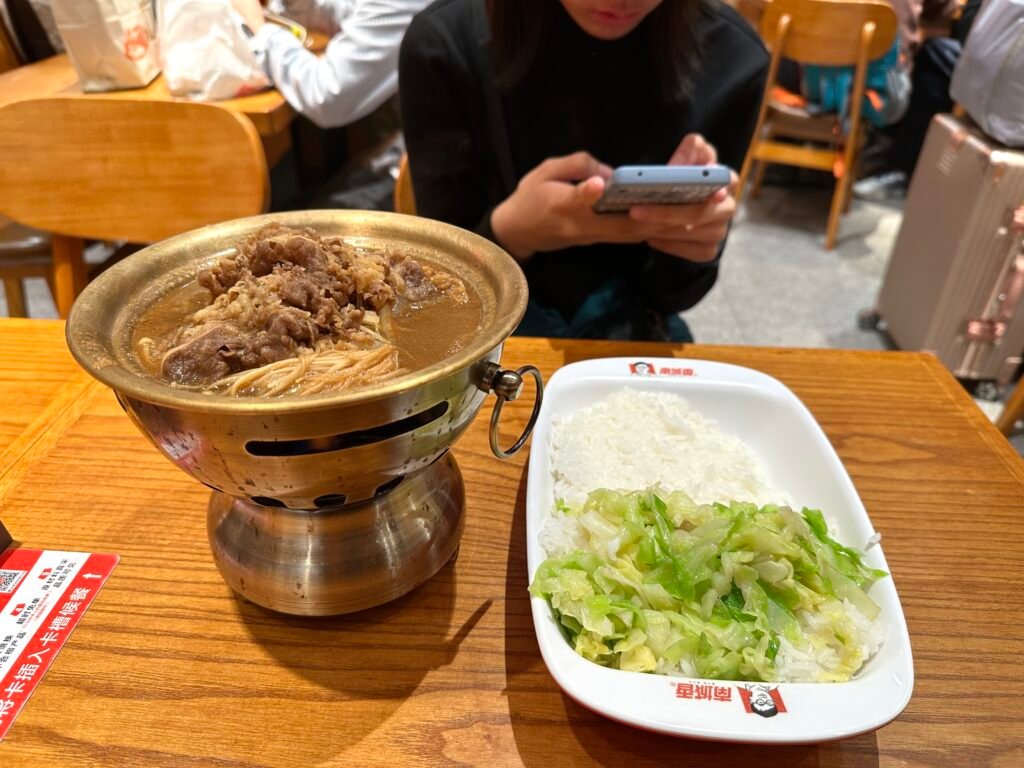
Dinner at 南城香 (Nanchengxiang) in Beijing — not a tourist attraction, just everyday local food. Rice, dumplings and warm dishes became our reliable comfort meals during our Beijing journey.
Finding Everyday Comfort Food in Beijing — Rice, Dumplings and Simple Local Meals
One lesson we learned after several China trips:
You do not need to eat “famous food” every meal.
When travelling in Beijing for many days, especially as a family, sometimes what you really want is simple, reliable comfort food.
When Elaine was younger, finding food was actually one of Dad’s biggest travel challenges. If she was tired, hungry, or unsure about unfamiliar dishes, fast food often became the emergency solution.
But as Elaine grew older, travelling around China became much easier.
We discovered that Beijing is full of casual local restaurants serving simple rice dishes, noodles and dumplings — exactly the kind of food we could happily eat again and again.
One restaurant we returned to multiple times was 南城香 (Nánchéng Xiāng).
The bright red signboard is difficult to miss when walking around Beijing.
Inside, it was not a tourist restaurant. We saw ordinary Beijing families eating dinner there — office workers after work, parents bringing their children after school, locals simply having their everyday meal.
And that is usually a good sign.
If local Beijing families trust it for dinner, the food is probably doing something right.
For Elaine, this became one of her “safe choices”.
Rice? ✅
Dumplings? ✅
Warm soup? ✅
Not spicy? ✅
Perfect.
The dishes were not fancy, but after walking 20,000 steps exploring Beijing attractions, visiting museums, hutongs, and historical sites, a simple warm meal sometimes feels better than a complicated restaurant.
🐧 Cheers: “Elaine travelled all the way to China… just to eat rice?”
🐼 Panda: “After walking around Beijing the whole day, rice becomes treasure.”
🐧 Cheers: “So Dad finally escaped the fast-food years?”
Dad: “Yes. Beijing travel became much easier.” 😄
Elaine: “As long as there is rice.”
For first-time visitors worried about food in China, don’t panic.
Beijing has incredible traditional dishes, but it also has thousands of everyday restaurants where locals eat — affordable, convenient and family-friendly.
Sometimes the best China travel memories are not from expensive restaurants.
Sometimes they come from sitting beside Beijing families, eating the same simple dinner they eat after school and work.
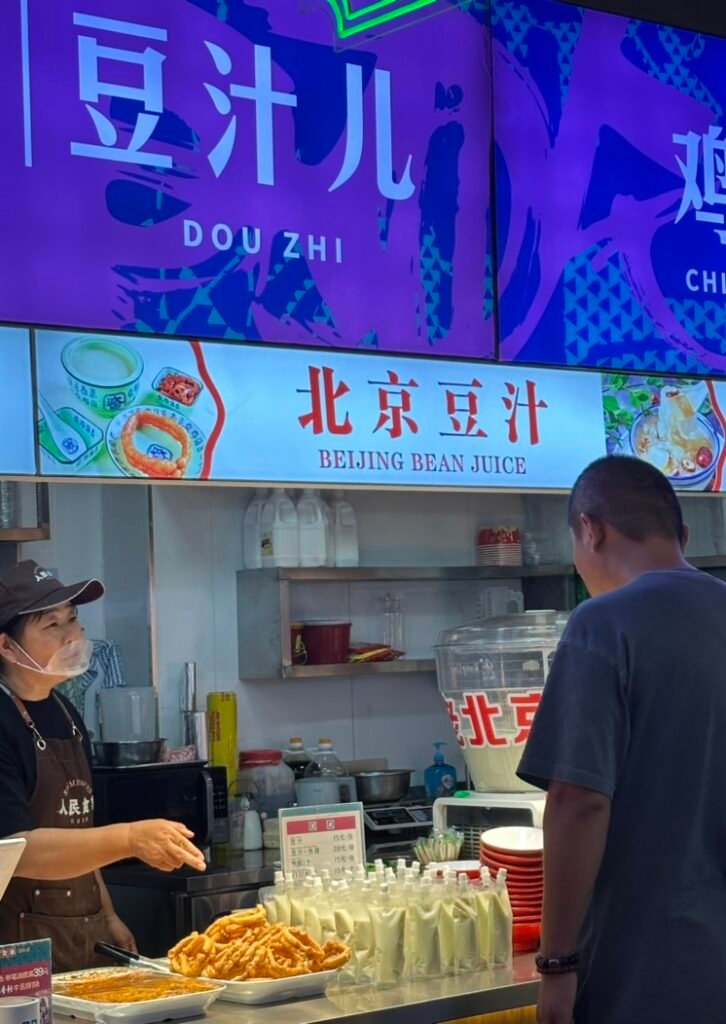
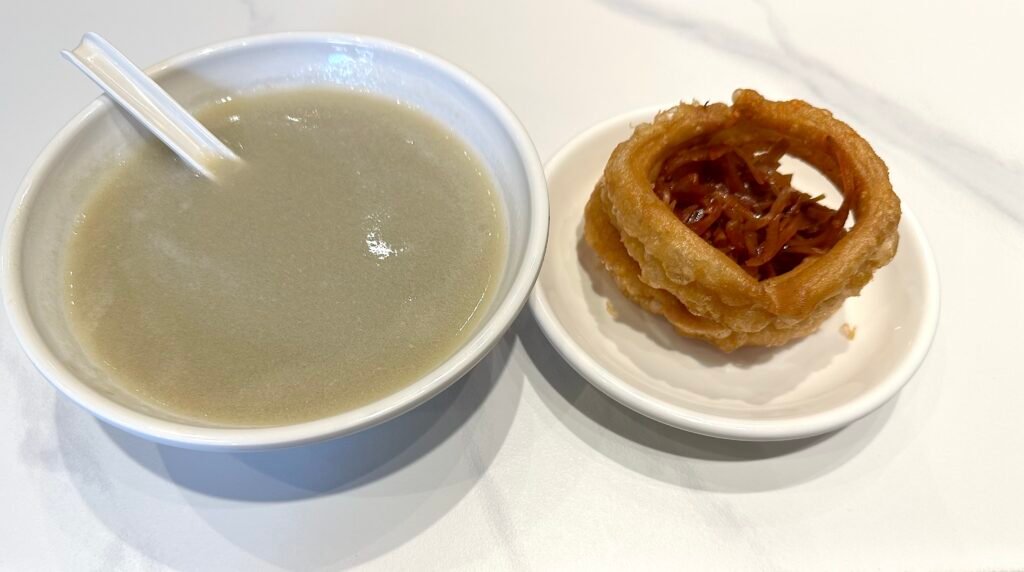
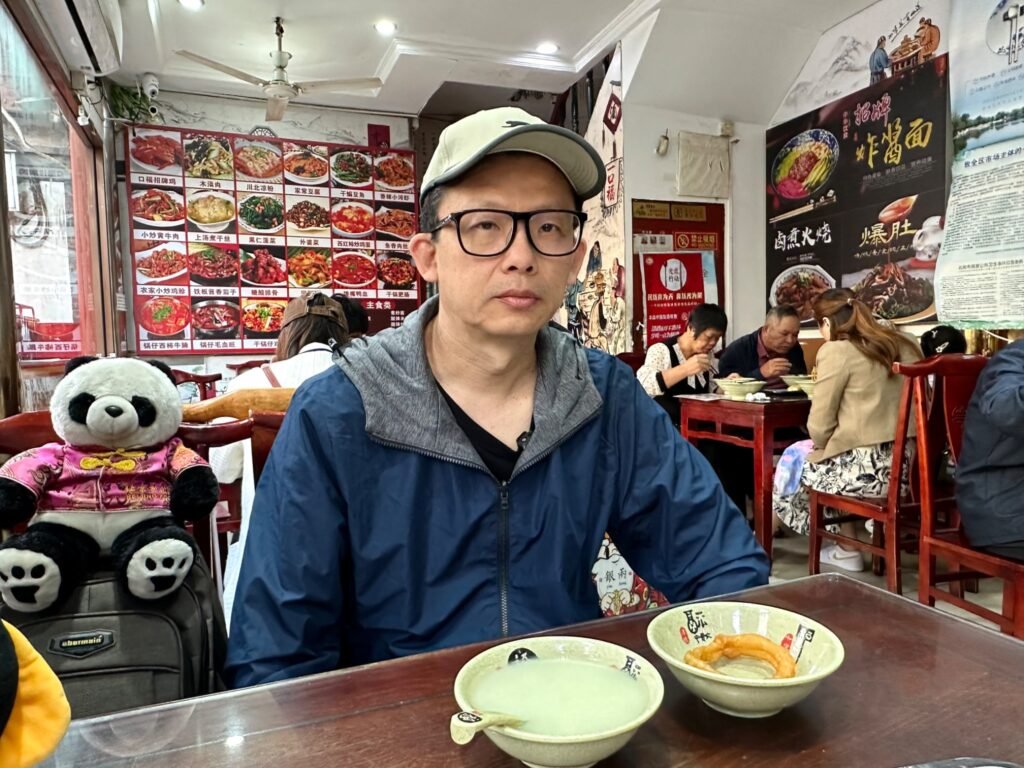
Traveller Warning: Douzhi 豆汁儿 Is NOT Doujiang 豆浆 — Don’t Order the Wrong One! 😆
Before you confidently walk into a Beijing breakfast shop and order, there is one very important China travel survival tip:
Please do not confuse:
🥛 豆浆 (Dòujiāng) — Soy Milk
Your friendly breakfast drink.
VS
🥣 豆汁儿 (Dòuzhīr) — Beijing Fermented Mung Bean Drink
Your “are you ready to become a real Beijinger?” challenge.
The names sound dangerously similar.
The experience is completely different.
Doujiang 豆浆 is the one most travellers already know — smooth, slightly sweet, comforting soy milk enjoyed all across China. Pair it with fried dough sticks 油条 (yóutiáo) and you have a classic Chinese breakfast.
Douzhi 豆汁儿, however…
Welcome to Beijing. 😆
This old Beijing specialty is fermented, slightly sour, and has a strong aroma that surprises many first-time visitors.
Dad looked at the bowl.
Elaine looked at Dad.
Panda quietly moved behind Dad.
🐧 Cheers: “Wait… this is the same as soy milk, right?”
🐼 Panda: “No.”
🐧 Cheers: “How different can a bean drink be?”
🐼 Panda: “That is exactly what every tourist says before the first sip.”
Elaine: “Dad, you try first.” 😇
Dad: “Why am I always the experiment?”
🐼 Panda: “Because you are the Journey Architect.” 😂
And that is how Dad became the official ChinaTravelBug douzhi tester.
Would Elaine try it?
Still no.
Would Panda?
Apparently not — judging from where he was sitting safely in the photo.
But should adventurous travellers visiting Beijing try it once?
Absolutely.
Because Beijing travel is not only about the Forbidden City, the Great Wall, or famous attractions.
Sometimes the most unforgettable memories come from a simple bowl of traditional food that locals have loved for generations.
Just remember:
Doujiang = breakfast comfort.
Douzhi = Beijing bravery test. 😆
Final Thoughts: Once You Understand Beijing, China Travel Becomes Much Easier
Many first-time visitors worry about travelling independently in China.
Is Beijing too big?
Will the subway be confusing?
Will ordering food be difficult?
We had the same questions during our earlier trips.
But after returning to Beijing again and again, Dad and Elaine discovered something:
Beijing is actually one of the best cities to learn how to travel in China.
The subway system connects many of Beijing’s famous attractions. Local restaurants offer far more choices than most travellers expect. And once you understand a few simple tricks — like finding familiar comfort food, reading basic signs, and knowing the difference between 豆浆 (doujiang) and 豆汁儿 (douzhi!) — the city becomes much less intimidating.
You start noticing another Beijing.
Not only the Beijing of the Forbidden City (故宫), the Great Wall of China (长城), and famous tourist sights.
But also the Beijing where families eat dinner after school, commuters move through subway stations, grandparents enjoy morning walks, and small restaurants continue traditions passed down for generations.
That is the Beijing we enjoy discovering.
🐧 Cheers: “So the secret to Beijing travel is simple?”
🐼 Panda: “Yes. Learn the subway. Find good food. Walk slowly.”
🐧 Cheers: “And avoid accidentally ordering douzhi?”
🐼 Panda: “Unless Dad volunteers first.” 😆
For us, Beijing is not just a place to visit once.
It is a city to return to, explore layer by layer, and understand a little more each time.
Now that we know how to move around Beijing and survive mealtimes…
Where should we stay?
And how can we use Beijing as a base to discover even more amazing places nearby?
That is exactly where our next journey begins.
Continue Exploring Beijing
If this is your first time visiting China’s capital, you might also enjoy our guides to:
- Beijing Travel Guide: Discover China’s Ancient Capital, Local Life and Future China
- Returning to Qianmen Street (前门大街): Beijing’s Historic Walking Street
- Wangfujing (王府井): Beyond Beijing’s Famous Shopping Street
- Beijing Hutongs (胡同): Discovering Everyday Life in the Capital
- Visiting Great Wall of China from Beijing: