Some journeys begin with a plane ticket.
Some begin with a map.
Our journey into 5,000 years of Chinese civilisation began with something much simpler:
Breakfast.
Because before Elaine and I attempted to travel from ancient China to modern China inside one of the largest museums in the world, Dad had one very practical thought:
“Better fill up our stomachs first.” 😄
The National Museum of China (中国国家博物馆, Zhōngguó Guójiā Bówùguǎn) is not a small museum where you simply walk in, take a few photos, and leave.
Located beside Tiananmen Square (天安门广场) in Beijing, the capital of China, this museum tells the long story of Chinese history — from early human civilisation, ancient dynasties, emperors and inventions, all the way to the China we see today.
It is not just another item on a list of Beijing tourist attractions.
For us, it was another chapter in our father-daughter China journey.
But first…
Beijing breakfast. 🍜
Starting The Morning Like Ordinary Beijingers
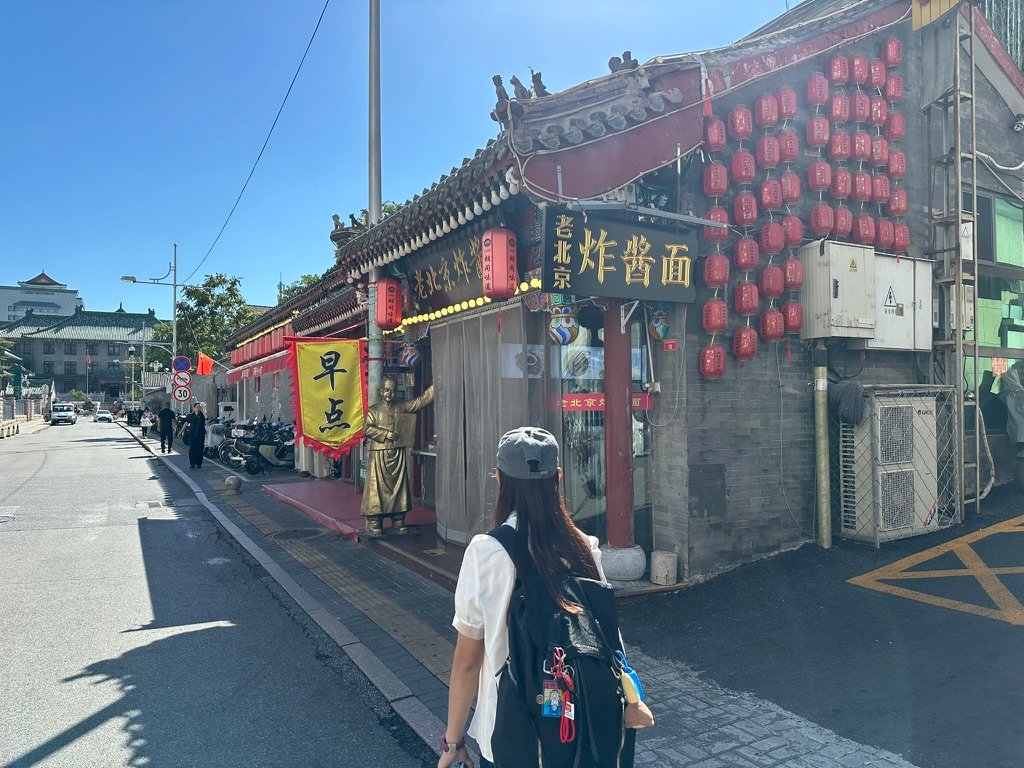
Before entering the National Museum, Elaine and I walked around the nearby streets looking for something to eat.
This is something I always enjoy during our China travels.
Yes, Beijing has famous landmarks:
- the Forbidden City (故宫)
- the Great Wall of China (长城)
- Tiananmen Square (天安门)
But China is also found in ordinary streets.
Small restaurants.
People going to work.
Families eating breakfast.
The everyday rhythm of life.
Sometimes, understanding a country begins before you even enter the museum.
A Bowl Of Beijing Before 5,000 Years Of History
Our breakfast choice?
A Beijing classic:
炸酱面 (zhá jiàng miàn) — Beijing noodles mixed with soybean paste sauce.
For Elaine, Chinese culture was never only something written inside textbooks.
Since young, she enjoyed discovering China through stories, videos, language, food and travelling.
Dad’s idea was simple:
Don’t just memorise history.
Experience it.
A name on a timeline becomes different when you stand in the place where it happened.
A dynasty becomes more meaningful when you see what people created.
A culture becomes easier to understand when you taste, hear and walk through it.
And after breakfast?
It was time to step into China’s timeline.
Walking Into The National Museum Of China
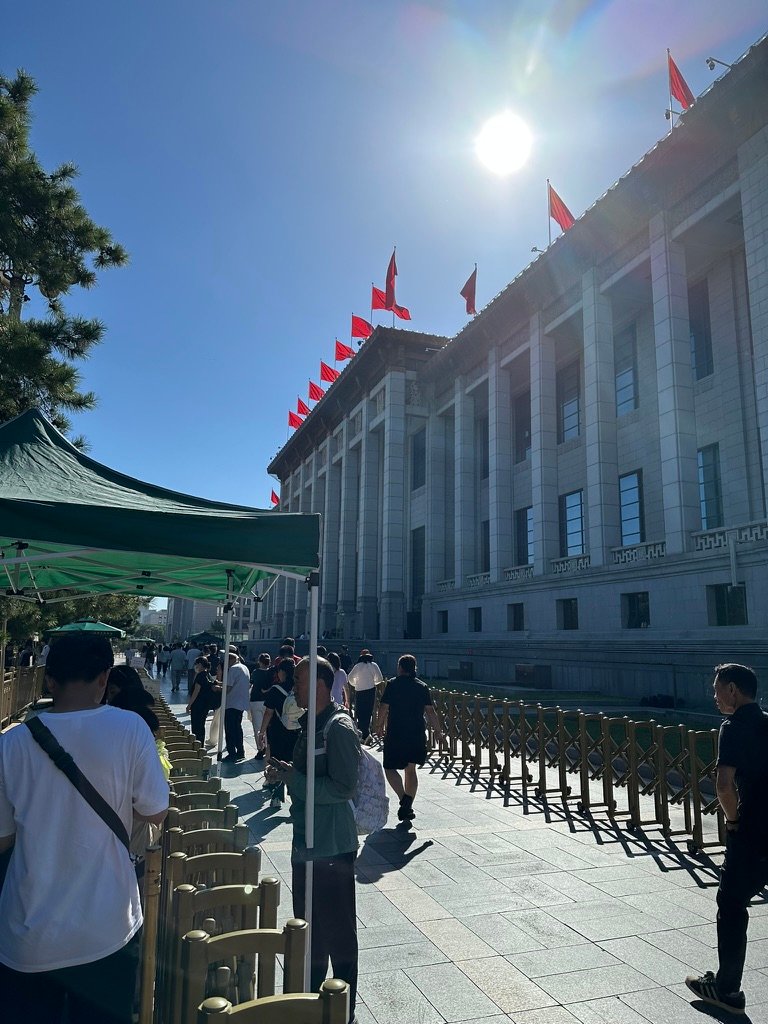
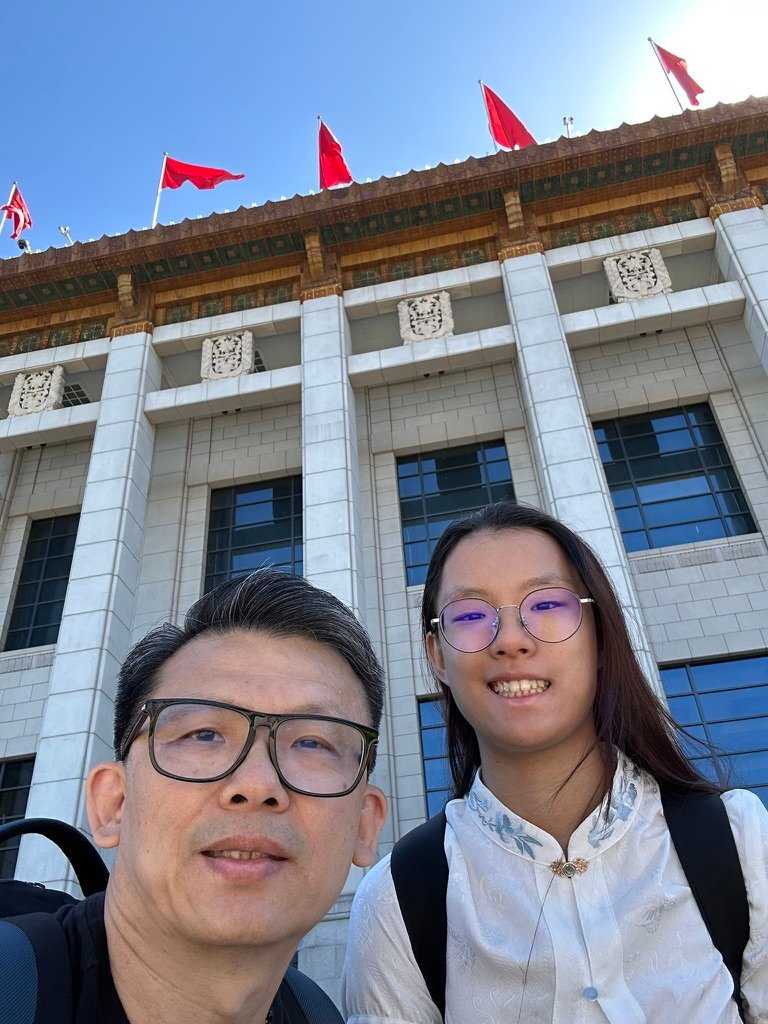
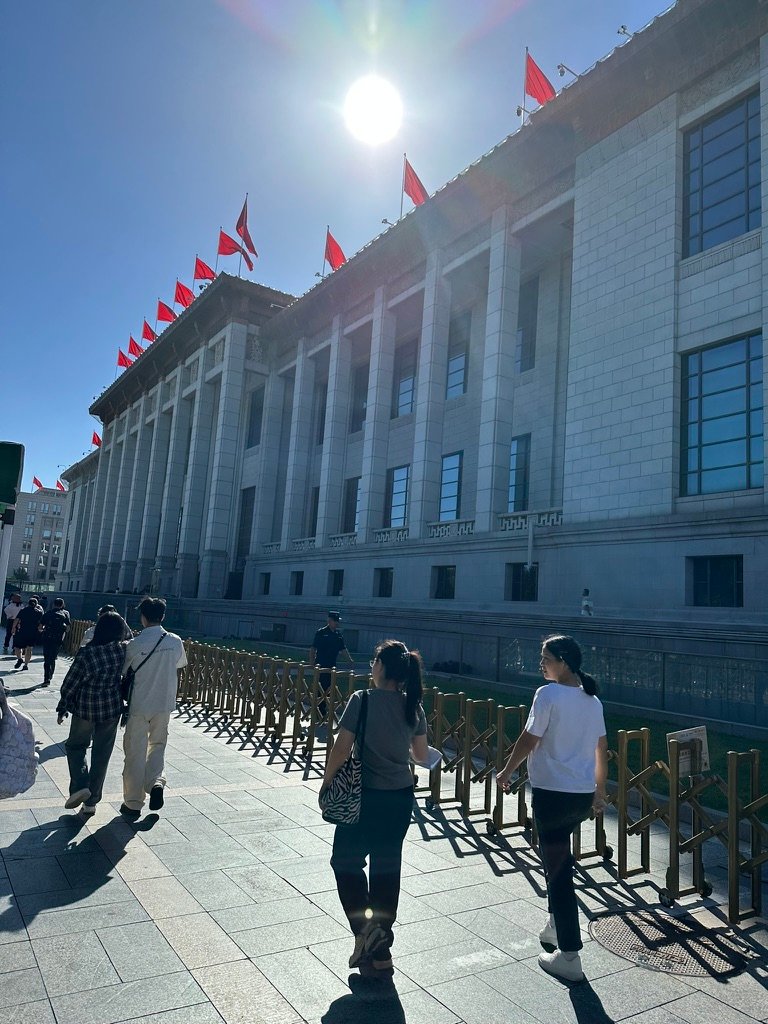
Standing outside the National Museum of China, the building itself already feels impressive.
The red flags above the museum.
The huge columns.
The crowds slowly entering.
It feels like you are not just entering a building.
You are entering a long story.
A story that began thousands of years ago.
For many visitors travelling to Beijing China, the Forbidden City shows the lives of emperors.
The Great Wall shows the scale and determination of ancient China.
But the National Museum helps answer a bigger question:
How did China become China?
That was the question Elaine and I wanted to explore.
Do Not Try To See Everything — Your Brain Will Surrender First 😄
When Elaine and I walked into the National Museum of China (中国国家博物馆), the first feeling was:
“Wow.”
The second feeling was:
“Uh oh…” 😅
Because this museum is HUGE.
Really huge.
Inside this building beside Tiananmen Square (天安门广场) is a journey covering thousands of years of Chinese history — from ancient humans, early civilisation, bronze culture, emperors, dynasties, inventions, and eventually modern China.
Basically:
China decided to squeeze 5,000 years of homework into one building.
Good luck finishing everything in one afternoon. 😂
That is why Dad had a rule:
Do not try to see everything.
Trying to finish a giant museum is like trying to watch a 100-episode Chinese historical drama in one night.
Possible?
Maybe.
Will your brain remember anything the next morning?
Probably not. 😄
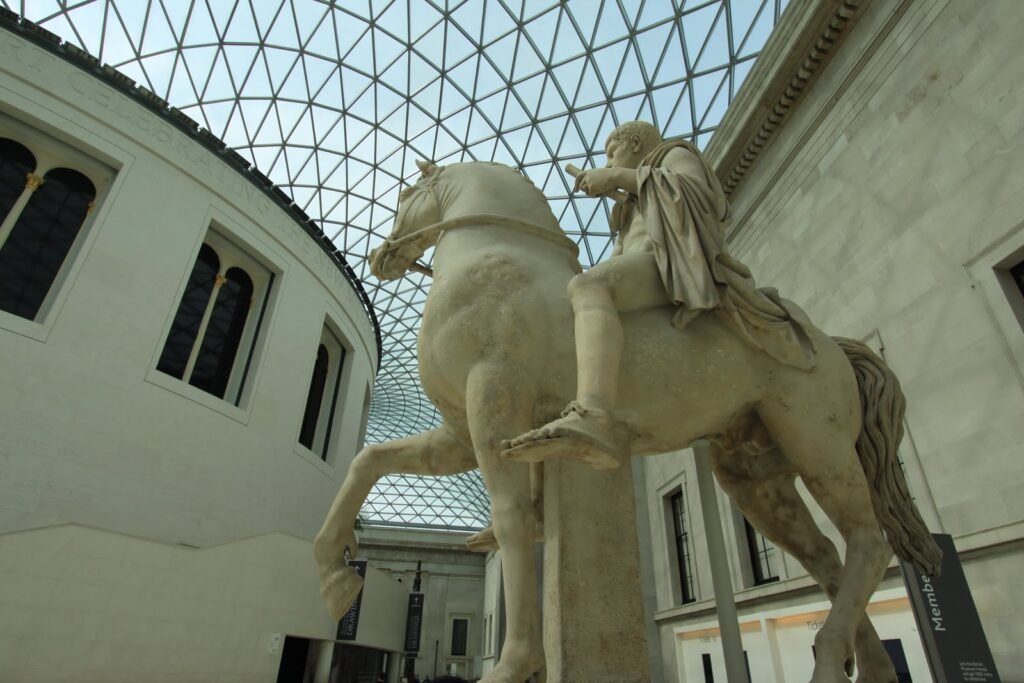
A Lesson I Learned From The British Museum
Actually, I learned this lesson years earlier during my visit to the British Museum in London.
The British Museum is another amazing place where you can easily get lost among thousands of years of world history.
Ancient Egypt.
Greece.
Rome.
Mesopotamia.
Human civilisation everywhere.
My strategy?
I surrendered early. 😂
Instead of rushing through every room taking hundreds of photos I would never understand later, I chose one story:
How early human civilisation began.
So I spent my time with ancient Egypt, early writing systems, and of course, the famous Rosetta Stone.
Because sometimes a museum is not about how many things you see.
It is about how many stories you bring home.
Our Mission In Beijing: Find The Beginning Of China
So when Elaine and I visited the National Museum of China, we followed the same idea.
We were not museum warriors trying to conquer every exhibition hall.
Our mission was simpler:
Find the beginning.
How did China become China?
Before the famous emperors.
Before the Forbidden City (故宫).
Before the Great Wall (长城) became a symbol known around the world.
There were people.
Villages.
Ideas.
Discoveries.
Slowly, generation after generation, a civilisation was born.
🐧 Cheers’ Question:
“Wait Elaine… so before emperors and palaces, people were just trying to figure out farming, tools and everyday life?”
🌱 Elaine:
“Exactly. Dynasties don’t suddenly appear from nowhere. Civilisations grow slowly.”
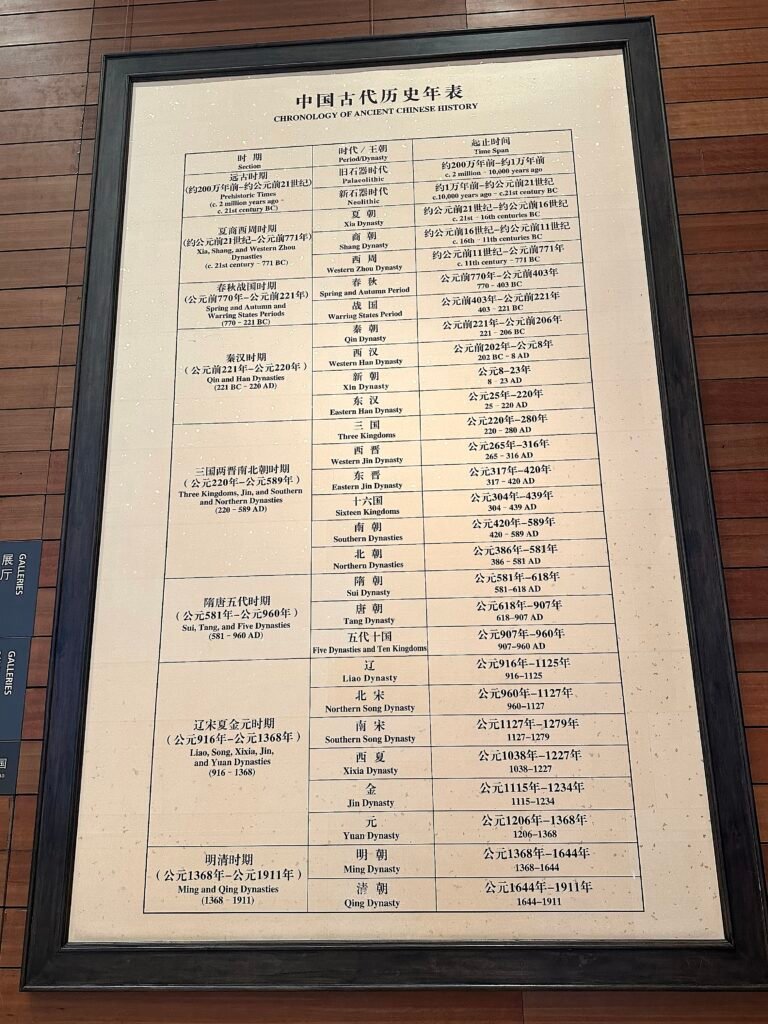
Walking Into Ancient China (古代中国)
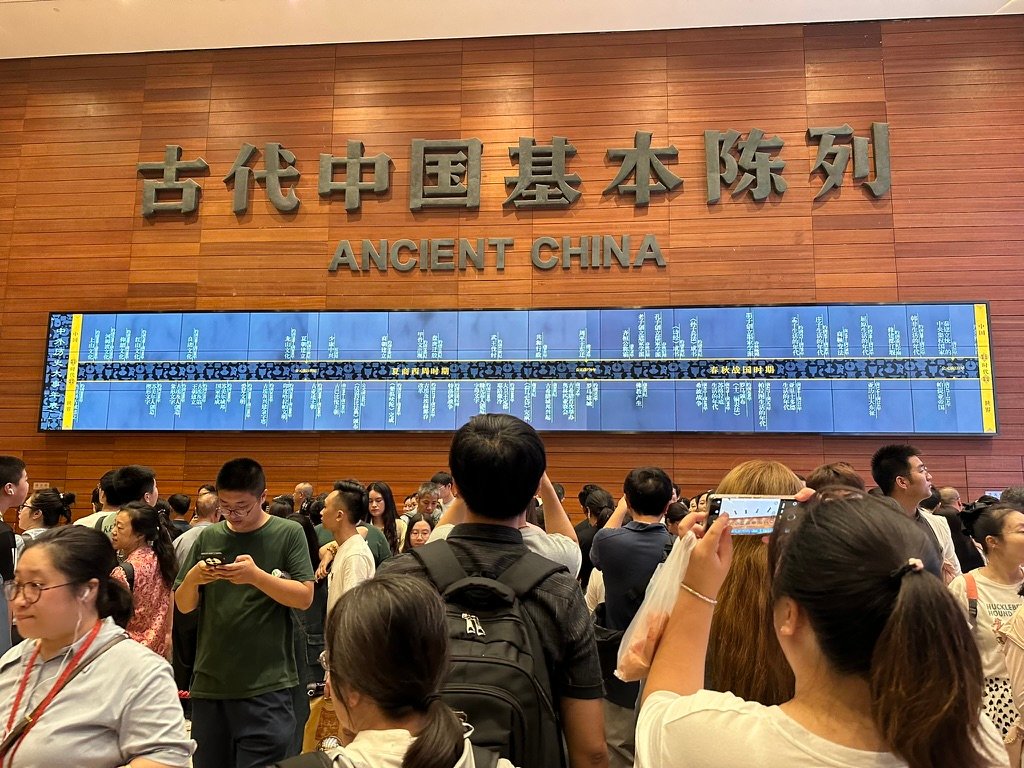
Our first target was the Ancient China (古代中国) exhibition.
This was especially meaningful for Elaine.
Years ago, when she first started exploring Chinese history, she created her own emperor timeline — arranging dynasties, rulers and stories together.
Back then, they were just names:
Qin (秦).
Han (汉).
Tang (唐).
Ming (明).
Qing (清).
But standing here was different.
The timeline was no longer only on a computer screen.
The objects in front of us were created by real people who lived thousands of years ago.
History had become something we could see.
Something we could touch with our imagination.
And the journey started with some of the simplest objects:
Pottery.
Tools.
Bronze vessels.
Things ordinary people used long before China became the civilisation we recognise today.
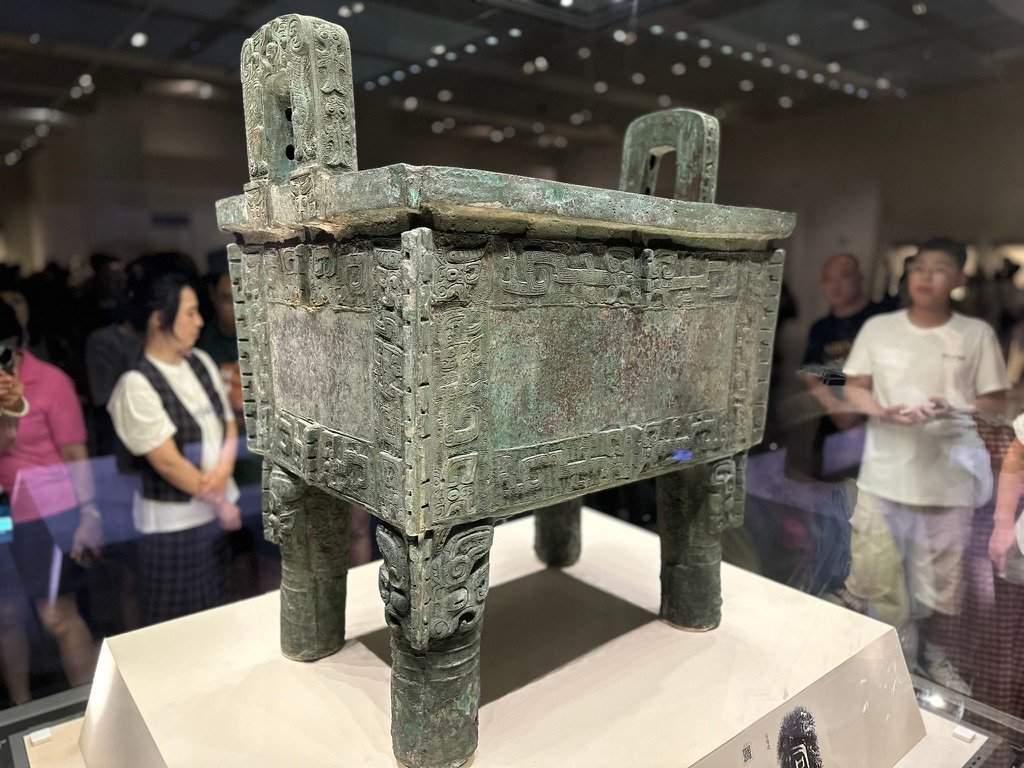
Meeting The Giant Bronze “Pot” — Wait… Is Cheers Going Inside? 🐧
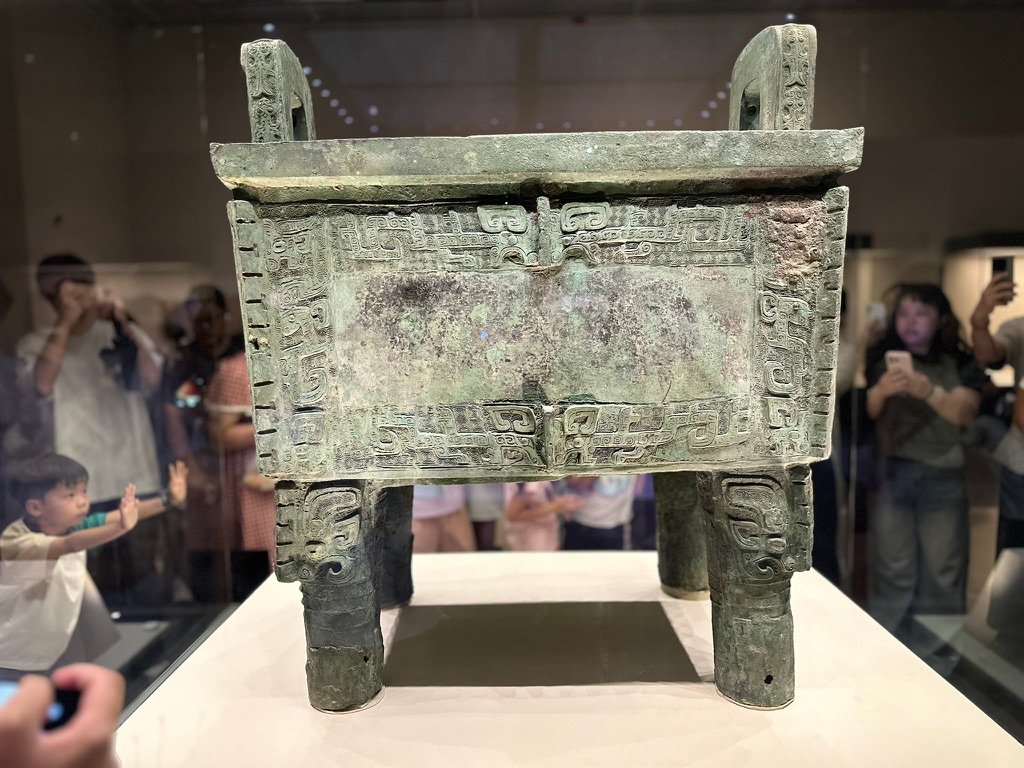
Walking into the Ancient China (古代中国) exhibition, we finally met one of the biggest stars of the National Museum of China:
Hou Mu Wu Ding (后母戊鼎).
A huge green bronze vessel standing proudly in front of us.
🐧 Cheers immediately became nervous.
“Elaine… why are we looking at a giant cooking pot?”
“And why is it big enough to fit a penguin?”
“Wait… you are not planning to cook me, right?” 😨
🌱 Elaine:
“Cheers… relax. Nobody is cooking penguin soup.” 😂
“And this is NOT a cooking pot.”
This giant bronze object is actually one of China’s greatest ancient treasures.
It came from the Shang Dynasty (商朝), more than 3,000 years ago.
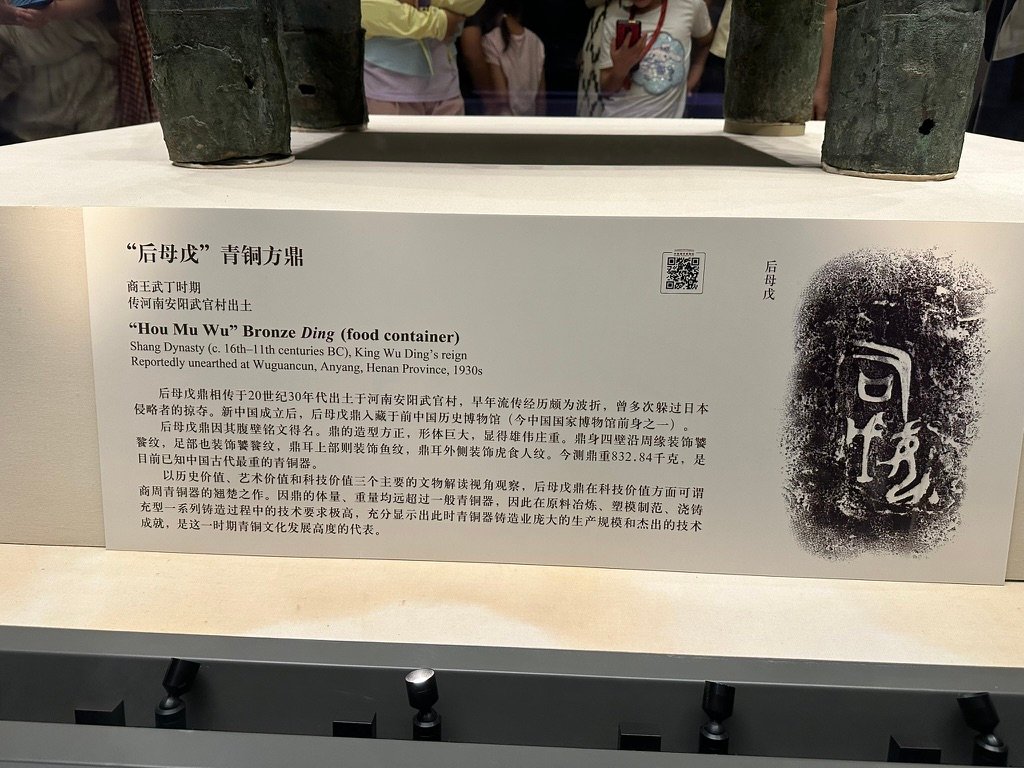
Discovered near Anyang (安阳), Henan Province — close to the ancient Shang capital Yin Xu (殷墟) — the Hou Mu Wu Ding is the largest and heaviest ancient bronze ritual vessel (青铜礼器) ever discovered in China.
It weighs more than 800 kilograms.
🐧 Cheers:
“800 kilograms?!”
“Okay… even if I fell inside, nobody can carry the pot away.” 😌
Why Did Ancient People Make Such A Huge Thing?
🐧 Cheers:
“So Elaine… if it wasn’t for cooking, why make it so big?”
Good question.
Thousands of years ago, Shang people did not create bronze vessels just because they wanted giant decorations.
Bronze vessels (青铜器) were connected to:
- ancestor worship (祭祖)
- rituals (礼)
- royal power
- status
The inscription 后母戊 shows this vessel was created to honour an important royal female ancestor.
🌱 Elaine:
“Think of it like leaving a message across thousands of years.”
🐧 Cheers:
“So ancient people didn’t upload memories to the cloud…”
“They uploaded them into bronze?”
Exactly. 😂
And their “storage device” survived more than 3,000 years.
Wait… Why Is It Green? 🐧
Cheers looked again.
🐧:
“Elaine… one more question.”
“Did Shang people just really like green?”
🌱 Elaine:
“Cheers…”
“It was not originally green.”
😮🐧
The green colour appeared because of oxidation (氧化) over thousands of years.
When it was first made, bronze would have looked much brighter — a shiny metallic bronze colour.
Imagine a Shang ceremony:
🔥 firelight
🥁 ritual music
✨ giant shining bronze vessels
🐧 Cheers:
“Okay… now I understand.”
“Ancient people were not making a big pot.”
“They were making something that said: remember us.”
The Bronze Vessel That Recorded a War Story — Xiong Han Ding (熊悍鼎)
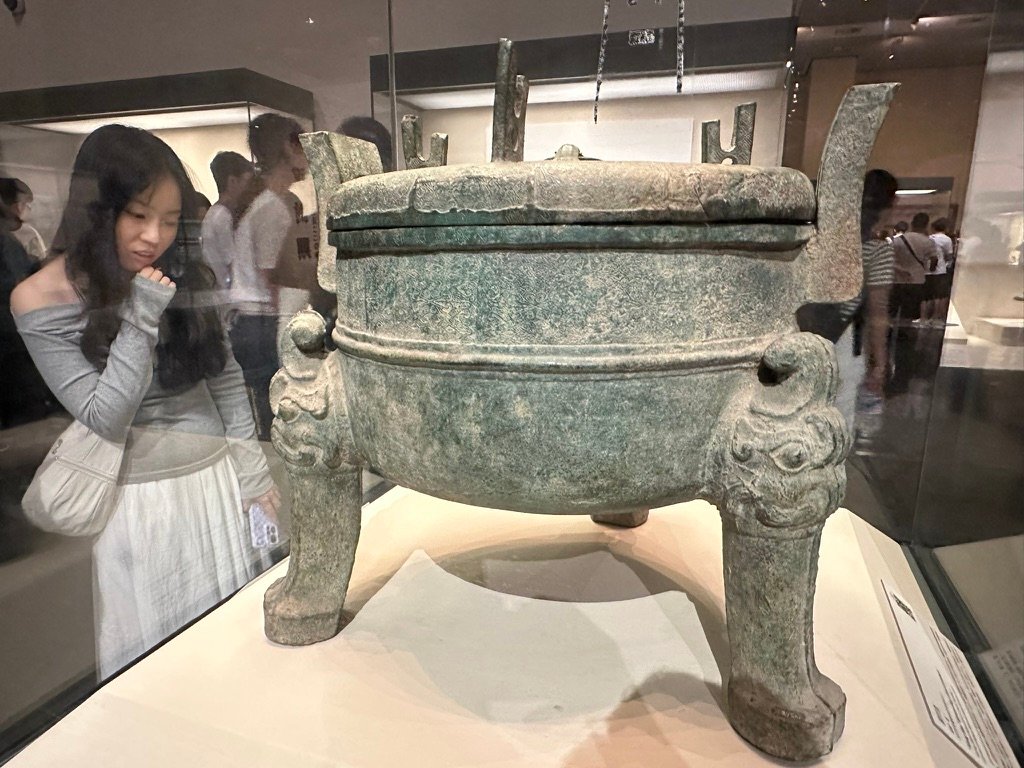
After meeting the gigantic Houmuwu Ding (后母戊鼎) — the heavyweight champion of ancient Chinese bronze — we continued exploring the Ancient China exhibition (古代中国基本陈列) inside the National Museum of China.
Then Elaine stopped in front of another bronze vessel.
It looked smaller.
Less dramatic.
Less “wow”.
🐧 Cheers looked relieved:
“Finally! A normal size pot. Maybe this one cannot cook a travel bug.”
😂
But ancient Chinese bronzes have a habit:
The more quietly they sit, the louder their stories become.
Wait… This Was Not Just a Food Container?
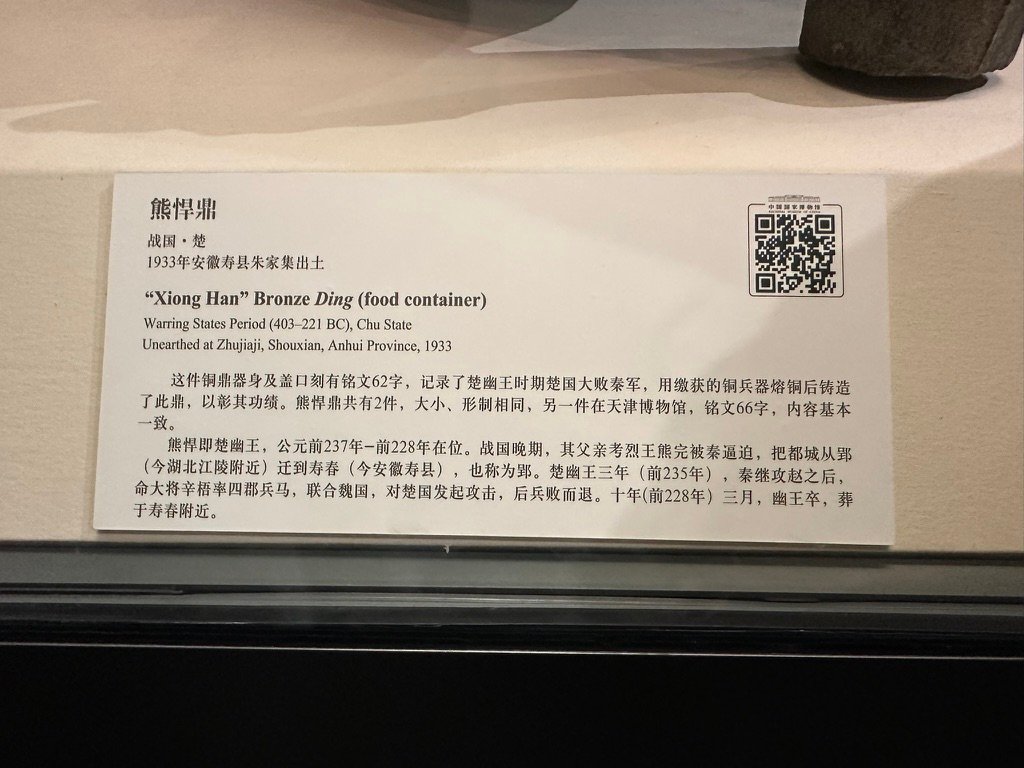
The label said:
熊悍鼎 — Xiong Han Bronze Ding
Period:
Warring States Period (战国时期), Chu State (楚国)
403–221 BC
At first glance:
A tourist sees:
“Old green container.”
An archaeologist sees:
“A 2,000+ year old message.”
Because inside the vessel were 62 Chinese characters (铭文 míngwén).
🐧 Cheers:
“Wait… someone wrote inside the pot?”
🌱 Elaine:
“Yes. Bronze vessels were like ancient China’s permanent memory storage.”
Today we save things in:
phones
computers
cloud storage
Ancient China?
They saved important events in:
bronze.
And bronze lasted thousands of years.
(Your phone probably won’t.)
😂
Why Did Ancient Chinese People Make Bronze Vessels?
This was one of my favourite discoveries.
In ancient China, especially during the:
- Shang Dynasty 商朝
- Zhou Dynasty 周朝
- Warring States 战国
bronze vessels were not ordinary kitchen equipment.
Nobody said:
“Honey, can you use our 800kg bronze ding to cook noodles tonight?”
😂
These objects were made for serious reasons:
1. To Honour Ancestors 祭祀祖先
The famous Houmuwu Ding 后母戊鼎 was believed to be created by a Shang king to honour his mother.
A giant bronze vessel was a statement:
“My family remembers.”
“My ancestors matter.”
2. To Record Important Achievements 记录功绩
Many Zhou bronze vessels recorded:
- victories
- rewards from kings
- appointments
- family achievements
Almost like:
Ancient LinkedIn.
Except instead of:
“Congratulations on your promotion 🎉”
They made a bronze object that survived 3,000 years.
😂
3. To Record War and Politics (Important events)
And this brings us back to the Xiong Han Ding.
This vessel recorded events involving the Chu state during the Warring States period.
It was a time when powerful states fought before China was finally unified under Qin (秦).
🐧 Cheers:
“So this pot watched the road towards the first Chinese empire?”
🌱 Elaine:
“Kind of. These objects were created when China was still divided into competing kingdoms.”
Why Are So Many Famous Objects Here in Beijing?
One interesting thing about visiting the National Museum of China is:
Many exhibits are the “superstars” of Chinese archaeology.
The biggest.
The rarest.
The most historically important.
That is why travellers sometimes notice:
“Wait… why is this from Henan, Anhui, Shaanxi… but displayed in Beijing?”
😂
Because national museums around the world often collect objects representing the entire civilisation.
It is similar to my visit to the British Museum in London.
There, I did not try to see everything.
Impossible.
I focused on early civilisation:
- Rosetta Stone
- Ancient Egypt
- Mesopotamia
The same strategy works here.
Don’t try to “defeat” the National Museum of China.
You won’t.
The museum wins.
😂
Pick a story.
Follow it.
For us:
It was:
pottery
↓
bronze
↓
writing
↓
civilisation
🐧 Cheers:
“So today we didn’t look at old pots…”
🌱 Elaine:
“We looked at memories.”
Exactly.
The bronze vessels were not simply objects.
They were messages sent across thousands of years.
And somehow, one afternoon in Beijing…
A father, a daughter, and a confused travel bug were standing there reading them.
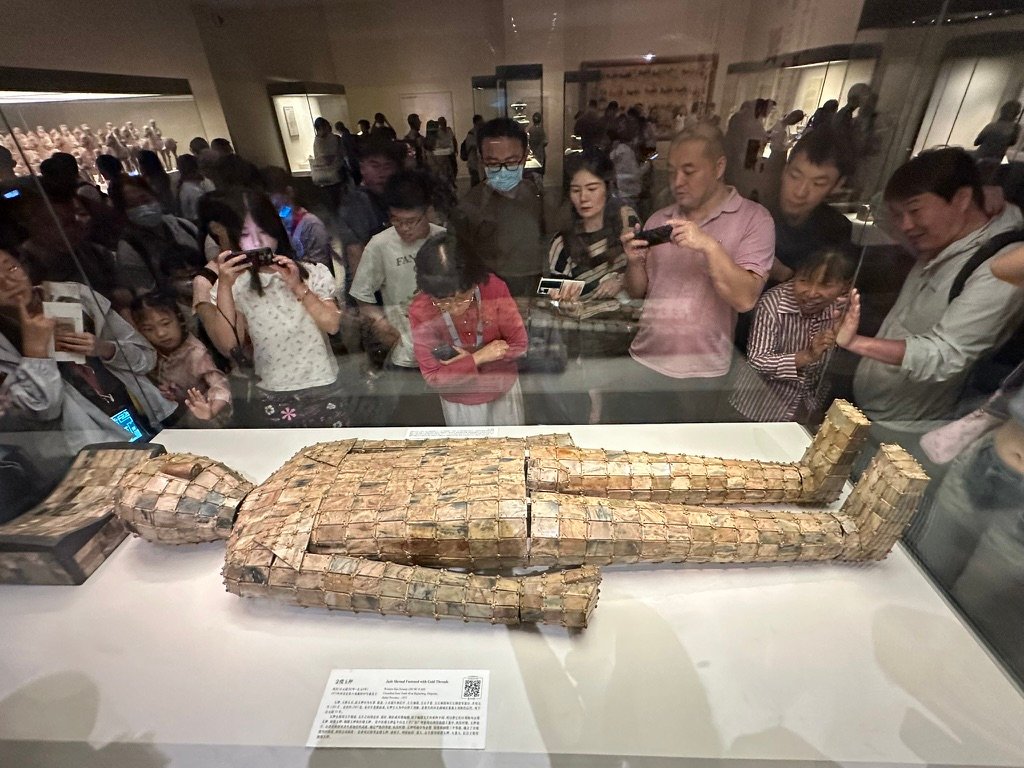
Jade Burial Suit — When Ancient China Tried to Dress for Eternity
After the bronze vessels, we walked further into the Ancient China exhibition.
Then suddenly…
A crowd appeared.
In a huge museum, crowds are usually a clue.
Something important is hiding there.
🐧 Cheers:
“Dad… why is everyone surrounding this glass box?”
🌱 Elaine:
“Usually it means we found one of the museum celebrities.”
😂
And there it was.
A complete suit.
But not made from cloth.
Not silk.
Not armour.
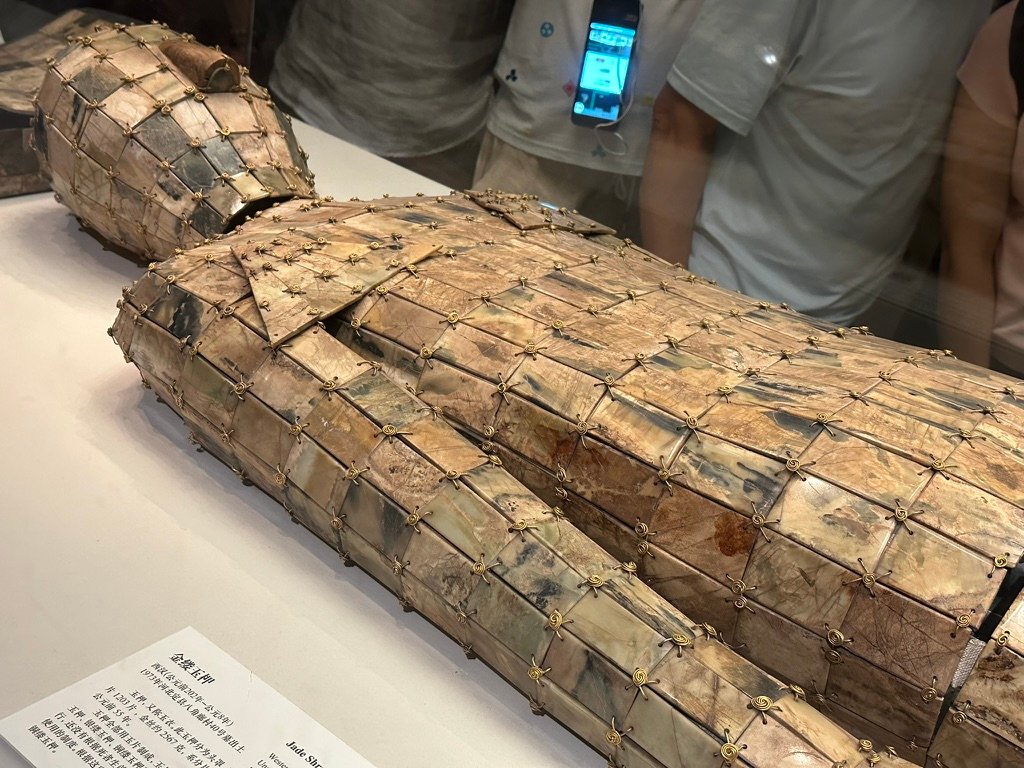
It was made from thousands of pieces of jade.
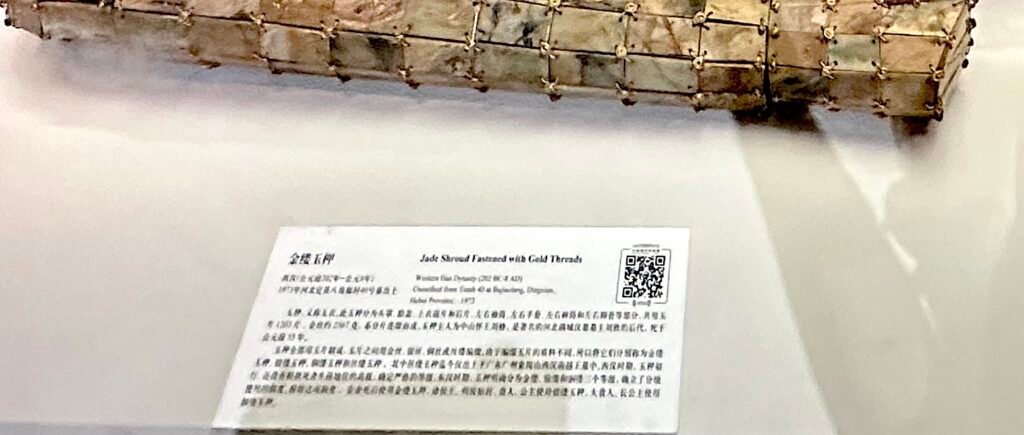
金缕玉衣 — Jade Burial Suit Sewn with Gold Thread.
Wait… Ancient Chinese People Made Clothes From Jade?
Yes.
And not for fashion.
Nobody in the Han Dynasty woke up and said:
“Hmm… jade outfit today. Maybe match with jade shoes.”
😂
This was a burial suit.
A special object created for members of the royal family and highest-ranking nobles of the Han Dynasty (汉朝).
Ancient Chinese believed jade (玉 yù) was special.
It represented:
purity
status
virtue
connection between humans and heaven
For powerful rulers, jade was also connected with another dream:
preserving the body after death.
🐧 Cheers:
“So they thought jade could help them live forever?”
🌱 Elaine:
“Not exactly live forever… but they believed jade had protective power.”
And that tells us something important:
Ancient objects are not just about technology.
They reveal how people thought.
What they feared.
What they hoped for.
Why Gold Thread?
Look closer.
Thousands of small jade plates were carefully cut.
Then connected together.
The highest level jade burial suits used:
金缕 (jīn lǚ) — gold threads
Different ranks used different materials.
Gold was reserved for the highest elites.
Imagine the work:
Cut jade.
Polish jade.
Drill tiny holes.
Connect every piece.
One mistake?
Start crying.
😂
🐧 Cheers:
“Dad… assembling Elaine’s desktop computer sounds easier.”
Dad:
“Yes. At least PC parts come with instructions.”
😂😂
Why This Object Matters
This jade burial suit is not just beautiful.
It tells us that by the Han Dynasty:
China already had:
✔ advanced craftsmanship
✔ organised labour
✔ specialised artisans
✔ complex beliefs
✔ powerful royal systems
A single object tells a civilisation story.
This is why I told Elaine:
When visiting museums, don’t try to remember 5,000 objects.
Impossible.
Even the brain will display:
Storage Full. Please upgrade memory.
😂
Pick a few objects.
Understand their stories.
Then suddenly the museum becomes alive.
🐧 Cheers:
“So today we met a giant bronze cooking pot and a jade outfit nobody can wear?”
🌱 Elaine:
“Yes. But both were actually about something bigger.”
One honoured the ancestors.
One searched for eternity.
Two objects.
Two windows into ancient China.
Leaving the Museum… But Not Leaving the Story
After spending hours inside the Ancient China exhibition, one thing became very clear.
The National Museum of China is not a place you “finish”.
It is impossible.
And maybe that is the wrong way to experience it.
A museum with 5,000 years of civilisation is not a checklist.
It is a doorway.
On this visit, Elaine and I followed only one path:
From early civilisation…
to bronze vessels that honoured ancestors…
to jade suits created for eternity.
Just a few objects.
But each object opened another question:
“Why did ancient people make this?”
“What did they believe?”
“What kind of world were they living in?”
That is when history stops becoming dates in a textbook.
It becomes stories about people.
🐧 Cheers:
“So Dad… we survived 5,000 years of Chinese history?”
Dad:
“Only the first few chapters.”
🐧 Cheers:
“There are MORE chapters?”
🌱 Elaine:
“Cheers… this is China.”
😂
But Chinese civilisation did not stop with bronze and jade. More than a thousand years later, another China appeared — colourful, international and connected through the Silk Road. That story was waiting for us in two Tang Dynasty treasures.”
Two Tang Dynasty Treasures Inside the National Museum of China