From weights and measures to roads, farming, education and medicine, the practical innovations that shaped Chinese civilisation.
In the first article, we explored how the Qin (秦) and Han (汉) dynasties built the political foundations of Chinese civilisation. The museum argued that their greatest legacy was not simply military conquest, but the creation of institutions capable of holding together one of the world’s largest and most diverse societies.
But institutions alone cannot change a civilisation.
They must touch ordinary people’s lives.
How do farmers measure grain? How do merchants know whether a weight is fair? How can officials govern thousands of kilometres away using the same laws? How can travellers trust the coins they receive in distant cities?
As Elaine and I continued through the galleries, the exhibition shifted from political philosophy to practical innovation. One after another, we discovered reforms that transformed daily life across the empire. Many were introduced more than 2,000 years ago, yet their influence can still be recognised in China’s long historical development today.
The museum presents a fascinating argument: the Qin and Han did not simply unite China—they made a unified civilisation function.
One Empire, One Standard: The Reform That Made Trade Possible (统一货币和度量衡)
One of the first practical reforms highlighted by the museum seems almost ordinary today.
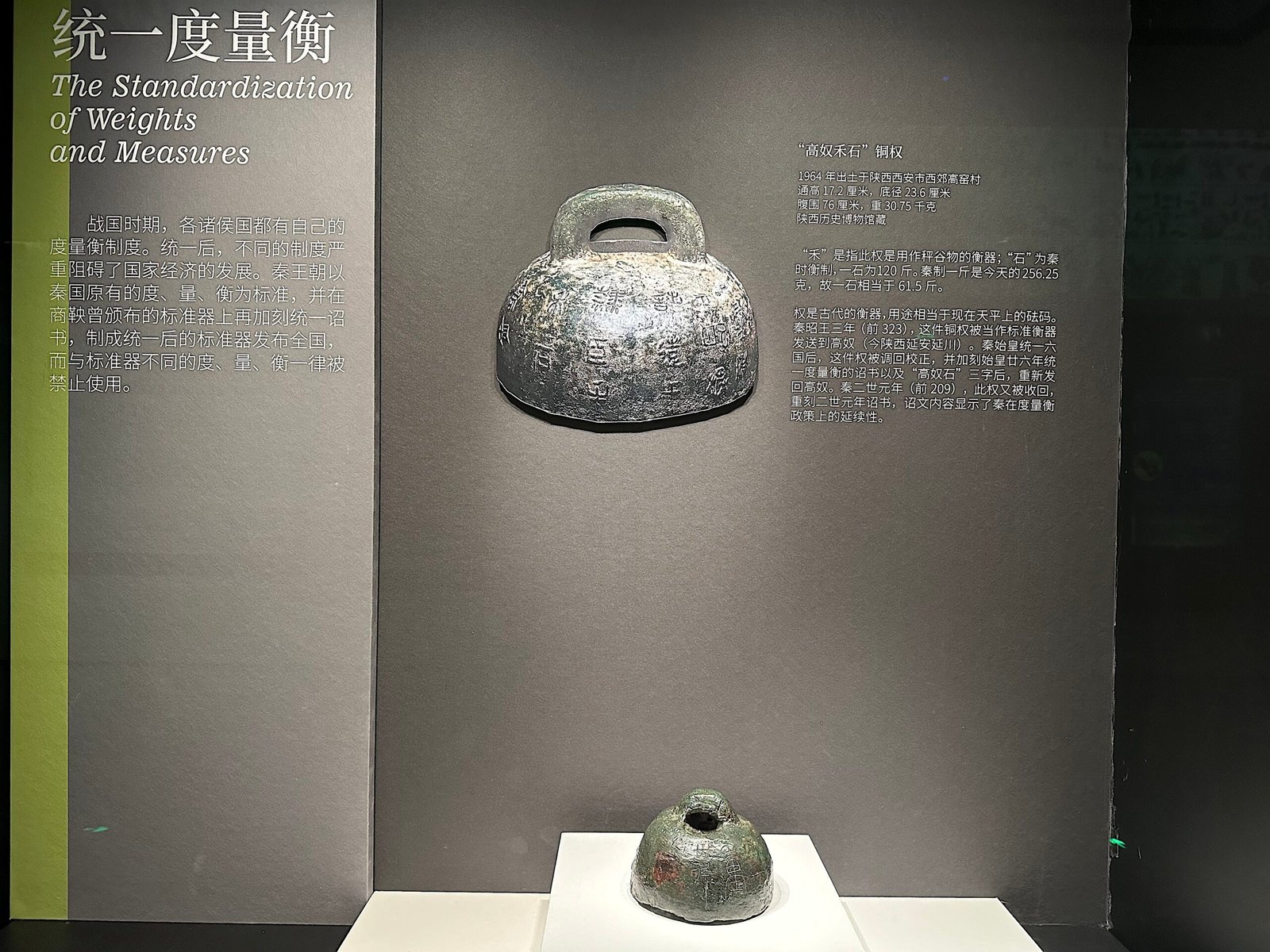
Standardising weights, measures and currency.
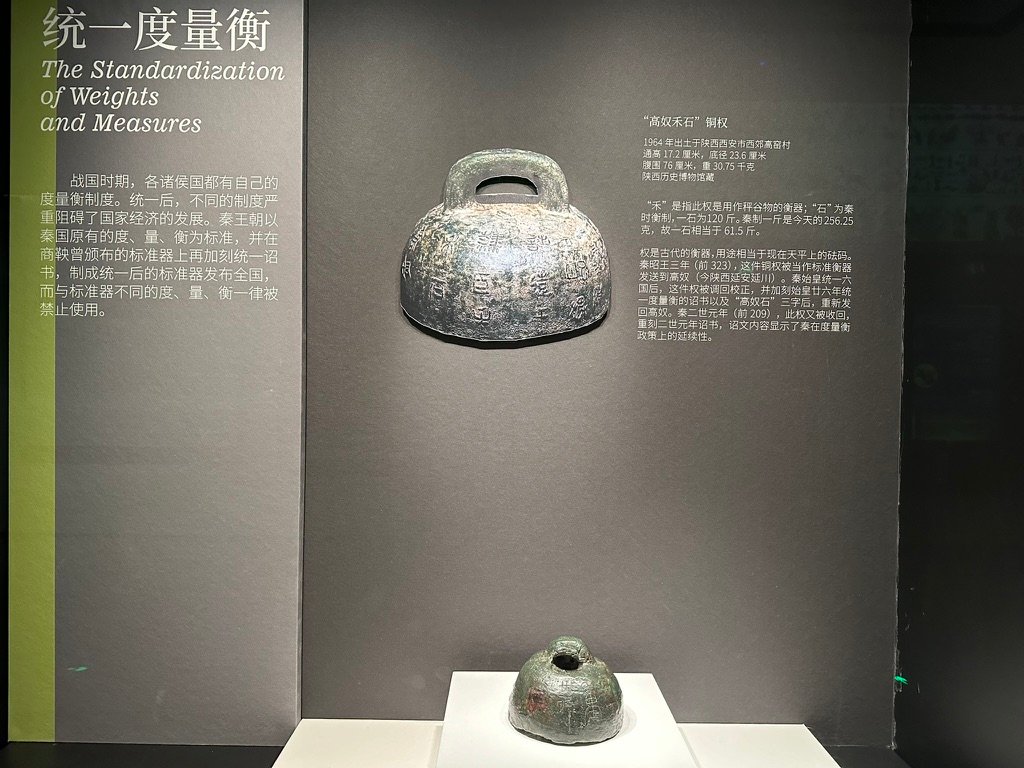
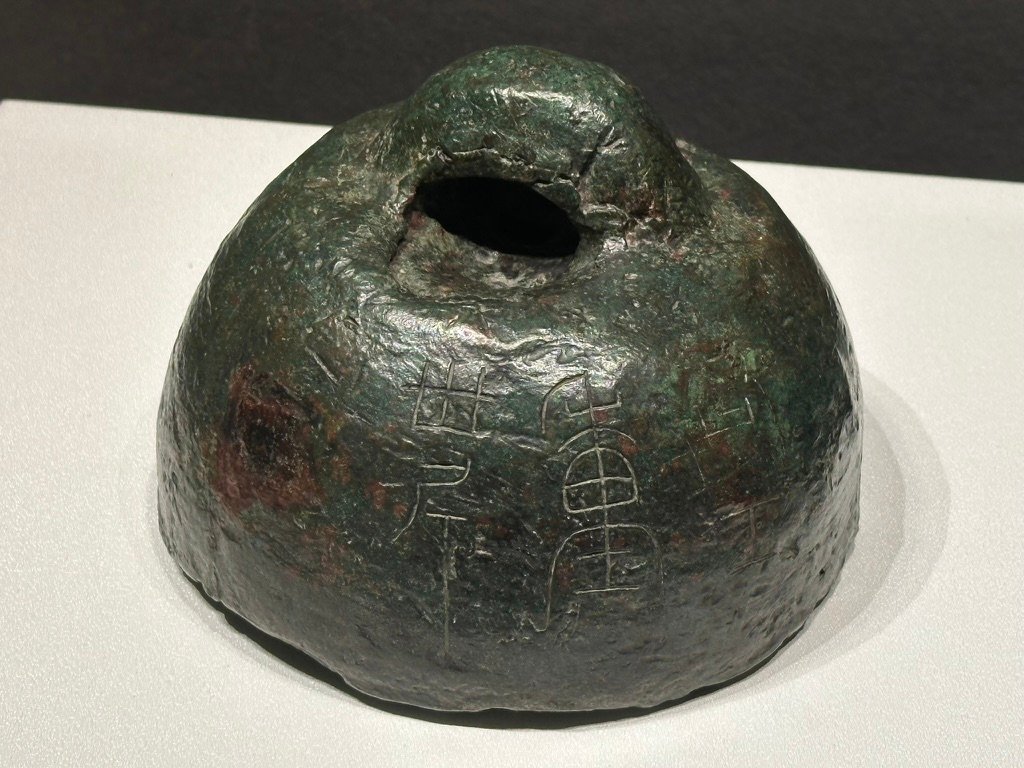
Yet two thousand years ago, it was revolutionary.
Before Qin unified China, every state had developed its own coins, measuring systems and standards. A merchant travelling from one kingdom to another might have to exchange currencies, recalculate weights and learn entirely different measurement systems before conducting business.
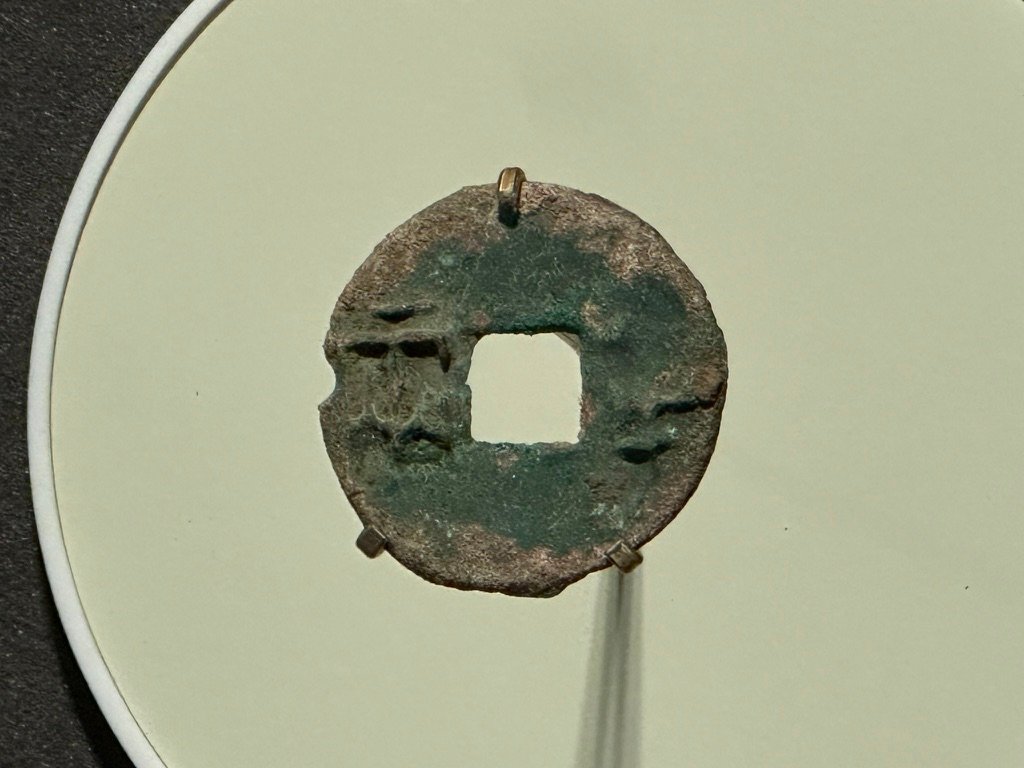
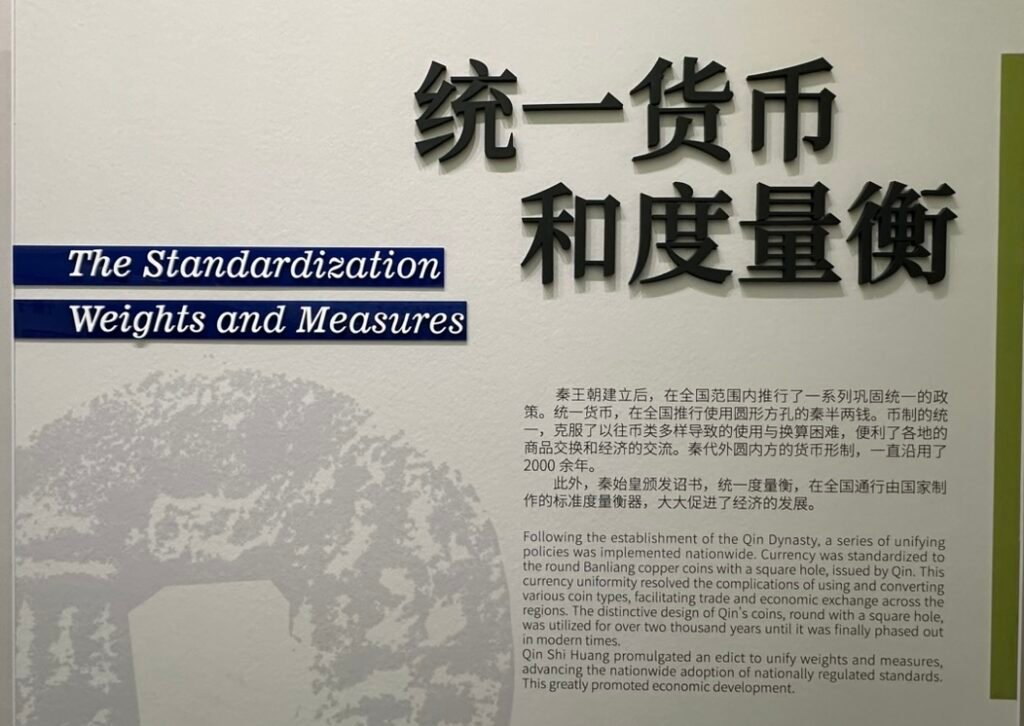
The museum explains that after the establishment of the Qin Dynasty (秦朝), the imperial government introduced nationwide standards. The famous Banliang coin (半两钱)—a round bronze coin with a square hole—became the empire’s official currency. According to the exhibition, this distinctive design remained influential for more than 2,000 years, becoming one of the most recognisable symbols of traditional Chinese civilisation.
Currency, however, was only part of the reform.
Qin Shi Huang (秦始皇) also ordered the standardisation of weights and measures throughout the empire. Official measuring instruments were manufactured according to national standards, allowing merchants, tax collectors and government officials to operate under the same system regardless of where they were.
Today, this sounds obvious.
Back then, it was transformative.
A farmer selling grain in one province could expect the same unit of measurement to be recognised hundreds of kilometres away. Merchants no longer needed to constantly convert between competing local systems. The reduction in confusion helped stimulate trade, strengthened tax collection and allowed economic life to operate on a much larger scale.
The museum makes an important point that is easy to overlook.
Standardisation was not merely about efficiency.
It was about trust.
People could trust that a weight meant the same thing throughout the empire. A coin carried the same value wherever it travelled. That shared confidence became an invisible foundation supporting commerce across Qin and later Han China.
🐧 Cheers’ Corner
Cheers stared at the famous round coin with its square hole.
“Dad… so Qin Shi Huang invented money?”
Dad laughed.
“Not quite. Coins already existed.”
“So what did he invent?”
“He made sure everyone was finally using the same ones.”
Cheers scratched his little head.
“Ohhh… so before that, shopping in another kingdom was like travelling to five different countries that all used different money, rulers and weighing scales?”
“Exactly.”
“No wonder they standardised everything. Imagine arguing with every shopkeeper before you could even buy lunch.”
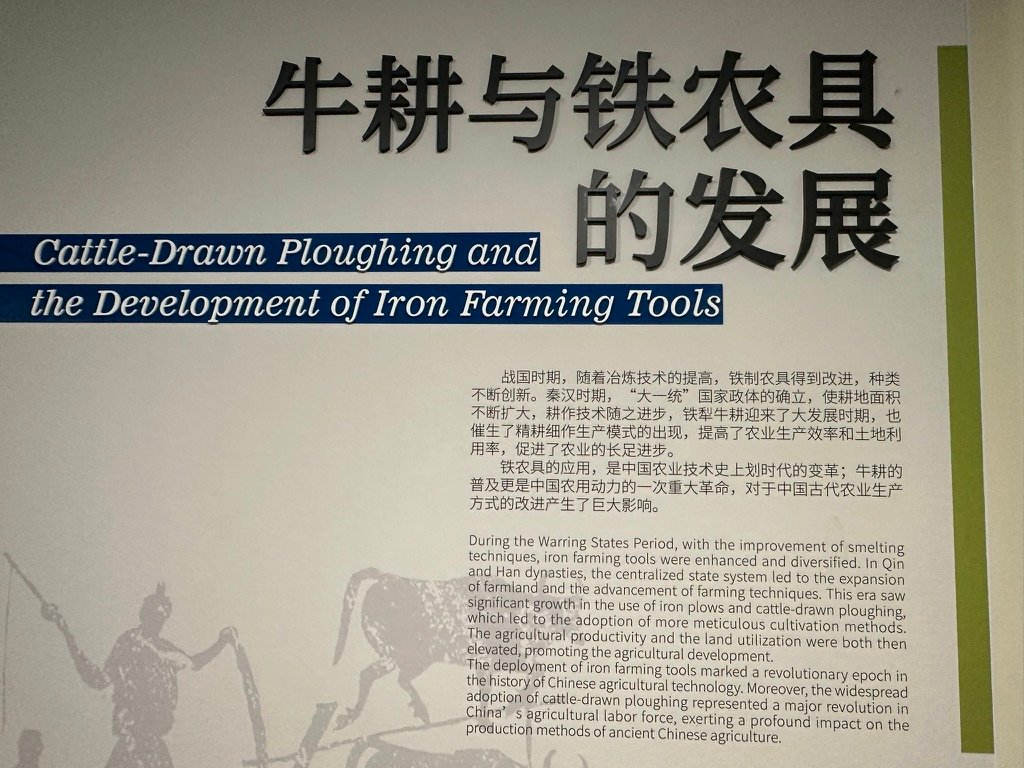
Iron, Oxen and an Agricultural Revolution (牛耕与铁农具的发展)
Political stability alone could not sustain an empire.
People still needed food.
The museum argues that one of the greatest engines behind the prosperity of the Qin (秦) and Han (汉) dynasties was something much less glamorous than armies or palaces—better farming.
By the Warring States period (战国时期), advances in iron smelting had already produced stronger and more varied farming tools. During the Qin and Han dynasties, however, these technologies spread across a unified empire on an unprecedented scale.
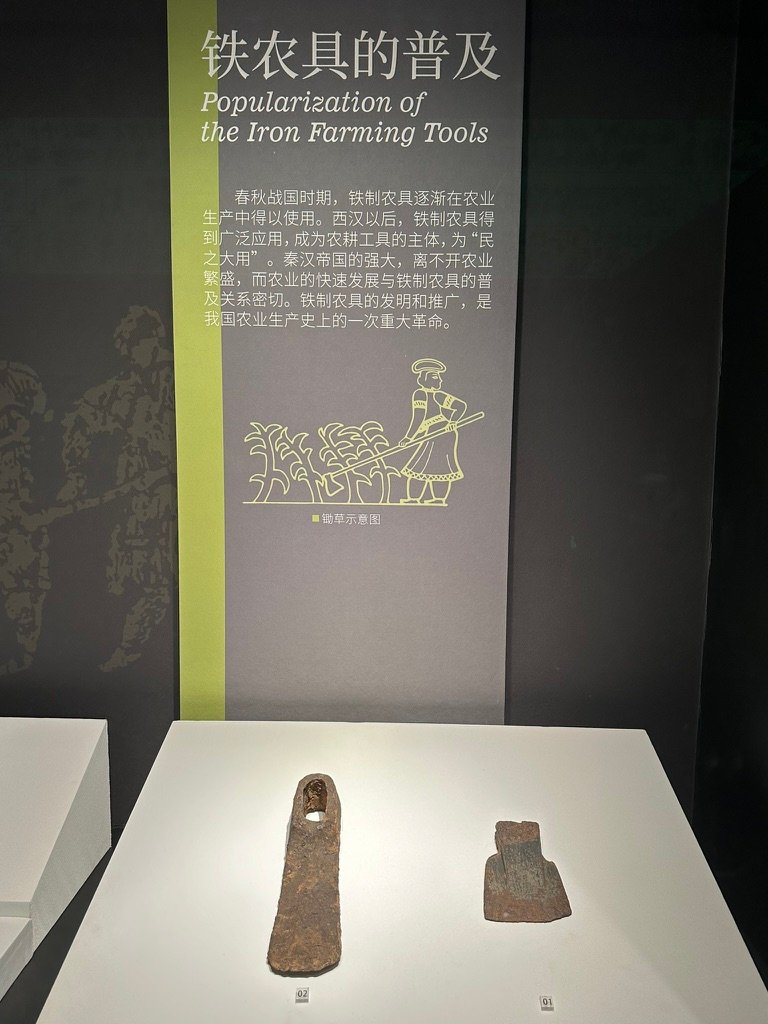
Iron ploughs replaced many older wooden implements. Even more importantly, oxen (牛) increasingly pulled the ploughs instead of relying solely on human labour.
The result was profound.
Fields could be cultivated more quickly, larger areas of farmland could be brought under production, and farmers could till the soil more deeply and efficiently. The museum describes this as a revolution in Chinese agricultural history, one that dramatically increased productivity and made better use of the land.
The exhibition suggests that unification itself accelerated this transformation. Stable government, expanding farmland and improved farming technology reinforced one another, allowing agriculture to support a rapidly growing empire.
🐧 Cheers’ Corner
Cheers stared at the picture of the ox pulling the plough.
“Wait… the cow is doing all the hard work?”
Dad nodded.
“Pretty much.”
Cheers looked impressed.
“Finally… someone invented agricultural horsepower.” 🐂
Rome and China: Two Great Civilisations, Two Different Fields
One detail surprised me.
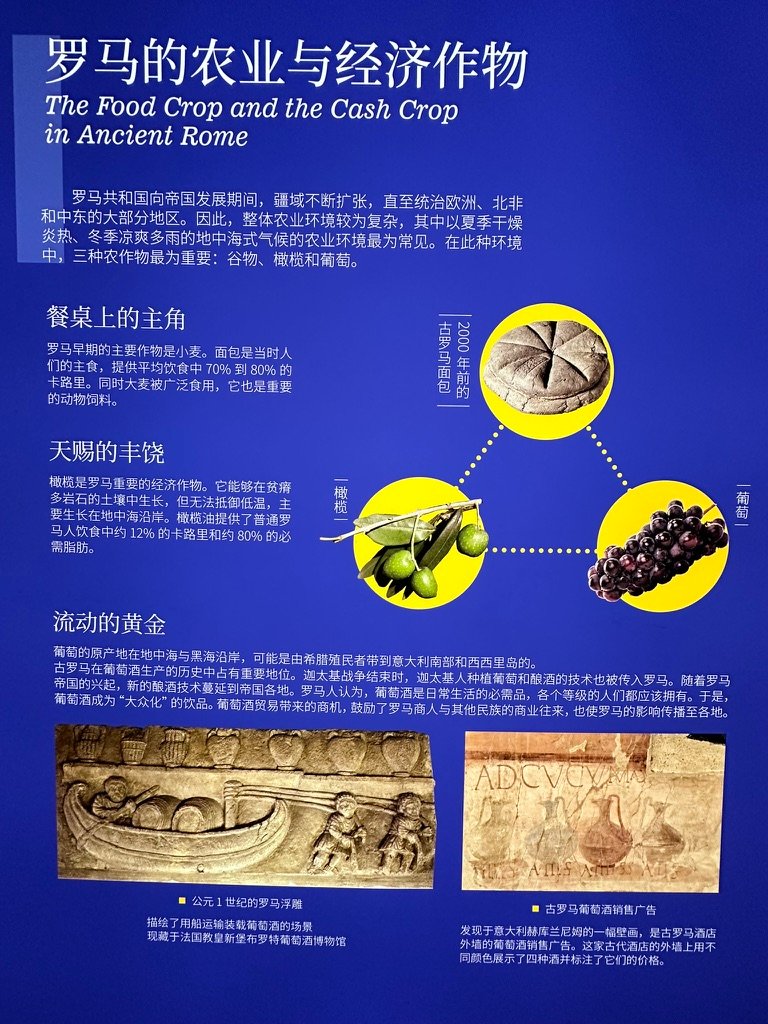
Rather than discussing China alone, the museum invites visitors to compare ancient agriculture with another great civilisation—Rome.
According to the exhibition, the Mediterranean world relied heavily on three key crops:
- wheat for bread,
- olives for oil,
- grapes for wine.
Bread formed the staple food for much of the Roman population. Olive oil was used not only in cooking but also for lighting and daily life. Grapes and wine became major commercial products that travelled throughout the Roman Empire.
Standing in front of this display, I realised that agriculture reflects geography as much as civilisation.
Rome developed around the warm Mediterranean climate, where olives and vineyards flourished.
China developed across vast river plains and seasonal monsoon climates, where intensive grain cultivation demanded continual improvements in irrigation, farming tools and land management.
Both civilisations became powerful empires.
But each was shaped by very different landscapes.
One became famous for vineyards and olive groves.
The other invested heavily in iron ploughs, ox-drawn cultivation and the intensive farming needed to feed one of the world’s largest populations.
Elaine’s Note
“I always thought museums only compared China with… China.”
“I didn’t expect to see Ancient Rome here.”
“It actually made the Chinese exhibits easier to understand. I already knew Romans ate bread, drank wine and used olive oil. Seeing China’s farming tools beside Rome’s food crops helped me realise that every civilisation solves the same problem—feeding millions of people—but in completely different ways.”
🐧 Cheers’ Final Thought
“So Rome conquered with bread and wine…”
“China conquered with iron ploughs and very hardworking cows.”
Dad smiled.
“Both conquered because they could feed their people.”
Cheers nodded seriously.
“Never underestimate a civilisation with good farming.”
Farming Was Too Important to Leave to Chance
As we continued through the exhibition, another pattern began to emerge.
The Qin government did not simply encourage agriculture—it managed it through law.
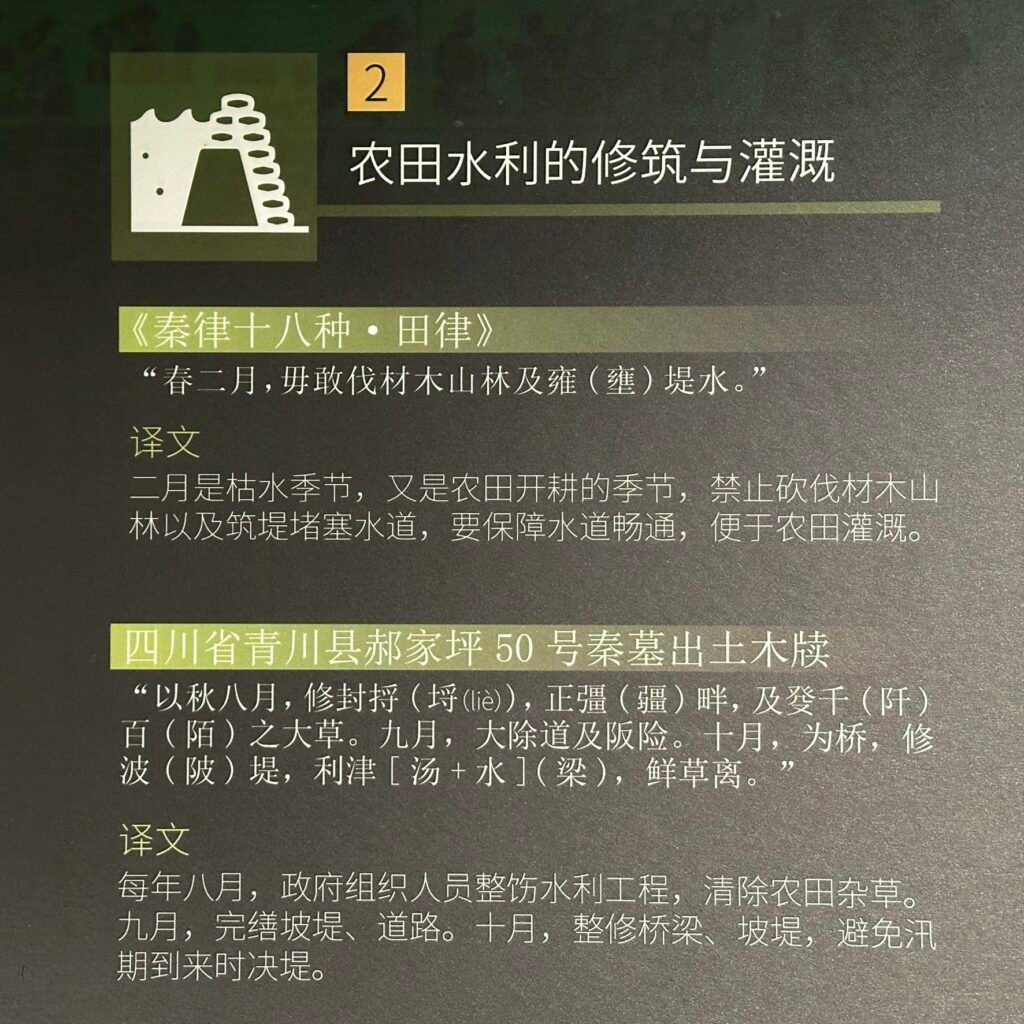
The museum presents several surviving legal texts from the Qin Laws (《秦律十八种》) that regulated farming in remarkable detail. Rather than issuing broad principles, these laws prescribed exactly when irrigation canals should be maintained, how draft animals should be protected, and even how officials would be rewarded or punished according to agricultural performance.
For a civilisation whose prosperity depended on feeding millions of people, farming was simply too important to be left to chance.
Water Was a National Priority
One legal text from the Field Laws (田律) immediately caught my attention.
It prohibited people from cutting timber or blocking irrigation channels during the second month of spring, precisely when fields required water for planting.
The museum explains the reasoning clearly:
Irrigation channels had to remain open so farmland could receive sufficient water during the planting season.
Another excavated Qin document from Qingchuan County (青川县), Sichuan Province (四川省) lays out an annual maintenance schedule for public works.
Every autumn, government workers were organised to:
- repair irrigation systems,
- remove weeds from farmland,
- reinforce embankments,
- repair roads,
- strengthen bridges,
- and maintain flood-control structures before the rainy season arrived.
Reading these regulations, it felt surprisingly modern.
This was not emergency disaster relief.
It was preventive infrastructure management.
The Qin state understood that maintaining canals in autumn was far cheaper than repairing collapsed embankments after floods.
🐧 Cheers’ Corner
Cheers scratched his head.
“So… they already had scheduled maintenance over two thousand years ago?”
Dad nodded.
“Apparently.”
Cheers looked thoughtfully at the irrigation law.
“Meanwhile… I still forget to service my bicycle until something falls off.” 🚲😂
Protecting the Empire’s Most Valuable Workers
Another group of laws focused on something equally essential.
Oxen.
The exhibition explains that cattle had become indispensable to agriculture after the widespread adoption of ox-drawn ploughs.
Without healthy draft animals, fields could not be cultivated efficiently.
So the Qin government did something remarkable.
It wrote laws to protect them.
Officials regularly inspected farming oxen. Herdsmen whose animals were well cared for received rewards, including wine, dried meat and even exemptions from labour duties. Poor performance brought penalties.
The regulations went even further.
If an ox became noticeably thinner because of neglect while ploughing, the responsible supervisor could be punished.
Another legal text prohibited people from injuring working horses or cattle. Deliberately killing agricultural animals could even incur punishments comparable to those imposed on thieves.
Elaine’s Note
“I expected ancient laws to talk about crimes.”
“I didn’t expect them to worry about irrigation schedules and whether cows were being treated properly.”
“It suddenly made me realise that if agriculture was the foundation of the empire, then protecting farmers, canals and oxen was really protecting the country itself.”
A Different Way of Looking at Ancient Law
Many people imagine ancient legal systems as collections of harsh punishments.
The Qin laws certainly had a reputation for severity.
But the museum invites visitors to notice something else.
A significant portion of these laws dealt with keeping society functioning.
Water had to keep flowing.
Roads had to remain usable.
Bridges had to be repaired.
Fields had to be cultivated.
Working animals had to stay healthy.
Long before modern governments spoke of infrastructure, environmental management or agricultural policy, the Qin state had already recognised that an empire depended on countless practical details being managed well.
Perhaps that is the real lesson hidden in these bamboo texts.
The laws were not simply written to punish wrongdoing.
They were written to ensure that an entire civilisation could keep producing food, year after year.
🐧 Cheers’ Final Thought
Cheers looked at the display one last time.
“So the Qin Empire basically had… a Ministry of Farming, a Department of Irrigation, an Animal Welfare Office and annual performance reviews?”
Dad laughed.
“When you put it that way…”
Cheers grinned.
“Running an empire sounds suspiciously like running a very, very large company.”
Salt and Iron: When the Government Controlled the Economy (盐铁官营)
By now, one theme of the museum had become unmistakable.
The Qin and Han governments believed that some things were simply too important to leave entirely to the market.
Agriculture.
Law.
Roads.
And now—salt and iron.
To modern ears, government monopolies may sound unusual. Yet to the rulers of the Western Han Dynasty (西汉), these two commodities formed the economic backbone of the empire.
Two Resources Every Family Needed
Unlike silk or jade, salt and iron were not luxury goods.
Everyone needed salt.
Every farmer needed iron.
Salt preserved food long before refrigeration existed, while iron was essential for making ploughs, farming tools, weapons and countless everyday implements.
Control these two resources, and you controlled much of the empire’s economy.
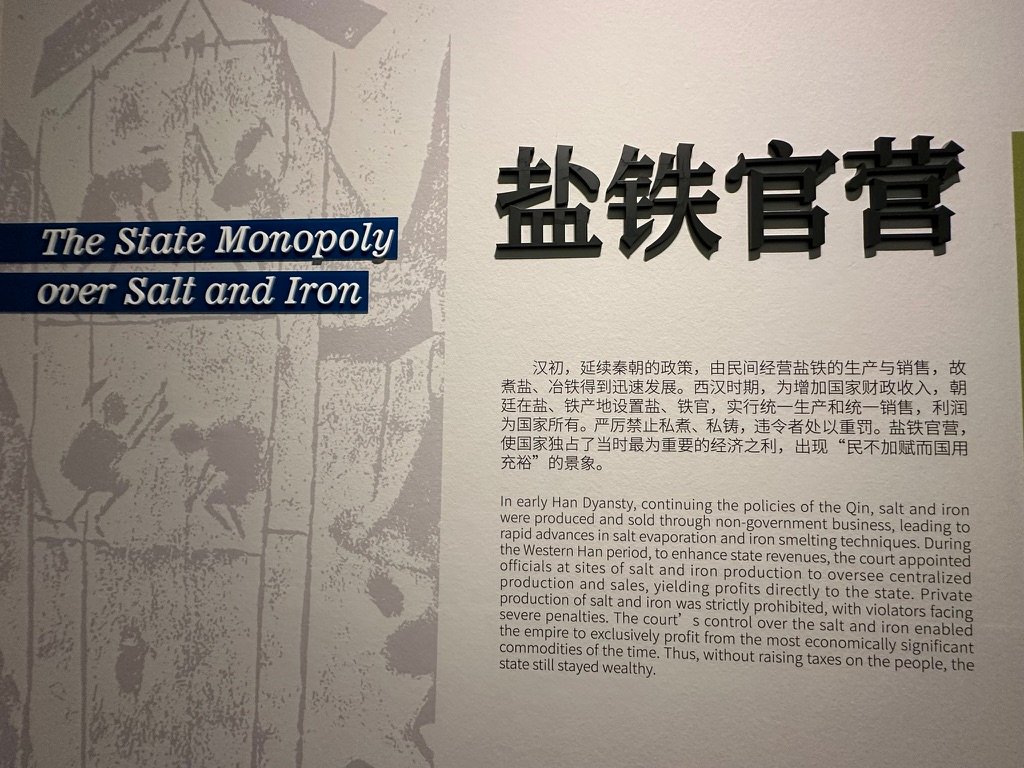
The museum explains that in the early Han period, private businesses continued producing and selling salt and iron, building on earlier Qin policies. Improvements in salt production and iron smelting rapidly increased output.
Later, during the Western Han Dynasty, the imperial court changed course.
Instead of allowing private merchants to dominate these industries, the government established official Salt Offices (盐官) and Iron Offices (铁官) in major production regions. Production and distribution became centrally managed, with profits flowing directly into the imperial treasury.
Private production was prohibited, and severe penalties were imposed on those who broke the law.
🐧 Cheers’ Corner
Cheers looked puzzled.
“Wait… the government sold the salt?”
“And the iron.”
“So… there wasn’t an ancient version of Walmart?”
Dad laughed.
“Not for salt and iron.”
Cheers blinked.
“Imagine getting arrested for opening your own salt shop…”
Funding an Empire Without Raising Taxes
One sentence on the museum panel particularly caught my attention.
It explains that by controlling the salt and iron industries, the Han government accumulated enormous wealth, creating a situation where:
“The people did not bear heavier taxes, yet the state remained prosperous.” (民不加赋而国用充裕)
That is an extraordinary statement.
Rather than relying solely on higher taxes from farmers, the state generated revenue by operating industries that everyone depended upon.
The profits helped finance government administration, infrastructure, defence and other public expenditures.
Whether one agrees with the policy is another matter.
But economically, it represented a sophisticated attempt to balance public revenue with social stability.
A Debate That Still Feels Modern
Standing before this exhibit, I couldn’t help thinking how familiar this discussion sounds today.
Should essential resources be controlled by governments?
Or should they be left entirely to private businesses?
Countries around the world still wrestle with similar questions over electricity, water, railways, oil, healthcare and telecommunications.
The Qin and Han Museum does not tell visitors which answer is correct.
Instead, it reminds us that these debates are far older than we often imagine.
More than two thousand years ago, Chinese rulers were already experimenting with different ways of financing a state, regulating strategic industries and balancing public interests with private enterprise.
Elaine’s Note
“This section surprised me because it didn’t feel ancient at all.”
“It felt like reading today’s news.”
“Governments everywhere still argue about which industries should be publicly controlled and which should be privately owned. I wasn’t expecting a museum about Qin and Han China to make me think about modern economics.”
🐧 Cheers’ Final Thought
Cheers looked at the words “State Monopoly over Salt and Iron.”
“Dad…”
“Yes?”
“So this was basically the government’s biggest business?”
Dad smiled.
“You could say that.”
Cheers nodded.
“Turns out running an empire wasn’t just about conquering kingdoms.”
“It was also about having a really good finance department.”
Governing Hearts as Well as Empires: Why Han Chose Confucianism (尊崇儒术)
By the time I reached this gallery, I noticed something interesting.
The museum was no longer talking about roads, coins or farming tools.
Instead, it turned to something far less visible—but perhaps even more powerful.
Ideas.
After all, laws could govern behaviour.
But what governed people’s values?
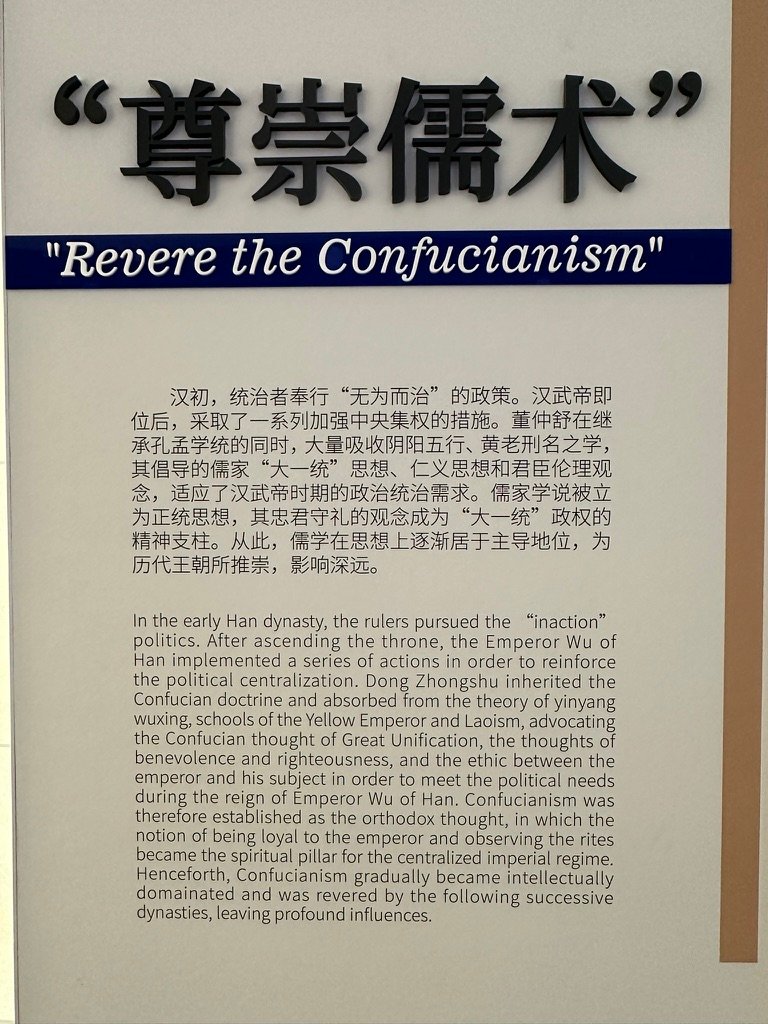
The exhibition explains that the early Han Dynasty (汉朝) initially adopted a relatively hands-off style of government, influenced by Daoist (道家) ideas of wuwei (无为)—literally “non-action,” or more accurately, governing with minimal interference.
That changed dramatically during the reign of Emperor Wu of Han (汉武帝).
As the empire expanded, governing millions of people required more than armies and officials. It also required a shared moral framework.
The museum credits the scholar Dong Zhongshu (董仲舒) with helping provide that framework.
Rather than simply repeating the teachings of Confucius (孔子), Dong combined Confucian ethics with ideas from Yin-Yang (阴阳) philosophy, the Five Elements (五行), and other schools of thought. The result was a political philosophy that emphasised Great Unity (大一统), benevolence (仁), righteousness (义), proper conduct (礼), and clearly defined responsibilities between ruler and subject.
Gradually, Confucianism became the state’s orthodox ideology, influencing Chinese government, education and society for nearly two thousand years.
🐧 Cheers’ Corner
Cheers scratched his head.
“Wait…”
“So the Han didn’t invent Confucianism?”
“No.”
“They… promoted it?”
“Exactly.”
Cheers nodded thoughtfully.
“So Confucius wrote the book…”
“…and Emperor Wu basically made it the official reading list?” 📚😂
Dad laughed.
“That’s actually not a bad way to remember it.”
Education Leaves the Palace
The next gallery continues this story with another fascinating development.
Its title reads:
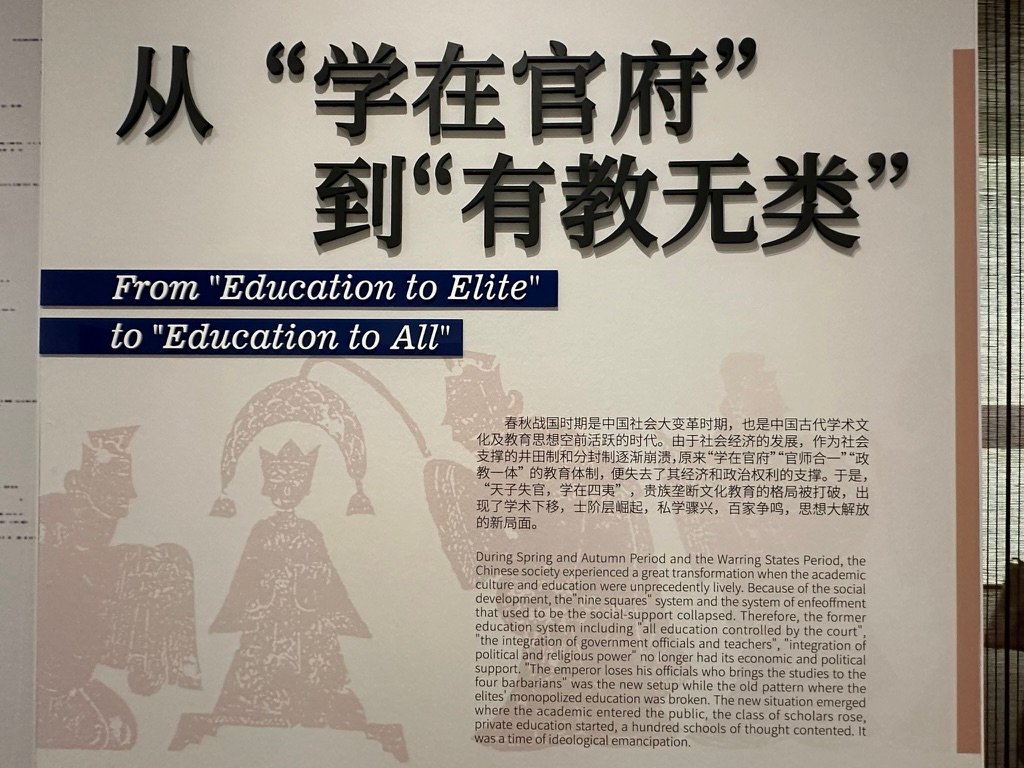
“From ‘Education to Elite’ to ‘Education to All'” (从”学在官府”到”有教无类”)
For centuries, education had largely belonged to aristocratic families and government officials.
Knowledge was a privilege.
But during the Spring and Autumn (春秋) and Warring States (战国) periods, China’s old aristocratic order began to crumble.
As political reforms reshaped society, private academies emerged, scholars travelled from state to state, and ideas competed openly in what later became known as the Hundred Schools of Thought (诸子百家).
Among these thinkers was Confucius, who famously argued:
“In education, there should be no class distinctions.” (有教无类)
It was a remarkably radical idea for its time.
Instead of believing that learning belonged only to nobles, Confucius argued that anyone willing to learn deserved the opportunity.
The museum suggests that this intellectual transformation became one of the greatest legacies of the Qin-Han era. As Confucianism gained official support under the Han, education increasingly became a pathway through which talent—not merely birth—could contribute to government.
The merit-based civil service examinations familiar from later dynasties would come centuries afterward, but the philosophical foundation had already been laid.
🐧 Cheers’ Corner
Cheers looked at Confucius’ famous quote.
“Education for everyone?”
Dad nodded.
“At least in principle.”
Cheers grinned.
“Good.”
“Otherwise Elaine would’ve needed to be born into a noble family before she could keep asking Dad 537 history questions every day.” 😂
Elaine smiled.
“I think I’m already over 537.”
Why This Still Matters
For many Western visitors, Confucianism is often introduced simply as an ancient philosophy.
The Qin and Han Museum presents it differently.
It argues that Confucianism became one of the invisible foundations that helped hold a vast empire together—not through military conquest, but through shared ideas about morality, education, family, and public service.
In other words, after unifying China’s territory, the Han also sought to cultivate something less tangible but perhaps even more enduring:
a common way of thinking about society itself.
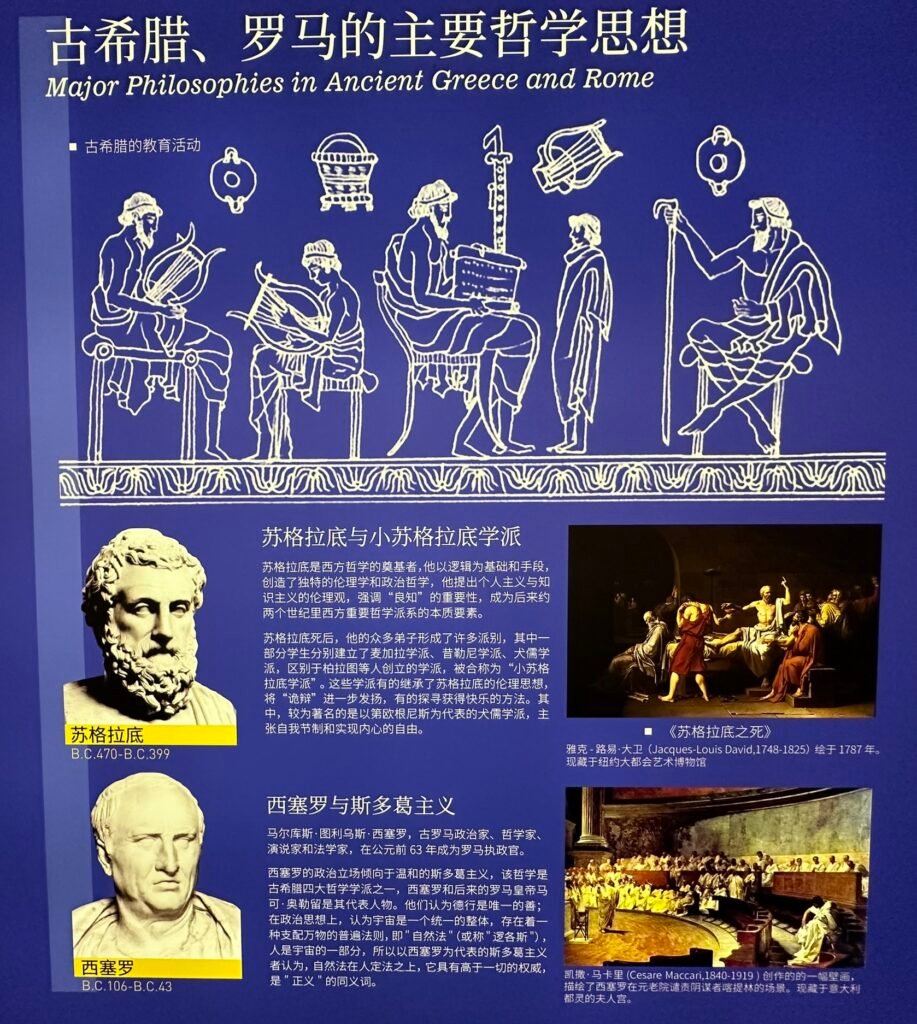
The Axial Age: When Civilisations Began Asking the Same Questions
One of the museum’s most unexpected exhibits has very little to do with Qin or Han.
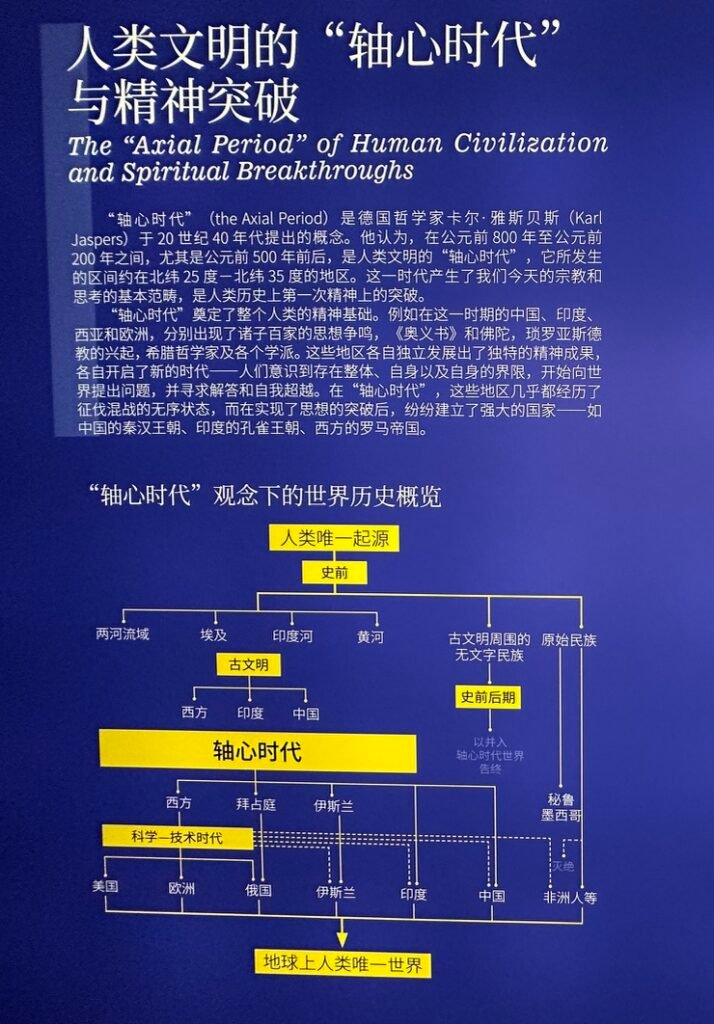
Instead, it introduces a much bigger idea known as the “Axial Age” (轴心时代), a concept proposed by German philosopher Karl Jaspers in the 20th century.
According to Jaspers, roughly between 800 BC and 200 BC—especially around the fifth century BC—several of the world’s great civilisations experienced remarkable intellectual breakthroughs almost simultaneously.
Without communicating with one another, thinkers across Eurasia began asking many of the same fundamental questions.
What makes a good ruler?
How should society be organised?
What is justice?
How should human beings live?
The museum presents this period as humanity’s first great age of philosophical awakening.
While China produced Confucius (孔子), Laozi (老子) and the thinkers of the Hundred Schools of Thought (诸子百家), India witnessed the teachings of the Buddha, Persia saw the rise of Zoroastrianism, and Greece gave birth to philosophers such as Socrates, whose questions would shape Western philosophy for over two millennia.
Rather than viewing Chinese civilisation in isolation, the exhibition places it alongside these parallel developments across Eurasia.
It is an ambitious perspective—and one that many visitors may not expect to encounter in a museum devoted to Qin and Han history.
Ancient China and Ancient Greece Were Asking Different Questions
The museum even compares the major philosophical traditions of Ancient Greece and Rome with those of China.
In Greece, figures such as Socrates encouraged questioning, dialogue and logical inquiry into ethics and knowledge. His student Plato, and later Aristotle, would profoundly shape Western philosophy. In Rome, thinkers such as Cicero further developed Stoicism, emphasising virtue, natural law and civic responsibility.
Meanwhile, China’s philosophers were grappling with a different challenge.
Rather than asking primarily “What is truth?”, many Chinese thinkers asked “How can order be restored after centuries of war?”
Confucius emphasised moral government and proper relationships.
Legalists focused on strong institutions and clear laws.
Daoists sought harmony with nature and minimal interference.
Different answers—but remarkably similar concerns.
🐧 Cheers’ Corner
Cheers stared at the timeline.
“Wait…”
“So Socrates was asking questions in Greece…”
“Confucius was teaching in China…”
“And Buddha was teaching in India…”
“…at roughly the same time?”
Dad nodded.
Cheers blinked.
“Nobody had WhatsApp back then.” 😂
“Yet somehow everyone started asking life’s biggest questions at once.”
Elaine smiled.
“History is weirder than fiction sometimes.”
More Connected Than We Often Imagine
The museum’s message is subtle but powerful.
The Qin and Han period did not emerge in isolation. It belonged to a remarkable era when multiple civilisations were independently laying the intellectual foundations that would influence humanity for thousands of years.
China’s answer centred on unity, governance and social harmony.
Greece’s legacy emphasised reason and philosophical inquiry.
India explored spiritual liberation.
Persia developed enduring ideas about ethics and moral order.
Different paths, yet all sought to answer the same timeless question:
How should human beings live together?
For Western travellers, this final comparison is perhaps the most thought-provoking takeaway of the gallery. Rather than presenting China as an entirely separate civilisation, the museum invites visitors to see it as one participant in a much larger human story—one in which different cultures were wrestling with remarkably similar questions at remarkably similar moments in history.
🐧 Elaine’s Note
Somehow, that made ancient history feel much smaller—and much more connected
I used to think history was like separate school subjects—China over here, Greece over there, Rome somewhere else.
This gallery made me realise they were actually living through the same period, asking many of the same questions, just in different languages and cultures.
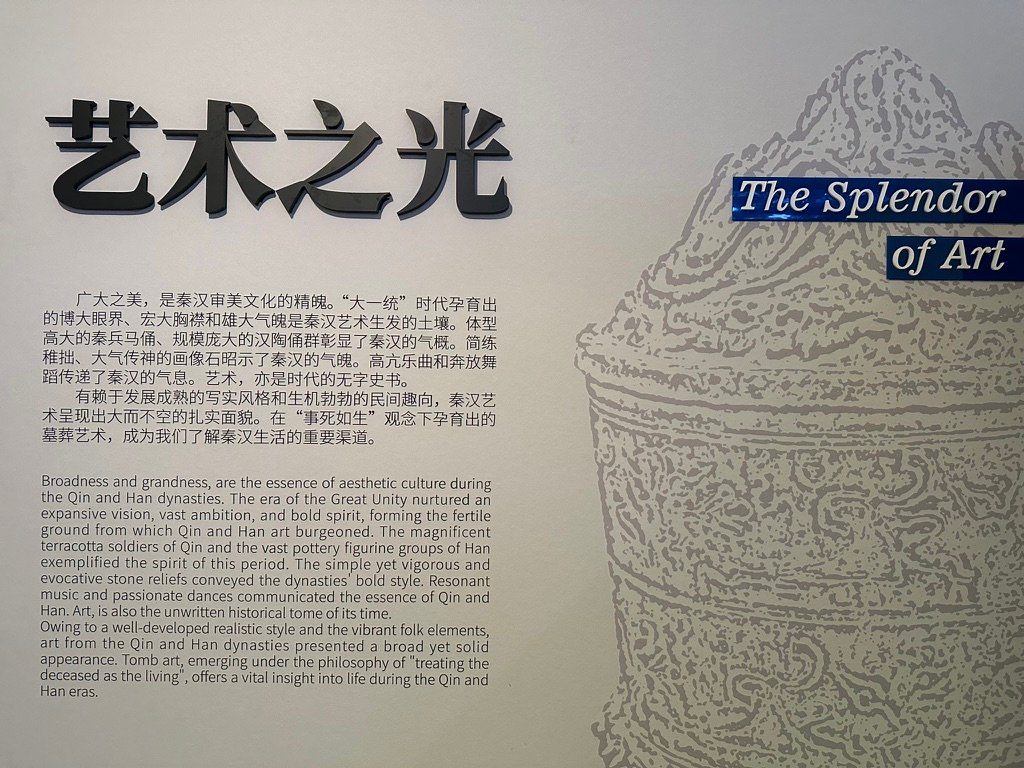
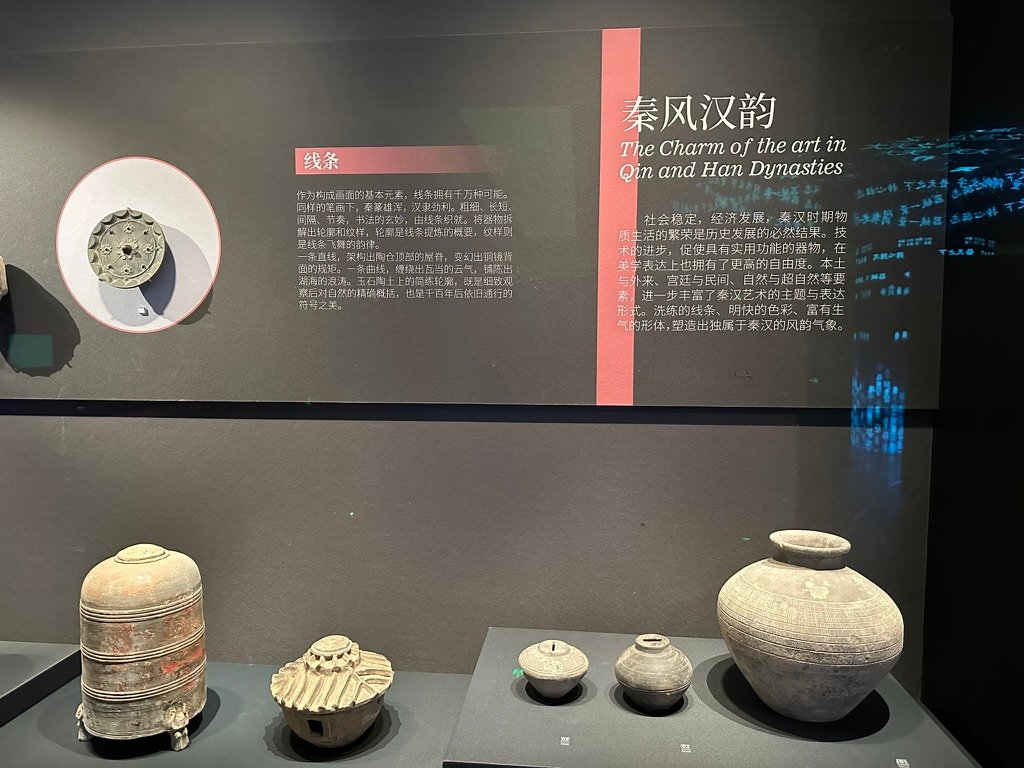
The Splendour of Art: When an Empire Found Its Cultural Confidence (艺术之光)
After galleries filled with laws, agriculture, education and philosophy, it was refreshing to arrive at a section devoted to something different.
Beauty.
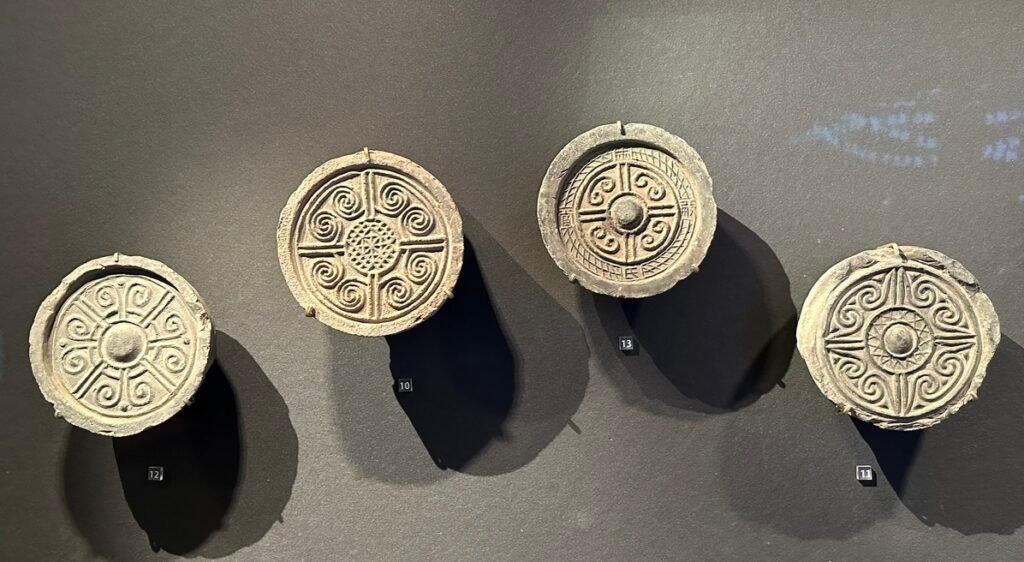
The museum argues that the political stability and prosperity created during the Qin and Han dynasties did more than strengthen government—it also created the conditions for an extraordinary flourishing of art.
Its description repeatedly returns to three words:
breadth, grandeur and confidence.
These qualities can already be recognised in some of China’s most famous cultural treasures.
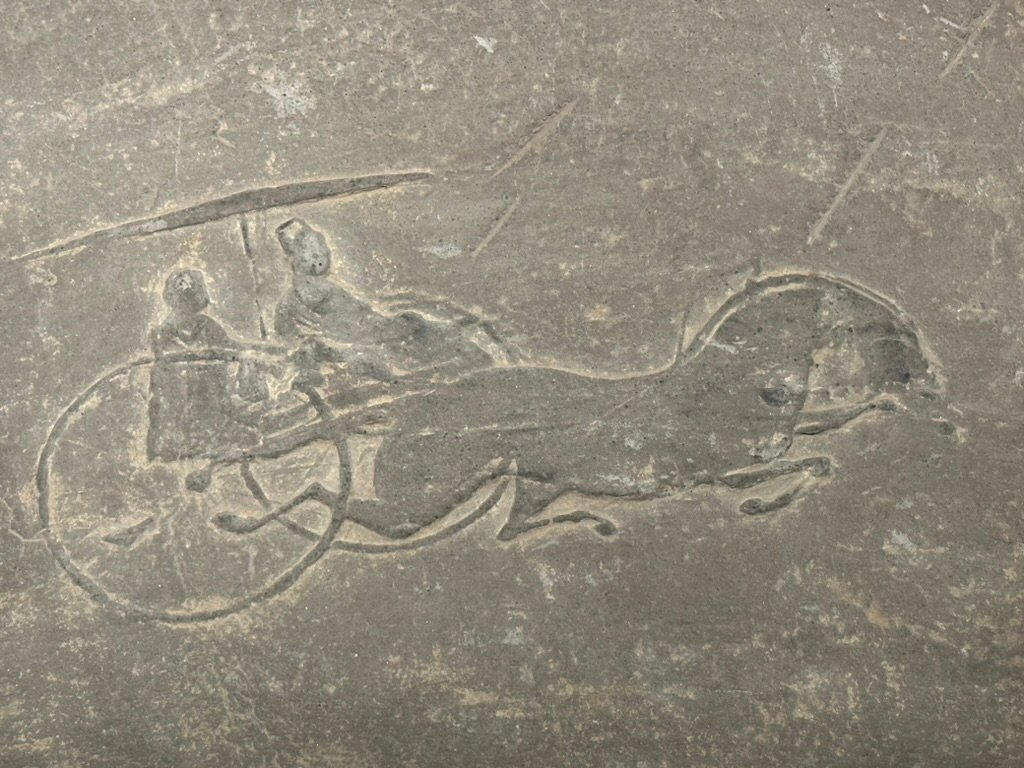
The imposing Terracotta Army (兵马俑), the vast pottery figures of the Han tombs, powerful stone reliefs carved with scenes of daily life, music, dance and ceremonies—all reflected a civilisation that had grown confident enough to express itself on an unprecedented scale.
Unlike the highly stylised bronzes of earlier dynasties, Qin and Han art often feels surprisingly alive. Human figures became more natural, animals more energetic, and everyday life increasingly found its way into artistic expression.
As the museum beautifully puts it,
Art became the unwritten history book of its age.
For historians, these artworks are far more than beautiful objects. They preserve details of clothing, hairstyles, musical instruments, farming, entertainment, military life and religious beliefs that written records often overlook.
Many of the finest surviving works also come from tombs, reflecting the ancient Chinese belief of “treating the deceased as if they were still living” (事死如生). Objects buried with the dead were intended not merely as symbols, but as companions for the afterlife.
Ironically, these burial customs have become one of the greatest windows through which we understand everyday life in Qin and Han China today.
🐧 Cheers’ Corner
Cheers stared at the enormous pottery figures.
“So…”
“People buried miniature houses…”
“Miniature servants…”
“Miniature musicians…”
Dad nodded.
“And sometimes entire armies.”
Cheers paused.
“That’s one very expensive moving service to the afterlife.” 😂
Elaine laughed.
“Lucky for archaeologists they packed so carefully.”
A Different Kind of Greatness
What struck me was that the museum never treats art as something separate from history.
Instead, it presents art as evidence.
The sculptures, carvings and pottery are not simply masterpieces to admire—they are historical documents that reveal how people dressed, celebrated, farmed, travelled and imagined life after death.
For travellers, that changes the way you look at every exhibit.
You are no longer looking at an ancient object.
You are looking at a snapshot of a civilisation nearly two thousand years ago.
East and West, Different Artistic Legacies
One aspect I particularly appreciated was that the museum never treats Chinese civilisation as existing in isolation.
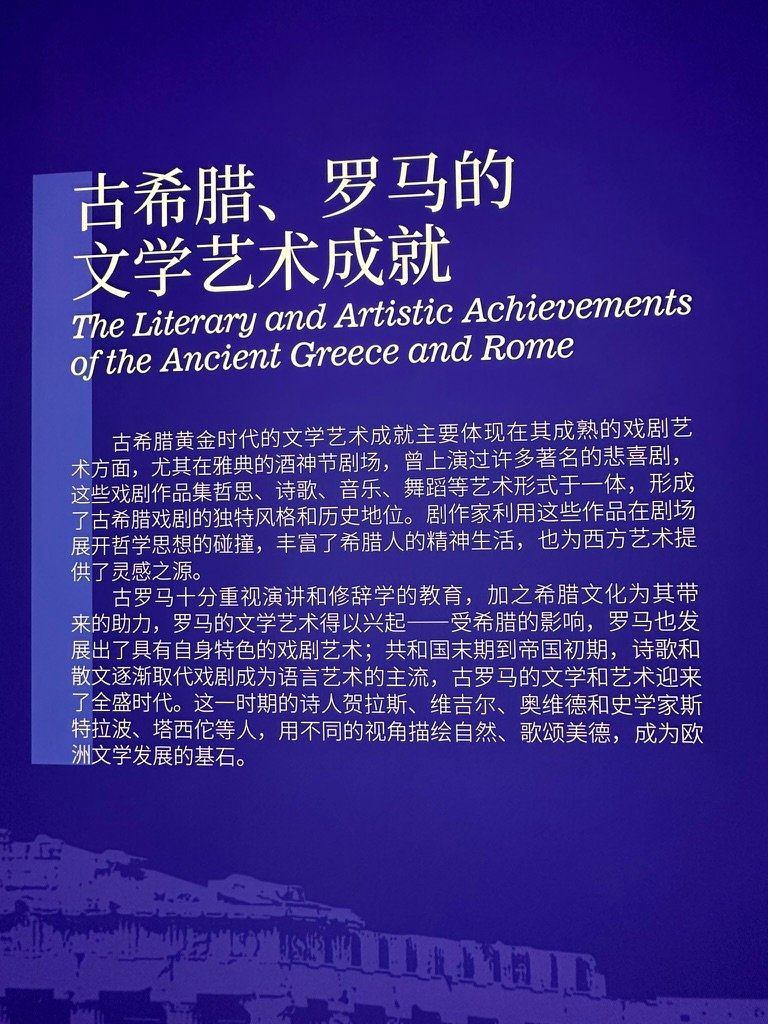
Alongside galleries showcasing Qin and Han achievements, it regularly pauses to introduce developments in other great civilisations. This panel turns our attention westward to Ancient Greece and Rome, whose artistic legacy shaped much of European culture.
The museum highlights the flourishing of Greek drama, where tragedy and comedy were performed in great theatres during religious festivals. These productions blended poetry, music, philosophy and performance into a single art form. Playwrights such as Aeschylus, Sophocles and Euripides explored timeless questions about justice, fate, power and human nature—questions that continue to resonate today.
The Romans inherited much of this Greek tradition while adding their own distinctive voice. As the Republic gave way to the Empire, literature increasingly flourished through epic poetry, speeches and historical writing. Writers such as Virgil, Horace, Ovid, Cicero and the historian Tacitus helped establish literary traditions that would profoundly influence Europe for centuries.
What fascinated me was not that one civilisation was “better” than another, but that they expressed greatness in different ways.
While Greek and Roman civilisation became famous for philosophy, drama and literature, Qin and Han China often expressed its ideals through monumental sculpture, tomb art, music, ritual objects and visual storytelling. One civilisation preserved its spirit in epic poems and theatrical performances; the other left behind terracotta armies, stone reliefs and magnificent burial treasures.
Both sought to answer the same timeless question:
How should a civilisation preserve its memory?
🐧 Cheers’ Corner
Cheers looked from the Greek theatre panel back towards the Terracotta Army.
“So Greece built theatres…”
“China built an underground army…”
Dad laughed.
“They certainly had different ideas of leaving something memorable behind.”
Cheers nodded seriously.
“One gave us Shakespeare’s ancestors…”
“…the other gave us eight thousand life-sized soldiers.” 😂
Two Civilisations, Two Cultural Languages
Walking through this gallery, I realised that the museum was quietly encouraging visitors to appreciate both traditions without forcing them into competition.
Ancient Greece and Rome gave the Western world enduring works of literature, philosophy and theatre.
Qin and Han China produced artistic achievements deeply intertwined with statecraft, ritual, everyday life and beliefs about the afterlife.
Together, they remind us that every great civilisation leaves behind more than monuments.
It leaves behind stories—whether carved in stone, buried in earth, written on bamboo slips, or performed beneath the open sky.
From Ideas to Infrastructure
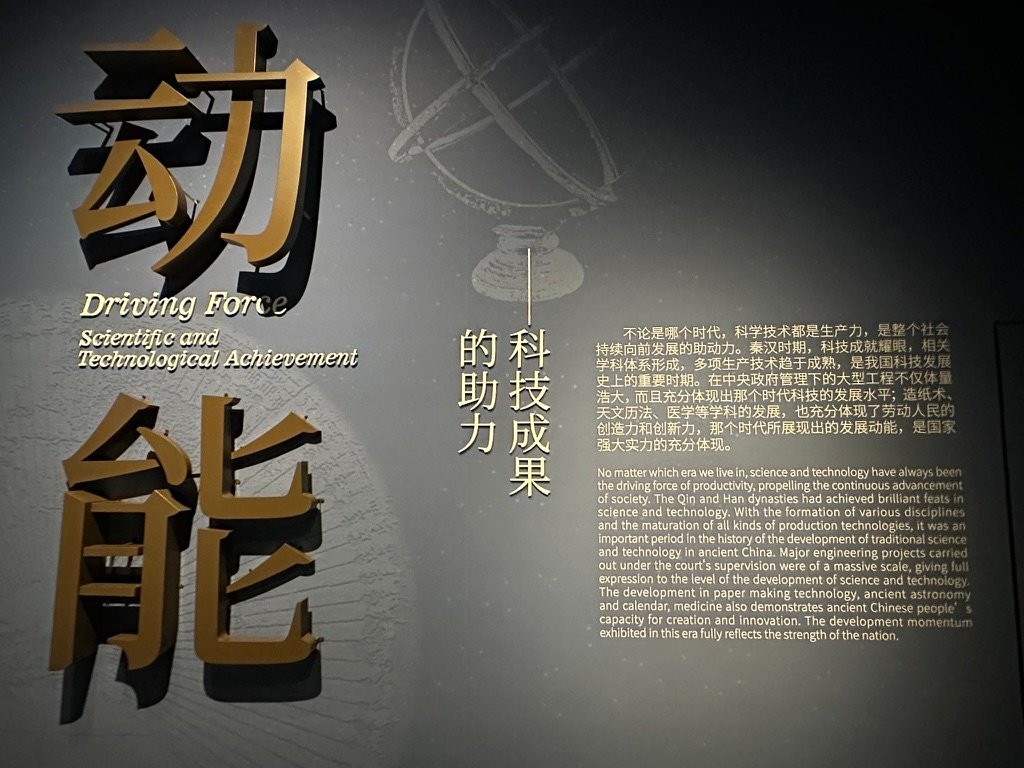
Modern countries often measure their strength through highways, railways, ports and power stations. The Qin and Han dynasties had their own equivalent.
The museum reminds visitors that science and technology were never merely collections of clever inventions. They were practical tools that allowed governments to organise resources, improve productivity and undertake projects on a scale previously unimaginable.
By the Qin and Han period, China had developed increasingly sophisticated knowledge in engineering, astronomy, medicine, metallurgy and manufacturing. Under a unified government, these advances were no longer isolated regional innovations—they could be applied across an entire empire.
As production techniques matured and scientific knowledge accumulated, the state gained something even more valuable than new inventions.
It gained the ability to build.
A Unified Empire Could Finally Think Big
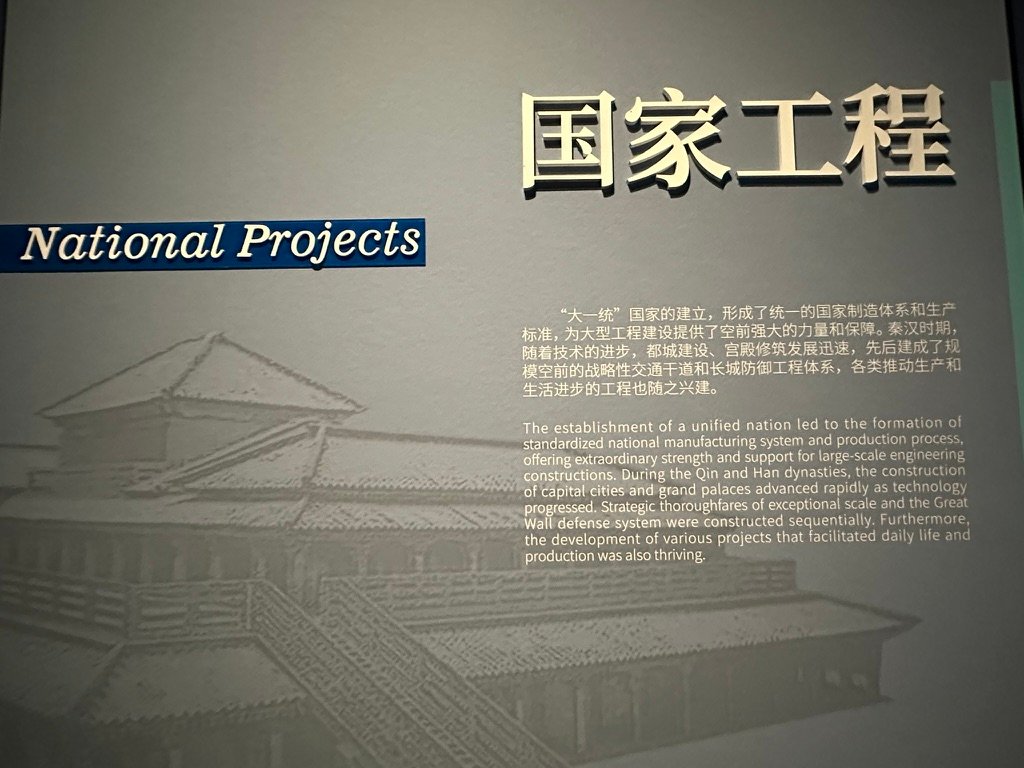
The museum explains that political unification created more than a larger territory.
It created common manufacturing standards, shared technical knowledge and a central administration capable of coordinating enormous projects across vast distances.
During the Qin and Han dynasties, cities expanded, magnificent palace complexes were constructed, roads linked distant commanderies, defensive systems—including the early Great Wall—were strengthened, and countless public works supported both daily life and agricultural production.
These were not isolated construction projects.
They were the physical expression of a unified civilisation.
Without standardised measurements, common laws, reliable taxation, organised labour and efficient transportation, such engineering achievements would have been almost impossible.
Each reform described earlier in this article was like laying another brick in the foundation.
Eventually those foundations became roads, canals, palaces and cities.
Science Was a Tool of Government
One insight I found particularly interesting is that the museum does not present science as something detached from society.
Instead, scientific achievement is shown as closely connected with governance.
Advances in engineering enabled larger public works.
Astronomy improved the calendar, helping farmers know when to plant and harvest.
Medical knowledge became increasingly systematised.
Improved metallurgy produced stronger tools and more durable weapons.
Even papermaking, which would later transform education and administration, had its roots during the Han period.
Science, in other words, was not pursued simply for curiosity.
It strengthened the state, increased agricultural productivity, improved administration and ultimately enhanced the lives of millions of people.
Looking Beyond Monuments
Today, visitors often remember the Qin and Han dynasties for spectacular monuments such as the Terracotta Army or the Great Wall.
But after walking through this gallery, I began to appreciate something less visible.
The real achievement was not simply building impressive structures.
It was creating the political, economic and technological system that made those structures possible in the first place.
An empire’s greatest engineering project is never just stone and timber.
It is the system that allows millions of people to work together toward a common goal.
🐧 Cheers’ Corner
Cheers stared at the enormous construction diagrams.
“So…”
“First they standardised the rulers.”
“Then the roads.”
“Then the farming.”
“Then the money.”
Dad nodded.
“And after all that?”
Cheers looked around the museum.
“They unlocked Empire Builder Mode.“
😂
“Turns out,” Dad laughed, “the Terracotta Army wasn’t built by magic.”
“It was built by organisation.”
Beyond Power: The Qin and Han Search for Harmony
As I reached the end of the exhibition, the focus shifted unexpectedly.
After galleries filled with laws, engineering, education, agriculture, science and state-building, the museum ended not with another technological achievement, but with a philosophy.
Two simple Chinese characters appeared repeatedly:
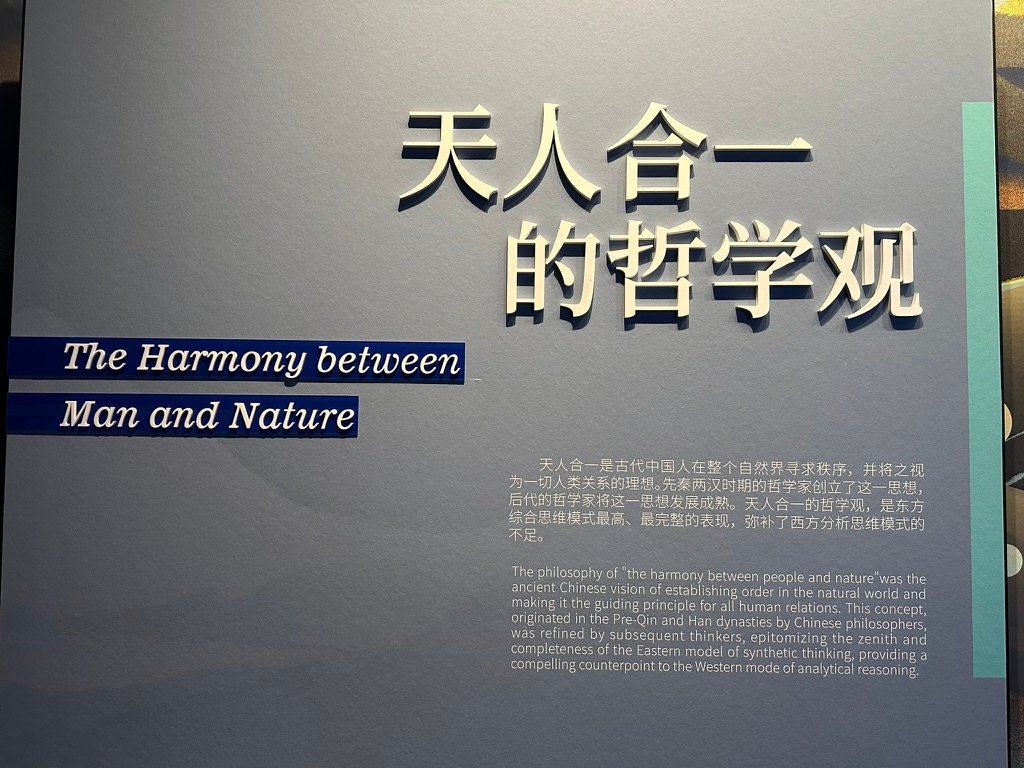
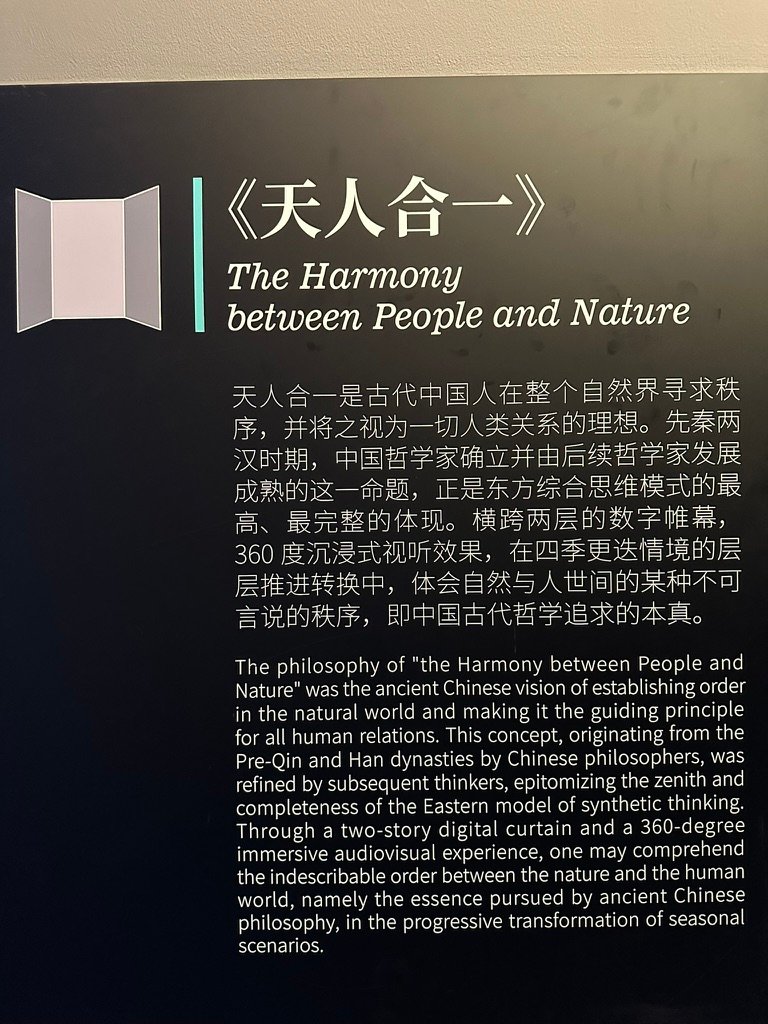
天人合一 (Tiān Rén Hé Yī)
“Harmony between Humanity and Nature.”
At first glance, it seems almost out of place after learning about powerful emperors, massive engineering projects and expanding frontiers.
Yet perhaps this was exactly the point.
The builders of one of history’s greatest empires believed that true order did not come from controlling nature alone, but from understanding humanity’s place within it.
More Than Environmentalism
Modern readers might mistake Harmony between Humanity and Nature as an ancient version of environmental protection.
It is much broader than that.
The idea suggests that human society, political order and the natural world should exist in balance rather than conflict.
Ancient Chinese thinkers observed the rhythms of the seasons, rivers, mountains and stars, believing that good governance should reflect the same natural order.
An emperor who ignored these principles risked creating disorder not only in society but also in the relationship between Heaven, Earth and humanity.
Whether or not one accepts this worldview today, it profoundly shaped Chinese civilisation for more than two thousand years.
A Different Way of Seeing the World
One sentence on the museum panel particularly caught my attention.
It describes Harmony between Humanity and Nature as the highest expression of the Eastern tradition of synthetic thinking, contrasting it with the more analytical approach commonly associated with Western philosophy.
Of course, this is a broad generalisation—both Eastern and Western traditions contain analytical and holistic thinkers.
But the comparison highlights an important difference in emphasis.
Classical Greek philosophy often sought to understand the world by dividing it into categories, defining concepts and using logical argument.
Traditional Chinese philosophy more often asked how seemingly different things relate to one another:
- Heaven and Earth
- Ruler and people
- Humans and nature
- Individual and society
Rather than asking, “How do these things differ?”, Chinese thinkers frequently asked, “How can these things work together?”
Neither approach is inherently better.
Together, they represent two remarkable ways that human civilisation has tried to understand the world.
Why It Still Matters Today
Perhaps this explains why the museum chose this philosophy as its concluding message.
The Qin and Han dynasties were not remembered simply because they conquered territory or built impressive monuments.
They created institutions.
They standardised laws.
They transformed agriculture.
They invested in education.
They encouraged scientific innovation.
But beneath all of these achievements lay a deeper aspiration:
to create a society that was orderly, stable and ultimately in harmony with both people and the natural world.
Whether China always lived up to that ideal is another question.
But the ideal itself has endured for more than two millennia.
🐧 Cheers’ Corner
Cheers looked around the final gallery.
“So after all those chapters…”
“Money.”
“Roads.”
“Farming.”
“Science.”
“Laws.”
“The final lesson is…”
Dad smiled.
“Balance.”
Cheers tilted his head.
“So ancient China spent two thousand years saying…”
“Don’t fight the river.
Learn how the river flows.”
Dad nodded.
“And maybe that’s why so many Chinese gardens don’t try to conquer nature.”
“They’re designed to live with it.“
Cheers stared thoughtfully at the painted mountains on the wall.
“…That’s actually a pretty nice way to end an exhibition.”
Building a Civilisation… and Looking Beyond It
As Elaine and I paused before leaving this section of the museum, we realised something.
The galleries we had just walked through were not really about famous emperors.
They were about how a civilisation learned to organise itself.
Standardised writing.
Common laws.
Reliable measurements.
Improved farming.
Education.
Science.
Art.
Each gallery added another piece to a much larger picture.
Elaine smiled.
“So… Qin and Han didn’t just build an empire.”
“They built the foundations of everyday life.”
I nodded.
“I think that’s exactly what the museum has been trying to tell us.”
Cheers began counting on his little wings.
“One writing system.”
“One currency.”
“One law.”
“Better farming.”
“Schools.”
“Roads.”
Then he looked up.
“So… all these things made China stronger from the inside?”
“Exactly.”
Before anyone could continue, Bing Ma Zai pointed towards the next gallery.
“And once a civilisation becomes strong…”
“…people begin travelling farther.”
“Merchants begin trading.”
“New ideas begin arriving.”
It was a simple observation, but it perfectly connected everything we had just learned.
During the reign of Emperor Wu of Han (汉武帝), while the Han Empire was strengthening its government, economy and culture at home, it was also reaching outward. Envoys travelled west, new trade routes emerged, and contacts with distant civilizations gradually increased.
The story of the Qin and Han was no longer only about building China.
It was also becoming the story of China meeting the wider world.
That is where our journey continues in the next article:
The World Before the Silk Road: How Foreign Cultures Helped Influenced Ancient China