Every day, thousands of travellers land at Xi’an Xianyang International Airport (西安咸阳国际机场).
Almost all of them do exactly the same thing.
They collect their luggage, call a Didi, board the airport metro, or catch the high-speed train, eager to reach the famous sights of Xi’an (西安)—the Terracotta Army (兵马俑), the Ancient City Wall (西安城墙), the Muslim Quarter (回民街), and the Giant Wild Goose Pagoda (大雁塔).
Hardly anyone stops.
Even fewer realise that just a short drive from the airport lies one of the most important yet overlooked places in Chinese civilisation.
This is Xianyang (咸阳).
Most people know Xianyang only as the capital of Qin Shi Huang (秦始皇) and the Qin Dynasty (秦朝). But during our visit, Elaine and I stumbled upon an even greater surprise.
Nearly 800 years before the First Emperor unified China, another story had already begun here.
It was the story of four extraordinary people whose ideas, leadership and vision would shape Chinese civilisation for the next three thousand years:
- 周文王 (King Wen of Zhou) — the visionary.
- 姜子牙 (Jiang Ziya) — the strategist.
- 周武王 (King Wu of Zhou) — the founder.
- 周公 (Duke of Zhou) — the statesman who transformed ideals into lasting institutions.
To our surprise, their mausoleums and memorial sites remain remarkably peaceful. There were no long queues, no crowds of tour groups, and almost no foreign visitors. Instead, we found ourselves walking through places where later emperors—including Kangxi (康熙帝) and Qianlong (乾隆帝)—had travelled to pay their respects centuries after the Zhou Dynasty had ended.
It was one of those rare travel moments that makes you wonder:
How can a place this important remain almost unknown to international travellers?
Looking back, we’re glad we didn’t rush straight into Xi’an.
Spending a few nights in Xianyang first unexpectedly changed the way we understood everything that followed—from the Qin Dynasty and the Terracotta Army to Confucius, the Forbidden City, and even modern China.
Sometimes, the greatest discoveries aren’t found where everyone is looking.
Sometimes, they’re waiting just beyond the airport.
Before We Read the Stone Tablets…
One thing we appreciate whenever travelling around China is that many historical sites provide detailed information boards explaining why the place matters, not just what visitors are looking at.
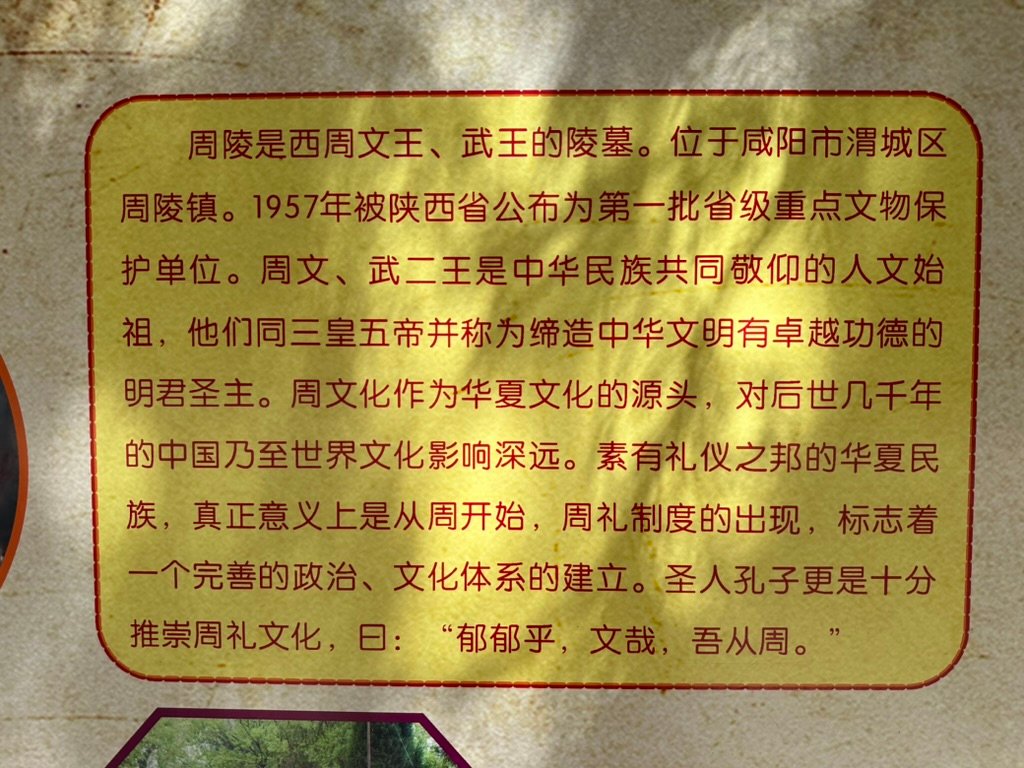
Before Elaine and I began reading the ancient stone tablets, we spent quite some time studying the official displays installed throughout Zhouling (周陵). These information boards explain the historical significance of the mausoleum, the Zhou royal lineage, and why this quiet site has remained a place of state remembrance for over two thousand years.
Several points immediately stood out.
First, Zhouling (周陵) is officially recognised as the burial place of King Wen of Zhou (周文王) and King Wu of Zhou (周武王). The site was designated one of Shaanxi Province’s first protected cultural heritage sites (陕西省第一批省级重点文物保护单位) in 1957.
More importantly, the displays describe King Wen and King Wu as cultural ancestors (人文始祖) jointly revered by the Chinese people. They explain that Zhou culture (周文化) became one of the principal sources of Huaxia civilisation (华夏文化), and that many ideas associated with Chinese civilisation—including the Zhou system of rites (周礼制度), political institutions, and moral governance—began here.
One sentence particularly caught our attention:
郁郁乎,文哉,吾从周。
“How splendid is the culture of Zhou. I follow Zhou.” — Confucius (孔子)
For readers who have visited Qufu (曲阜), Confucius’ hometown, this quotation may already sound familiar. It reminds us that even Confucius, who lived several centuries after the Western Zhou, regarded Zhou civilisation as the model worthy of admiration and preservation.
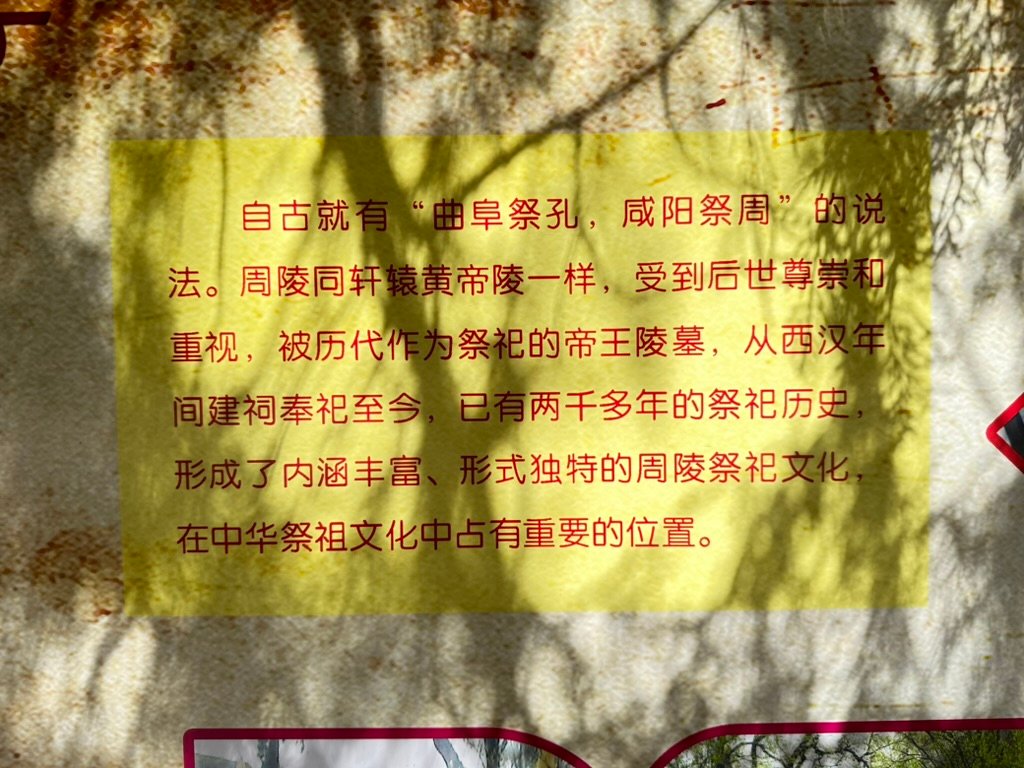
Another panel reveals something equally fascinating. Since the Western Han Dynasty (西汉), emperors have continued coming here to perform state sacrifices. The tradition has lasted for more than two thousand years, giving rise to the saying:
曲阜祭孔,咸阳祭周。
“In Qufu, people honour Confucius; in Xianyang, they honour Zhou.”
Only after understanding this background did the two stone tablets begin to make sense. They were not simply carved names on stone. They formed the opening chapter of one of China’s greatest civilisational stories—a story that begins long before the Qin Empire, and nearly 800 years before Qin Shi Huang (秦始皇) unified China.
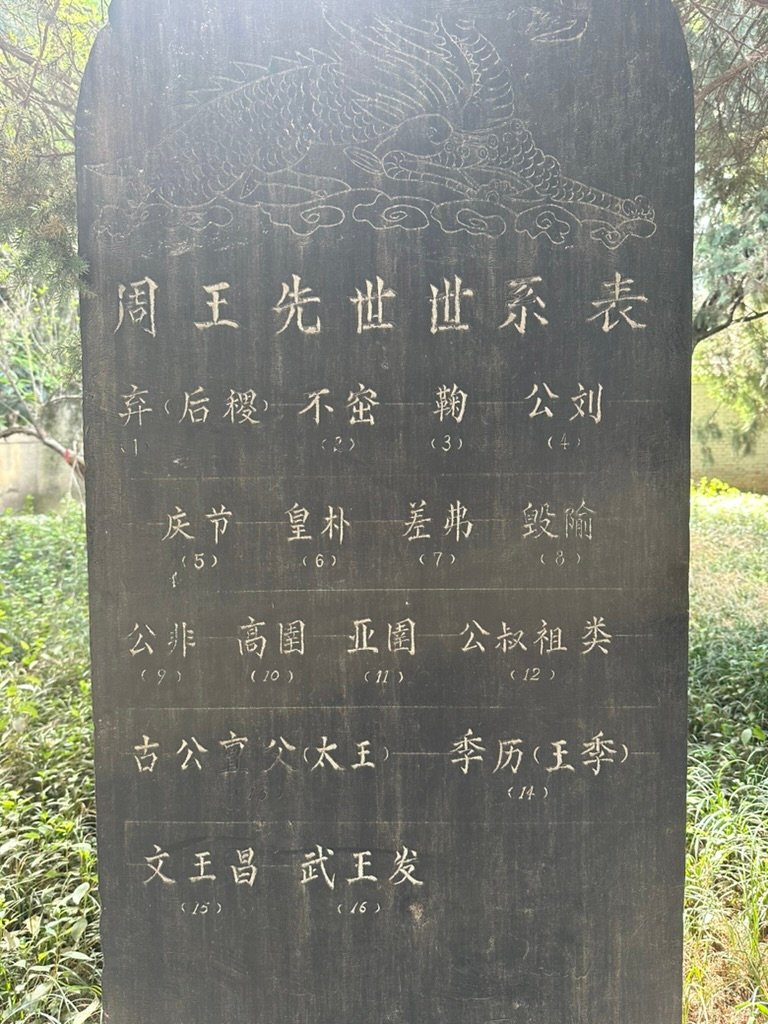
The 1st monument is titled “Genealogy of the Ancestors of the Zhou Kings” (周王先世世系表). Rather than listing emperors, it traces the family line of the Zhou people long before they became kings. It begins with the legendary Hou Ji (后稷), revered as the ancestor of the Zhou people and closely associated with agriculture, before continuing through generations of tribal leaders such as Gong Liu (公刘) and Gugong Danfu (古公亶父), eventually arriving at King Wen (周文王)and King Wu (周武王).
Standing in front of this monument, I realised something I had never appreciated before.
The Zhou Dynasty wasn’t founded overnight.
Long before they overthrew the Shang Dynasty, the Zhou people had already spent generations building their society, strengthening their leadership and developing a culture that would later influence China for thousands of years.
The second monument continues where the first one ends.
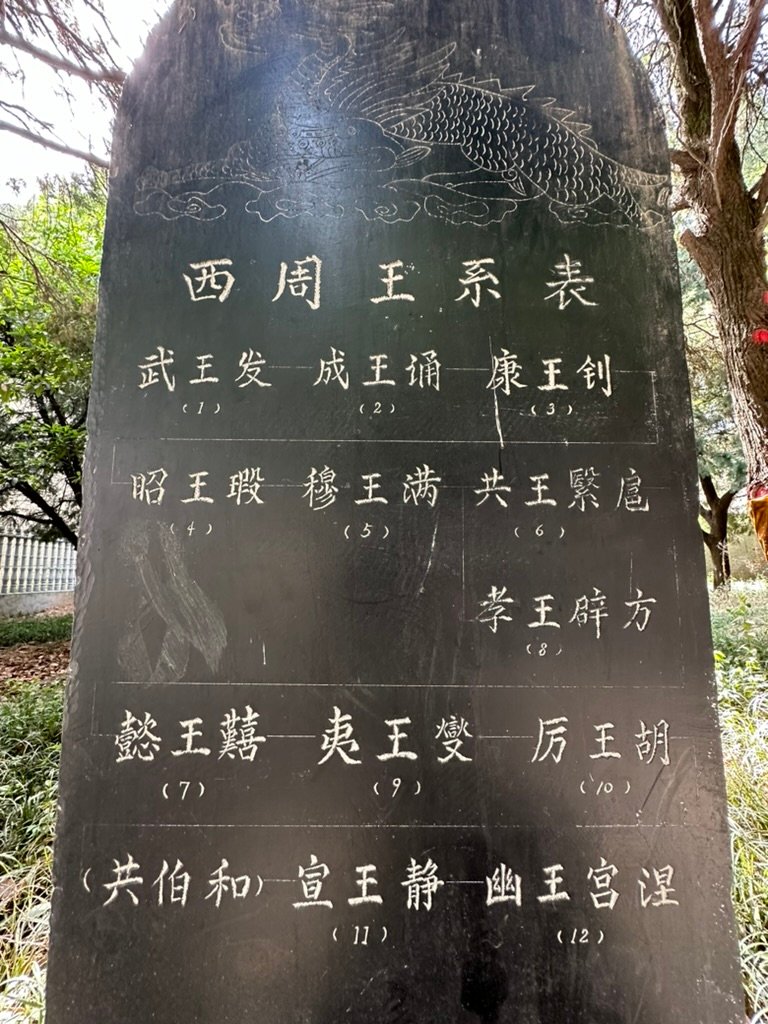
Titled “Genealogy of the Western Zhou Kings” (西周王系表), it begins with King Wu, the founder of the Western Zhou Dynasty, followed by successive rulers including King Cheng, King Kang, King Mu, and eventually King You (周幽王).
King You’s reign ended in 771 BC when the Zhou capital fell, marking the collapse of the Western Zhou. The royal court later moved east to Luoyang, beginning the Eastern Zhou period.
For many Western travellers, the first name that comes to mind when thinking about Xi’an is Qin Shi Huang and his Terracotta Warriors.
Yet standing among these monuments offers a different perspective.
The Qin certainly built China’s first unified empire, but many of the ideas that defined Chinese civilisation—rituals (礼), political order, ancestor worship, governance and moral leadership—had already taken root centuries earlier during the Zhou.
In many ways, the Qin unified China politically.
The Zhou helped shape China culturally.
That is why these weathered stone monuments matter. They quietly remind us that China’s story did not begin with the First Emperor. Long before the Terracotta Warriors were buried beneath the earth, another civilisation had already been growing here for generations.
Sometimes, the most important history isn’t the attraction everyone comes to see.
It’s the one almost everyone walks past.
📚 Bing Ma Zai’s History Break
“Everyone remembers the First Emperor. But before you understand Qin, you should first meet the people who built the civilisation Qin inherited.
China wasn’t created in one dynasty. Every dynasty stood on the shoulders of the one before it.”
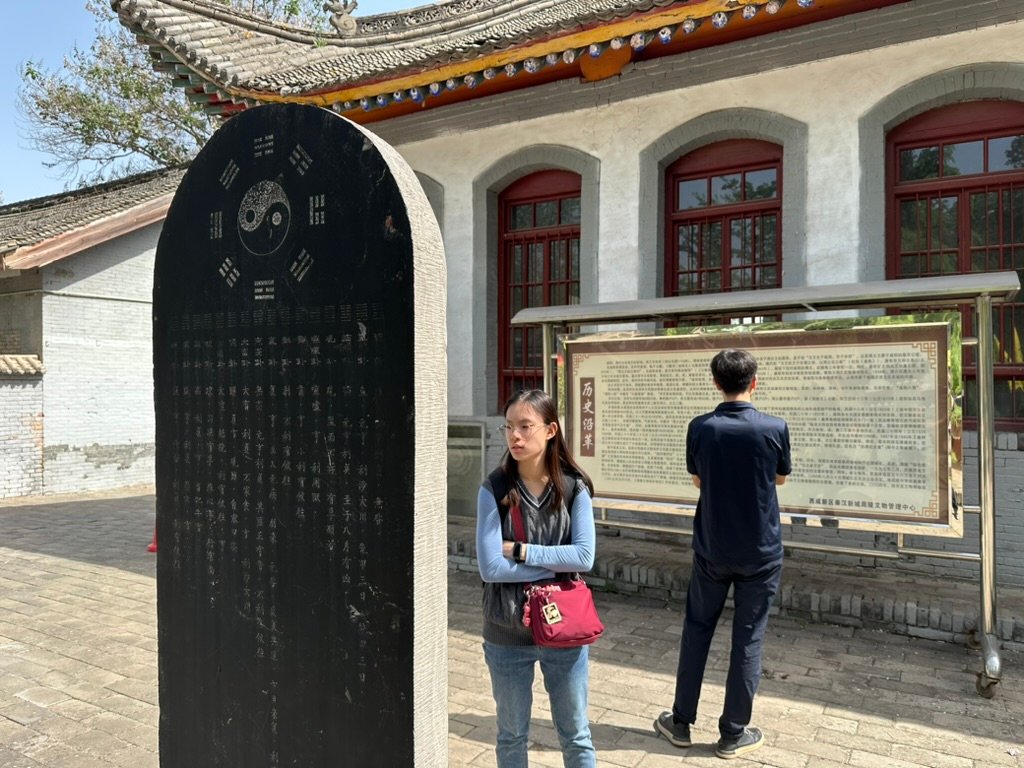
Reading Before Walking
One thing I’ve learnt over the years is that ancient China rewards curious travellers.
At places like the Zhou Mausoleums, it can be tempting to walk straight to the ancient tombs and monuments. But taking just a few minutes to read the information boards first completely changes the experience.
That was exactly what we did.
While I was studying the history and translating some of the Chinese text, Elaine patiently waited nearby. Around us, several Chinese visitors were doing the same thing—reading, discussing and trying to piece together a story that stretches back more than 3,000 years.
Only after understanding who these kings were did the stone monuments suddenly come alive.
History became more than names and dates.
It became the beginning of a civilisation.
When Ming Emperor Came Back to Pay Respect 2000 years later
A Stone That Has Been Waiting More Than 650 Years
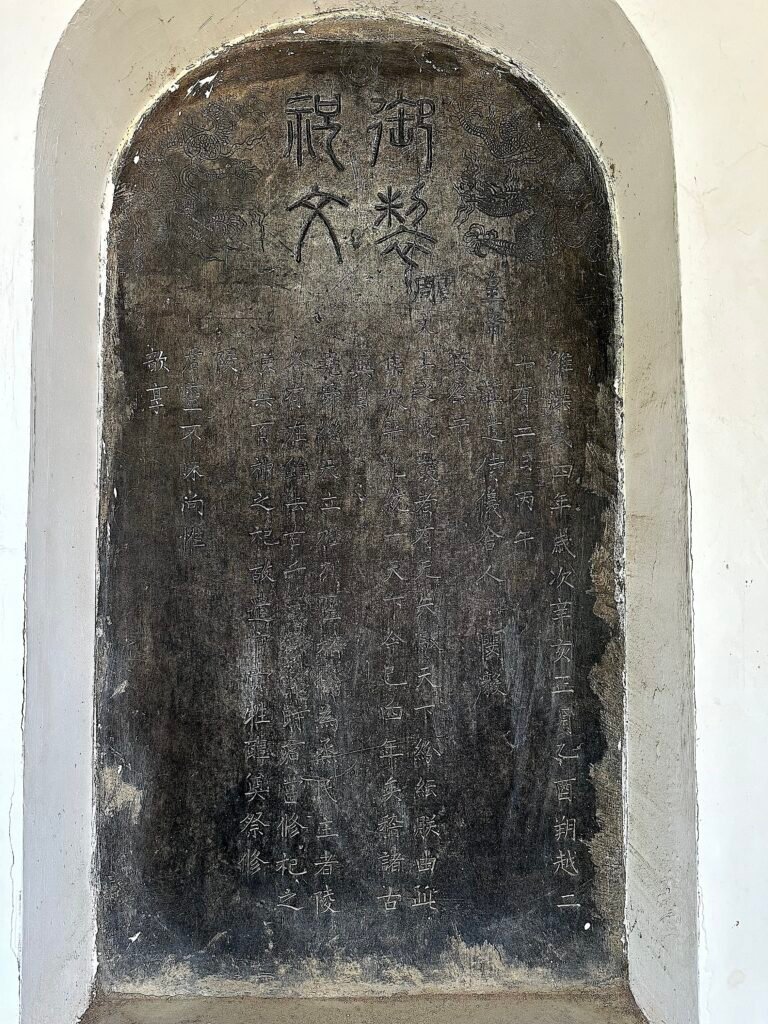
As we wandered around the quiet grounds of Zhou Wen Wang Ling (周文王陵), one weathered stone tablet immediately caught Elaine’s attention.
Unlike many ancient steles that have become too worn to read, this one was still remarkably legible.
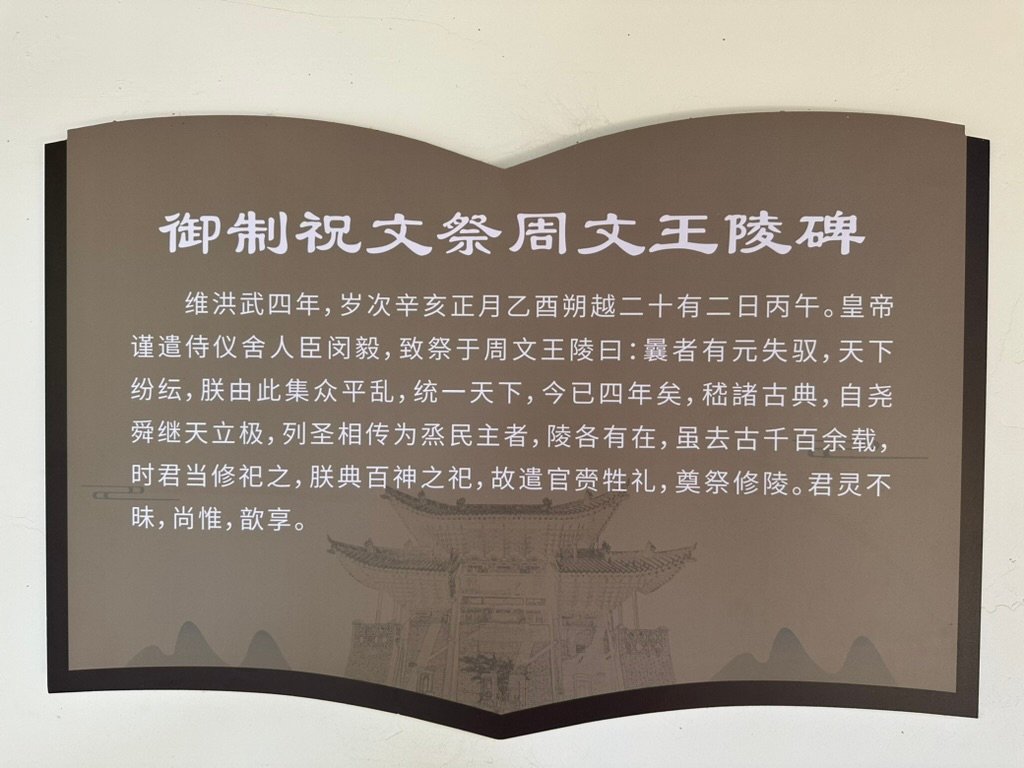
Beside it, a modern information board explained exactly what we were looking at.
It wasn’t simply another stone inscription.
It was a surviving record of an imperial ceremony.
“Wait… this isn’t about the Zhou Dynasty.”
Cheers tilted his head.
Cheers: “Hang on… wasn’t King Wen of Zhou living almost 3,000 years ago? Why is this stone talking about the Ming Dynasty?”
Bing Ma Zai smiled.
Bing Ma Zai: “Because later emperors never forgot him.”
The modern sign explains that this inscription is titled:
御制祝文祭周文王陵碑
“Imperially Commissioned Prayer for Sacrifices at the Tomb of King Wen of Zhou.”
The tablet records an event that took place during the 4th year of the Hongwu Emperor (洪武四年) — 1371 AD, only a few years after the founding of the Ming Dynasty.
The inscription begins:
“维洪武四年,岁次辛亥,正月乙酉朔越二十有二日丙午……”
In modern English, this means:
“In the fourth year of the Hongwu reign (1371 AD), on the twenty-second day of the first lunar month…”
It then records that the Hongwu Emperor sent his minister Min Yi (闵毅) to perform official state sacrifices at the tomb of King Wen of Zhou.
A Message From One Emperor to Another — Across Two Millennia
The inscription goes far beyond recording a ceremony.
It explains why the Ming emperor believed this tribute mattered.
Paraphrased into modern English, the emperor says:
When the ancient world fell into disorder, King Wen gathered the people, restored order and laid the foundations for good government. Thousands of years have passed, but the tomb remains. As the ruler of today, it is my responsibility to continue honouring these great sages, repair their resting place, and respectfully offer sacrifices.
In other words…
This wasn’t simply a political ritual.
The Ming emperor saw himself as continuing a civilisation that had begun thousands of years before his own reign.
Cheers Gets Curious…
Cheers: “Wait… so even after the Qin, Han, Tang, Song and Yuan Dynasties came and went… they were stillcoming here?”
Bing Ma Zai nodded.
Bing Ma Zai: “Exactly.”
“Dynasties changed.”
“Capitals moved.”
“Emperors came and went.”
“But King Wen remained someone worth remembering.”
Dad Connects the Dots
Standing in front of that stone, I suddenly realised something.
Western history often remembers each kingdom or empire as a separate chapter.
China certainly had many dynasties too.
Yet there is also a remarkable sense of continuity.
New rulers rarely believed history began with themselves.
Instead, they looked backwards, honouring earlier sages and rulers whom they regarded as founders of Chinese civilisation.
This stone is proof.
Not legend.
Not folklore.
A government inscription, carved more than 650 years ago, recording an official state ceremony honouring a king who had lived more than 2,000 years before.
That continuity helps explain why the Zhou kings are still remembered today—not just in history books, but in places where people continue to visit, study and pay their respects.
As we left the tablet behind, Bing Ma Zai quietly looked back one last time.
Bing Ma Zai: “Civilisations don’t survive simply because they’re old.”
“They survive because each generation chooses to remember the one before.”
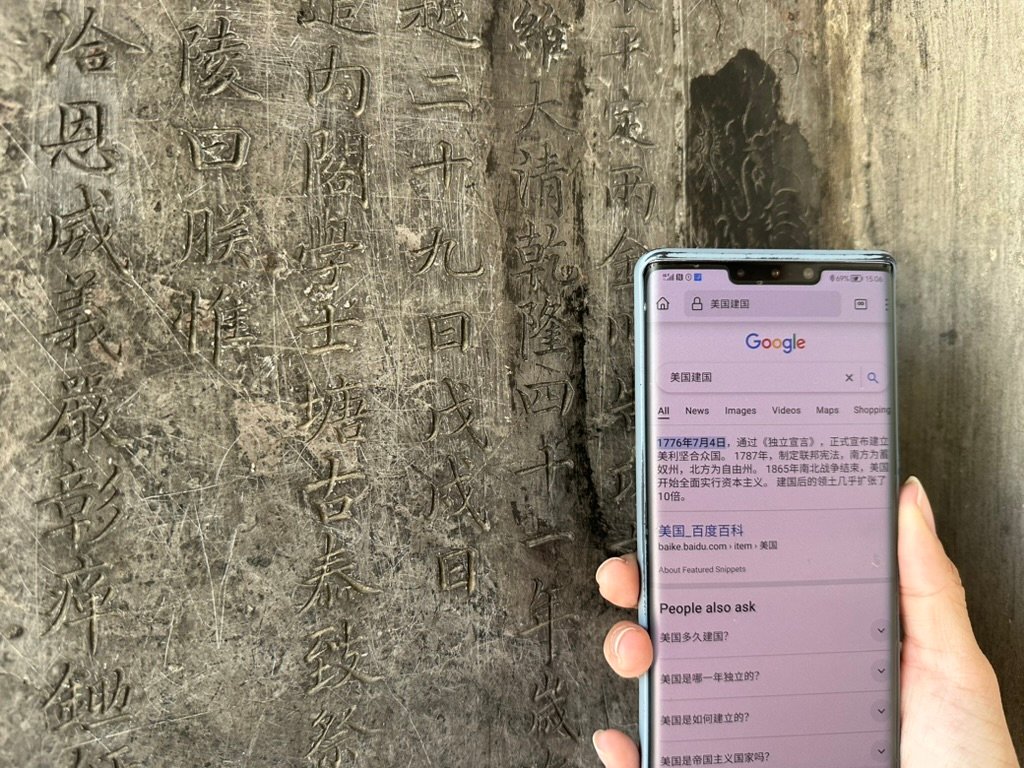
When the United States Was Just Born, China Was Still Honouring a King Who Lived Nearly 3,000 Years Earlier
This photograph almost never happened.
It was Elaine who noticed something unusual.
After reading the opening lines carved into the stone, she suddenly said,
“Dad… this says Qianlong 52 (乾隆五十二年).”
We quickly converted the imperial reign year.
1787 AD.
Then I asked her,
“Now search when the United States was founded.”
She typed just three Chinese characters:
美国建国
Google’s answer appeared immediately:
1776.
Without saying another word, I held her phone beside the inscription and took this photograph.
Cheers Blinked…
Cheers: “Wait… so America had only been independent for about ten years…”
Bing Ma Zai nodded.
Bing Ma Zai: “Yes.”
“And at exactly the same time…”
“…the Qing Emperor was still officially sending imperial officials here to honour King Wen of Zhou (周文王).”
The opening lines of the inscription read:
维大清乾隆五十二年岁次丁未……
In modern English:
“In the 52nd year of the Qianlong Emperor of the Great Qing Dynasty (1787 AD)…”
The inscription records another official imperial ceremony held at the tomb of King Wen.
That means almost 2,700 years after King Wen lived, China’s imperial government was still preserving this place, conducting state rituals, and recording them in stone.
Cheers Had One More Question…
Cheers: “Why keep coming back after so many centuries?”
Bing Ma Zai smiled.
Bing Ma Zai: “Because remembering is part of Chinese civilisation.”
“Dynasties changed.”
“Capitals moved.”
“Emperors came and went.”
“But they believed civilisation didn’t begin with themselves.”
Standing there, I realised this photograph isn’t really about comparing China and America.
It’s about seeing two completely different historical timelines in a single frame.
One civilisation was welcoming a brand-new nation into world history.
The other was still honouring a king who had lived nearly three thousand years earlier.
That’s the kind of perspective no textbook can give you.
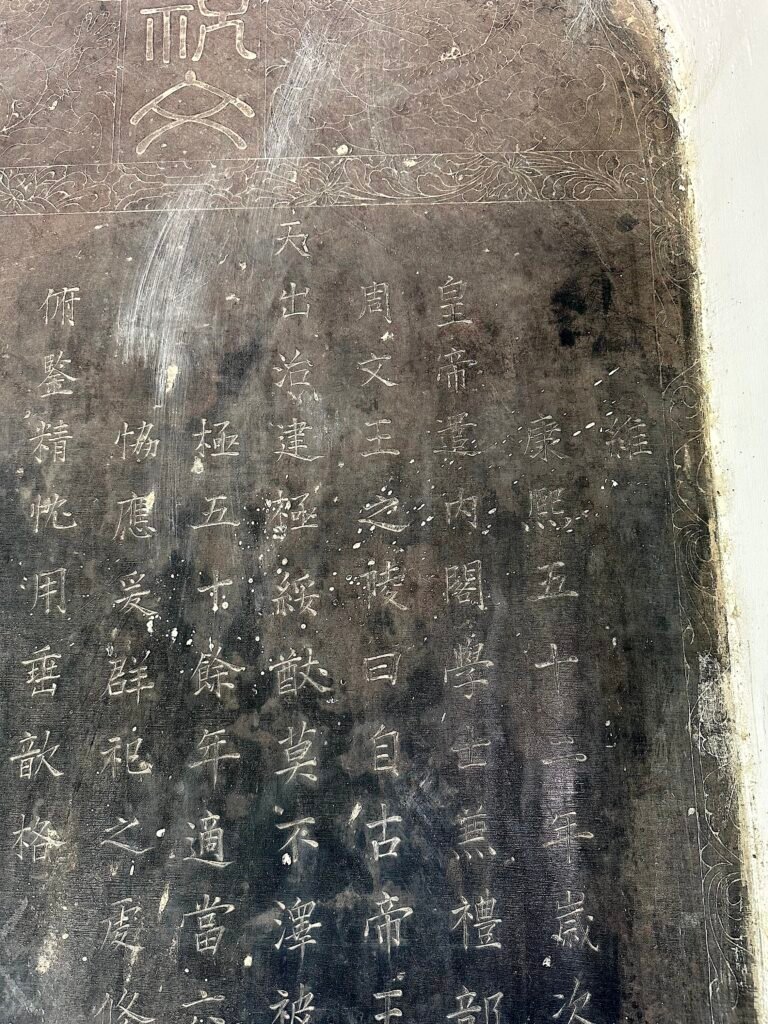
Elaine Suddenly Connected Beijing and Xianyang
As Elaine carefully read another weathered stone tablet, she looked up and smiled.
“Dad… this one isn’t from Qianlong.”
She pointed to the opening words carved into the stone.
Although parts of the inscription have become worn after centuries of exposure, the beginning can still be read:
维康熙五十二年岁次癸巳……
“In the 52nd year of the Kangxi Emperor…”
That places this imperial ceremony in 1713 AD.
Immediately, something clicked.
“Wait… I know Kangxi!”
Elaine laughed.
“We kept hearing about Kangxi and Qianlong in Beijing!”
Exactly.
If you’ve visited the Forbidden City (故宫) in Beijing, chances are you’ve already encountered these two famous Qing emperors.
Kangxi (康熙帝) ruled for an extraordinary 61 years, making him the longest-reigning emperor in Chinese history.
His grandson, Qianlong (乾隆帝), later became one of China’s most famous emperors, ruling for another six decades and overseeing the Qing Empire at its height.
For many visitors, Kangxi and Qianlong are simply names associated with Beijing’s imperial palaces.
But standing here in Xianyang, those same emperors suddenly felt much closer.
Cheers Was Curious…
Cheers: “Hold on… why would the emperors from Beijing travel all the way here?”
Bing Ma Zai smiled.
Bing Ma Zai: “Because this wasn’t just another tomb.”
“To them, King Wen of Zhou (周文王) was one of the founding figures of Chinese civilisation.”
The inscription records that during Kangxi’s reign, an imperial official came here to perform state sacrifices on behalf of the emperor.
Several decades later, another surviving inscription records that Qianlong continued exactly the same tradition.
Think about that for a moment.
A grandfather.
Then his grandson.
Two of China’s greatest emperors.
Separated by decades, yet both continued paying official tribute to a king who had lived almost three millennia earlier.
Dad’s Reflection
That was the moment I realised this wasn’t really a story about the Qing Dynasty.
Nor was it only about the Zhou Dynasty.
It was a story about continuity.
Standing in Beijing, we learnt about the emperors who ruled China.
Standing in Xianyang, we discovered who those emperors themselves looked back to with respect.
History suddenly became a chain.
King Wen of Zhou.
↓
More than 2,000 years later, Emperor Kangxi.
↓
Then his grandson, Emperor Qianlong.
↓
And today…
A father and daughter from Southeast Asia, reading the very same inscriptions.
Some journeys don’t just take you across places.
They take you across thousands of years.
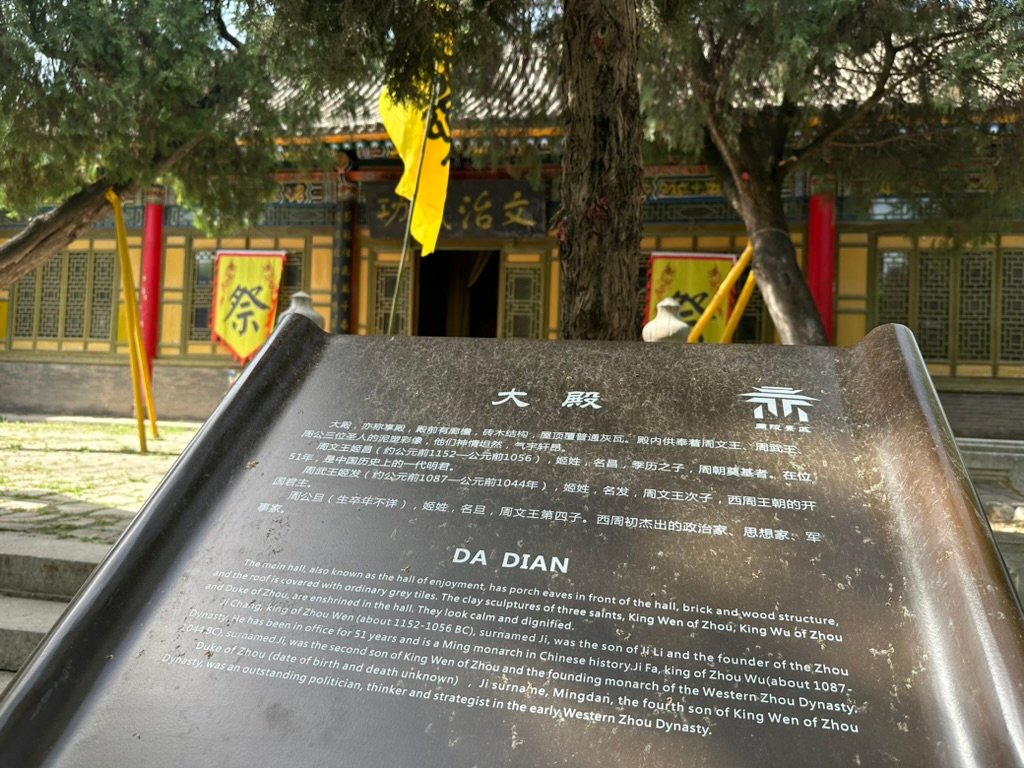
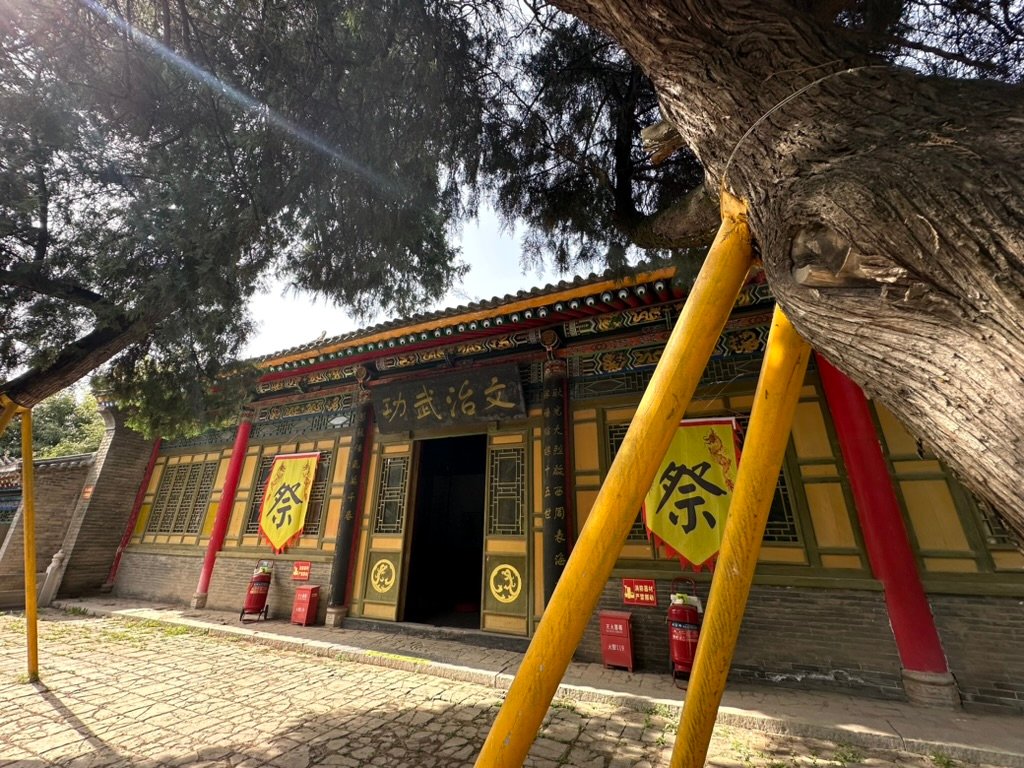
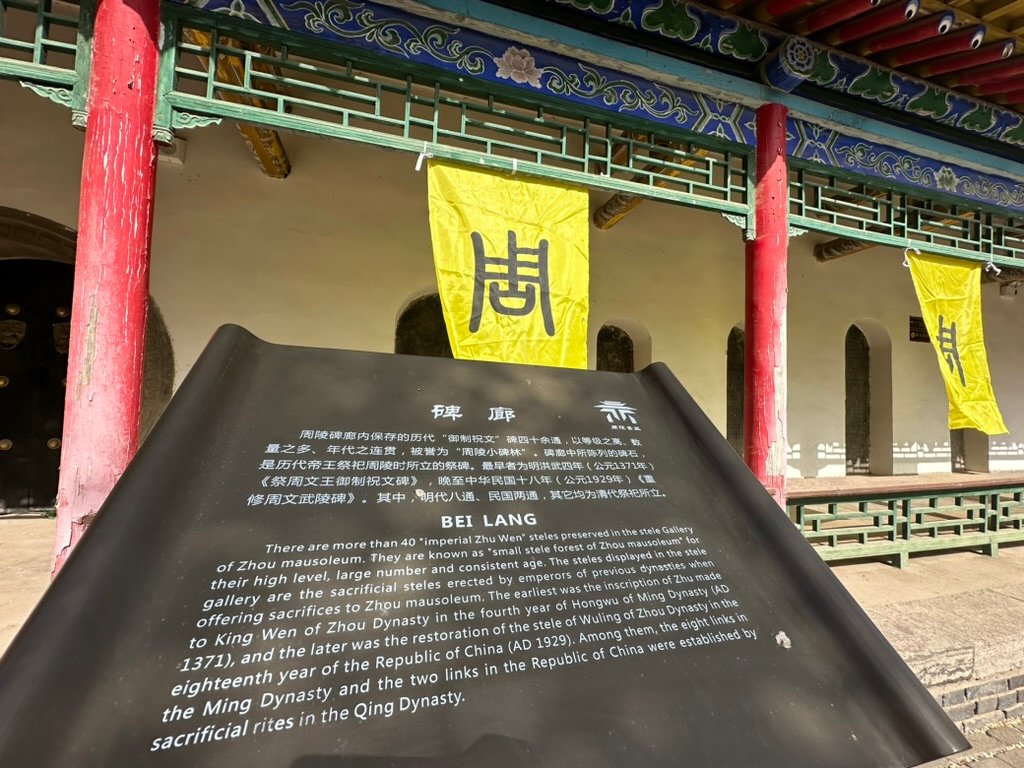
The Hall Where Nearly Every Dynasty Came Back
As we walked into the Da Dian (大殿), the Main Hall of the Zhou Wen Wang Mausoleum (周文王陵), Cheers suddenly stopped.
🐞 Cheers: “Wait… are these just statues of King Wen of Zhou (周文王) and King Wu of Zhou (周武王)?”
Bingmazai smiled.
🏺 Bingmazai: “Not quite. The statues are important… but they’re not the real treasure.”
He pointed towards a long gallery of ancient stone tablets.
At first glance, they all looked similar.
Until Elaine started reading them.
📖 Elaine’s History Corner
One by one, Elaine recognised the reign titles (年号) carved into the stones.
“This one says Hongwu (洪武)…”
“Here’s Kangxi (康熙)…”
“And this one is Qianlong (乾隆)!”
Suddenly, these weren’t just old tablets anymore.
They were Imperial Sacrificial Steles (御制祝文碑)—official stone inscriptions commissioned by successive Chinese emperors after they came here to pay tribute to King Wen (周文王) and King Wu (周武王), the founding rulers of the Western Zhou Dynasty (西周).
According to the information board, more than 40 Imperial Sacrificial Steles (御制祝文碑) have been preserved inside the Stele Gallery (碑廊) of the mausoleum.
Because of their number and historical value, the collection has earned the nickname:
“The Little Forest of Steles of Zhou Mausoleum” (周陵小碑林).
The earliest surviving inscription dates to the Hongwu Emperor (洪武帝) of the Ming Dynasty (明朝) in 1371 AD.
Many more were added during the Qing Dynasty (清朝), including by two of China’s most famous emperors—Emperor Kangxi (康熙帝) and his grandson Emperor Qianlong (乾隆帝).
Each tablet records an imperial visit.
Each represents another emperor making the journey to honour rulers who had lived almost three thousand years earlier.
🐞 Cheers: “Hold on… different emperors? Different dynasties? They all came back here?”
🏺 Bingmazai: “Exactly.”
“The Zhou Dynasty (周朝) had long disappeared, but later emperors believed that Chinese civilisation truly began flourishing under the values established by King Wen (周文王) and King Wu (周武王).”
“Coming here wasn’t simply paying respect to two ancient kings.”
“It was paying respect to the foundations of Chinese civilisation itself.”
Standing inside the Da Dian (大殿), I realised this wasn’t simply another temple.
It was a place where history was continuously renewed.
Generation after generation.
Dynasty after dynasty.
The Han (汉朝), Tang (唐朝), Ming (明朝) and Qing (清朝) all rose and fell.
Governments changed.
Capitals moved.
Yet the memory of the Zhou founders endured.
Perhaps that is one of the quiet reasons why Chinese civilisation has remained remarkably continuous for over three millennia.
China doesn’t only preserve ancient buildings.
It preserves memory (记忆).
And when memory is carved into stone, it can outlive empires.
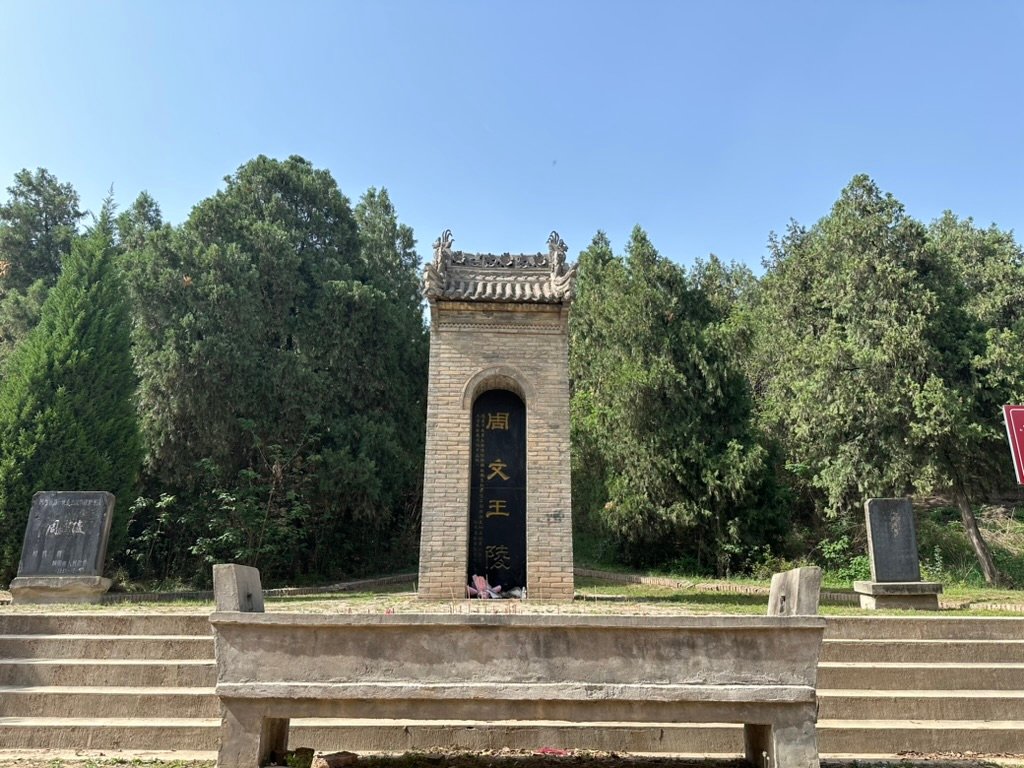
Standing Before King Wen’s Mausoleum
After reading the imperial tablets, studying the inscriptions, and following the footsteps of emperors across more than two thousand years, we finally arrived at the resting place of King Wen of Zhou (周文王).
There were no crowds.
No souvenir shops.
No dramatic performances.
Just a simple stone monument marking the entrance to one of the most influential figures in Chinese history.
🐞 Cheers: “So… this is it?”
🏺 Bingmazai: “Sometimes the most important places don’t need to be the biggest.”
“Without King Wen (周文王) and his son King Wu (周武王), there might never have been the Western Zhou Dynasty (西周).”
“Without the Zhou, there would have been no Mandate of Heaven (天命), no Zhou Ritual System (周礼), and perhaps no foundation upon which later Chinese civilisation was built.”
Cheers looked quietly at the ancient mound behind the monument.
🐞 Cheers: “And emperors kept coming back here for nearly three thousand years…”
🏺 Bingmazai: “Exactly.”
“Empires rose and fell.”
“Han (汉朝). Tang (唐朝). Song (宋朝). Yuan (元朝). Ming (明朝). Qing (清朝).“
“But they never forgot where many believed the story truly began.”
Standing there, I understood why this place felt so different from many famous tourist attractions.
You don’t come to Zhou Wen Wang Ling (周文王陵) to admire grand architecture.
You come to witness one of the world’s longest acts of historical remembrance.
That may be one of China’s greatest strengths.
It doesn’t only preserve monuments.
It preserves gratitude.
And perhaps that is why, more than three thousand years later, people are still making the journey to honour a king whose ideas helped shape a civilisation.
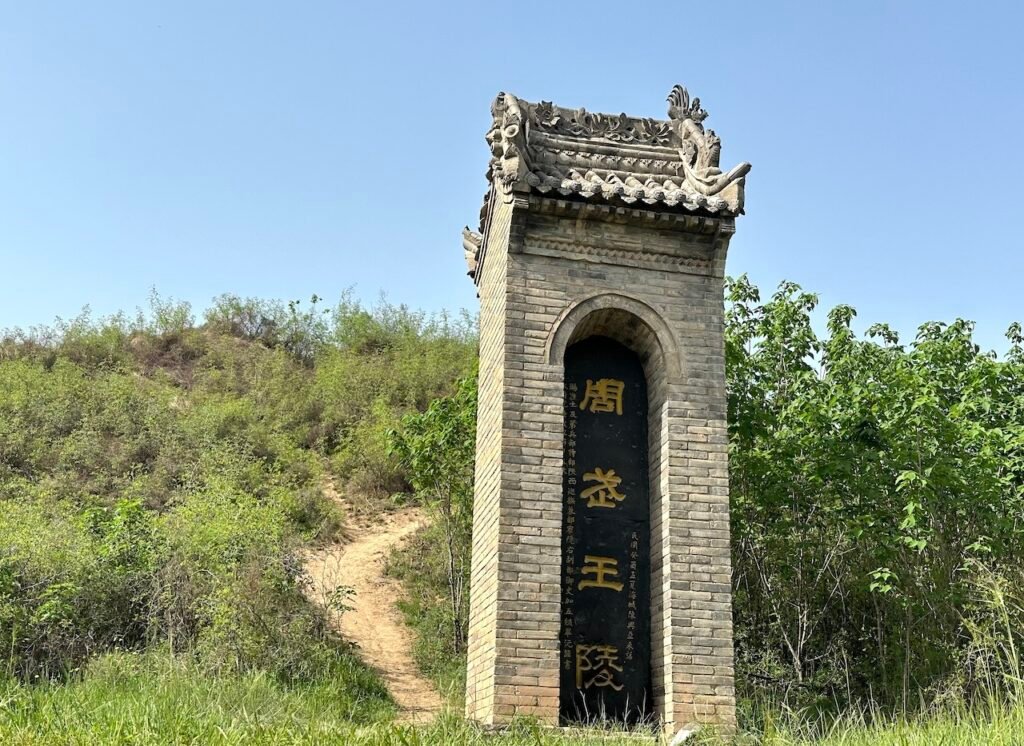
“Wait… I Know Those Characters!”
As we walked towards the mausoleum, Elaine suddenly stopped.
She wasn’t looking at the ancient gateway.
She was staring at the four large golden characters carved into the black stone.
周 武 王 陵
“Wait…” she smiled.
“I know that name!”
🐞 Cheers: “You do? I thought these were just old Chinese characters.”
👧 Elaine: “No… it’s 周武王 (Zhōu Wǔ Wáng)!”
“I’ve seen his name so many times while learning Chinese history.”
“He’s always mentioned together with 周文王 (Zhōu Wén Wáng) and 周公 (Zhōu Gōng).”
“I never imagined I’d actually be standing at his mausoleum.”
Cheers tilted his head.
🐞 Cheers: “So… who exactly was King Wu?”
🏺 Bingmazai: “If King Wen (周文王) designed the blueprint…”
“…then King Wu (周武王) completed the mission.”
“He defeated the Shang Dynasty (商朝) at the famous Battle of Muye (牧野之战) around 1046 BC, ending one dynasty and founding the Western Zhou Dynasty (西周).”
“More importantly, he didn’t simply replace one king with another.”
“His victory introduced the idea of the Mandate of Heaven (天命)—that rulers govern because they possess virtue, and when they lose that virtue, Heaven may withdraw its support.”
Elaine looked again at the gateway.
“I’ve read about him before…”
“…but today, he suddenly feels like a real person instead of just another name in a history book.”
And that’s exactly what travel can do.
A textbook chapter had quietly turned into a place.
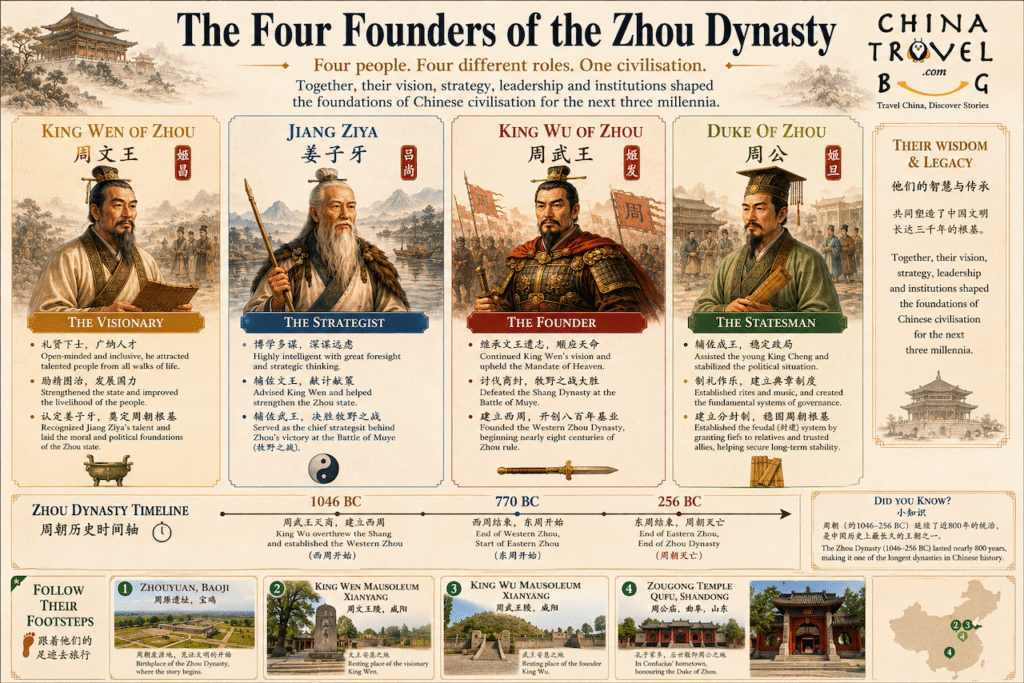
“Who’s Who in the Early Zhou Story?”
Standing before 周武王陵 (Zhōu Wǔ Wáng Líng), Cheers looked slightly overwhelmed.
🐞 Cheers: “Wait… I’m getting confused already.”
“There’s 周文王 (King Wen), 周武王 (King Wu), 周公 (Duke of Zhou)…”
“…and someone called 姜子牙 (Jiāng Zǐyá) keeps appearing too.”
“Who’s related to whom?”
Elaine smiled.
“This is actually one of my favourite parts of Chinese history.”
She picked up a stick and sketched a simple family tree in the sand.
                 姜子牙 (Jiāng Zǐyá)
          Legendary strategist & adviser


           周文王 King Wen (父 Father)
      Visionary who laid the foundations
                     │
          ┌──────────┴──────────┐
          │                     │
   周武王 King Wu         周公 Duke of Zhou
     Founder                 Statesman
👑 周文王 (Zhōu Wén Wáng) — The Visionary
👧 Elaine: “King Wen never actually conquered the Shang Dynasty (商朝).”
“But he spent years building alliances, attracting talented people, governing wisely, and preparing for the future.”
“He also recognised the genius of 姜子牙 (Jiāng Zǐyá) and invited him to become his chief adviser.”
“Many of the ideas that later shaped Chinese civilisation—virtuous government, moral leadership, and the concept of 天命 (Mandate of Heaven)—began during King Wen’s time.”
🏺 Bingmazai: “Great victories usually begin long before the battle.”
⚔️ 周武王 (Zhōu Wǔ Wáng) — The Founder
👧 Elaine: “King Wu was King Wen’s son.”
“After his father’s death, he continued the plan.”
“Together with 姜子牙, he defeated the Shang army at the famous Battle of Muye (牧野之战) around 1046 BC, founding the Western Zhou Dynasty (西周).”
“Without King Wu, the Zhou might have remained just another regional state.”
🏺 Bingmazai: “If King Wen drew the map, King Wu walked the road.”
📜 周公 (Zhōu Gōng, Duke of Zhou) — The Builder of a Civilisation
🐞 Cheers: “So the story ends there?”
👧 Elaine: “Actually… this is where it becomes even more interesting.”
“King Wu died only a few years after founding the dynasty.”
“His son, 周成王 (King Cheng of Zhou), was still a child.”
“So King Wu’s younger brother, 周公 (Duke of Zhou), became regent.”
“Many people expected him to seize the throne.”
“Instead, he ruled only until his nephew came of age—and then voluntarily handed power back.”
Cheers blinked.
🐞 Cheers: “He… gave the throne back?”
👧 Elaine: “Yes.”
“That decision made him one of the most respected figures in Chinese history.”
“He wasn’t remembered because he became emperor.”
“He was remembered because he chose not to.”
The Duke of Zhou then helped transform Zhou ideals into lasting institutions.
He organised the early Zhou government, developed the 封建制度 (Fēngjiàn system) by granting lands to trusted relatives and allies, strengthened the 礼乐制度 (Rites and Music System), and helped establish political and ceremonial traditions that influenced Chinese society for more than two thousand years.
Later generations—including 孔子 (Kǒngzǐ, Confucius)—admired the Duke of Zhou so deeply that Confucius famously lamented:
“甚矣吾衰也!久矣吾不复梦见周公。”
“How I have declined! It has been so long since I dreamed of the Duke of Zhou.”
🎣 姜子牙 (Jiāng Zǐyá) — The Master Strategist
🐞 Cheers: “And what about the old fisherman?”
🏺 Bingmazai: “Ah… 姜子牙 (Jiāng Zǐyá).”
“One of China’s most legendary strategists.”
According to tradition, King Wen met Jiang Ziya while he was fishing by the 渭河 (Wèi River). Recognising his extraordinary talent, King Wen invited him to join the Zhou cause.
Jiang Ziya became the architect behind much of the Zhou military strategy. His advice helped prepare the Zhou state during King Wen’s reign and played a decisive role in King Wu’s victory over the Shang.
Whether every detail of the famous fishing story is historical or legendary, the message has endured for nearly 3,000 years:
Great leaders do not succeed alone. They recognise great people and know when to listen to them.
🐞 Cheers: “So… the Zhou wasn’t built by just one great man.”
🏺 Bingmazai: “Exactly.”
“King Wen (周文王) imagined it.”
“King Wu (周武王) founded it.”
“The Duke of Zhou (周公) made it work.”
“Jiang Ziya (姜子牙) helped make all three possible.”
Elaine looked once more towards the ancient mausoleum.
“No wonder Chinese history keeps mentioning these four names together.”
“They weren’t just people.”
“Together, they built the foundations of one of the world’s longest continuous civilisations.”
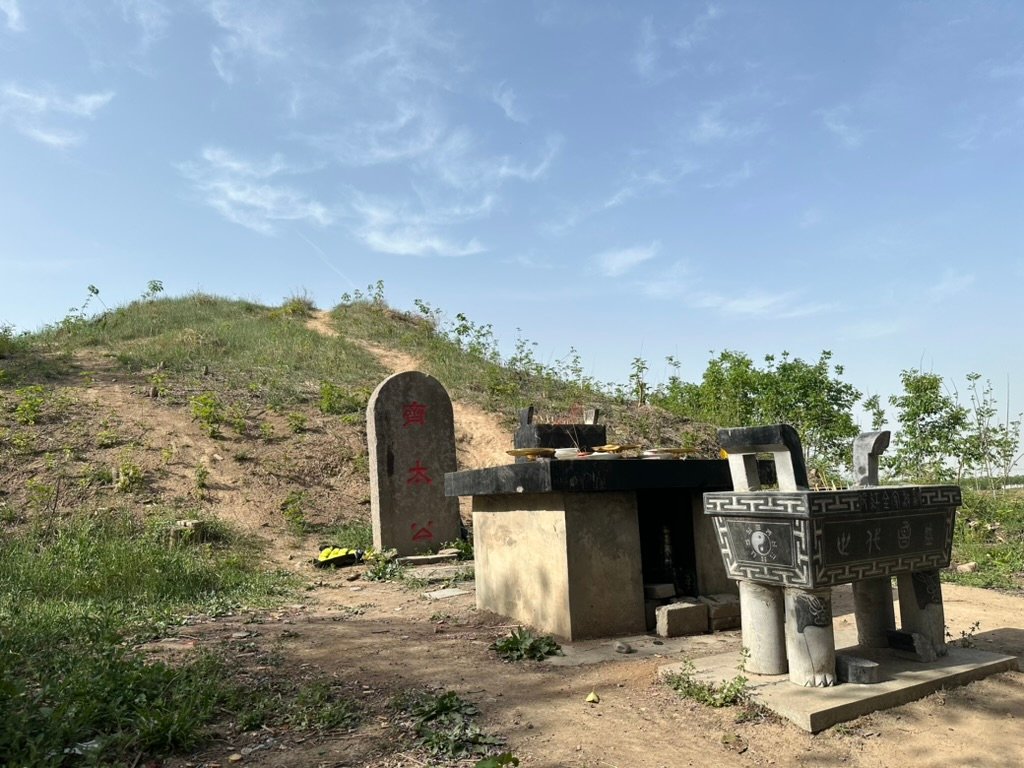
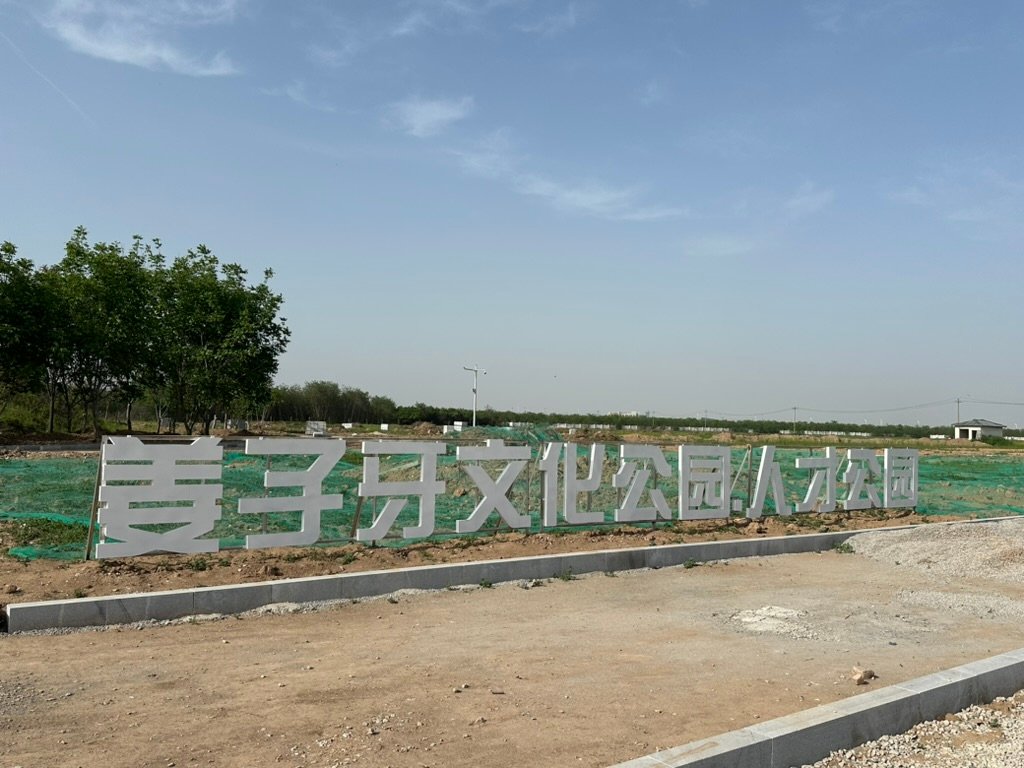
Meeting Qi Taigong (齐太公) — When Elaine Became the Teacher
After visiting 周文王陵 (Zhōu Wén Wáng Líng) and 周武王陵 (Zhōu Wǔ Wáng Líng), Dad pointed towards another grassy mound nearby.
A simple stone marker stood quietly before it.
齐太公 (Qí Tàigōng).
Dad frowned.
“I know 姜子牙 (Jiāng Zǐyá)…”
“…but who’s Qi Taigong (齐太公)?”
Before Bingmazai could answer, Elaine smiled.
👧 Elaine: “Dad… they’re the same person!”
Dad looked surprised.
“The same person?”
👧 Elaine: “Yes!”
“姜子牙 (Jiāng Zǐyá) was his personal name.”
“After helping 周武王 (King Wu of Zhou 周武王) establish the Western Zhou Dynasty (西周), he was granted the State of Qi (齐国) by the Zhou court.”
“That’s why later generations respectfully called him 齐太公 (Qi Taigong).”
She paused for a second before another light bulb went on.
👧 Elaine: “Dad!”
“We’ve been there before!”
“Zibo (淄博)!”
Dad immediately laughed.
“Of course!”
During an earlier trip, we had explored Linzi (临淄), the ancient capital of the State of Qi (齐国) in today’s Zibo (淄博), Shandong (山东).
At the time, we learned how Qi became one of the most powerful states during the Spring and Autumn (春秋) and Warring States (战国) periods.
Only now did another piece of the puzzle fall into place.
The man standing quietly before us wasn’t simply a legendary strategist.
He was also the founding ruler of the State of Qi (齐国).
The kingdom whose capital we had already walked through.
🐞 Cheers: “Wait…”
“So this isn’t just another tomb?”
“It’s connected to somewhere we’ve already visited?”
🏺 Bingmazai: “Exactly.”
“That’s one of the joys of travelling through China.”
“Every journey connects to another.”
“First you visit Linzi (临淄) and wonder how the State of Qi became so powerful.”
“Later, you arrive here in Xianyang (咸阳) and meet the very man who founded it.”
Elaine looked at the simple earthen mound once more.
“It’s funny.”
“If I had come here before visiting Zibo, this would probably have been just another name.”
“But now…”
“…it feels like meeting an old friend.”
That was one of those unforgettable ChinaTravelBug moments.
Not because we discovered something new.
But because two journeys, hundreds of kilometres apart, had suddenly connected into one story.
From Ancient Kings to a Living Chinese City
By late afternoon, both our brains and stomachs were telling us the same thing.
Enough history.
Time for dinner.
Rather than heading straight back to Xi’an (西安), we decided to do what local people would probably do.
We opened DiDi (滴滴出行), China’s ride-hailing app, and booked a car for around RMB30 into downtown Xianyang (咸阳市区).
Within twenty minutes, the landscape had completely changed.
The quiet cypress trees surrounding 周文王陵 (King Wen’s Mausoleum) and 周武王陵 (King Wu’s Mausoleum) gave way to bright neon shopfronts, busy traffic, restaurants, fruit stalls and families enjoying their evening.
History had quietly handed the stage back to modern China.
“This Doesn’t Feel Like a Tourist Street…”
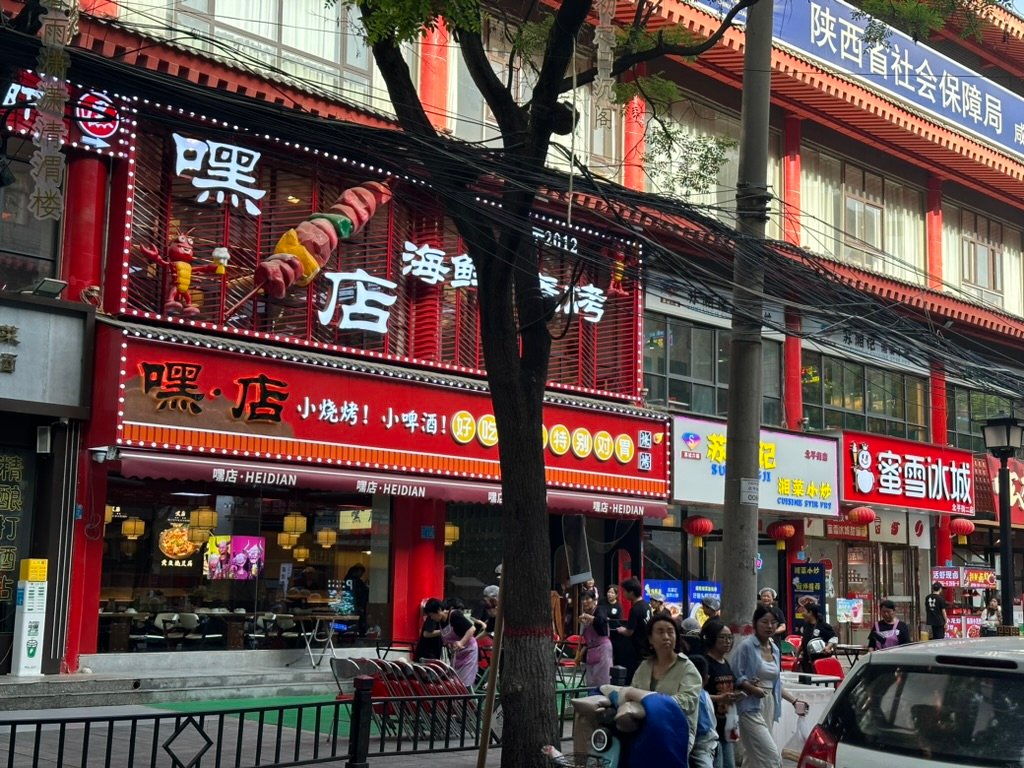
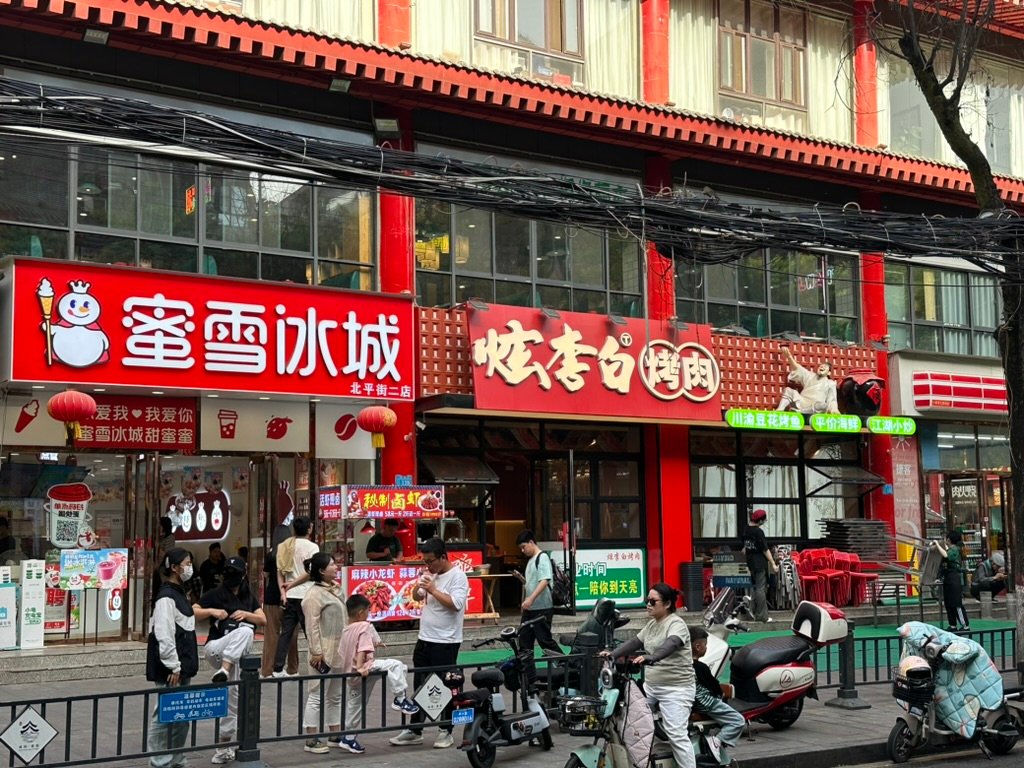
As we wandered along 北平街 (Beiping Street), something immediately caught our attention.
Unlike some of China’s better-known tourist food streets, this one felt…local.
Office workers had just finished work.
Parents were buying fruit for home.
Children tugged excitedly at their mothers after spotting ice cream.
Neighbours sat outside barbecue restaurants chatting over bottles of beer.
Nobody seemed to be in a hurry.
It felt less like a tourist attraction and more like the city’s evening living room.
🐞 Cheers: “Are we… still sightseeing?”
🏺 Bingmazai: “Of course.”
“China isn’t only found inside museums.”
“Sometimes the best way to understand a city is simply to watch people deciding what to eat after work.”
A Taste of Everyday Xianyang
The street was full of names that many foreign visitors would probably walk past without noticing.
There was 嘿店 (Hēi Diàn), a lively barbecue restaurant advertising 小烧烤 (xiǎo shāokǎo) and 小啤酒 (xiǎo píjiǔ)—small skewers and cold beer, a classic northern Chinese evening combination.
Nearby, locals were choosing fruit from colourful street displays.
Boxes of blueberries sat beside towering piles of durians (榴莲) and watermelons, while shopkeepers chatted with regular customers.
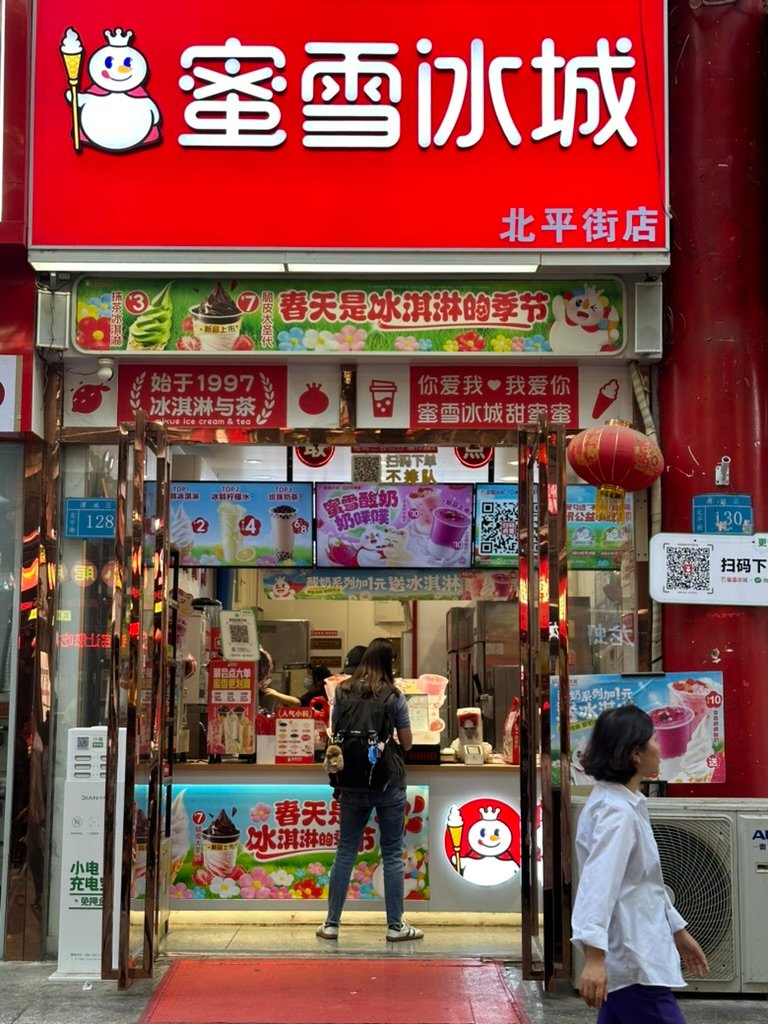
Across the street, bright red signs for 蜜雪冰城 (Mìxuě Bīngchéng / Mixue Ice Cream & Tea) glowed like a beacon.
By now, many travellers to China will recognise the smiling snowman mascot.
Founded in 1997, Mixue has grown into one of the world’s largest bubble tea and ice cream chains, with tens of thousands of outlets across China and overseas.
Naturally…
Elaine couldn’t resist.
A Modern Chinese Evening
One of the things we enjoy most about travelling in China is this constant change of scenery.
In a single afternoon, we had stood before the resting places of King Wen of Zhou (周文王), King Wu of Zhou (周武王) and Duke of Zhou (周公)—people whose ideas helped shape Chinese civilisation over 3,000 years ago.
Less than half an hour later, we were strolling through an ordinary neighbourhood where teenagers queued for bubble tea, grandparents shopped for fruit and friends gathered for barbecue.
China never asks you to choose between its past and its present.
It invites you to experience both—sometimes on the very same day.
📍Location Tip
Beiping Street (北平街), Xianyang (咸阳) is a lively local commercial street about a 20-minute DiDi ride from Zhouling (周陵).
If you’ve spent the day exploring the Zhou royal mausoleums, it’s an excellent place to experience everyday local life, enjoy 陕西烧烤 (Shaanxi barbecue), try 蜜雪冰城 (Mixue), and simply watch the city come alive after sunset.
Back to Our Comfort Food
There are some foods that simply feel like coming home.
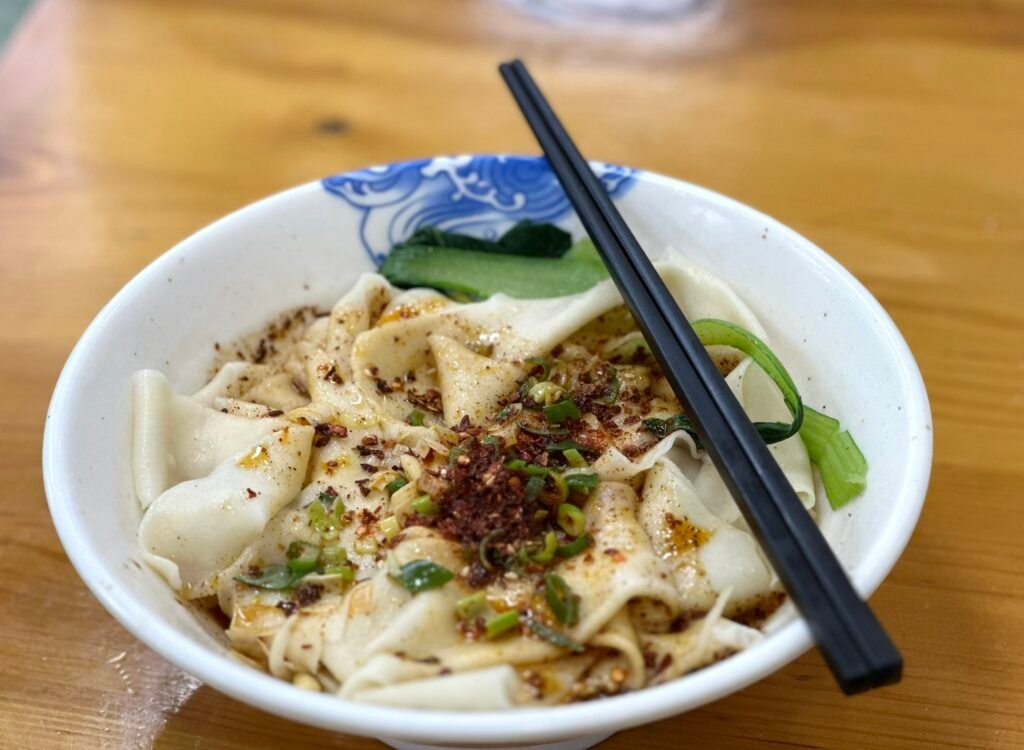
For us, one of them is Xi’an’s famous 油泼面 (Yóupō Miàn).
After hours of walking around 周陵 (Zhōulíng), learning about 周文王 (King Wen of Zhou), 周武王 (King Wu of Zhou) and 周公 (Duke of Zhou), our feet were tired and our stomachs were protesting.
Fortunately, we knew exactly what would fix the problem.
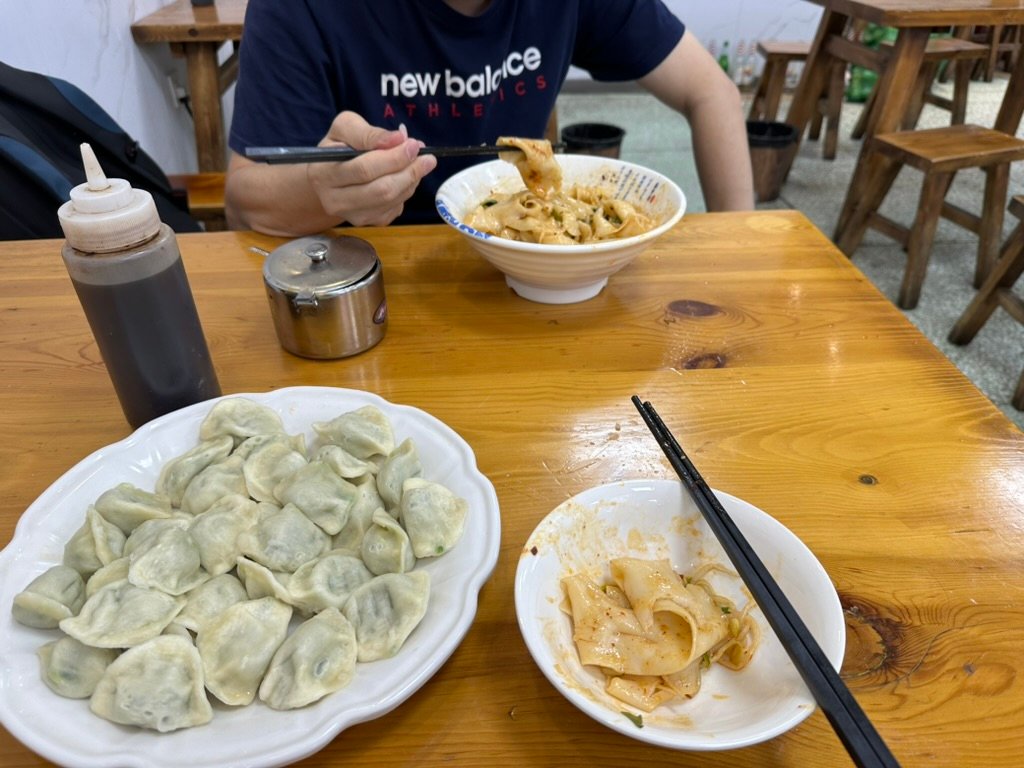
A big bowl of freshly made noodles.
And dumplings.
Lots of dumplings.
“Didn’t We Come to Xianyang?”
As soon as the bowls arrived, Cheers looked slightly confused.
🐞 Cheers: “Wait… we’re in Xianyang (咸阳) now.”
“Why are we eating Xi’an (西安) food again?”
🏺 Bingmazai: “Because great food doesn’t stop at city boundaries!”
“Xi’an and Xianyang have been connected for over 2,000 years. People commute between them every day, families have relatives on both sides, and many of the famous dishes of Guanzhong (关中) belong to the whole region—not just one city.”
Elaine nodded while mixing the noodles with her chopsticks.
👧 Elaine: “Think of it like Osaka and Kyoto… or Kuala Lumpur and Petaling Jaya.”
“Different cities, but they share much of the same food culture.”
The Magic of 油泼面 (Yóupō Miàn)
If you’ve never tried 油泼面, you’re missing one of northwestern China’s simplest culinary pleasures.
Freshly hand-pulled biangbiang noodles (𰻝𰻝面 / Biángbiáng Miàn) or broad wheat noodles are placed in a bowl with chopped spring onions, garlic, chilli flakes and fragrant spices.
Then comes the best part.
Smoking hot oil is poured over everything.
“滋啦——!”
That dramatic sizzling sound releases an incredible aroma as the chilli, garlic and spices instantly bloom.
A splash of soy sauce and black vinegar finishes the dish.
The result isn’t overwhelmingly spicy.
Instead, it’s wonderfully fragrant, slightly smoky, pleasantly chewy and incredibly satisfying after a long day exploring.
And of Course… Dumplings
No visit to northern China feels complete without 饺子 (Jiǎozi).
These weren’t fancy restaurant dumplings.
They were simple, freshly boiled dumplings filled with vegetables and meat—the kind locals order without even looking at the menu.
Sometimes the best meals aren’t the most expensive.
They’re simply the ones you crave after walking several kilometres under the Shaanxi sun.
Elaine’s Note 💡
“When we first started travelling around China, Dad always wanted to try something new.
Now it’s become a family joke.
No matter how many exciting local dishes we discover…
…we somehow end up ordering 油泼面 and 饺子 again.
Some foods become more than food.
They become part of your travel memories.
Whenever I smell chilli oil hitting fresh noodles, I immediately think of Shaanxi.”
📍Location Tip
You don’t have to return to Xi’an (西安) to enjoy excellent 油泼面 (Yóupō Miàn) or 饺子 (Jiǎozi).
Many neighbourhood restaurants in downtown Xianyang (咸阳市区) serve authentic Guanzhong (关中) cuisine at very reasonable prices. Skip the tourist restaurants if you can, and look for places filled with local families—it’s often a sign you’ve found the real thing.
💡 Elaine’s Note: “Wait… Zhou Was Before Qin?”
As we were leaving 周陵 (Zhōulíng), I realised something that changed how I think about Chinese history.
Most foreign visitors—including Dad before we started travelling around China—usually think Qin (秦) is where ancient China begins.
That’s understandable.
The Terracotta Army (兵马俑) and Qin Shi Huang (秦始皇) are world-famous.
But actually…
The Zhou Dynasty (周朝) came first.
A lot earlier.
Around 800 years earlier.
I tried explaining it to Dad this way.
Western Zhou (西周)
1046 BC
     │
     │  ← about 800 years
     │
Qin Dynasty (秦朝)
221 BC
The Qin united China politically.
But the Zhou had already spent centuries developing many of the ideas that later became the foundation of Chinese civilisation.
周文王 (King Wen) imagined a new political order.
周武王 (King Wu) founded the Zhou Dynasty after defeating the Shang.
周公 (Duke of Zhou) built its institutions, rituals (礼, lǐ), government and system of rule.
Even the famous philosopher 孔子 (Confucius), who lived centuries later, admired the Zhou so much that he often spoke of returning to the ideals of the Duke of Zhou (周公).
So when we stood in front of 周文王陵 and 周武王陵, we weren’t simply visiting another ancient tomb.
We were standing near the beginning of a civilisation that would later influence the Qin, the Han, the Tang, the Ming and the Qing.
No wonder emperors kept returning here to pay their respects.
Appendix 1: Official Information Board Translation (周陵 Zhouling)
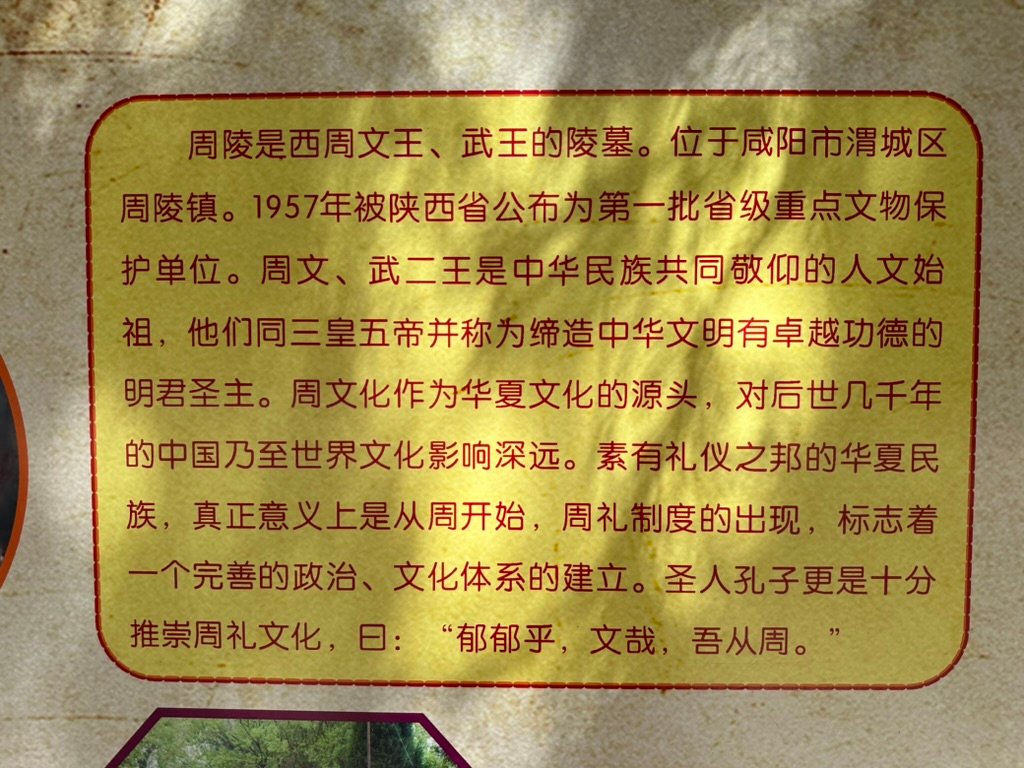
The following is a faithful English translation of the official information board displayed at Zhouling (周陵). Chinese names and key terms are retained for readers who wish to explore further.
Zhouling (周陵)
Zhouling (周陵) is the mausoleum of King Wen of Zhou (周文王) and King Wu of Zhou (周武王). It is located in Zhouling Town (周陵镇), Weicheng District (渭城区), Xianyang (咸阳).
In 1957, Zhouling was designated one of the first Provincial Key Cultural Heritage Protection Sites of Shaanxi Province (陕西省第一批省级重点文物保护单位).
King Wen and King Wu are jointly revered by the Chinese people as Humanistic Ancestors (人文始祖). Together with the legendary Three Sovereigns and Five Emperors (三皇五帝), they are honoured as enlightened rulers whose achievements made exceptional contributions to the formation of Chinese civilisation.
The information board further explains that Zhou Culture (周文化) forms one of the principal origins of Huaxia civilisation (华夏文化). Its influence has extended not only throughout the history of China over several millennia but has also had a profound impact on East Asian civilisation.
The Chinese civilisation often described as the “Land of Propriety and Rites” (礼仪之邦) is said to have truly taken shape during the Zhou Dynasty. The establishment of the Zhou system of rites (周礼制度) marked the creation of a mature political, ethical and cultural order that became the foundation for later Chinese society.
The board concludes by noting that Confucius (孔子) deeply admired the civilisation of the Zhou and famously said:
郁郁乎,文哉,吾从周。
“How splendid and refined the culture of Zhou is! I choose to follow the Zhou.”
Appendix 2: Official Information Board Translation
The Imperial Tradition of Honouring the Zhou Kings
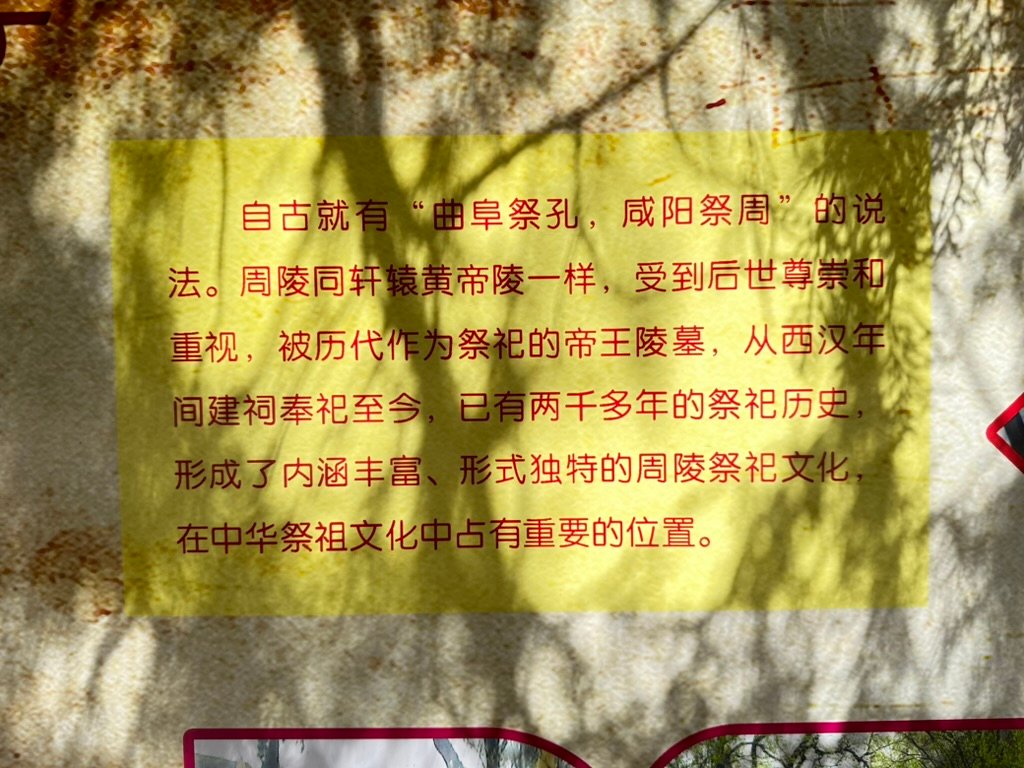
From ancient times, there has been a well-known saying:
曲阜祭孔,咸阳祭周
“In Qufu (曲阜), people honour Confucius (孔子); in Xianyang (咸阳), they honour the Zhou.”
Like the Yellow Emperor’s Mausoleum (黄帝陵) at Qiaoshan (桥山), Zhouling (周陵) has long been revered and respected by successive generations.
Throughout history, it has served as an Imperial Mausoleum for State Sacrifices (帝王陵墓祭祀). Beginning in the Western Han Dynasty (西汉), temples were established here for official ceremonies, and the tradition of paying tribute has continued for more than two thousand years.
Over the centuries, this gave rise to a rich and distinctive Zhouling Sacrificial Culture (周陵祭祀文化), which today occupies an important place within China’s broader tradition of ancestor veneration (祭祖文化).
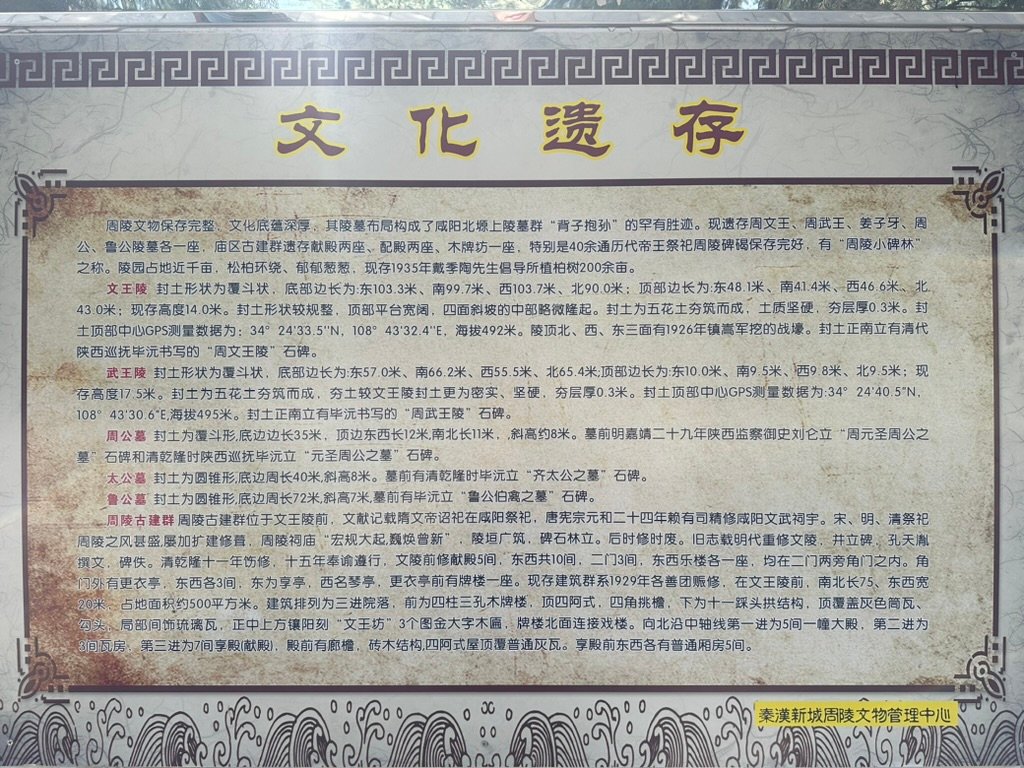
Appendix 3: Official Information Board Translation
Preservation of Cultural Heritage (文化遗存)
The following is a faithful English translation of the official information board displayed at Zhouling (周陵).
Preservation of Cultural Heritage
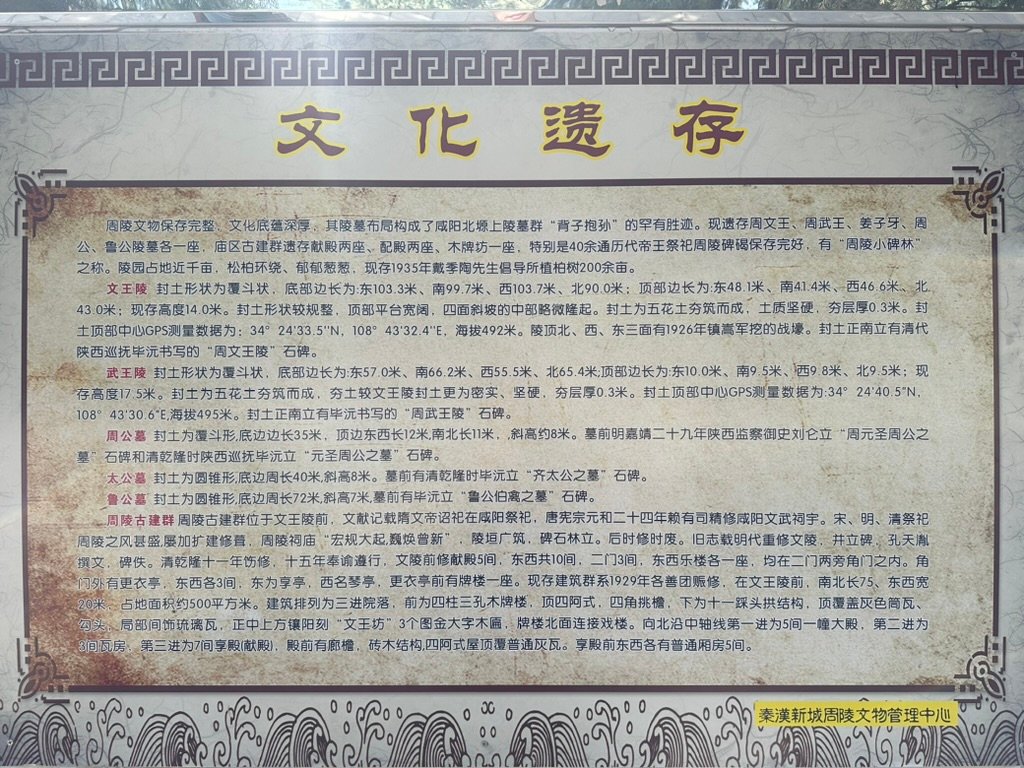
The cultural relics at Zhouling (周陵) are exceptionally well preserved and possess profound historical and cultural significance. Their arrangement forms the distinctive pattern known as “背子抱孙” (bèi zǐ bào sūn, “the elder embracing the younger”) among the imperial mausoleums north of Xianyang (咸阳).
Today the site preserves the mausoleums of:
- King Wen of Zhou (周文王陵)
- King Wu of Zhou (周武王陵)
- Jiang Ziya (姜子牙陵)
- Duke of Zhou (周公陵)
- Duke of Lu (鲁公伯禽陵)
Also surviving are:
- two ancient ancestral halls (献殿)
- two auxiliary halls (配殿)
- a wooden memorial tablet pavilion (木牌坊)
Particularly noteworthy are the forty imperial sacrificial steles (祭祀碑) erected by successive dynasties, which remain remarkably well preserved. Because of this collection, the site is often referred to as the “Small Forest of Steles of Zhouling” (周陵小碑林).
The cemetery occupies nearly 1,000 mu (approximately 165 acres) and is surrounded by pines and cypress trees. More than 200 cypress trees planted under the guidance of Mr. Dai Jitao (戴季陶) in 1935 still survive today.
King Wen’s Mausoleum (文王陵)
The burial mound is a truncated square pyramid.
Its base measures:
- East: 103.3 m
- South: 99.7 m
- West: 103.7 m
- North: 90.0 m
The summit measures:
- East: 48.1 m
- South: 41.4 m
- West: 46.6 m
- North: 43.0 m
The mound stands approximately 14 metres high.
It is well preserved, with a broad flat summit and slightly raised central section. The mound consists of layers of compacted multicoloured loess (五花土) approximately 0.3 metres thick.
GPS coordinates:
34°24′33.5″N, 108°43′32.4″E
Elevation:
492 metres above sea level.
Archaeological trenches excavated by General Feng Yuxiang (冯玉祥) in 1926 remain visible on the northern, eastern and western sides.
A stone stele inscribed “周文王陵” (King Wen’s Mausoleum), written by Bi Yuan (毕沅), Governor-General of Shaanxi during the Qing Dynasty, stands south of the mound.
King Wu’s Mausoleum (武王陵)
The burial mound is likewise a truncated square pyramid.
Base dimensions:
- East: 57.0 m
- South: 66.2 m
- West: 55.5 m
- North: 65.4 m
Summit dimensions:
- East: 10.0 m
- South: 9.5 m
- West: 9.8 m
- North: 9.5 m
Current height:
17.5 metres.
Like King Wen’s mound, it is constructed from compacted multicoloured loess, although the soil is denser and harder.
GPS coordinates:
34°24′40.5″N, 108°43′30.6″E
Elevation:
495 metres above sea level.
A stone stele bearing the inscription “周武王陵” (King Wu’s Mausoleum), also written by Bi Yuan, stands directly south of the mound.
Duke of Zhou’s Mausoleum (周公墓)
A semi-circular earthen mound.
- Base circumference: 35 metres
- Summit: 12 m × 12 m
- Height: 8 metres
In front of the mound stand stone steles erected during both the Ming and Qing Dynasties, inscribed:
- “周元圣周公之墓” (“Tomb of the Primordial Sage, Duke of Zhou”)
- “元圣周公之墓” (“Tomb of the Primordial Sage, Duke of Zhou”)
Jiang Ziya’s Mausoleum (太公墓)
A circular conical mound.
- Base circumference: 40 metres
- Height: 8 metres
A Qing Dynasty stele in front bears the inscription:
“齐太公之墓”
“Tomb of Grand Duke Tai of Qi (Qi Taigong).”
Duke of Lu’s Mausoleum (鲁公墓)
A circular conical mound.
- Base circumference: 72 metres
- Height: 7 metres
A Qing Dynasty stele stands before the mound bearing the inscription:
“鲁公伯禽之墓”
“Tomb of Duke Bo Qin of Lu.”
Ancient Architectural Complex of Zhouling (周陵古建群)
The historic architectural complex stands before the Mausoleum of King Wen.
Historical records indicate that Emperor Gaozu of the Tang Dynasty (唐高祖) ordered official sacrifices here, while Emperor Xuanzong (唐玄宗) established the Temple of King Wen (文武祠) in the 24th year of the Kaiyuan reign (736 AD).
During the Song, Ming, and Qing Dynasties, the ceremonial buildings were repeatedly expanded and restored, giving rise to the saying:
“宏规大起,巍焕曾新”
“Its magnificent scale continually expanded and was repeatedly renewed in splendour.”
The present buildings date largely from a reconstruction in 1929.
The complex extends approximately:
- 75 metres north-south
- 20 metres east-west
covering roughly 500 square metres.
It follows a traditional three-courtyard layout, including:
and subsidiary wing rooms on both the eastern and western sides.
a front gateway with three timber archways,
corner watchtowers,
reception halls,
worship halls,
timber galleries,
brick-and-timber structures with tiled roofs,