The Silk Road Didn’t Begin China’s Global Story: Foreign Influences on Qin and Han China
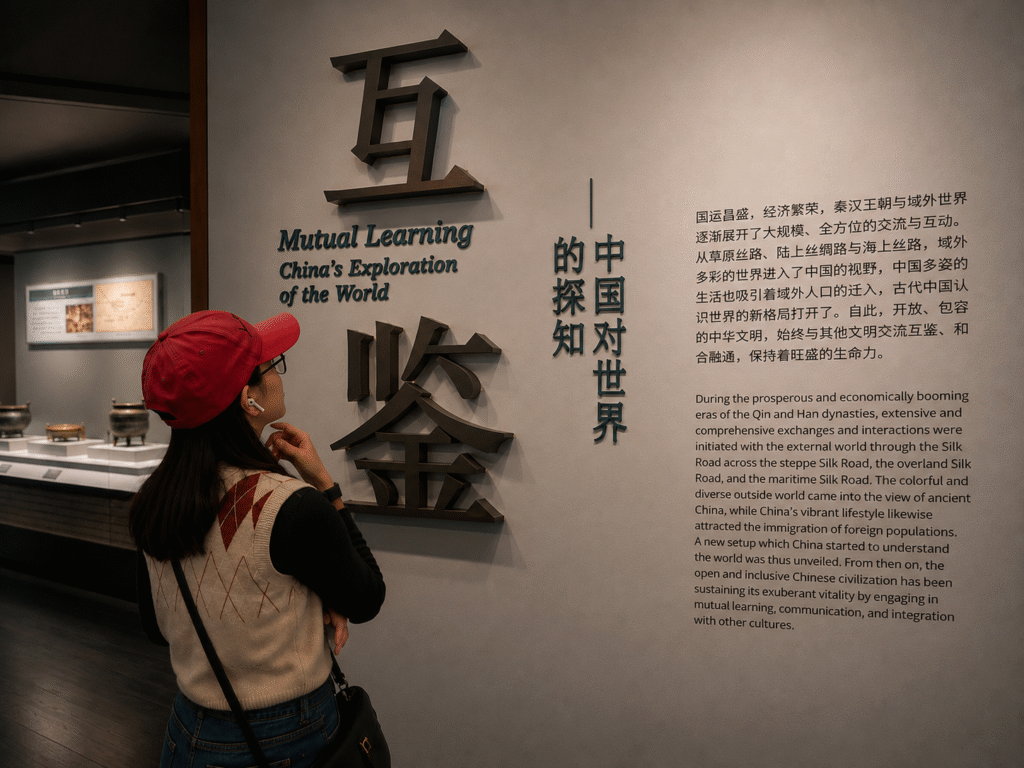
One of the biggest surprises waiting inside the Qin and Han Civilization Museum is that China’s connection with the outside world did not begin with the Silk Road.
Most of us imagine ancient China developing behind mountains and deserts, only opening to foreign civilizations when caravans began crossing Central Asia during the Han Dynasty.
The museum quietly challenges that assumption.
Long before the famous Silk Road existed, ideas, technologies, artistic styles and luxury goods were already travelling across the vast Eurasian continent. The western frontier of the Qin state was not the end of the Chinese world—it was one of the places where different civilizations met.
Rather than developing in complete isolation, early Qin culture was already absorbing influences from peoples living across the Eurasian steppe and Western Asia. By the time Emperor Wu of Han (汉武帝) formally opened the overland Silk Road, these exchanges had already been taking place for centuries.
In many ways, the Silk Road did not create East-West exchange.
It simply expanded and organized connections that had existed long before.
Before the Silk Road, Qin Was Already Looking West
One exhibit immediately caught our attention.
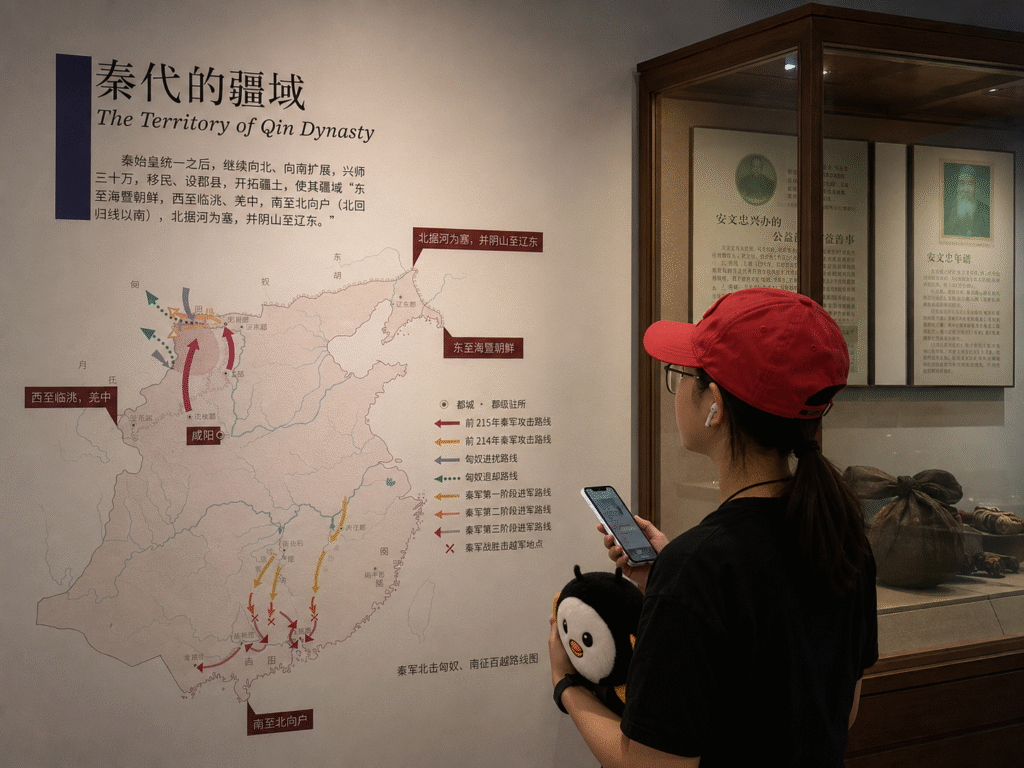
It explained that the early Qin people lived along the upper reaches of the Wei River (渭河) and around Mount Long (陇山)—the western frontier of the ancient Chinese world. This region stood between the agricultural civilizations of the Central Plains and the nomadic cultures of the northern Eurasian steppe.
Instead of being a remote backwater, Qin occupied one of ancient Eurasia’s great crossroads.
Archaeologists have discovered that many luxury objects found in early Qin tombs—including jade ornaments, bronze weapons, gold decorations and sophisticated metalworking techniques—show striking similarities with objects from the Eurasian steppe and Western Asia. Techniques such as gemstone inlay, granulation and delicate gold filigree likely travelled east through networks of merchants, craftsmen and migrating peoples long before official diplomatic missions existed.
Elaine looked at the display for a moment before saying,
“So the Silk Road didn’t suddenly appear?”
“Exactly,” I replied.
“It had a very long prequel.”
Cheers immediately drew an imaginary road in the air.
“So… the Silk Road wasn’t the first chapter?”
“No.”
“It was the moment when thousands of little roads finally became one famous road.”
Bing Ma Zai nodded proudly.
“Qin didn’t simply inherit Central Plains culture.”
“It also stood where civilizations met.”
That geographical position would eventually become one of China’s greatest historical advantages.
A Bronze Kettle That Traveled Across Eurasia
When we think about cultural exchange, we often imagine luxury goods—silk, gold, jade or precious gemstones.
Yet sometimes the most revealing objects are the ordinary ones.
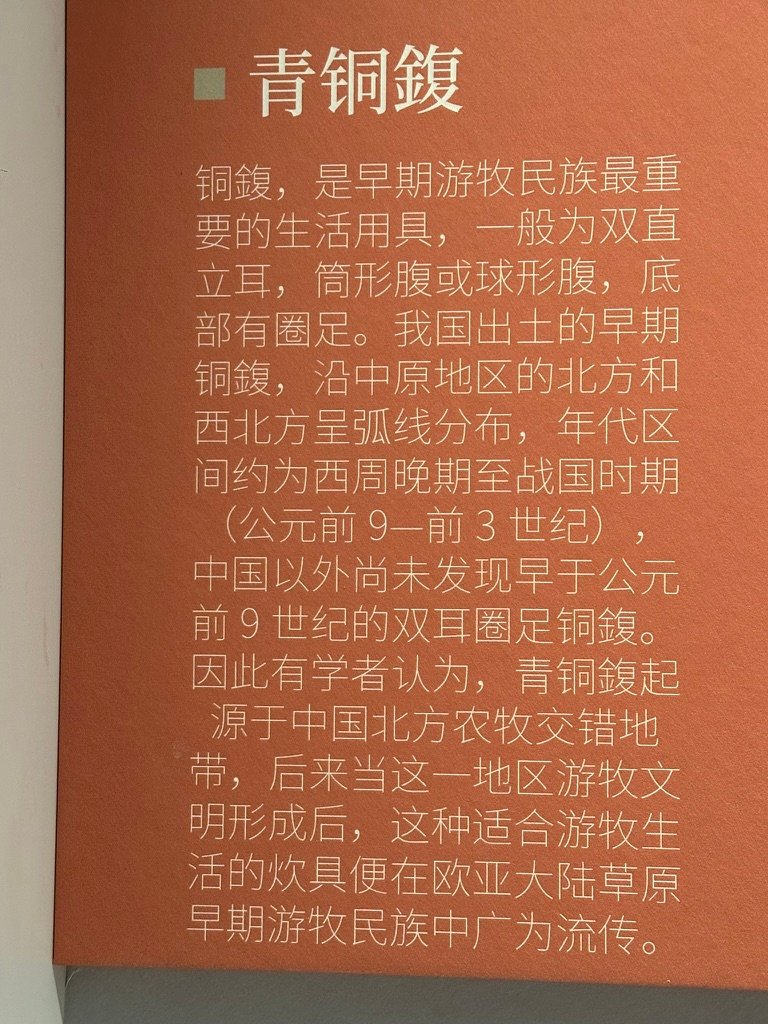
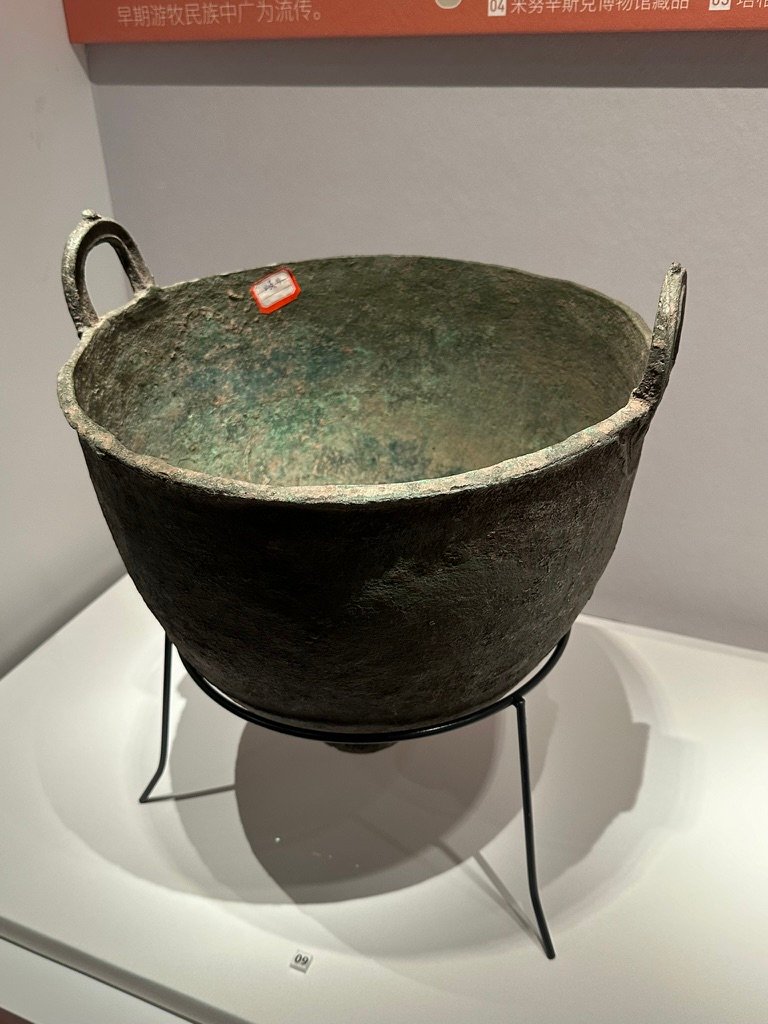
One exhibit introduces the bronze fu (青铜鍑), a sturdy cooking vessel that was an essential piece of equipment for early nomadic peoples. Designed with two upright handles and a rounded body supported by ring-shaped feet, it was practical, durable and well suited for a mobile lifestyle on the vast Eurasian grasslands.
Archaeological discoveries show that these bronze vessels appeared across northern and northwestern China between the late Western Zhou and the Warring States period (roughly the 9th to 3rd centuries BC). Interestingly, comparable examples dating before the 9th century BC have not been found elsewhere. Some scholars therefore suggest that this type of bronze kettle may have originated in the farming-pastoral frontier of northern China before spreading westward as nomadic cultures expanded across the Eurasian steppe.
That possibility challenges another common assumption.
When discussing ancient cultural exchange, we often picture ideas flowing only into China. This humble bronze vessel reminds us that exchange was never one-way. Just as Qin adopted technologies and artistic influences from its western neighbours, innovations developed in China’s frontier regions may also have travelled in the opposite direction.
Elaine smiled when she realised what that meant.
“So even a cooking pot can tell a world history story?”
“It can,” I replied.
Cheers looked thoughtfully at the bronze kettle.
“So before people traded silk…”
“…they were already sharing dinner?”
Even Bing Ma Zai couldn’t help laughing.
History is often remembered through emperors and famous battles, but sometimes it travels in something much simpler—a cooking pot carried from camp to camp across the endless Eurasian grasslands.
When Art Crossed the Grasslands
Not every cultural exchange was driven by merchants or diplomats.
Sometimes, it travelled through art.
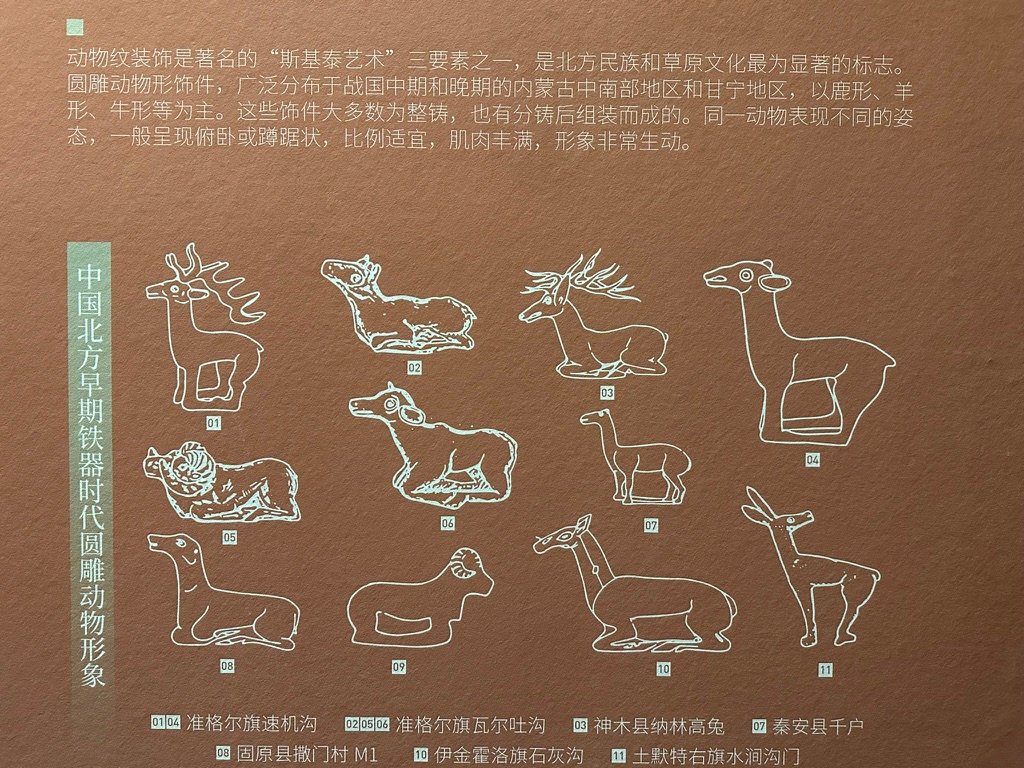
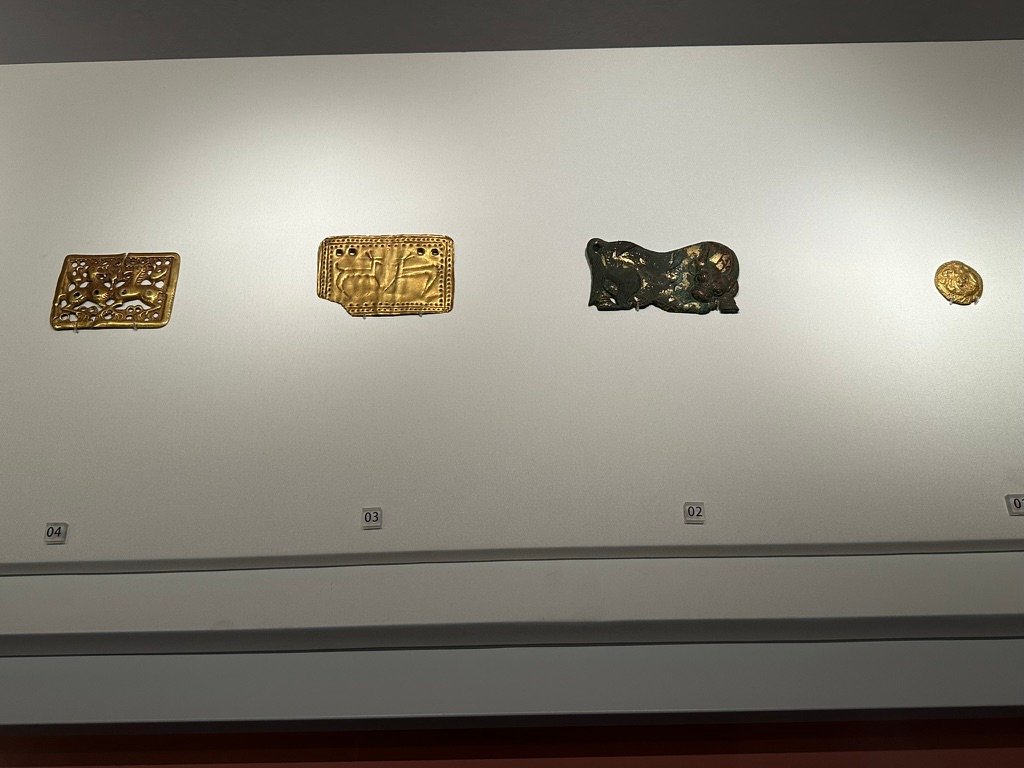
One fascinating exhibit introduces the distinctive “Animal Style” (动物纹饰), one of the defining artistic traditions of the Eurasian steppe. Popular among the nomadic peoples of northern China and the vast grasslands beyond, these bronze ornaments depicted animals such as deer, sheep and other wildlife in remarkably lively poses. Rather than standing still, the animals are shown crouching, leaping or turning their heads, their bodies compact yet full of energy.
Archaeologists have unearthed these ornaments across what is now Inner Mongolia and Gansu, dating mainly to the middle and late Warring States period. The exhibit illustrates how this artistic style spread widely across the northern frontier, becoming a shared visual language among different pastoral communities.
For the Qin people, who occupied the western edge of the Central Plains, these artistic traditions were impossible to ignore. Living between the agricultural world and the Eurasian steppe meant that Qin craftsmen encountered not only new technologies and goods, but also new ways of expressing beauty and identity.
Elaine studied the elegant outlines of the deer.
“They don’t look like the bronze vessels we’ve been seeing.”
“They don’t,” I replied.
“They feel… freer.”
Cheers tilted his head.
“So people weren’t only exchanging products.”
“They were exchanging ideas about art.”
Exactly.
Long before the Silk Road carried silk and porcelain across continents, artistic styles were already crossing mountains and grasslands. These graceful bronze animals remind us that culture has always travelled alongside people, quietly shaping civilizations long before history gave those journeys a famous name.
Mutual Learning, Not One-Way Exchange
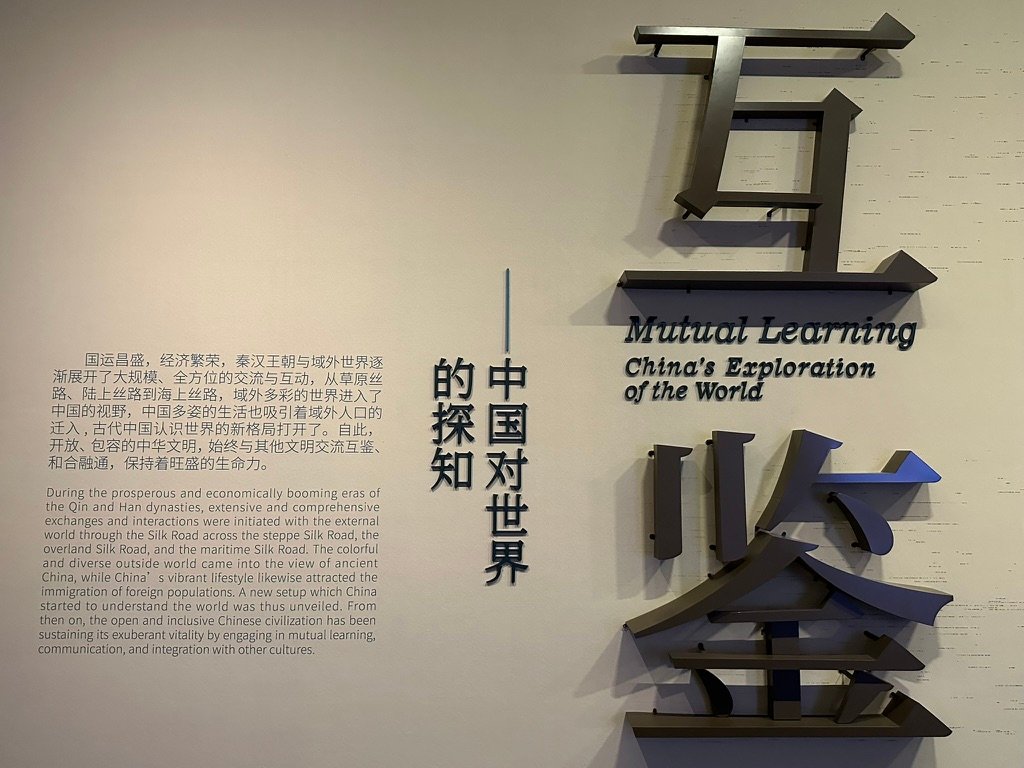
One phrase in the exhibition stayed with us.
“Mutual Learning” (互鉴).
That wording matters.
The Silk Road is often imagined as China exporting silk to the West.
Reality was far richer.
Chinese silk, lacquerware and ironware travelled westward.
At the same time, horses, grapes, pomegranates, walnuts, glassware, musical instruments, artistic techniques, religious beliefs and entirely new ideas travelled eastward.
Neither side remained unchanged.
Civilizations grew because they learned from one another.
The museum reminds visitors that ancient China did not become stronger by isolating itself. Instead, the confidence built during the Qin and Han dynasties allowed it to engage openly with other civilizations while remaining unmistakably Chinese.
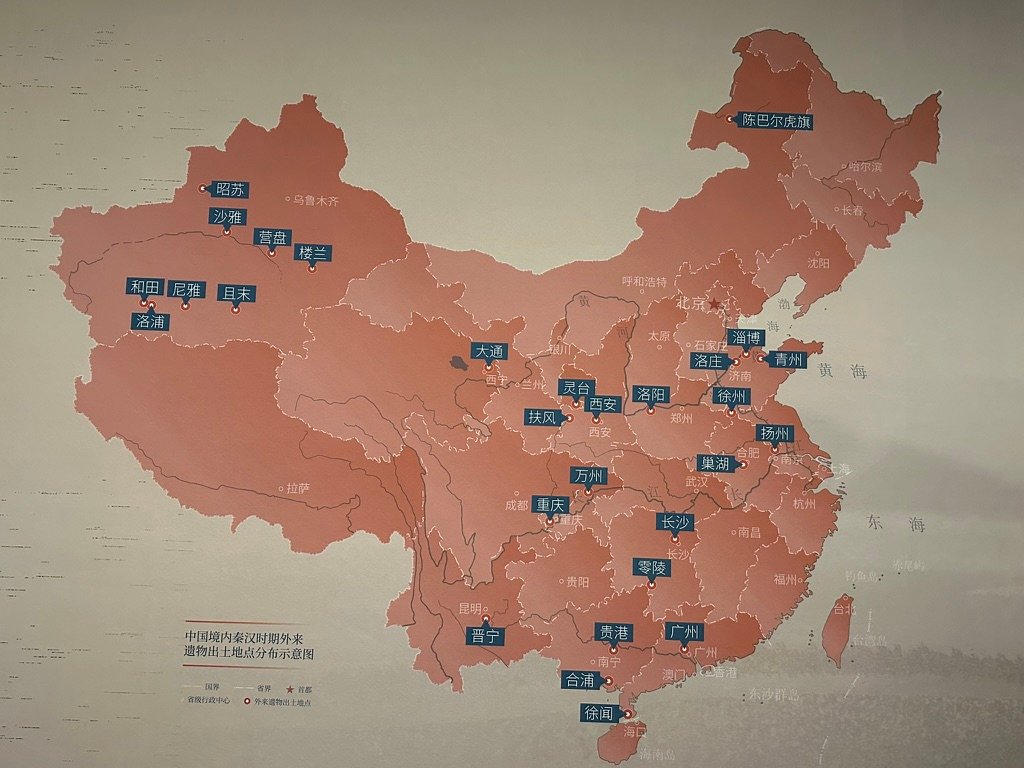
The Map That Changed How We Read Chinese History
Standing beside the exhibition was a large map showing where foreign artefacts from the Qin and Han period have been discovered across China.
What surprised me was not where they were found.
It was how widely they were distributed.
From Xinjiang in the far west to Shandong on the eastern coast.
From the old capitals around Xi’an and Luoyang to ports in Guangzhou, Hepu, Xiapu and Taizhou.
Foreign objects had travelled thousands of kilometres before finally being buried in Chinese tombs.
The map quietly tells a remarkable story.
Ancient China was never connected to the outside world through a single road.
It was connected through an entire network.
Mountain passes.
River valleys.
Grassland routes.
Desert caravans.
And eventually, busy seaports facing the South China Sea.
Each route carried not only goods, but also languages, customs, technologies and ideas.
Elaine stepped closer to the map.
“So… the Silk Road wasn’t really just one road.”
“No,” I smiled.
“It was more like an entire transportation network.”
Cheers traced the routes with his tiny pointer.
“So everyone keeps talking about the Silk Road…”
“…when it was actually hundreds of roads?”
Bing Ma Zai nodded proudly.
“And every one of them carried stories.”
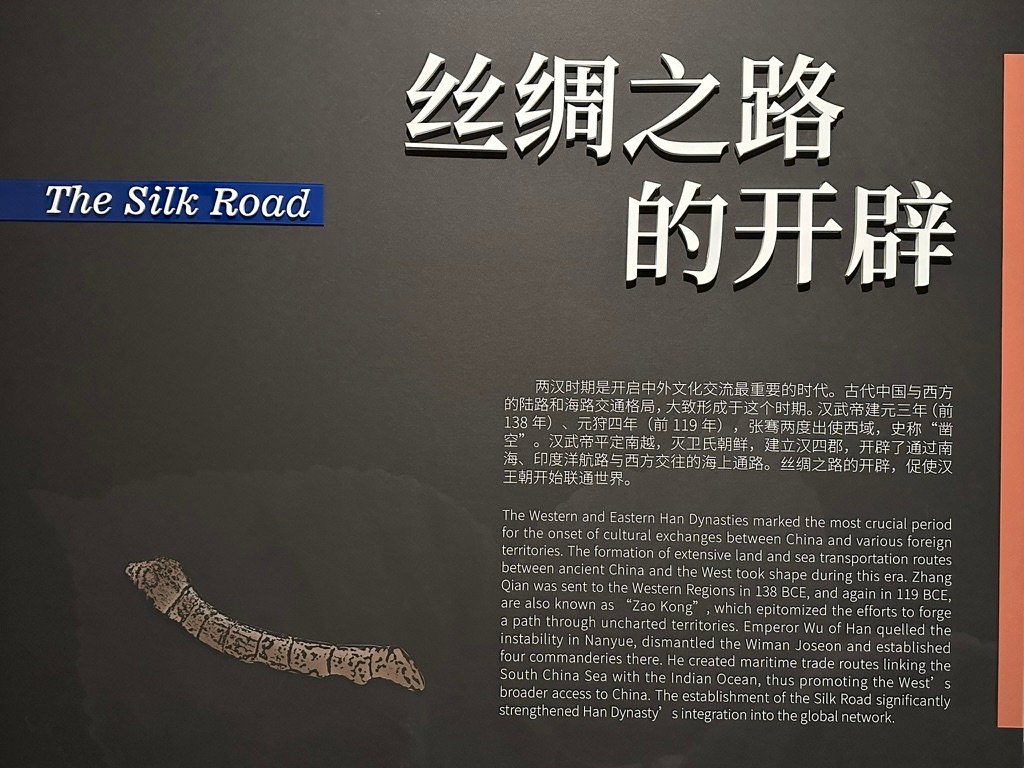
The Silk Road: When Ancient China Opened a New Chapter
By the time Emperor Wu of Han (汉武帝) came to the throne, China was no longer a collection of competing kingdoms. It was a confident, unified empire with stable institutions, expanding agriculture, thriving industries and growing technological capabilities.
It was now ready to look beyond its own frontiers.
The Silk Road did not appear overnight. Earlier exchanges between the Qin state and the peoples of the Eurasian steppe had already laid important foundations. What Emperor Wu achieved was something far more ambitious—he transformed these scattered contacts into an organised network linking China with Central Asia and, ultimately, the Mediterranean world.
Dad’s side note:
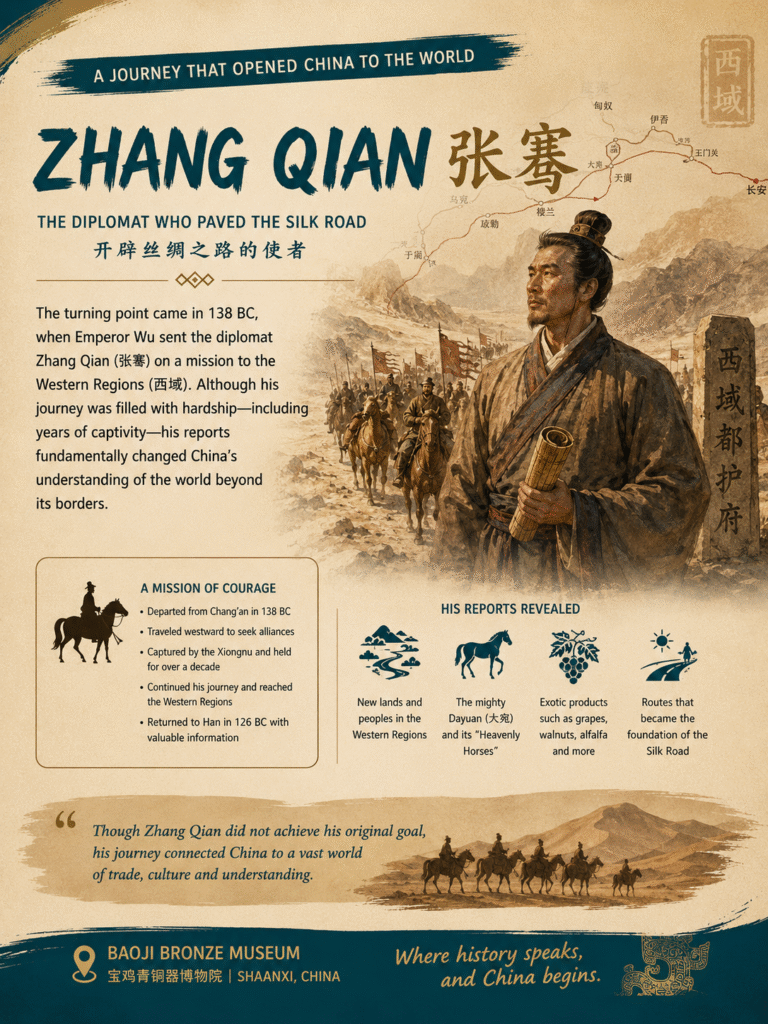
The turning point came in 138 BC, when Emperor Wu sent the diplomat Zhang Qian (张骞) on a mission to the Western Regions (西域). Although his journey was filled with hardship—including years of captivity—his reports fundamentally changed China’s understanding of the world beyond its borders. A second mission in 119 BC further strengthened these connections, opening regular diplomatic and commercial contacts across Central Asia.
These expeditions marked the beginning of what later generations would call the Silk Road (丝绸之路).
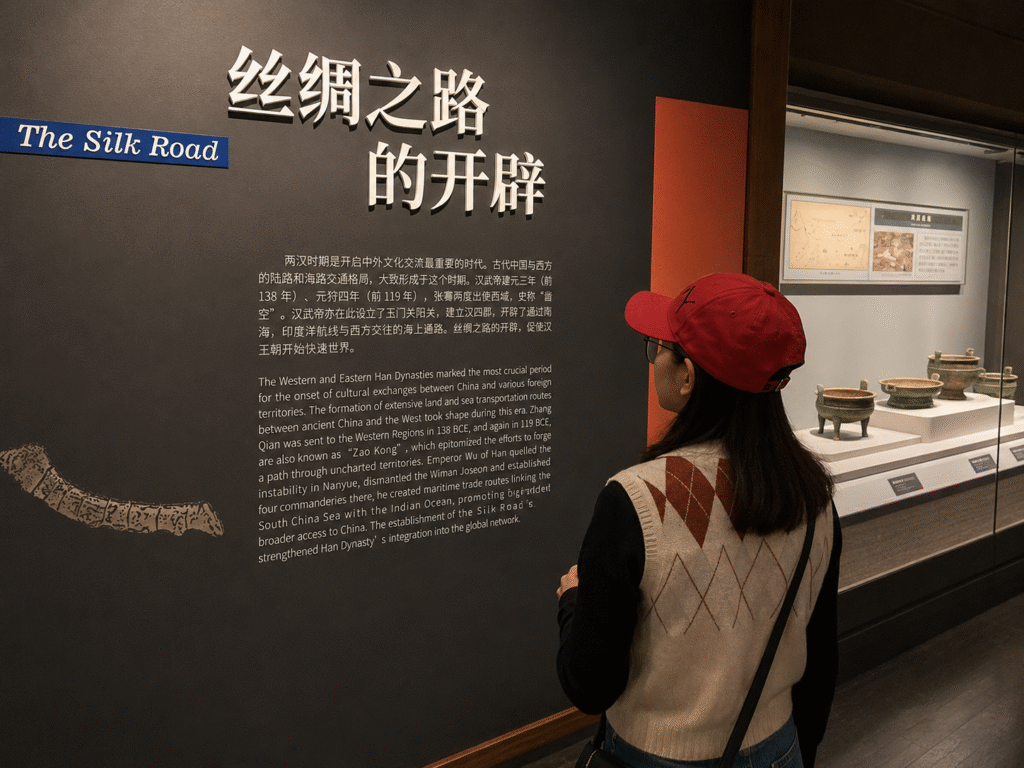
More Than a Road for Silk
The name “Silk Road” can be misleading.
It was never a single road.
Nor was silk its only cargo.
Across deserts, mountain passes and fertile river valleys travelled jade, horses, spices, precious metals, glassware, paper, musical instruments and countless other goods. Just as importantly, ideas travelled alongside them—religions, artistic styles, scientific knowledge, technologies and new ways of understanding the world.
Trade was only one part of the story.
The Silk Road became one of humanity’s greatest highways for the exchange of civilizations.
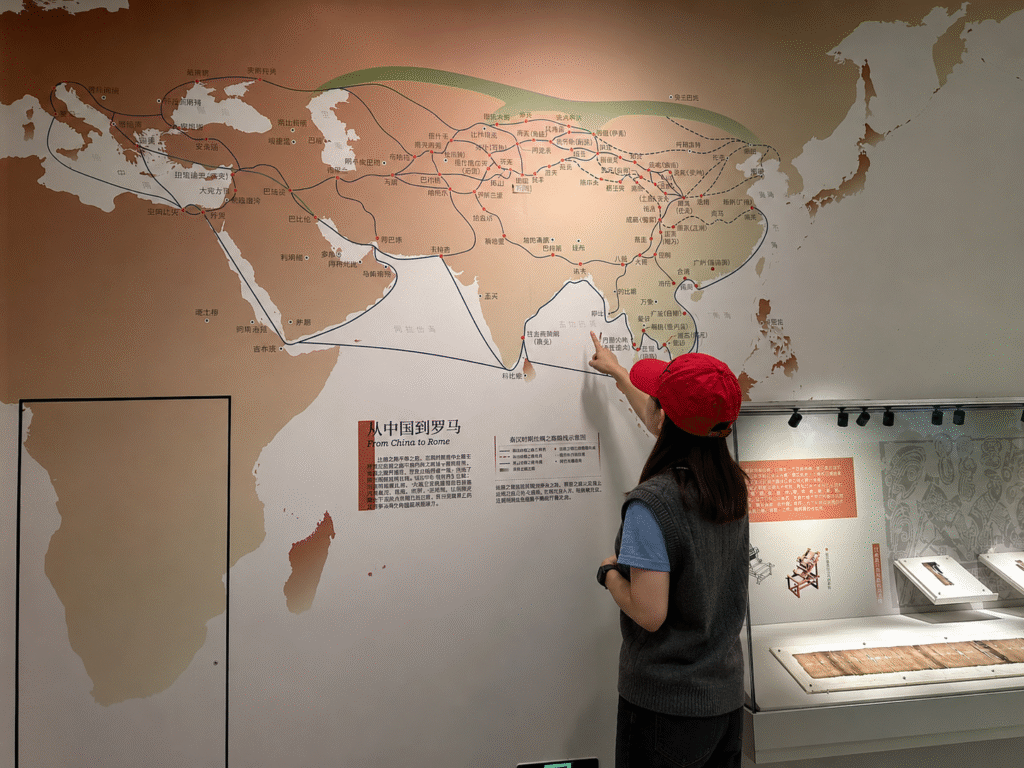
Elaine studied the route stretching west from Chang’an (长安)—today’s Xi’an.
“So people weren’t just exporting products.”
“They were exporting curiosity.”
I nodded.
“And importing it too.”
Cheers stretched his tiny pointer across the map.
“So this wasn’t really a Silk Road.”
“It was a knowledge road.”
Bing Ma Zai smiled proudly.
“And Chang’an became one of the world’s great crossroads.”
From the End of the World to the Centre of Eurasia
Perhaps the greatest achievement of the Silk Road was not economic.
It was psychological.
For centuries, the Chinese world had largely looked inward, focused on consolidating its own civilisation.
Now, for the first time, China possessed a clearer picture of lands far beyond its western mountains.
Likewise, distant civilizations gained their first sustained understanding of China.
The world suddenly became much larger—and much more connected.
Standing in the museum, it became clear that the Silk Road did not simply move goods across continents.
It reshaped how civilizations saw one another.
The Tiny Silkworm That Connected Continents
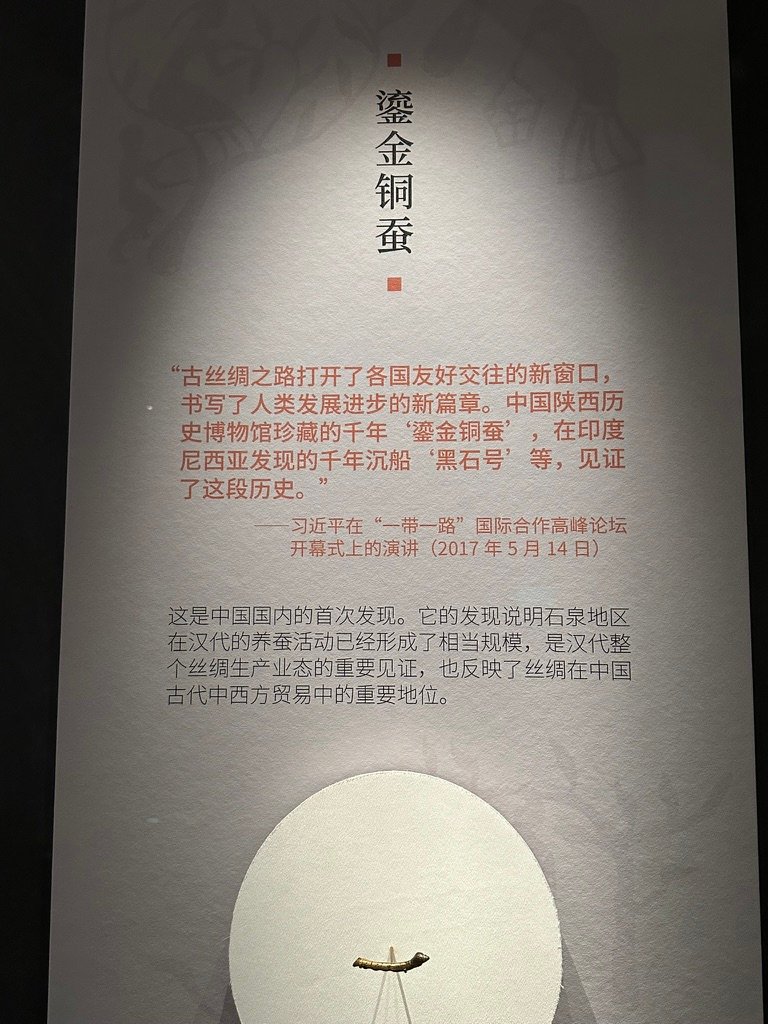
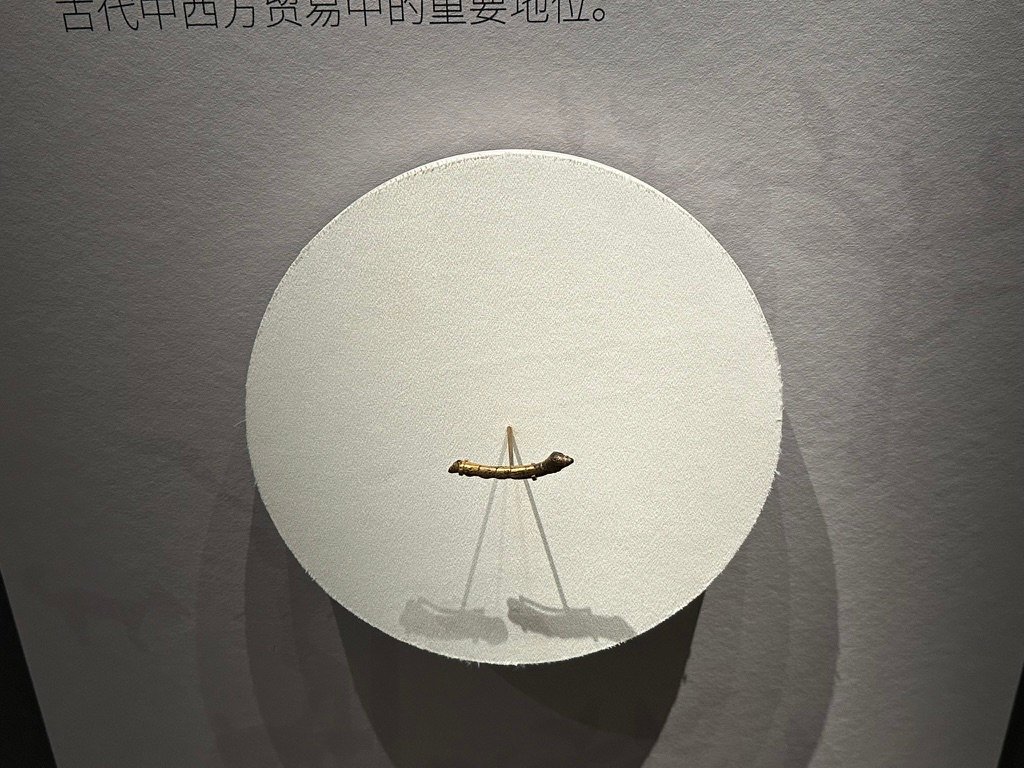
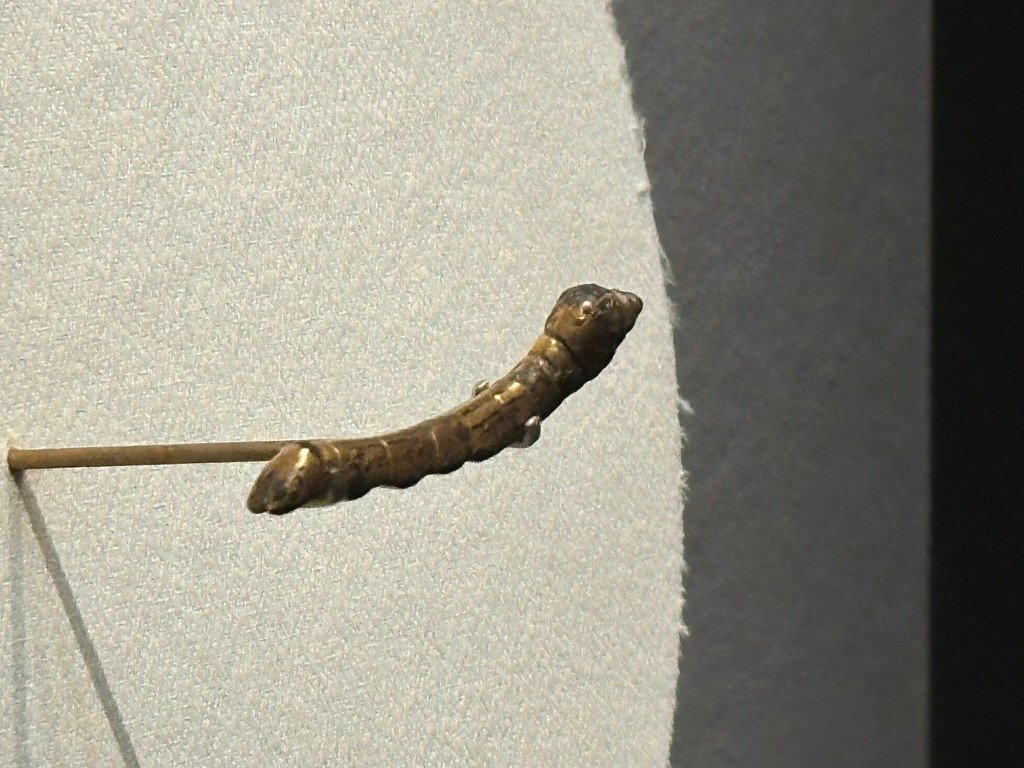
Standing quietly in its display case is a remarkably small artefact—a gilt bronze silkworm (鎏金铜蚕).
At first glance, it hardly looks important.
There are no armies, no emperors, no towering monuments. Yet this tiny bronze silkworm represents one of the most valuable commodities in the ancient world: Chinese silk.
For thousands of years, silk was China’s most famous export. Coveted by royalty from Central Asia to Rome, it travelled thousands of kilometres across deserts, mountains and seas, becoming the namesake of the Silk Road (丝绸之路) itself.
This artefact, discovered in Shiquan County (石泉县), Shaanxi Province, provides rare archaeological evidence that sericulture—the cultivation of silkworms and silk production—had already developed into a sophisticated industry during the Han dynasty. It is a reminder that behind every luxurious silk robe worn by distant kings were countless ordinary farmers carefully raising silkworms, harvesting cocoons and weaving silk thread in villages across China.
The Silk Road, therefore, was never just about merchants crossing deserts.
It began much earlier—with the patient work of countless anonymous families who transformed a humble silkworm into one of history’s most valuable exports.
Elaine looked at the tiny bronze insect for a long moment.
“So the Silk Road…”
“…started with this little fellow?”
Cheers laughed.
“Not with camels?”
“Not with caravans?”
“Not even with Zhang Qian?”
Bing Ma Zai gently shook his head.
“It started with people who knew how to care for silkworms.”
Sometimes the greatest changes in history begin with the smallest creatures.
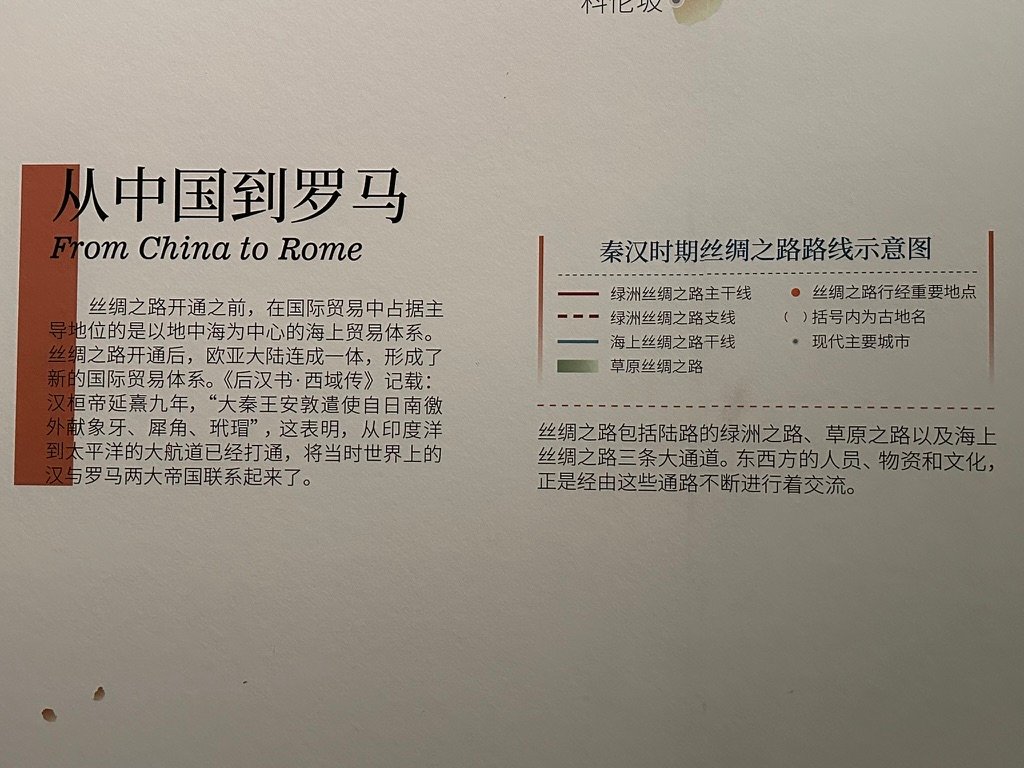
From China to Rome: The World’s First Great Network
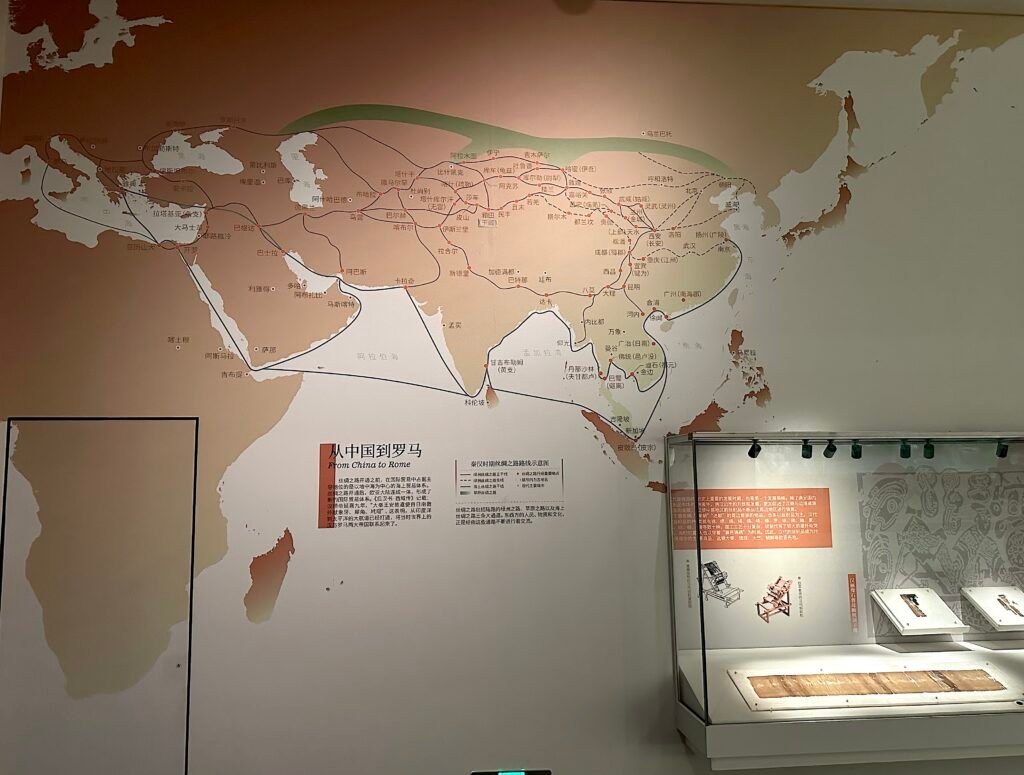
Standing before this enormous map, it suddenly became obvious that the Silk Road was never just a single road.
It was an entire network stretching across continents.
Before the Silk Road emerged, international commerce was dominated by regional trading systems centred around the Mediterranean. China and Rome—the two greatest empires of the ancient world—lay at opposite ends of Eurasia, separated by thousands of kilometres of deserts, mountains and unfamiliar kingdoms.
Yet during the Han dynasty, something extraordinary happened.
Following the pioneering missions of Zhang Qian (张骞) under Emperor Wu of Han (汉武帝), China gradually opened routes westward through Central Asia. At the same time, maritime connections expanded through Southeast Asia and across the Indian Ocean. Together with the northern steppe routes, these formed an interconnected web linking East Asia with Central Asia, Persia, India, Arabia and eventually the Roman world.
For the first time in history, goods, technologies, religions and ideas could travel across nearly the entire Eurasian continent.
The Silk Road was less a road than the world’s earliest international network.
A Route Built by Thousands
Looking closely at the map, one quickly notices something else.
There is no single Silk Road.
Instead, countless routes branch and reconnect across deserts, mountain passes and coastlines.
There were the Overland Silk Road, the Grassland Silk Road, and the Maritime Silk Road. Merchants constantly adapted their journeys according to politics, weather, wars and local conditions. No caravan travelled from China to Rome in one continuous trip. Instead, goods changed hands repeatedly, passing through many different peoples and civilizations before finally reaching distant markets.
Silk from China might be exchanged in Central Asia, transported through Persia, carried to ports on the Mediterranean, and eventually worn by Roman aristocrats who had little idea where it had originally come from.
Likewise, ideas, technologies and artistic styles travelled east along the very same routes.
The Silk Road worked because no single civilisation owned it.
It succeeded because countless cultures participated in it.
More Than Trade
Standing before this map, Elaine quietly traced the route with her finger.
“It looks like today’s airline routes.”
In many ways, she was right.
The Silk Road was the ancient world’s version of a global network.
Instead of carrying emails, it carried merchants.
Instead of data, it carried silk, glassware, spices, horses, paper, religions, music, languages and ideas.
Long before the internet connected continents digitally, the Silk Road connected them physically—and perhaps even more importantly, culturally.
It reminds us that globalization did not begin in the modern age.
Its foundations were already being laid more than two thousand years ago.
When Shipbuilding Crossed Continents
One exhibit stopped us in our tracks—not because of what it looked like, but because of what it revealed.
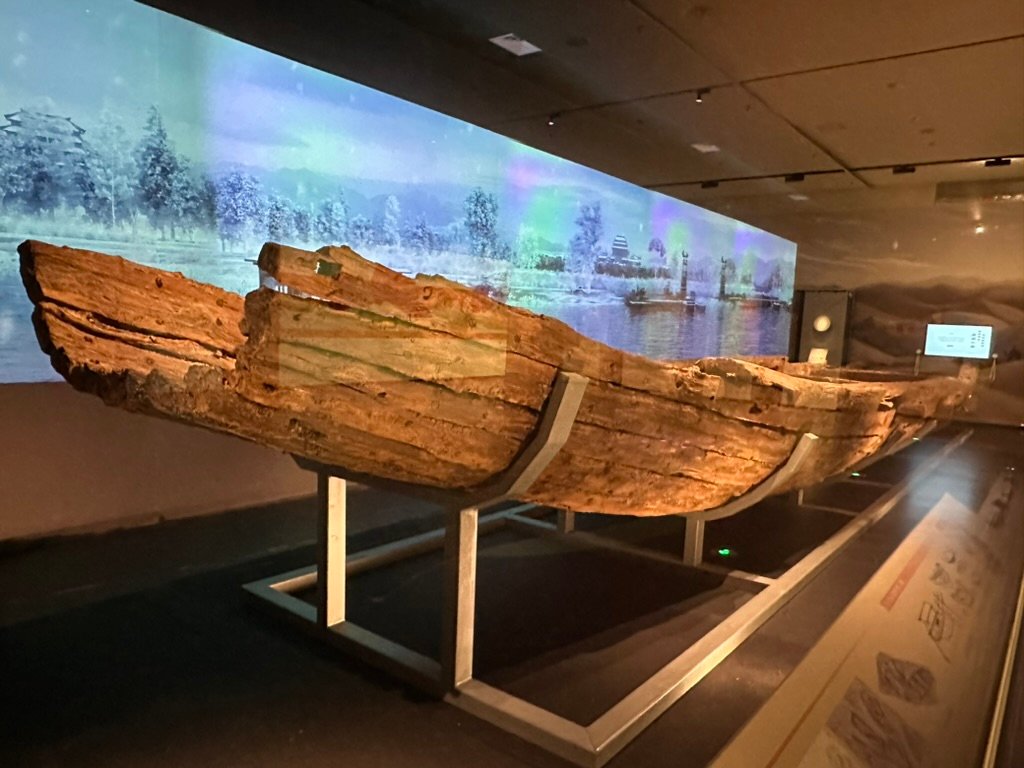
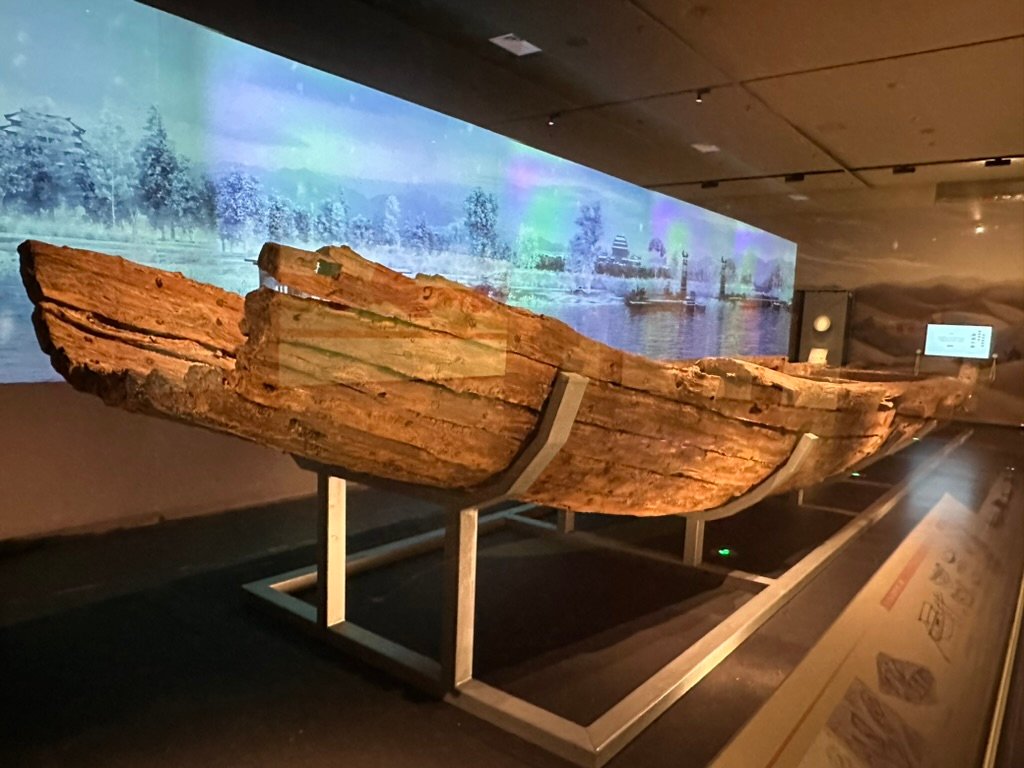
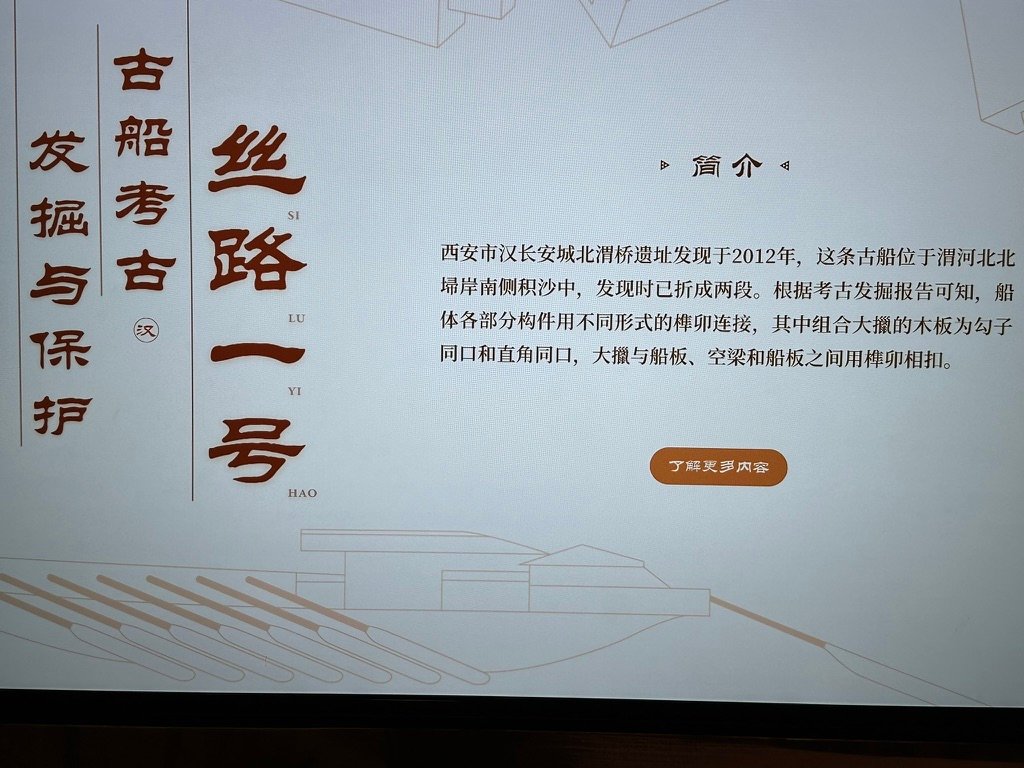
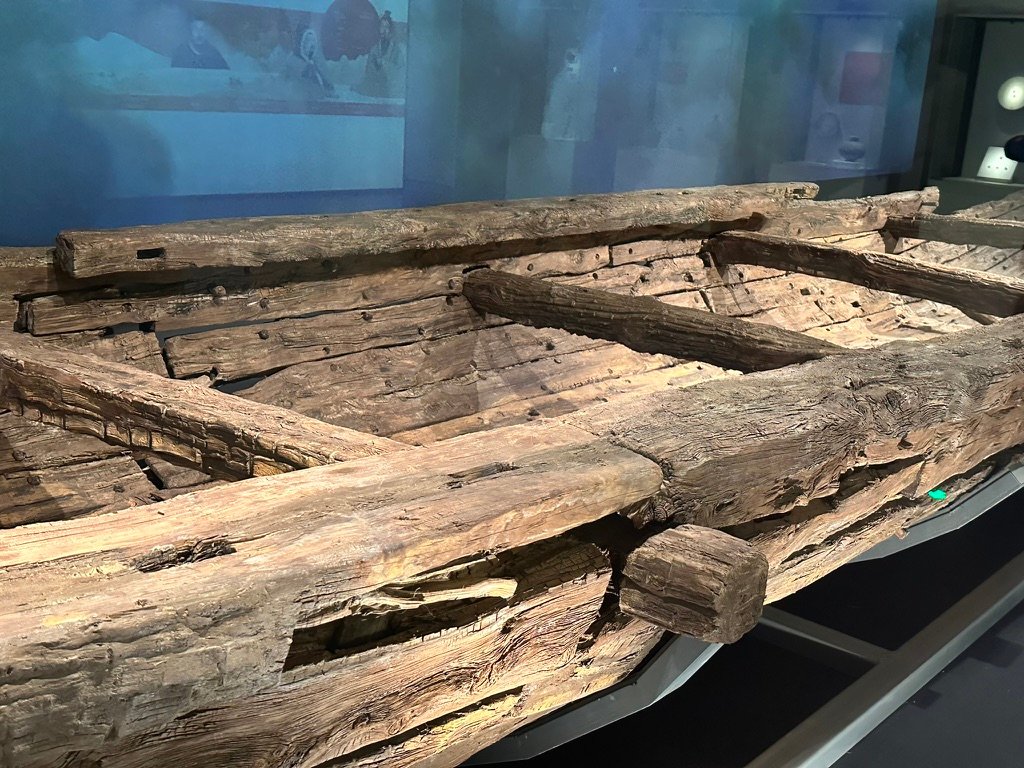
Archaeologists excavating the Beitou Bridge (北湑桥) site in ancient Chang’an (长安) uncovered the remains of a Han dynasty wooden boat. At first glance, it seemed like just another archaeological discovery.
Then researchers examined how the boat had been built.
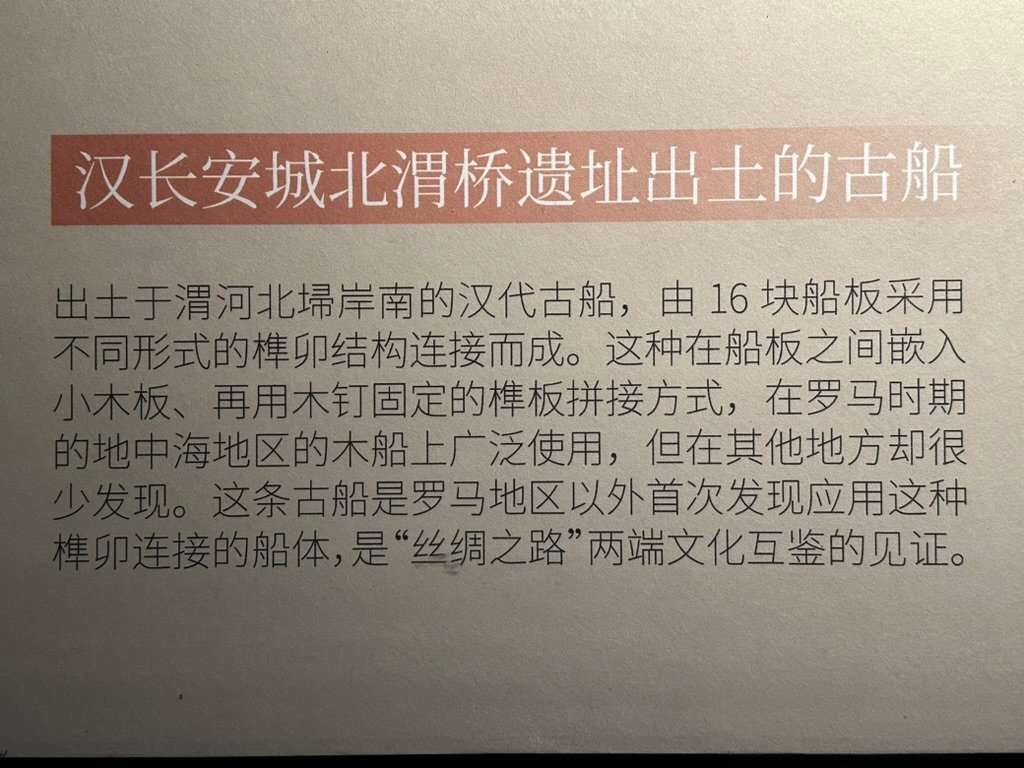
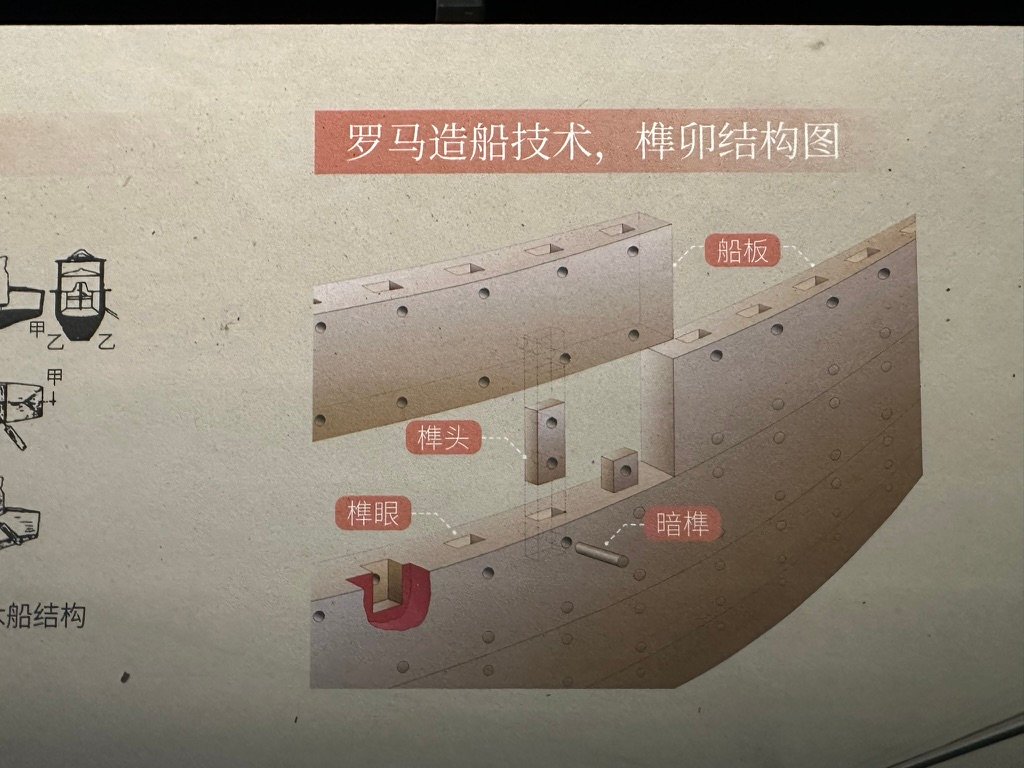
The sixteen wooden planks were joined together using a sophisticated mortise-and-tenon fastening technique that closely resembles methods widely used in Roman Mediterranean shipbuilding. Outside the Roman world, this type of construction is extremely rare.
In other words, this was not simply a Chinese boat.
It was physical evidence that ideas about engineering and shipbuilding were travelling across Eurasia, just as silk, spices and precious goods were.
The Silk Road was carrying knowledge as well as merchandise.
Trade Was Never One-Way
When people hear the words Silk Road, it is easy to imagine caravans leaving China with silk and returning empty.
History was far more interesting.
As merchants travelled between East and West, they exchanged far more than products. They shared technologies, craftsmanship, engineering techniques and practical solutions to everyday problems. Shipbuilding methods, metalworking, artistic styles and agricultural knowledge all crossed cultural boundaries, gradually becoming part of local traditions.
This ancient boat reminds us that civilisation advances not only through invention, but also through the willingness to learn from others.
The Silk Road was not simply China’s gift to the world.
It was also one of history’s greatest classrooms.
Elaine’s Note 💡
Elaine looked at the reconstruction and smiled.
“So… even boats had passports?”
Not quite.
But their ideas certainly did.
Just as today’s engineers borrow ideas from around the world, craftsmen more than two thousand years ago were already learning from people living thousands of kilometres away. Long before the internet connected experts globally, the Silk Road had already become a highway for innovation.
A Roman Technique in a Han Dynasty Boat?
The museum does not ask visitors to simply accept the conclusion.
Instead, it explains why archaeologists believe this remarkable discovery matters.
The ancient boat, excavated in 2012 from the Beitou Bridge (北湑桥) site in Han dynasty Chang’an, was constructed from sixteen wooden planks joined together using an intricate mortise-and-tenon fastening system (榫卯结构). Individual wooden tenons were inserted into precisely cut slots before being secured with wooden pegs, creating a hull that was both strong and remarkably flexible.
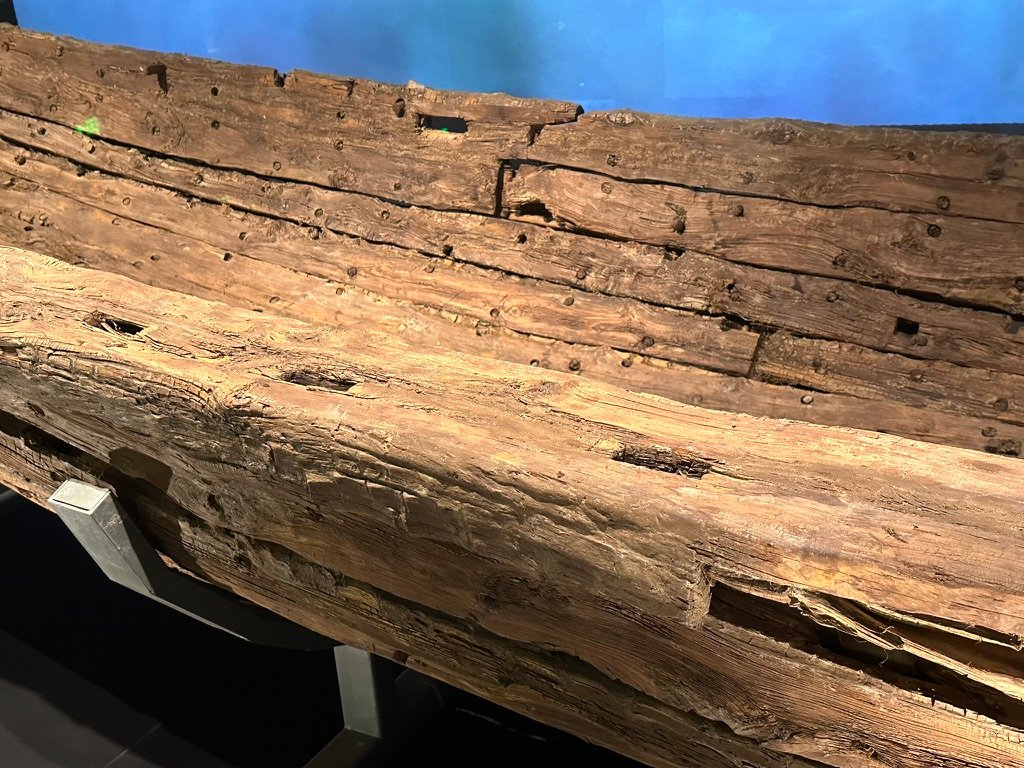
At first glance, the construction looks unmistakably Chinese. After all, mortise-and-tenon joints have been one of the defining features of Chinese wooden architecture for thousands of years.
Yet the particular way these hull planks were assembled surprised archaeologists.
The same plank-joining technique was widely used in Roman Mediterranean shipbuilding, but had rarely been found elsewhere. According to the museum, this Han dynasty vessel represents the first known example outside the Roman world of a ship built using this distinctive structural method.
Whether the technology travelled directly, indirectly through intermediaries, or developed through prolonged contact remains a subject for ongoing research. But one conclusion is difficult to ignore.
Ideas were travelling across Eurasia alongside merchandise.
The Silk Road Carried Technology Too
The Silk Road is often imagined as a route for luxury goods.
Silk travelled west.
Glassware travelled east.
Spices, horses and precious stones crossed deserts and oceans.
But technologies also moved quietly between civilizations.
A carpenter does not need to speak another person’s language to learn a better way to join wooden planks. A shipbuilder can study a vessel arriving in port and adapt its construction. Over decades and centuries, practical knowledge spreads almost invisibly, carried by craftsmen, merchants and sailors rather than official envoys.
Standing before the reconstructed diagrams of the ancient boat, it became clear that the Silk Road was not simply exchanging products.
It was exchanging solutions.
A Different Way to Look at the Silk Road
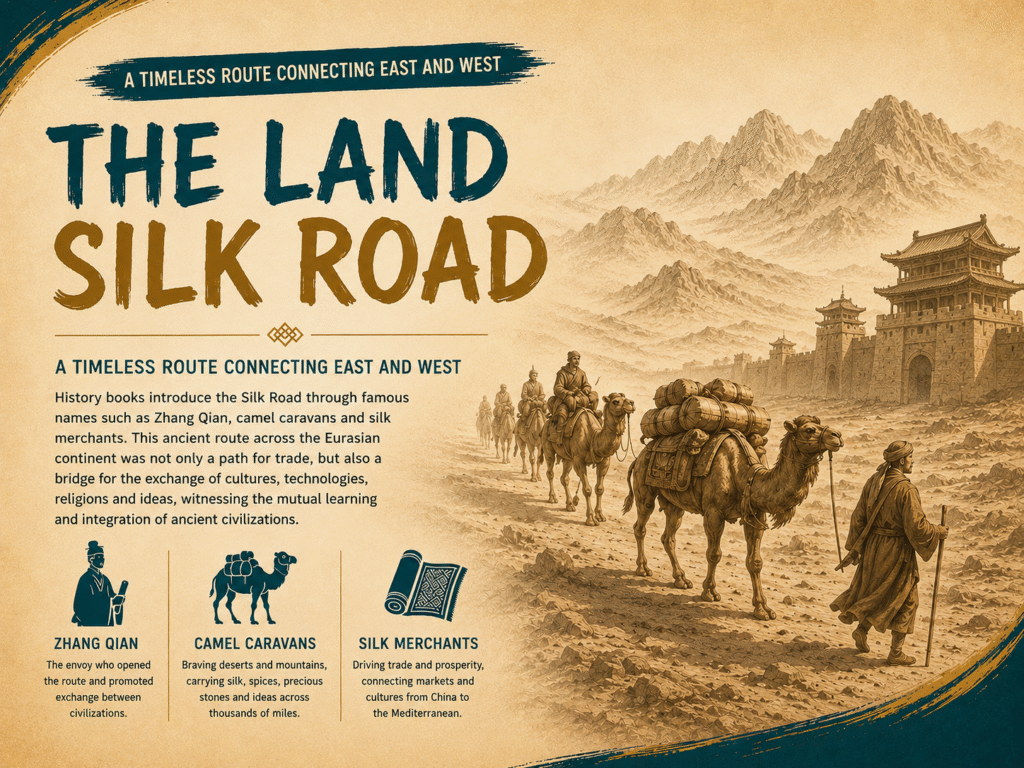
Most history books introduce the Silk Road through famous names such as Zhang Qian, camel caravans and silk merchants.
This ancient boat tells a quieter story.
It reminds us that the Silk Road also connected engineers, craftsmen and shipbuilders. While emperors signed treaties and merchants negotiated prices, ordinary artisans were observing, borrowing and improving one another’s techniques.
The world’s first age of globalization was not built only by diplomats.
It was also built by people with tools in their hands.
The Mirror That Reflected More Than a Face
Silk was not the only thing travelling along the Silk Road.
Ideas travelled.
Technology travelled.
Even beauty travelled.
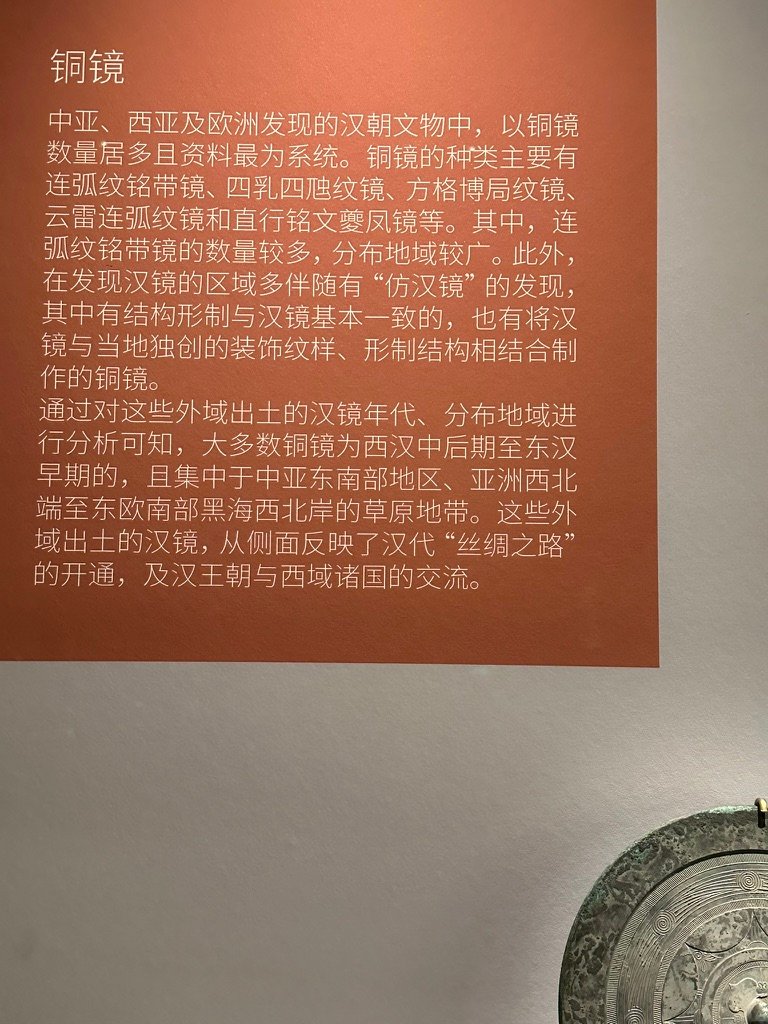
One display introduces an unexpected traveller from Han China—a bronze mirror (铜镜, tóngjìng).
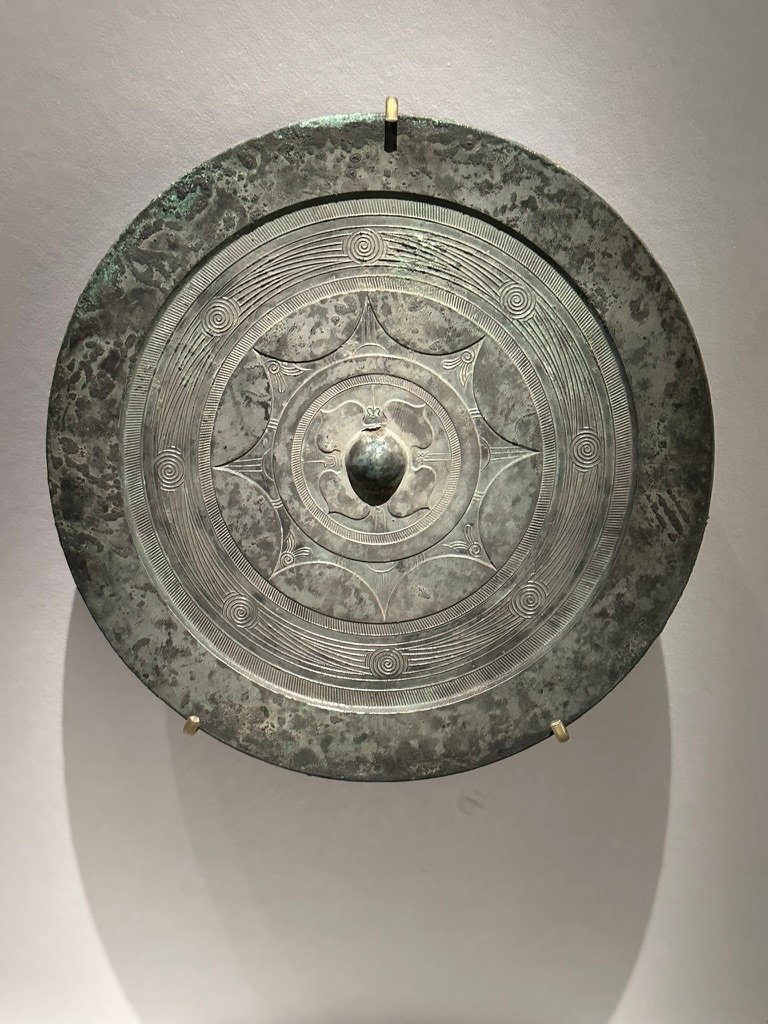
Archaeologists have uncovered Han Dynasty bronze mirrors across Central Asia, Western Asia and even parts of Eastern Europe. Some were made in China and carried thousands of kilometres by merchants and diplomats. Others were locally produced “Han-style mirrors,” carefully copying Chinese designs while blending them with regional artistic traditions.
To historians, this is far more than evidence of trade.
It is evidence of influence.
People rarely imitate objects they do not admire. The fact that craftsmen so far from China reproduced Han mirrors tells us that Chinese craftsmanship, decorative patterns and metalworking techniques had become recognised and valued across Eurasia.
Elaine paused for a moment.
“So these weren’t just exports.”
“They became fashion.”
I nodded.
“Exactly.”
Cheers tilted his head thoughtfully.
“So people didn’t only buy Chinese mirrors…”
“They wanted mirrors that looked Chinese.”
Even Bing Ma Zai looked rather pleased.
“Now that’s influence.”
The museum explains that most of these mirrors date to the later Western Han and early Eastern Han periods, precisely when Emperor Wu’s opening of the Silk Road had transformed scattered regional contacts into a continent-wide exchange network. Their distribution—from Central Asia to the northwestern fringes of Asia and the Black Sea region—provides archaeological evidence of just how extensive those connections had become.
For modern travellers, these mirrors tell a surprisingly familiar story.
Today, successful products are copied because they are fashionable, trusted or admired. More than two thousand years ago, Han bronze mirrors were already doing exactly that.
Sometimes the greatest sign of cultural influence is not what others buy.
It is what they choose to imitate.
The Maritime Silk Road Began Long Before Zheng He
When most people hear the words Silk Road, they picture camel caravans slowly crossing deserts toward Central Asia.
Standing in front of this gallery, however, Elaine noticed something unexpected.
There were no camels.
Instead, the museum displayed a map filled with coastlines, islands and sea routes stretching across Southeast Asia and the Indian Ocean.
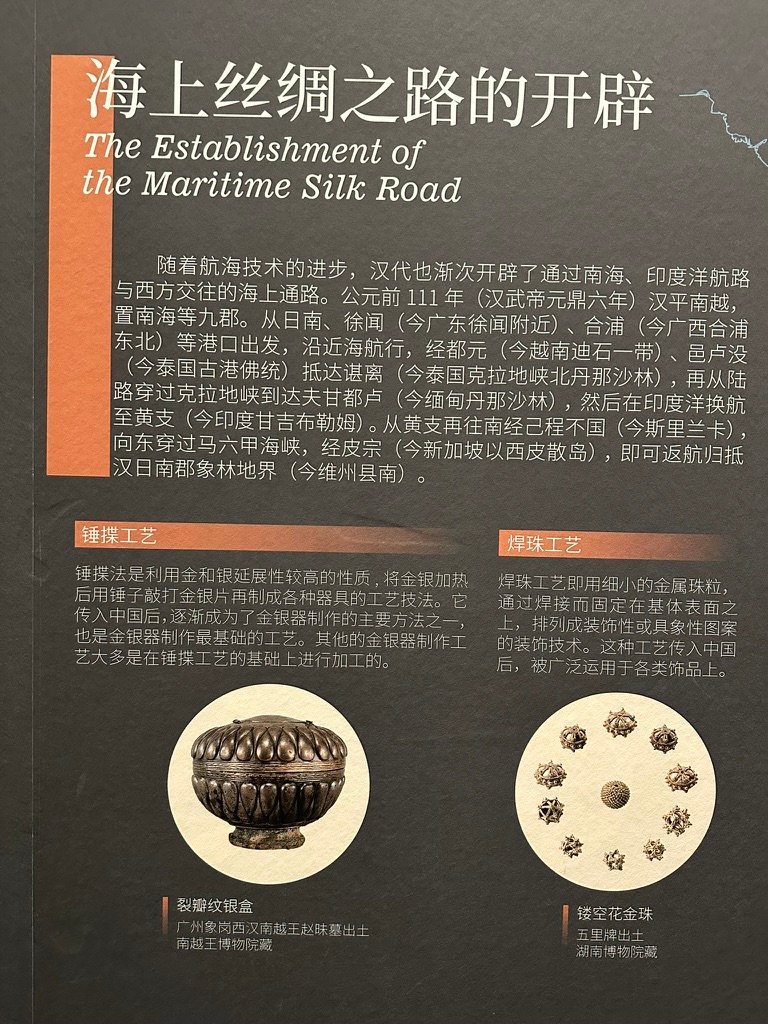
It was the Maritime Silk Road (海上丝绸之路).
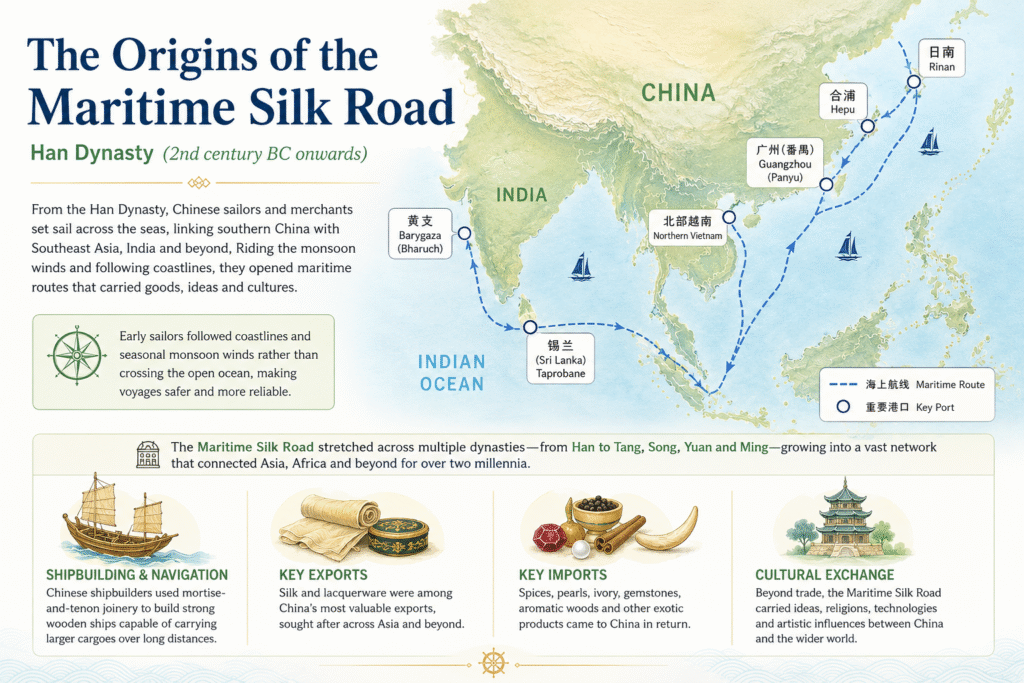
During the reign of Emperor Wu of Han (汉武帝), China did not only open the famous overland Silk Road through Central Asia. Improvements in navigation and shipbuilding also allowed Han merchants and officials to sail south through the South China Sea, following the coasts of present-day Vietnam, Thailand and the Malay Peninsula before crossing the Indian Ocean toward Sri Lanka and India.
The map immediately caught our attention.
“Dad…”
Elaine pointed towards the route.
“It goes through our part of the world.”
She was right.
For perhaps the first time, the Silk Road no longer felt like a distant story about deserts in western China. It suddenly became something much closer to home. The route passed through seas that today connect China, Vietnam, Malaysia and Singapore—waters that millions of Southeast Asians cross every year without realising they once formed one of the world’s earliest international trade highways.
More Than Silk Travelled Across These Seas
The museum also reminds visitors that maritime trade was never simply about transporting silk.
Displayed alongside the map are examples of goldworking techniques such as hammering (锤揲工艺) and granulation (焊珠工艺). These sophisticated decorative methods originated in Western Asia before gradually appearing in China, where local craftsmen adapted and refined them into distinctly Chinese artistic styles.
The exchange worked in both directions.
Chinese goods, ideas and technologies travelled west, while foreign artistic techniques, materials and craftsmanship flowed east. Every voyage carried not only merchants and cargo, but also skills, fashions and new ways of seeing the world.
The Silk Road, whether by land or sea, was never a one-way journey.
From a National Empire to a Global Outlook
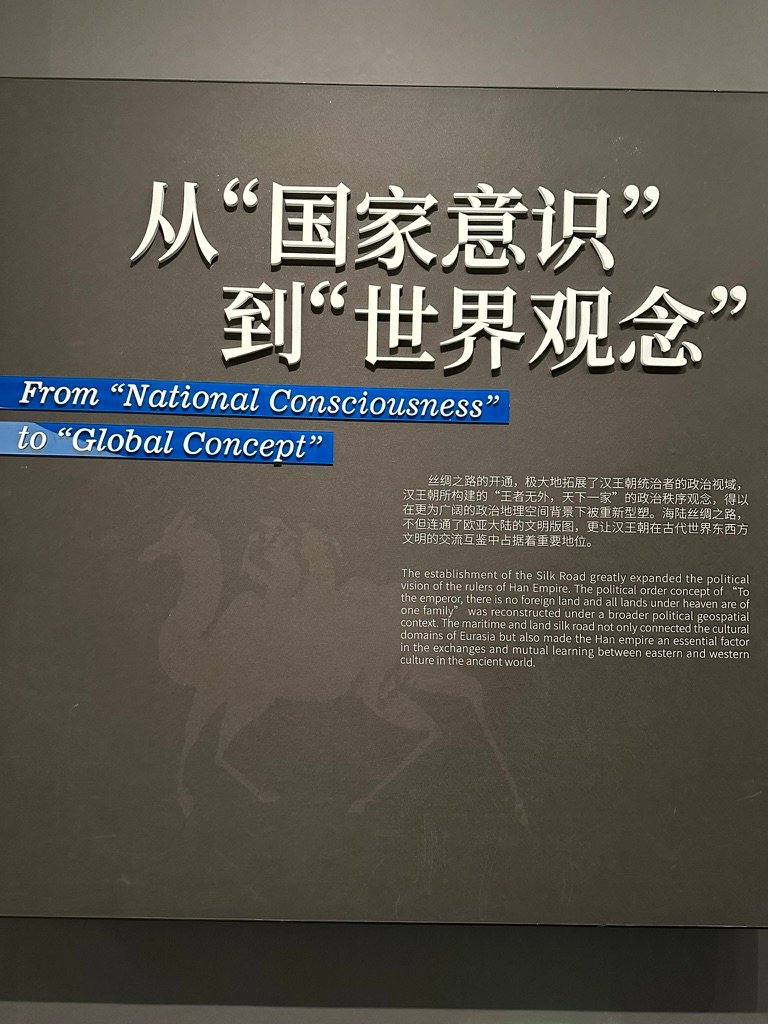
One museum panel carries a striking title:
“From National Consciousness to Global Concept.”
It perfectly captures how the Silk Road transformed the Han Empire.
Opening the land and maritime routes expanded far more than trade. It expanded China’s understanding of the world itself.
For the rulers of Han, the empire was no longer simply centred on the Yellow River. Their political horizon now stretched across Central Asia, the Indian Ocean and distant kingdoms connected by commerce and diplomacy.
This was one of the earliest moments when China began thinking beyond its own borders—not through conquest alone, but through exchange.
Elaine’s Note
“I always thought the Silk Road meant camels in the desert.
I never imagined that ships were sailing through places like Vietnam, Malaysia and Singapore almost 2,000 years ago.
It’s funny… I kept looking at the map thinking, ‘Wait… that’s practically our neighbourhood.’
History suddenly felt much closer.”
🐧 Cheers: “So technically… we’ve been living beside the Silk Road all along?”
🏺 Bing Ma Zai: “Exactly. You just didn’t know the highway was made of water.“
The Silk Road Lived On
If Emperor Wu of Han opened the doors, later generations walked through them.
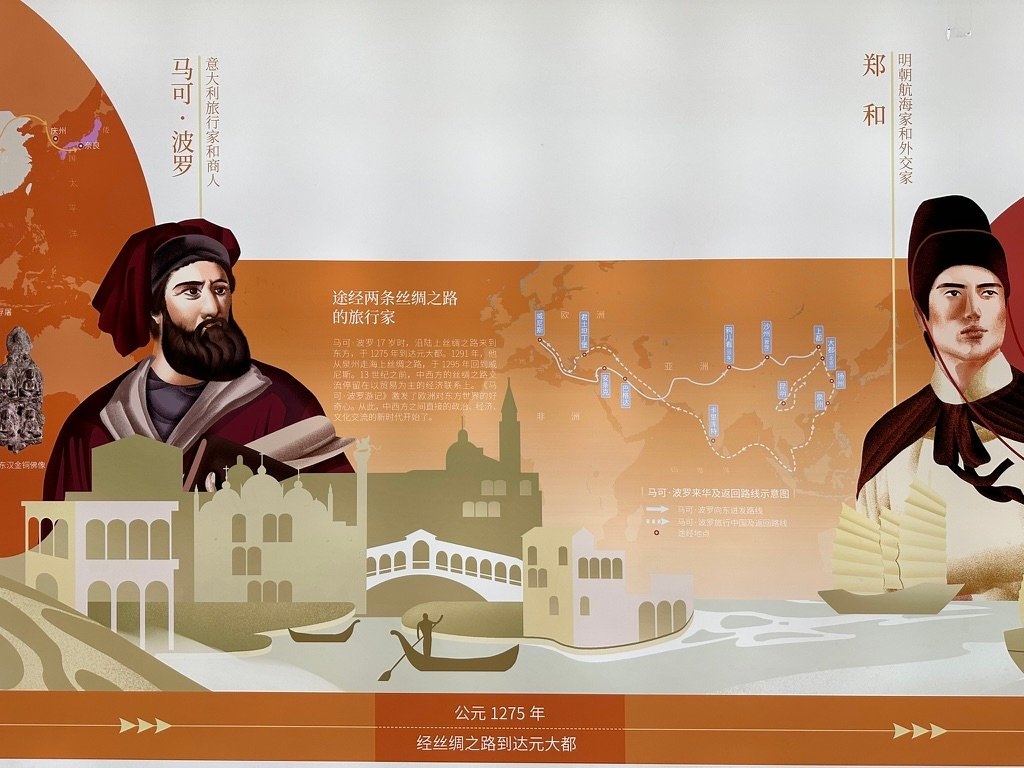
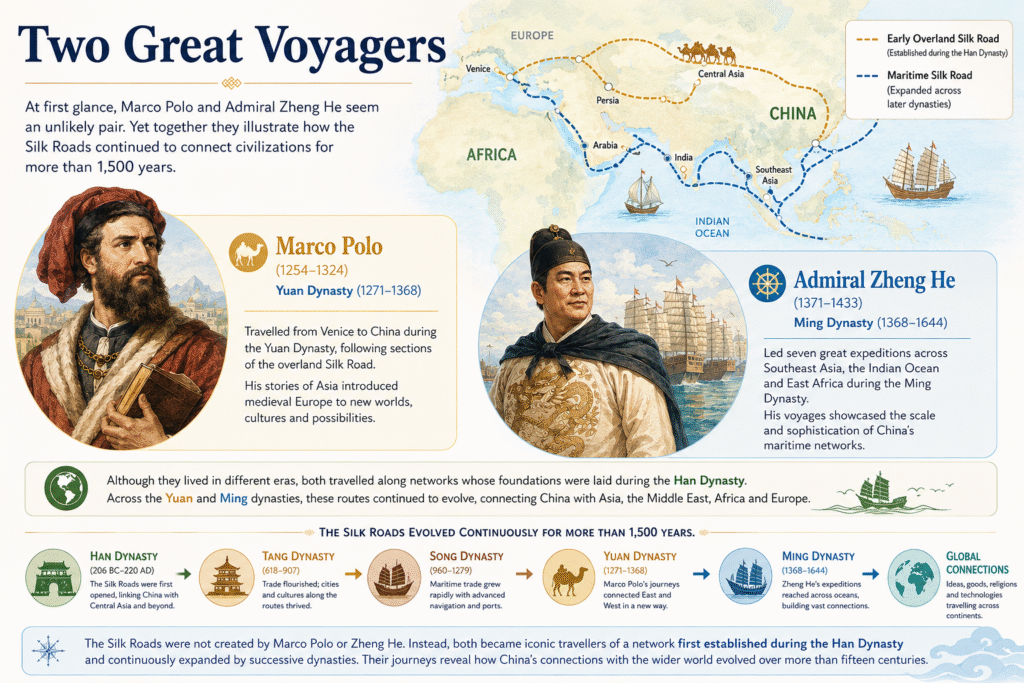
One of the final displays in the gallery brings together two remarkable figures separated by almost two centuries — Marco Polo (1254–1324) and Admiral Zheng He (1371–1433).
At first glance, it seems an unusual pairing.
One travelled east from Venice to China along the overland Silk Road.
The other sailed west from China across the Indian Ocean with enormous treasure fleets.
Yet both became symbols of the same idea: that the world had become more connected because of the routes first pioneered during the Han Dynasty.
Marco Polo’s journey introduced medieval Europe to the wealth, cities and sophistication of China. His writings inspired generations of Europeans to imagine lands far beyond their own horizons.
More than a century later, Zheng He commanded fleets unlike anything the world had seen, visiting Southeast Asia, India, Sri Lanka, Arabia and the east coast of Africa. His voyages demonstrated that the Maritime Silk Road had grown into one of the greatest international trading networks of the medieval world.
Standing between their portraits, Elaine quietly laughed.
“So…”
“One came all the way to China…”
“…and the other sailed halfway around the world.”
Exactly.
Different directions.
Different centuries.
But both followed the same spirit of curiosity that had first taken shape during the Han Dynasty.
Elaine’s Note 💡
“I used to think Marco Polo and Zheng He belonged in completely different history books.
Now I realise they’re actually chapters of the same story.”
🐧 Cheers: “One took the scenic route.”
🏺 Bing Ma Zai: “The other built a fleet.”
🐧 Cheers: “…show-off.”
Conclusion: From Xi’an to the World
When we first walked into the Qin-Han Civilization Gallery, I thought we were simply visiting another museum about ancient China.
Three hours later, Elaine and I walked out with a very different understanding.
This wasn’t just the story of the Qin and Han dynasties.
It was the story of how a civilisation learned to organise a nation, develop institutions, encourage innovation, build confidence in its own culture, and finally open itself to the wider world.
Looking back across the three parts of this series, the journey almost feels like watching China grow up.
First came unification.
Then came the systems, philosophies, technology and culture that gave the empire its strength.
Finally came the moment when China looked beyond its own frontiers, opening both the overland and maritime Silk Roads that connected East and West for centuries to come.
Standing in front of the final gallery, Elaine smiled.
“So… China wasn’t isolated after all.”
“Not at all,” I replied.
“It spent thousands of years learning from others… and giving something back.”
🐧 Cheers had already started tracing the Silk Road across the museum map.
“So technically…” he announced proudly, “…our flight home is following a route people have been travelling for over two thousand years.”
🏺 Bing Ma Zai folded his arms.
“Just with slightly better snacks.”
We all agreed that modern aviation does have a few advantages.
As we left the museum, one thought stayed with us.
Understanding China isn’t simply about memorising emperors, dynasties or dates.
It is about understanding how one civilisation gradually connected itself with the rest of the world—a story that continues today.
And perhaps that’s the greatest lesson of the Qin and Han dynasties.
Not that they built walls.
But that they also built roads.
Some crossed deserts.
Others crossed oceans.
Together, they connected people.
Continue Your China Journey
Understanding China’s Civilisation
- Why Xi’an Was China’s Greatest Ancient Capital
- Walking the Ancient City Wall of Xi’an
- The Terracotta Army: More Than 8,000 Soldiers
Following the Silk Road
- The Giant Wild Goose Pagoda: Where the Silk Road Arrived in Xi’an
- The Muslim Quarter: Where the Silk Road Still Lives Today
- A Morning at Xi’an’s Breakfast Market
Building the Bigger Story
China’s UNESCO World Heritage Sites: Understanding a Civilisation Through Places
Beijing Travel Guide: China’s Ancient Capital and Modern Future
The Small Wild Goose Pagoda: A Quiet Survivor of the Tang Dynasty