“Want to understand Chinese food? Don’t start in a restaurant. Start in a market.”
We Didn’t Expect a Morning Market to Become One of the Highlights of Chengdu
When people think about Chengdu, they usually picture giant pandas, spicy hotpot and the famous giant panda climbing the IFS shopping mall.
Those places are wonderful.
But they don’t necessarily tell you how Chengdu actually lives.
Elaine and I have developed a little travel habit over the years.
Whenever we visit a new city in China, we deliberately stay near a neighbourhood market (菜市场, càishìchǎng).
Not a tourist market.
Not a shopping mall.
Just an ordinary market where local families buy dinner.
It has become one of our favourite ways to understand a city.
That’s exactly what happened during our first week in Chengdu.
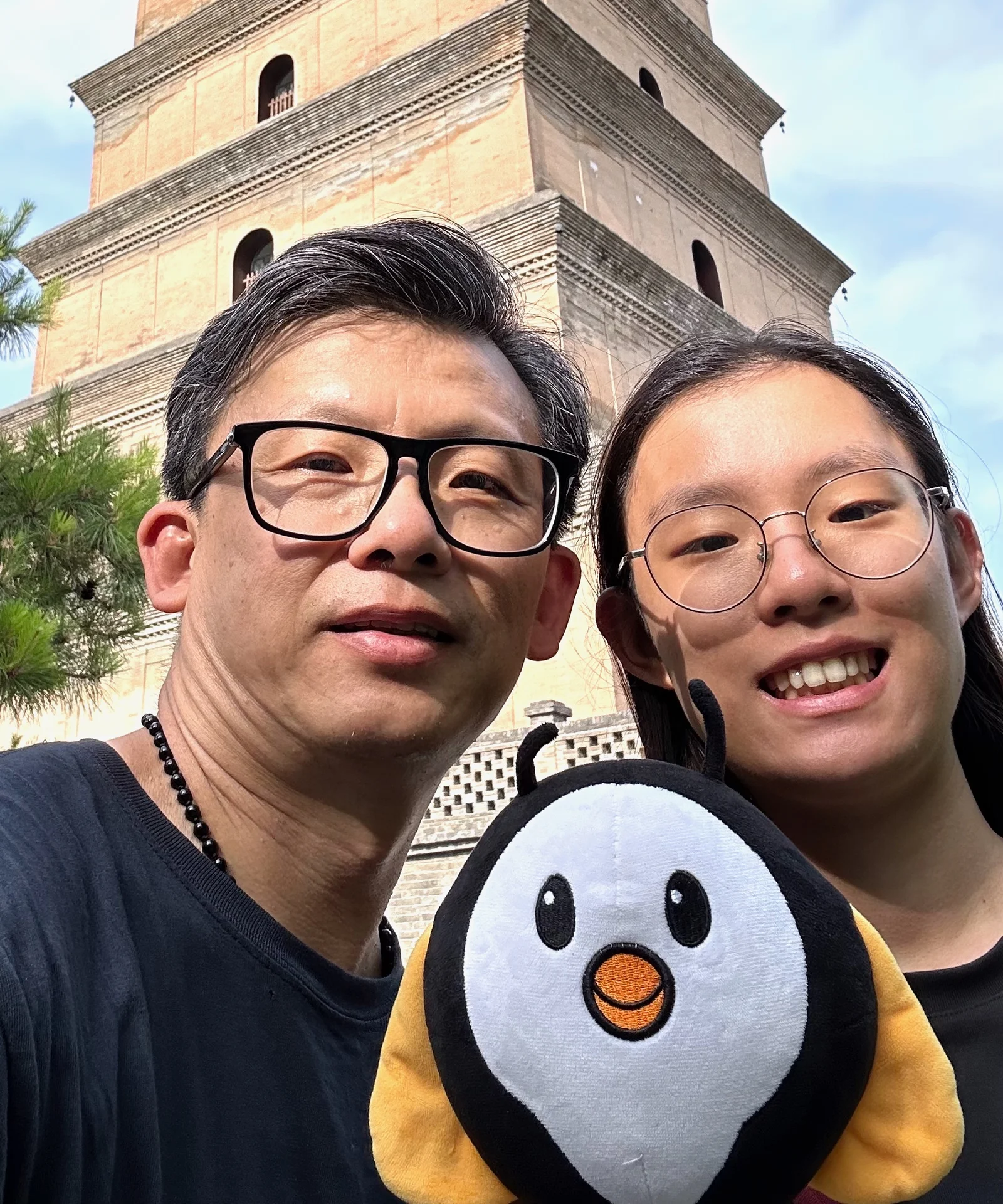
As a reward for Elaine completing part of our long-running Chinese Emperors Timeline Project, we travelled to China together in 2019. We spent one week exploring Chengdu before boarding the high-speed train (高铁, gāotiě) to Xi’an for another week—our very first visit to both cities.
Instead of choosing a hotel in the busiest tourist district, Elaine picked a traditional courtyard homestay in Jinniu District (金牛区).
That single decision changed the entire trip.
Every morning, instead of walking into crowds of tourists…
…we walked into the everyday rhythm of Chengdu.
The Real Chengdu Starts Before Breakfast
Most travel guides begin their Chengdu itinerary with the pandas.
Ours began with grandparents carrying vegetables.
Every morning, the streets slowly came alive.
Bicycles rolled past carrying baskets overflowing with fresh produce.
Shopkeepers swept the pavements.
Neighbours stopped for a chat outside roast duck shops.
Someone was already preparing breakfast noodles.
Someone else was delivering tofu.
Nobody paid us much attention.
We weren’t in a tourist attraction anymore.
We were simply watching Chengdu wake up.
For us, these ordinary moments are often the most memorable part of travelling through China.
Because this is the China that millions of people experience every single day.
Then We Walked Into a World of Colours
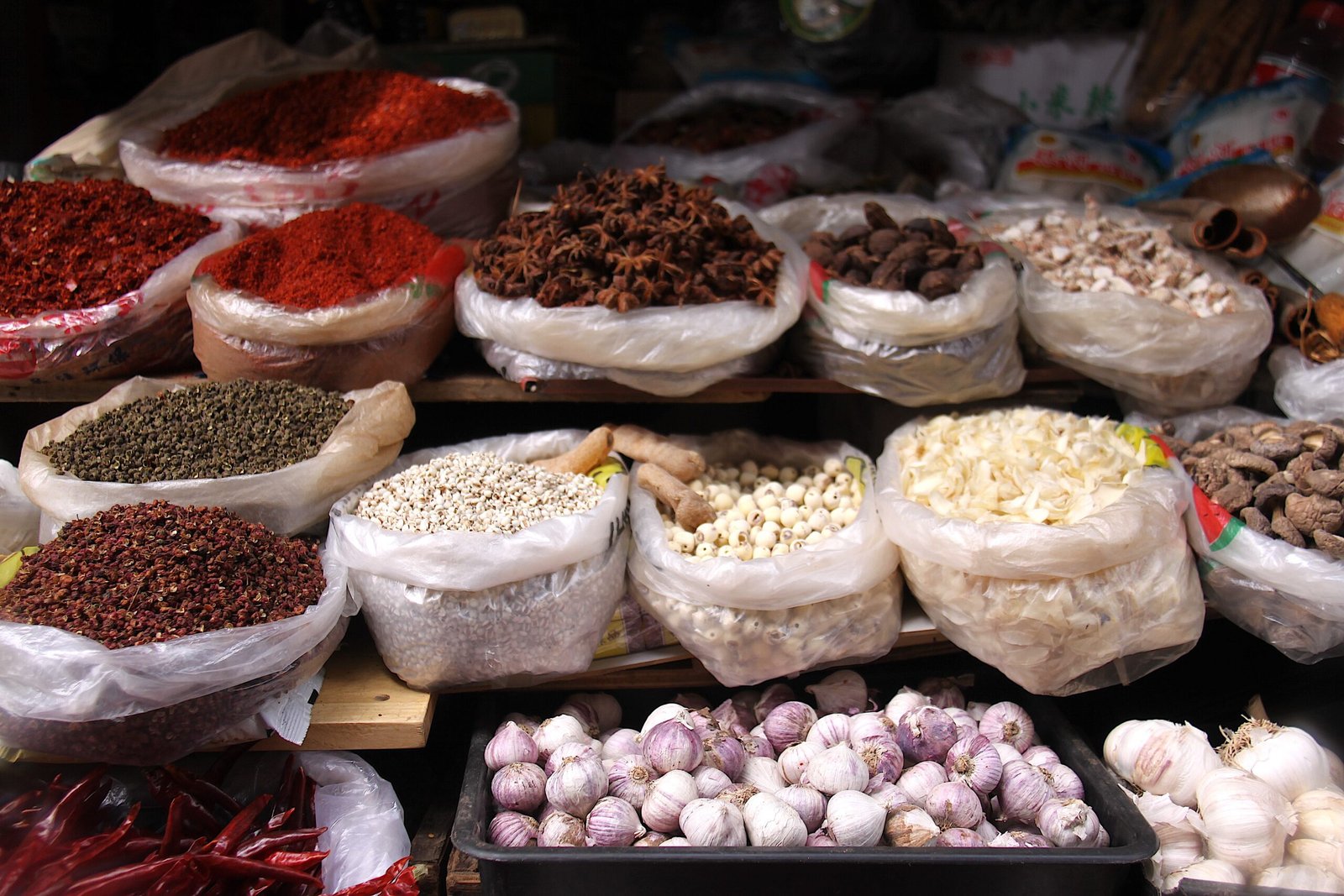
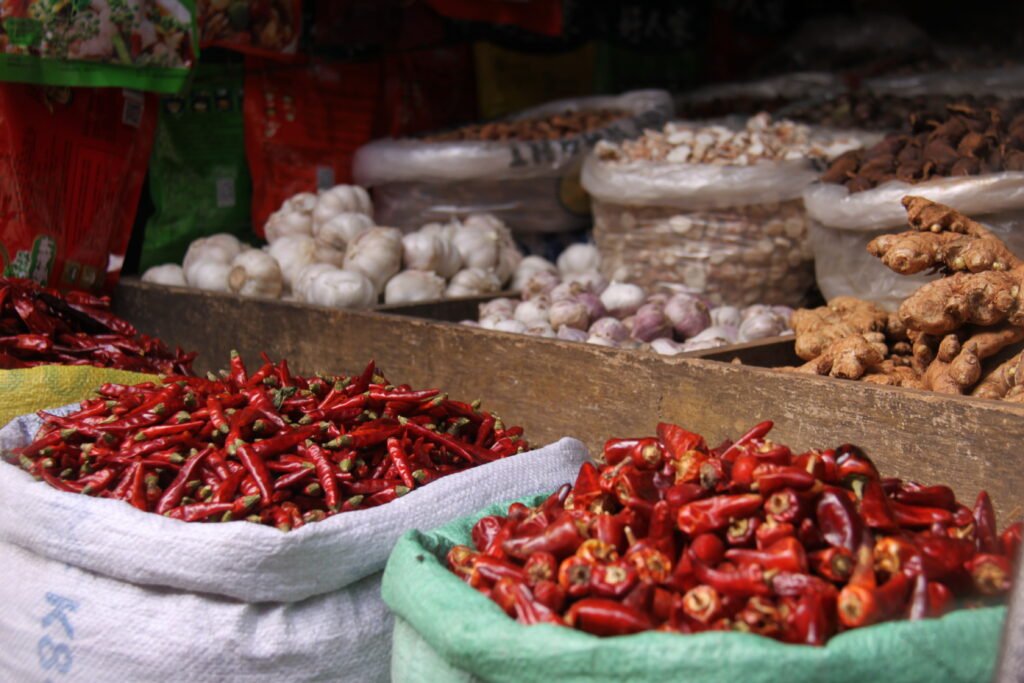
Walking into the market felt like stepping into a giant artist’s palette.
Red.
Brown.
Black.
Green.
Cream.
Golden.
Large cloth sacks overflowed with ingredients that many foreign visitors had never seen before.
Yet every one of them plays an important role in Sichuan cuisine (川菜, Chuāncài).
At first, Elaine simply admired the colours.
Then she leaned closer.
“Dad… these aren’t just spices.”
She was right.
Some were spices.
Some were medicinal ingredients.
Some were soup ingredients.
Some added fragrance.
Some added heat.
Some added the famous má (麻)—that gentle tingling sensation unique to Sichuan cooking.
Suddenly we realised something.
Chinese food isn’t simply “spicy.”
It’s layered.
Each ingredient has a specific job.
Just like an orchestra, every spice contributes its own note to the final flavour.
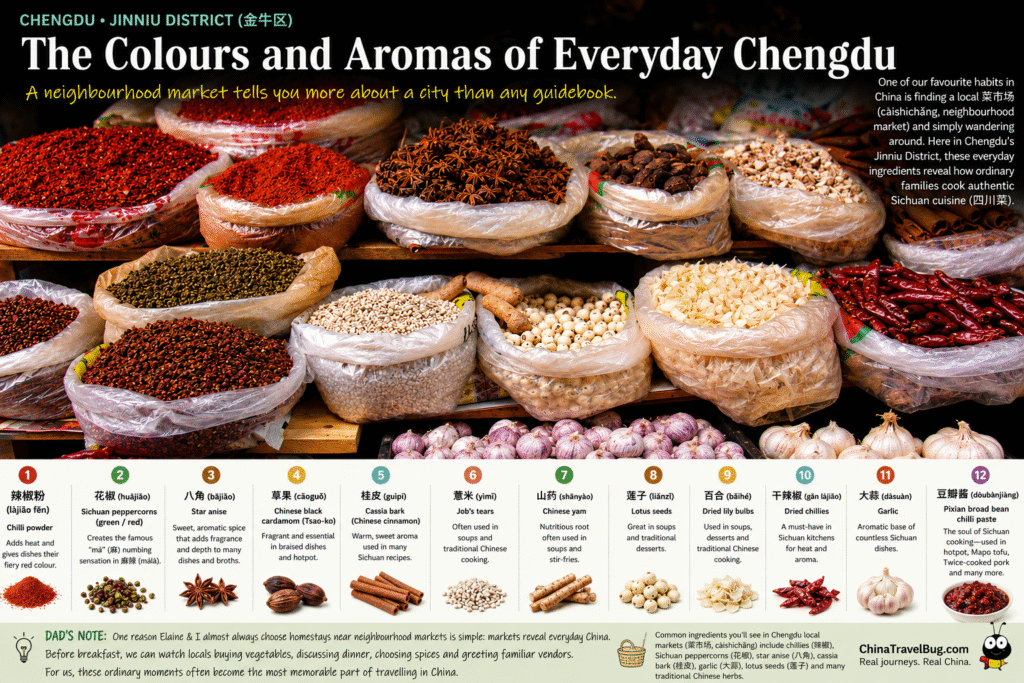
The Ingredients Behind Sichuan Cuisine
Standing in front of those colourful sacks, we slowly began recognising names that we’d seen on restaurant menus.
花椒 (Huājiāo) — Sichuan Peppercorns
Perhaps the most misunderstood ingredient in Chinese cooking.
Despite the English name, Sichuan peppercorn isn’t actually pepper.
It comes from the prickly ash tree and creates the famous 麻 (má) sensation—a gentle citrusy numbness that makes Sichuan food unlike any other cuisine in the world.
Without 花椒, dishes like 麻婆豆腐 (Mápó Dòufu) and authentic 火锅 (Huǒguō) would lose their signature character.
八角 (Bājiǎo) — Star Anise
Its beautiful star shape makes it easy to recognise.
Sweet, warm and aromatic, star anise quietly works behind the scenes in countless braised dishes.
Many visitors have smelled it before without realising what it was.
草果 (Cǎoguǒ)
Sometimes called Chinese black cardamom.
Larger and smokier than Indian cardamom, it adds remarkable depth to slow-cooked broths, braised meats and hotpot soup bases.
桂皮 (Guìpí)
Chinese cassia bark.
Similar to cinnamon—but bolder and less sweet.
It provides warmth rather than sweetness and is one of the quiet heroes of Sichuan cooking.
莲子 (Liánzǐ), 百合 (Bǎihé) and 薏米 (Yìmǐ)
Not everything in the market was fiery red.
We also discovered ingredients used in nourishing soups and traditional Chinese home cooking.
Lotus seeds.
Dried lily bulbs.
Job’s tears.
These ingredients reminded us that Chinese cuisine isn’t only about bold flavours.
It also values balance, nourishment and seasonal eating.
That was another little surprise for us.
Then We Found the “Soul” of Sichuan Food
The deeper we walked into the market, the more we noticed another pattern.
Rows and rows of enormous black bottles.
Large red jars.
At first, they didn’t look particularly exciting.
Until we realised…
Almost every Sichuan kitchen probably has some version of these sitting on a shelf.
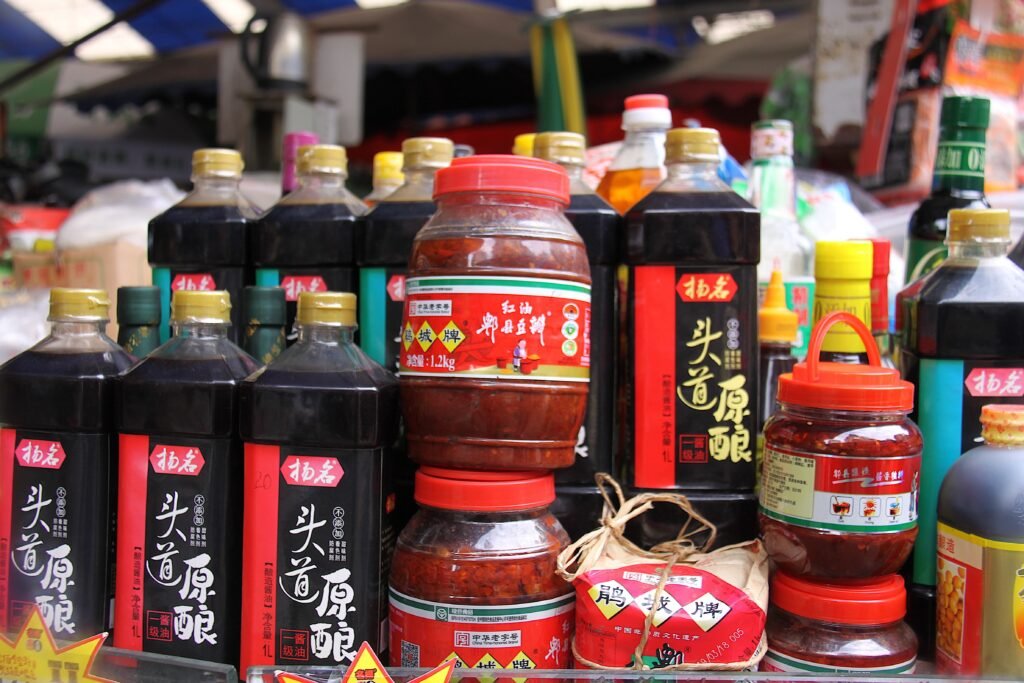
Behind Every Great Sichuan Dish Is a Shelf Like This
Walking a little further through the market, Elaine stopped again.
This time, it wasn’t because of colourful spices.
It was because of an entire stall filled with enormous black bottles and bright red jars.
At first glance, they didn’t look particularly exciting.
“They’re just bottles of soy sauce, right?” Elaine asked.
Not quite.
The stall owner was actually selling the flavour foundation of Sichuan cuisine.
For the first time, we realised that every Chinese kitchen probably has its own collection of trusted sauces and pastes—just as an Italian kitchen keeps olive oil, or a Japanese kitchen keeps soy sauce and miso.
The Black Bottles: 酱油 (Jiàngyóu) – Naturally Brewed Soy Sauce
The large black bottles immediately caught our attention.
The label reads:
头道原酿 (Tóudào Yuánniàng)
Literally:
“First Press, Naturally Brewed.”
This isn’t ordinary soy sauce.
It comes from the first extraction during traditional fermentation, giving it a richer aroma and deeper flavour than lower-grade soy sauces.
No wonder locals buy them in one-litre bottles.
Chinese families cook at home almost every day.
Soy sauce isn’t a condiment sitting forgotten in the refrigerator.
It’s an everyday ingredient.
The Red Jars: 郫县豆瓣酱 (Píxiàn Dòubànjiàng)
Then our eyes moved to the large red jars in the middle.
If soy sauce is one pillar of Sichuan cooking…
Pixian Doubanjiang is the other.
Made from fermented broad beans (蚕豆, cándòu) and chillies (辣椒, làjiāo), this famous paste comes from Pixian (郫县), now part of greater Chengdu.
Many Chinese chefs call it:
“The soul of Sichuan cuisine (川菜之魂).”
Without it, many iconic dishes would lose their unmistakable character.
Among them are:
- 麻婆豆腐 (Mápó Dòufu) – Mapo Tofu
- 回锅肉 (Huíguōròu) – Twice-Cooked Pork
- 鱼香肉丝 (Yúxiāng Ròusī) – Fish-Fragrant Shredded Pork
- countless stir-fries, braised dishes and hotpot soup bases.
Standing in front of those jars, we finally understood why Chengdu’s food tastes different.
The secret isn’t simply “more chilli.”
It’s the depth created through fermentation.
Every Bottle Has a Job
Looking around the stall, we noticed bottles and jars in different shapes, sizes and colours.
There were:
- 酱油 (jiàngyóu) – Soy sauce
- 生抽 (shēngchōu) – Light soy sauce, used for seasoning.
- 老抽 (lǎochōu) – Dark soy sauce, mainly for colour and richness.
- 芝麻油 (zhīmayóu) – Sesame oil, added just before serving for fragrance.
- 辣椒油 (làjiāoyóu) – Chilli oil, adding heat and aroma.
- Different varieties of 豆瓣酱 (dòubànjiàng) for different styles of cooking.
To us, they looked like a wall of mysterious Chinese labels.
To local home cooks, choosing the right bottle is as natural as selecting the right vegetables.
Understanding China Starts Here
One thing Elaine and I have gradually discovered while travelling across China—from Beijing to Xi’an, Baoji and now Chengdu—is that understanding a country’s food doesn’t begin in restaurants.
It begins in neighbourhood markets.
Restaurants show you the finished masterpiece.
Markets reveal the ingredients, habits and traditions that make those masterpieces possible.
Standing in front of these bottles, we weren’t just looking at condiments.
We were looking at the everyday flavour of millions of Chinese family dinners.
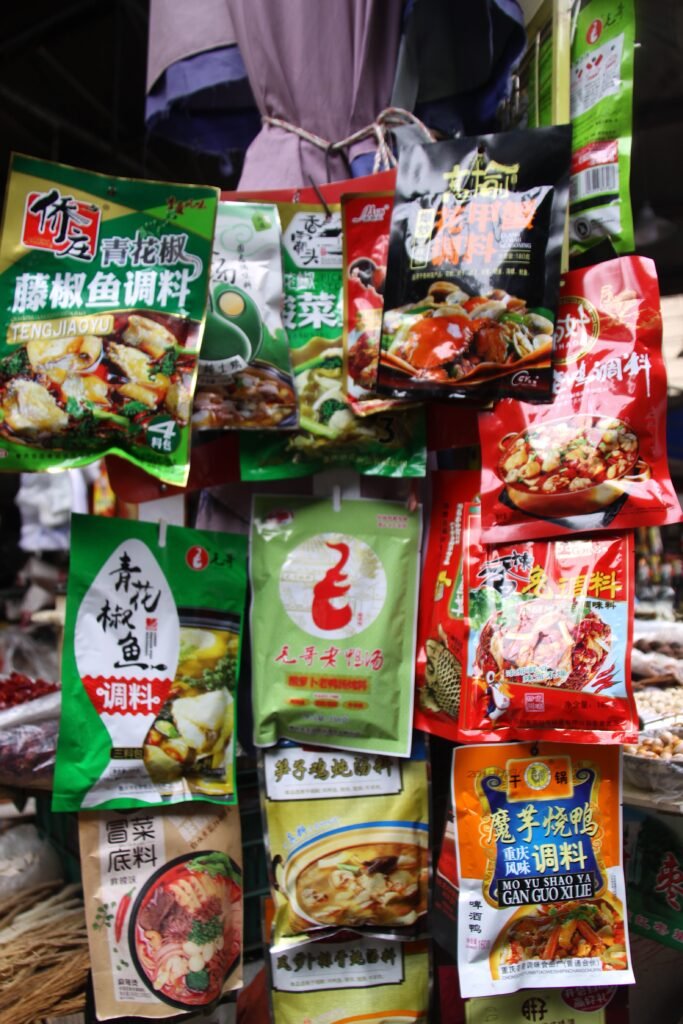
From Traditional Ingredients to Modern Convenience
As we were about to leave the market, another stall caught Elaine’s attention.
Rows of colourful seasoning packets hung from a rack, each promising a different famous Chinese dish.
It felt strangely familiar.
Back home in Southeast Asia, we are used to seeing ready-made curry pastes and spice mixes for dishes like laksa, rendang or tom yum.
China has its own version.
Only here, the packets were for dishes that many of us have only ever ordered in restaurants.
A Shortcut to Authentic Sichuan Cooking
Reading the packets was like reading a menu.
Among them were seasonings for:
- 青花椒藤椒鱼调料 — Green Sichuan Pepper Fish
- 冒菜底料 — Mao Cai soup base
- 重庆风味调料 — Chongqing-style spicy dishes
- 魔芋烧鸭调料 — Braised Duck with Konjac seasoning
- various hotpot bases, braised dishes and stir-fries.
Instead of buying ten different spices separately, families could simply pick up one packet that already contained the correct balance of chilli, Sichuan peppercorns, fermented bean paste and aromatic spices.
For busy households, it made perfect sense.
Just as Italians buy ready-made pasta sauces and Japanese families use curry roux cubes, many Chinese families rely on these carefully blended seasoning packets to recreate traditional flavours at home.
Tradition Doesn’t Stand Still
What fascinated us was not that China had convenience foods.
It was how those convenience foods reflected centuries of culinary tradition.
Earlier that morning, we had admired sacks of dried chillies, star anise, cassia bark, Sichuan peppercorns and fermented bean paste.
Now we were seeing those same ingredients transformed into ready-to-use recipes.
Traditional knowledge had simply been packaged for modern life.
Looking Beyond the Tourist Attractions
People often travel to Chengdu to eat hotpot, visit the Giant Panda Base or stroll through Jinli Ancient Street.
Those are wonderful experiences.
But one of the most memorable parts of our week in Chengdu happened inside an ordinary neighbourhood market in Jinniu District.
There were no tour groups.
No souvenir shops.
No famous landmarks.
Instead, we watched elderly neighbours discussing what to cook for dinner, vendors recommending different types of chilli, families buying soy sauce by the litre, and shelves filled with ingredients that quietly define one of China’s greatest regional cuisines.
For Elaine and me, this is why we almost always choose to stay in local neighbourhoods instead of tourist districts.
Markets like these reveal something no guidebook can fully explain.
They show how people actually live.
China is not only discovered in its palaces, ancient walls and famous attractions.
It is also discovered in its neighbourhood markets, where every basket of vegetables, every bottle of soy sauce and every packet of seasoning tells a small part of the country’s everyday story.
Dad’s Note
Whenever Elaine and I plan a trip in China, one question always comes before choosing a hotel:
“Is there a neighbourhood market nearby?”
Because if we can spend an hour wandering through one of these markets, we usually leave understanding the city far better than if we had spent the same hour shopping in a mall.
The famous sights tell you what China built.
Neighbourhood markets show you how China lives.