Ask almost anyone planning their first trip to Chengdu (成都, Chéngdū) and you’ll hear the same list.
See the giant pandas.
Eat hotpot.
Visit 宽窄巷子 (Kuānzhǎi Xiàngzi).
Walk 春熙路 (Chūnxī Lù, Chunxi Road).
Take a selfie with the famous panda climbing out of the IFS shopping mall.
We did all that too.
But strangely enough…
One of my favourite memories of Chengdu wasn’t any famous attraction.
It was simply walking back to our homestay every evening through Jinniu District (金牛区, Jīnniú Qū).
The Chengdu We Didn’t Plan To Discover
When Elaine was fourteen, she had just completed part of our Emperor Timeline Project.
Instead of buying another gadget as a reward, I promised her something much better.
“You’ve earned a trip to China.”
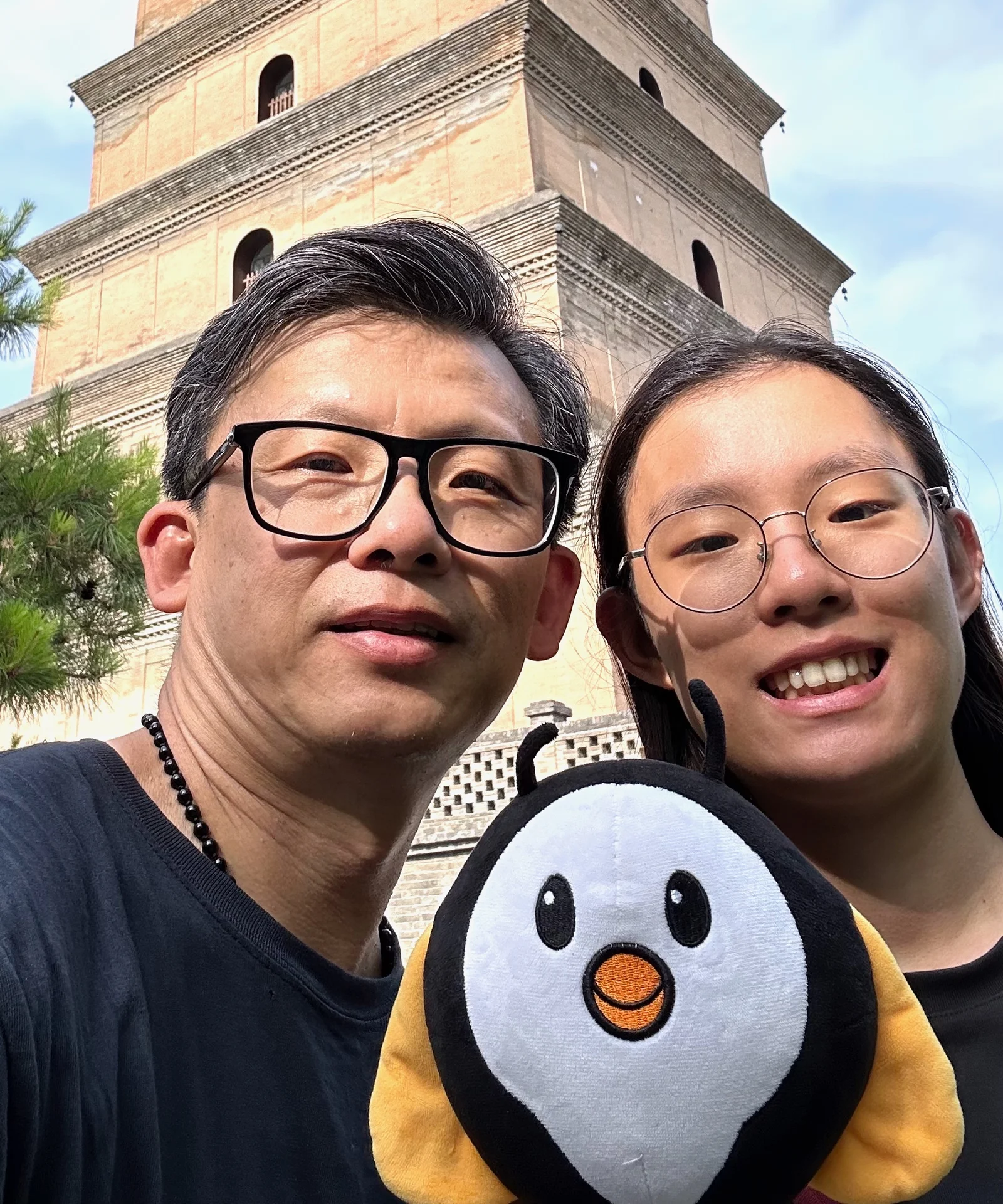
So in 2019, we spent our first week exploring Chengdu before taking China’s High-Speed Rail (高铁, gāotiě) to Xi’an for another week.
Like many first-time visitors, we expected Chengdu to be about pandas and spicy food.
Instead…
We accidentally discovered ordinary China.
Living Among Locals
Our 民宿 (mínsù) wasn’t beside a famous attraction.
It sat quietly inside Jinniu District, surrounded by apartment blocks, neighbourhood shops and tree-lined streets.
We hardly saw foreign tourists.
In fact, we rarely even noticed Chinese tour groups.
This wasn’t a sightseeing district.
It was simply where people lived.
Every morning elderly residents swept the pavements outside their homes.
Fruit sellers arranged colourful baskets outside neighbourhood shops.
Delivery riders buzzed past on electric scooters.
Children returned home from school.
Grandparents chatted beneath the trees.
For one week…
We became part of that rhythm.
Not locals.
But temporary neighbours.
A Street That Never Needed To Impress Anyone
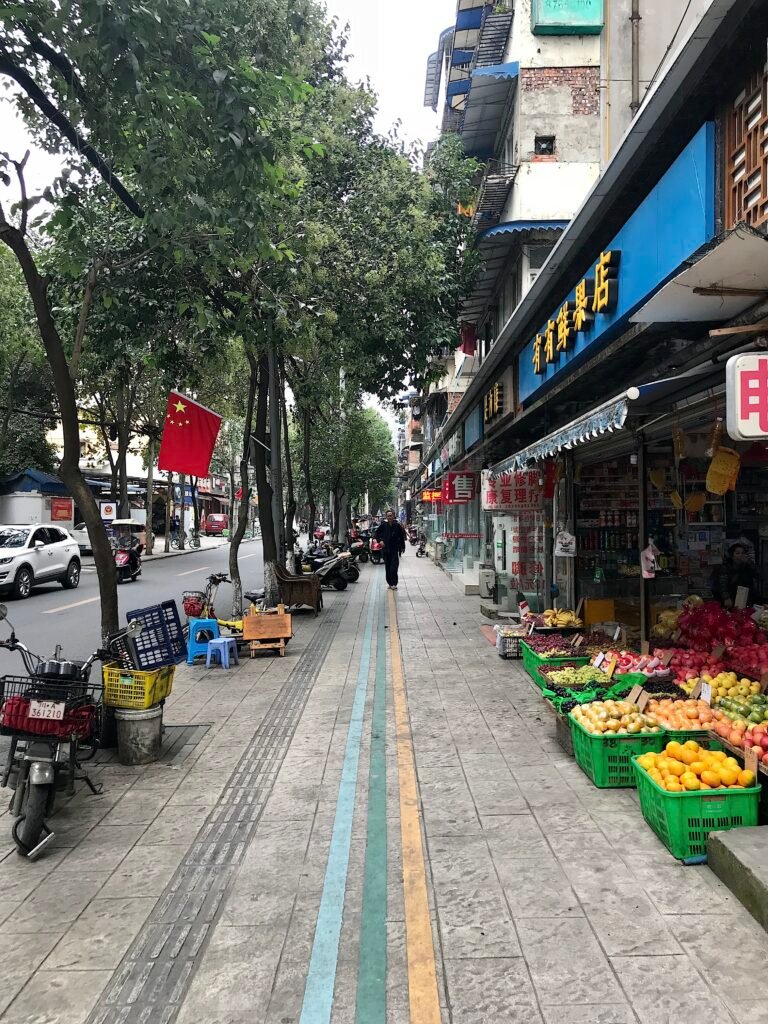
Unlike Chengdu’s famous shopping streets, nobody here was trying to impress tourists.
There were no souvenir shops.
No costumed performers.
No giant panda sculptures.
Instead, there were things I enjoy photographing even more.
A neighbourhood fruit shop overflowing with oranges, apples and dragon fruit.
A tiny pharmacy next to a convenience store.
An old uncle parking his bicycle before buying vegetables.
A lady carrying groceries home after work.
These weren’t attractions.
They were simply everyday life.
Ironically…
That made them some of my favourite travel memories.
Why I Love Mature Chinese Neighbourhoods
One thing I’ve learned after travelling across China is this.
If you only visit famous attractions…
You’ll learn about China’s history.
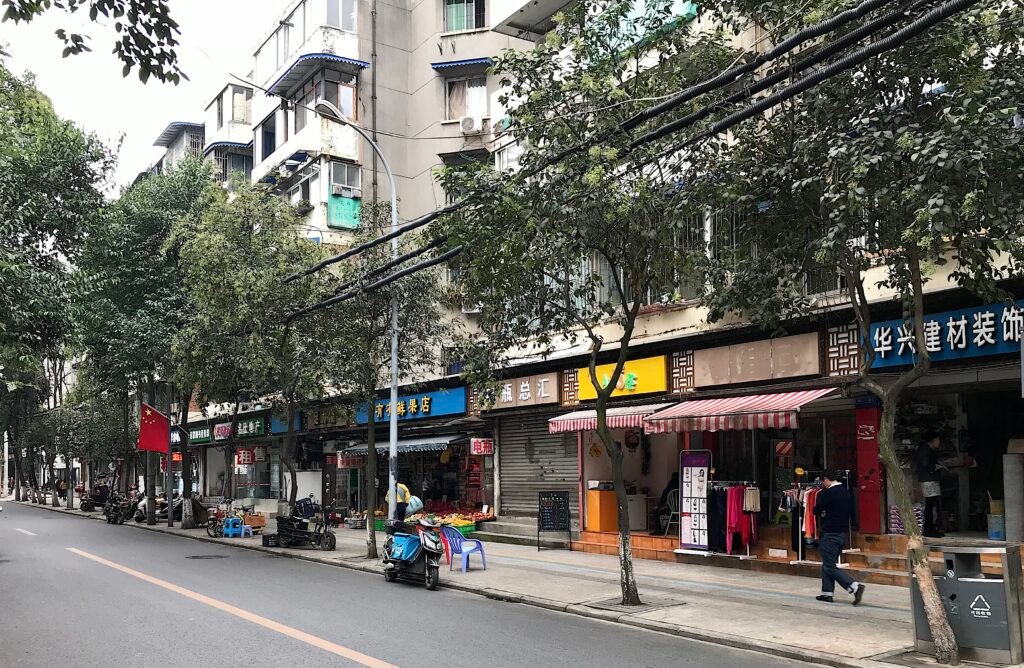
If you spend time in neighbourhoods like Jinniu (金牛区)…
You’ll begin to understand China today.
You notice little things.
The incredibly clean pavements.
How almost every neighbourhood has its own 超市 (chāoshì) selling fresh fruit, yoghurt and snacks.
How people greet familiar shopkeepers.
How grandparents happily take grandchildren for evening walks.
How food deliveries arrive every few minutes.
How modern China quietly functions.
None of these appear in guidebooks.
Yet together, they tell a much richer story.
One Rule We Almost Always Follow: Stay Near a Local Market
By our second and third trips to China, Elaine and I had developed an unusual habit.
Whenever we booked a 民宿 (mínsù, homestay) or hotel, we didn’t just look for a convenient metro station.
We looked for something else.
Was there a 菜市场 (càishìchǎng) nearby?
The word literally means a vegetable market, but don’t let the name fool you.
A Chinese 菜市场 is much more than vegetables.
It is the beating heart of a neighbourhood.
Why We Love Chinese Markets
Some travellers collect passport stamps.
Others collect luxury shopping bags.
Elaine and I…
We collect local markets.
Almost every city we visit, we try to find one.
Beijing.
Xi’an.
Baoji.
Chengdu.
Even in smaller cities, we’ll happily spend an hour wandering through the market without buying very much.
Why?
Because markets tell you far more about a place than any museum can.
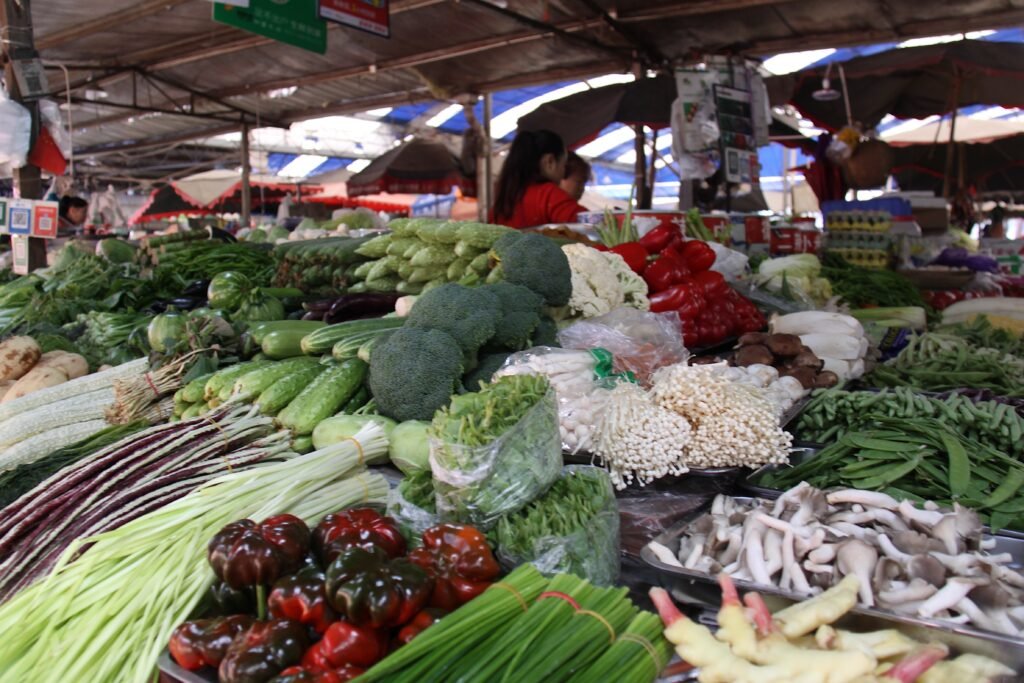
Every Market Tells You What People Really Eat
Within a few minutes, you begin noticing things.
Vegetables you’ve never seen before.
Ten different varieties of mushrooms (蘑菇, mógū).
Bundles of fresh coriander (香菜, xiāngcài).
Lotus root (莲藕, lián’ǒu).
Winter melon (冬瓜, dōngguā).
Chinese chives (韭菜, jiǔcài).
Long beans (豇豆, jiāngdòu).
Fresh tofu (豆腐, dòufu).
Live fish.
Fresh pork.
Handmade noodles.
Huge piles of garlic and ginger.
If you want to understand why Sichuan cuisine tastes the way it does…
Start here.
Better Than Visiting Another Shopping Mall
I’m probably unusual.
If you gave me a choice between another luxury shopping mall…
or a local market…
I’d choose the market almost every time.
Because shopping malls around the world are becoming increasingly similar.
The same fashion brands.
The same cafés.
The same chain stores.
But neighbourhood markets?
Every city has its own personality.
Every province grows different vegetables.
Every region has its own ingredients.
Every stall tells another little story.
Elaine’s Favourite Part
Elaine enjoys something slightly different.
She likes guessing what the vegetables are.
Sometimes she gets them right.
Quite often…
She has absolutely no idea.
“Dad… what on earth is THAT?”
Usually…
Neither do I.
So we start Googling.
Or we simply ask the stall owner.
Those tiny conversations have taught us more Chinese than many language apps.
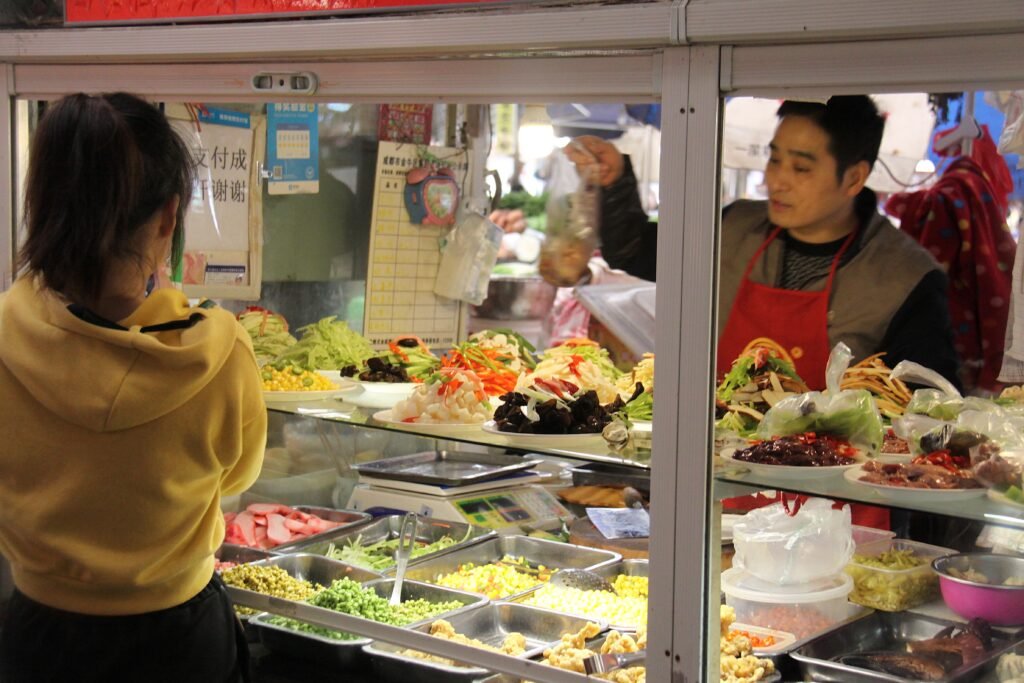
A Window Into Everyday China
This is why we almost always choose accommodation near residential neighbourhoods instead of tourist zones.
It isn’t because they’re cheaper.
It’s because we want to wake up where local people wake up.
To hear the market coming alive.
To watch grandparents buying vegetables.
To see office workers picking up breakfast.
To watch children being dragged reluctantly to school.
By the time we’ve visited the nearby market…
We no longer feel like tourists.
For a little while…
We feel like neighbours.
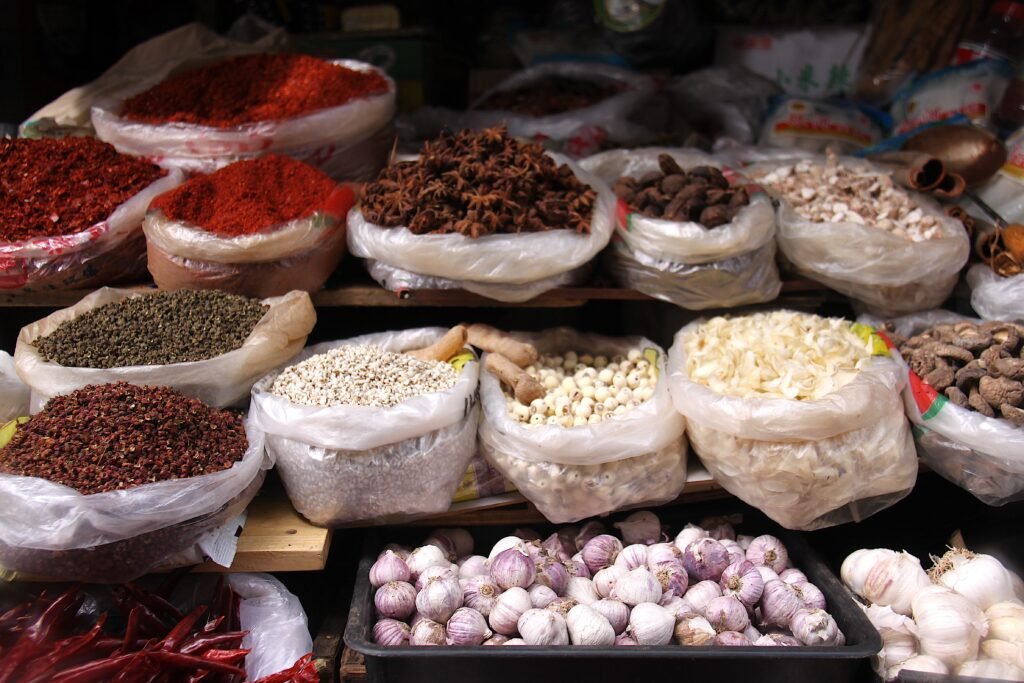
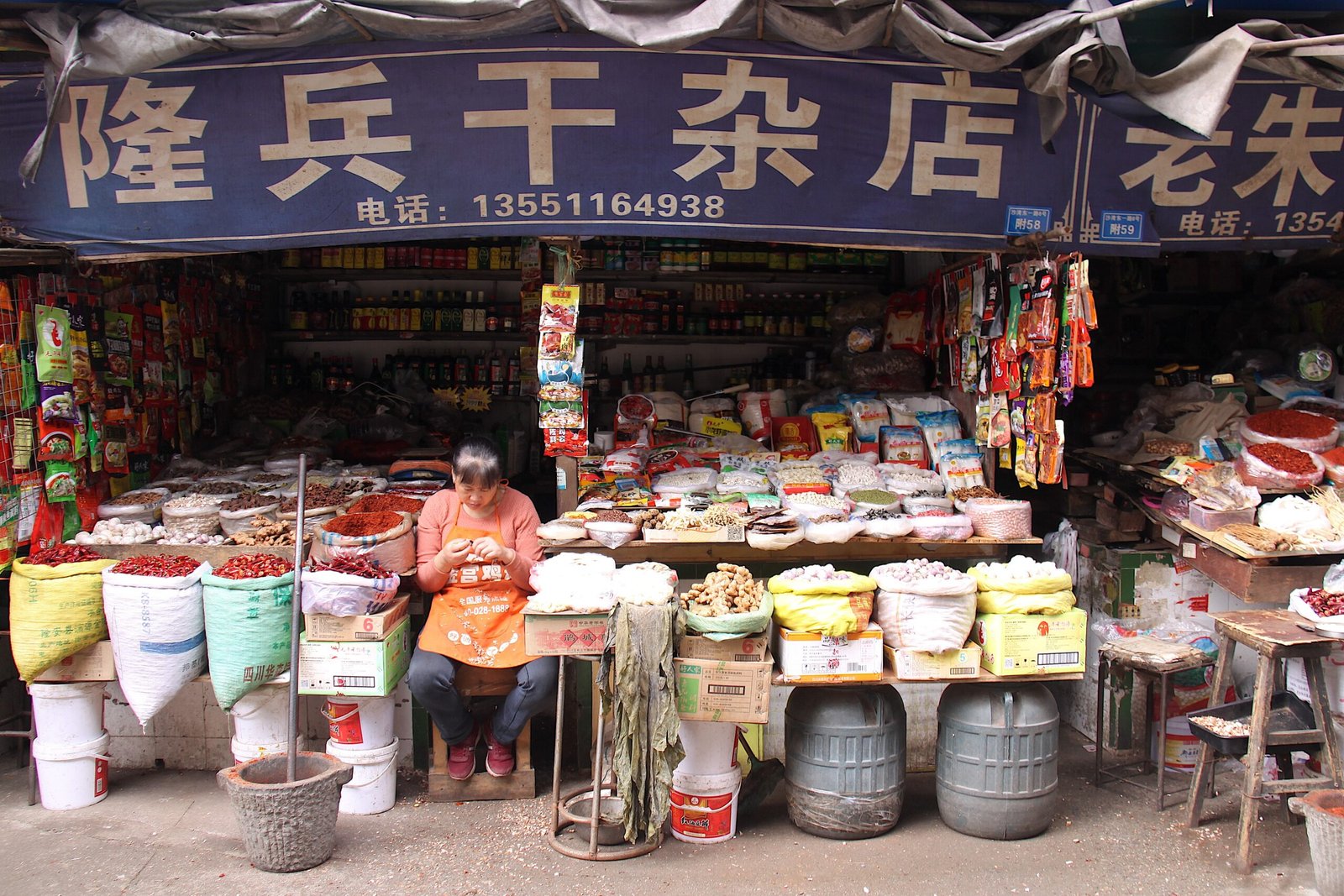
The Stall That Smelled Like Sichuan
One stall stopped us in our tracks.
Not because it looked beautiful.
Because it smelled incredible.
The air was filled with aromas that were warm, earthy, smoky and slightly citrusy all at the same time. We couldn’t identify half of what we were looking at, but somehow it all smelled unmistakably… Chinese.
For many Western visitors, Sichuan cuisine (四川菜, Sìchuān cài) is simply “spicy food.”
Standing in front of this little neighbourhood spice stall, I realised how oversimplified that description really is.
Spiciness is only one small chapter of the story.
A Rainbow of Flavours
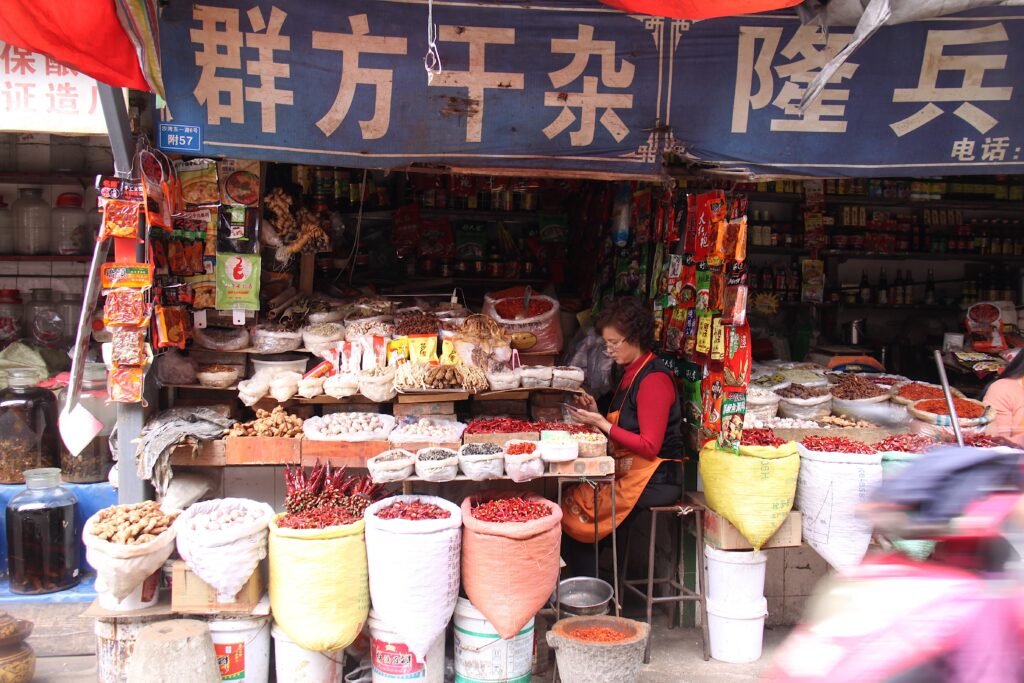
Instead of neatly packaged jars lined up on supermarket shelves, everything was sold in generous open sacks.
Bright red 辣椒粉 (làjiāo fěn) and coarse 辣椒碎 (làjiāo suì) glowed like little volcanoes.
Mountains of 八角 (bājiǎo)—star anise—filled the air with a sweet liquorice fragrance.
There were piles of 花椒 (huājiāo), the famous Sichuan peppercorns responsible for the unique 麻 (má) sensation that gently tingles and numbs your lips.
Nearby sat 草果 (cǎoguǒ), a large black cardamom used in slow-braised dishes, together with fragrant 桂皮 (guìpí), Chinese cinnamon, and bundles of dried chillies (干辣椒, gān làjiāo) waiting to become someone’s hotpot broth.
Mixed among the spices were ingredients that surprised us.
莲子 (liánzǐ), lotus seeds.
百合 (bǎihé), dried lily bulbs.
薏米 (yìmǐ), Job’s tears.
These weren’t fiery spices at all—they’re used in soups, herbal dishes and traditional desserts.
It was a gentle reminder that Chinese cooking isn’t only about heat. It is also about fragrance, texture and balance.
“Dad… Which One Makes Your Mouth Go Numb?”
Elaine stared at the colourful piles for a while before asking the question many first-time visitors eventually ask.
“Dad… which one is the famous numbing spice?”
I pointed towards a mound of tiny reddish-brown peppercorns.
“花椒 (huājiāo).”
Contrary to what many people think, they aren’t ordinary pepper, and they aren’t exceptionally hot.
Instead, they create the famous 麻辣 (málà) combination that defines many Sichuan dishes.
辣 (là) means spicy.
麻 (má) means that curious tingling, buzzing sensation that makes your lips feel as though they’ve just had a gentle encounter with electricity.
It sounds strange.
Until you try it.
Then you understand why people become addicted to it.
The Secret Behind Sichuan Cuisine Isn’t a Recipe
Looking around this humble market stall, another thought struck me.
The secret behind great Chinese food isn’t hidden inside famous restaurants.
It starts here.
With ordinary home cooks buying spices by the scoop.
With grandparents choosing today’s vegetables.
With families selecting ingredients that have been used for generations.
Every scoop of 花椒, every handful of dried chillies, every piece of 八角 eventually finds its way into somebody’s family dinner.
Long before we sat down to enjoy a steaming bowl of noodles or a bubbling 火锅 (huǒguō, hotpot), this little spice stall had already told us the story of Sichuan cuisine.
And somehow, that made the meal taste even better.
📸 Dad’s Note
One of the reasons Elaine and I love exploring neighbourhood 菜市场 (càishìchǎng, wet markets) is that they answer questions no guidebook can.
What do local families really cook?
What ingredients are unique to this region?
Why does Chengdu food taste different from Xi’an or Beijing?
Sometimes, the best museum in China isn’t a museum at all.
Sometimes…
It’s a spice stall tucked inside an ordinary market in Jinniu District (金牛区).
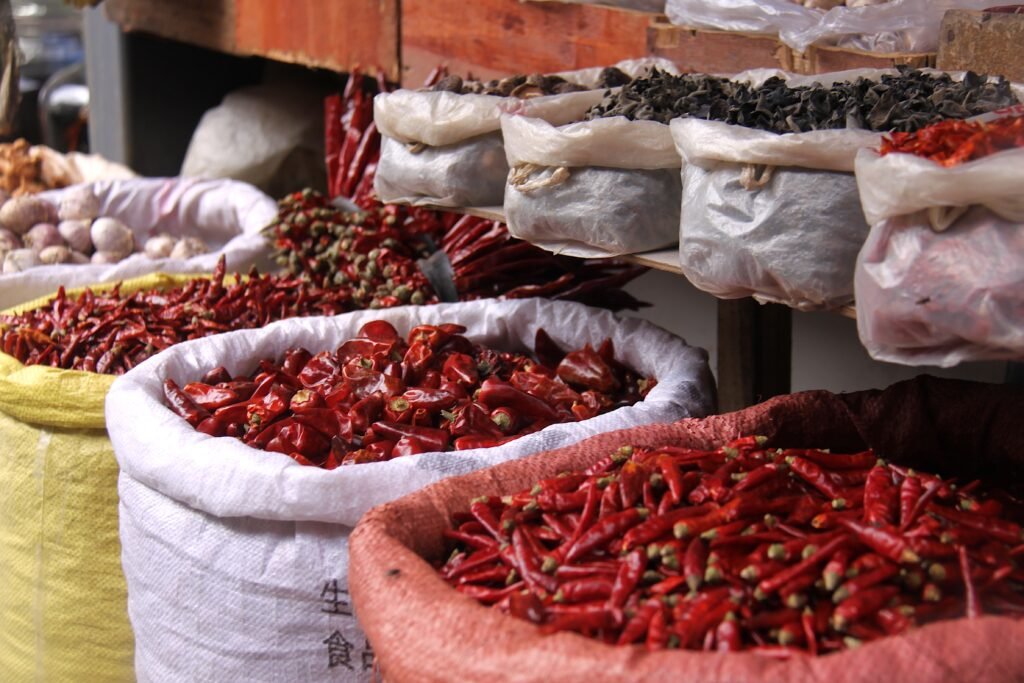
“Wait… They’re All Different?”
If you’ve never visited a Sichuan (四川, Sìchuān) market before, this photo probably looks like one giant pile of red.
To local shoppers?
They’re seeing completely different ingredients.
Elaine stood staring at the stall for quite a while.
“Dad… aren’t they all just chillies?”
That innocent question made the stall owner smile.
“No,” he laughed.
“Different dishes. Different chillies.”
Suddenly, what looked like one ingredient became an entire colour palette for cooking.
One Province. Dozens of Chillies.
Many first-time visitors imagine that Chinese food simply becomes “spicier” the further west they travel.
The reality is much more interesting.
Sichuan cooks choose different chillies (辣椒 làjiāo) for different purposes.
Some are long and thin.
Some are short and fat.
Some provide deep colour.
Others give fragrance.
Some deliver a slow-burning heat, while others are surprisingly mild and mainly add aroma.
Walking through the market felt almost like visiting a paint shop—except the colours were all shades of red.
Spice Isn’t Just About Heat
What surprised me most was discovering that Sichuan cooking isn’t a competition to see who can tolerate the hottest food.
Instead, local chefs carefully layer flavours.
One chilli provides colour.
Another contributes fragrance.
Then comes 花椒 (huājiāo)—the famous Sichuan peppercorn—which creates the unique 麻 (má) tingling sensation.
Together they create 麻辣 (málà).
Not merely “spicy.”
But spicy, fragrant, numbing, smoky and deeply aromatic—all at the same time.
It’s far more sophisticated than most visitors expect.
A Market That Teaches Better Than a Cookbook
Standing in this ordinary neighbourhood market, I realised something.
Every famous Sichuan dish begins right here.
Before the steaming 火锅 (huǒguō).
Before the 麻婆豆腐 (Mápó Dòufu).
Before the 宫保鸡丁 (Gōngbǎo Jīdīng).
Before the bowls of 担担面 (Dàndàn Miàn).
It all starts with local cooks deciding which chilli belongs in today’s dinner.
You don’t learn that from restaurant menus.
You learn it by wandering through markets where almost no tourists ever stop.
And that’s one of the reasons Elaine and I keep choosing neighbourhood markets over shopping malls whenever we travel across China.
📸 Dad’s Note
One of the biggest lessons from travelling through Chengdu (成都) wasn’t learning how spicy Sichuan food could be.
It was learning how carefully Sichuan cooks think about flavour.
After all…
If one market stall sells six or seven different kinds of chillies, perhaps “spicy” is far too simple a word to describe Sichuan cuisine (四川菜, Sìchuān cài).
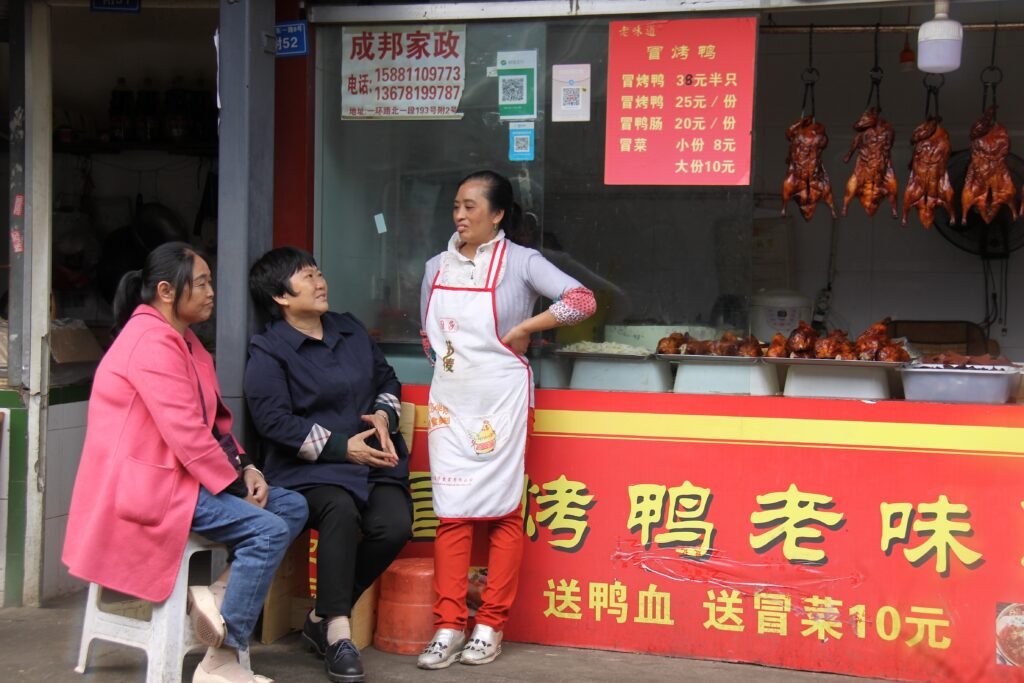
Outside a neighbourhood roast duck shop in Chengdu’s Jinniu District. The ducks were hanging in the window, but what caught our attention was something else entirely—the owner chatting with regular customers as if time had slowed down.
The Roast Duck Stall That Taught Me About Neighbourhood China
One thing Elaine and I gradually realised after several trips around China was this:
If you want to understand a city, don’t only visit its attractions.
Watch where people buy their meals.
That lesson came alive one morning while wandering through the neighbourhood market in Jinniu District (金牛区, Jīnniú Qū).
Unlike the polished food streets promoted to tourists, this was simply another morning for local residents.
Outside a tiny 烧鸭店 (shāoyā diàn)—a roast duck shop—we noticed something that made us stop.
Nobody seemed to be in a hurry.
Morning Gossip, Chengdu Style
Two ladies had pulled up stools outside the shop.
The owner wasn’t busy trying to attract customers.
Instead, she stood outside chatting with them as if they had all the time in the world.
Behind them, several beautifully roasted ducks hung quietly in the window, waiting for lunchtime customers.
No one was shouting.
No one was rushing.
Just neighbours catching up on life.
It reminded me that food shops in China are often much more than businesses.
They’re community gathering places.
“The Same Shop for Twenty Years”
Looking closer at the bright red menu board, another detail caught my attention.
It proudly read:
二十年老店 (èrshí nián lǎodiàn)
“A twenty-year-old shop.”
In China, that’s not just advertising.
It’s a badge of honour.
Locals are remarkably loyal to neighbourhood businesses.
When a small shop has survived for twenty years, chances are several generations have grown up eating there.
Children who once came holding their parents’ hands may now be bringing their own children back.
That kind of trust can’t be manufactured.
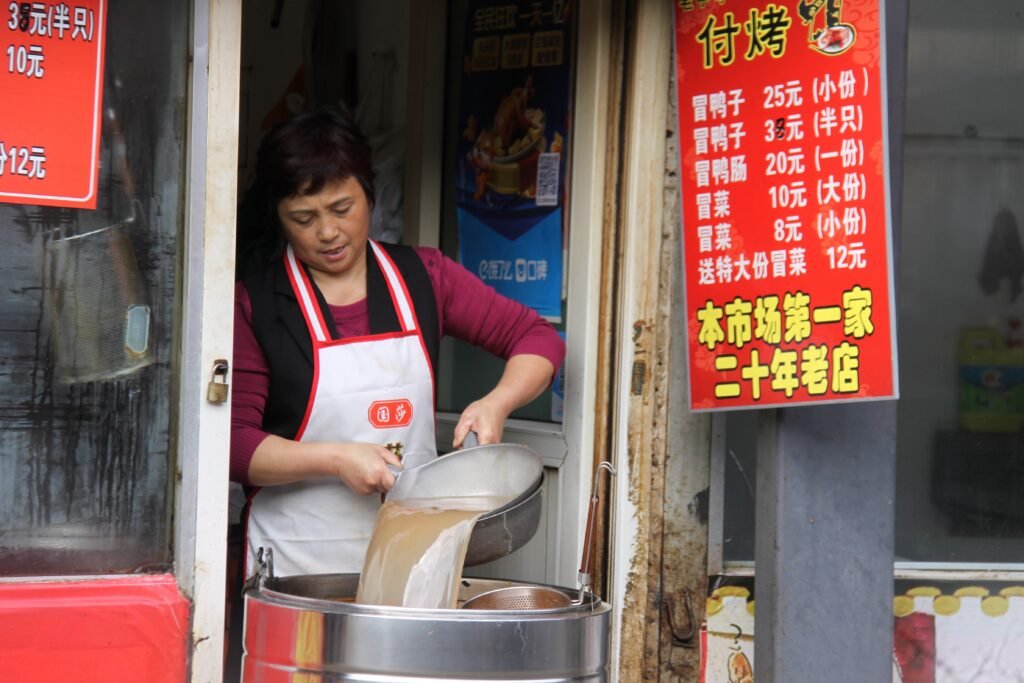
Every morning begins with preparation. Fresh broth is poured into the cooking pot before customers arrive. It’s a simple scene, yet it hints at the care behind countless neighbourhood meals served across Chengdu.
A Pot of Stock Worth More Than the Ducks
A few minutes later, another lady emerged from the kitchen carrying a huge metal pot.
She carefully poured litres of steaming broth into an even larger cooking pot.
Nothing dramatic.
No performance.
Just another ordinary step in preparing for the day’s business.
Yet I couldn’t stop watching.
In many Chinese family-run food stalls, the broth (汤 tāng) or stock is prepared fresh every morning.
Sometimes it has been simmering for hours.
Sometimes recipes have been passed down through generations.
Long before customers arrive, the day’s flavours are already taking shape.
Everyday China Is Often the Most Memorable
Many travel guides tell you where to eat.
Few tell you to simply pause and observe.
Yet moments like these became some of my favourite travel memories.
Not because we ate roast duck that morning.
But because, for a few minutes, we were quietly watching neighbourhood life unfold.
There were no performances for tourists.
No carefully curated experiences.
Just local residents chatting, shopkeepers preparing food, and another ordinary morning in Chengdu.
Sometimes, that’s exactly where the real China reveals itself.
Before the Rest of the World Caught On
One tiny moment in Chengdu caught my attention more than all the skyscrapers downtown.
It wasn’t a futuristic robot.
It wasn’t a self-driving car.
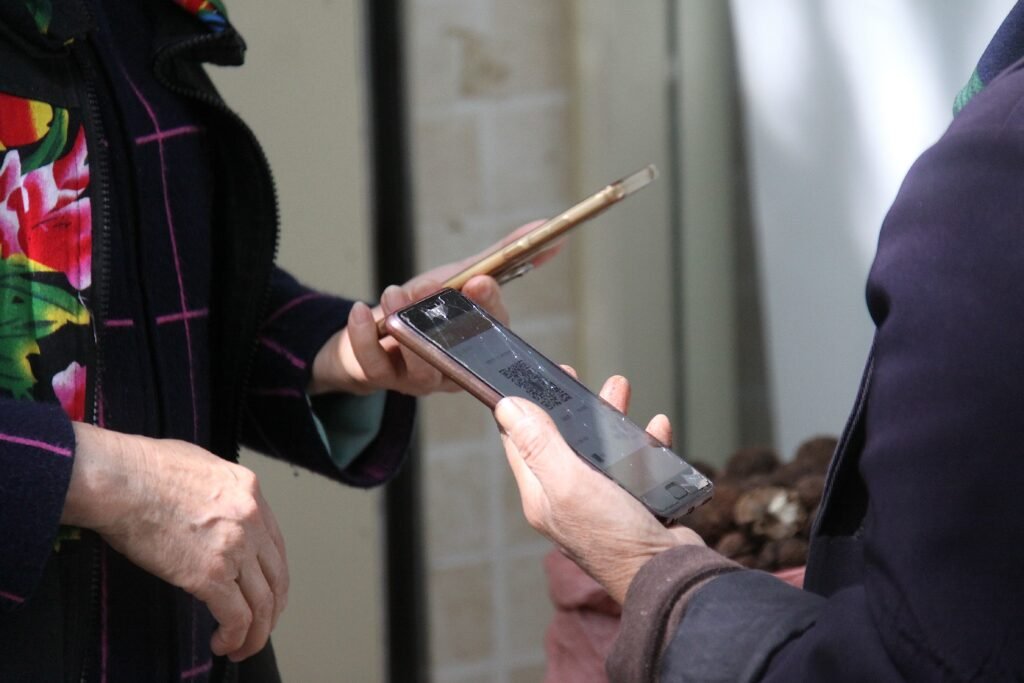
It was two elderly ladies buying vegetables.
Using QR codes.
In 2019, digital payments had already become part of everyday life across much of China.
Not just inside shopping malls.
Not just in international coffee chains.
But here, in an ordinary neighbourhood market in Jinniu District (金牛区, Jīnniú Qū).
One lady simply held up her phone.
The other scanned a 二维码 (èrwéimǎ)—a QR code.
Payment completed.
No wallets changing hands.
No counting coins.
Just a familiar “beep”.
For Elaine and me, travelling from Southeast Asia, it was fascinating to witness. We had expected China’s famous high-speed trains and glittering skylines. We hadn’t expected one of the country’s biggest technological stories to be quietly unfolding at a humble neighbourhood vegetable market.
When Technology Becomes Ordinary
What impressed me wasn’t the technology itself.
It was how completely ordinary it had become.
Nobody stopped to admire it.
Nobody talked about it.
The vegetable seller wasn’t demonstrating innovation.
The customer wasn’t trying something new.
This was simply how neighbours bought today’s vegetables.
Fruit sellers.
Butchers.
Breakfast stalls.
Small family-run shops.
Across the market, 移动支付 (yídòng zhīfù)—mobile payment—had quietly become part of everyday life.
Looking Back, We Witnessed a Turning Point
At the time, we didn’t realise we were witnessing a small piece of history.
Today, travellers planning a China trip spend hours reading about Alipay (支付宝, Zhīfùbǎo) and WeChat Pay (微信支付, Wēixìn Zhīfù) before they fly.
Yet years earlier, the transformation had already happened.
Not through flashy demonstrations.
But one neighbourhood…
One market…
One everyday purchase at a time.
Even elderly shoppers buying vegetables had embraced the technology.
Conclusion: The Chengdu We Remember Most Wasn’t the One on the Postcards
When people think of Chengdu, they usually think of giant pandas, hotpot, or perhaps the bustling crowds of Chunxi Road (春熙路).
Those places deserve their reputation.
We enjoyed them too.
But when Elaine and I look back on our very first week in Chengdu in 2019, it isn’t the pandas that come to mind first.
Instead, we remember waking up in our traditional courtyard homestay in Jinniu District (金牛区), stepping outside into quiet neighbourhood streets, and wandering to the local 菜市场 (càishìchǎng, neighbourhood market) before breakfast.
We remember fruit sellers arranging their produce.
The aroma of freshly made 豆瓣酱 (dòubànjiàng), the famous Sichuan fermented broad bean chilli paste.
Rows of different chillies, 花椒 (huājiāo, Sichuan peppercorns), star anise, cassia bark and herbs whose names we didn’t yet know.
Shopkeepers chatting with familiar customers.
Elderly residents stopping to exchange a few words before continuing home with vegetables for lunch.
Nothing about these moments was designed for tourists.
And perhaps that is exactly why they stayed with us.
As travellers from Southeast Asia, we realised something important.
If you only visit famous attractions, you can say you’ve seen China.
But if you spend time in neighbourhoods like Jinniu District, you begin to understand China.
That lesson would shape every journey we made afterwards.
When we travelled on to Xi’an by high-speed rail the following week, we deliberately chose another homestay near a local market.
We repeated the same habit in Beijing.
And we’ve continued doing it ever since.
Today, whenever we plan a new China trip, one question comes before almost everything else:
“Is there a local market within walking distance?”
Because over the years we’ve discovered that neighbourhood markets reveal more about a city than many museums.
They show what people cook.
What families eat.
What ingredients define a region.
How neighbours greet one another.
How ordinary life quietly unfolds every morning.
That’s the China we hope to share through ChinaTravelBug.
Not just the China of famous landmarks.
But the China where everyday life happens.
Sometimes, the most memorable destination isn’t a UNESCO World Heritage Site or a world-famous attraction.
Sometimes, it’s simply an ordinary street in Jinniu District, where two curious travellers slowed down long enough to discover the real rhythm of Chengdu.
Dad’s Note
Looking back, that reward trip was never just about Chengdu or Xi’an.
It was part of a much bigger journey.
Elaine had earned this trip after completing part of our “Emperor Timeline” learning project, and I wanted her to discover something no textbook could teach.
Travel is one of the greatest classrooms in the world.
The Chinese proverb says it perfectly:
读万卷书,不如行万里路
“Reading ten thousand books is not as valuable as travelling ten thousand miles.”
That week in Chengdu proved the proverb right.
The greatest lessons didn’t come from monuments.
They came from walking slowly, staying curious, and learning from ordinary people living ordinary lives.
“If Jinniu District showed us how ordinary Chengdu lives, the local markets also introduced us to the ingredients that make Sichuan cuisine one of China’s greatest food traditions. Join us as we explore the colours, aromas and flavours hidden inside a Chengdu neighbourhood market.“