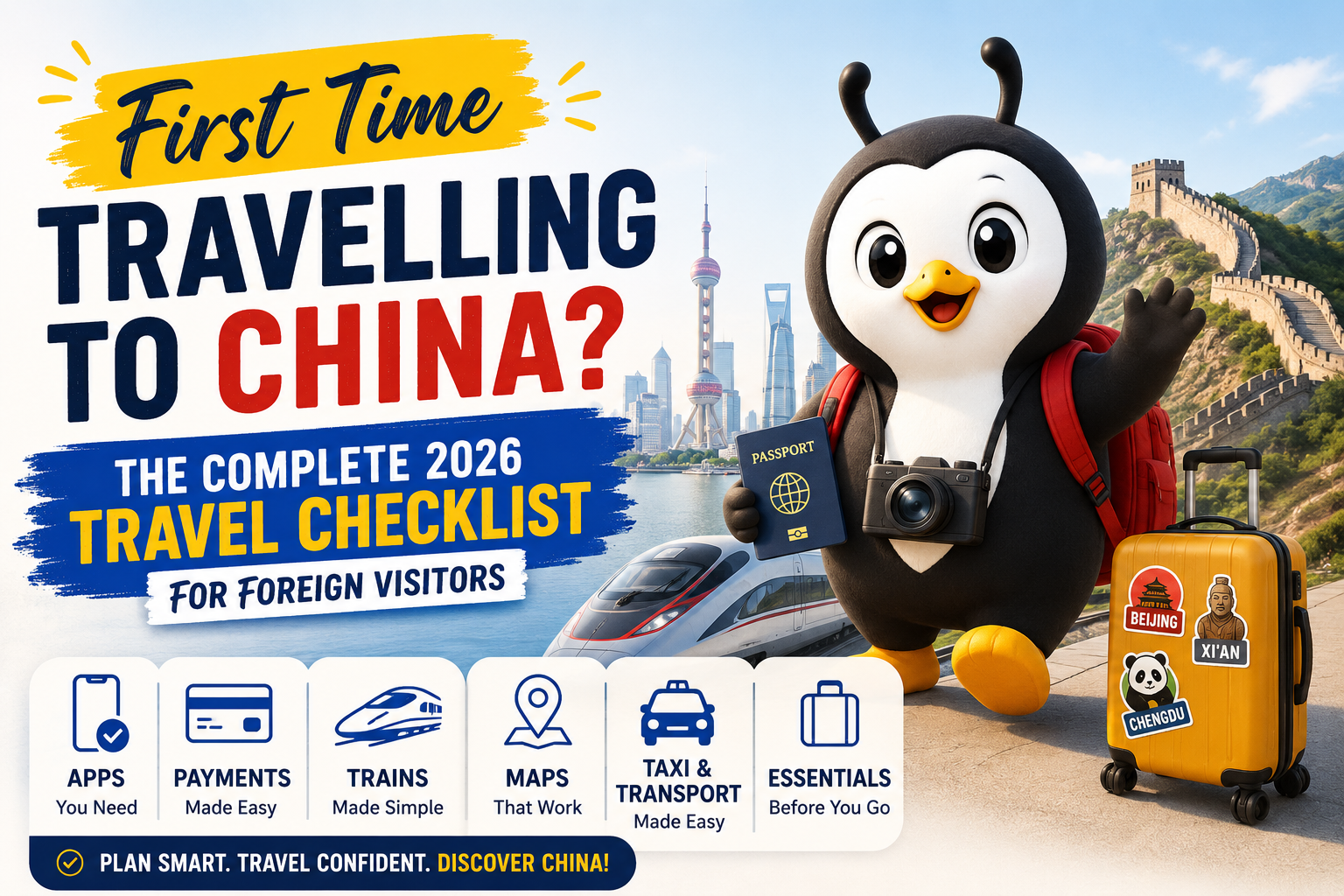
The Complete 2026 Travel Checklist for Foreign Visitors
“I’m planning my first trip to China. What should I prepare before I fly?”
If you’ve been researching your first trip to China, you’ve probably seen the same questions repeated in Facebook groups, Reddit discussions and travel forums:
- Which apps should I download?
- Can I use my home mobile number?
- Will my credit card work?
- Should I bring cash?
- How do I book China’s famous high-speed trains?
- Which map app works best?
- Is China really difficult to travel around?
The good news is that travelling independently in China is much easier today than many first-time visitors expect.
The biggest challenge isn’t travelling around China—it’s understanding how China’s digital travel ecosystem works before you arrive.
Once you’ve prepared a few essentials, you’ll discover that China has one of the world’s most efficient transport networks, an extensive digital payment system, excellent public transport and modern travel infrastructure.
This guide brings together everything you should know before boarding your flight.

Before You Fly: Your Essential China Travel Checklist
Before thinking about attractions or hotels, make sure these essentials are ready.
✅ Passport (with at least six months’ validity)
✅ Visa (or confirm your visa-free eligibility)
✅ Comprehensive travel insurance
✅ International credit or debit cards
✅ Hotel reservations
✅ Flight confirmations
✅ International roaming or eSIM
✅ Power bank
✅ Copies of important documents
A little preparation before departure can save a great deal of stress once you arrive.
Download These Apps Before Leaving Home
China is one of the world’s most digitally connected countries.
Your smartphone quickly becomes your:
- wallet
- train ticket
- taxi booking app
- metro pass
- navigation system
- translator
- hotel booking reference
Install these before flying.
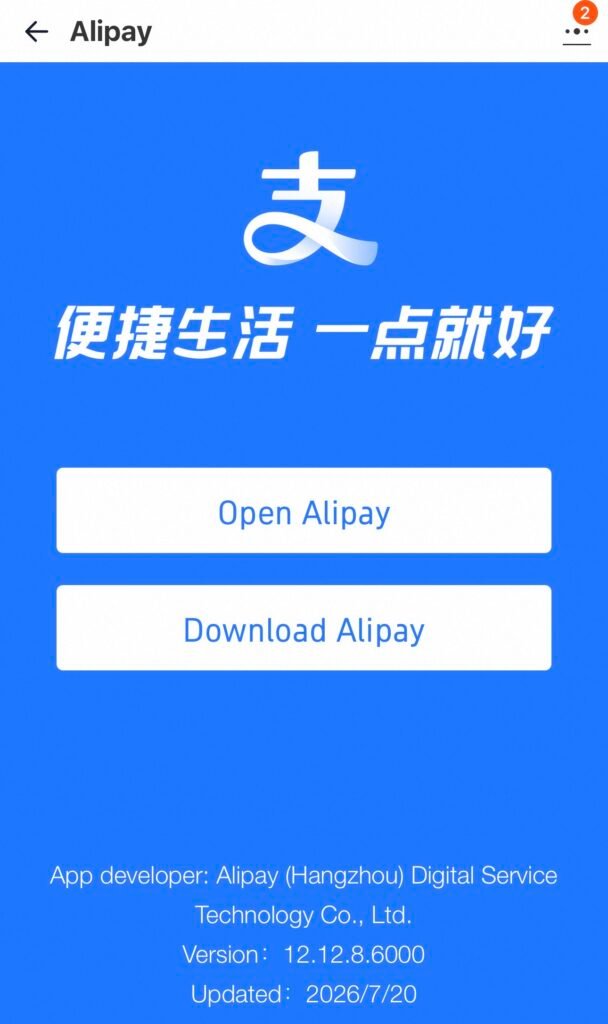
1. Alipay (支付宝)
For most foreign visitors, Alipay is the single most useful app in China.
You can use it to:
- pay in shops
- restaurants
- supermarkets
- convenience stores
- many attractions
- some public transport systems
- DiDi taxis
Many overseas Visa, Mastercard, American Express, JCB and other international cards can now be linked, although availability depends on your card issuer and country. It’s worth completing the verification process before you travel.
Read next:
Can Foreign Tourists Use Alipay in China?
2. WeChat (微信)
Even if you mainly use Alipay, WeChat is still worth installing.
Many businesses communicate through WeChat, and it provides a useful backup payment option.
3. Trip.com
Trip.com is one of the easiest booking platforms for international visitors.
Use it for:
- hotels
- domestic flights
- attraction tickets
- China’s high-speed rail
4. DiDi (滴滴出行)
Think of DiDi as China’s version of Uber.
You can book taxis directly or access DiDi through Alipay.
5. Amap (高德地图)
Google Maps can still display many locations, but its navigation, business listings and public transport information are often incomplete or outdated within mainland China.
For day-to-day navigation, Amap (Gaode Maps) or Baidu Maps generally provide more accurate directions and real-time transport information. Apple Maps also performs well on iPhones.
6. Google Translate
Download the Chinese language pack before you leave home.
Offline translation is surprisingly useful when travelling in areas with limited internet access.
Can You Use Your Home Mobile Phone Number?
Yes.
Many travellers simply activate international roaming with their home mobile provider.
Others choose:
- an eSIM
- a local Chinese SIM card
Each option has different costs, data allowances and convenience.
For short holidays, roaming or an eSIM is often the simplest solution.
Read next:
Can You Use Your Home Mobile Phone Number in China?
Understanding Payments Before You Arrive
One of the biggest worries for first-time visitors is paying for everyday purchases.
The good news is that mobile payments are now much easier for international visitors than they were just a few years ago.
Before travelling, understand these common Chinese terms:
支付宝 (Zhīfùbǎo) — Alipay
微信支付 (Wēixìn Zhīfù) — WeChat Pay
付款码 (Fùkuǎn Mǎ) — Your payment code
收款码 (Shōukuǎn Mǎ) — Merchant’s QR code
扫一扫 (Sǎo yí sǎo) — Scan
Although QR-code payments are the preferred method across China, Renminbi (RMB) cash remains legal tender and is still accepted. Carrying a small amount of cash is a sensible backup, particularly for smaller businesses or unexpected situations.
Read next:
Can Foreign Tourists Use Alipay in China?

Travelling on China’s High-Speed Rail
China’s high-speed rail network is one of the country’s greatest achievements.
For journeys between major cities, it is often:
- faster than flying
- more comfortable
- more punctual
- more convenient
Foreign visitors normally travel using their passport as the travel document.
Stations require identity verification and airport-style security screening, so arriving 30 to 60 minutes before departureis recommended.
Read next:
China High-Speed Rail for Foreign Tourists (2026 Guide)
Which Map App Should You Use?
Many travellers assume Google Maps is enough.
In mainland China, you’ll have a better experience using:
- Amap (Gaode Maps)
- Baidu Maps
- Apple Maps (iPhone)
These apps offer more accurate navigation, better public transport information and up-to-date business listings.
Getting Around Chinese Cities
China’s cities have some of the world’s best public transport systems.
Most visitors rely on:
🚄 High-speed rail
🚇 Metro
🚕 DiDi
🚶 Walking
Major cities such as Beijing, Xi’an, Chengdu and Shanghai have extensive metro systems that are clean, affordable and easy to use.
Do You Need to Speak Chinese?
Not necessarily.
Many younger people working in hotels, airports and major attractions have some English.
However, learning a few simple Chinese phrases makes travelling much smoother.
| Chinese | Pinyin | English |
|---|---|---|
| 你好 | Nǐ hǎo | Hello |
| 谢谢 | Xièxie | Thank you |
| 多少钱? | Duōshǎo qián? | How much? |
| 扫一扫 | Sǎo yí sǎo | Scan |
| 地铁 | Dìtiě | Metro |
Even using a few words usually brings a smile.
A Suggested First China Itinerary
If this is your first visit and you have around 10–14 days, one of the most rewarding routes is:
Hong Kong (2–3 days)
Ease into your China adventure through one of Asia’s easiest international gateways.
Highlights include:
- Victoria Harbour
- Star Ferry
- Peak Tram
- Dim sum
- Efficient public transport
Remember that Hong Kong has its own immigration system, currency (HKD), Octopus transport card and payment ecosystem, so it operates differently from mainland China.
Beijing (4–5 days)
China’s capital introduces you to over 800 years of imperial history alongside a vibrant modern city.
Don’t miss:
- Forbidden City
- Tiananmen Square
- Temple of Heaven
- Summer Palace
- Mutianyu Great Wall
- Historic hutongs
Xi’an (3 days)
Xi’an is where much of China’s imperial story comes alive.
As the capital of several dynasties and the eastern starting point of the ancient Silk Road, it offers an unforgettable blend of archaeology, history and local culture.
Recommended highlights:
- Terracotta Warriors
- Xi’an City Wall
- Muslim Quarter
- Giant Wild Goose Pagoda
- Xi’an Museum
History enthusiasts may also enjoy the Han Yang Ling Mausoleum (Hanyangling Museum) or the Qin-Han Civilization Museum, both of which provide fascinating insights into the Qin and Han dynasties.
Chengdu (3–4 days)
After Beijing’s grandeur and Xi’an’s history, Chengdu offers a slower pace.
Enjoy:
- Giant Pandas
- People’s Park
- Traditional tea houses
- Sichuan cuisine
- Jinli Ancient Street
If time permits, don’t miss the remarkable Sanxingdui Museum, one of China’s most important archaeological discoveries.
Cheers’ Final Travel Checklist
Before heading to the airport, Cheers checks his red backpack one last time.
🎒 Passport
📱 Alipay
🚄 Trip.com
🚕
DiDi
🗺️ Amap
📶 eSIM or roaming
🔋 Power bank
💳 International bank card
💴 Emergency RMB cash
🏨 Hotel reservations
Elaine smiles.
“Looks like we’re ready for China!”

Final Thoughts
Many people spend weeks worrying that China will be difficult to visit.
In reality, most first-time travellers discover that the country itself is remarkably easy to navigate once they’ve prepared properly.
Understanding China’s payment systems, transport apps and digital tools before you arrive removes most of the uncertainty.
The rest is what travel should be about—exploring ancient capitals, riding world-class high-speed trains, tasting regional cuisine and discovering the stories behind one of the world’s oldest continuous civilisations.
China isn’t just a destination.
It’s a journey of discovery.
Continue Planning Your China Adventure
If this is your first visit, these CTB guides will help you prepare in more detail:
China High-Speed Rail for Foreign Tourists (2026 Guide)