
First Time in Hong Kong? Here’s Exactly What We Did from Landing to Checking into Our Hotel
Landing in Hong Kong foe the first time is exciting.
It’s also the moment when most travellers feel a bit uncertain.
After months of planning, you’re finally here—but suddenly practical questions take over.
Where do we buy transport tickets?
Should we exchange money?
How do we get into the city?
Is the Airport Express worth the extra cost?
Can we use credit cards?
These were exactly the questions on our minds when Elaine and I landed at Hong Kong International Airport (HKIA).
Fortunately, Hong Kong turned out to be one of the easiest cities we’ve travelled in. Clear bilingual signs, an efficient transport system, and simple payment options meant that within an hour of landing, we were already comfortably making our way towards our hotel.
This guide isn’t based on research alone.
It’s exactly what happened during our first afternoon in Hong Kong—and what we’d recommend to anyone visiting for the first time.
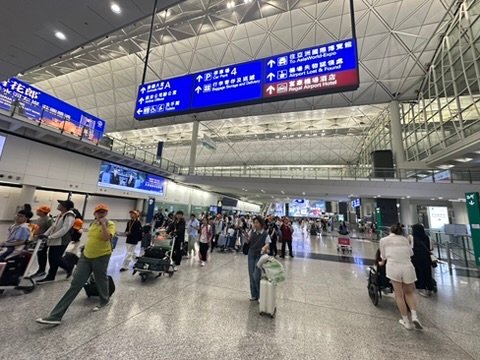
Quick Arrival Checklist
Here’s the order we recommend after landing.
✅ Clear Immigration
✅ Collect your luggage
✅ Get your Octopus Card ready
✅ Pick up drinks or snacks if needed
✅ Decide between the Airport Express or Airport Bus
✅ Travel to your hotel
Simple.
Now let’s go through each step.
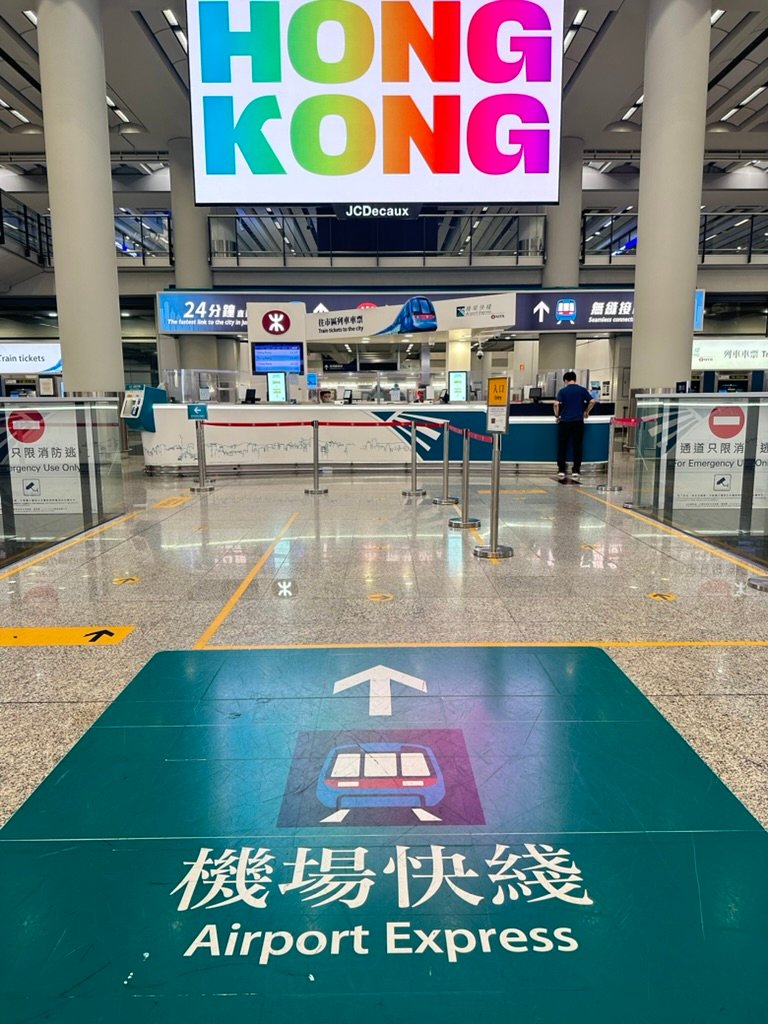
Step 1 – Follow the Signs
One of the first things we noticed was how easy Hong Kong Airport was to navigate.
Every major direction—from the Airport Express to buses, taxis and public transport—is clearly displayed in both English and Traditional Chinese.
Even though it was our first visit in several years, we never once felt lost.
The airport seems designed with international travellers in mind.
That immediately removed much of the stress that often comes with arriving in a new destination.
ChinaTravelBug Tip: Don’t rush. Simply follow the signs. Hong Kong Airport has one of the clearest wayfinding systems we’ve experienced in Asia.
Step 2 – Get Your Octopus Card Ready
Before leaving the airport, we made sure our Octopus Cards were ready to use.
If there’s one thing we’d recommend every visitor to Hong Kong do, it’s this.
The Octopus Card isn’t just a transport card.
It quickly becomes your everyday wallet.
During our stay, we used it for:
- MTR
- Airport buses
- City buses
- Trams
- Ferries
- 7-Eleven
- Circle K
- Drinks
- Snacks
- Supermarkets
By the second day, we realised we hardly needed cash.
What surprised us most was that Elaine and I ended up using Octopus in completely different ways.
Dad’s Choice: The Physical Octopus Card
I’ve always liked keeping things simple.
So throughout the trip, I continued using a physical Octopus Card.
I enjoyed the simplicity.
Just tap and go.
No unlocking my phone.
No worrying about battery life.
For me, the traditional card still feels incredibly convenient.
Elaine’s Choice: Octopus on Her iPhone
Elaine took a very different approach.
Instead of carrying a physical card, she added an Octopus Card directly to her iPhone’s Apple Wallet.
Since her credit card is already linked to Apple Pay, setting it up was straightforward.
Throughout the trip, she simply tapped her phone at MTR gates, buses and convenience stores.
No wallet.
No searching for a card.
Everything stayed inside her iPhone.
Elaine’s Notes
“I actually preferred using Octopus on my iPhone. Since I already use Apple Pay regularly, tapping my phone felt completely natural. I didn’t need to carry another card, and topping up was really easy.”
Watching Elaine use her phone made me realise how differently younger travellers experience a city.
I still instinctively reach for a physical card.
She instinctively reaches for her phone.
Both worked perfectly.
Which Octopus Option Should You Choose?
After using both throughout the trip, we’d say there isn’t a single right answer.
Choose a physical Octopus Card if you:
- like keeping things simple
- prefer a dedicated travel card
- don’t want to depend on your phone battery
- are travelling with younger children or older family members
Choose Octopus on your iPhone if you:
- already use Apple Pay regularly
- prefer carrying fewer cards
- like managing everything digitally
- enjoy the convenience of topping up directly from your phone
For us, it wasn’t about deciding which was better.
It was simply two generations choosing the method that suited them best.
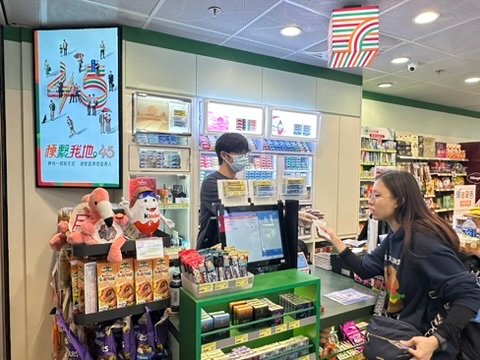
Step 3 – Pick Up Some Essentials
(Insert Photo – Elaine paying at 7-Eleven.)
Before leaving the airport, we stopped at 7-Eleven.
It’s an easy place to buy:
- bottled water
- snacks
- drinks
- travel essentials
It also became our first opportunity to use our Octopus Cards.
Within minutes of arriving, we had already experienced just how widely accepted they are.
It’s little touches like this that make travelling around Hong Kong feel incredibly convenient.
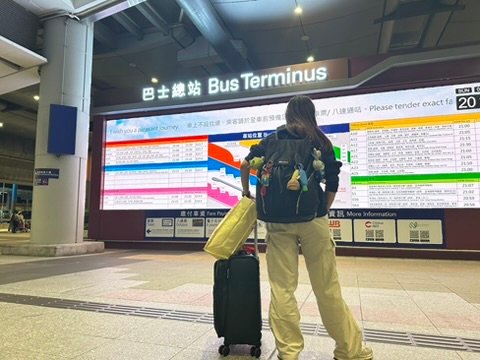
Airport Express or Airport Bus?
This is probably the biggest decision first-time visitors face after arriving.
Most guidebooks recommend taking the Airport Express.
It certainly is the fastest way into the city.
Large advertisements proudly remind passengers that it reaches Hong Kong Station in just 24 minutes.
(Insert Airport Express photo.)
But faster doesn’t always mean better.
Airport Express vs Airport Bus
| Airport Express | Airport Bus |
|---|---|
| Fastest | Better value |
| Around 24 minutes | Around 45–70 minutes |
| Higher fare | Much cheaper |
| Often requires another transfer | Many buses stop near hotels |
| Best for business travellers | Excellent for leisure travellers |
Why We Chose the Airport Bus
Our hotel was Ibis Hong Kong Central & Sheung Wan.
We could have taken the Airport Express and transferred to the MTR.
Instead, we chose the airport bus.
Why?
Because it stopped much closer to our hotel.
That meant:
- less walking with luggage
- no train transfers
- lower transport costs
- comfortable seating
- wonderful views entering Hong Kong Island
Rather than rushing underground, we watched the skyline gradually appear through the bus windows.
Sometimes, slowing down lets you appreciate a city before you’ve even checked into your hotel.
Why We Stayed at Ibis Hong Kong Central & Sheung Wan

When planning this trip, we compared dozens of hotels.
Our priorities weren’t luxury.
Instead, we wanted:
- good public transport
- excellent location
- affordable pricing
- easy airport access
- authentic neighbourhood atmosphere
The Ibis offered exactly that.
From here, we could easily explore:
- Sheung Wan
- Central
- Western Market
- Hong Kong Tram
- Star Ferry
- local cafés
- traditional streets
- heritage buildings
For travellers who plan to spend their days exploring rather than sitting in a hotel room, it’s outstanding value.
A Lesson Beyond Transport
One thing I deliberately encourage on every trip is for Elaine to make her own travel decisions.
Instead of simply following me, she compares transport options, works out payment methods and decides what suits her best.
This time, she chose to go fully digital with her Octopus Card.
I stayed with the traditional physical card.
Neither choice was right or wrong.
Travel isn’t just about reaching a destination.
It’s about learning how different cities work—and gradually becoming confident enough to navigate them independently.
As the Chinese proverb says:
读万卷书,不如行万里路。
“Reading ten thousand books is not as valuable as travelling ten thousand miles.”
Hong Kong reminded us that those ten thousand miles often begin with something as simple as tapping an Octopus Card.
Frequently Asked Questions
Should I buy an Octopus Card at Hong Kong Airport?
Yes. Whether you choose the physical card or add one to your iPhone, it’s the easiest way to pay for transport and many small purchases throughout Hong Kong.
Is the Airport Express worth it?
It depends on where you’re staying. If your hotel is close to Hong Kong Station, it’s an excellent option. However, if an airport bus stops nearby—as it did for our hotel—you may save both money and the hassle of transferring with luggage.
Can I use an Octopus Card on my iPhone?
Absolutely. Elaine used an Octopus Card stored in Apple Wallet throughout the trip. If you already use Apple Pay, it’s a seamless and highly convenient option.
Can I use the Octopus Card in convenience stores?
Yes. We used it regularly at 7-Eleven and other convenience stores for drinks, snacks and everyday purchases.
Is Ibis Hong Kong Central & Sheung Wan a good choice?
If you’re looking for a hotel that combines convenience, location and value for money, we found it to be an excellent base for exploring Hong Kong Island.
ChinaTravelBug Tips
✔ Decide whether a physical or digital Octopus Card suits your travel style before you leave the airport.
✔ Don’t automatically assume the Airport Express is the best option—check whether an airport bus serves your hotel directly.
✔ Choose your hotel based on transport connections, not just star ratings.
✔ Pick up drinks and snacks before leaving the airport.
✔ Most importantly, don’t rush your arrival. Those first moments of learning how a city works are part of the adventure.

Our First Impression of Hong Kong
Our first few hours in Hong Kong weren’t defined by famous landmarks or spectacular skylines.
Instead, they were shaped by a series of small, thoughtful experiences: clear airport signage, a transport system that simply worked, the flexibility of the Octopus Card, and a comfortable bus ride that gradually introduced us to the city.
For me, the physical Octopus Card felt reassuringly simple. For Elaine, using her iPhone was faster and more natural. Two different choices, both equally valid.
Perhaps that’s the biggest lesson from our arrival.
The best way to travel isn’t always the same for everyone. The best way is the one that gives you the confidence to explore independently—and that’s exactly how our Hong Kong adventure began