From Our Beijing Guides
Authentic local advice from the licensed Beijing guides we work with.
Quick Answer
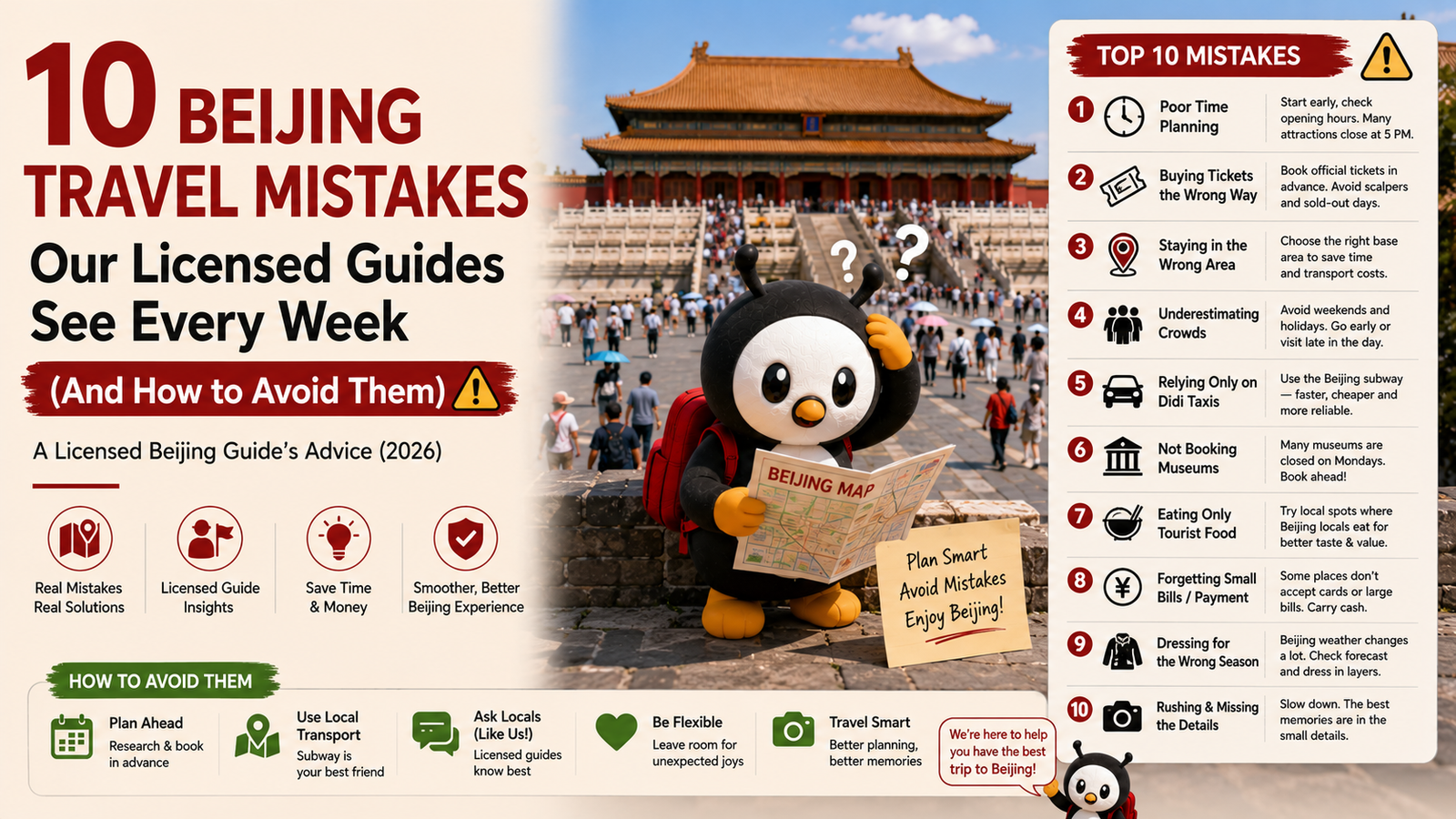
Most first-time visitors to Beijing make the same handful of mistakes—and thankfully, most are easy to avoid.
According to the licensed Beijing guides we work with, the biggest problems aren’t getting lost or being scammed. They’re trying to do too much, underestimating Beijing’s size, and overlooking practical details that locals take for granted.
Avoid these ten common mistakes, and you’ll spend less time worrying about logistics and more time enjoying one of the world’s most fascinating capital cities.
Why This Question Matters
When we first travelled independently in Beijing, we made several of these mistakes ourselves.
We underestimated travel times.
We packed too many attractions into a single day.
We didn’t realise just how enormous 北京 (Běijīng) really is.
Later, after speaking with the licensed Beijing guides we now work with, we discovered something reassuring.
These weren’t beginner mistakes unique to us.
They’re exactly the same mistakes they help overseas visitors avoid almost every week.
The good news?
Once you know what to expect, they’re remarkably easy to avoid.
Mistake #1: Trying to See Too Much in One Day
This is the number one mistake our guides see.
Many first-time visitors plan an itinerary like this:
- 故宫 (Gùgōng) — the Forbidden City
- 景山公园 (Jǐngshān Gōngyuán) — Jingshan Park
- 天坛 (Tiāntán) — Temple of Heaven
- 颐和园 (Yíhéyuán) — Summer Palace
- 王府井 (Wángfǔjǐng) — Wangfujing Shopping Street
On Google Maps, they don’t seem impossibly far apart.
In reality, they can easily fill an entire day—or more.
The Forbidden City (故宫 Gùgōng) alone covers more than 70 hectares and deserves at least four to six hours if you want to appreciate it properly.
Our guide’s favourite advice is wonderfully simple:
“Don’t count attractions. Count energy.”
You’ll enjoy Beijing far more by exploring two places well than rushing through five.
Mistake #2: Underestimating Beijing’s Size
Beijing is one of the world’s largest capital cities.
Even travelling by 滴滴 (Dīdī)—China’s equivalent of Uber—journeys between attractions often take 30 to 60 minutes depending on traffic.
Our guide recommends planning your itinerary by neighbourhood instead of by attraction.
For example:
Imperial Beijing
- 天安门广场 (Tiān’ānmén Guǎngchǎng) — Tiananmen Square
- 故宫 (Gùgōng) — the Forbidden City
- 景山公园 (Jǐngshān Gōngyuán) — Jingshan Park
Western Beijing
- 颐和园 (Yíhéyuán) — Summer Palace
- 圆明园 (Yuánmíngyuán) — Old Summer Palace
Grouping nearby attractions will save you hours of travelling.
Mistake #3: Assuming Every Attraction Takes One Hour
Some attractions are much larger than visitors expect.
Our guides generally recommend allowing:
| Attraction | Suggested Time |
|---|---|
| 故宫 (Gùgōng) | 4–6 hours |
| 颐和园 (Yíhéyuán) | 4–5 hours |
| 天坛 (Tiāntán) | 2–3 hours |
| 雍和宫 (Yōnghégōng) – Lama Temple | 1–2 hours |
| Hutong walk | 2–3 hours |
Trying to rush these places usually means missing what makes them special.
Mistake #4: Visiting Every Attraction During Peak Hours
Most tour groups arrive between 10.00 am and 3.00 pm.
So do most independent travellers.
Our guide recommends changing your timing slightly.
Visit 天坛 (Tiāntán) early in the morning when local residents are practising tai chi, singing or dancing.
Explore 什刹海 (Shíchàhǎi) in the evening, when the lakeside comes alive with families, cafés and restaurants.
A simple change in timing can transform your experience.
Mistake #5: Forgetting to Book Tickets in Advance
Many overseas visitors are surprised to discover that several major attractions require advance reservations.
The best-known example is the 故宫博物院 (Gùgōng Bówùyuàn).
Tickets frequently sell out during weekends, Chinese public holidays and school holidays.
Our guide’s advice?
As soon as your flights are confirmed, book your major attractions too.
Mistake #6: Following Social Media Instead of Local Advice
Social media changes quickly.
One month everyone is queuing outside a particular restaurant.
The next month, locals have already moved on.
Rather than relying entirely on trending videos, our guide suggests asking local people where 北京人 (Běijīngrén) are currently eating.
For example, many visitors automatically head to 全聚德 (Quánjùdé) because it’s famous.
Many locals, however, now prefer 四季民福 (Sìjì Mínfú), 大董 (Dà Dǒng) or 便宜坊 (Biànyífāng)—each offering a different style of Beijing roast duck.
Mistake #7: Thinking Every Hutong Is the Same
“Hutong” simply means a traditional alleyway.
But every hutong neighbourhood has its own personality.
Our guide recommends exploring several different areas, including:
- 五道营胡同 (Wǔdàoyíng Hútòng)
- 东四胡同 (Dōngsì Hútòng)
- 国子监街 (Guózǐjiàn Jiē)
- 什刹海 (Shíchàhǎi)
Each tells a different story about old Beijing.
Mistake #8: Wearing the Wrong Shoes
This sounds obvious.
Yet our guides see it almost every day.
Visitors wearing fashionable shoes often regret it after several hours exploring 故宫 (Gùgōng) or climbing 慕田峪长城 (Mùtiányù Chángchéng).
Comfortable walking shoes are probably the most useful item you’ll pack for Beijing.
Mistake #9: Ignoring Beijing’s Weather
Beijing experiences four very distinct seasons.
Summer can be hot and humid.
Winter is often freezing.
Spring occasionally brings dusty winds.
Autumn (秋天 Qiūtiān) is generally considered the city’s most pleasant season, with clear blue skies and comfortable temperatures.
Always check the weather before leaving your hotel each morning.
Mistake #10: Trying to Do Everything Independently
Our guide isn’t suggesting you join guided tours every day.
Instead, he recommends a balanced approach.
Explore neighbourhoods such as 南锣鼓巷 (Nánluógǔxiàng), 五道营胡同 (Wǔdàoyíng Hútòng) and 什刹海 (Shíchàhǎi) independently.
But for places rich in history—such as 故宫 (Gùgōng)—or destinations further from the city centre like 慕田峪长城 (Mùtiányù Chángchéng), a knowledgeable guide can help you understand far more while saving valuable time.
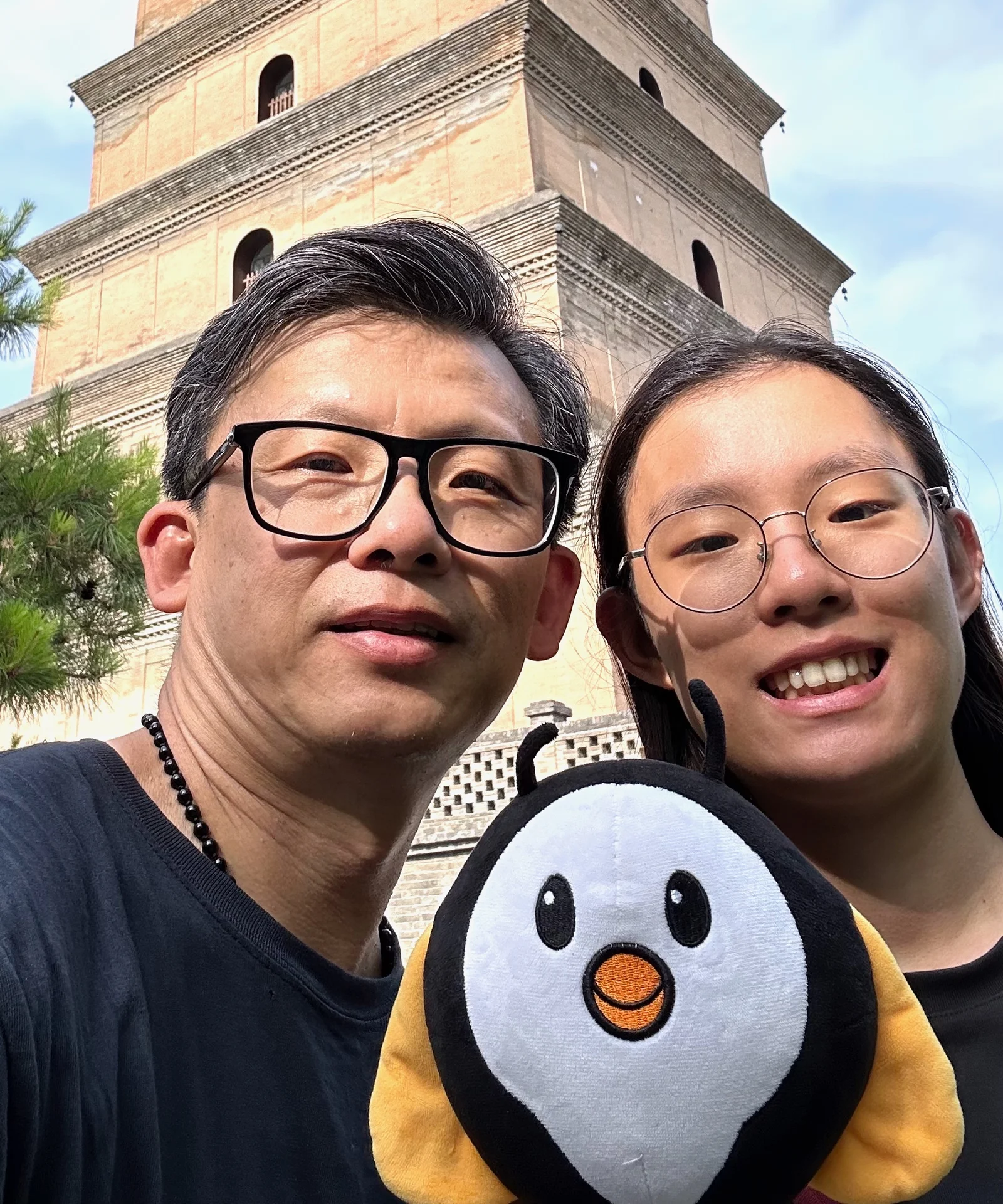
Dad & Elaine’s Experience
Over three separate trips to Beijing, we’ve gradually adopted exactly this approach.
We enjoy exploring hutongs, cafés and museums on our own.
But when visiting places filled with centuries of history, we’ve found that spending a day with a knowledgeable local guide completely changes the experience.
Instead of simply admiring beautiful buildings, we begin to understand the stories behind them.
Travel Tips at a Glance
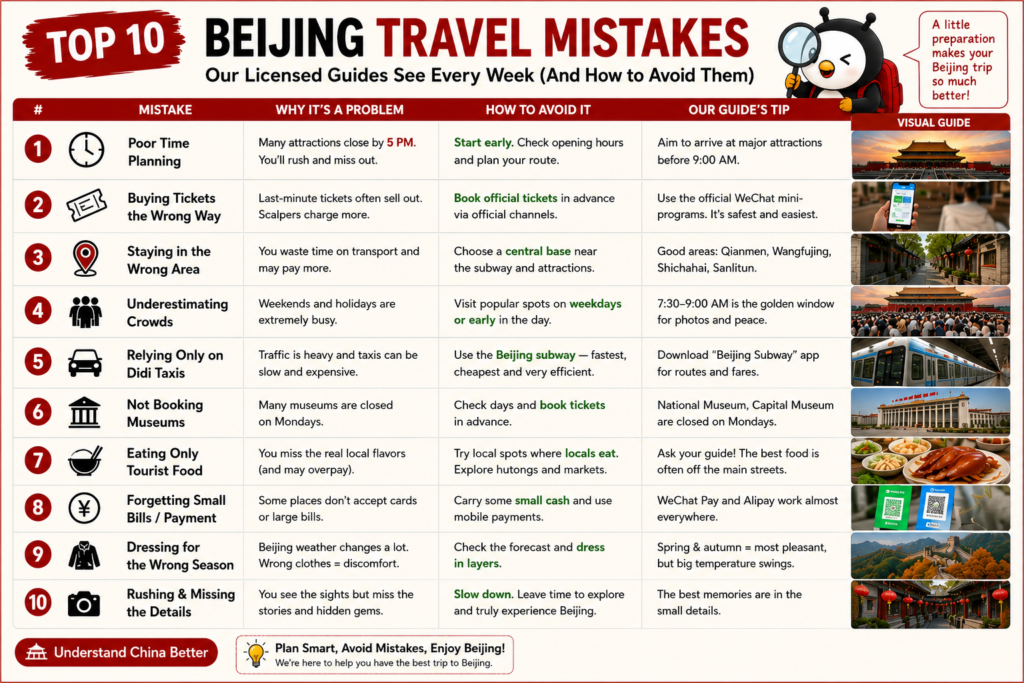
Biggest mistake: Trying to see too much.
Most underestimated factor: The size of 北京 (Běijīng).
Most important reservation: 故宫博物院 (Gùgōng Bówùyuàn).
Best transport app: 滴滴 (Dīdī).
Most comfortable season: 秋天 (Qiūtiān) — autumn.
Best overall strategy: Combine independent exploration with local expertise where it genuinely adds value.
Understanding China Better
Why Do Chinese Travellers Plan So Carefully?
Many first-time visitors notice how organised Chinese travellers seem.
That’s because travelling within China often requires advance planning.
Popular attractions have visitor limits.
High-speed trains (高铁 Gāotiě) frequently sell out.
Major destinations become extremely busy during national holidays.
Planning ahead isn’t just helpful—it’s part of the travel culture.
Following the same habit will make your own journey much smoother.
Final Verdict
One of the biggest lessons our Beijing guides have taught us is that enjoying Beijing isn’t about seeing the greatest number of attractions.
It’s about giving yourself enough time to appreciate them.
A slower itinerary doesn’t mean seeing less.
It usually means understanding more.
Avoid these ten common mistakes, and you’ll discover a Beijing that’s less stressful, more rewarding and far more memorable.
After all, the goal isn’t simply to visit 北京 (Běijīng).
It’s to understand it.
Continue Reading
This article is part of our From Our Beijing Guides series, where licensed local guides answer the questions foreign travellers ask most often while sharing the practical local knowledge that transforms a first visit into a far richer travel experience.