
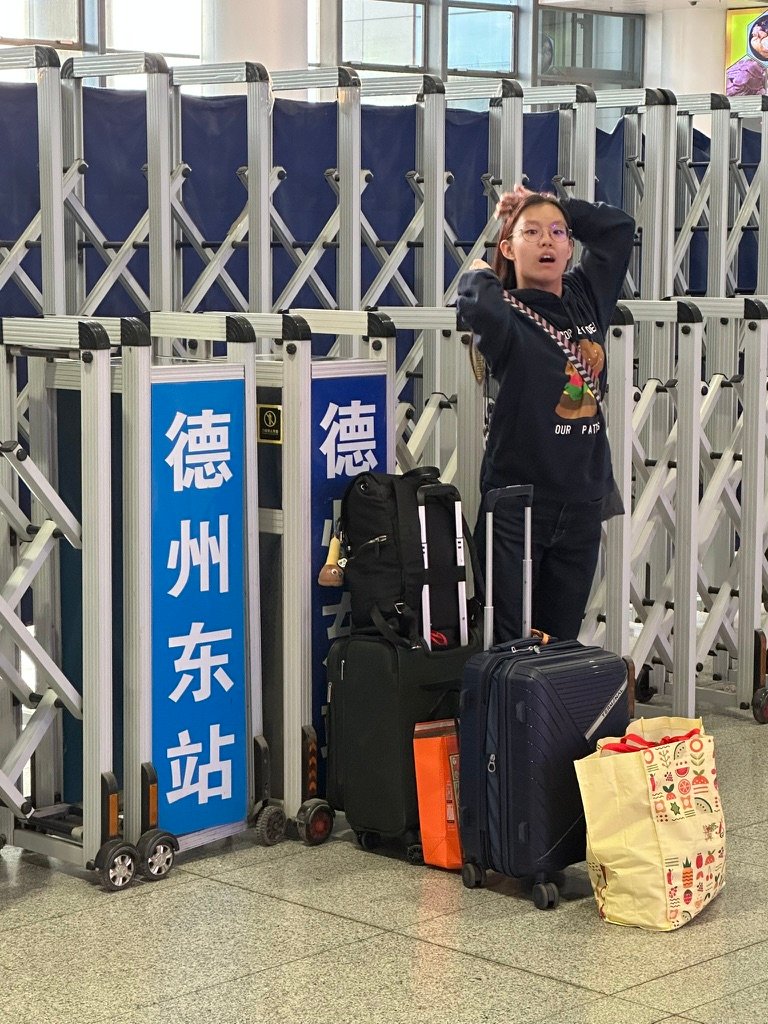
Our Shandong journey was coming to an end. Dad & Elaine had reached Dezhou (德州, Dézhōu), and that evening we were heading back to Beijing. The journey sounded straightforward: DiDi → Dezhou East Railway Station → high-speed train → Beijing South → Beijing Metro → hotel. By this stage of our China travels, that combination was beginning to feel almost normal. What Dad didn’t know was that Elaine had plans for the journey. Somewhere between Dezhou and Beijing, traveling at a photographed 305 km/h, Dad was going to have a birthday celebration. There was just one small problem. We didn’t have a birthday candle. 😂 ☕ Our Journey at a Glance Route: Dezhou → BeijingDeparture: Dezhou East Railway Station (德州东站, Dézhōu Dōng Zhàn)Train: G190 high-speed trainTime: EveningOnward transport: Beijing MetroWhere we’d been: Traveling through Shandong ProvinceWhat made it memorable: Elaine’s improvised birthday celebration at high speed ❤️ 🚗 Our Journey Started With a DiDi Before the HSR came the first little piece of the journey: getting ourselves to Dezhou East Railway Station. We called an executive-category DiDi (滴滴, Dīdī). When the car arrived, Dad noticed the badge: 红旗 (Hóngqí) — Hongqi, literally “Red Flag.” Hongqi is a Chinese premium automobile brand with a particularly interesting history. The brand has long been associated with Chinese state and ceremonial vehicles. Dad’s reaction was considerably less historical: “Wah. Our DiDi today quite atas. (high class) 😂” But there’s something useful for a first-time traveler hidden inside this very ordinary photograph. We were in Dezhou, far outside the standard Beijing–Xi’an–Shanghai first-trip triangle. Yet getting ourselves to the station was: open phone → call DiDi → car arrives → go to station. New city. Familiar travel rhythm. That’s one reason independent travel around China gradually became less intimidating for us. If you’re still trying to understand when to use HSR, metro, DiDi, taxis or flights, our Getting Around China: The Essential Guide for First-Time Travelers puts the pieces together. 📷 Then Came One of Dad’s Favorite Kinds of Travel Photos At Dezhou East, Dad & Elaine took a selfie beside the station sign: 德州东站 Dézhōu Dōng Zhàn Dezhou East Railway Station. Nothing spectacular. No Great Wall. No UNESCO monument. Just: Dad + Elaine + railway station. We even photographed our shadows while walking. At the time, that’s just a silly little travel photograph. Later? It says something a postcard cannot: We were there together. That’s exactly why we’re sharing photographs like these in FOLLOW OUR STORIES. The beautiful photographs show you China. The ordinary photographs often show you: what traveling China actually felt like. 🚄 What Did Boarding the HSR at Dezhou East Actually Look Like? This is the part a first-time international traveler may find difficult to picture before arriving in China. So instead of showing you another screenshot… watch what Dad & Elaine actually saw. Our G190 high-speed train arriving at Dezhou East Railway Station for the evening journey to Beijing. Passengers were already waiting. People lined up. Then the train appeared. That’s it. 😂 Before your first China trip, the railway process can sound intimidating: huge station + security + passport + waiting hall + boarding gate + platform + train number. Once you’ve done it several times, those separate worries start turning into a rhythm. Dad & Elaine weren’t standing there thinking: “Can foreigners really use China’s HSR?” We were thinking: “There’s our train.” 😂 If you’re preparing for your first journey, our China High-Speed Rail for Foreign Tourists — 2026 Guide covers the booking, passport, station, boarding and luggage process in detail. 🎫 Sometimes the Most Reassuring Photograph Is the Most Ordinary One Elaine had her backpack. Headphones. Suitcase. Phone. And she walked toward the railway gate, and board the HSR train.. If you’re wondering what other first-time travelers worry about before their first HSR ride, we’ve also published this real traveler question: China High-Speed Rail for First-Time Travelers: What Should You Know Before Your First Journey? 🚄 G190 — 305km/h Once aboard, we settled in for the evening journey to Beijing. Then Dad photographed the display. There it was: G190 19:44 and: 305 km/h 😳 The first few times Dad experienced China’s high-speed rail, numbers like that were the story. 305 km/h! But something funny happens after you travel around China by HSR repeatedly. Eventually: 305 km/h becomes the background. You’re sitting down. Looking at your phone. Doing something on your iPad. Having a drink. Waiting to arrive. Which is exactly what Elaine was doing. Except Elaine was secretly working on something else. 😂 ❤️ Dad’s Birthday at 305 km/h Elaine had an iPad. Dad had a small cake. But: no candle. Problem? Apparently not. 😂 Elaine took Dad’s photograph and started drawing. A candle appeared. Then: HAPPY BIRTHDAY DAD. No real candle. No flame. No matches. China Usually Has Another Way. 😂 And then came the photograph Dad still remembers. Dad. A little cake. Milk. A drink. Blue HSR seats. Somewhere between Dezhou and Beijing. And Elaine behind the camera. ❤️ Dad even posted about it that evening: “Super memorable BIRTHDAY cake cutting ceremony on board China High Speed Rail on the way to Beijing… candle was provided (hand-drawn) by Elaine.” Photo credit? Elaine Lee. 😊 Sometimes the best travel memories aren’t the things you put into the itinerary. 🚄 By Then, HSR Wasn’t Really an Attraction Anymore That’s perhaps the most interesting part of this story. Dad & Elaine had traveled on Chinese high-speed trains before. By this journey, HSR wasn’t something we were taking simply because: “China has cool bullet trains.” It was infrastructure we actually used to travel. Our wider Shandong journey had taken us through: Beijing → Jinan → Mount Tai → Qufu → Zibo / Linzi → Dezhou → Beijing. Different places. Different experiences. And the railway helped stitch the journey together. That evening, G190 was simply taking us back to Beijing. Dad happened to be having a birthday along the way. 😂❤️ 🐇 Why Were Dad & Elaine in Dezhou Anyway?
Expensive Meal With a View? — What We Ate on China’s High-Speed Rail 😂
Some restaurants charge extra for the view. Dad & Elaine found another version in China. Our table was tiny. Our chairs couldn’t be moved. Lunch came in a plastic box. And Dad remembers paying: more than RMB 50. 😬 Expensive for a simple meal in China? Yes. But our restaurant had one rather unusual feature. It was traveling across China at almost: 200 km/h. 😂 ☕ Our Meal at a Glance Where: On a China high-speed train高铁 (gāotiě): high-speed railWhat we ate: Chinese-style boxed meal盒饭 (héfàn): boxed mealDad’s remembered price: RMB 50+How Elaine ordered: QR code on the seat armrestSpeed Dad photographed: 199 km/hBest part: The view kept changing 🚄 Our Restaurant Was Moving at 199 km/h Look at the display above the carriage: 当前时速 199 km/h 当前时速 (dāngqián shísù) means: current speed. 199 km/h. And Dad & Elaine were simply sitting there. That’s one of the strange things about China’s high-speed rail. You know you’re moving quickly. But inside the carriage? People are sitting. Looking at phones. Resting. Eating. Doing ordinary things. And outside the window… China keeps moving past. 🏞️ Lunch Came With a Moving View Fields. Villages. Hills. Farmland. Then something different. Then something different again. 😂 No need to ask: “Can we have the table beside the window?” Elaine already had one. And unlike a restaurant with a mountain or river view, ours changed every few minutes. Then Elaine became hungry. 📱 Wait — We Can Order Lunch From HERE? Elaine noticed a QR code on the armrest beside our seat. So she scanned it. 扫码 (sǎomǎ) — scan a QR code. The food-ordering service opened on her phone. Elaine could look through the available choices… choose what she wanted… place the order… and then: stay in her seat. 😂 No walking through the train trying to find the dining car. No standing somewhere wondering what food was available. The little QR code beside us had effectively become: our menu. 🔌 And Of Course Elaine Was Charging Her Phone 😂 This photograph makes Dad smile. Think about what the phone was doing during our China travels. It could help with: payments maps translation transport train information and now… ordering lunch. Meanwhile the train itself provided somewhere to charge it. For a traveler in China, keeping the phone alive can become surprisingly important. Dad calls it: battery anxiety. 😂 Elaine probably calls it: normal life. 🍱 Then Lunch Arrived at Our Seat And there it was. Lunch. A Chinese-style boxed meal: 盒饭 (héfàn). Rice: 米饭 (mǐfàn). Vegetables: 蔬菜 (shūcài). Meat and other cooked dishes arranged in separate sections. Nothing fancy. No beautiful restaurant plating. No waiter carrying a silver tray. Just: hot food in a plastic meal box. And Dad remembers paying more than RMB 50. 💰 RMB 50+? That’s Not Cheap for This Meal Let’s be clear. By the standards of the ordinary meals Dad & Elaine were eating elsewhere in China: RMB 50+ for this simple boxed meal was expensive. 😂 We’ve eaten perfectly satisfying local meals for considerably less. And historically, high-speed rail catering has offered meals across different price levels, with onboard meals often costing noticeably more than inexpensive everyday food on the ground. So what were we paying for? Not merely: rice + vegetables + meat. We were also paying for: CONVENIENCE. Elaine didn’t leave the seat. She scanned the QR code. Ordered on the phone. The food came to us. And while all this happened… our restaurant kept moving across China. 😂 💡 What We’d Tell a First-Time Traveler If saving money matters: buy food before boarding or bring something with you. Chinese railway stations usually give you opportunities to buy food and drinks before getting onto the train. You don’t have to order an onboard meal. But if you’re already traveling, you’re hungry, and you don’t particularly feel like organizing lunch before boarding? The onboard option can be wonderfully convenient. For Dad & Elaine, that convenience was worth paying for that day. 🍚 Finally, Dad Let Elaine Eat Chopsticks out. Rice disappearing. Scenery still moving. Phone charging. Dad still taking photographs. 😂 This wasn’t one of the great culinary experiences of our China journeys. And that’s exactly why it belongs in WHAT WE ATE. Because traveling isn’t made entirely from: famous restaurants signature dishes food markets and: “10 Foods You MUST Try in China.” Sometimes you’re simply hungry between two cities. And lunch looks like this. 🀄 A Few Useful Chinese Words 高铁 (gāotiě) — high-speed rail 盒饭 (héfàn) — boxed meal 米饭 (mǐfàn) — cooked rice 蔬菜 (shūcài) — vegetables 二维码 (èrwéimǎ) — QR code 扫码 (sǎomǎ) — scan a QR code 点餐 (diǎncān) — order food 当前时速 (dāngqián shísù) — current speed You don’t need these words to eat lunch on a Chinese train. But Dad thinks recognizing a few of them makes traveling China more interesting. ☕ Expensive Meal With a View? So let’s answer Dad’s original question. Was the meal expensive? For what was inside the box? Yes. 😂 Dad remembers paying RMB 50+. Could we have eaten more cheaply before boarding? Absolutely. But Elaine ordered lunch without leaving her seat. The food came to us. Her phone was charging. And outside the window, China kept rolling past while our dining room traveled at 199 km/h. So perhaps Dad’s final restaurant review should be: Food: ordinary. Price: expensive for what we ate. Convenience: excellent. View: constantly changing. Restaurant speed: 199 km/h. 😂 Would Dad & Elaine pay the convenience premium again on the right journey? Yes. Sometimes you’re not paying only for the meal. You’re paying to stay in your seat… eat something hot… and watch China go by. Real Journeys. Real Stories. Real China. See China. Understand It Better.
What We Ate in Beijing: Why Dad & Elaine Kept Going Back to 南城香
FOLLOW OUR STORIES → WHAT WE ATE When people ask what to eat in Beijing (北京, Běijīng), the famous answers usually come first. 北京烤鸭 (Běijīng kǎoyā) — Peking duck. 炸酱面 (zhájiàngmiàn) — noodles with fried soybean and meat sauce. 饺子 (jiǎozi) — dumplings. And perhaps, for the brave, 豆汁 (dòuzhī) — Beijing’s famously challenging fermented mung-bean drink. 😂 But one of Dad & Elaine’s favorite places to eat during our Beijing travels wasn’t a famous restaurant at all. It was 南城香 (Nánchéngxiāng). And we didn’t eat there just once. We kept going back. 😂 🍚 Not Every Meal Needs to Be Famous This is something Dad has gradually learned from traveling around China. When you’re visiting for a few days, perhaps you want every meal to be an experience. But when you’re traveling for longer? Sometimes you just want: something hot + something familiar + vegetables + rice + somewhere comfortable to sit. 南城香 became that kind of place for us. It wasn’t somewhere we traveled across Beijing specially to visit. It was simply a casual local restaurant chain that worked. Bright. Clean. Affordable. Plenty of choices. And filled with ordinary people having ordinary meals. That last part mattered. Because sometimes experiencing China isn’t about finding another attraction. Sometimes it’s sitting down and eating dinner where everybody else is eating dinner. ❤️ How a Restaurant Becomes “Our Place” After eating somewhere once, you know roughly what to expect. After the second visit, ordering becomes easier. And after several visits… Dad & Elaine had effectively developed a Beijing fallback: “Don’t know what to eat?” “南城香?” “Okay.” 😂 That may not sound like much of a travel story. But anyone who has traveled for several weeks will probably understand. Finding one place where you know you can sit down, understand the system and find something everybody wants to eat is strangely comforting. 🍆 What Did Dad Actually Eat? This photograph is probably the most Dad-looking meal imaginable. 😂 Rice. Vegetables. And 肉酱茄子饭 (ròujiàng qiézi fàn) — rice with eggplant in a savory minced-meat sauce. A few useful Chinese food words: 米饭 (mǐfàn) — cooked rice 青菜 (qīngcài) — green vegetables 茄子 (qiézi) — eggplant 肉酱 (ròujiàng) — meat sauce Nothing fancy. Nothing that required a food guide. Nothing Dad needed to photograph from six different angles before eating. 😂 But after a long day walking around Beijing, sometimes this was exactly what Dad wanted. Rice. Vegetables. A proper hot dish. Done. 🥟 Elaine’s Wontons Another easy choice was: 三鲜大馄饨 (sānxiān dà húntun) — large “three-fresh” wontons served in soup. The menu described the filling as containing: The menu also offered a 半份 (bàn fèn) — half portion. That meant five wontons. Simple. Warm. Comforting. And importantly when you’re traveling: you didn’t have to order an enormous restaurant meal just because you wanted something to eat. 📱 Then Dad Had to Learn How to Order 😂 There wasn’t necessarily a waiter arriving with a thick printed menu. Instead, there was this: A QR code. The Chinese instruction was: 扫码点餐 (sǎomǎ diǎncān) Literally: scan the code to order. You scan the code with your phone, open the digital menu, choose the dishes and place the order. Depending on the restaurant’s system, payment can also be completed digitally. For first-time international travelers, that can initially produce a: “Errr… where’s the menu?” 😬 moment. Dad understands. We had those moments too. ChinaTravelBUG has a separate explanation here: 👉 Why Do Some Restaurants in China Make You Scan a QR Code to Order? 😂 Dad’s Secret Weapon: PICTURES Fortunately, the digital menu showed photographs. That made life much easier. Dad could look. Elaine could read. And together we could work out what Dad was actually about to order. 😂 During our October 2023 Beijing trip, for example, we saw: 安格斯肥牛饭 (Āngésī féiniú fàn)Angus fatty-beef rice — RMB 25.50 肉酱茄子饭 (ròujiàng qiézi fàn)Rice with eggplant and minced-meat sauce — RMB 17 三鲜大馄饨(半份)(sānxiān dà húntun, bàn fèn)Half portion of three-fresh wontons — RMB 9.50 ⚠️ Important Price Note Those are October 2023 prices from our own visit. They are NOT current-price quotations. Menus, portion sizes and prices change. We’re showing them because they provide a useful snapshot of what this kind of everyday Beijing meal cost when Dad & Elaine ate there in October 2023. 💳 And Yes — We Paid With the Phone Mobile payment was already simply part of everyday life around us. Two Chinese terms international travelers will quickly encounter are: 支付宝 (Zhīfùbǎo) — Alipay 微信支付 (Wēixìn Zhīfù) — WeChat Pay If you’re preparing for your first China trip, set these up before you arrive rather than trying to figure everything out while standing hungry beside a restaurant table. 👉 How to Use Alipay & WeChat Pay in China — First-Time Visitor’s Guide 🀄 Dad’s Mini Chinese Menu You don’t need to learn Chinese to eat in China. But knowing a few words makes the experience more interesting. 南城香 (Nánchéngxiāng) — the restaurant chain 米饭 (mǐfàn) — cooked rice 青菜 (qīngcài) — green vegetables 茄子 (qiézi) — eggplant 牛肉 (niúròu) — beef 猪肉 (zhūròu) — pork 馄饨 (húntun) — wonton 半份 (bàn fèn) — half portion 扫码点餐 (sǎomǎ diǎncān) — scan the QR code to order And two particularly useful ones: 不要香菜 (bú yào xiāngcài) — no cilantro/coriander 不要小葱 (bú yào xiǎocōng) — no scallions Dad suspects the last two may be more useful to some travelers than learning how to say “Where is the Forbidden City?” 😂 🏙️ This Was Also Part of Seeing Beijing When first-time travelers imagine Beijing, they naturally think about: the Forbidden City, the Great Wall, the Temple of Heaven, Tiananmen, hutongs, Peking duck. Of course. Those are part of Beijing. But this was Beijing too. [PHOTO — restaurant interior with local diners] Families eating. People coming in after work. Someone scanning a QR code. Someone collecting dinner. Dad eating his rice. Elaine having wontons. Nothing particularly remarkable was happening. And that’s precisely why Dad remembers it. This was everyday
What We Ate in Beijing: A Surprisingly Cheap Bowl of Shaanxi Noodles
FOLLOW OUR STORIES · WHAT WE ATE Sometimes our China food stories begin with a famous dish. This one began with Dad looking at a sign and thinking: RMB 9.60? In Beijing? 😳 We had found a casual Shaanxi noodle shop. Yes: Shaanxi noodles — in Beijing. 😂 And because Dad & Elaine have traveled around Shaanxi Province (陕西省, Shǎnxī Shěng) ourselves, we weren’t going to walk past without trying a bowl. Dad’s simple Shaanxi-style noodle meal in Beijing. 🍜 What Was in the Bowl? Dad chose the 秘制肉酱面 (mìzhì ròujiàng miàn) — noodles with the shop’s seasoned meat sauce. The bowl arrived with thick noodles topped with minced meat, chopped green onions and preserved vegetables. Nothing elaborate. Nothing dressed up for tourists. Just a quick, filling bowl of noodles. And Dad rather liked it. 😂 😳 But RMB 9.60? The shop was advertising selected noodle dishes for: RMB 9.60 That caught Dad’s attention immediately. For Beijing, this was very cheap. In fact, this was probably the cheapest proper meal Dad ate in Beijing on this trip. ⚠️ Dad’s Price Reality Check Please don’t use RMB 9.60 as your normal Beijing noodle budget. 😂 This was an unusually inexpensive promotional price. From our own travels, a simple local noodle dish in China has more commonly cost us somewhere around the teens to RMB 20, depending on the city, neighborhood and what we ordered. And location matters. At touristy Qianmen (前门) in Beijing, for example, Dad paid RMB 20 for another simple bowl of noodles. So the lesson is NOT: “Noodles in Beijing cost RMB 9.60.” The better lesson is: Even in Beijing, you can occasionally stumble across remarkably inexpensive everyday food — especially if you’re eating simply and away from expensive restaurants. 🥢 Then Dad Noticed the Sign There was another small detail that interested Dad almost as much as the price. It said: 面汤自取 (miàntāng zìqǔ)Help yourself to the noodle soup / noodle cooking water. And: 小料自取 (xiǎoliào zìqǔ)Help yourself to the condiments. 😂 This is exactly the kind of tiny thing Dad likes noticing when we travel. You order the noodles. Then you see what everybody else is doing. Take some condiments. Adjust the bowl to your own taste. And if you want some 面汤 (miàntāng), help yourself. No ceremony. No explanation for international travelers. It’s simply how the shop works. 🍵 Wait — What’s 面汤? For an international traveler, 面汤 (miàntāng) can be confusing. You may expect “noodle soup” to mean a flavored broth with noodles inside it. But here it can refer to the hot liquid associated with cooking the noodles — something simple that can accompany the meal. Dad loves little discoveries like this. Not because 面汤 is some famous Chinese delicacy that you must travel across the world to taste. 😂 Quite the opposite. It’s interesting because it’s ordinary. Everybody around you understands what to do. You are the traveler standing there thinking: “What’s that?” And one tiny piece of everyday China has just appeared. 🗺️ Shaanxi Food… In Beijing?! There was another reason this little meal made us smile. Shaanxi Province (陕西省, Shǎnxī Shěng) has become very familiar territory for Dad & Elaine. We’ve eaten noodles in Xi’an (西安, Xī’ān). We’ve traveled beyond Xi’an into other parts of Shaanxi. And we’ve learned something important along the way: “Chinese food” isn’t really one food. Move around China and the noodles change. The dumplings change. The bread changes. The breakfast changes. Even the things sitting beside your bowl change. So finding Shaanxi noodles in Beijing felt a little like encountering an old acquaintance somewhere unexpected. And, of course, there’s a simple reason you can do this: China’s regional foods travel too. Beijing isn’t a city where you can eat only Beijing cuisine. It’s a huge national capital where people — and their food traditions — have arrived from all over China. If you’d like to follow more of the foods Dad & Elaine encountered across the country, continue with: → What Do People Really Eat in China? Our Father & Daughter Food Journey From Beijing to Xi’an and Beyond ❤️ What We Ate — And What We Noticed Was this the best meal Dad ate in Beijing? No. Was it the fanciest? Definitely not. 😂 It was a cheap bowl of noodles. But it gave us three little pieces of our China journey: Shaanxi food in Beijing. An unexpectedly cheap RMB 9.60 meal. And: 面汤自取. Help yourself to the noodle soup. That’s why we’re keeping these little What We Ate stories. Not every meal needs to be Peking duck. Not every restaurant needs to be famous. Sometimes Dad & Elaine simply sit down, eat what ordinary people around us are eating… and notice something we didn’t know yesterday. One bowl at a time, China gets a little easier to understand. 🍜
Dinner in Beijing — Beef Noodles, Free-Flow Chili and Oranges 😂
This wasn’t one of Beijing’s famous restaurants. And that was partly why Dad & Elaine went in. It was dinner time, and inside were local families, a young child and workers still wearing their orange work uniforms. In other words: people were simply having dinner. For Dad & Elaine, that’s often a good enough recommendation. A Bowl of Beef Noodles Elaine ordered a steaming bowl of beef noodles (牛肉面, niúròu miàn). Beef, noodles, broth, coriander and spring onion. Simple. Hot. Comforting after another day walking around Beijing. But Dad also noticed the little things surrounding the bowl. There was chili sauce and other condiments available for diners to help themselves. And then there were the oranges. Complimentary. Take one. Want another? Take another. 😂 None of this would make a list of “Beijing’s Top 10 Must-Eat Foods.” But perhaps that’s exactly why Dad photographed it. What Travelers Don’t Usually Photograph When we talk about eating in China, attention naturally goes to famous dishes: Peking duck. Dumplings. Hotpot. Regional specialties. But most people in China aren’t eating a famous dish every evening. They’re finishing work. They’re bringing a child out for dinner. They’re sitting down with colleagues. They’re ordering a bowl of noodles. The workers at the next table weren’t part of a food tour. Neither was the little girl having dinner with her family. This was simply where local people ate. And for one evening in Beijing, Dad & Elaine ate there too. ☕ ChinaTravelBUG’s Take Sometimes Dad chooses a restaurant because everyone online recommends it. Sometimes because a local guide takes us there. And sometimes we look through the window and think: “Lots of local people are eating here. Let’s try.” No reservation. No famous chef. No carefully researched “must-eat” list. Just a hot bowl of beef noodles, plenty of chili sauce… and a couple of free oranges for the road. 😂 That’s part of what we actually ate in China too.