Most international travelers who reach Xi’an (西安, Xī’ān) already know one ancient Chinese name:
Qin Shi Huang (秦始皇, Qín Shǐhuáng)
China’s first emperor.
And they probably know his:
Terracotta Warriors (兵马俑, Bīngmǎyǒng)
But Dad & Elaine took another train west.
To:
Baoji (宝鸡, Bǎojī)
in Shaanxi Province (陕西省, Shǎnxī Shěng).
Why?
Because we wanted to go:
BEFORE QIN.
And one of the best places to start is:
Baoji Bronze Ware Museum
宝鸡青铜器博物院
Bǎojī Qīngtóngqì Bówùyuàn
青铜器 (Qīngtóngqì)
→ bronze vessels / bronze objects
博物院 (Bówùyuàn)
→ museum
Baoji sits in a landscape deeply connected with the:
Western Zhou dynasty (西周, Xī Zhōu)
c. 1046–771 BCE
That’s centuries before Qin Shi Huang unified China in 221 BCE.
But Dad has one warning.
😂
Walk into this museum and you will see:
A LOT OF BRONZE.
Don’t try to remember everything.
We’re going to look for just:
ONE technology
ONE word
ONE person
ONE family
and:
ONE landscape.
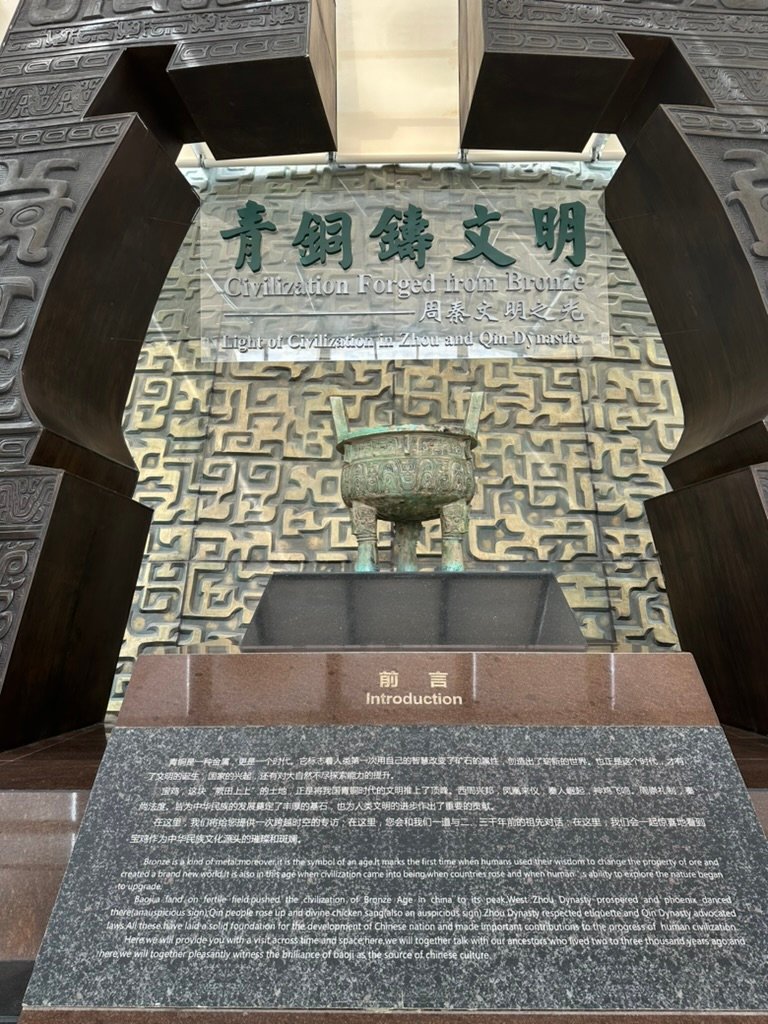
🎥 First — Walk Into the “Kingdom of Bronze”
Dad & Elaine walked into the museum’s huge main hall.
And the wall basically told us what we’d gotten ourselves into:
青铜器王国
Qīngtóngqì Wángguó
“Kingdom of Bronze Ware”
😂
Good.
Let’s start cooking.
🥉 DISCOVERY 1 — Bronze Was High Technology
At first, ancient Chinese bronzes can look like:
very beautiful old containers.
Then Dad saw how they were made.
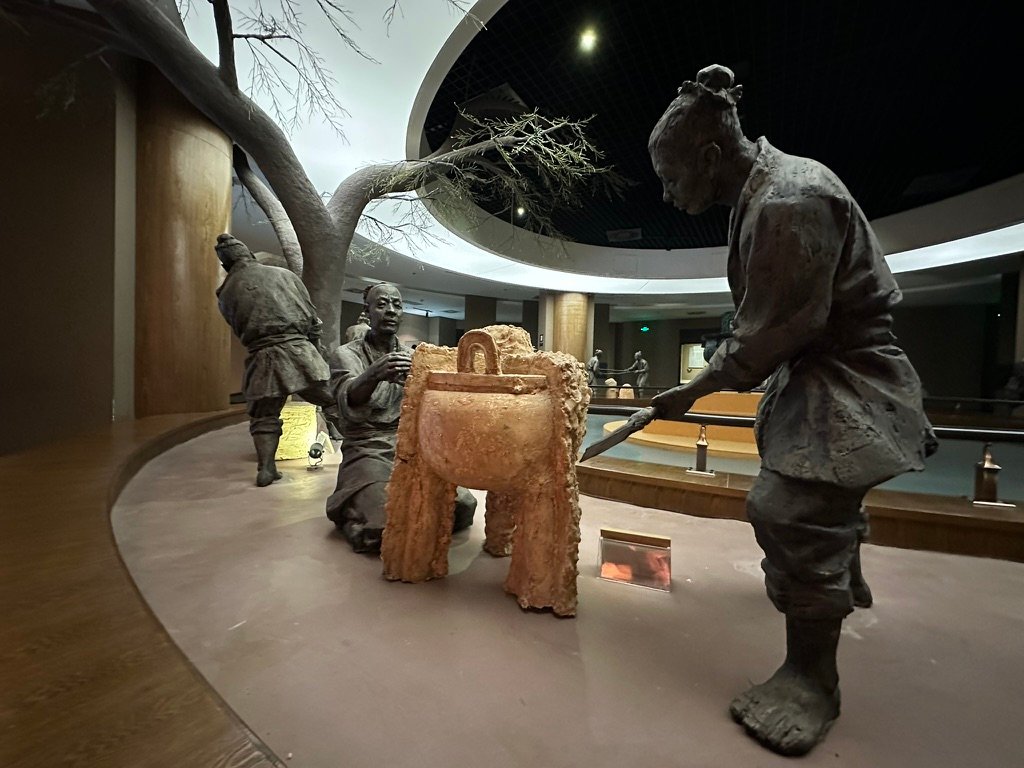
Reconstruction of an ancient bronze-casting scene inside Baoji Bronze Ware Museum (宝鸡青铜器博物院, Bǎojī Qīngtóngqì Bówùyuàn).
The museum introduces:
范铸法
Fànzhù Fǎ
“mold-casting method”
Producing an elaborate bronze required much more than:
melt metal → pour metal → finished.
Craftspeople had to coordinate:
the model
mold sections
the inner core
alloy composition
furnace temperature
and:
the casting itself.
Get it wrong?
Very expensive ancient mistake.
😂
Dad’s Technology Handrail
No electricity.
No computer-controlled furnace.
No modern machine tools.
Yet craftspeople could produce complex ritual bronzes with elaborate decoration, handles, projections and controlled forms.
And sometimes they added something even more remarkable:
WRITING.
Inside the bronze.
🔥
That’s when these objects stopped being merely beautiful to Dad.
They became:
TECHNOLOGY + ART + DOCUMENT.
And that leads to the trick that changes this entire museum visit.
Don’t just look AT the bronze.
LOOK INSIDE.
🐇
✍️ Because the Bronzes Can Talk
Inside many Zhou dynasty (周朝, Zhōucháo) bronzes you’ll find:
金文
Jīnwén
“bronze inscriptions”
This ancient writing developed within the long evolution of Chinese writing that also includes earlier:
甲骨文
Jiǎgǔwén
“oracle-bone writing.”
The characters don’t look exactly like modern Chinese.
Of course not.
We’re going back roughly:
3,000 YEARS.
But those inscriptions can preserve:
names
dates
wars
royal commands
appointments
rewards
ancestors
and even:
family histories.
So here’s Dad’s museum rule:
Without 金文 (Jīnwén), these are beautiful bronzes.
With 金文, they start talking.
🔥
And one of the most famous bronzes in the entire museum has something written inside that Dad already knew how to read:
中国
Zhōngguó
Today:
China.
😳
So Dad & Elaine went looking for:
He Zun (何尊, Hé Zūn).
尊 (Zūn)
→ ritual wine vessel.
And that’s where our second discovery begins.
→ GO DEEPER: He Zun (何尊, Hé Zūn) — The 3,000-Year-Old Bronze That Bears the Characters 中国 (Zhōngguó)
🈶 DISCOVERY 2 — One Bronze. Two Characters. 中国.
Now Dad & Elaine went looking for the museum’s superstar:
He Zun (何尊, Hé Zūn)
何 (Hé)
→ the clan/name associated with its owner
尊 (Zūn)
→ ritual wine vessel
But the reason He Zun is famous isn’t only what you see outside.
It’s what was cast:
INSIDE.
🎥 Come With Us to Find He Zun
We entered:
周礼之邦
Zhōulǐ Zhī Bāng
“Land of Zhou Ritual”
and eventually reached:
何尊特别展
Hé Zūn Tèbié Zhǎn
“He Zun Special Exhibition”
Then there it was.
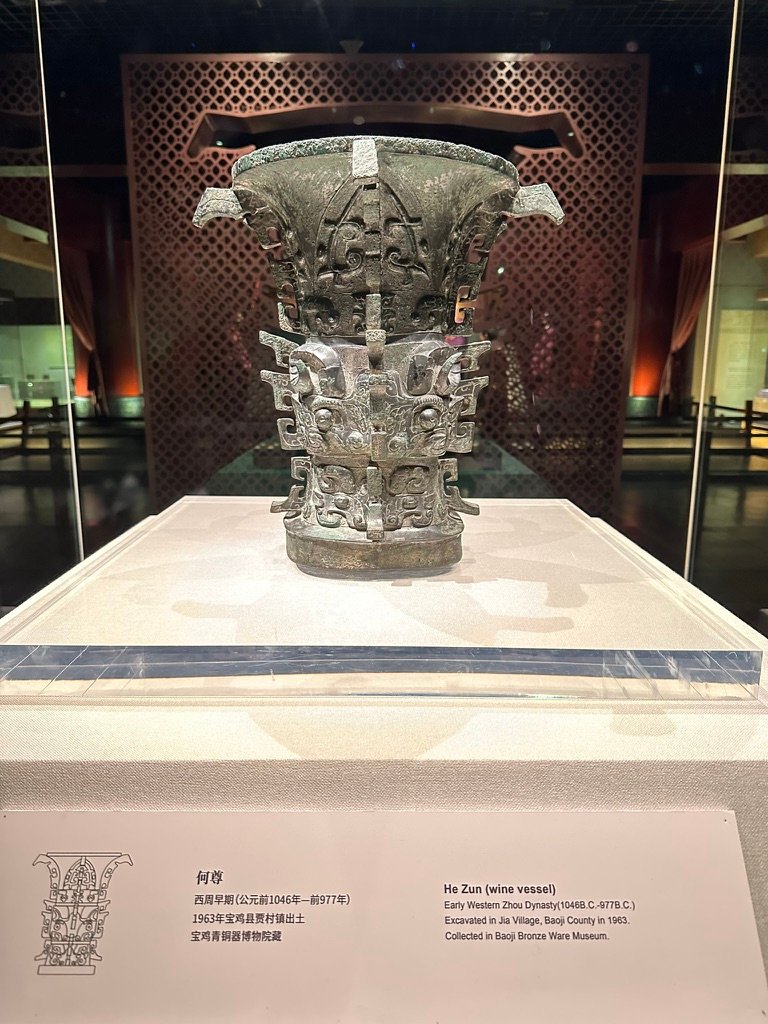
He Zun (何尊, Hé Zūn), an early Western Zhou (西周, Xī Zhōu) bronze ritual vessel and one of the star exhibits of Baoji Bronze Ware Museum (宝鸡青铜器博物院, Bǎojī Qīngtóngqì Bówùyuàn).
Beautiful outside.
But remember Dad’s new rule:
LOOK INSIDE.
🐇
中国 — Zhōngguó
The inscription inside He Zun contains:
宅兹中国
Zhái zī Zhōngguó
The famous part is:
中国
Zhōngguó
Today those two characters are the standard Chinese name for:
China.
But be careful.
The inscription is roughly 3,000 years old.
Here 中国 did not yet mean the modern nation-state called China.
In its ancient context, it referred more closely to the:
“central region” / “central lands.”
🔥
That’s much more interesting.
The characters survived.
Their meaning evolved.
And thousands of years later:
中国
became the name used for China itself.
Dad’s Language Handrail
This is why ancient Chinese writing is such a wonderful rabbit hole.
Sometimes you recognize the characters…
but that doesn’t mean they meant:
exactly what they mean today.
😂
Same writing.
Different historical world.
For the full He Zun inscription, archaeological context and the debate around 中国 (Zhōngguó), Dad has already gone much deeper here:
→ GO DEEPER: He Zun (何尊, Hé Zūn) — The 3,000-Year-Old Bronze That Bears the Characters 中国
We’re not going to cook that entire dish again.
😂
Because elsewhere in the museum, Dad found bronzes whose inscriptions tell a completely different kind of story.
Not the history of:
ONE WORD.
But the career of:
ONE MAN.
His name was:
逨
Lái
Lai.
And remarkably…
Dad found him in:
TWO CONSECUTIVE YEARS.
🐇
👤 DISCOVERY 3 — Meet Lai (逨, Lái)
After He Zun (何尊, Hé Zūn), Dad thought he understood the trick.
Look inside the bronze.
Find the writing.
Learn something about ancient China.
Then we met:
Lai (逨, Lái).
And suddenly the bronzes started behaving like:
someone’s personal file.
😂
First — Year 42
Dad found:
四十二年逨鼎
Sìshí’èr Nián Lái Dǐng
“42nd-Year Lai Ding”
鼎 (Dǐng)
→ tripod ritual vessel
The museum dates it to:
786 BCE
in the museum’s chronology
And the inscription tells us about:
Lai’s military service.
It records Lai participating in a campaign against the:
猃狁
Xiǎnyǔn
a northern people who fought the Zhou
The story is essentially:
WAR
↓
MILITARY ACHIEVEMENT
↓
ROYAL REWARD
↓
CAST IT INTO BRONZE.

Western Handrail — How Old Is 786 BCE?
The museum dates the:
42nd-Year Lai Ding
(四十二年逨鼎, Sìshí’èr Nián Lái Dǐng)
to:
786 BCE.
For an international traveler, that can feel like:
“Okay… very old.”
😂
So here’s Dad’s Western handrail.
According to Roman tradition:
Rome was founded in 753 BCE.
Which means that when Lai (逨, Lái) was recording his military service and royal reward inside this bronze…
Rome had not traditionally been founded yet.
😳
Its traditional founding date was still about:
33 YEARS AWAY.
Meanwhile, during China’s:
Western Zhou dynasty
(西周, Xī Zhōu),
this bronze inscription could already preserve:
a named official
military service
a king
a royal reward
and:
a date
in writing cast directly into:
BRONZE.
🔥
Across the Mediterranean, this was also broadly the world in which the Greek epic tradition associated with Homer was taking shape.
But Dad isn’t trying to turn this into:
China vs the West.
Different societies developed in different ways.
The comparison simply gives international travelers somewhere familiar to hang the date.
So next time you see:
786 BCE
remember:
Lai’s career was being written in bronze
↓
Rome’s traditional founding was still 33 years away.
Now Dad can remember the date too.
😂
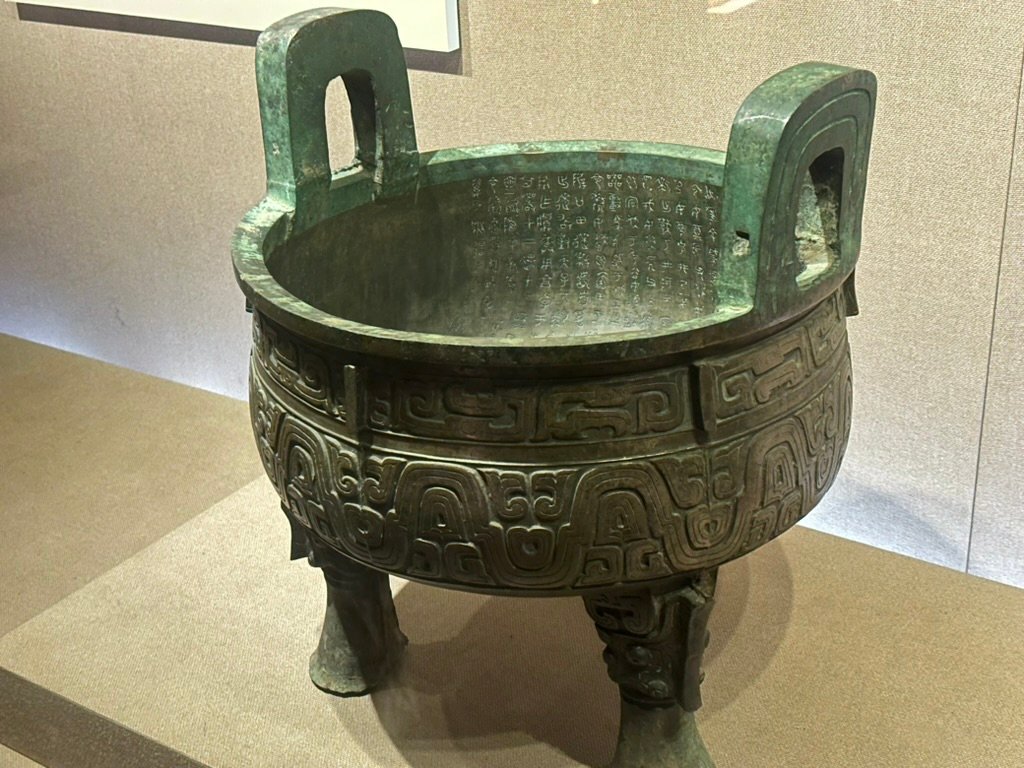
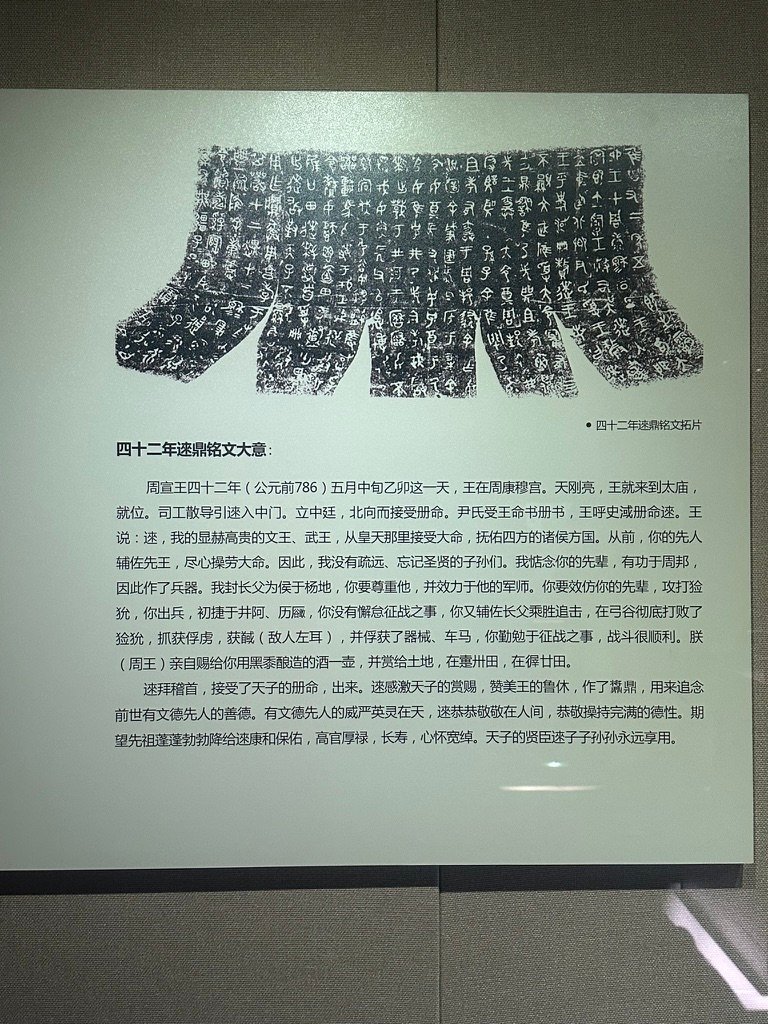
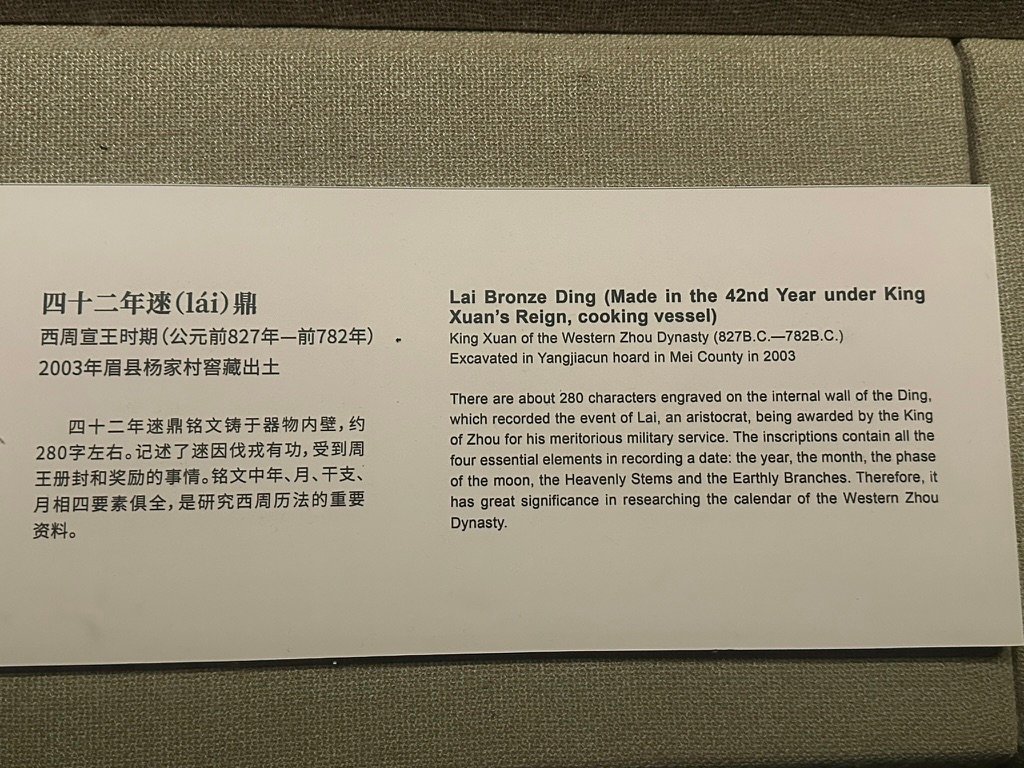
42nd-Year Lai Ding (四十二年逨鼎, Sìshí’èr Nián Lái Dǐng), late Western Zhou dynasty (西周, Xī Zhōu). Its inscription preserves a chapter from Lai’s military career.
Now Dad understood why:
金文 (Jīnwén)
bronze inscriptions
matter.
Without the inscription?
Beautiful ancient vessel.
With it?
A MAN HAS APPEARED.
Then Dad Found Him Again.
One year later.
😂
四十三年逨鼎
Sìshísān Nián Lái Dǐng
“43rd-Year Lai Ding”
The museum dates this one to:
785 BCE
in its chronology.
Same:
Lai (逨, Lái).
Different chapter of his life.
Year 43 — Promotion
Now the inscription isn’t mainly about fighting.
Lai receives a:
册命
Cèmìng
royal appointment / investiture command
from:
King Xuan of Zhou
(周宣王, Zhōu Xuānwáng)
— a king of the late Western Zhou dynasty (西周, Xī Zhōu).
Lai is given:
new responsibilities
royal instructions
and:
prestigious gifts.
But Dad particularly likes what comes next.
The royal command isn’t simply:
“Congratulations on the promotion.”
😂
It also tells Lai, in essence:
work diligently
act impartially
distinguish right from wrong
don’t abuse your authority
and:
don’t enrich yourself improperly.
Hang on.
This is:
785 BCE.
😳
🪜 Dad’s Political Science Handrail
Suddenly this isn’t merely:
“ancient Chinese bronze.”
We’re listening to a government telling an official:
Here is your office.
Here is your authority.
Here is how we expect you to behave.
That’s:
bureaucracy
political responsibility
and:
ideas about good government
cast into bronze roughly:
2,800 YEARS AGO.
🔥
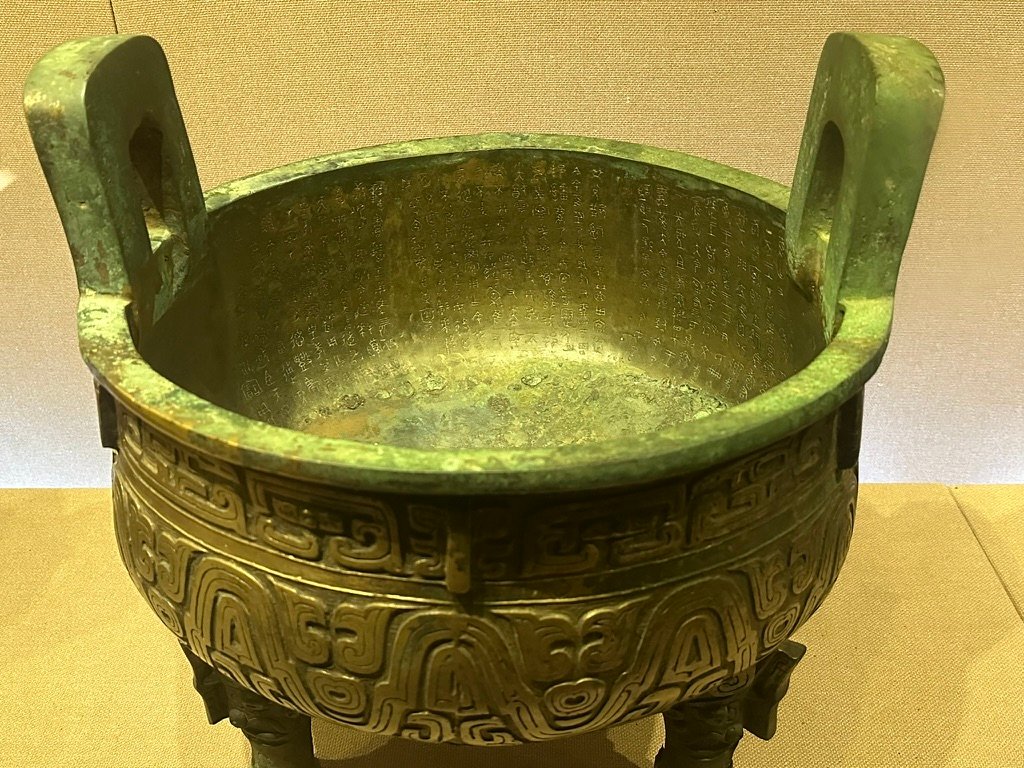
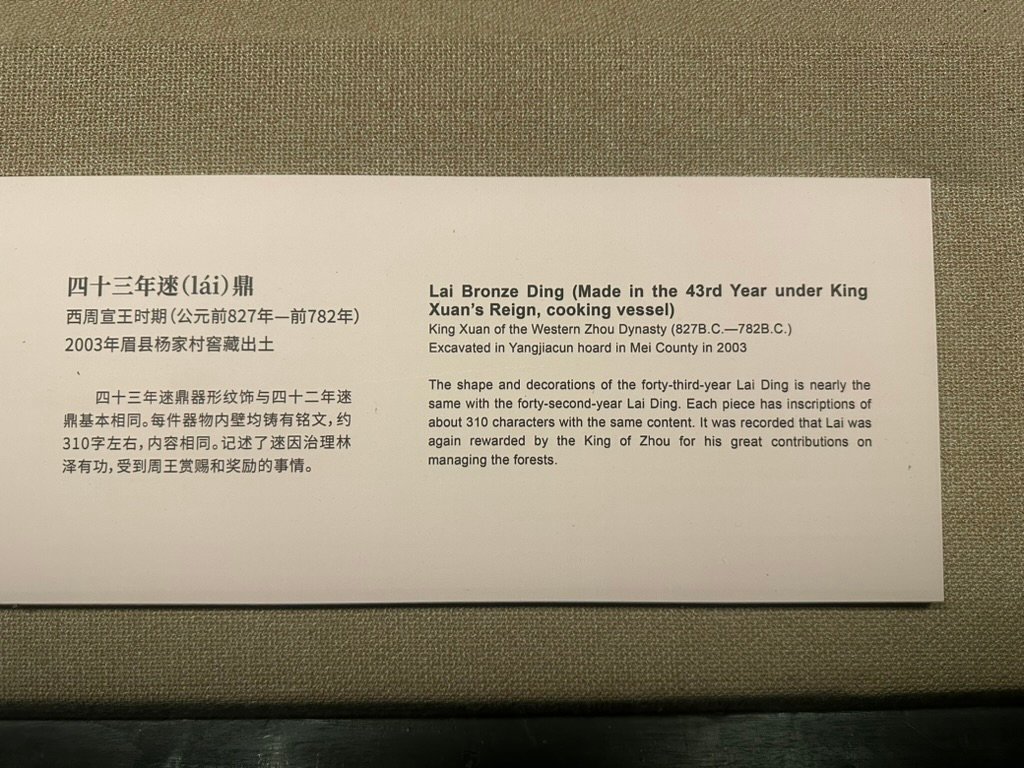
43rd-Year Lai Ding (四十三年逨鼎, Sìshísān Nián Lái Dǐng). One year after the military story recorded in the 42nd-Year vessel, another inscription preserves Lai’s royal appointment and responsibilities.
👀 Look Inside
Now use Dad’s rule again.
Don’t stare only at the legs.
Don’t admire only the decoration.
LOOK INSIDE.
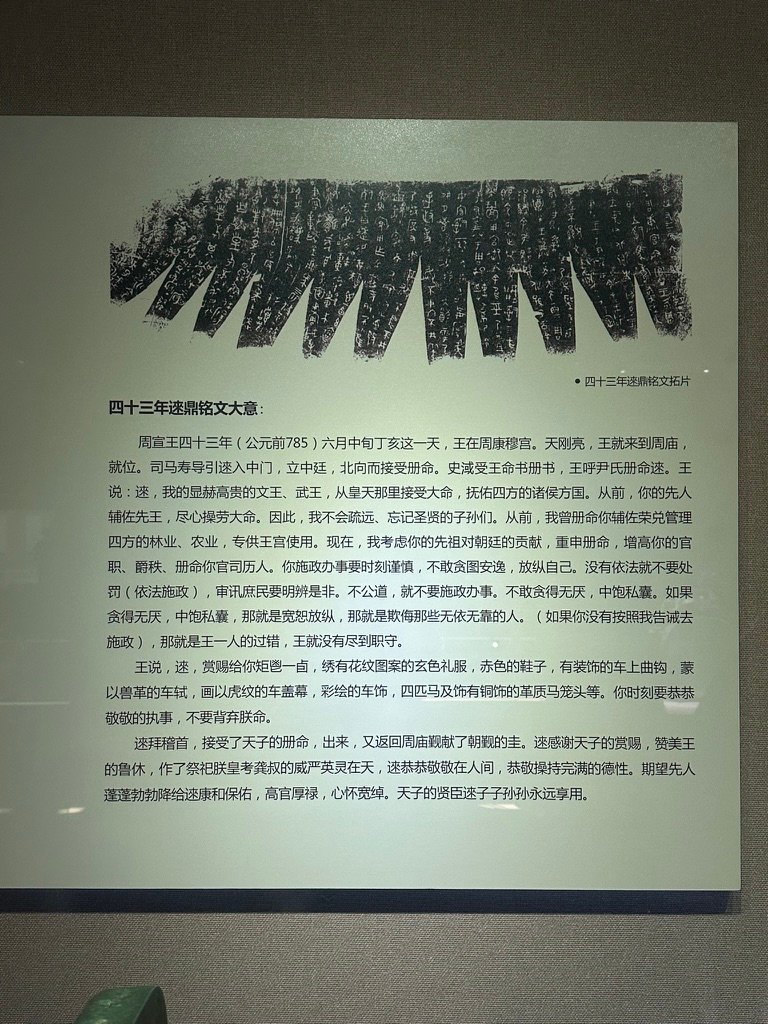
Those rows of characters are:
金文
Jīnwén
bronze inscriptions.
They preserve:
the king
the official
the date
the appointment
the reward
and:
the reason the bronze was made.
Dad had come expecting:
ARTIFACTS.
Instead we were reading:
DOCUMENTS.
Except somebody had saved the file in:
BRONZE.
Good luck accidentally deleting that.
😂
⭐ Two Years. One Career.
Put the vessels beside each other:
YEAR 42
Lai goes to war
↓
performs military service
↓
receives royal recognition
YEAR 43
Lai receives an appointment
↓
takes on responsibility
↓
receives instructions from the king
Same person.
Two consecutive years.
Two chapters of a life.
And suddenly the Western Zhou (西周, Xī Zhōu) doesn’t feel quite so anonymous anymore.
There were:
PEOPLE.
With:
careers
bosses
promotions
responsibilities
and apparently…
performance expectations.
😂
But the museum had one more Lai surprise for Dad.
We had gone from:
ONE WORD
中国
to:
ONE PERSON
Lai (逨).
Next the bronze inscription was about to zoom out again.
Not one person.
Not two years.
But:
EIGHT GENERATIONS OF ONE FAMILY.
🐇
👨👩👧👦 DISCOVERY 4 — Lai Pan (逨盘, Lái Pán): A Family Archive Cast in Bronze
Dad had just followed:
Year 42
↓
Year 43
↓
two chapters in the career of:
Lai (逨, Lái).
Then the museum zoomed out.
A lot.
😂
Meet:
Lai Pan (逨盘, Lái Pán)
逨 (Lái)
→ Lai, the man associated with the inscription
盘 (Pán)
→ basin / ritual vessel
At first glance?
Another magnificent Western Zhou bronze.
Then Dad remembered the museum rule:
LOOK INSIDE.
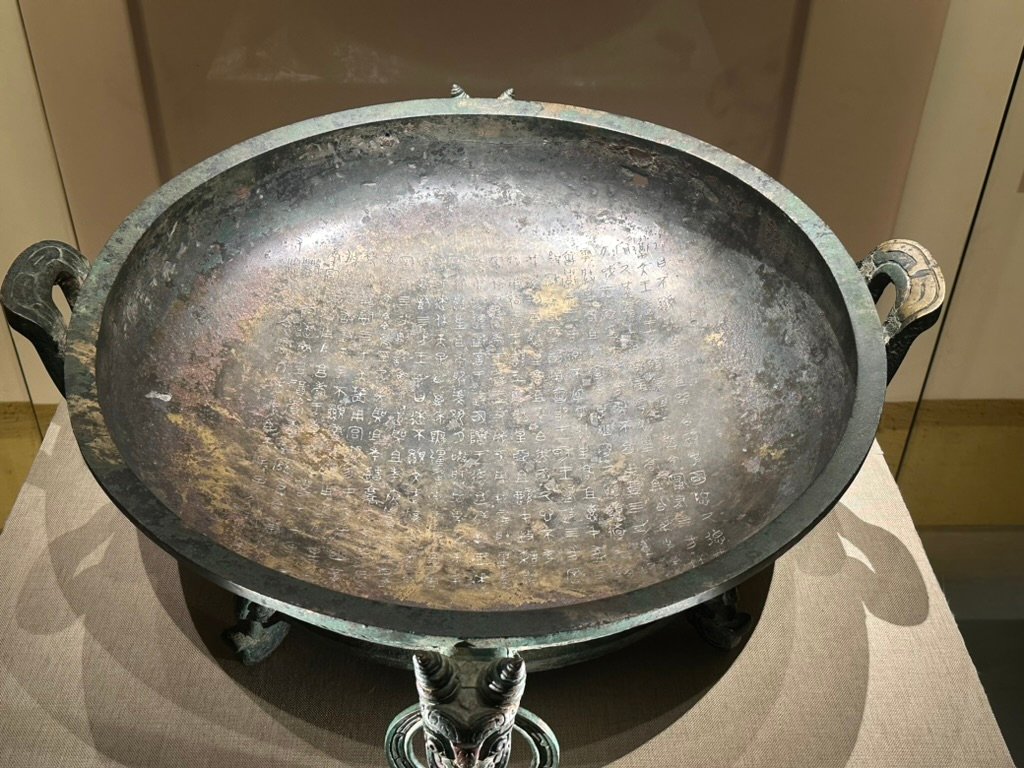
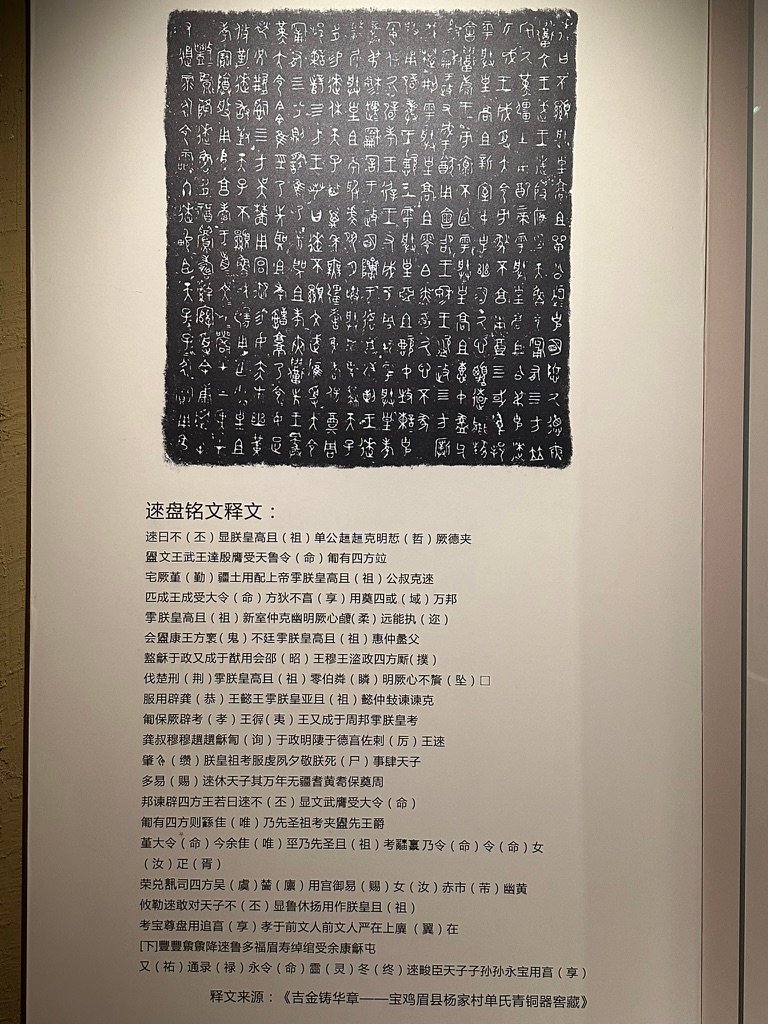
Lai Pan (逨盘, Lái Pán), discovered in 2003 at Yangjiacun (杨家村, Yángjiācūn), Mei County (眉县, Méixiàn), Shaanxi Province (陕西省, Shǎnxī Shěng). The long inscription inside turns this ritual vessel into something much more than a beautiful bronze.
Inside is:
金文
Jīnwén
“bronze inscription”
And this time we’re not following:
one year.
Or even:
one man’s career.
We’re following:
A FAMILY.
Eight Generations. Twelve Zhou Kings.
The inscription records Lai’s ancestral line across:
EIGHT GENERATIONS
and places that family history alongside a sequence of:
TWELVE ZHOU KINGS.
😳
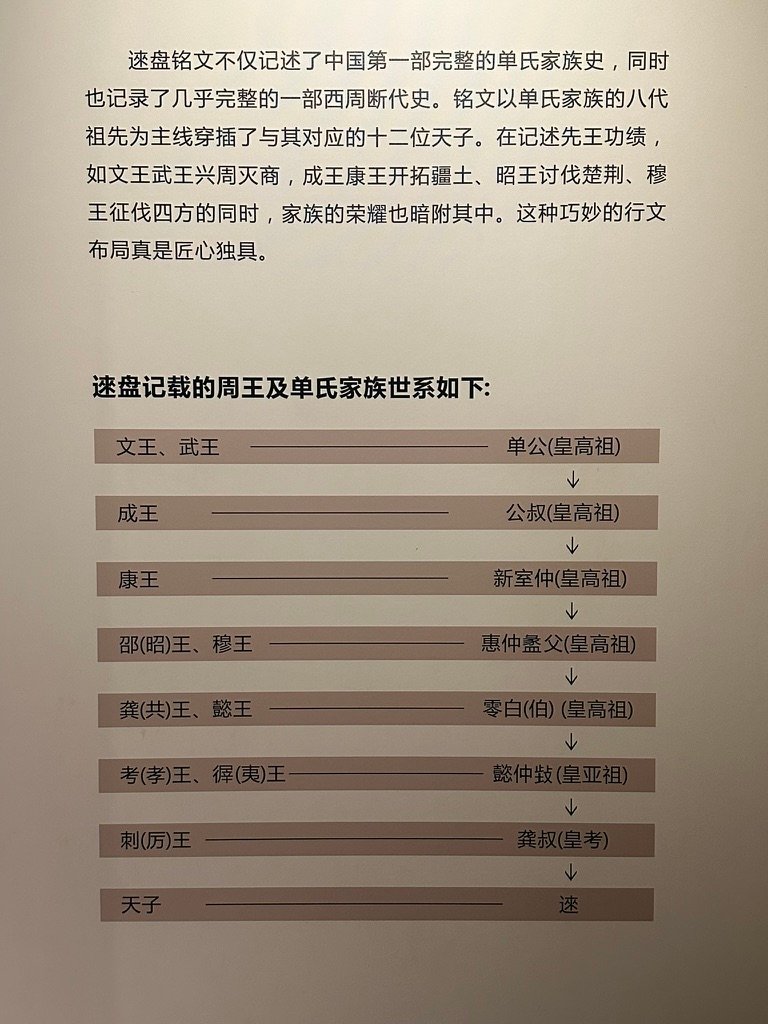
The Baoji Bronze Ware Museum display places eight generations of Lai’s ancestral line alongside twelve rulers of the Zhou dynasty (周朝, Zhōucháo).
Dad’s handrail?
Think family archive.
Except instead of saving the family history in:
paper
a book
a computer
or:
the cloud
they cast it into:
BRONZE.
😂
Good luck accidentally deleting that file.
Why Put Your Family History Inside a Bronze?
The inscription repeatedly connects Lai’s ancestors with service to successive rulers of the:
Zhou dynasty (周朝, Zhōucháo).
Generation after generation.
King after king.
So the Lai Pan isn’t simply saying:
“Remember Lai.”
It’s also saying:
“Remember who our family was.”
and:
“Remember whom our ancestors served.”
That gives us:
ANCESTRY
+
POLITICAL SERVICE
+
FAMILY MEMORY
+
ROYAL HISTORY
inside one bronze vessel.
🔥
But then Dad noticed something else.
Twelve Zhou kings?
Hang on.
Dad had seen a list like that before.
🐇
🐇 Our Old Friend Sima Qian (司马迁, Sīmǎ Qiān) Is Back
Remember:
Sima Qian (司马迁, Sīmǎ Qiān)
the great Han dynasty historian behind:
《史记》
Shǐjì
Records of the Grand Historian
Sima Qian lived during the:
Han dynasty (汉朝, Hàncháo)
centuries after the Western Zhou dynasty (西周, Xī Zhōu).
Yet his:
《周本纪》
Zhōu Běnjì
“Basic Annals of Zhou”
preserved a succession of Zhou rulers inherited from much older historical traditions.
Now Dad is standing in Baoji looking at:
BRONZE.
Not a later history book.
Not a legend retold centuries afterward.
An excavated Western Zhou object carrying its own ancient inscription.
And the Lai Pan refers to a sequence of:
TWELVE ZHOU KINGS.
🔥
Suddenly historians can put:
TEXT
beside:
ARCHAEOLOGY.
And ask:
Do they agree?
⭐ Dad’s Rule — Cross-Check, Don’t Force
Be careful here.
The Lai Pan does not mean:
“Archaeology proved every sentence Sima Qian wrote.”
And Sima Qian writing something doesn’t automatically make it:
archaeological fact.
The interesting method is:
TRANSMITTED TEXT
↓
EXCAVATED INSCRIPTION
↓
COMPARE.
Where they agree:
interesting.
Where they differ:
also interesting.
😂
That’s how ancient history gets stronger.
Wait… Dad Has Seen This Before
The rabbit suddenly jumped from:
Baoji (宝鸡, Bǎojī)
to:
Anyang (安阳, Ānyáng).
Why?
Because Dad had encountered something similar with the:
Shang dynasty (商朝, Shāngcháo).
Sima Qian’s:
《殷本纪》
Yīn Běnjì
“Basic Annals of Yin”
preserved a lineage of Shang rulers.
For centuries, later readers had that transmitted historical tradition.
Then archaeologists began uncovering:
甲骨文
Jiǎgǔwén
“oracle-bone inscriptions”
at:
Yinxu (殷墟, Yīnxū)
in Anyang (安阳, Ānyáng).
Those inscriptions provided independent archaeological evidence for the late Shang royal world and substantially supported the royal genealogy preserved in the transmitted tradition — while also allowing scholars to refine and correct details.
😳
So Dad now has two wonderful historical cross-checks:
SHANG (商)
Sima Qian’s transmitted royal lineage
↓
oracle-bone inscriptions (甲骨文, Jiǎgǔwén)
↓
COMPARE.
and:
ZHOU (周)
Sima Qian’s transmitted royal lineage
↓
bronze inscriptions (金文, Jīnwén)
↓
COMPARE.
🔥
Why This Matters
Sima Qian wasn’t standing beside the Shang kings.
He wasn’t standing beside the early Zhou kings either.
He lived centuries later.
Yet archaeology shows that some of the historical traditions available to later Chinese historians preserved information reaching remarkably far into the past.
That doesn’t make:
《史记》 = archaeology.
It makes the relationship between:
TEXT
and:
EXCAVATED EVIDENCE
one of the most fascinating ways to investigate early Chinese history.
And Dad loves that.
Because now an ancient bronze isn’t simply telling us:
“Here was Lai’s family.”
It lets us ask:
How much of China’s ancient historical memory survived accurately?
🐇
⭐ Look How Far One Museum Has Taken Us
We started with:
HE ZUN (何尊, Hé Zūn)
and found:
ONE WORD
中国 (Zhōngguó)
↓
Then:
42nd-Year + 43rd-Year Lai Ding
(四十二年逨鼎 / 四十三年逨鼎)
gave us:
ONE PERSON
Lai (逨, Lái)
↓
Then:
LAI PAN (逨盘, Lái Pán)
gave us:
ONE FAMILY
eight generations
↓
Then those generations gave us:
TWELVE ZHOU KINGS
↓
And suddenly we’re comparing:
ARCHAEOLOGY
with:
ANCIENT HISTORICAL TEXTS.
🔥
Not bad for something Dad initially thought was:
another bronze basin.
😂
But one question remains.
Where did this world of:
Zhou kings
elite families
ritual bronzes
ancestral memory
and:
bronze workshops
actually exist?
The museum gave Dad another name:
Zhouyuan (周原, Zhōuyuán)
周 (Zhōu)
→ Zhou
原 (Yuán)
→ plain / plateau
“The Zhou Plain.”
And this time Dad & Elaine didn’t have to imagine it.
We went there.
🐇
🌾 DISCOVERY 5 — Zhouyuan (周原, Zhōuyuán): Take the History Out of the Glass Case
By now Dad had met:
He Zun (何尊, Hé Zūn)
Lai (逨, Lái)
the Shan clan (单氏, Shàn Shì)
and:
twelve Zhou kings.
But they were all still inside:
A MUSEUM.
Dad wanted to know:
Where did this Zhou world actually live?
The answer kept appearing:
Zhouyuan (周原, Zhōuyuán)
周 (Zhōu)
→ Zhou
原 (Yuán)
→ plain / plateau
A useful traveler handrail:
“The Zhou Plain.”
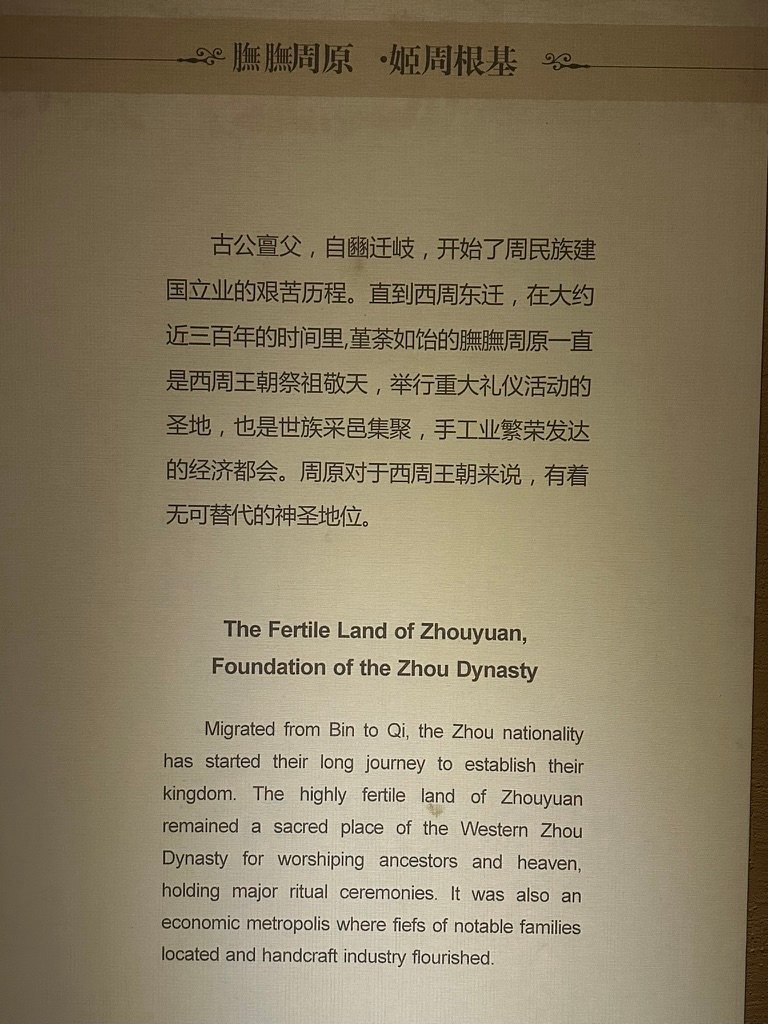
The museum describes Zhouyuan as one of the foundational landscapes of the:
Zhou dynasty (周朝, Zhōucháo).
This wider region around Qishan (岐山, Qíshān) became associated with:
settlements
elite lineages
ancestral ritual
worship of Heaven
craft production
and:
BRONZE.
Suddenly the objects in the glass cases had:
AN ADDRESS.
😂
🐇 Before King Wen and King Wu…
Another name appears:
Gugong Danfu (古公亶父, Gǔgōng Dǎnfù)
— an early ancestral leader of the Zhou people.
Traditional accounts remember him leading the Zhou toward the area beneath:
Mount Qi (岐山, Qíshān).
Later came names international travelers may encounter again:
King Wen of Zhou (周文王, Zhōu Wénwáng)
→ remembered as a foundational Zhou ruler
King Wu of Zhou (周武王, Zhōu Wǔwáng)
→ conquered the Shang and established Zhou rule
Duke of Zhou (周公, Zhōugōng)
→ statesman associated with the consolidation of the new Zhou order.
But we’re stopping there.
😂
Because this is the:
BRONZE MUSEUM ARTICLE.
Not:
Everything Dad Knows About the Zhou Dynasty.
🎥 One More Look Around the Museum
As Dad looked around the museum atrium, another exhibition caught his attention:
乡愁
Xiāngchóu
“Nostalgia” / “Longing for Home”
and:
散失的宝鸡青铜器
Sànshī de Bǎojī Qīngtóngqì
“Baoji Bronzes Elsewhere”
Bronzes unearthed from this wider region have ended up in collections far beyond Baoji.
So the museum isn’t simply preserving:
“old Chinese objects.”
It’s reconnecting objects with:
THE PLACE THEY CAME FROM.
And Dad now wanted to do the reverse.
Leave the objects behind…
and go find:
THE PLACE.
🚗 So Dad & Elaine Went to Zhouyuan
We traveled out toward:
Qishan (岐山, Qíshān)
and:
Zhouyuan (周原, Zhōuyuán).
Museum first.
Landscape second.
That order worked beautifully.
At the museum:
“This bronze came from the Zhou world.”
At Zhouyuan:
“Ahhh… THIS was the Zhou world.”
😂
→ GO DEEPER: Qishan (岐山, Qíshān) & Zhouyuan (周原, Zhōuyuán) — Walking Through the Homeland of the Zhou
⭐ Dad’s Five Museum Discoveries
Remember Dad’s promise at the entrance?
Don’t memorize hundreds of bronzes.
Take away five things.
1. TECHNOLOGY
范铸法 (Fànzhù Fǎ)
mold casting
These bronzes required sophisticated craft and engineering.
↓
2. ONE WORD
He Zun (何尊, Hé Zūn)
中国 (Zhōngguó)
Writing lets one bronze preserve a word across roughly 3,000 years.
↓
3. ONE PERSON
Lai Ding (逨鼎, Lái Dǐng)
Year 42.
Year 43.
A man’s career appears inside bronze.
↓
4. ONE FAMILY
Lai Pan (逨盘, Lái Pán)
Eight generations.
Twelve Zhou kings.
Family memory becomes historical evidence.
↓
5. ONE LANDSCAPE
Zhouyuan (周原, Zhōuyuán)
The bronzes didn’t come from nowhere.
They belonged to:
A WORLD.
🔥
And that’s when Dad realized the Baoji Bronze Ware Museum had changed the question.
We entered asking:
“Which bronzes should we see?”
We left asking:
“Where did these people live?”
🐇
And once that happens…
the museum visit isn’t really finished when you walk out the door.
🚪 Walking Out — The Museum Was Only the Beginning
Dad & Elaine had entered:
Baoji Bronze Ware Museum
(宝鸡青铜器博物院, Bǎojī Qīngtóngqì Bówùyuàn)
expecting:
BRONZES.
We walked out carrying:
technology
writing
people
families
kings
and:
QUESTIONS.
😂
And as we were leaving…
another generation was coming in.
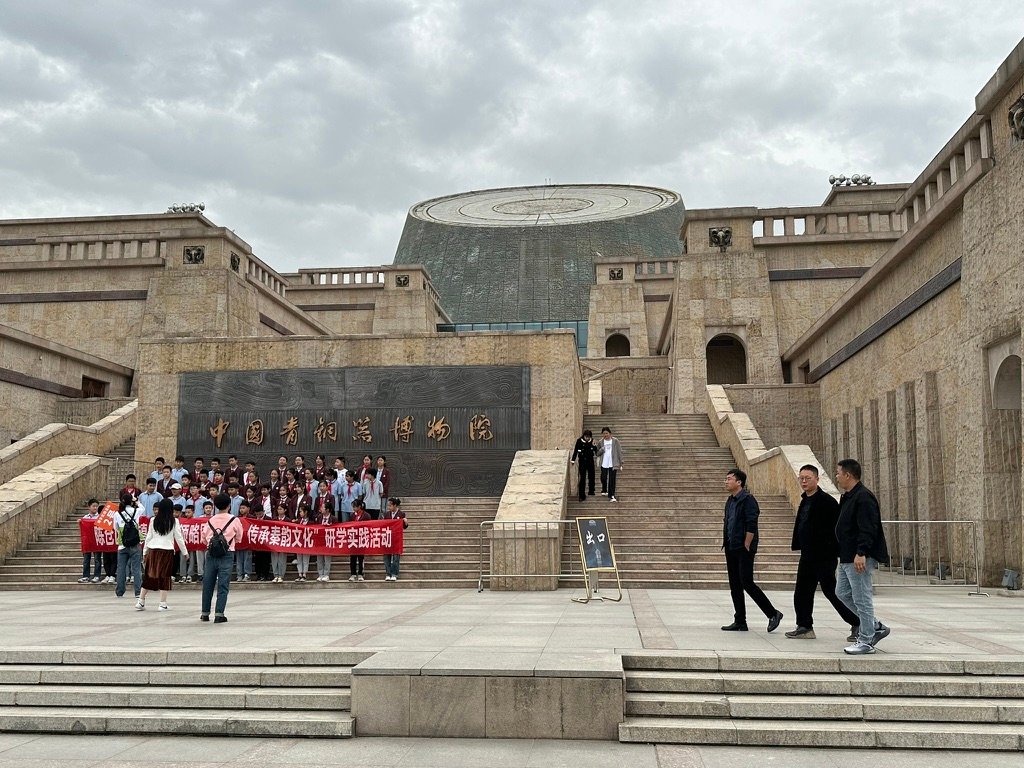
Schoolchildren visiting Baoji Bronze Ware Museum. More than 3,000 years separate them from the people whose names were cast inside these bronzes — but the objects are still being read, studied and remembered.
Dad liked that moment.
The people who commissioned these bronzes wanted:
memory to survive.
Names.
Ancestors.
Service.
Achievements.
Family.
Thousands of years later…
people are still reading them.
🔥
🐇 But Dad & Elaine Weren’t Finished
The museum had given us:
OBJECTS.
Now we wanted:
PLACES.
So our Baoji journey began expanding.
Baoji (宝鸡, Bǎojī)
→ bronzes + inscriptions
↓
Qishan (岐山, Qíshān)
→ Zhou homeland
↓
Zhouyuan (周原, Zhōuyuán)
→ the landscape behind the bronzes
↓
Duke of Zhou (周公, Zhōugōng)
→ political ideas and early Zhou order
↓
and eventually:
Wuzhangyuan (五丈原, Wǔzhàngyuán)
→ Zhuge Liang (诸葛亮, Zhūgě Liàng)
→ more than 1,000 years later.
Wait.
What happened to our timeline?
😂
Exactly.
Places accumulate history.
🍽️ Want to Travel the Whole Story?
Dad & Elaine eventually connected these places into:
What Came Before Qin?
West of Xi’an Michelin History Tasting JOURNEY
The route:
Xi’an (西安, Xī’ān)
↓
Baoji (宝鸡, Bǎojī)
↓
Qishan (岐山, Qíshān)
↓
Zhouyuan (周原, Zhōuyuán)
↓
Wuzhangyuan (五丈原, Wǔzhàngyuán)
↓
Xi’an (西安, Xī’ān)
One course at a time.
One question at a time.
→ FOLLOW THE FULL JOURNEY: What Came Before Qin? — West of Xi’an Michelin History Tasting JOURNEY

⭐ ChinaTravelBUG’s Take
If you’re visiting Xi’an for the first time, Dad isn’t suggesting you skip:
Terracotta Warriors (兵马俑, Bīngmǎyǒng).
Go.
They’re extraordinary.
But if Qin Shi Huang (秦始皇, Qín Shǐhuáng) leaves you wondering:
What came before Qin?
then Baoji opens another door.
And Baoji Bronze Ware Museum gives you a wonderfully simple way to begin.
Don’t try to remember:
200 BRONZES.
Remember:
范铸法 (Fànzhù Fǎ)
→ how they made them
金文 (Jīnwén)
→ how they wrote inside them
何尊 (Hé Zūn)
→ one word: 中国
逨鼎 (Lái Dǐng)
→ one man’s career
逨盘 (Lái Pán)
→ one family’s history
周原 (Zhōuyuán)
→ the landscape behind them.
That’s enough.
Because once you understand that these bronzes can preserve:
words
people
appointments
wars
families
and:
kings
they stop looking like:
beautiful old containers.
They start talking.
🔥
And once the bronzes start talking…
Dad knows exactly what’s going to happen.
Another rabbit hole.
😂🐇
SEE → ASK → CONNECT → UNDERSTAND → FOLLOW
See China. Understand It Better.
China Usually Has Another Way.
🧭 How to Visit Baoji Bronze Ware Museum (宝鸡青铜器博物院, Bǎojī Qīngtóngqì Bówùyuàn)
The good news?
This is DEEP China history without difficult travel.
😂
The museum is in:
Chinese Stone Drum Garden
(中华石鼓园, Zhōnghuá Shígǔ Yuán)
in Baoji (宝鸡, Bǎojī).
If you’re staying in Baoji, Dad would simply use:
DiDi (滴滴, Dīdī)
or a local taxi.
Public buses 10, 20 and 71 also serve the museum area.
🕘 Opening Hours
Current regular opening hours:
Tuesday–Sunday
9:00–17:00
Last entry:
16:30
Regular Monday:
CLOSED
Holiday schedules can change, so check the museum’s current notice before visiting.
→ Official Baoji Bronze Ware Museum Visitor Information
🎫 Admission
FREE.
The museum uses a reservation system.
For international travelers, here’s the useful part:
official museum guidance states that visitors holding a:
FOREIGN PASSPORT
can register at the:
first-floor Visitor Service Center
and arrange entry with their valid document.
Dad would bring the actual passport.
Don’t leave it in the hotel because:
“Dad said the museum is free.”
😂
Free doesn’t mean:
no identification.
⏱️ How Long Should You Allow?
Dad would give the museum:
2–5 HOURS.
A serious bronze enthusiast could easily stay longer.
But don’t try to photograph and understand every vessel.
Remember our five:
范铸法 (Fànzhù Fǎ)
→ technology
何尊 (Hé Zūn)
→ 中国
逨鼎 (Lái Dǐng)
→ one person
逨盘 (Lái Pán)
→ one family
周原 (Zhōuyuán)
→ one landscape.
If you leave understanding those…
you’ve eaten enough bronze.
😂
⭐ Dad’s Best Advice
Visit the museum:
BEFORE Zhouyuan (周原, Zhōuyuán).
Museum first:
objects → inscriptions → people → kings
Then go outside Baoji toward:
Qishan (岐山, Qíshān)
and
Zhouyuan (周原, Zhōuyuán).
Suddenly you’re no longer looking at:
“an archaeological landscape.”
You’re standing in:
THE WORLD BEHIND THE BRONZES.
🐇