
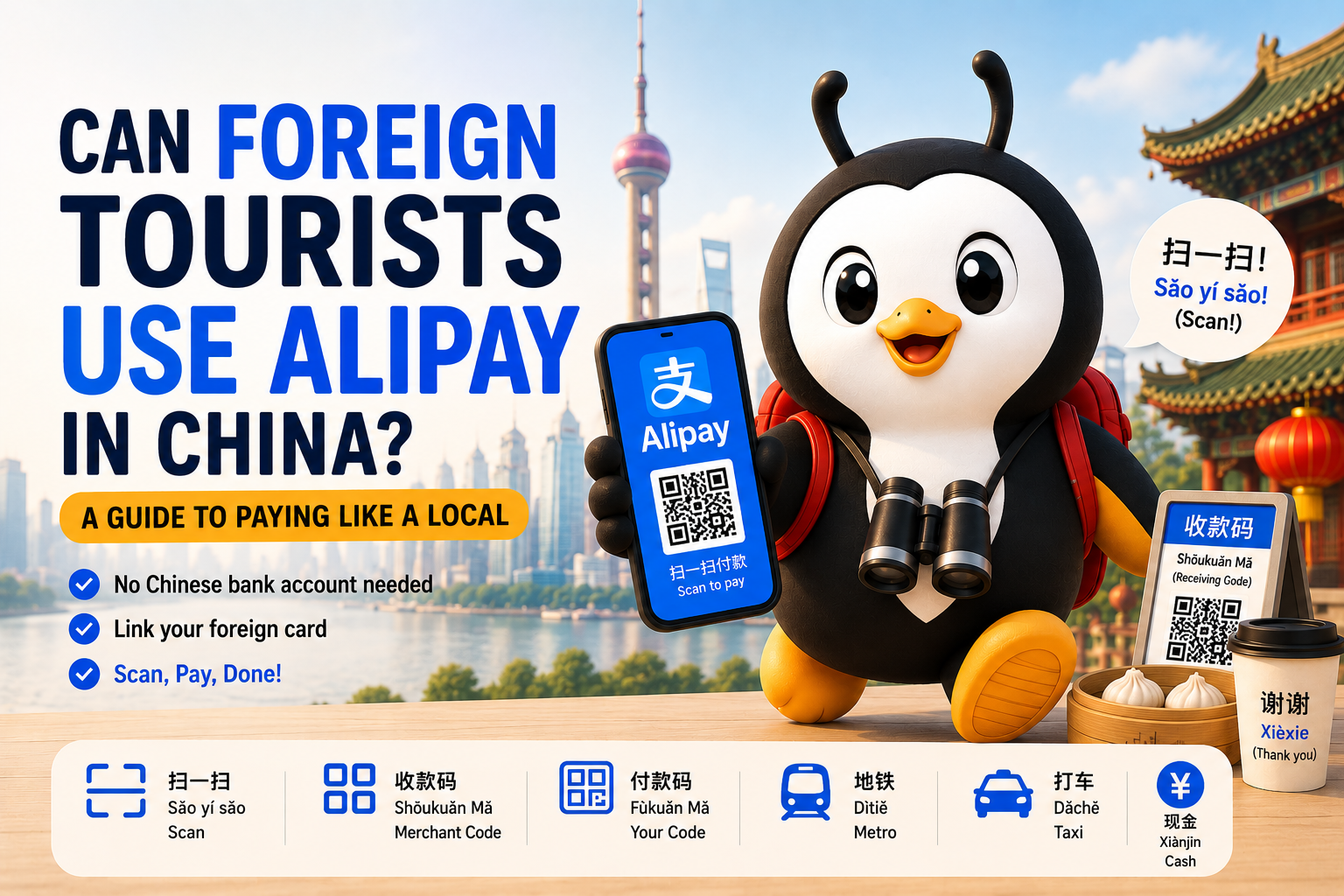
A First-Timer’s Guide to Paying in China with a Foreign Credit Card
You have just arrived in China.
You walk into a convenience store, place a bottle of water on the counter and reach for your wallet.
The cashier does not point towards a card terminal.
Instead, she points towards a square black-and-white code.
In Chinese, it is called:
二维码 — Èrwéimǎ — QR code
She may even say:
扫一扫 — Sǎo yí sǎo — Give it a scan
For many first-time visitors, this is the moment when China’s digital world suddenly becomes real.
“Can I actually use Alipay without a Chinese bank account?”
The reassuring answer is:
Yes.
Foreign tourists can generally use Alipay in China by registering with an overseas mobile number and linking a supported international credit or debit card.
You do not normally need:
- a Chinese bank account;
- a Chinese credit card;
- a mainland Chinese mobile number.
Once it is set up, Alipay can help you pay for food, shop in convenience stores, book a DiDi and use public transport in many Chinese cities.
But there is one important limitation:
A foreign card linked to Alipay is mainly designed for purchases from registered merchants. It may not work for every personal QR code, money transfer, deposit or mini program.
Alipay is extremely useful.
It is not completely universal.
That is why ChinaTravelBUG recommends using it as your main payment method while carrying sensible backups.
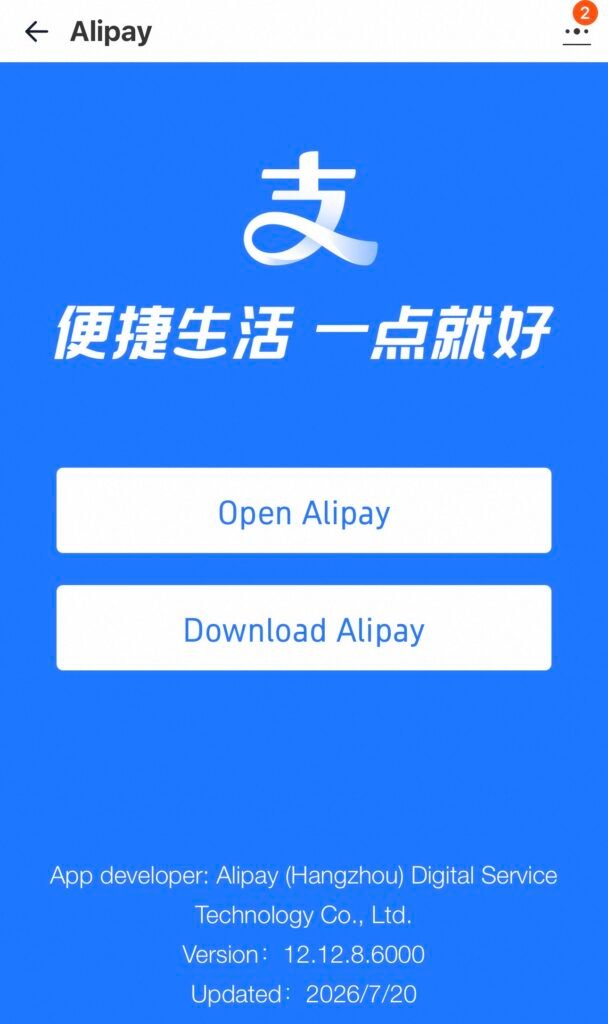
What Is Alipay Called in Chinese?
Alipay is:
支付宝 — Zhīfùbǎo
The name literally combines ideas connected with payment and security.
WeChat Pay is:
微信支付 — Wēixìn Zhīfù
In everyday conversation, many people simply say:
微信 — Wēixìn — WeChat
The general Chinese term for mobile payment is:
移动支付 — Yídòng Zhīfù — Mobile payment
You will also often see:
扫码支付 — Sǎomǎ Zhīfù — Scan-code payment
That is the payment system used throughout much of daily life in China.
Can Foreign Tourists Really Use Alipay?
Yes.
Foreign visitors can normally register using an overseas mobile number, complete identity verification with a passport and add a supported international bank card.
Depending on the card issuer and current platform rules, accepted networks may include:
- Visa;
- Mastercard;
- American Express;
- JCB;
- Discover;
- Diners Club;
- UnionPay.
The exact cards accepted may vary by country, issuing bank and account.
Most travellers will need:
- a smartphone;
- a passport;
- an overseas mobile number;
- a supported international card;
- access to banking verification messages;
- a reliable internet connection.
Your passport is called:
护照 — Hùzhào
At hotel reception or during app verification, you may hear:
护照,谢谢。
Hùzhào, xièxie.
Passport, please. Thank you.
China Travel Bug Tip
Set up Alipay before leaving home.
Do not wait until you are standing at a Chinese airport trying to upload your passport while a taxi queue forms behind you.
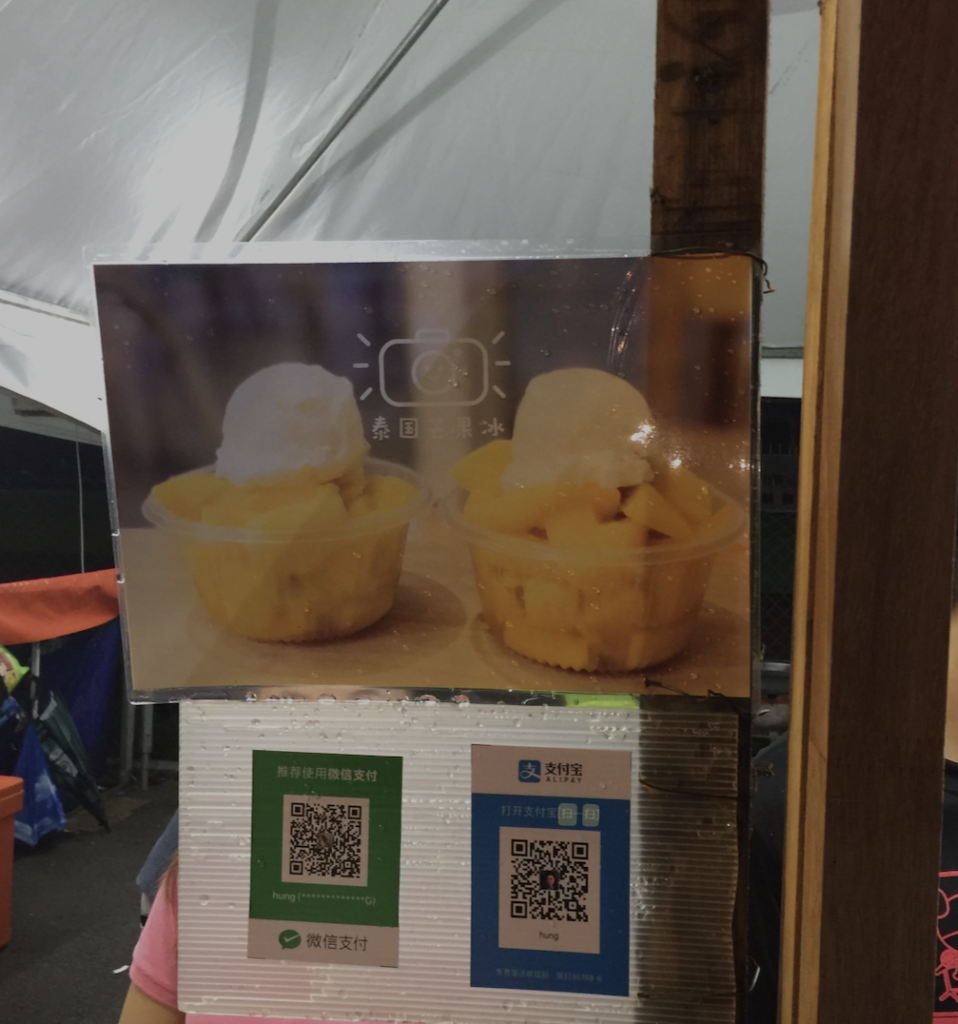
Why Paying in China Feels So Different
China is not legally cashless.
RMB cash remains an official payment method, and physical cards are accepted in some places.
But everyday life is heavily built around mobile payments.
People use QR codes to pay for:
- restaurant meals;
- coffee;
- convenience-store purchases;
- taxis;
- metro journeys;
- attraction tickets;
- supermarket shopping;
- street food;
- vending machines;
- small everyday services.
The surprise is not simply that Alipay is widely used.
It is how deeply mobile payment is connected to ordinary life.
In many countries, your phone supports your trip.
In China, your phone may become your:
- wallet;
- metro pass;
- taxi-booking device;
- map;
- translator;
- hotel confirmation;
- attraction ticket;
- communication tool.
That makes preparation more important than carrying a thick wallet.
Alipay or WeChat Pay?
Both Alipay and Weixin Pay are widely used in China.
For many first-time travellers, and in our own experience, Alipay is usually the easier starting point.
Its international interface tends to make travel-related functions easier to find.
Depending on your location and account, Alipay may provide access to:
- merchant payments;
- bus and metro QR codes;
- DiDi or taxi services;
- train and attraction services;
- translation tools;
- mini apps;
- travel bookings.
What About WeChat Pay?
Weixin Pay is integrated into WeChat, China’s dominant messaging platform.
It can be extremely useful because many restaurants, attractions and businesses operate through WeChat mini programs.
These are called:
小程序 — Xiǎochéngxù — Mini programs
However, mini programs can feel less intuitive to someone using WeChat for the first time.
Our practical recommendation is:
Use Alipay as your main payment app.
Set up Weixin Pay as your backup.
Do not merely download WeChat. Register the account, activate its payment function where available, add a bank card and complete any requested verification.
Cheers Asks…
“Do I really need both?”
Not necessarily.
Many visitors complete an entire trip using Alipay alone. But having Weixin Pay properly prepared gives you another option if one platform, card or merchant system does not work.
How to Set Up Alipay Before Your Trip
The setup process is usually manageable, but it is best completed while you are still at home.
You may need access to:
- your normal mobile number;
- your passport;
- your banking app;
- SMS verification;
- a stable internet connection.
Step 1: Download the Official Alipay App
Download Alipay from your phone’s official app store.
Check the publisher carefully so that you install the genuine application.
Step 2: Register with Your Overseas Mobile Number
Select your country code and enter your normal mobile number.
Make sure you can still receive text messages while travelling.
Your bank may also use SMS or in-app approval when you add a card or complete a payment.
A mobile number is:
手机号码 — Shǒujī Hàomǎ
Step 3: Complete Passport Verification
Alipay may ask for:
- your full name;
- nationality;
- passport number;
- passport photograph;
- facial verification.
Identity verification is:
实名认证 — Shímíng Rènzhèng — Real-name verification
Enter your name exactly as requested and make sure it matches your passport.
Pay particular attention to:
- middle names;
- family-name order;
- spaces;
- hyphens;
- initials.
Limited functions may sometimes work before full verification, but CTB strongly recommends completing passport verification before departure.
Doing so may reduce the risk of lower limits or restricted functions during your trip.
Step 4: Link Your International Bank Card
Open the card-management section and add your card.
A bank card is:
银行卡 — Yínhángkǎ
Your bank may ask you to confirm the connection using:
- a one-time password;
- an in-app banking approval;
- a fraud-prevention check;
- an online transaction authorisation.
Step 5: Check Everything Before Flying
Before departure, confirm that:
- your card appears inside Alipay;
- passport verification is complete;
- your phone number remains active;
- your bank allows overseas transactions;
- you know your payment password;
- you can find the Scan and Pay buttons;
- you can receive security alerts.
You may not be able to complete a normal Chinese merchant payment before arrival, but you can still make sure the account appears properly prepared.
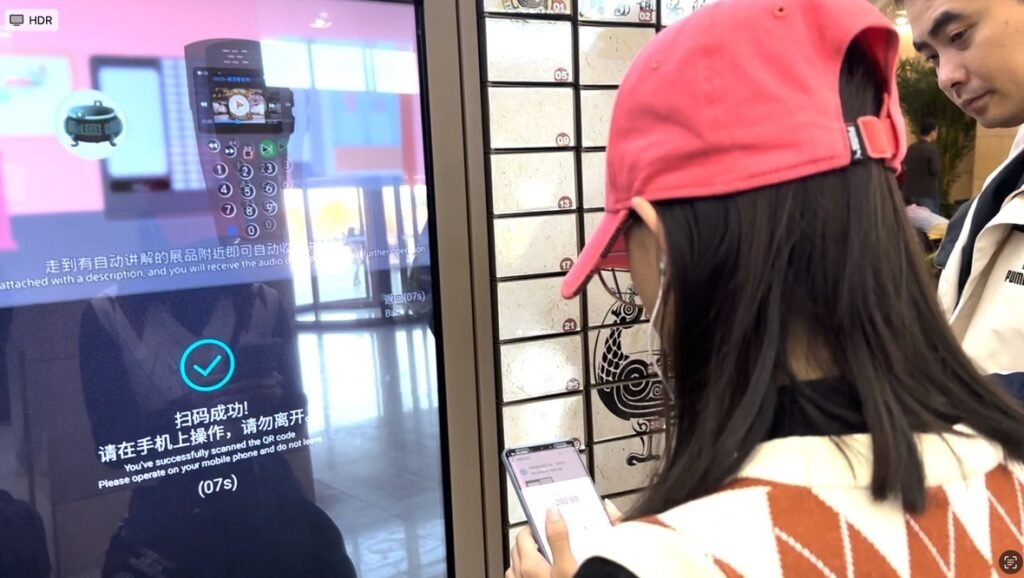
How Do You Pay with Alipay?
There are two main methods.
Method 1: You Scan the Merchant’s QR Code
This is common in restaurants, cafés, market stalls and smaller shops.
The merchant’s collection code is called:
收款码 — Shōukuǎn Mǎ — Receiving-payment code
The usual process is:
- Open Alipay.
- Tap 扫一扫 — Sǎo yí sǎo — Scan.
- Scan the merchant’s 收款码.
- Enter the amount if required.
- Check the merchant’s name.
- Confirm payment.
To ask how much something costs, you can say:
多少钱?
Duōshao qián?
How much?
Always check the amount before pressing confirm.
A missing decimal point can turn a cheap meal into a very expensive one.
Method 2: The Merchant Scans Your Payment Code
This is common in convenience stores, supermarkets and larger retailers.
Your payment code is called:
付款码 — Fùkuǎn Mǎ — Payment code
You:
- Open your Alipay payment code.
- Show it to the cashier.
- Allow the cashier to scan it.
- Wait for payment confirmation.
You may hear:
出示付款码。
Chūshì fùkuǎn mǎ.
Please show your payment code.
After a few attempts, both methods become second nature.
Elaine’s Note
The first payment feels like a test.
You watch the screen, wondering whether your card will work.
Then the payment succeeds, the cashier continues as normal, and you realise the system is much less intimidating than it looked.
Why Might a QR Code Still Fail?
Although Alipay is accepted extremely widely, linking an overseas card does not unlock every function available to a mainland user.
A foreign card is mainly intended for purchases from registered merchants.
It may not support:
- transfers to another person;
- Alipay personal transfers;
- WeChat red packets;
- some personal QR codes;
- certain refundable deposits;
- some mini programs;
- subscriptions;
- selected online transactions;
- financial products.
A money transfer is called:
转账 — Zhuǎnzhàng — Transfer money
This distinction matters at small businesses.
A QR code displayed at a stall may be:
- a registered merchant-payment code; or
- the owner’s personal collection code.
The first may work with your foreign card.
The second may not.
If a payment fails, ask whether the merchant can:
- provide a merchant-payment code;
- scan your Alipay payment code;
- accept Weixin Pay;
- accept RMB cash;
- accept a physical international card.
You can ask:
可以用支付宝吗?
Kěyǐ yòng Zhīfùbǎo ma?
Can I use Alipay?
Or:
可以付现金吗?
Kěyǐ fù xiànjīn ma?
Can I pay cash?
China Travel Bug Reality Check
Alipay is widely accepted, but “widely accepted” does not mean that every QR code will work with every foreign card.
Are There Fees for Using a Foreign Card?
Alipay and Weixin Pay may charge a service fee when an overseas card is used.
A commonly applied structure has been:
- RMB200 or less in one transaction: no additional platform service fee;
- above RMB200: a service fee of approximately 3% may apply.
However, payment terms can change.
The fee displayed inside the app at the time of payment is the figure that matters.
Where the fee applies, it may be charged on the whole qualifying transaction, not only the portion above RMB200.
A service fee is:
服务费 — Fúwùfèi
Your own bank may also charge:
- a foreign-transaction fee;
- a currency-conversion fee;
- an exchange-rate margin;
- an overseas processing fee.
The exchange rate is:
汇率 — Huìlǜ
This means the total cost may involve both:
the platform’s service fee
and
your bank’s currency-conversion charge
China Travel Bug Tip
Before travelling, check whether your main card charges foreign-transaction fees.
A card may work perfectly with Alipay but still be expensive if the issuing bank applies a poor exchange rate.
Can You Use Wise with Alipay?
Some travellers successfully link Wise cards to Alipay.
Compatibility may depend on:
- the card’s issuing country;
- the card network;
- Alipay’s current rules;
- the merchant;
- the type of transaction;
- Wise’s security controls.
Do not assume that every Wise card will work in every situation.
Wise also does not automatically remove every possible charge.
You may still encounter:
- Alipay service fees;
- Wise currency-conversion fees;
- merchant restrictions;
- card-verification problems;
- transaction limits.
Wise may be useful, but it should not be your only payment option.
Bring another card issued by a different bank where possible.
What Should You Do if Alipay Rejects Your Card?
A rejected card does not necessarily mean Alipay cannot be used.
The problem may come from the bank, identity details, internet connection, merchant type or card itself.
Check Your Name
Make sure the name entered in Alipay matches your passport and bank records.
Pay particular attention to middle names and surname order.
Contact Your Bank
Your bank may interpret a payment involving China as unusual activity.
Tell the bank that:
- you are travelling to China;
- you plan to link your card to Alipay or Weixin Pay;
- legitimate Chinese merchant transactions may appear.
Try Another Card
Where possible, carry cards from two different banks.
Two cards from the same bank may be affected by the same security system.
Try a Credit Card
Some travellers find credit cards more reliable than debit cards, although this depends on the issuing bank.
Check Your Internet Connection
A payment may fail simply because your eSIM, roaming connection or Wi-Fi has stopped working.
An internet connection is:
网络 — Wǎngluò
You may see:
网络错误 — Wǎngluò Cuòwù — Network error
Before trying repeatedly, confirm that your phone still has data.
Check Whether It Is a Personal QR Code
The card may be functioning correctly, but the displayed code may be designed for a personal transfer that foreign cards do not support.
Ask the merchant for another payment method.
Try Weixin Pay
A transaction that fails on one platform may sometimes work on the other.
This is not guaranteed, but it is one reason to prepare both apps.
Should You Carry Cash in China?
Yes.
Not because cash is necessarily the easiest way to pay.
Because technology occasionally fails.
Cash is called:
现金 — Xiànjīn
RMB cash remains an official payment option, and visitors can obtain it through:
- compatible ATMs;
- banks;
- authorised foreign-exchange outlets.
An ATM is commonly called:
自动取款机 — Zìdòng Qǔkuǎnjī
Cash becomes useful when:
- your phone battery dies;
- mobile data stops working;
- your card is temporarily blocked;
- a personal QR code rejects your foreign card;
- an app asks for extra verification;
- a transport system does not support your chosen payment method;
- an online payment system is unavailable.
China Travel Bug suggests keeping several hundred yuan as emergency cash.
The appropriate amount depends on:
- the length of your trip;
- the size of your group;
- your destinations;
- your comfort level.
You do not need to carry the entire amount every day.
Keep some securely at your hotel and take a smaller amount when going out.
Carry Smaller Notes
Useful denominations include:
- RMB10;
- RMB20;
- RMB50.
A RMB100 note may be inconvenient for a small purchase.
Some cash bus fares also require exact change.
To ask whether change is available, you can say:
有零钱吗?
Yǒu língqián ma?
Do you have change?
China Travel Bug Reality Check
Cash is not mainly for street-food sellers.
Many small vendors actively prefer QR payments.
Cash matters because your phone, card, internet connection or foreign-card compatibility may occasionally fail.
Can You Use a Physical Visa or Mastercard Directly?
Sometimes.
But do not expect to use a foreign card everywhere.
A credit card is:
信用卡 — Xìnyòngkǎ
Direct international-card acceptance is more likely at:
- international hotels;
- major shopping malls;
- airports;
- luxury stores;
- large attractions;
- major restaurant chains;
- tourist-oriented businesses.
It may be less predictable at:
- neighbourhood restaurants;
- smaller cafés;
- independent shops;
- local markets;
- small transport businesses.
For everyday travel, linking your card to Alipay is usually more practical than handing a physical card to a cashier.
However, your physical card remains an important backup.
You can ask:
可以刷卡吗?
Kěyǐ shuākǎ ma?
Can I pay by card?
Can You Pay for Everything Through Alipay?
No.
Most ordinary merchant purchases may work, but some services can still require a mainland payment method or a different form of payment.
Possible problem areas include:
- hotel security deposits;
- refundable bicycle deposits;
- certain mini programs;
- some ticketing platforms;
- subscriptions;
- identity-linked services;
- personal transfers;
- specialist financial products.
Do not assume that because Alipay works at a convenience store, it will automatically work for every service inside every mini program.
For major expenses such as hotels, check the accepted payment methods before booking.
Using Alipay for the Metro
Metro is:
地铁 — Dìtiě
Transport is:
交通 — Jiāotōng
Inside Alipay, the usual route is:
Alipay → Transport → Select City → Metro or Bus
Bus is:
公交 — Gōngjiāo
You may need to complete identity verification before receiving a transport code.
For a typical metro journey:
- Open the transport QR code.
- Scan it at the entrance gate.
- Take your journey.
- Scan again when exiting.
- The fare is charged automatically.
Entry is:
进站 — Jìnzhàn
Exit is:
出站 — Chūzhàn
Availability differs between cities.
Some networks have their own apps, while selected systems may also accept contactless international cards or physical tickets.
Metro systems generally require scanning when entering and exiting.
Bus procedures vary by city. Some require only boarding validation, while others may ask passengers to scan again when leaving.
Follow the instructions shown in the app and on the vehicle.
China Travel Bug Tip
Activate your city’s transport code while sitting comfortably in your hotel.
Do not attempt the entire setup for the first time while commuters are queuing behind you at the gate.
Using Alipay to Book a DiDi
Calling a taxi or ride-hailing car is:
打车 — Dǎchē
DiDi is:
滴滴 — Dīdī
You can often access it through Alipay instead of downloading a separate app.
The route may appear as:
Alipay → Transport → Taxi or DiDi
Enter:
- your pickup point;
- your destination;
- your preferred vehicle category.
Pickup point is:
上车点 — Shàngchē Diǎn
Destination is:
目的地 — Mùdìdì
Before getting into the car, compare:
- the licence-plate number;
- vehicle model;
- vehicle colour;
- driver information.
A licence plate is:
车牌号 — Chēpái Hào
Airports and major railway stations may have several designated ride-hailing pickup zones.
Check the floor, gate number or pickup area shown in the app.
Do not get into a car simply because a driver waves at you.
A useful phrase is:
请到这里接我。
Qǐng dào zhèlǐ jiē wǒ.
Please pick me up here.

Dad and Elaine’s China Payment Strategy
We prefer a payment system that is simple enough to remember when tired, jet-lagged or standing inside a crowded station.
Main Payment Method
Alipay linked to an international credit card
Use this for most everyday merchant purchases.
Backup App
Weixin Pay, fully registered and configured
Useful if Alipay encounters a problem or a service operates through WeChat.
Backup Card
Carry another physical card, ideally issued by a different bank.
Emergency Cash
Keep several hundred yuan available, with some smaller notes.
Reliable Internet
Arrange an eSIM, international roaming plan or another dependable connection before arrival.
Power Backup
Carry a charged power bank.
A power bank is:
充电宝 — Chōngdiànbǎo
This word is especially useful in China because power banks can be rented in many shopping malls, restaurants and railway stations.
In China, a dead phone may mean losing access to:
- payments;
- metro travel;
- taxi bookings;
- maps;
- translations;
- hotel addresses;
- attraction tickets.
A 充电宝 is not merely a phone accessory.
It is part of your travel-payment system.
Your Alipay Checklist Before Flying
Before leaving home, make sure you have:
- downloaded the official Alipay app;
- registered with your overseas mobile number;
- completed passport verification;
- linked your main international card;
- added a second card where possible;
- checked your bank’s overseas-payment settings;
- registered for WeChat;
- activated Weixin Pay where available;
- linked a backup card to Weixin Pay;
- arranged an eSIM or roaming connection;
- packed a power bank;
- obtained some RMB cash;
- saved your hotel address in English and Chinese.
Do not share screenshots of your personal payment QR code.
Treat it as you would treat your bank card.
So, Is Paying in China Difficult?
At first, it may feel difficult because the system is unfamiliar.
The screens are different.
The payment habits are different.
The apps are different.
But after your first few successful transactions, the process becomes remarkably simple.
Buying breakfast becomes:
扫一扫 → 确认 → 支付
Scan → Confirm → Pay
Taking the metro becomes:
打开 → 扫码 → 乘车
Open → Scan → Ride
Booking a taxi becomes:
输入目的地 → 确认车辆 → 出发
Enter destination → Confirm car → Go
The difficult part is not using Alipay.
The difficult part is arriving in China without preparing it.
Set up your apps before departure.
Carry another card.
Keep some emergency cash.
Make sure your phone remains connected and charged.
Then you may discover what we did:
China’s payment system feels strange before you use it—and surprisingly convenient once you understand it.
Quick Answers for First-Time Visitors
Can foreign tourists use Alipay in China?
Yes. Foreign visitors can register with an overseas mobile number and add supported international bank cards.
Do I need a Chinese bank account?
No. A Chinese bank account is not normally required for ordinary tourist purchases through a linked foreign card.
Should I complete passport verification?
Yes. Limited functions may sometimes work without full verification, but completing 实名认证 — real-name verification before departure reduces the risk of restrictions.
Is Alipay or WeChat Pay better for tourists?
For many first-time visitors, Alipay is the easier starting point. Weixin Pay is valuable as a properly configured backup.
Will Alipay work with every QR code?
No. Overseas cards mainly support registered merchant purchases. Personal transfers, called 转账, and some personal QR codes may not work.
Does Alipay charge a fee?
A service fee, 服务费, may apply to overseas-card transactions above a specified amount. Check the fee displayed inside the app before confirming payment.
Should I carry cash?
Yes. Keep several hundred yuan in 现金 as an emergency reserve.
Can I rely on my physical Visa or Mastercard?
No. Direct card acceptance is improving but remains inconsistent, especially at smaller businesses.
Can I use Alipay for the metro?
In many cities, yes. Look for 交通 and 地铁 inside Alipay.
Can I book DiDi through Alipay?
Often, yes. Look for 打车 or 滴滴 in Alipay’s transport section.
Cheers Learns Chinese
Cheers looked at the two QR codes and scratched his head.
“They look exactly the same to me.”
Dad pointed towards the shopkeeper’s code.
“That is the 收款码. The merchant receives the money.”
Elaine opened Alipay on her phone.
“And this is our 付款码. We use it to pay.”
Cheers nodded seriously.
“So I only need to remember four words?”
支付宝 — Alipay
扫一扫 — Scan
收款码 — Merchant’s receiving code
付款码 — Your payment code“Exactly,” Elaine said. “You have already learnt enough Chinese to buy lunch.”
China Travel Bug Mini Travel Chinese: Paying in China
| Chinese | Pinyin | Meaning |
|---|---|---|
| 支付宝 | Zhīfùbǎo | Alipay |
| 微信支付 | Wēixìn Zhīfù | WeChat Pay |
| 二维码 | Èrwéimǎ | QR code |
| 扫一扫 | Sǎo yí sǎo | Scan |
| 收款码 | Shōukuǎn Mǎ | Merchant receiving code |
| 付款码 | Fùkuǎn Mǎ | Your payment code |
| 转账 | Zhuǎnzhàng | Transfer money |
| 现金 | Xiànjīn | Cash |
| 信用卡 | Xìnyòngkǎ | Credit card |
| 银行卡 | Yínhángkǎ | Bank card |
| 服务费 | Fúwùfèi | Service fee |
| 地铁 | Dìtiě | Metro |
| 公交 | Gōngjiāo | Bus |
| 打车 | Dǎchē | Call a taxi |
| 护照 | Hùzhào | Passport |
| 充电宝 | Chōngdiànbǎo | Power bank |
| 谢谢 | Xièxie | Thank you |
China Travel Bug’s Final Tip
Do not try to master every Alipay feature—or every Chinese word—before your journey.
Learn only the four functions you will probably need on your first day:
- how to scan a merchant’s 收款码;
- how to show your 付款码;
- how to open your city’s 地铁 transport code;
- how to use 打车 to book a DiDi.
Then prepare three backups:
- another payment app;
- another bank card;
- several hundred yuan in cash.
Once you have paid for your first drink, entered your first metro station and completed your first DiDi ride, China’s digital world will stop feeling like an obstacle.
It will simply become part of the adventure.