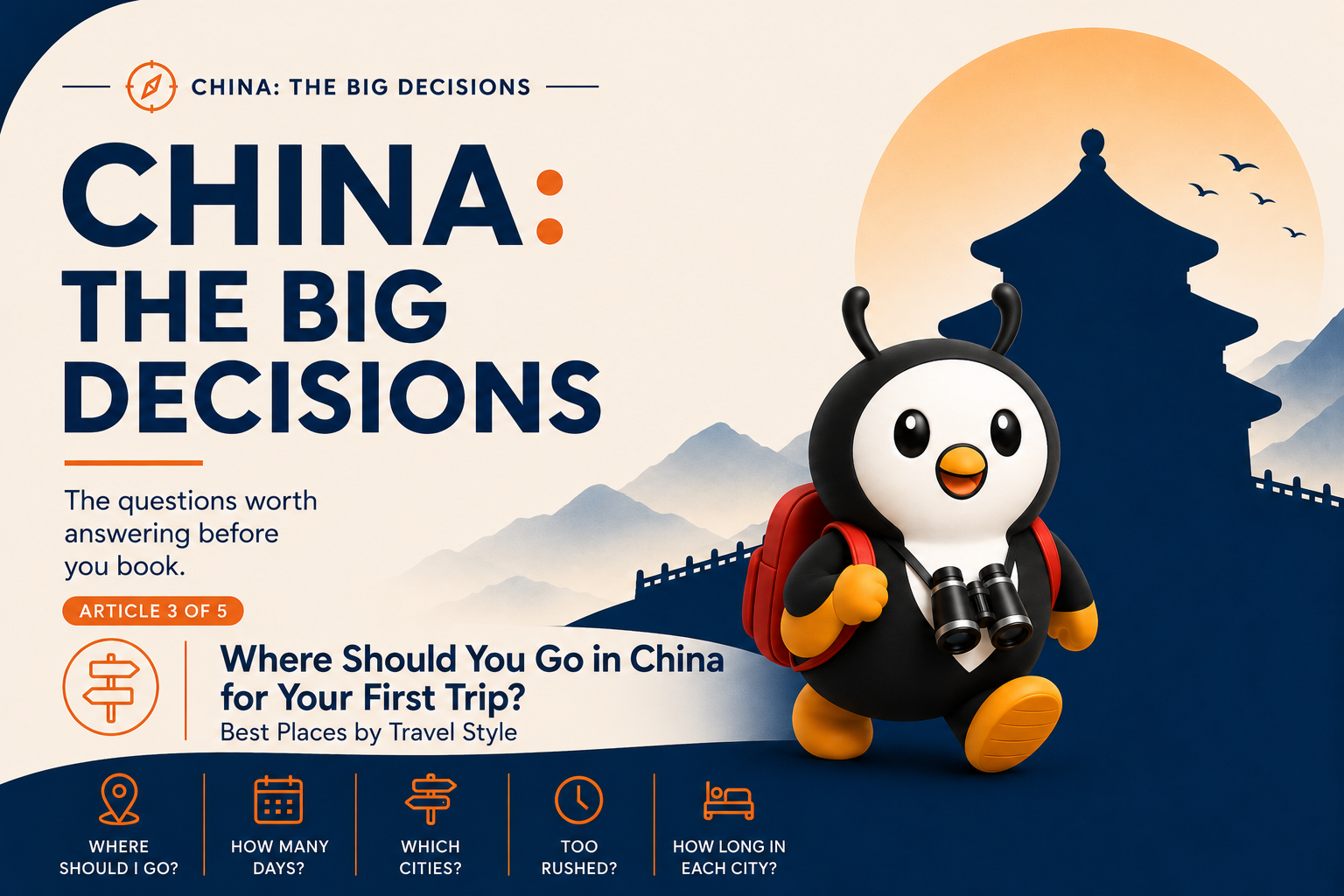
CHINA: THE BIG DECISIONS — Article 3
The questions worth answering before you book.
Where should you go on your first trip to China?
For many first-time travelers, Beijing, Xi’an, Shanghai and Chengdu are excellent places to start — but they aren’t automatically the best places for you.
If you love history, consider Beijing and Xi’an.
If food is the reason you’re traveling, look seriously at Chengdu, Xi’an and Guangzhou.
If you love mountains and photography, destinations such as Zhangjiajie and Guilin/Yangshuo may matter more than another major city.
And if you’re fascinated by modern China, Shanghai or Chongqing can provide very different perspectives.
The key is not to ask:
“What are the must-see places in China?”
Ask:
“What kind of China do I want to experience?”
Answer that first, and choosing where to go becomes much easier.
Quick Answer: Best Places to Visit in China for First-Time Travelers
| If You Want… | Consider… | Why |
|---|---|---|
| Imperial China & the Great Wall | Beijing | Forbidden City, imperial sites, Great Wall |
| Ancient China & archaeology | Xi’an | Terracotta Army, ancient capital, Silk Road |
| Modern & international China | Shanghai | Architecture, commerce, neighborhoods, modern history |
| Food & everyday city life | Chengdu | Sichuan cuisine, teahouses, parks |
| Dramatic modern cityscapes | Chongqing | Hills, rivers, bridges, extraordinary urban form |
| Mountains & photography | Zhangjiajie | Dramatic sandstone landscapes |
| Karst scenery & countryside | Guilin / Yangshuo | Rivers, limestone peaks, rural landscapes |
| Cantonese food & southern China | Guangzhou | Cantonese cuisine and southern urban culture |
| A classic first introduction | Beijing + Xi’an + Shanghai | Three very different chapters of China |
| A broader two-week journey | Beijing + Xi’an + Chengdu + Shanghai | History + food + everyday life + modern China |
These are starting points, not rules.
The best first China itinerary depends on your interests, your pace and what you want to remember after the trip.
The ChinaTravelBUG Rule: Give Every Destination a Job
Before choosing your cities, try something simple.
Write down every destination you’re considering.
Then complete this sentence for each one:
“I’m going here because…”
For example:
Beijing — I want to understand imperial China and see the Great Wall.
Xi’an — ancient Chinese history fascinates me.
Chengdu — I want Sichuan food, teahouses and a different rhythm of city life.
Shanghai — I want to see another face of modern China.
Zhangjiajie — landscapes and photography are major reasons for my trip.
Now look at your list again.
If your only reason for including somewhere is:
“Everyone goes there.”
question it.
And if two destinations are doing essentially the same job, ask whether you really need both.
This is one of the simplest ways to turn a collection of famous cities into a journey designed around you.
Stop Asking “What Are the Must-See Cities in China?”
This is where many first-time China itineraries go wrong.
A traveler searches:
“Best cities to visit in China.”
They find ten famous destinations.
Then they try to fit six into two weeks.
But popularity doesn’t tell you whether a destination belongs in your trip.
Instead of asking:
“Is this place famous?”
ask:
“What will this place add to my experience of China?”
Beijing and Xi’an are both rich in history.
But they don’t tell the same story.
Shanghai and Chongqing are both enormous modern cities.
But they don’t feel remotely the same.
Chengdu and Guangzhou are both excellent food destinations.
But their food cultures are very different.
You’re not choosing dots on a map.
You’re choosing different experiences of China.
Should You Visit Beijing on Your First Trip to China?
For many first-time travelers, Beijing is difficult to replace.
Not simply because it contains famous attractions.
Several major threads of China’s story come together here.
The Forbidden City introduces the world of China’s imperial court.
The Temple of Heaven reveals another side of imperial ritual and cosmology.
The hutongs provide glimpses of older urban Beijing.
The Great Wall takes you beyond the city to one of the world’s most recognizable historical structures.
And modern Beijing remains China’s political center.
Beijing is best for travelers interested in:
- Chinese history;
- imperial architecture;
- museums;
- the Great Wall;
- major cultural landmarks; and
- understanding connections between China’s past and present.
ChinaTravelBUG View
If your goal is to understand China rather than simply see China, Beijing deserves serious consideration.
But does that mean every first-time visitor must go there?
No.
Do You Have to Visit Beijing on Your First China Trip?
Absolutely not.
There is no rule saying your first China trip must include Beijing.
If your dream trip revolves around Sichuan food, mountain landscapes and photography, forcing four days in Beijing into your itinerary simply because it’s the capital may make little sense.
You could return home having visited all the “correct” places while missing the trip you actually wanted.
Ask yourself:
“Am I choosing Beijing because I’m genuinely interested in it — or because I think I’m supposed to?”
If it’s the second answer, keep exploring your options.
China offers many different ways in.
Should You Visit Xi’an on Your First Trip to China?
If Beijing introduces imperial China, Xi’an takes you much further back.
Xi’an is best known internationally for the Terracotta Army.
But reducing the city to one archaeological site misses much of its significance.
Historically known as Chang’an, the city served as the capital of several Chinese dynasties and became one of the great cities connected with the Silk Road.
Its city walls, museums, religious sites and Muslim food traditions reveal layers of Chinese history that feel very different from Beijing.
Xi’an is best for travelers interested in:
- archaeology;
- ancient Chinese history;
- the Terracotta Army;
- the Silk Road;
- historic cities; and
- food shaped by cultural exchange.
Beijing or Xi’an?
If you can visit both, they complement each other extremely well.
If you have to choose:
Choose Beijing for a broader combination of imperial history, major landmarks, the Great Wall and modern political China.
Choose Xi’an if ancient history, archaeology and the Silk Road are your strongest interests.
Should You Visit Shanghai on Your First Trip to China?
Shanghai is sometimes described simply as “modern China.”
That’s true — but incomplete.
Shanghai is also a city shaped by trade, foreign interaction, commerce, migration and China’s turbulent modern history.
The Bund and Pudong almost face each other like two chapters of the same story.
One looks toward Shanghai’s complicated international past.
The other has become an icon of China’s extraordinary urban transformation.
Shanghai is best for travelers interested in:
- architecture;
- urban history;
- contemporary city life;
- neighborhoods and cafés;
- shopping;
- photography; and
- China’s global connections.
Beijing or Shanghai?
Choose Beijing if Chinese history, imperial landmarks and the Great Wall are priorities.
Choose Shanghai if you’re more interested in architecture, modern urban life and China’s international connections.
If time allows, visiting both creates one of the most interesting contrasts on a first China trip.
Should You Visit Chengdu on Your First Trip to China?
Yes — especially if food and everyday life matter to you.
And Chengdu deserves much more than:
“Go there for the pandas.”
For many travelers, the city’s deeper appeal is its combination of Sichuan food, teahouses, parks and social life.
Spend some time in a traditional teahouse and you may find yourself watching people chatting, playing cards, drinking tea and simply spending time together.
That everyday rhythm can reveal something about China that a famous monument cannot.
Chengdu is best for travelers interested in:
- Sichuan cuisine;
- food;
- pandas;
- teahouses;
- parks;
- everyday local life; and
- a somewhat more relaxed urban rhythm.
ChinaTravelBUG View
If food is one of the main reasons you’re traveling to China, don’t treat Chengdu as a two-night panda stop.
Give the city time to feed you.
Literally. 😎
Cheers Asks 🧳
“Am I choosing cities because I want to visit them — or because everyone else’s itinerary says I should?”
There’s a Chinese expression:
各有所爱 (gè yǒu suǒ ài)
Roughly:
“Everyone has what they love.”
Travel works the same way.
Your friend may think the Terracotta Army is unmissable.
You may dream about Sichuan food.
Someone else may happily spend two weeks photographing mountains.
None of those travelers is wrong.
The best China itinerary isn’t the one everyone agrees with. It’s the one that makes sense for you.
One of the Travel Tools Dad & Elaine Actually Use
When Elaine and I travel around China, Trip.com is one of the platforms we genuinely use ourselves. Over our journeys together, we’ve used it to book hotels, flights, trains, attractions and tours — in China and elsewhere.
It has helped us many times while planning our trips, and we’ve had good experiences with it. So when friends or ChinaTravelBUG readers ask us “Where do you actually book?”, Trip.com is one of the places we’re comfortable recommending because we use it too.
✈️ 🏨 🚄 🎟️ Explore and plan your China trip on Trip.com →
Affiliate link — ChinaTravelBUG may earn a small commission at no extra cost to you.
Should You Visit Chongqing?
Choose Chongqing if you want to experience a modern Chinese city that sometimes seems almost physically impossible.
The city can feel three-dimensional.
Roads cross at different levels.
Buildings rise from steep hillsides.
Metro lines appear to pass through buildings.
The Yangtze and Jialing rivers meet beneath a dense landscape of bridges, towers and lights.
At night, parts of Chongqing can feel almost cinematic.
Chongqing is best for travelers interested in:
- dramatic cityscapes;
- urban photography;
- spicy food;
- megacities;
- unusual urban design; and
- another side of modern China.
Chengdu or Chongqing?
Choose Chengdu for Sichuan food, teahouses, pandas and a more relaxed urban experience.
Choose Chongqing for dramatic cityscapes, intense urban energy and extraordinary geography.
Or visit both.
Their proximity makes them a natural combination, while their personalities are surprisingly different.
Where Should You Go in China for Mountains and Nature?
If mountains, landscapes and photography are the reason you’re traveling, don’t build your entire itinerary around cities.
Two famous starting points are:
Zhangjiajie
Zhangjiajie’s towering sandstone landscapes have become among China’s most recognizable natural scenes.
Consider it if you love:
- mountains;
- dramatic scenery;
- hiking;
- landscape photography; and
- nature-focused travel.
Guilin and Yangshuo
Guilin and nearby Yangshuo offer a different landscape.
Here you’ll find limestone karst peaks, rivers and countryside.
Consider the region if you love:
- river scenery;
- karst landscapes;
- cycling;
- countryside;
- photography; and
- slower travel.
One warning:
Nature destinations can require more logistical time than a city-to-city itinerary suggests.
Don’t squeeze them between major cities simply because they fit on the map.
Give the landscape time.
Where Should You Go in China for Food?
If food is the main reason you’re visiting China, your itinerary should reflect that.
China doesn’t have one “Chinese cuisine.”
Regional food traditions can be dramatically different.
Three excellent starting points are:
Chengdu
For Sichuan cuisine, hotpot, noodles, snacks and teahouse culture.
Xi’an
For noodles, roujiamo, dumplings and food traditions influenced by the city’s long history of cultural exchange.
Guangzhou
For Cantonese cuisine, dim sum and the food culture of southern China.
A food-focused traveler might reasonably choose:
Chengdu → Xi’an → Guangzhou
instead of:
Beijing → Xi’an → Shanghai
That’s not a lesser first trip.
It’s simply a trip designed around a different reason for traveling.
What If You Don’t Care About Beijing, Xi’an or Shanghai?
Then don’t automatically go.
Many travelers feel strangely guilty about skipping famous places.
But China is not an exam.
Nobody is checking whether you completed the correct attractions.
If you have 14 days and what genuinely excites you is:
Chengdu → Chongqing → Zhangjiajie
that may be a much better first trip for you than forcing yourself through a conventional route you aren’t interested in.
The classic cities are famous for good reasons.
But:
Famous doesn’t mean compulsory.
Build Your First China Trip Around Contrasts
If you don’t have one dominant interest, another excellent strategy is to deliberately choose contrasting destinations.
This allows a first trip to show you several different sides of China.
For example:
| Type of Journey | Possible Route |
|---|---|
| Classic First Trip | Beijing → Xi’an → Shanghai |
| History + Food | Beijing → Xi’an → Chengdu |
| Food Journey | Chengdu → Xi’an → Guangzhou |
| Modern Urban China | Shanghai → Chongqing |
| Cities + Landscapes | Beijing → Xi’an → Zhangjiajie |
| Sichuan + Urban Energy | Chengdu → Chongqing |
| Broader Two-Week Introduction | Beijing → Xi’an → Chengdu → Shanghai |
These aren’t prescriptions.
They’re examples of a planning principle:
Each destination should earn its place by adding something different to the journey.
Which China Trip Fits Your Travel Style?
If you’re still unsure where to begin, use this:
| Your Main Interest | Start Exploring |
|---|---|
| First-time classic China | Beijing + Xi’an + Shanghai |
| Chinese history | Beijing + Xi’an |
| Food | Chengdu + Xi’an + Guangzhou |
| Modern China | Shanghai + Chongqing |
| Photography | Chongqing + a landscape destination |
| Mountains & nature | Zhangjiajie + Guilin/Yangshuo or other nature regions |
| Everyday culture | Chengdu + slower neighborhood-focused stays |
| Understanding China’s contrasts | Beijing + Xi’an + Chengdu + Shanghai |
Don’t treat this table as an itinerary.
Treat it as a direction finder.
Once you know the direction, building the actual route becomes much easier.
Frequently Asked Questions About Where to Go in China
What are the best places to visit in China for first-time travelers?
Beijing, Xi’an, Shanghai and Chengdu are strong starting points because they offer very different experiences. However, the best destinations depend on whether you’re most interested in history, food, modern cities, landscapes or everyday culture.
What three cities should I visit in China?
For a classic first trip, Beijing, Xi’an and Shanghai provide a strong combination of imperial history, ancient civilization and modern urban China. Food or nature-focused travelers may prefer a different combination.
Do I have to visit Beijing on my first trip to China?
No. Beijing is historically and culturally important, but it isn’t compulsory. If your strongest interests are food, nature or another region, build your itinerary around the places that genuinely excite you.
Beijing or Shanghai: which is better for a first trip?
Choose Beijing for imperial history, major cultural landmarks and the Great Wall. Choose Shanghai for modern urban life, architecture and China’s global connections. Visiting both provides an excellent contrast if you have enough time.
Beijing or Xi’an: which should I choose?
Choose Beijing for a broader combination of imperial history, famous landmarks, the Great Wall and modern political China. Choose Xi’an if ancient history, archaeology and the Silk Road are your main interests.
Chengdu or Chongqing: which is better?
Choose Chengdu for Sichuan food, teahouses, pandas and a more relaxed urban experience. Choose Chongqing for dramatic cityscapes, spicy food and extraordinary urban geography.
Where should I go in China if I love food?
Consider Chengdu, Xi’an and Guangzhou. They represent very different regional food traditions and can form the basis of a China trip designed primarily around eating and food culture.
Where should I go in China if I love mountains and photography?
Consider Zhangjiajie, Guilin/Yangshuo and other landscape-focused regions rather than automatically building your trip around China’s biggest cities.
Where should I go in China if I don’t like museums?
Build your journey around food, neighborhoods, landscapes and contemporary cities. Chengdu, Chongqing, Zhangjiajie and Guilin/Yangshuo are possible starting points depending on your interests.
Is Beijing, Xi’an, Chengdu and Shanghai a good first China itinerary?
Yes. For a trip of around two weeks, these four destinations can provide a strong introduction to imperial history, ancient China, Sichuan food and everyday life, and modern urban China. Travelers who prefer a slower pace may choose three instead.
So, Where Should You Go on Your First Trip to China?
Don’t begin with:
“What are China’s top ten attractions?”
Begin with:
“Why am I going to China?”
If the answer is history, your journey may begin with Beijing and Xi’an.
If it’s food, Chengdu or Guangzhou may become much more important.
If it’s mountains and photography, perhaps Zhangjiajie belongs near the top.
If it’s modern China, Shanghai or Chongqing may fascinate you.
And if your answer is:
“I want to understand China.”
then deliberately choose destinations that reveal different chapters of the country.
Ancient.
Imperial.
Everyday.
Modern.
There’s a well-known Chinese saying:
读万卷书,行万里路
(dú wàn juàn shū, xíng wàn lǐ lù)
Often expressed roughly as:
“Read ten thousand books; travel ten thousand miles.”
Travel can teach us things that reading alone cannot.
But that doesn’t mean traveling to the greatest number of places.
It means paying attention to the places you choose.
So don’t build your first China trip around the destinations you think you’re supposed to visit.
Build it around the China you’re curious to discover.
Not Sure Where You Should Go in China?
This is exactly the kind of decision the ChinaTravelBUG AI Travel Planner can help with.
Instead of simply asking:
“Give me a 14-day China itinerary.”
tell it something about yourself.
Try:
“I have 14 days. I love mountains, landscapes and photography and don’t care much about museums. Where should I go?”
Or:
“Food is the main reason I’m visiting China. I have 12 days. Where would you send me?”
Or even:
“I’ve never been to China and honestly don’t know what I want. Help me figure it out.”
That’s a much better starting point.
Because the destination should come after the traveler.
Not before.
Next in China: The Big Decisions
Is Your China Itinerary Too Rushed?
Five cities in seven days?
Four hotels in ten?
Every morning starting before sunrise?
Next, we’ll show you how to tell whether your China itinerary actually works — before you start booking it.