
A real traveler question answered by the ChinaTravelBUG AI Travel Planner
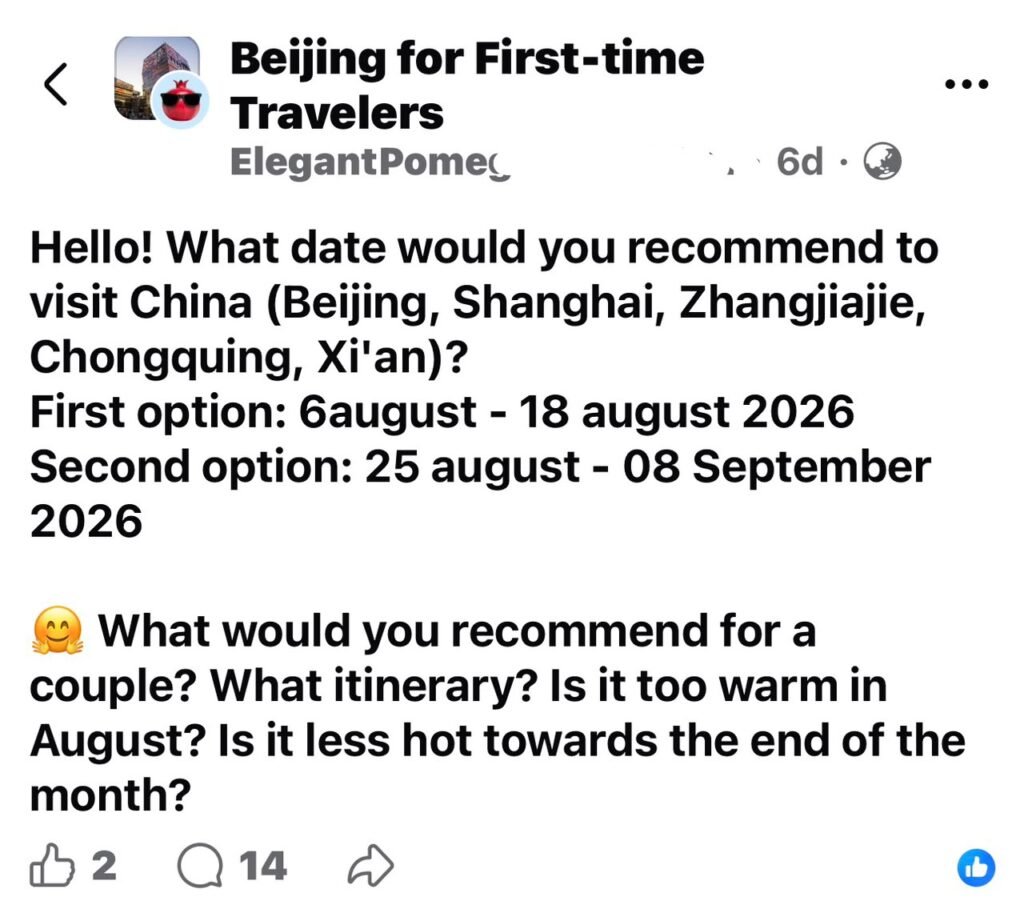
August is one of those months when planning a China trip involves more than asking, “Will it be hot?”
China is enormous. Beijing, Xi’an, Chongqing, Zhangjiajie and Shanghai can feel very different even during the same two-week trip. And when you have only around 14 nights, weather isn’t the only consideration—route, pace and the number of hotel changes matter too.
A couple planning their first China trip recently had two possible travel windows and asked which one we would choose.

ChinaTravelBUG AI Travel Planner’s ANSWER
I’d choose the second option: 25 August–8 September 2026.
It will still be summer, so I wouldn’t choose those dates expecting cool weather. But late August generally gives you a better chance of slightly lower temperatures than 6–18 August, particularly in Xi’an and Zhangjiajie. Historical climate patterns show temperatures easing toward the end of August in both places.
The important exception is Chongqing. August can be extremely hot and humid there, with periods of 35–40°C (95–104°F), so even in late August I would plan Chongqing around the heat rather than hope to avoid it.
For a couple with roughly 14 nights, I’d also simplify the proposed five-city trip slightly. Beijing, Shanghai, Zhangjiajie, Chongqing and Xi’an is possible, but it creates four major transfers and leaves relatively little breathing room. For a first visit, fewer hotel changes usually produces a much more enjoyable trip.
What I’d recommend
Beijing — 4 nights
Start with imperial China: Forbidden City, Temple of Heaven, Great Wall, but also leave time for hutongs and an early-morning park.
Xi’an — 3 nights
This gives the Terracotta Army proper context rather than treating Xi’an as a one-attraction stop. The city helps explain where unified imperial China began.
Zhangjiajie — 3 nights
A welcome change from the big cities. Mountain areas can be noticeably cooler than downtown, although August remains humid and changeable, with rain and mist possible.
Shanghai — 4 nights
Finish more slowly with the Bund, historic neighborhoods, good food and contemporary China.
I would drop Chongqing on this particular trip. Not because it isn’t worth visiting—it certainly is—but because it is the destination most likely to make an August itinerary physically tiring. Removing it also gives you a much better-paced journey as a couple. Beijing and Xi’an are especially rewarding when they aren’t rushed; Shanghai provides a completely different view of China at the end.
Ready to Check Zhangjiajie Hotels?
Dad & Elaine have personally used Trip.com many times when travelling in China and elsewhere — for hotels, flights, attractions and tours. We’ve had good experiences with it, so it’s one of the booking platforms we use ourselves.
🏨 Check Zhangjiajie hotels & current prices on Trip.com →
Affiliate link — ChinaTravelBUG may earn a small commission at no extra cost to you.
Ready to Check Shanghai Hotels?
Dad & Elaine have personally used Trip.com many times when travelling in China and elsewhere — for hotels, flights, attractions and tours. We’ve had good experiences with it, so it’s one of the booking platforms we use ourselves.
🏨 Check Shanghai hotels & current prices on Trip.com →
Affiliate link — ChinaTravelBUG may earn a small commission at no extra cost to you.
Ready to Check Beijing Hotels?
Dad & Elaine have personally used Trip.com many times when travelling in China and elsewhere — for hotels, flights, attractions and tours. We’ve had good experiences with it, so it’s one of the booking platforms we use ourselves.
🏨 Check Beijing hotels & current prices on Trip.com →
Looking for Else Where Hotels in China?
Dad & Elaine have personally used Trip.com many times when travelling across China and elsewhere — for hotels, flights, attractions and tours. We’ve had good experiences with it, so it’s one of the booking platforms we use ourselves.
🏨 Check hotels & current prices across China on Trip.com →
Further Reading
The Perfect First Trip to China Itinerary: Beijing, Xi’an and Beyond (7, 14 & 21 Days China Travel Guide)
Read the article:
https://chinatravelbug.com/the-perfect-first-trip-to-china-itinerary-beijing-xian-and-beyond-7-14-21-days-china-travel-guide/
This is particularly useful for deciding how many destinations comfortably fit into a two-week first trip.
My next decision would be whether Chongqing is one of the places you most want to experience. If it is, I’d keep it and redesign the route rather than simply squeeze five cities into 14 nights.
A Note About This AI Travel Planner Answer
This answer is shown essentially as originally generated, without editorial rewriting of the recommendation.
Weather is inherently unpredictable, and historical climate patterns cannot tell you what conditions will be like on specific travel dates. Temperatures, rainfall, transport schedules, attraction opening arrangements and other time-sensitive information can also change.
Before traveling, check current weather forecasts and verify any transport schedules, reservations and other information that could have changed.
Based on a real question posted by a traveler online. The question may be lightly edited or anonymized for clarity and privacy.
So, Is Late August Actually a Good Time to Visit China?
Yes—with realistic expectations.
The important point is that August isn’t equally uncomfortable everywhere in China.
The traveler is considering five very different destinations:
Beijing → Xi’an → Chongqing → Zhangjiajie → Shanghai
Weather interacts with each of them differently.
Beijing can be hot, but much of a first visit can be organized around early starts and a mixture of indoor and outdoor attractions.
Xi’an can also be hot, particularly when you’re walking the City Wall or visiting outdoor archaeological sites.
Zhangjiajie introduces altitude, mountains, forests and more variable conditions.
Shanghai can be hot and humid, with late-summer rain another consideration.
And then there is Chongqing.
That is where weather becomes more than a minor inconvenience.
Why Chongqing Changes the Decision
Chongqing is extraordinary.
Its hills, vertical cityscape, monorails, bridges, rivers and dense urban neighborhoods make it unlike almost anywhere else in China.
But summer heat and humidity can make intensive sightseeing physically demanding.
This is an important distinction.
The question isn’t simply:
“Is Chongqing worth visiting?”
Of course it is.
The better question is:
“Is Chongqing worth including in this particular 14-night August itinerary?”
Those are completely different questions.
If the couple had three weeks, the answer might change.
If Chongqing were the destination they were most excited about, the answer might change.
If they were traveling in a cooler season, the answer might change again.
But with 14 nights, five destinations and August weather, something has to give.
The Planner chooses Chongqing.
That’s not a judgment on Chongqing.
It’s a judgment on the trip as a whole.
Cheers Explains: Don’t Choose Travel Dates by Temperature Alone
Here’s the bigger planning lesson.
Suppose the forecast says 35°C (95°F).
That number doesn’t tell you whether your day will be enjoyable.
Think instead about what you’ll actually be doing.
35°C + relaxed Shanghai day
Late breakfast, museum, café, neighborhood wandering, evening on the Bund.
Potentially manageable.
35°C + packed Chongqing sightseeing day
Hills, stairs, outdoor viewpoints, crowded attractions, multiple metro journeys and an ambitious sightseeing list.
Very different experience.
Warm weather + Zhangjiajie
Now visibility, rain, mist and mountain conditions matter in addition to temperature.
So don’t choose your China travel dates based only on:
“Which week is three degrees cooler?”
Ask:
“How will the weather affect what we’re actually planning to do?”
That’s a much better travel-planning question.
Why August 25–September 8 Gets the Edge
The second travel window doesn’t magically transform summer into autumn.
The traveler should still prepare for heat, humidity and rain.
But when choosing between early/mid-August and late August into early September, the later window gets the Planner’s vote because it offers a reasonable possibility of somewhat more comfortable conditions in parts of the itinerary.
There is another advantage.
Traveling into early September starts moving you beyond the main summer vacation period.
But the key word is possibility.
Weather doesn’t follow the calendar precisely.
Don’t build the trip around the assumption that September 1 will suddenly feel cool.
Is Five Cities Too Many for 14 Nights?
This may actually be the more important question.
Five destinations in 14 nights sounds reasonable when written as a list:
Beijing
Xi’an
Chongqing
Zhangjiajie
Shanghai
But each additional destination creates another cycle:
Pack → check out → station/airport → travel → arrival → hotel transfer → check in → unpack → orient yourself again.
A three-hour train journey doesn’t necessarily consume only three hours of your trip.
This is why the Planner recommends:
Beijing — 4 nights → Xi’an — 3 nights → Zhangjiajie — 3 nights → Shanghai — 4 nights
Four very different experiences.
Imperial China.
Ancient China.
Dramatic natural landscapes.
Modern China.
That’s already an exceptionally varied first trip.
Why This Route Helps You Understand China Better
There is another reason I like this combination.
Each destination contributes something different rather than simply adding another famous city.
Beijing — Imperial China
The Forbidden City, Temple of Heaven and Great Wall provide historical context, but don’t spend the entire four days sightseeing.
Visit a neighborhood park.
Walk through the hutongs.
Watch how people actually use Beijing’s public spaces.
Xi’an — Where a Unified China Begins
The Terracotta Army is extraordinary, but Xi’an shouldn’t be reduced to one archaeological attraction.
The city helps tell the story of China’s early imperial unification and later Silk Road connections.
Zhangjiajie — Landscape China
After Beijing and Xi’an, the change is dramatic.
Mountains, forests and extraordinary sandstone formations replace giant urban spaces.
Shanghai — Contemporary China
Finish somewhere completely different again.
Shanghai introduces another China: cosmopolitan, commercial, architectural and unmistakably modern.
The Bund becomes more meaningful when you’ve just spent the previous ten days experiencing other layers of the country.
But What If You Really Want Chongqing?
Then keep Chongqing.
This is where personalized travel planning matters.
If you’ve been dreaming about Chongqing’s extraordinary cityscape for years, removing it simply because the weather might be uncomfortable doesn’t necessarily make sense.
Instead, redesign the trip around it.
That might mean removing another destination, spending fewer nights elsewhere or accepting a faster pace.
The wrong approach would be:
“We’ll keep all five and somehow make everything fit.”
The better approach is:
“Which experience matters least to us?”
That’s how a good itinerary gets built.
Not by asking how many places can technically fit into 14 nights.
But by deciding which places deserve those nights.
What Should a Couple Pack for an August China Trip?
Think summer first, even if you’re traveling into early September.
Lightweight, breathable clothing is important, but so are comfortable walking shoes. Beijing, Xi’an and Zhangjiajie can all involve substantial walking.
Also consider:
- Sun protection
- Refillable water bottle
- Small umbrella or lightweight rain protection
- Comfortable shoes with good grip for Zhangjiajie
- A light layer for strong indoor air-conditioning
- Small daypack
- Portable power bank
Most importantly, don’t schedule every sightseeing day from early morning until late evening.
Heat becomes much easier to manage when the itinerary itself allows you to slow down.
The ChinaTravelBUG Verdict
Between the two proposed periods:
Choose August 25–September 8.
But don’t choose it because you expect autumn weather.
Choose it because, between these two options, it gives you a reasonable chance of somewhat more comfortable conditions in parts of the trip.
And for approximately 14 nights, I’d favor:
Beijing 4 nights → Xi’an 3 nights → Zhangjiajie 3 nights → Shanghai 4 nights
I’d leave Chongqing for another journey unless Chongqing is one of the main reasons you’re coming to China.
That’s the decision that matters more than squeezing another city into the itinerary.

Try the FREE ChinaTravelBUG AI-Assisted Travel Planner
Planning your own China trip?
Your best route may be completely different.
Tell the FREE ChinaTravelBUG AI-assisted Travel Planner:
- When you’re traveling
- How many days you have
- Which cities you’re considering
- What interests you most
- Whether you prefer a fast or relaxed trip
- Who you’re traveling with
- What you’re worried about
Then ask:
“Which of these two travel dates would you choose?”
“Is August too hot for my itinerary?”
“Should I include Chongqing?”
“Are five cities too many for two weeks?”
“Which destination would you remove?”
Or paste your entire itinerary and simply ask:
“Would you change anything?”
The goal isn’t to fit the maximum number of famous places into your vacation.
It’s to help you build a China trip that works for you.
Try the FREE ChinaTravelBUG AI-assisted Travel Planner with your own China travel question.