
A traveler planning a late-February China trip wondered whether Beijing’s attractions return to normal after the main Chinese New Year holiday — and whether it is possible to visit the Great Wall without overwhelming crowds before the Lantern Festival.
This is a particularly good traveler question because there are really three different calendars involved: the official public holiday, the broader Spring Festival season, and the huge 春运 (Chūnyùn) travel period.
The Traveler’s Question
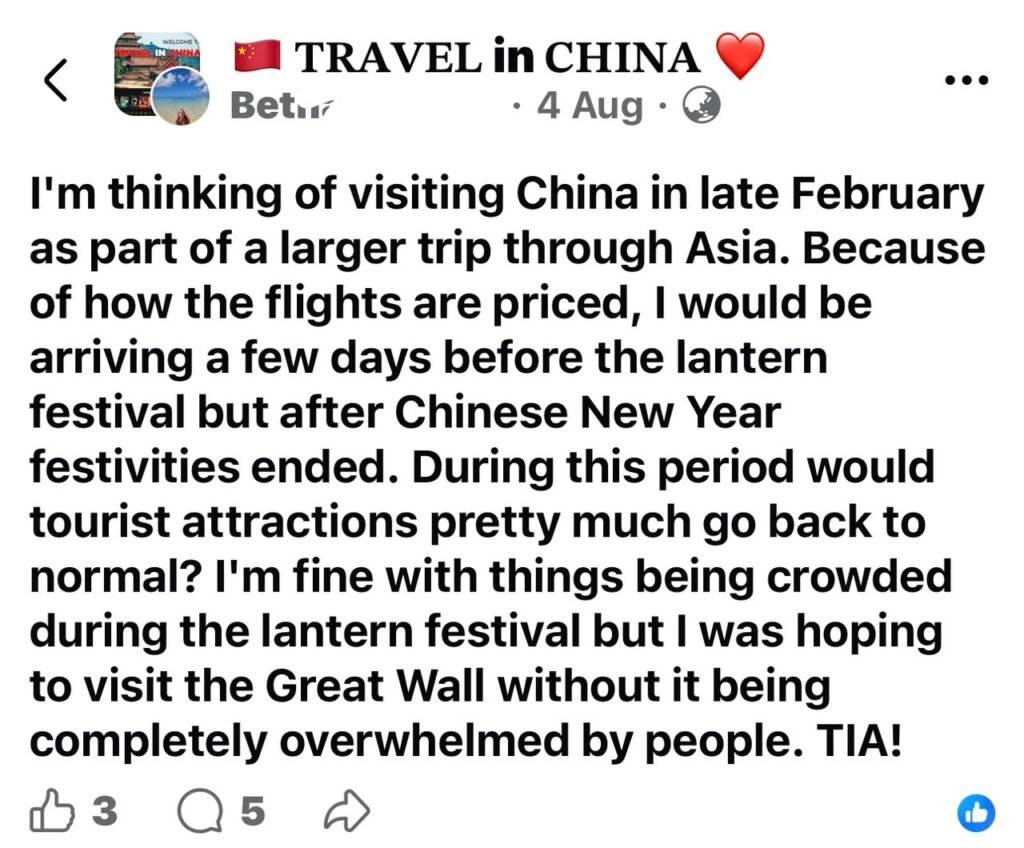
“I’m thinking of visiting China in late February as part of a larger trip through Asia. Because of how the flights are priced, I would be arriving a few days before the Lantern Festival but after Chinese New Year festivities ended.
During this period would tourist attractions pretty much go back to normal? I’m fine with things being crowded during the Lantern Festival but I was hoping to visit the Great Wall without it being completely overwhelmed by people.”

AI Travel Planner Answers
Yes — the period after the main Chinese New Year holiday but before the Lantern Festival can actually be a very good time to visit Beijing and the Great Wall. I wouldn’t avoid the trip for that reason.
One important distinction: Chinese New Year doesn’t really “finish” when the official public holiday ends. The festive season traditionally continues through the Lantern Festival, so you may still see lanterns, decorations and seasonal events. In Beijing in 2026, for example, official lantern events continued after the main holiday and through Lantern Festival.
For ordinary sightseeing, however, things generally move back toward normal after the official holiday. Museums and attractions resume their usual schedules, although individual sites can have special holiday arrangements. In 2026, Beijing museums had various temporary schedules during Spring Festival before returning to regular operations afterward.
What about the Great Wall?
This is actually where your timing could work nicely.
Late February is winter at the Great Wall: cold, often windy, and potentially icy. But the upside is considerably fewer visitors than during China’s warmer peak seasons. If avoiding a wall packed with people matters to you, I’d choose Mutianyu rather than Badaling, and go on a weekday if possible.
There is one caveat. The nationwide chunyun Spring Festival travel period extends well beyond the official holiday. For comparison, in 2026 the official holiday ended February 23, but the national travel rush continued until March 13. That matters much more for intercity trains, airports and transport than for whether the Great Wall itself will be overwhelmed.
So my recommendation would be: don’t let this timing put you off Beijing. You could get an unusually interesting combination — relatively quiet winter sightseeing during the day, while still catching the tail end of the New Year atmosphere and then experiencing Lantern Festival.
Just bring genuinely warm clothing and footwear with good grip. Winter conditions on the Wall are a bigger consideration than crowds.
Further Reading
Mutianyu or Badaling? Which Great Wall Should You Visit? A Licensed Beijing Guide Explains (2026)
Useful for deciding which section suits you if crowd levels are one of your priorities.
If you tell me which year you’re planning for and roughly what dates you’d be in Beijing, I can check where those dates fall relative to the official Spring Festival holiday and Lantern Festival.
ChinaTravelBUG Verification Note
Last verified: August 13, 2026
The dates matter here because Spring Festival and Lantern Festival move every year.
For example, Chinese New Year in 2027 falls on February 6, while Lantern Festival (元宵节, Yuánxiāo Jié) falls on February 20. (Wikipedia)
Therefore, travelers should not reuse dates from the 2026 example in the AI Travel Planner’s original answer when planning a later trip. Official public-holiday arrangements, attraction opening schedules, ticketing arrangements and transport schedules should always be checked for the specific year of travel.
ChinaTravelBUG Editorial Note
The original AI Travel Planner answer above is published unedited as part of our AI Travel Planner Answers series.
This question originally appeared in an online China travel community. Personal identifying details have been omitted. ChinaTravelBUG is not affiliated with the original poster or the Facebook group.
Time-sensitive information — particularly holiday arrangements, attraction opening hours, ticketing rules and transport arrangements — should always be verified with current official sources before booking.
Why This Traveler Question Matters
This is more than a question about Great Wall crowds. It captures a recurring first-time traveler anxiety:
“What actually happens in China immediately after Chinese New Year?”
The useful distinction is between the official holiday, the longer cultural Spring Festival period, and Chūnyùn (春运). A traveler can encounter relatively normal attraction operations while New Year decorations and festivities are still visible and China’s transport system remains unusually busy.
For some travelers, that may actually make this an especially interesting time to experience Beijing.

Planning Your Own China Trip?
Not sure whether your dates clash with a Chinese holiday? Wondering whether Beijing will be crowded, how many days you need, or how to fit the Great Wall into a realistic itinerary?
Tell the FREE ChinaTravelBUG AI Travel Planner your dates, interests and travel pace, and let it help you work through your China trip one decision at a time.