
For many first-time travelers to China, getting online can sound far more complicated than it needs to be.
Do you need an eSIM?
Do you need a VPN?
Do you need an eSIM with a VPN built into it?
And if your normal travel eSIM has always worked elsewhere, will it still work behind China’s internet restrictions?
One traveler planning a family trip to Beijing (北京, Běijīng), Xi’an (西安, Xī’ān) and Shanghai (上海, Shànghǎi) had exactly this concern.
We put the question to the ChinaTravelBUG AI Travel Planner.
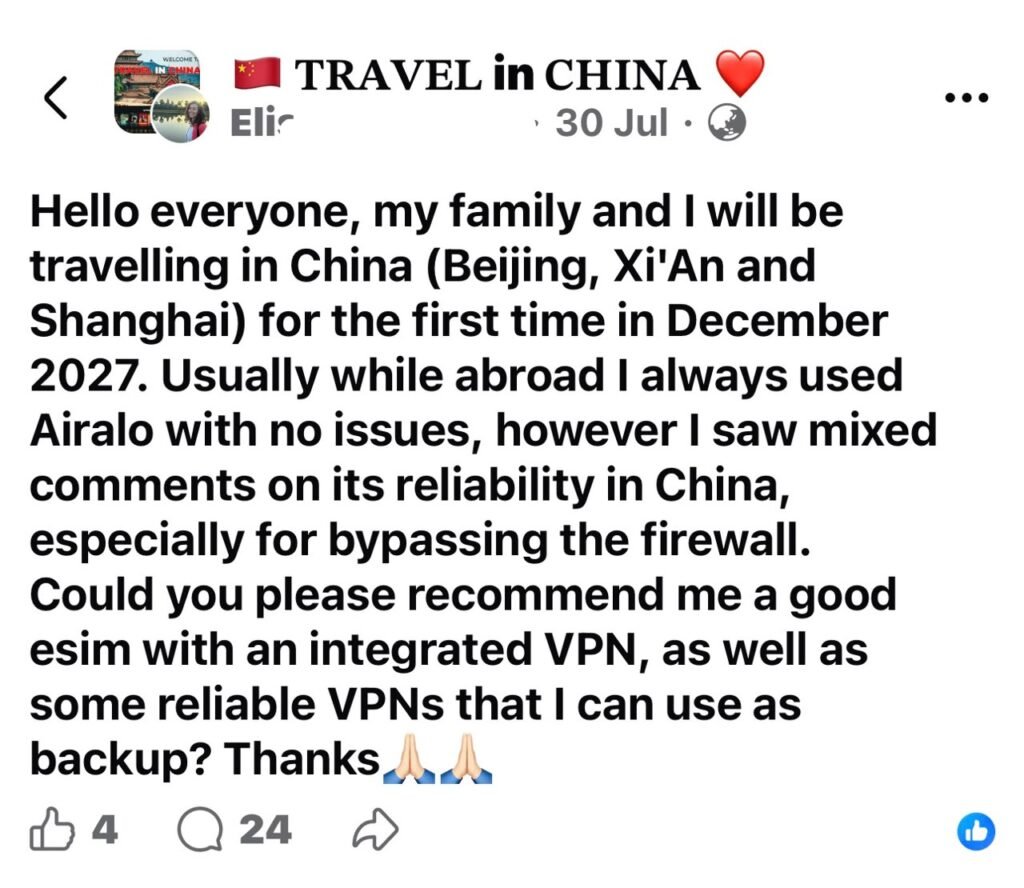
The Traveler’s Question
“Hello everyone, my family and I will be traveling in China (Beijing, Xi’An and Shanghai) for the first time in December 2027.
Usually while abroad I always used Airalo with no issues, however I saw mixed comments on its reliability in China, especially for bypassing the firewall.
Could you please recommend me a good eSIM with an integrated VPN, as well as some reliable VPNs that I can use as backup? Thanks.”

AI Travel Planner Answers
For a first family trip to Beijing, Xi’an and Shanghai, I’d keep this simpler than “eSIM with an integrated VPN + backup VPN.” The most dependable setup is usually a travel eSIM whose international roaming route already gives access to the wider internet, plus one VPN installed as a backup for hotel Wi-Fi/laptops.
Airalo isn’t necessarily a bad choice. Recent 2026 comparisons report that China travel eSIMs from Airalo, Nomad and Holafly generally route mobile data outside mainland China, meaning services such as Google, WhatsApp and Instagram can work without switching on a VPN.
My setup would be:
Primary phone data: Airalo or Nomad if you want a straightforward fixed-data package; Holafly can make sense for heavier data use. I wouldn’t specifically look for an “integrated VPN”—the important question is where the eSIM routes its data.
Keep your normal SIM active: particularly useful for receiving SMS verification codes. Just disable data roaming on that SIM if your carrier charges heavily.
Backup: install a VPN before arriving in China. VPN performance in China changes frequently and can vary by network, device and even week, so I would never depend on a single VPN. Current 2026 reports are particularly mixed, even for historically popular services.
Hotel Wi-Fi: this is where the backup VPN becomes more useful, because your travel eSIM’s international routing only helps while you’re actually using its mobile data.
Since you’re travelling in December 2027, however, I would not choose or buy the VPN now. What works in China in August 2026 may be completely different 16 months later. I’d check current reports again a few weeks before departure and install your chosen backup(s) before flying.
One useful distinction: a roaming travel eSIM isn’t really “breaking through” the firewall in the same way a VPN tries to. Its data can be routed through an overseas network in the normal course of international roaming. That’s one reason I prefer it as the primary solution for first-time visitors.
For a family, I’d also put the eSIM on more than one phone rather than making everyone dependent on one device/hotspot. It costs a little more, but it’s much less stressful if you become separated at a railway station or attraction.
Further Reading
Can You Use Your Home Mobile Phone Number in China? (2026 Guide for Foreign Tourists)
Read the article:
https://chinatravelbug.com/can-you-use-your-home-mobile-phone-number-in-china-2026-guide-for-foreign-tourists/
Useful for understanding how your normal number, roaming and a China travel SIM/eSIM can work together.
ChinaTravelBUG Note
There’s one particularly important idea buried inside this answer:
Don’t choose a China eSIM simply by looking for the words “integrated VPN.”
For an international visitor, the more useful question is:
How does this eSIM route my mobile data while I’m in mainland China?
That distinction explains why travelers sometimes report being able to use Google, Gmail, WhatsApp and other international services through certain travel eSIMs without turning on a separate VPN.
It also explains why another traveler using ordinary hotel Wi-Fi can have a completely different experience.
First Understand China’s Internet Situation
Mainland China’s internet environment is different from what most international visitors are accustomed to.
A number of international services may not be normally accessible through a standard mainland internet connection.
That can include services travelers routinely depend on at home.
This is why you’ll often see first-time visitors asking:
“Which VPN works in China?”
But that’s not necessarily the first question we’d ask anymore.
For a short international trip, we’d start with:
“How am I going to get my mobile data?”
Because the answer to that can change how important a VPN is.
Option 1: International Roaming
The simplest solution may already be sitting inside your phone.
If your home mobile carrier offers affordable international roaming in China, this can be extremely convenient.
You keep your:
- existing SIM
- existing phone number
- SMS capability
- familiar carrier
- normal mobile setup
And because international roaming traffic can be routed differently from an ordinary mainland connection, travelers may find that international internet services remain available through their roaming data.
The downside?
Price.
Some carriers offer excellent China roaming packages.
Others charge enough to make a travel eSIM much more attractive.
So compare before departure.
Option 2: A Travel eSIM
For many travelers, this is the sweet spot.
Companies such as Airalo, Nomad and Holafly offer travel eSIM products that include mainland China.
But we would not permanently recommend one provider simply because it happens to perform well today.
Products change.
Routing changes.
Packages change.
Prices change.
And this traveler isn’t going until December 2027.
Before buying, we’d check four things:
- Does the current plan explicitly cover mainland China?
- How is the data routed?
- Can international services normally be accessed using that connection?
- What are the current data allowance, hotspot and fair-use restrictions?
Those details matter more than simply seeing “China eSIM” in the product name.
Does a China Travel eSIM Need an Integrated VPN?
Not necessarily.
This is one of the biggest sources of confusion.
Some travelers think the connection must work like this:
China → Great Firewall → VPN → Google
But an internationally routed travel eSIM may work differently.
Its data connection can be routed through an overseas network as part of the roaming arrangement.
So the traveler may be able to access international services using mobile data without separately switching on a VPN.
That’s why we’d avoid making “integrated VPN” the main buying criterion.
Instead, verify how the particular product works at the time you’re traveling.
So Why Carry a VPN at All?
Because your eSIM only solves the problem while you’re actually using that mobile connection.
Imagine this:
You return to your hotel.
Your phone automatically connects to the hotel’s Wi-Fi.
Your internationally routed eSIM is no longer carrying that internet traffic.
Now you’re using a local Wi-Fi connection.
Your internet experience can therefore be different.
That’s one situation where having a suitable backup connectivity solution can be useful.
The same issue can matter with a laptop or tablet connected to hotel Wi-Fi.
Don’t Choose Your December 2027 VPN in August 2026
This is particularly important for this traveler.
The trip is 16 months away.
We would absolutely not buy a long-term VPN subscription now because somebody on Facebook said it worked during their China holiday this summer.
China connectivity is something to verify close to departure.
A service that works reliably today may behave differently by December 2027.
So we’d wait.
A few weeks before departure:
Check recent traveler reports → check the provider’s current China guidance → install anything you may need before entering mainland China.
That gives you information that’s actually relevant to your trip.
Keep Your Home SIM Active
There’s another reason not to think only about the travel eSIM.
Your normal phone number can still be useful.
Particularly for:
SMS verification codes.
Banking.
Email security.
Account logins.
Travel bookings.
Card verification.
You may unexpectedly need access to a code sent to your normal mobile number.
So if your phone supports dual SIM/eSIM operation, a useful arrangement can be:
Home SIM → calls/SMS
Travel eSIM → mobile data
Then disable expensive data roaming on the home SIM if necessary.
Check your own carrier’s charges before departure, because receiving calls or SMS abroad can be treated differently depending on the provider.
For Families, Don’t Depend on One Phone
This is something we’d emphasize for this particular question.
The traveler isn’t going alone.
They’re traveling as a family through Beijing (北京, Běijīng), Xi’an (西安, Xī’ān) and Shanghai (上海, Shànghǎi).
We wouldn’t put the entire family’s connectivity onto one parent’s phone and assume everyone can hotspot from it.
That works beautifully…
until somebody isn’t standing beside the hotspot.
Think about a large railway station.
Or a crowded attraction.
Or one parent taking a child back to the hotel while the others continue sightseeing.
Having mobile data on at least two phones provides useful redundancy.
For a family trip, we’d happily pay a little extra for that independence.
A Simple China Internet Setup
For many first-time travelers, we’d aim for something like this:
| Purpose | Setup |
|---|---|
| Primary internet | International roaming or suitable travel eSIM |
| Normal phone number | Keep home SIM active |
| SMS verification | Home SIM |
| Google/WhatsApp/etc. | Internationally routed mobile data where supported |
| Hotel Wi-Fi | Treat separately from the travel eSIM connection |
| Backup connectivity | Check current options shortly before departure |
| Family redundancy | Data connection on more than one phone |
Notice what’s missing?
A complicated stack of five different services.
You don’t necessarily need one.
What We’d Do for This Particular Trip
For Beijing → Xi’an → Shanghai in December 2027, we’d probably start by comparing:
1. Home-carrier roaming
If the price is reasonable, simplicity has value.
2. A reputable travel eSIM
Compare current China packages from providers such as Airalo, Nomad and Holafly closer to departure.
3. Keep the normal SIM active
Useful for SMS and account verification.
4. Put mobile data on at least two family phones
Don’t make the entire family dependent on one device.
5. Reassess backup connectivity shortly before departure
Not 16 months beforehand.
That’s considerably simpler than searching today for the mythical:
“Perfect China eSIM + integrated VPN + guaranteed backup VPN that will definitely still work in December 2027.”
Nobody can responsibly guarantee that this far ahead.
ChinaTravelBUG Verification Note
Last verified: August 14, 2026
Internet access and travel eSIM products can change quickly.
ChinaTravelBUG therefore does not treat any particular eSIM or connectivity service mentioned in this article as a permanent recommendation.
Airalo, Nomad and Holafly currently market eSIM options covering mainland China, but travelers should verify current coverage, routing, data allowances, hotspot restrictions, prices and access to the international services they requireimmediately before purchasing.
This is especially important for a trip planned for December 2027.
The principle we would retain is:
Choose the connection close to departure—not the brand 16 months in advance.
Further Reading
Can You Use Your Home Mobile Phone Number in China? (2026 Guide for Foreign Tourists)
Useful for understanding how your normal number, roaming and a China travel SIM/eSIM can work together.
About This Traveler Question
This question was adapted from a real traveler discussion shared in a China travel community online.
Personal identifying details have been omitted.
And we think it captures a very common first-time China concern.
Travelers hear about the Great Firewall.
Then they hear they need a VPN.
Then somebody says their VPN didn’t work.
Someone else says they didn’t use one at all.
Another traveler recommends an eSIM.
And suddenly something as basic as “How do I get internet on holiday?” feels enormously complicated.
It doesn’t have to be.
For most short-term international visitors, we’d solve the problem in this order:
Reliable mobile data first.
Keep your normal number available.
Understand how your chosen connection works.
Then decide what backup you actually need.
That’s much easier than starting with the question:
“Which VPN should I buy?”

Planning Your Own First Trip to China?
Not sure whether you need roaming, an eSIM, a VPN—or some combination of all three?
Tell the ChinaTravelBUG AI Travel Planner your travel dates, phone setup and China itinerary.
It can help you work through the practical choices for your trip without making your first China visit more complicated than it needs to be.
Try the FREE ChinaTravelBUG AI Travel Planner.