
If you’re already visiting Shanghai (上海, Shànghǎi), Beijing (北京, Běijīng) and Chengdu (成都, Chéngdū), is it worth adding another three nights in Hong Kong (香港; Mandarin: Xiānggǎng; Cantonese: Hēunggóng)?
Or would those precious days be better spent slowing down elsewhere in mainland China?
That’s the decision one traveler faced while planning a first China trip that already included the Great Wall, a water town, pandas and Leshan (乐山, Lèshān).
We put the question to the ChinaTravelBUG AI Travel Planner.
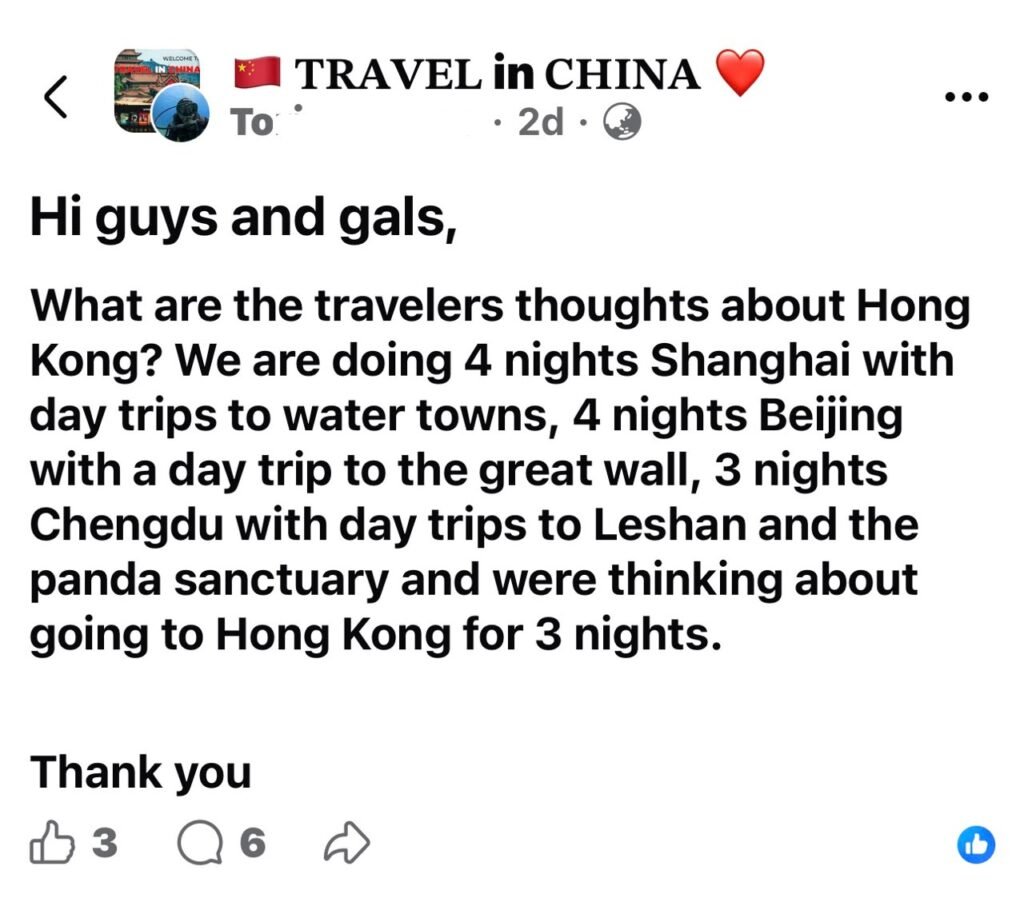
The Traveler’s Question
“Hi guys and gals,
What are the travelers thoughts about Hong Kong? We are doing 4 nights Shanghai with day trips to water towns, 4 nights Beijing with a day trip to the great wall, 3 nights Chengdu with day trips to Leshan and the panda sanctuary and were thinking about going to Hong Kong for 3 nights.
Thank you”

AI Travel Planner Answers
I’d include Hong Kong (香港, Xiānggǎng) — three nights fits this itinerary nicely.
What I like about adding Hong Kong here is that it doesn’t feel like simply adding another Chinese megacity. After Shanghai (上海, Shànghǎi), Beijing (北京, Běijīng) and Chengdu (成都, Chéngdū), Hong Kong gives you a noticeably different final chapter: harbor scenery, Cantonese food, dense street life, mountains and beaches sitting surprisingly close to skyscrapers.
For three nights, I’d keep it simple:
Day 1 — Hong Kong Island + Victoria Harbour
Explore Central and Sheung Wan, take the Star Ferry (天星小轮, Tiānxīng Xiǎolún) across Victoria Harbour, and enjoy the skyline after dark.
Day 2 — Old neighborhoods + food
Spend time around Kowloon rather than only visiting headline attractions. Markets, local restaurants, cha chaan tengs and neighborhood streets are a big part of why Hong Kong is worth visiting.
Day 3 — Choose a different side of Hong Kong
Depending on your interests, do Victoria Peak (太平山, Tàipíng Shān) plus more city exploration, or get away from the urban core for hiking, an outlying island or the coast.
I’d also slightly rethink the rest of the itinerary.
Four nights Shanghai with a water-town day trip: good.
Four nights Beijing with the Great Wall: good.
Three nights Chengdu with both Leshan and the panda base: this is the part that feels tight. The panda base doesn’t really need to be treated as a full day trip from Chengdu, but Leshan (乐山, Lèshān) does consume a substantial part of a day. With only three nights, make sure you leave enough time to experience Chengdu itself—tea houses, neighborhoods and Sichuan food—rather than sleeping there while spending most of your waking hours elsewhere.
So I wouldn’t take the three Hong Kong nights and give them to the mainland cities. Your trip already has enough time in Shanghai and Beijing.
Hong Kong adds something genuinely different.
One practical point: Hong Kong is a separate immigration and travel environment from mainland China, so check the entry requirements for your nationality and make sure your China entry arrangements also work with your complete itinerary if you plan to enter mainland China again afterward.
If this were my first trip, I’d happily finish with three nights in Hong Kong. After Beijing’s imperial history, Shanghai’s modernity and Chengdu’s relaxed Sichuan character, it gives the trip a very different ending.
Ready to Compare Hong Kong Hotels?
Dad & Elaine have personally used Trip.com many times when travelling in China, Hong Kong and elsewhere — for hotels, flights, attractions and tours. We’ve had good experiences with it, so it’s one of the booking platforms we use ourselves.
🏨 Check Hong Kong hotels & current prices on Trip.com →
Affiliate link — ChinaTravelBUG may earn a small commission at no extra cost to you.
Ready to Check Trains from Shanghai to Hong Kong?
Dad & Elaine have personally used Trip.com many times when travelling in China and elsewhere — for trains, hotels, flights, attractions and tours. We’ve had good experiences with it, so it’s one of the booking platforms we use ourselves.
🚆 Check Shanghai → Zhangjiajie train times & fares on Trip.com →
Ready to Check Trains from Beijing to Hong Kong?
High-speed rail (HSR) is Dad & Elaine’s preferred way of travelling between Chinese cities. We’ve taken many HSR journeys during our travels around China and genuinely enjoy the experience — comfortable, convenient, and a great way to see the country as we move from one city to another.
We’ve also personally used Trip.com many times for our travel bookings in China and elsewhere.
🚄 Check Shanghai → Beijing HSR train times & fares on Trip.com →
ChinaTravelBUG Note
The most important sentence in the Planner’s answer is:
“Hong Kong adds something genuinely different.”
That’s why we’d keep it.
If this itinerary already included six or seven mainland destinations, adding Hong Kong might simply create another rushed hotel change.
But this trip has a relatively clear structure:
Shanghai → Beijing → Chengdu → Hong Kong
And each stop gives the traveler a distinctly different experience of China.
Why Hong Kong Isn’t Just “Another Big Chinese City”
Look at what the traveler already has.
Shanghai (上海, Shànghǎi)
Four nights introduce modern urban China, the Bund, historic neighborhoods and the lower Yangtze region through a water-town excursion.
Beijing (北京, Běijīng)
Four nights bring imperial China—the Forbidden City (故宫, Gùgōng), historic neighborhoods and a day at the Great Wall (长城, Chángchéng).
Chengdu (成都, Chéngdū)
Three nights shift the mood completely toward Sichuan food, tea-house culture, pandas and the enormous Leshan Giant Buddha (乐山大佛, Lèshān Dàfó).
Then comes Hong Kong.
And the rhythm changes again.
Hong Kong (香港; Mandarin: Xiānggǎng; Cantonese: Hēunggóng) brings Cantonese culture, Victoria Harbour, vertical cityscapes, historic ferries, dense neighborhood streets—and surprisingly easy access to mountains, islands and coastline.
That’s why we wouldn’t look at Hong Kong merely as:
City number four.
It changes the experience.
Are Three Nights Enough for Hong Kong?
Yes.
Not enough to “see Hong Kong” comprehensively.
But certainly enough to make adding it worthwhile.
For a first visit, we’d resist the temptation to build a checklist of 15 attractions.
Instead, give the three days different personalities.
Day 1: Victoria Harbour and the Classic Hong Kong Skyline
Start around Central (中环, Zhōnghuán) and Sheung Wan (上环, Shànghuán).
Then cross Victoria Harbour (维多利亚港, Wéiduōlìyà Gǎng) rather than simply traveling underneath it.
The Star Ferry (天星小轮, Tiānxīng Xiǎolún) is transportation, but it’s also part of the Hong Kong experience.
Finish around Tsim Sha Tsui (尖沙咀, Jiānshāzuǐ) or somewhere overlooking the harbor after dark.
This gives you the Hong Kong people imagine before they arrive.
Day 2: Neighborhood Hong Kong + Cantonese Food
This is the day we’d deliberately spend less time chasing famous attractions.
Explore parts of Kowloon (九龙, Jiǔlóng).
Walk.
Eat.
Look up.
Hong Kong’s density is part of the experience—the apartment towers, shop signs, markets, tiny restaurants, buses and streets layered on top of one another.
And eat something beyond hotel breakfast and international restaurants.
Look for:
- dim sum
- wonton noodles
- roast meats
- egg tarts
- milk tea
- neighborhood bakeries
- a traditional cha chaan teng (茶餐厅, chàhchāantēng)
Hong Kong’s Cantonese food culture is one of the strongest reasons for keeping these three nights.
Day 3: Discover the Hong Kong Beyond the Skyline
This is the day that can change someone’s impression of Hong Kong.
Many first-time visitors imagine nothing but skyscrapers.
They don’t necessarily expect mountains, hiking trails, beaches, islands and fishing communities to be so close.
You could visit Victoria Peak (太平山, Tàipíng Shān) and continue exploring Hong Kong Island.
Or deliberately leave the dense urban core.
That contrast—
tower blocks → mountain → sea
—is part of what makes Hong Kong unusual.
But There’s One Problem Elsewhere in the Itinerary
We agree with the Planner:
Chengdu is the section we’d watch.
Not because three nights in Chengdu is inherently too short.
It’s because the traveler wants to use those three nights for:
Chengdu + pandas + Leshan.
The Chengdu Research Base of Giant Panda Breeding (成都大熊猫繁育研究基地, Chéngdū Dàxióngmāo Fányù Yánjiū Jīdì) can be incorporated into a Chengdu sightseeing day rather than automatically sacrificing an entire day.
But Leshan (乐山, Lèshān) is a genuine excursion.
So we’d make sure the itinerary doesn’t accidentally become:
Arrive Chengdu → pandas → Leshan → leave Chengdu.
Because then you’ve visited Chengdu without really experiencing Chengdu.
And that would be a shame.
Tea houses, Sichuan food, parks and the city’s relaxed everyday rhythm are part of the reason to go.
Would We Take a Night From Hong Kong and Give It to Chengdu?
Probably not.
If the traveler had only two nights in Chengdu, we’d be more concerned.
With three, careful planning can make it work.
And reducing Hong Kong from three nights to two starts to make Hong Kong feel much more like an add-on.
Three nights gives you enough time to experience:
harbor Hong Kong + neighborhood Hong Kong + another side of Hong Kong.
That’s a much more satisfying introduction.
The Bigger Question: Does Hong Kong Improve This Particular Trip?
This is how we’d decide.
Don’t ask:
“Is Hong Kong worth visiting?”
Of course it can be.
Ask:
“What does Hong Kong add to the trip I already have?”
In this itinerary, quite a lot.
The journey becomes:
Shanghai — modern China and the lower Yangtze.
Beijing — imperial history and political heartland.
Chengdu — Sichuan culture, food and a slower rhythm.
Hong Kong — Cantonese culture, harbor life and a very different historical and urban environment.
That’s a strong first journey.
One Important Immigration Detail
There is a practical distinction travelers need to understand.
Hong Kong is part of China, but it maintains its own immigration controls.
Foreign-passport holders should therefore check the Hong Kong entry rules applicable to their nationality separately. Hong Kong’s Immigration Department says passport holders from about 170 countries or regions can currently visit visa-free subject to the rules applicable to their particular travel documents, while travelers who do not qualify for a waiver need the appropriate visa or entry permit. (Immigration Department Hong Kong)
Hong Kong Immigration Department — Visit and Transit Requirements
There is another consequence that matters if your route looks like:
Mainland China → Hong Kong → Mainland China
Going to Hong Kong means leaving mainland China’s immigration area. Returning to the mainland is therefore another mainland entry, so your passport, visa, visa-free status or other entry arrangement must permit that itinerary.
This is particularly important for travelers relying on a single-entry Chinese visa or a specific transit/visa-free arrangement.
China’s National Immigration Administration currently maintains its own rules for mainland visa-free and transit entry, and these can depend on nationality and itinerary. (National Immigration Administration)
ChinaTravelBUG Verification Note
Last verified: August 14, 2026
Hong Kong and mainland China operate separate immigration controls.
Hong Kong’s Immigration Department states that foreign-passport entry requirements depend on nationality/travel document and that many nationalities currently enjoy visa-free visits for specified periods. (Immigration Department Hong Kong)
Mainland China’s visa-free and transit policies are administered separately by the National Immigration Administration and may depend on nationality, travel document, route and length of stay. (National Immigration Administration)
Travelers planning mainland China → Hong Kong → mainland China should therefore verify that their mainland entry permission allows the second mainland entry rather than assuming the original entry remains valid.
Immigration policies can change. Check the current official requirements for your passport before booking consequential travel arrangements.
About This Traveler Question
This question was adapted from a real traveler discussion shared in a China travel community online.
Personal identifying details have been omitted.
And it’s a deceptively useful question.
On the surface:
“Should we visit Hong Kong?”
But underneath it is one of the most important decisions in itinerary planning:
Is another destination adding something new—or merely adding another hotel?
In this case, we think Hong Kong earns its three nights.
Not because the traveler needs another list of attractions.
Because it changes the journey.

Planning Your Own China Itinerary?
Trying to decide between Hong Kong (香港), another mainland city—or simply slowing your itinerary down?
Tell the ChinaTravelBUG AI Travel Planner your travel dates, destinations and number of nights.
Instead of simply adding more places, it can help you decide which destinations genuinely make your trip better—and which ones you can leave for next time.
Try the FREE ChinaTravelBUG AI Travel Planner.