
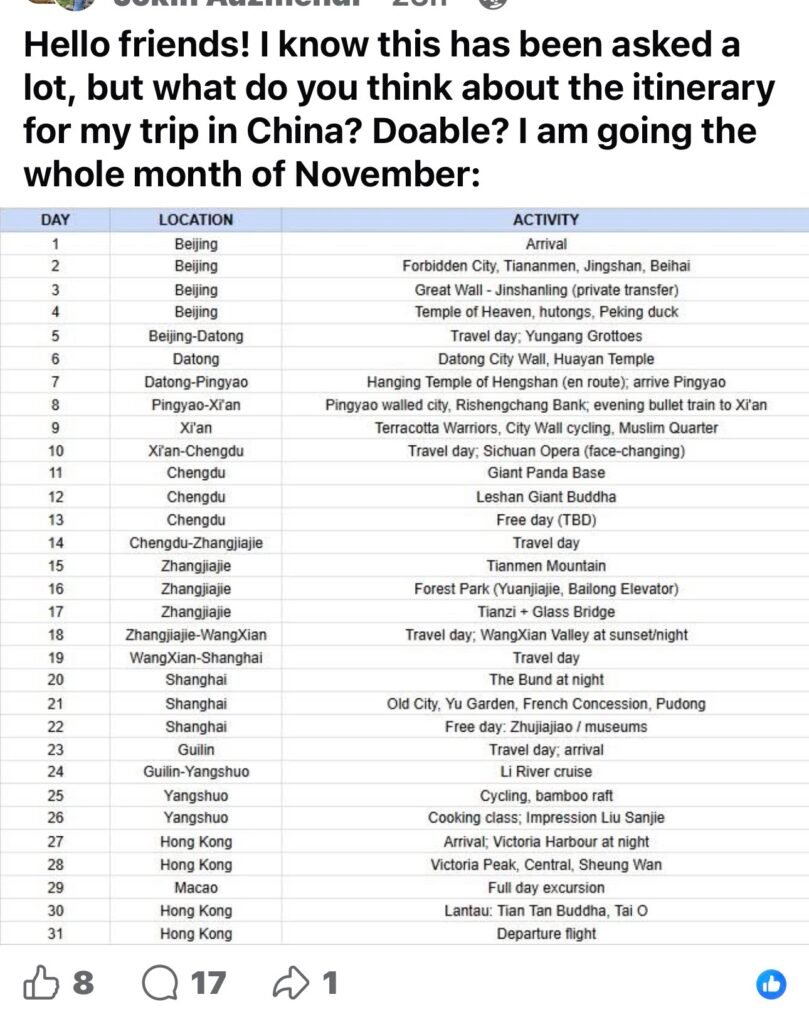
A traveler planning to spend the entire month of November in China asked whether this ambitious 31-day itinerary was actually doable.
The proposed journey runs through Beijing, Datong, Pingyao, Xi’an, Chengdu, Zhangjiajie, Wangxian Valley, Shanghai, Guilin, Yangshuo, Hong Kong and Macao.
On paper, a month sounds like plenty of time. But is this itinerary trying to do too much?
We asked the ChinaTravelBUG AI Travel Planner.

AI Travel Planner Answer
Yes — doable, but I would simplify it. The itinerary is intelligently routed in places, and a full month gives you room, but the middle and second half start to feel like a succession of transfers rather than a month-long journey.
The strongest part is Beijing (北京, Běijīng) → Datong (大同, Dàtóng) → Pingyao (平遥, Píngyáo) → Xi’an (西安, Xī’ān). I’d keep that. It creates a particularly good historical progression: imperial Beijing, Buddhist cave art at Yungang, traditional urban China in Pingyao, then the earlier imperial story in Xi’an. For someone interested in history, that sequence earns its time.
I’d also keep Chengdu (成都, Chéngdū), but I would reconsider the overall pace from Chengdu onward.
The itinerary then goes Zhangjiajie → Wangxian → Shanghai → Guilin/Yangshuo → Hong Kong, with several travel days and hotel changes.
A month sounds enormous when planning from home; in practice, repeated packing, stations, airports and hotel check-ins consume more energy than the spreadsheet suggests.
Travel days really shouldn’t be treated as normal sightseeing days.
A few specific changes stand out
Beijing: Four nights is reasonable, although I’d happily give it five. Day 2 — Forbidden City + Tiananmen + Jingshan + Beihai — is ambitious. I’d rather enjoy three properly than rush four.
Datong/Pingyao: Keep them. They make this itinerary more interesting than the standard first-trip route.
Xi’an: This is too compressed. Terracotta Warriors + City Wall cycling + Muslim Quarter in one day is possible, but Xi’an deserves more than being essentially a one-day stop. I’d add a night.
Chengdu: Good allocation. The free day is valuable; don’t automatically fill it.
Zhangjiajie (张家界, Zhāngjiājiè): Three sightseeing days is sensible.
Wangxian Valley (望仙谷, Wàngxiān Gǔ): This is the first place I’d cut. You’re spending substantial travel time for one evening experience.
Shanghai (上海, Shànghǎi): Three nights works, although Day 21 is again overloaded. The French Concession is much better when you have time to wander rather than treating it as another attraction.
Guilin/Yangshuo: Three nights is worthwhile and gives you a completely different, rural/scenic side of China.
Hong Kong: Good ending, especially if you’re flying home from there.
What I’d do instead
I’d use the Wangxian time — and perhaps one other recovered night — to slow the journey rather than add anything else.
Give Beijing and Xi’an more breathing room, preserve the free day in Chengdu, and don’t be afraid to leave parts of Shanghai or Yangshuo deliberately unplanned.
That still gives you an exceptionally varied trip, but fewer moments where you’re thinking about luggage and the next train.
The bigger idea is that 31 days doesn’t need to mean 31 days of planned experiences.
With a month in China, the luxury is having enough time to notice ordinary China too: breakfast shops, parks in the morning, neighborhoods, tea houses, metro journeys and an evening when you’ve planned absolutely nothing.
Those moments can do as much to help you understand the country as another famous attraction.
So my verdict is:
Good itinerary, about 20% too ambitious. Don’t redesign it — edit it.
The route has excellent bones; removing Wangxian and giving Beijing/Xi’an/Shanghai more breathing room would make it considerably better.
ChinaTravelBUG Takeaway: Don’t Waste the Advantage of Having a Month
This itinerary highlights an easy trap when planning a long China trip.
When you have 31 days, it’s tempting to think:
“Great — I can fit in even more places.”
But the real advantage of having a month isn’t the number of destinations you can collect.
It’s being able to travel through China without constantly rushing.
This traveler already has an unusually interesting route. Datong and Pingyao in particular take it beyond the standard Beijing–Xi’an–Shanghai first-trip itinerary.
We wouldn’t sacrifice that.
Instead, we’d remove the weakest detour and redistribute the time.
The one place we’d cut first: Wangxian Valley
Wangxian Valley (望仙谷, Wàngxiān Gǔ) is visually dramatic, but here it creates another accommodation change and another travel segment between Zhangjiajie and Shanghai.
For this itinerary, the time is more valuable elsewhere.
One additional night in Xi’an, for example, turns the city from a Terracotta Warriors stop into somewhere you can actually begin to experience.
Likewise, another unstructured day in Beijing or Shanghai can be surprisingly valuable after several weeks of traveling.
Is 31 Days in China Enough for This Route?
Yes. The problem isn’t the total number of days. It’s how often you’re moving.
That’s an important distinction.
A month is enough to combine northern China, Sichuan, Zhangjiajie, Shanghai, southern China and Hong Kong.
But every additional destination introduces another cycle:
pack → check out → reach station/airport → travel → reach hotel → check in → unpack
Do that repeatedly and even an efficient Chinese high-speed train journey can consume much of the useful day.
That’s why we’d judge this itinerary by hotel changes and travel days, not simply by counting attractions.
Don’t Turn Every Free Day Into Another Sightseeing Day
The Chengdu free day marked TBD is something we’d actively protect.
After nearly two weeks of traveling, you may discover that what you want most isn’t another attraction.
It might be a long lunch, a tea house, laundry, a neighborhood walk or simply a morning without an alarm.
That’s not wasted travel time.
On a month-long China journey, recovery time is part of good itinerary planning.
And it gives you space for the unexpected — including places you discover only after arriving.
The Bottom Line
This is already a very good one-month China itinerary.
We wouldn’t completely rebuild it.
We’d make three changes:
- Remove Wangxian Valley.
- Give Xi’an at least one additional night.
- Use the remaining recovered time to slow Beijing, Shanghai or another favorite destination rather than adding somewhere new.
Keep the excellent Beijing → Datong → Pingyao → Xi’an historical progression. Keep Chengdu and Zhangjiajie. Keep the contrast of Yangshuo before finishing in Hong Kong.
Then give yourself permission to occasionally do… nothing planned at all.
For a 31-day trip, that may be the change that turns an impressive itinerary into an enjoyable journey.
Further Reading
If you’re still deciding how many destinations belong in a first China trip, see The Perfect First Trip to China Itinerary: Beijing, Xi’an and Beyond (7, 14 & 21 Days China Travel Guide).
Because this particular itinerary depends heavily on trains, our China High-Speed Rail for Foreign Tourists (2026 Guide)also explains the practical side of traveling between Chinese cities.
About This Answer
This article is part of our AI Travel Planner Answers series, based on real questions being asked by travelers planning trips to China.
The original answer above was generated by the ChinaTravelBUG AI Travel Planner. ChinaTravelBUG adds context where useful while preserving the Planner’s recommendation.
Travel information can change. Train schedules, attraction opening arrangements and transport connections should always be checked again before travel.

Planning your own China itinerary? Ask the ChinaTravelBUG AI Travel Planner and work through your trip one decision at a time.