
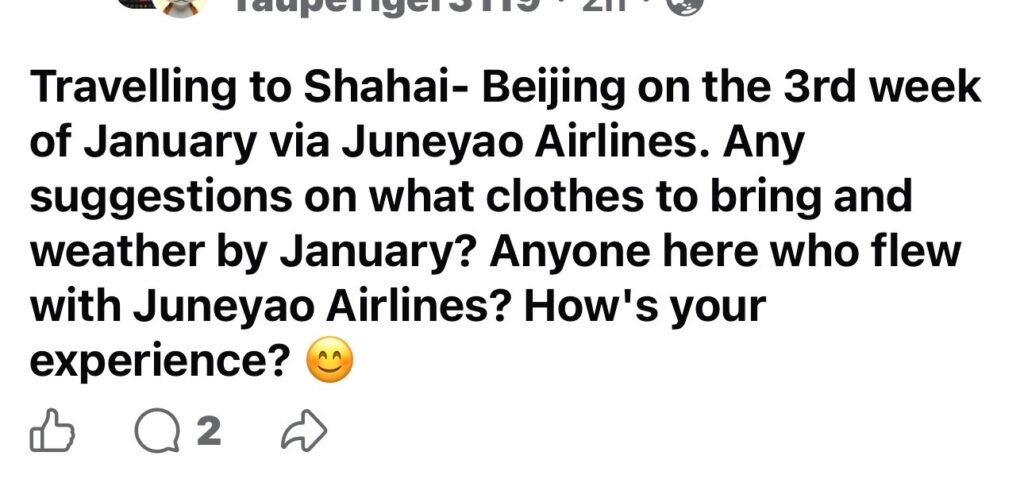
A traveler planning a January trip asked:
“Traveling to Shanghai–Beijing in the third week of January via Juneyao Airlines. Any suggestions on what clothes to bring and the weather in January? Anyone who flew with Juneyao Airlines — how was your experience?”
The most important thing to understand is that Shanghai and Beijing have quite different winter conditions.
Shanghai can feel surprisingly cold because of its dampness and wind. Beijing is generally colder, drier and frequently below freezing, particularly at night.
If the Great Wall is on your itinerary, prepare for an even colder and windier day.

AI Travel Planner Answer
For the third week of January, prepare for proper winter — especially in Beijing (北京, Běijīng).
Shanghai in January: Cold, Damp and Sometimes Windy
Shanghai (上海, Shànghǎi) is firmly in winter by January.
What surprises some international visitors isn’t simply the temperature. It’s the combination of cold, humidity and wind.
This can be particularly noticeable around the Bund (外滩, Wàitān) and the Huangpu River, where an otherwise manageable winter temperature can feel considerably colder when the wind picks up.
I’d pack clothing that can be layered rather than relying on one extremely heavy item.
For Shanghai, useful winter clothing includes:
- Thermal or other comfortable base layers
- Sweater or fleece
- Warm wind-resistant coat
- Long pants
- Warm socks
- Comfortable closed shoes
- Scarf
- Gloves
Layers are useful because you’ll constantly move between outdoor winter conditions and heated or warmer indoor spaces such as malls, restaurants, museums and the metro.
Beijing Is Colder
Don’t make the mistake of packing for Shanghai and assuming the same conditions will apply throughout the trip.
Beijing is significantly colder in January.
The winter climate is generally cold, dry and often windy, and temperatures can fall well below freezing.
That means I’d bring a proper winter coat for the Beijing portion of the trip rather than relying only on a light jacket plus sweater.
A useful packing combination is:
Thermal base layer → sweater/fleece → insulated winter coat
Then add gloves, scarf and a warm hat when necessary.
The advantage of layering is that you can remove clothing once you’re inside heated buildings.
Visiting the Great Wall in January
If you’re visiting the Great Wall (长城, Chángchéng), prepare for what could be the coldest-feeling day of your trip.
Sections such as Mutianyu (慕田峪, Mùtiányù) are in exposed mountain terrain.
Wind can make a major difference.
For the Great Wall, I’d bring:
- Thermal base layers
- Warm sweater or fleece
- Insulated wind-resistant coat
- Gloves
- Scarf
- Beanie or another warm hat
- Warm socks
- Shoes with good grip
Covering your hands, neck and ears can make a surprisingly large difference to how comfortable you feel.
And remember that the Great Wall involves stone steps, slopes and uneven surfaces. Comfortable footwear matters just as much as staying warm.
Shanghai vs Beijing: Pack for Beijing
The simplest way to think about your trip is:
Shanghai → cold + damp + potentially windy
Beijing → colder + dry + often below freezing
Great Wall → potentially the coldest and windiest part of the journey
If you’re trying to decide how warm a coat to bring, pack for Beijing rather than Shanghai.
You can always remove layers in Shanghai.
It’s much harder to compensate for inadequate winter clothing while standing on the Great Wall in January.
What About Juneyao Airlines?
Juneyao Air (吉祥航空, Jíxiáng Hángkōng) is an established Shanghai-based Chinese airline.
Rather than judging the airline from a few individual traveler experiences, I’d pay particular attention to the conditions attached to your specific ticket.
Check:
- Checked baggage allowance
- Cabin baggage allowance
- Seat-selection rules
- Whether meals are included
- Change/cancellation conditions
- Airport and terminal information
- Transit arrangements if your itinerary includes a connection
These details can vary according to the route and fare you’ve purchased.
If you’re carrying bulky winter clothing, the baggage allowance is particularly worth checking before packing.
Ready to Check Shanghai Hotels?
Dad & Elaine have personally used Trip.com many times when travelling in China and elsewhere — for hotels, flights, attractions and tours. We’ve had good experiences with it, so it’s one of the booking platforms we use ourselves.
🏨 Check Shanghai hotels & current prices on Trip.com →
Affiliate link — ChinaTravelBUG may earn a small commission at no extra cost to you.
Looking for Else Where Hotels in China?
Dad & Elaine have personally used Trip.com many times when travelling across China and elsewhere — for hotels, flights, attractions and tours. We’ve had good experiences with it, so it’s one of the booking platforms we use ourselves.
🏨 Check hotels & current prices across China on Trip.com →
One More January Consideration: Spring Festival
There is another issue that can matter much more than the weather.
Chinese New Year / Spring Festival (春节, Chūnjié) moves each year.
The weeks around Spring Festival create one of the world’s largest annual travel movements, commonly known as Chunyun (春运).
If your January dates fall close to that period, domestic flights and trains can become significantly busier.
So don’t simply assume that “January is low season.”
Check the Spring Festival calendar for the specific year you’re traveling, and book important intercity transportation accordingly.
A note about this AI Travel Planner answer: This answer is shown as originally generated, without editorial rewriting. Travel information can change, especially transport schedules, border procedures, opening hours, ticketing rules and holiday arrangements. Before making bookings or travel decisions, always verify time-sensitive details with current official sources.
ChinaTravelBUG Practical Tip
Check the actual weather forecast again shortly before departure.
Historical climate patterns are useful for deciding what kind of clothing you’ll probably need, but they can’t tell you whether your particular Great Wall day will be relatively calm or bitterly windy.
I’d therefore pack enough winter clothing to handle a genuinely cold Beijing day, while using layers to avoid overheating indoors.
And don’t overlook simple items such as gloves and a scarf. They’re small enough to carry in your day bag but can completely change how enjoyable an outdoor January sightseeing day feels.
Related Traveler Questions
If Beijing forms a major part of your trip, these ChinaTravelBUG guides may also help with planning:
What Is the Best Time of Year to Visit Beijing?
This compares Beijing across the seasons and helps explain what a winter visit means in practical terms.
How Many Days Do You Really Need in Beijing?
Useful when deciding how much time to give Beijing rather than squeezing the Great Wall, Forbidden City and other major sights into an overly rushed itinerary.
Verification Note — August 16, 2026
Seasonal weather descriptions in this article are intended as planning guidance rather than a forecast for a specific January travel date.
Actual temperatures, wind, precipitation and Great Wall conditions can vary substantially from day to day. Travelers should check the current forecast shortly before departure and again before outdoor excursions such as the Great Wall.
Airline schedules, baggage allowances, fare conditions, onboard services and airport arrangements can also change. Travelers flying Juneyao Air should verify the conditions attached to their specific booking directly with the airline before departure.
Spring Festival and the associated Chunyun travel period also occur on different dates each year, so travelers should verify the official holiday calendar for their particular year of travel.

Ask the ChinaTravelBUG AI Travel Planner
Not sure how many days to divide between Shanghai and Beijing, whether to travel by high-speed rail or air, or how to fit the Great Wall into a winter itinerary?
Ask the ChinaTravelBUG AI Travel Planner.
Tell it your exact dates, number of days, arrival and departure cities and who you’re traveling with, and it can help you build a realistic first-trip itinerary.
This article is part of ChinaTravelBUG’s AI Travel Planner Answers series, based on real questions asked by travelers planning trips to China. The original traveler question has been anonymized where appropriate. AI-assisted answers are editorially reviewed and supplemented with practical context before publication.