
ChinaTravelBUG AI Travel Planner Answers
A traveler has planned an ambitious China journey covering Guangzhou (广州, Guǎngzhōu), Guilin (桂林, Guìlín), Yangshuo (阳朔, Yángshuò), the Longji Rice Terraces (龙脊梯田, Lóngjǐ Tītián), Zhangjiajie (张家界, Zhāngjiājiè), Shanghai (上海, Shànghǎi) and Beijing (北京, Běijīng) — all between October 12 and October 25.
On paper, almost every individual day works.
But that’s not necessarily the right question.
The more useful question is: will this itinerary leave enough time and energy to actually experience China, rather than simply moving through it?
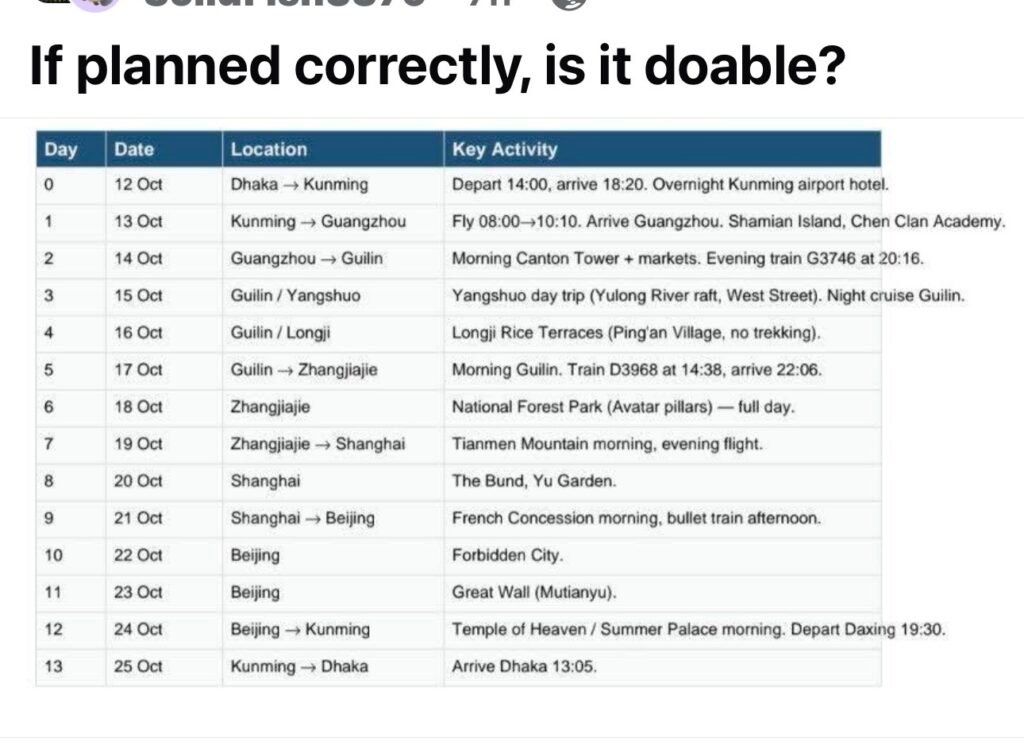
The Traveler’s Question
If planned correctly, is it doable?
12 Oct: Dhaka → Kunming. Arrive 18:20. Overnight near Kunming Airport.
13 Oct: Kunming → Guangzhou. Fly 08:00–10:10. Shamian Island, Chen Clan Academy.
14 Oct: Guangzhou → Guilin. Canton Tower + markets. Evening train.
15 Oct: Guilin/Yangshuo. Yulong River raft, West Street, Guilin night cruise.
16 Oct: Longji Rice Terraces and Ping’an Village.
17 Oct: Guilin → Zhangjiajie. Train 14:38–22:06.
18 Oct: Zhangjiajie National Forest Park.
19 Oct: Tianmen Mountain, then evening flight to Shanghai.
20 Oct: Shanghai — Bund and Yu Garden.
21 Oct: French Concession, then afternoon high-speed train to Beijing.
22 Oct: Forbidden City.
23 Oct: Mutianyu Great Wall.
24 Oct: Temple of Heaven / Summer Palace, then 19:30 flight from Beijing Daxing.
25 Oct: Kunming → Dhaka.

AI Travel Planner Answer
Yes — technically this itinerary is doable, but I would not recommend it exactly as written. The problem isn’t any single day; it’s the accumulation of transfers. You have roughly 12 sightseeing days but move through Kunming → Guangzhou → Guilin/Yangshuo → Zhangjiajie → Shanghai → Beijing → Kunming. That gives you very little recovery time. For a first China trip, travel days tend to consume more energy than they appear to on a spreadsheet.
Where I See the Pressure Points
- Guangzhou: Arriving on 13 Oct and leaving the following evening is possible. Shamian Island + Chen Clan Academy on arrival day is reasonable if the flight is punctual. Canton Tower + markets before an evening train also works.
- Guilin/Yangshuo: This is where I’d change things. Yangshuo on the 15th, Longji on the 16th, then Zhangjiajie on the 17th means three substantial days in succession, including considerable road travel.
- Zhangjiajie: One full day in the National Forest Park followed by Tianmen Mountain and an evening flight is possible, but tiring. Weather can also affect how rewarding such a tightly scheduled nature stop feels.
- Shanghai: This is too compressed. You effectively have one full day plus a morning. Bund + Yu Garden works, but Shanghai deserves time for its neighborhoods and everyday urban life, not merely its landmarks.
- Beijing: Two full days plus part of the 24th is the biggest compromise. Forbidden City one day and Mutianyu the next is sensible, but putting Temple of Heaven and Summer Palace together before a 19:30 Daxing departure is not something I’d choose. Beijing really rewards 4–5 full days.
What I Would Change
If these international flights through Kunming are fixed, I’d remove one destination rather than try to optimize every transfer.
My first candidate would actually be Shanghai. That gives you breathing room for Guilin/Zhangjiajie and, most importantly, another 1–2 days in Beijing. You already have Guangzhou for a major modern Chinese city, while Guilin and Zhangjiajie provide the spectacular landscapes that seem to be an important reason for this particular trip.
So I’d aim for something closer to:
Kunming → Guangzhou (2 nights) → Guilin/Yangshuo (3 nights) → Zhangjiajie (2–3 nights) → Beijing (3–4 nights) → Kunming
That is still an energetic trip, but it changes the feeling from “Can we physically accomplish this?” to “Can we actually enjoy this?”
One particularly important principle for this itinerary: don’t count a long transfer day as a sightseeing day. That’s one of the easiest ways a China itinerary that looks fine on paper becomes exhausting in practice.
Further Reading
Useful for comparing this fast itinerary with a more comfortable first-trip pace.
China High Speed Rail for Foreign Tourists 2026 Guide
Useful because several of your tightest days depend on getting rail transfers right.
If you tell me how many travelers there are and roughly their ages/energy level, I can tell you whether I’d remove Shanghai, Guangzhou, or Longji — because that choice changes depending on who is traveling.
A note about this AI Travel Planner answer: This answer is shown as originally generated, without editorial rewriting. Travel information can change, especially transport schedules, border procedures, opening hours, ticketing rules and holiday arrangements. Before making bookings or travel decisions, always verify time-sensitive details with current official sources.
ChinaTravelBUG Planning Note: Doable Is Not the Same as Enjoyable
This itinerary illustrates one of the biggest traps in planning a first trip to China.
A spreadsheet can make a transfer look deceptively simple:
Morning sightseeing → train → arrive → hotel → sightseeing tomorrow.
But a transfer involves more than the scheduled train or flight time.
You need to check out, reach the station or airport, navigate security, find the correct departure area, travel, arrive in an unfamiliar city, reach the next hotel and check in again.
Repeat that every couple of days and the itinerary begins to feel very different.
The traveler isn’t attempting an impossible trip.
They’re attempting a trip with almost no margin for disruption, tiredness or simply wanting to stay somewhere longer.
The Guilin–Yangshuo–Longji Section Is Particularly Intense
The itinerary currently gives three consecutive days to:
Yangshuo → Longji → transfer toward Zhangjiajie.
These destinations look geographically connected on a China map, but the actual travel experience involves substantial ground transportation.
Yangshuo deserves time for its karst landscape, countryside and the Yulong River (遇龙河, Yùlóng Hé).
The Longji Rice Terraces are another excursion altogether.
Trying to experience both immediately before a long journey to Zhangjiajie turns what should be one of the most scenic portions of the trip into one of its most tiring.
If something needs to disappear, Longji is therefore another reasonable candidate.
That would preserve Shanghai while creating a recovery day around Guilin or Yangshuo.
Zhangjiajie Needs Some Weather Flexibility
The proposed Zhangjiajie schedule is:
Day 1 — Zhangjiajie National Forest Park
Day 2 — Tianmen Mountain + evening flight
It works.
But it leaves very little flexibility.
Zhangjiajie’s landscapes are strongly affected by mountain weather. Mist can create spectacular scenery, but poor visibility can also obscure the views travelers have crossed China to see.
With only one day allocated to the National Forest Park and Tianmen Mountain locked into the departure day, there isn’t much opportunity to swap days around.
If landscapes are one of the main priorities of the entire China trip, giving Zhangjiajie 2–3 nights makes considerably more sense.
Ready to Check Zhangjiajie Hotels?
Dad & Elaine have personally used Trip.com many times when travelling in China and elsewhere — for hotels, flights, attractions and tours. We’ve had good experiences with it, so it’s one of the booking platforms we use ourselves.
🏨 Check Zhangjiajie hotels & current prices on Trip.com →
Is Shanghai Really the Destination to Remove?
Not necessarily.
Removing Shanghai is the cleanest solution if the traveler’s priorities are Beijing plus China’s spectacular landscapes.
But there’s another argument.
Shanghai provides something Guilin, Yangshuo and Zhangjiajie cannot: an introduction to the scale, energy and modernity of one of China’s great global cities.
So there are really three possible cuts.
Option 1: Remove Shanghai
Best for travelers prioritizing landscapes, nature and Beijing’s historical sights.
Use the recovered time for Zhangjiajie and Beijing.
Option 2: Remove Longji
Best for travelers who want to preserve Shanghai’s big-city contrast while reducing one substantial road excursion.
Yangshuo already gives the trip a major southern-China landscape experience.
Option 3: Reduce Guangzhou
This can work if flight and transport logistics allow it.
However, because the traveler is arriving from Kunming and Guangzhou forms part of the south-China progression, removing it may not produce as much useful time as it initially appears.
The correct cut therefore depends on what the traveler most wants to experience — not simply which destination receives the fewest nights.
Beijing Is Where I Would Add Time
The current Beijing plan is:
22 October — Forbidden City
23 October — Mutianyu Great Wall
24 October — Temple of Heaven / Summer Palace → Daxing Airport
The first two days are sensible.
The third is where the itinerary becomes unnecessarily ambitious.
The Temple of Heaven (天坛, Tiāntán) lies south of central Beijing.
The Summer Palace (颐和园, Yíhéyuán) is far to the northwest.
And Beijing Daxing International Airport (北京大兴国际机场, Běijīng Dàxīng Guójì Jīchǎng) is well south of the city.
Trying to combine both major attractions before a 19:30 flight creates exactly the kind of last-day pressure that travelers don’t need.
Pick one, preferably based on what the earlier Beijing days already include.
Better still, recover another day elsewhere in the itinerary and give Beijing some breathing room.
Ready to Compare Beijing Hotels?
Dad & Elaine have personally used Trip.com many times when travelling in China and elsewhere — for hotels, flights, attractions and tours. We’ve had good experiences with it, so it’s one of the booking platforms we use ourselves.
🏨 Check Beijing hotels & current prices on Trip.com →
Affiliate link — ChinaTravelBUG may earn a small commission at no extra cost to you.
A Better Way to Think About the Trip
Instead of asking:
How many places can we fit into 13 days?
Ask:
Which different sides of China do we most want these 13 days to show us?
For example:
Guangzhou — southern Chinese urban life and Cantonese culture
Guilin/Yangshuo — karst landscapes and countryside
Zhangjiajie — dramatic mountain scenery
Shanghai — modern global China
Beijing — imperial history, political center and the Great Wall
That’s an excellent collection of experiences.
The problem is simply trying to experience all five properly within this amount of time.
Related Traveler Questions
A useful starting point is The Perfect First Trip to China Itinerary: Beijing, Xi’an and Beyond — 7, 14 & 21 Days China Travel Guide, which shows how the number of destinations should change as the amount of available time increases.
Because this itinerary also depends heavily on long-distance rail, China High Speed Rail for Foreign Tourists 2026 Guide explains the practical side of moving between Chinese cities.
The important lesson isn’t that fast travel through China is inherently wrong. Some travelers genuinely enjoy an energetic pace.
It’s that the pace should be chosen deliberately, rather than discovered halfway through the trip when every second day has become another checkout and transfer.
Verification Note – 16 August 2026
Train and flight schedules can change, and long-distance transport should be checked again when tickets become available.
Attractions including the Forbidden City and major Zhangjiajie scenic areas can also have reservation, ticketing and entry requirements. Travelers should verify current arrangements before finalizing tightly connected transport and sightseeing plans.
For an itinerary with little spare time, building some margin around major transfers is particularly important.
About This Answer
This article is based on a real traveler itinerary submitted to the ChinaTravelBUG AI Travel Planner.
The original planning answer is preserved above. ChinaTravelBUG has added editorial context to explain why an itinerary can be technically possible while still being unnecessarily rushed.
The goal isn’t to visit fewer places for its own sake.
It’s to make sure the places you do visit have enough time to become experiences rather than entries on a spreadsheet.

Planning Your Own China Itinerary?
If you’re staring at a spreadsheet wondering whether you’ve put too much into your first China trip, give the ChinaTravelBUG AI Travel Planner your dates, cities and proposed route.
It can help you identify the pressure points, decide what is worth keeping and build a more realistic journey — one decision at a time.
See China. Understand It Better.
Looking for Hotels Elsewhere in China?
Dad & Elaine have personally used Trip.com many times when travelling across China and elsewhere — for hotels, flights, attractions and tours. We’ve had good experiences with it, so it’s one of the booking platforms we use ourselves.
🏨 Check hotels & current prices across China on Trip.com →
Affiliate link — ChinaTravelBUG may earn a small commission at no extra cost to you.