
ChinaTravelBUG AI Travel Planner Answers
A traveler with a U.S. passport wants to spend several days in Guangzhou (广州, Guǎngzhōu) without obtaining a Chinese visa, then travel by high-speed rail to Hong Kong and fly back to Singapore on the same day.
The proposed route is:
Singapore → Guangzhou → Hong Kong → Singapore
The key questions are whether Hong Kong qualifies as the required onward destination and whether the traveler must spend a night there.
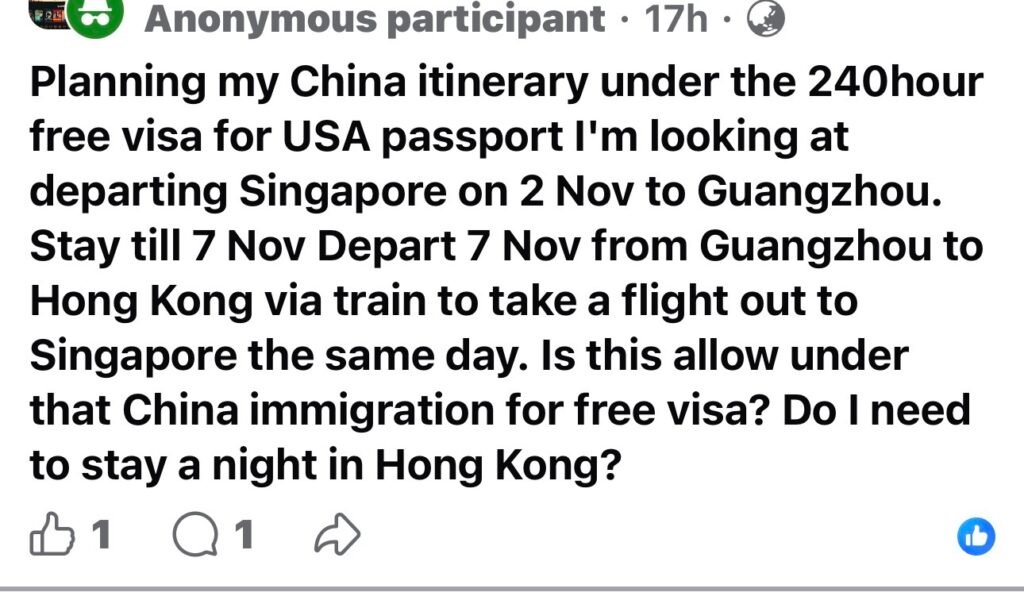
The Traveler’s Question
Planning my China itinerary under the 240-hour free visa for a USA passport.
I’m looking at departing Singapore on 2 Nov to Guangzhou. Stay till 7 Nov. Depart 7 Nov from Guangzhou to Hong Kong via train to take a flight out to Singapore the same day.
Is this allowed under China immigration for free visa? Do I need to stay a night in Hong Kong?

AI Travel Planner Answer
Yes — this itinerary appears to fit China’s 240-hour visa-free transit rules, provided the traveler has a confirmed onward ticket and uses an eligible exit port.
For a U.S. passport holder, the important sequence is:
Singapore → Guangzhou (Mainland China) → Hong Kong → Singapore
Hong Kong counts as a third country/region for the purpose of China’s transit-without-visa policy. The U.S. is one of the 55 eligible nationalities, and the National Immigration Administration requires onward travel from Mainland China to a third country or region within the permitted 240-hour period. (National Immigration Administration)
There is also no requirement to spend a night in Hong Kong. They can arrive in Hong Kong by train on November 7 and fly to Singapore later that same day. What matters for the Mainland China immigration requirement is the qualifying transit itinerary and confirmed onward arrangements—not an overnight stay in Hong Kong.
One detail is particularly important: the exact Guangzhou–Hong Kong train/exit arrangement should be confirmed before booking. West Kowloon Station on the Guangzhou–Shenzhen–Hong Kong Express Rail Link is now among the designated ports covered by the 240-hour policy. (National Immigration Administration)
I would therefore advise the traveler to have the Guangzhou → Hong Kong train booking and Hong Kong → Singapore flight confirmation available when checking in for the Singapore → Guangzhou flight and when applying for the 240-hour transit entry.
Further Reading
China Visa and Entry Requirements: A Simple 2026 Guide
Useful for understanding the broader entry requirements before finalizing the trip.
A note about this AI Travel Planner answer: This answer is shown as originally generated, without editorial rewriting. Travel information can change, especially transport schedules, border procedures, opening hours, ticketing rules and holiday arrangements. Before making bookings or travel decisions, always verify time-sensitive details with current official sources.
ChinaTravelBUG Planning Note: The Route Order Is What Matters
The term “240-hour visa-free transit” sometimes causes confusion because travelers understandably focus on the 240 hours.
But the more important concept is transit.
The traveler must be traveling through Mainland China between two different countries or regions.
In this case:
A: Singapore 🇸🇬
↓
B: Mainland China 🇨🇳 — Guangzhou
↓
C: Hong Kong 🇭🇰
That creates the required A → Mainland China → C structure.
Returning from Hong Kong to Singapore afterward does not change the fact that the traveler has already exited Mainland China for Hong Kong.
By contrast, something such as:
Singapore → Guangzhou → Singapore
would not satisfy the third-country/region transit structure merely because the traveler spent fewer than 240 hours in Guangzhou.
The official National Immigration Administration rules state that eligible travelers must have onward arrangements to a third country or region, and the United States remains among the eligible nationalities. (National Immigration Administration)
Does Hong Kong Count?
Yes.
For China’s visa-free transit framework, Hong Kong is treated as a separate region for the onward-transit requirement.
This is particularly useful for travelers visiting Guangdong because Hong Kong can form a natural endpoint to a southern China itinerary.
So a journey such as:
Singapore → Guangzhou → Hong Kong
can qualify where all the other conditions are satisfied.
Do You Need to Stay Overnight in Hong Kong?
No.
There is no rule requiring the traveler to spend 24 hours, one night, or any other minimum amount of time in Hong Kong after leaving Mainland China.
So this can work:
Morning: Guangzhou → Hong Kong West Kowloon
Later that day: Hong Kong → Singapore
The immigration significance is that the traveler has left Mainland China for the qualifying third country/region.
Whether the traveler spends six hours, one night or several days in Hong Kong is a separate travel-planning decision.
But Don’t Make the Hong Kong Connection Too Tight
Legally possible and logistically sensible are two different questions.
I would leave a generous buffer between the train arrival at Hong Kong West Kowloon (香港西九龙站, Xiānggǎng Xī Jiǔlóng Zhàn) and the flight from Hong Kong International Airport.
You will need to complete the rail journey and border procedures, get from West Kowloon to the airport, check in and clear airport security and departure formalities.
This is not a connection I’d deliberately make tight simply to save a few hours.
If the Hong Kong → Singapore flight is early in the day, staying overnight in Hong Kong could be the safer logistical choice — but that’s about protecting the flight connection, not satisfying China’s visa-free transit requirement.
One Important Date Detail
The screenshot says the traveler intends to enter Guangzhou on November 2.
Under the current rules, the 240-hour stay is calculated from 00:00 on the day following entry, rather than simply starting the stopwatch at the exact moment the aircraft lands. The traveler must still comply with the temporary-entry permission actually granted by immigration. (National Immigration Administration)
A November 2 arrival followed by a November 7 departure is therefore comfortably within the general 240-hour window, assuming all other eligibility requirements are met.
Keep the Evidence of the Whole Journey
For this type of trip, I would travel with easy access to:
- U.S. passport with sufficient validity
- Singapore → Guangzhou flight confirmation
- Guangzhou accommodation details
- Guangzhou → Hong Kong confirmed train booking
- Hong Kong → Singapore confirmed flight
- Any evidence required to show eligibility to enter the onward destination
The current NIA conditions require an eligible traveler to hold a valid international travel document and confirmed onward arrangements to a third country/region within 240 hours. (National Immigration Administration)
This is particularly important at the first flight check-in counter in Singapore. Airline staff need to be satisfied that the traveler can enter China under the intended immigration arrangement.
Related Traveler Questions
For travelers trying to understand the difference between an ordinary Chinese visa, visa exemption and transit-without-visa arrangements, China Visa and Entry Requirements: A Simple 2026 Guide is a useful starting point.
And once the immigration question is settled, don’t overlook the practical preparation. Payment and internet access are two of the biggest differences first-time international visitors encounter in Mainland China, so setting up Alipay/WeChat Pay and mobile data before departure can make the Guangzhou portion considerably easier.
Verification Note – 16 August 2026
Visa and immigration rules are consequential and can change.
This answer has therefore been checked against current information published by China’s National Immigration Administration (NIA). As of the current policy, U.S. citizens are among the eligible nationalities for the 240-hour visa-free transit scheme, and qualifying travelers must have onward arrangements to a third country or region. (National Immigration Administration)
Final admission and temporary-entry permission remain subject to Chinese immigration authorities.
For a route involving a specific train and border crossing, it is sensible to confirm the itinerary shortly before travel through the National Immigration Administration’s 12367 immigration service rather than relying solely on older travel blogs or social-media reports. The NIA itself directs travelers to 12367 for further consultation on the policy. (National Immigration Administration)
About This Answer
This article is based on a real traveler question submitted to the ChinaTravelBUG AI Travel Planner.
The original planning answer is preserved above, with additional editorial context and current official-source verification added by ChinaTravelBUG.
Immigration policies can change, so travelers should always verify consequential entry requirements before departure.

Planning Your Own China Trip?
Not sure whether your route qualifies for visa-free transit — or whether your itinerary actually makes sense once you enter China?
Give your passport nationality, entry city, onward destination and travel dates to the ChinaTravelBUG AI Travel Planner.
It can help you work through the route one decision at a time.
See China. Understand It Better.