Getting around China is often much easier than first-time visitors expect.
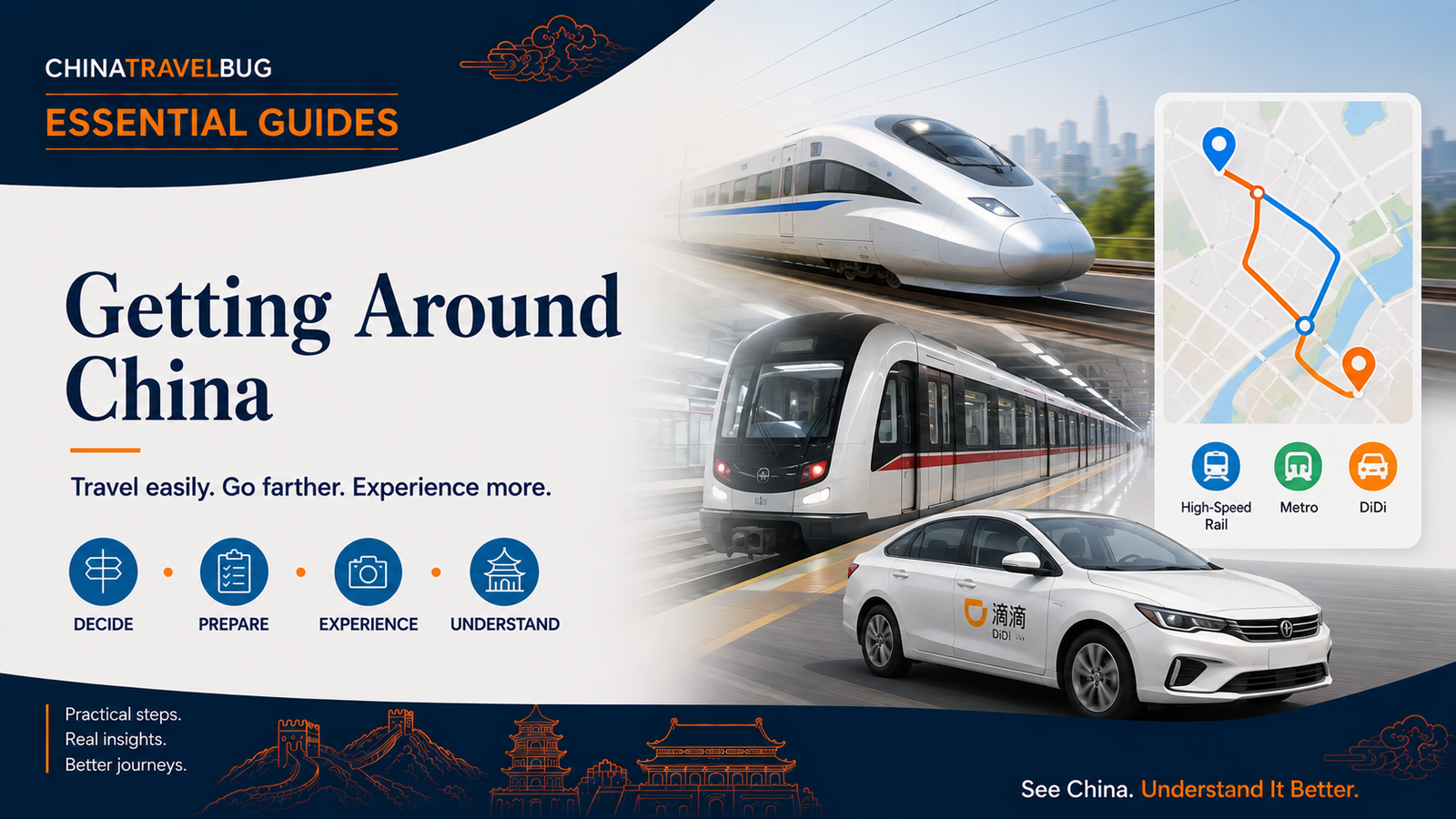
China’s high-speed rail network connects many major destinations, big cities have extensive metro systems, DiDi makes door-to-door travel easier, and domestic flights handle the country’s enormous distances.
For most first-time travelers, the simplest strategy is:
High-speed rail between well-connected cities, flights for very long distances, metro within major cities, and DiDi or taxis when door-to-door convenience matters.
You don’t need to master every transportation system in China.
You just need to know which one to use when.
Quick Answer: What’s the Best Way to Get Around China?
| Transport | Best for | Main advantage |
|---|---|---|
| High-speed rail 高铁 (gāotiě) | Intercity travel | Fast, comfortable and convenient |
| Domestic flights | Very long distances | Saves time across a huge country |
| Metro 地铁 (dìtiě) | Major cities | Efficient and inexpensive |
| DiDi 滴滴 (Dīdī) | Door-to-door travel | Destination entered digitally |
| Taxi 出租车 (chūzūchē) | Point-to-point trips | Useful alternative to ride-hailing |
| Private vehicle | Families, groups, remote sights | Convenience and flexibility |
| Walking | Neighborhoods | Best way to experience street-level China |
The ChinaTravelBUG transport formula
Think of transportation in three layers:
Between cities → Train or plane
Across cities → Metro
Door to door → DiDi, taxi or private vehicle
That simple framework handles most first China trips.
Is China’s High-Speed Rail Easy for Foreign Tourists?
Yes. China’s high-speed rail — 高铁 (gāotiě) — is one of the easiest ways for foreign travelers to move between many major Chinese cities.
China Railway uses real-name ticketing, and foreign passengers can use valid passports for railway bookings under the applicable identity-verification procedures.
For many first-time visitors, high-speed rail becomes part of the China experience itself.
The basic process is straightforward:
Book → check exact station → arrive with time → enter/security → find gate → board → keep passport accessible
For the detailed process, seat classes and booking information, read China High-Speed Rail for Foreign Tourists: 2026 Guide.
We also have a simpler step-by-step guide: How to Use China’s High-Speed Rail.
Which Train Class Should You Choose?
| Class | Best for |
|---|---|
| Second Class 二等座 (èrděngzuò) | Most travelers; good balance of price and comfort |
| First Class 一等座 (yīděngzuò) | More space and comfort |
| Business Class 商务座 (shāngwùzuò) | Premium travel at a much higher price |
For most tourists, Second Class is perfectly suitable.
The Railway Station Rule Every First-Timer Should Know
Chinese cities can have multiple major railway stations.
A city name alone is not enough.
You may see:
北 (běi) — North
南 (nán) — South
东 (dōng) — East
西 (xī) — West
These can represent completely different stations located far apart.
Before every train journey, check:
Exact station + train number + departure time
And allow a comfortable buffer at large unfamiliar stations.
This one habit prevents one of the easiest first-trip transport mistakes.
Can China High-Speed Train Tickets Sell Out?
Yes. Popular trains and desirable departure times can sell out, particularly during busy travel periods and major Chinese holidays.
How much this matters depends on the route, date, departure time and flexibility of your itinerary.
If missing a particular train would seriously disrupt your trip, treat that journey as an important booking.
For a real traveler example, see Do Shanghai–Nanjing Train Tickets Sell Out? How Early Should You Book? — AI Travel Planner Answers.
Major holiday periods deserve additional care. See Can You Get China High-Speed Train Tickets During Golden Week? — AI Travel Planner Answers.
Should You Take a Train or Fly in China?
The answer depends on door-to-door travel time, not just the timetable.
A two-hour flight is not necessarily two hours faster than a four-hour train.
Compare the whole journey.
| Consideration | High-Speed Rail | Flight |
|---|---|---|
| Short/medium distance | Often best | Sometimes |
| Very long distance | Sometimes | Often best |
| City access | Often convenient | Airports may be farther away |
| Pre-departure process | Usually simpler | More airport procedures |
| Luggage | Often convenient | Airline baggage rules apply |
| Ground-level experience | Yes | No |
A good China itinerary often uses trains within regional clusters and flights for major geographic jumps.
Don’t use a rigid “always fly over X hours” rule.
Compare:
hotel → hotel
Is China’s Metro Easy for Foreign Visitors?
Generally, yes. Metro systems are one of the most useful ways to get around China’s major cities.
You’ll commonly see:
地铁 (dìtiě) — metro/subway
Metro systems are particularly useful because they are:
- inexpensive;
- extensive;
- predictable;
- unaffected by most road congestion;
- and connected to many major attractions.
Payment and ticketing methods vary by city. Options may include single-journey tickets, transit cards, mobile-payment methods and, in some systems, direct bank-card payment.
For example, Beijing’s current official guidance supports contactless subway payment with several major international card networks.
But don’t assume what works in Beijing works identically everywhere else.
Local systems vary.
Metro or DiDi: Which Is Better?
Usually, use both.
| Situation | Start with |
|---|---|
| Crossing a congested city | Metro |
| Attraction beside a station | Metro |
| Solo traveler on a budget | Metro |
| Door-to-door journey | DiDi |
| Heavy luggage | DiDi |
| Family/group | Compare DiDi with metro |
| Older/tired traveler | DiDi may be easier |
| Destination far from metro | DiDi |
This is especially useful in huge cities such as Beijing and Shanghai.
A metro may be faster during heavy traffic.
A DiDi may be far easier after you’ve spent eight hours walking.
Use the system that improves the day.
Can Foreign Tourists Use DiDi in China?
Yes. DiDi 滴滴 (Dīdī) is extremely useful for foreign visitors.
Its biggest advantage is simple:
You enter the destination digitally.
That reduces the need to explain a Chinese address verbally to a driver.
DiDi is particularly useful for:
- hotels;
- railway stations;
- restaurants;
- attractions away from metro stations;
- travelers with luggage;
- families;
- groups;
- and evening journeys.
Traditional taxis — 出租车 (chūzūchē) — remain useful too.
Whichever you use, save your hotel’s Chinese name and address.
That’s one of the simplest China travel backups you can have.
What Is the Best Transport for Families and Groups?
Families and groups should optimize for total convenience, not just the cheapest fare.
Six travelers with six suitcases are a very different transportation problem from six travelers carrying day bags.
| Situation | Consider first |
|---|---|
| Airport → hotel with luggage | Larger vehicle / multiple vehicles |
| Intercity journey | High-speed rail |
| Attraction beside metro | Metro |
| Children tired after sightseeing | DiDi/taxi |
| Heavy cross-city traffic | Metro |
| Remote attraction | Driver/private transfer |
| Older traveler + difficult transfers | Door-to-door vehicle |
| Large group + luggage | Check vehicle capacity carefully |
Count:
people + luggage
not just seats.
And remember that hotel location is part of transportation planning. A well-located hotel near a useful metro line can save hours over several days.
How Much Time Does Changing Cities Really Take?
More than the scheduled train or flight time.
A three-hour train journey may actually be:
check out → reach station → enter/wait → 3-hour train → exit → reach hotel → check in
That can consume a substantial part of the day.
This is why fast trains should not become an excuse to add endless destinations.
If you’re changing hotels every one or two nights, you may have an itinerary problem rather than a transportation problem.
Read How Many Cities Should You Visit in China? A Realistic First-Trip Guide.
7 Common China Transportation Mistakes
| Mistake | Better approach |
|---|---|
| Counting only train time | Calculate hotel-to-hotel time |
| Going to the wrong station | Verify exact station name |
| Adding too many cities | Count complete transfer days |
| Packing too much | Pack for repeated station transfers |
| Using metro for everything | Use DiDi when convenience wins |
| Using DiDi for everything | Use metro when traffic makes sense |
| Ignoring group energy | Optimize for the whole travel party |
The most important one is adding too many cities.
China’s high-speed trains make ambitious routes technically possible.
They don’t necessarily make them enjoyable.
Quick China Transport Decision Guide
Before choosing transportation, ask:
Is there a convenient direct high-speed train?
If yes, start there.
Is the journey extremely long?
Compare flying.
Are both places near metro stations?
Use the metro.
Are you carrying luggage?
Compare DiDi/taxi.
Are you traveling with children, older travelers or a group?
Reduce unnecessary transfers.
Is the attraction remote?
A driver or private transfer may be worth it.
Are you adding another city because the train is “only three hours”?
Calculate the full transfer day first.
One of the Travel Tools Dad & Elaine Actually Use
When Elaine and I travel around China, Trip.com is one of the platforms we genuinely use ourselves. Over our journeys together, we’ve used it to book hotels, flights, trains, attractions and tours — in China and elsewhere.
It has helped us many times while planning our trips, and we’ve had good experiences with it. So when friends or ChinaTravelBUG readers ask us “Where do you actually book?”, Trip.com is one of the places we’re comfortable recommending because we use it too.
✈️ 🏨 🚄 🎟️ Explore and plan your China trip on Trip.com →
Affiliate link — ChinaTravelBUG may earn a small commission at no extra cost to you.
Frequently Asked Questions About Getting Around China
What is the best way to travel around China?
For most first-time visitors, use high-speed rail between well-connected cities, flights for very long distances, metro inside major cities, and DiDi/taxis for door-to-door journeys.
Can foreigners use China’s high-speed trains?
Yes. Foreign travelers can use China’s railway system with accepted identity documents such as valid passports under the applicable real-name ticketing and verification procedures.
Do foreigners need paper train tickets?
China Railway uses electronic ticketing. Travelers should keep the valid identity document associated with the booking accessible.
Can foreigners use China Railway 12306?
Yes. Foreign travelers can use the 12306 system subject to its current identity-verification and booking requirements.
Is high-speed rail better than flying in China?
For many short and medium intercity journeys, high-speed rail is highly competitive. Flights become more attractive over very long distances. Compare door-to-door time.
Can tourists use DiDi?
Yes. DiDi is particularly useful for foreign travelers because destinations can be entered digitally.
Do I need to speak Chinese to use public transport?
No. Many travelers navigate China’s major transport systems without speaking Mandarin. Translation tools and saved Chinese addresses make the experience easier.
Is China easy to travel independently?
For many visitors, yes. High-speed rail, metro systems, ride-hailing and mobile travel tools make independent travel practical across many popular destinations.
The ChinaTravelBUG Transport Rule
China’s transportation system can make an enormous country feel surprisingly connected.
But don’t let fast transportation convince you that you need to see everything.
Use high-speed rail.
Use the metro.
Take a DiDi when you’re tired.
Fly when the distance genuinely justifies it.
Walk when the neighborhood itself is worth experiencing.
And if your itinerary starts feeling like a sequence of railway stations and hotel check-ins:
remove something.
The purpose of China’s fast transportation isn’t to see China faster. It’s to make more of China accessible.
That’s a much better way to travel.
ChinaTravelBUG Verification Note
Last verified: August 16, 2026
The time-sensitive transportation information in this Essential Guide was checked against current official China Railway 12306, Chinese central-government and Beijing municipal-government guidance on August 16, 2026.
At the time of verification:
- Foreign travelers can use valid passports for China Railway real-name ticketing under the applicable identity-verification procedures.
- Foreign travelers can use the official 12306 system subject to current verification and booking requirements.
- China Railway uses electronic ticketing, and travelers should carry the valid identity document associated with their booking for relevant railway procedures.
- Current official guidance provides multiple ways for foreign visitors to use urban public transportation; exact ticketing and payment options vary by city.
- Beijing’s current official guidance supports contactless subway payment using China UnionPay, Mastercard, Visa, JCB and American Express cards. This should not be assumed to apply identically in every Chinese city.
- Railway ticketing arrangements, luggage rules, metro payment systems, airline procedures and ride-hailing features can change.
Travelers should verify time-sensitive railway information with China Railway 12306 and local transport information with the relevant official operator before travel.
Plan Your China Route
Not sure whether to take the train or fly, whether another city fits your itinerary, or whether you’re trying to cover too much China in too little time?
The ChinaTravelBUG AI Travel Planner can help you build a route around your actual travel days, interests and preferred pace.
Plan Your Perfect China Trip with the ChinaTravelBUG AI Travel Planner.