
For many first-time visitors to China, one of the biggest decisions is whether to travel independently, hire private guides, or combine the two.
This traveler is planning an October trip through Beijing 北京 (Běijīng), Zhangjiajie 张家界 (Zhāngjiājiè), Guilin 桂林 (Guìlín), Lijiang 丽江 (Lìjiāng), and Guangzhou 广州 (Guǎngzhōu) and has already been contacted through social media by several people offering their services as tourist guides.
That raises two practical questions: How do you know whether a guide is genuine and reputable? And do you actually need a guide if you can use DiDi and travel independently?
The Traveler’s Question
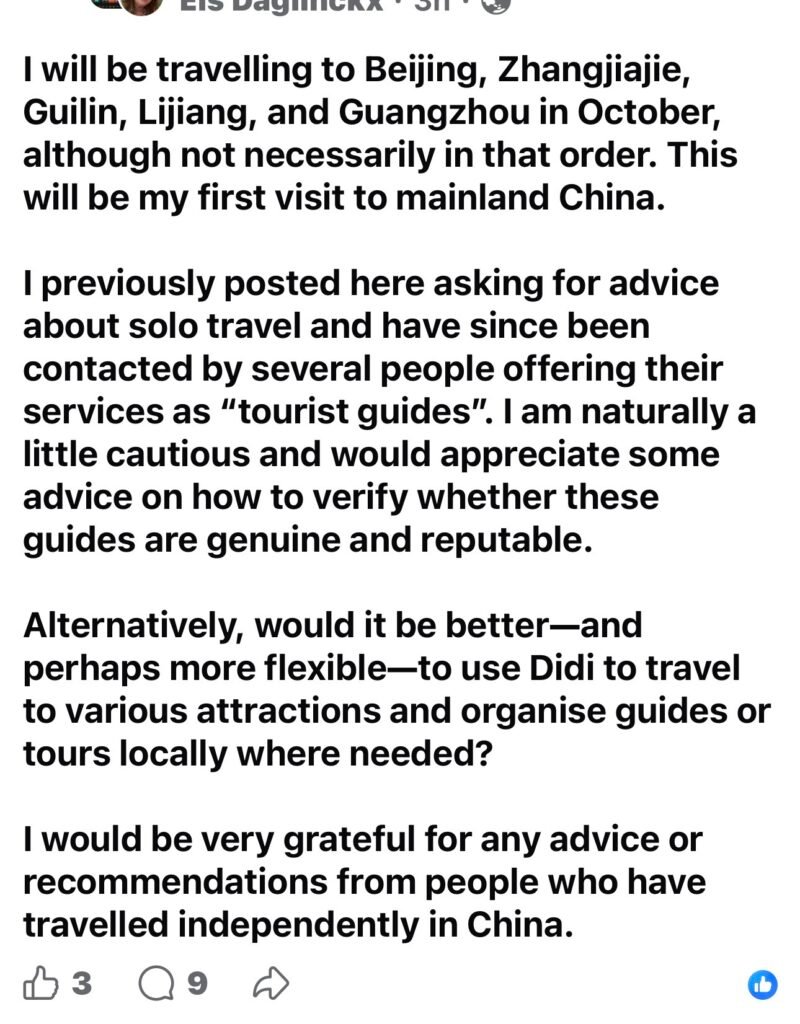
I will be travelling to Beijing, Zhangjiajie, Guilin, Lijiang, and Guangzhou in October, although not necessarily in that order. This will be my first visit to mainland China.
I previously posted here asking for advice about solo travel and have since been contacted by several people offering their services as “tourist guides”. I am naturally a little cautious and would appreciate some advice on how to verify whether these guides are genuine and reputable.
Alternatively, would it be better—and perhaps more flexible—to use Didi to travel to various attractions and organise guides or tours locally where needed?
I would be very grateful for any advice or recommendations from people who have travelled independently in China.

AI Travel Planner Answer
For a first trip, I’d recommend a hybrid approach: travel independently between Beijing, Zhangjiajie, Guilin, Lijiang and Guangzhou, then use a guide selectively where they genuinely add value. You certainly don’t need a guide simply because you don’t speak Chinese.
Didi is very useful, especially for getting between your hotel, stations and attractions, but I wouldn’t rely on finding a good guide after arrival at the last minute. For places where interpretation matters, arrange someone reputable in advance. For straightforward sightseeing, explore independently.
Regarding people contacting you through social media offering guiding services: being cautious is sensible. Before paying anyone, I would ask for:
- Their full name and guide credentials/licence details, and verify them where possible.
- The name of the registered travel company they work with, if applicable.
- Recent reviews or references that can be independently checked—not screenshots they provide themselves.
- A written itinerary showing exactly what is included, transportation arrangements, cancellation terms and total price.
- A secure, traceable payment method. Be wary of pressure to send large deposits directly to a personal account.
A genuine guide should be perfectly comfortable answering these questions. Someone becoming evasive or creating urgency would be enough reason for me to walk away.
For Beijing, a knowledgeable licensed guide can be particularly worthwhile for somewhere like the Forbidden City or Great Wall if you’re interested in the history rather than simply seeing the sights. Zhangjiajie can also benefit from some logistical help because of the geography. Guilin/Yangshuo, Lijiang and Guangzhou are quite enjoyable independently once you’ve sorted your transport, payments, maps and translation apps.
One other thought: five destinations is potentially a lot of China. Whether it’s a good itinerary depends heavily on how many days you have. China is enormous, and the Beijing–Zhangjiajie–Guilin–Lijiang–Guangzhou combination involves substantial distances. I’d sort out the route before deciding where you need guides.
If you tell me how many days you have in China, I can suggest the most logical order for those five places—and tell you honestly if I’d drop one.
A note about this AI Travel Planner answer: This answer is shown as originally generated, without editorial rewriting. Travel information can change, especially transport schedules, border procedures, opening hours, ticketing rules and holiday arrangements. Before making bookings or travel decisions, always verify time-sensitive details with current official sources.
ChinaTravelBUG Planning Note: The Hybrid Approach Makes Sense
The key point is that independent travel and hiring a guide are not opposites.
For many first-time visitors, the best solution is somewhere in the middle.
China’s 高铁 (gāotiě, high-speed rail), domestic flights, metros and ride-hailing make independent travel between major destinations very practical. Payment, mapping and translation apps have also made traveling without a tour considerably easier.
A guide becomes valuable when that person solves a specific problem.
That might mean explaining the history and symbolism of the Forbidden City 故宫 (Gùgōng), helping you understand the Great Wall 长城 (Chángchéng), navigating Zhangjiajie’s complicated scenic-area system, or simply making a tightly scheduled sightseeing day more efficient.
So instead of asking:
“Do I need a guide in China?”
Ask:
“Where on my trip would a good guide genuinely improve the experience?”
Where Would a Guide Add Value on This Route?
| Destination | Independent Travel? | Where a Guide May Add Value |
|---|---|---|
| Beijing 北京 | Very doable | Forbidden City, Great Wall and deeper historical interpretation |
| Zhangjiajie 张家界 | Doable, but more complicated | Navigating the scenic areas efficiently |
| Guilin 桂林 / Yangshuo 阳朔 | Generally easy | Countryside or specialist experiences |
| Lijiang 丽江 | Generally easy | Cultural or specialist excursions |
| Guangzhou 广州 | Very suitable | Optional unless you want specialist food or history experiences |
Beijing: A Guide Can Add Context, Not Just Transportation
Beijing is a good example of where a guide can add something that DiDi cannot.
You can certainly get around Beijing 北京 independently.
But the Forbidden City 故宫 is more than a collection of spectacular buildings. A knowledgeable guide can explain why the palace was designed the way it was, how imperial hierarchy shaped its architecture, and the meaning behind details that are easy to walk straight past.
The same principle applies to the Great Wall 长城.
If your goal is simply to see it, photograph it and hike, independent travel can work very well.
If you’re fascinated by Chinese history, however, a knowledgeable guide can turn sightseeing into understanding.
That’s exactly where ChinaTravelBUG’s philosophy of “See China. Understand It Better.” matters.
Zhangjiajie: A Different Reason to Consider a Guide
Zhangjiajie 张家界 (Zhāngjiājiè) is different.
Here, a guide can be useful less for interpretation and more for efficiently navigating the complicated scenic-area system.
The wider Zhangjiajie area isn’t one single attraction. Travelers encounter different entrances, scenic zones, shuttle buses, cableways, elevators and walking routes.
You may also be trying to distinguish between places such as Wulingyuan 武陵源 (Wǔlíngyuán) and Tianmen Mountain 天门山 (Tiānmén Shān).
Independent travel is absolutely possible.
But on a first visit, somebody who understands how the scenic areas fit together can potentially save time, reduce backtracking and help you choose routes that suit your fitness and available time.
That’s a very different reason for hiring a guide from Beijing.
Can You Just Use DiDi Instead?
For many journeys, yes.
DiDi 滴滴 (Dīdī) is extremely useful for foreign travelers in China, particularly for:
- hotel-to-station transfers
- station-to-hotel transfers
- short urban journeys
- reaching attractions that aren’t conveniently beside a metro
- reducing the need to explain destinations verbally to taxi drivers
But DiDi and a tour guide solve different problems.
A DiDi driver gets you somewhere.
A good guide helps you understand, navigate or experience that place.
So don’t hire a guide simply because you’re worried you won’t be able to move around China without speaking Mandarin.
How Can You Check Whether a China Tour Guide Is Genuine?
This deserves particular caution when somebody contacts you unsolicited through social media.
China’s Ministry of Culture and Tourism 文化和旅游部 (Wénhuà hé Lǚyóu Bù) provides an official 导游信息查询 (Tour Guide Information Inquiry) service.
The current system allows guide information to be checked using details including a guide’s name and 导游证号 (dǎoyóu zhènghào, tour guide ID number). The official record can show information including the guide’s language, organization and credential validity.
If somebody claims to be a licensed professional guide, ask for:
- their full name
- their 导游证号
- the organization or agency they work with
- recent independently verifiable reviews
- the complete itinerary in writing
- exactly what is included and excluded
- the total price
- cancellation conditions
- the payment arrangements
Don’t treat screenshots sent by the person themselves as independent verification.
And don’t ignore pressure tactics.
If somebody becomes evasive when you ask for credentials, pushes you to pay immediately, changes the quoted price, or pressures you to send a large deposit to an unfamiliar personal account, walking away is perfectly reasonable.
One Important October Question: Are You Traveling During Golden Week?
There is one detail in this traveler’s question that should immediately trigger another question:
When in October?
China’s National Day 国庆节 (Guóqìng Jié) holiday is one of the country’s major domestic travel periods.
For 2026, the official National Day holiday runs from October 1–7. The State Council notice also designates September 20 and October 10 as adjusted working days.
If your itinerary overlaps October 1–7, planning Beijing, Zhangjiajie, Guilin, Lijiang and Guangzhou becomes a different exercise.
Expect much stronger domestic travel demand around popular attractions and transportation.
That makes it even more important to think ahead about:
- train and flight arrangements
- hotels
- attraction reservations
- the order of your destinations
- how much flexibility you actually have
If your trip falls after the National Day holiday, that’s a much easier starting point.
Five Destinations May Actually Be the Bigger Issue
There’s another question hidden inside this traveler’s post:
How many days do you have?
Beijing, Zhangjiajie, Guilin, Lijiang and Guangzhou sound manageable when written in one sentence.
Geographically, they’re another story.
China is enormous.
Every extra destination means more than the journey itself. It also means packing, checking out, reaching the railway station or airport, traveling, transferring to the next hotel, checking in and getting oriented again.
That’s why ChinaTravelBUG generally favors realistic pacing over collecting destinations on a first trip.
With three weeks, five destinations could be reasonable.
With 10 or 12 days, we’d examine the route itself before worrying about which cities require guides.
Related Traveler Questions
Do You Need a Private Guide to Travel Around China? — AI Travel Planner Answers
A useful companion to this question, looking more broadly at when independent travel works and when private guiding adds genuine value.
Should You Hire a Private Guide for the Forbidden City and Tiananmen Square? — AI Travel Planner Answers
A Beijing-specific example of when historical interpretation can make hiring a knowledgeable guide worthwhile.
Can Foreign Tourists Use DiDi in English Through Alipay? — AI Travel Planner Answers
Practical help for first-time travelers who want the freedom to move around independently using ride-hailing.
Is This 4-Day Zhangjiajie Hiking Itinerary Realistic? — AI Travel Planner Answers
Useful for understanding why Zhangjiajie requires more route planning than many first-time visitors expect.
ChinaTravelBUG Verification Note
Last verified: 17 August 2026
ChinaTravelBUG checked the guide-verification advice against current information from China’s Ministry of Culture and Tourism.
The Ministry’s official 导游信息查询 (Tour Guide Information Inquiry) currently allows users to search guide information and displays fields including 导游证号 (tour guide ID number), 导游语种 (guide language), 所在机构 (organization), and 有效期限 (validity period).
The Ministry’s current 2026 national tour-guide examination notice also confirms the continuing official use of 导游资格证书 (Tour Guide Qualification Certificate).
ChinaTravelBUG also checked the October holiday warning. The State Council’s official 2026 holiday notice confirms that National Day is October 1–7, 2026.
Official Sources
Ministry of Culture and Tourism — 导游信息查询 (Tour Guide Information Inquiry)
Use this official Ministry service to check guide information.
Ministry of Culture and Tourism — 2026 National Tour Guide Qualification Examination Notice
Current Ministry information concerning the national guide qualification examination and 导游资格证书.
State Council — Official 2026 Public Holiday Arrangements
Official confirmation of the October 1–7, 2026 National Day holiday.
About This Answer
This question came from a real traveler planning a first visit to mainland China. Identifying personal details have been omitted where appropriate.
The AI Travel Planner Answer above is reproduced exactly as originally generated, without editorial rewriting.
ChinaTravelBUG then added the planning analysis, Chinese place names, current verification information and related traveler resources to provide additional context.
The goal isn’t to tell travelers that they must choose between an organized tour and doing everything alone.
It’s to help them decide where independence works well—and where local expertise genuinely makes the trip better.

Planning Your Own First Trip to China?
Not sure whether you need a guide, which cities to combine, how long to stay, or whether your itinerary is becoming too ambitious?
Try the FREE ChinaTravelBUG AI Travel Planner.
Tell it your travel dates, destinations, interests and preferred pace, and use it to work through your China trip one decision at a time.