Xi’an (西安, Xī’ān) can cause a problem.
It makes you start asking questions.
You see the Terracotta Warriors (兵马俑, Bīngmǎyǒng). You meet Qin Shi Huang (秦始皇, Qín Shǐhuáng). You learn that in 221 BCE, the Qin dynasty (秦朝, Qíncháo) unified the competing states and created an imperial system that would shape China for more than 2,000 years.
And then a question appears.
What was here before that?
Not 100 years before.
Not 500 years before.
What if we kept going backwards?
That question took Elaine and me out of Xi’an (西安, Xī’ān), across the Yellow River (黄河, Huáng Hé) and into Shanxi (山西, Shānxī).
We went to Linfen (临汾, Línfén).
And from Linfen (临汾, Línfén), we went looking for Taosi (陶寺, Táosì).
More Than 4,000 Years Back
Taosi (陶寺, Táosì) takes us into a very different China.
Actually, calling it “China” already raises an interesting question.
The archaeological site dates broadly to around 2300–1900 BCE — more than 4,000 years ago.
That puts us long before the Qin dynasty (秦朝, Qíncháo).
Before the Zhou dynasty (周朝, Zhōucháo).
Before the Shang dynasty (商朝, Shāngcháo).
We are entering the period traditionally associated with figures such as Yao (尧, Yáo) and Shun (舜, Shùn) — names Chinese children have encountered for generations in stories about the distant beginnings of Chinese civilisation.
But archaeology and tradition are not the same thing.
We’ll come back to that.
First, we wanted to see the place for ourselves.
We Left Linfen (临汾, Línfén) and Drove Into Xiangfen County (襄汾县, Xiāngfén Xiàn)
Taosi (陶寺, Táosì) isn’t in downtown Linfen (临汾, Línfén).
We drove roughly 20 kilometres out toward Xiangfen County (襄汾县, Xiāngfén Xiàn).
And before we even reached the archaeological site, we encountered a sign that told us exactly how this part of Shanxi (山西, Shānxī) sees its place in the Chinese story.
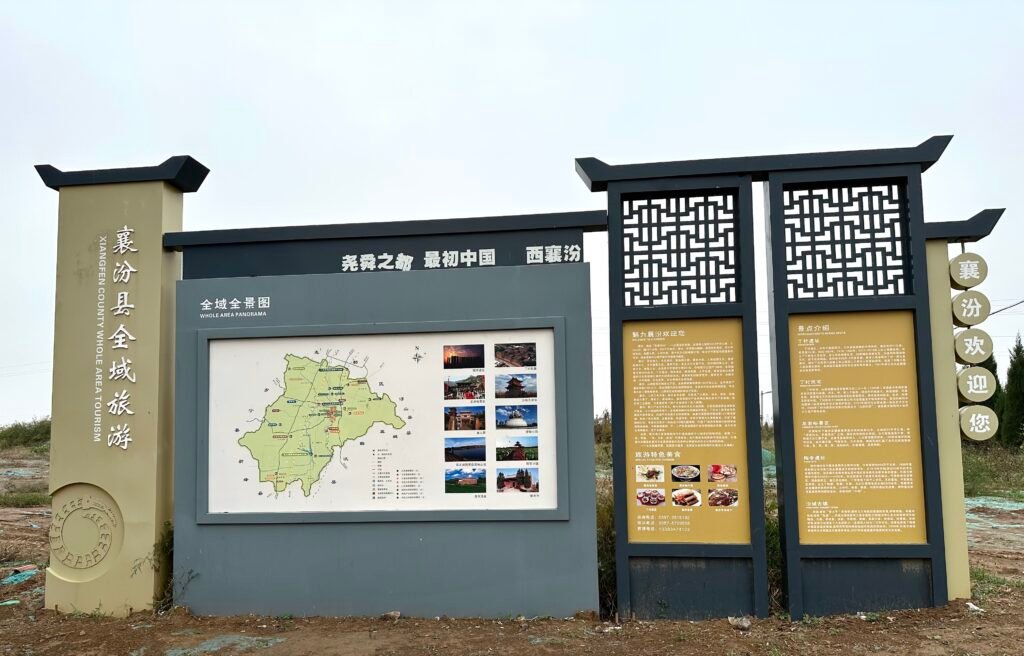
Across the top were eight characters:
尧舜之都 最初中国
Yáo Shùn zhī dū, zuìchū Zhōngguó
“Capital of Yao and Shun — the earliest China.”
The earliest China.
That’s a very big claim.
Dad immediately wanted to know what was behind it.
And that is where our journey into Taosi (陶寺, Táosì) really began.
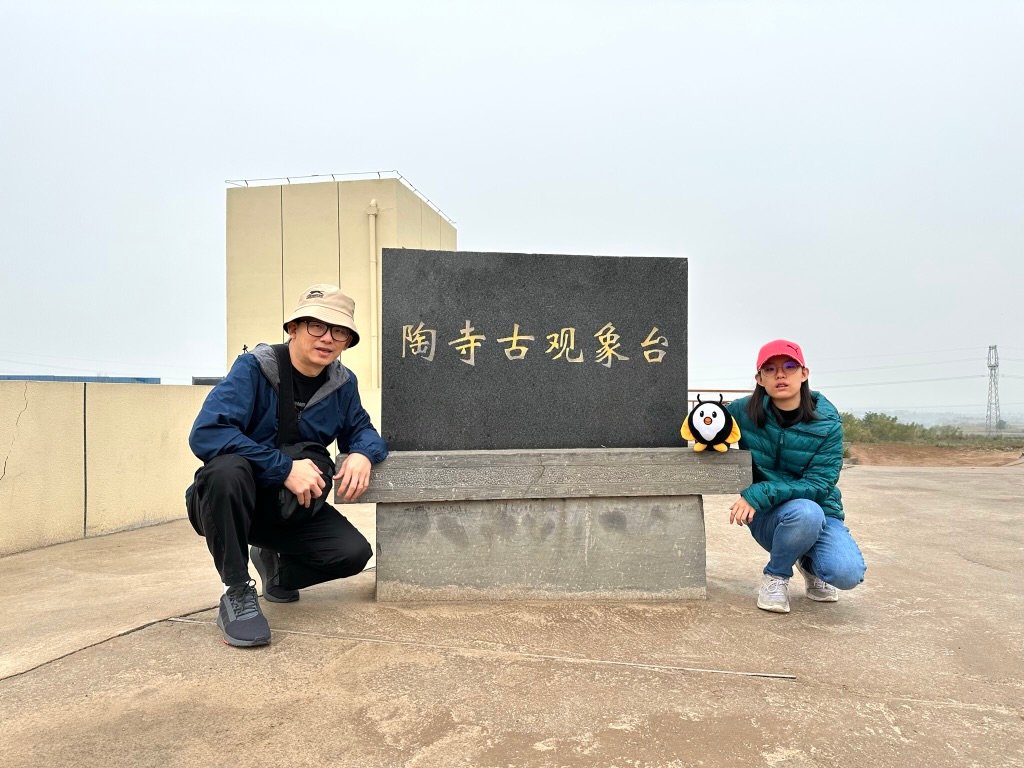
Our first stop was somewhere rather extraordinary:
the Taosi Ancient Observatory (陶寺古观象台, Táosì Gǔ Guānxiàngtái).
At first, there wasn’t much to see.
Fields.
Brown earth.
A hazy Shanxi (山西, Shānxī) sky.
Then a strange curved structure began to appear in front of us.
🎥 Our First Look at the Taosi Ancient Observatory
Don’t worry about understanding what you’re looking at yet.
Just walk in with us.
Tall pillars.
Narrow gaps.
A circular observation point.
Lines radiating across the ground.
What was this thing?
And what was it doing here more than 4,000 years ago?
That’s when Dad started explaining to Elaine why he’d brought her all the way to Taosi (陶寺, Táosì).
Dad Explains Why We Came All the Way to Taosi (陶寺, Táosì)
Standing beside the Taosi Ancient Observatory (陶寺古观象台, Táosì Gǔ Guānxiàngtái), Dad tried to explain to Elaine why this rather quiet patch of countryside had brought us all the way here.
This wasn’t just about an ancient observatory.
It was about what archaeologists had found around it.
🎥 Dad Explains Why Taosi Matters
This was Dad speaking on the spot — with Elaine behind the camera and our travelling penguin Qi’er joining the history lesson.
Dad had been reading about Taosi (陶寺, Táosì) before the trip.
What fascinated him was the combination of things archaeologists had uncovered here.
This wasn’t evidence of a tiny prehistoric village.
Taosi (陶寺, Táosì) was a large settlement with evidence of:
- substantial defensive or enclosing walls
- elite or palatial building areas
- cemeteries with striking differences in burial wealth
- specialised craft production
- ritual activity
- and what archaeologists have interpreted as an astronomical observation facility
Put those pieces together and something important starts to emerge.
People here were organising a complex society more than 4,000 years ago.
And that changes the way you look at those pillars.
This Wasn’t Really About Looking at the Stars
When we hear the word “observatory”, it’s easy to imagine ancient people simply being curious about astronomy.
But observing the sky had very practical consequences.
Knowing the movement of the Sun through the year could help a society recognise seasonal change.
That mattered for agriculture.
It mattered for organising time.
And eventually, calendars became connected with something even bigger:
the ability of rulers to organise society.
For Dad, this was the fascinating part.
We had come from Xi’an (西安, Xī’ān), where the power of Qin Shi Huang (秦始皇, Qín Shǐhuáng) is impossible to miss.
His empire had armies, officials, roads, laws, standardisation and monumental construction.
But here at Taosi (陶寺, Táosì), we were looking more than 1,500 years further back.
People were already building.
Organising.
Performing rituals.
Watching the sky.
And living inside a society with visible differences in status and power.
Then Comes Yao (尧, Yáo)
This is where the story becomes much more complicated.
In the video, Dad talks about the traditional association between this region and Yao (尧, Yáo), also called Emperor Yao (尧帝, Yáodì).
Yao (尧, Yáo) belongs to the ancient Chinese tradition of the Three Sovereigns and Five Emperors (三皇五帝, Sānhuáng Wǔdì) — rulers placed in the distant age before China’s historically documented dynasties.
And the dates associated with the Taosi culture fall tantalisingly close to the traditional era assigned to Yao (尧, Yáo).
So was Taosi (陶寺, Táosì) actually Yao’s capital?
Maybe. But we need to be careful.
Archaeology can show us that a sophisticated society existed here.
It can uncover walls, buildings, graves, pottery, tools and evidence of ritual and astronomical observation.
What it cannot currently do is point to one excavated building and say:
“Yao lived here.”
That’s an important distinction.
Archaeology is archaeology. Tradition is tradition.
The possible connection between the two is fascinating precisely because it remains a question worth investigating — not because the question has been neatly settled.
We’ll follow Yao (尧, Yáo) down his own rabbit hole elsewhere.
For now, we were standing in front of something we could actually examine.
Those strange pillars.
Those narrow gaps.
And those white lines radiating from one observation point.
So we walked closer.
→ Next: How the Taosi Ancient Observatory (陶寺古观象台, Táosì Gǔ Guānxiàngtái) was supposed to work.
We Walked Closer — And the Observatory Started to Make Sense
From a distance, the Taosi Ancient Observatory (陶寺古观象台, Táosì Gǔ Guānxiàngtái) looked almost like a curved wall broken into sections.
Up close, the details became much more interesting.
There was a central observation point on the ground.
From it, white lines radiated outward toward narrow gaps between the reconstructed pillars.
Those gaps were the key.
🎥 Come Closer and Look Through the Gaps
In this video, we walk right up to the reconstructed observatory.
Look at the lines on the ground.
Then look at where they lead.
As we moved around the structure, we could see labels marking different observation positions, including seasonal points such as the Vernal Equinox (春分, Chūnfēn), Autumnal Equinox (秋分, Qiūfēn) and Winter Solstice (冬至, Dōngzhì).
Suddenly, those strange gaps between the pillars didn’t look so random.
The Horizon Was Part of the Instrument
The basic idea is surprisingly easy to understand.
Stand at a fixed observation point.
Look through a particular narrow opening.
Watch where the Sun rises against the distant horizon.
As the seasons change, the sunrise position moves along the horizon.
By repeatedly observing those positions, people could track important points in the solar year.
So the observatory wasn’t simply a collection of pillars.
The observation point, the gaps, the Sun and the horizon worked together.
The landscape itself became part of the instrument.

A Western Handrail: Think Stonehenge — But Don’t Make Them the Same
For international travelers, Stonehenge in Britain provides a useful handrail.
Both immediately raise questions about ancient people observing the movement of the Sun and marking significant points in the year.
But don’t imagine that Taosi (陶寺, Táosì) was simply a “Chinese Stonehenge.”
Different society.
Different structure.
Different archaeological context.
The comparison is useful only for grasping the bigger idea:
people thousands of years ago were paying very careful attention to the sky.
Why Would That Matter So Much?
Because knowing the seasons wasn’t just interesting astronomy.
For an agricultural society, understanding the annual cycle mattered enormously.
When does the weather begin changing?
When should agricultural work begin?
When are important seasonal transitions approaching?
Over time, observing celestial cycles, maintaining calendars and organising agricultural and ritual life could also become connected with political authority.
And that takes us somewhere deeper.
We came here thinking we were looking at an ancient observatory.
But Taosi (陶寺, Táosì) was beginning to show us something much bigger:
a society capable of organising people, space, time and power.
The observatory was only one piece of the puzzle.
There was an entire settlement behind it.
Then the Archaeology Became Real at Linfen Museum (临汾博物馆, Línfén Bówùguǎn)
Standing at the Taosi Ancient Observatory (陶寺古观象台, Táosì Gǔ Guānxiàngtái), much of what we were trying to understand was still beneath our feet.
Earth.
Foundations.
Archaeological traces.
So back in Linfen (临汾, Línfén), Dad went to the Linfen Museum (临汾博物馆, Línfén Bówùguǎn).
And suddenly Taosi (陶寺, Táosì) became much easier to see.
These weren’t reconstructions of pillars standing in a field.
Here were objects excavated from the world we had just been trying to imagine.
A Bowl With a Dragon Looking Back at Us
One object stopped Dad.
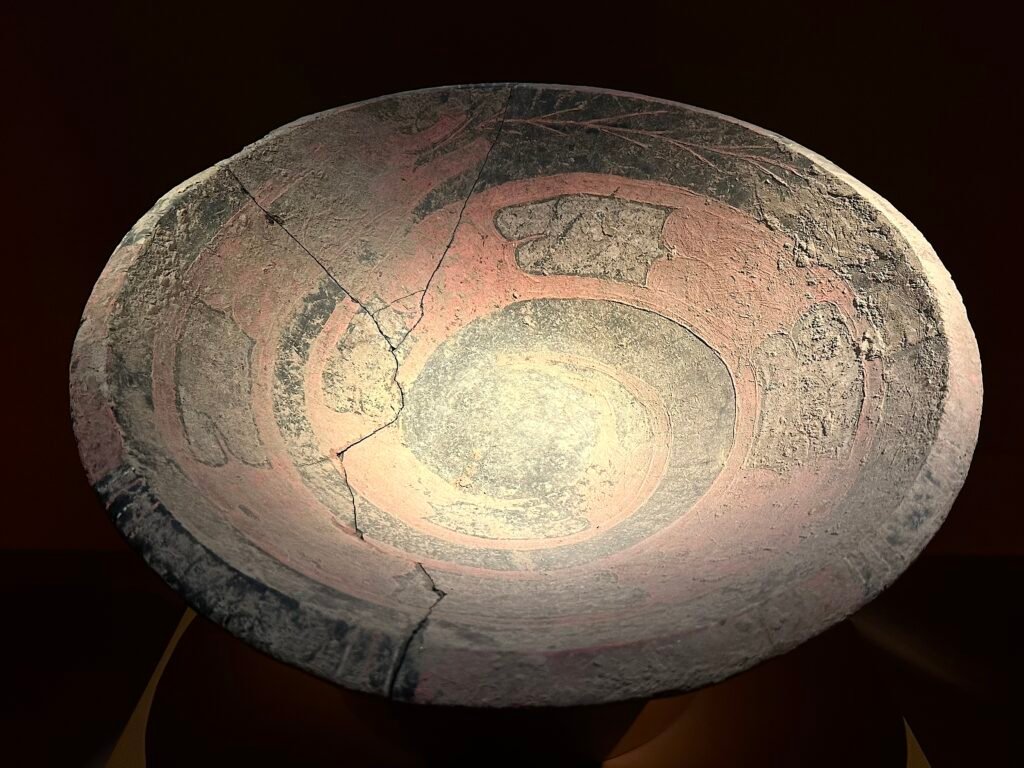
This painted pottery plate came from a Taosi elite tomb.
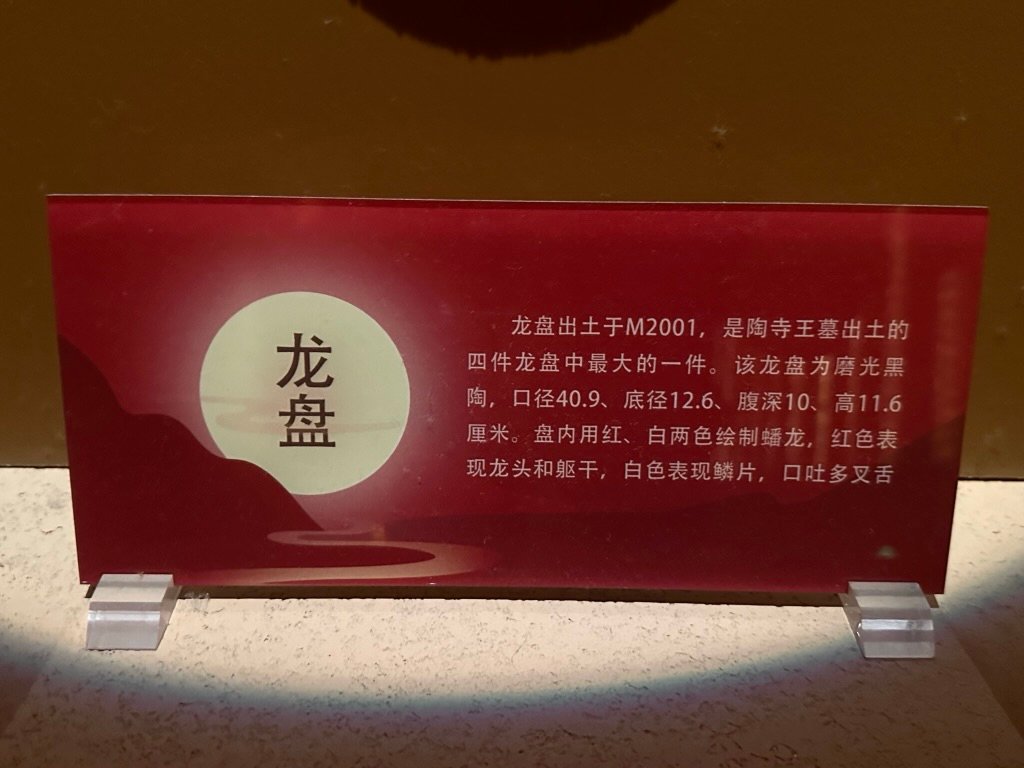
Across its dark surface curls a red-painted creature interpreted as a dragon.
More than 4,000 years later, you can still make out its body curling around the bowl.
That immediately raises another question.
How much of what later became recognisably “Chinese” was already beginning to appear in this much earlier world?
Not China as a modern country.
Not even China as the Qin (秦, Qín) empire.
But symbols, rituals, ideas about authority and ways of organising society that would continue changing for centuries.
Jade, Pottery — and Signs of Social Difference
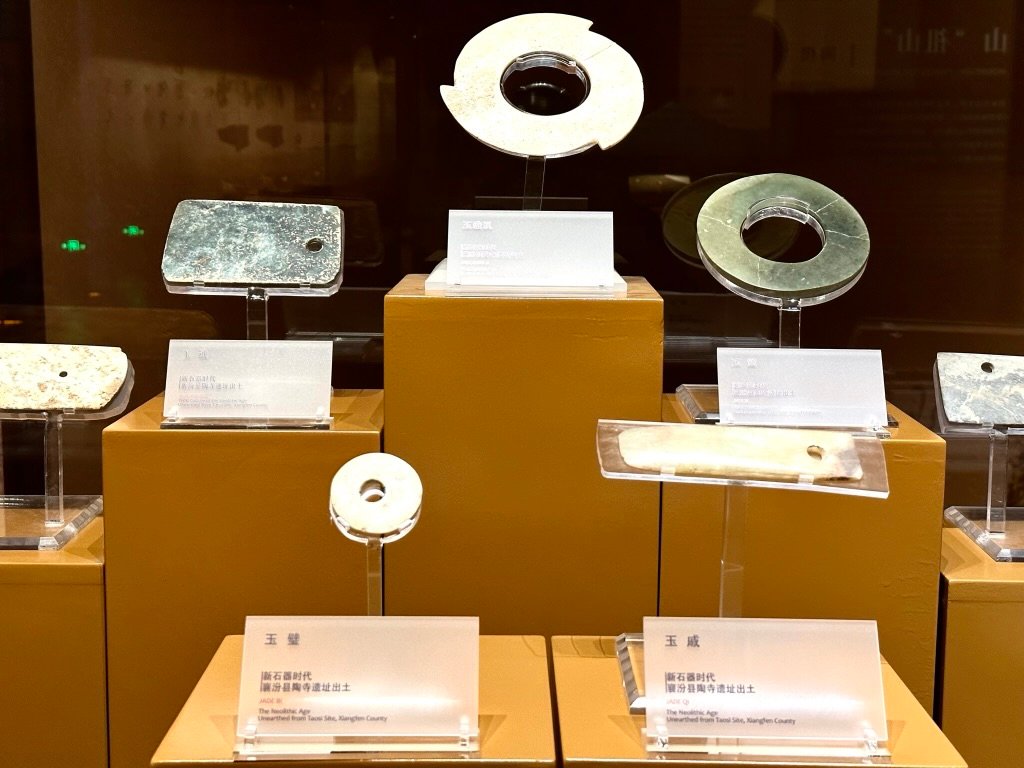
The museum cases also contained jade objects excavated from Taosi (陶寺, Táosì).
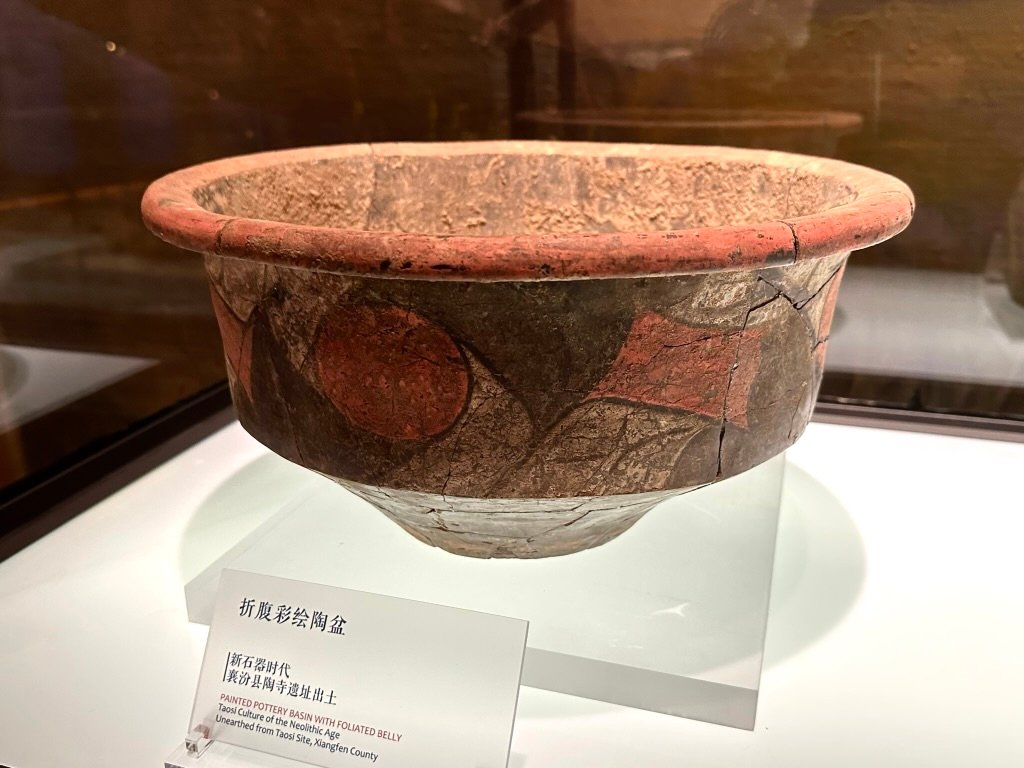
And beautifully decorated pottery.
These weren’t simply everyday objects to admire behind glass.
Archaeologists found major differences between Taosi burials.
Some graves were modest.
Others contained elaborate objects and ritual goods.
That tells us something important:
this was already a highly differentiated society.
Some people clearly possessed considerably more status and access to valuable objects than others.
They Even Had Ritual Music
Then Dad reached another display.
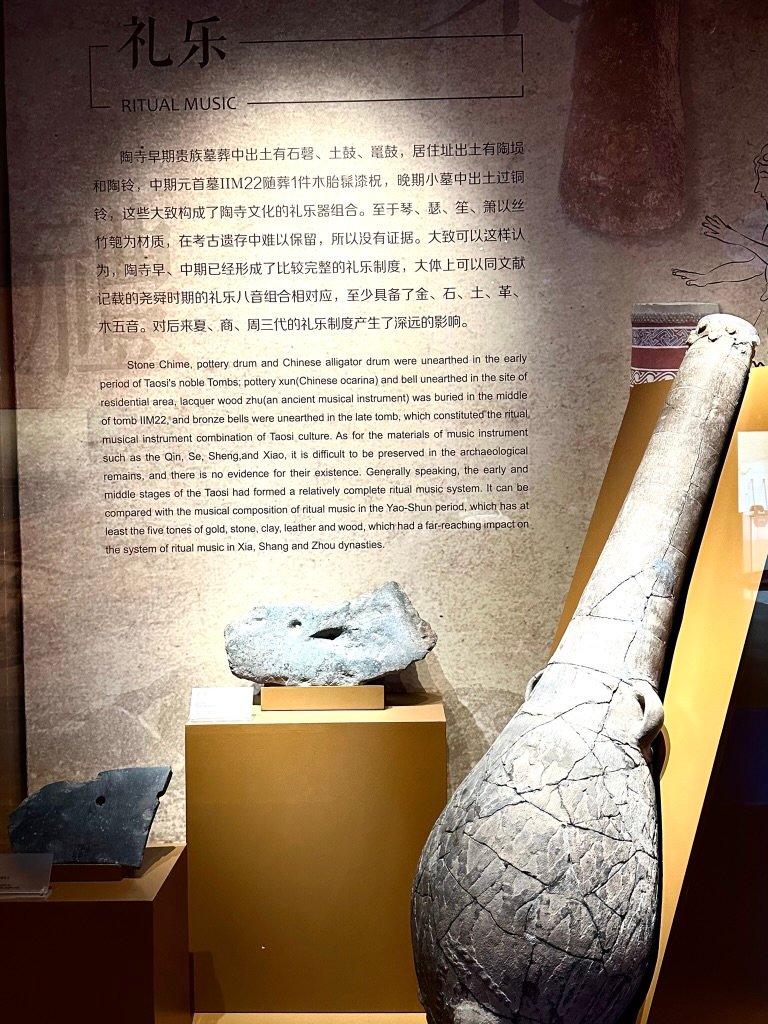
📷 Ritual Music at Taosi (陶寺, Táosì)
Ritual musical instruments from the Taosi culture (陶寺文化, Táosì Wénhuà), displayed at Linfen Museum (临汾博物馆, Línfén Bówùguǎn).
The museum board describes a surprisingly varied musical world at Taosi.
Archaeologists have found:
stone chimes (石磬, Shíqìng)
pottery drums (土鼓, Tǔgǔ)
Chinese-alligator drums (鼍鼓, Tuógǔ)
pottery xun / ocarinas (陶埙, Táoxūn)
and, in later burials:
bronze bells (铜铃, Tónglíng).
The large reconstructed drum in this display helps make the point:
this wasn’t music simply for entertainment.
The museum interprets the evidence as showing that by Taosi’s early and middle periods, a relatively developed system of:
礼乐 — Lǐyuè
ritual + music
had already emerged.
Music, ritual and elite burial were becoming connected.
And that matters because 礼乐 (Lǐyuè) would become enormously important in later Chinese political and ritual culture — especially in the worlds of the Xia, Shang and Zhou.
So when Dad looked at these instruments, the rabbit hole wasn’t:
“They had music 4,000 years ago.”
It was:
When did music become part of political and social order?
🐇
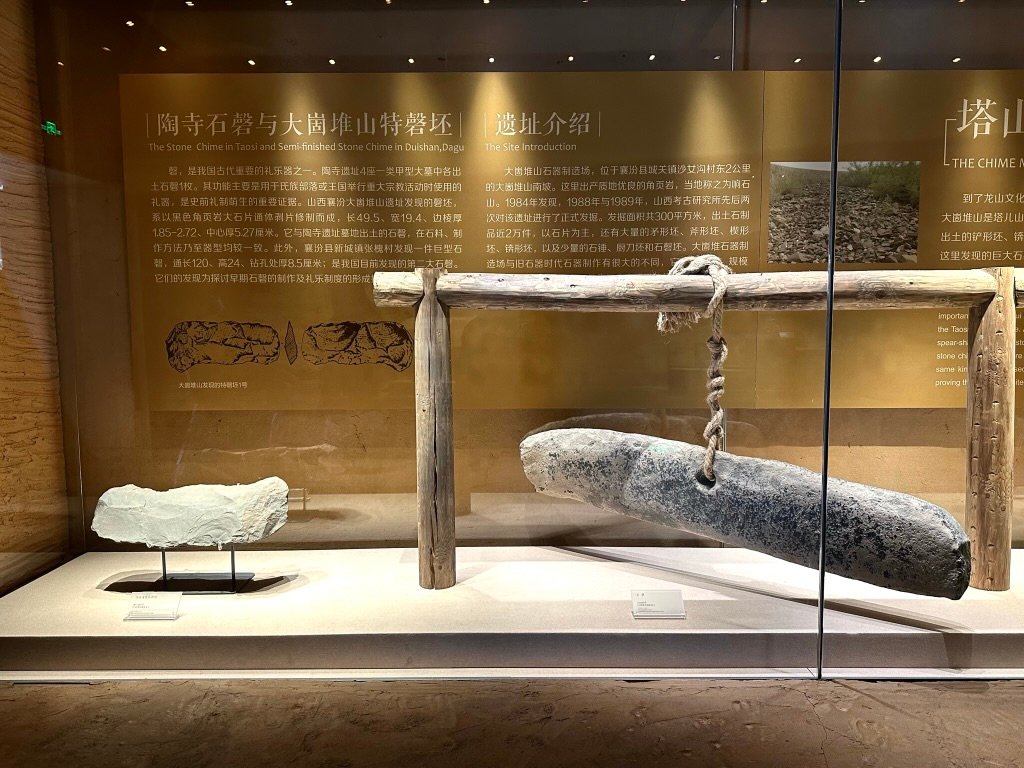
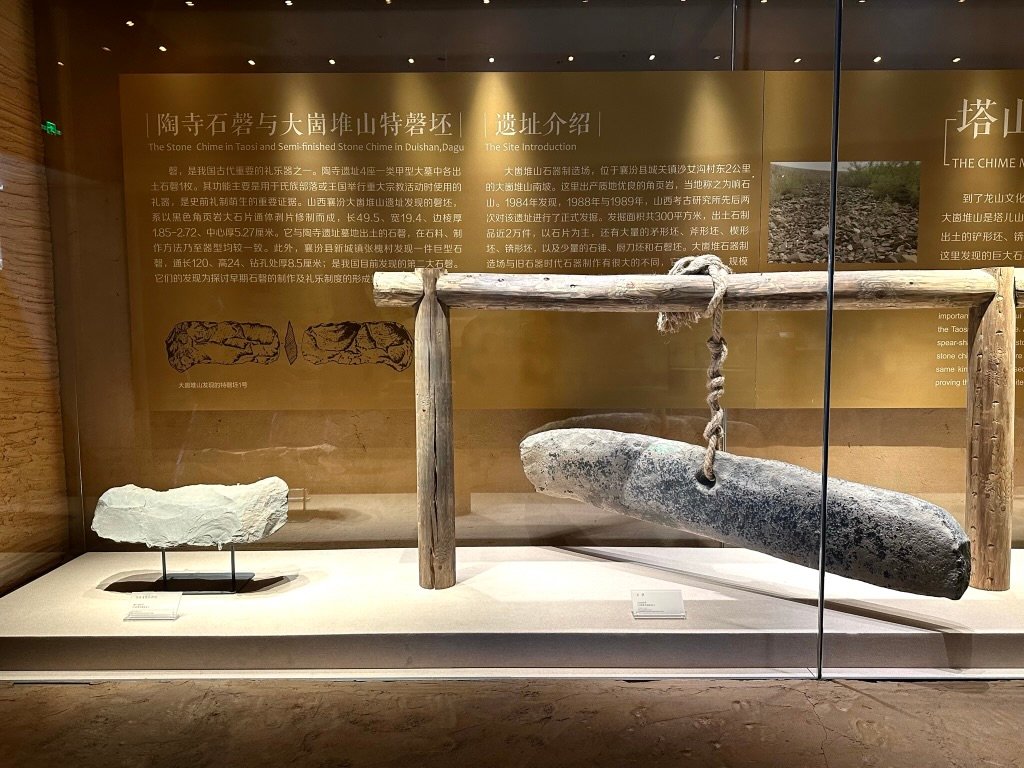
📷 Taosi Stone Chime (陶寺石磬, Táosì Shíqìng)
Stone chimes from the Taosi culture (陶寺文化, Táosì Wénhuà), displayed at Linfen Museum (临汾博物馆, Línfén Bówùguǎn).
The museum board describes the 磬 (Qìng) as one of ancient China’s important percussion instruments.
The large dark stone chime on display is reconstructed as it may have been suspended and struck.
According to the museum board, Taosi archaeologists have found stone chimes in elite burials, suggesting that music was already connected with:
ritual
status
and:
ceremonial authority
more than 4,000 years ago.
But the really interesting rabbit hole is where they came from.
The board also introduces Dagu Dui Shan (大崮堆山), about 2 km from the Taosi site, where archaeologists excavated a stone-working location in 1984.
They found:
stone material
semi-finished stone chimes
stone-working tools
and large quantities of stone debris.
So we’re not looking only at:
A MUSICAL INSTRUMENT.
We’re seeing part of the production chain behind it:
QUARRY / STONE SOURCE
↓
WORKSHOP
↓
CRAFT SPECIALIZATION
↓
RITUAL OBJECT
↓
ELITE BURIAL
🔥
That’s another clue that Taosi wasn’t simply a large prehistoric village.
It was a society capable of organizing:
specialized production + ritual + hierarchy.
🐇
The museum describes evidence for a developed system of ritual music (礼乐, Lǐyuè) at Taosi (陶寺, Táosì).
That matters because ritual music in later Chinese civilisation wasn’t simply entertainment.
Music, ceremony, hierarchy and political order became deeply connected.
Once again, Taosi was making us look much further backwards than we expected.
And Then We Saw These Four Words
One of the museum panels carried a striking title:
最早“中国”本义
“The Origin of the Earliest China.”
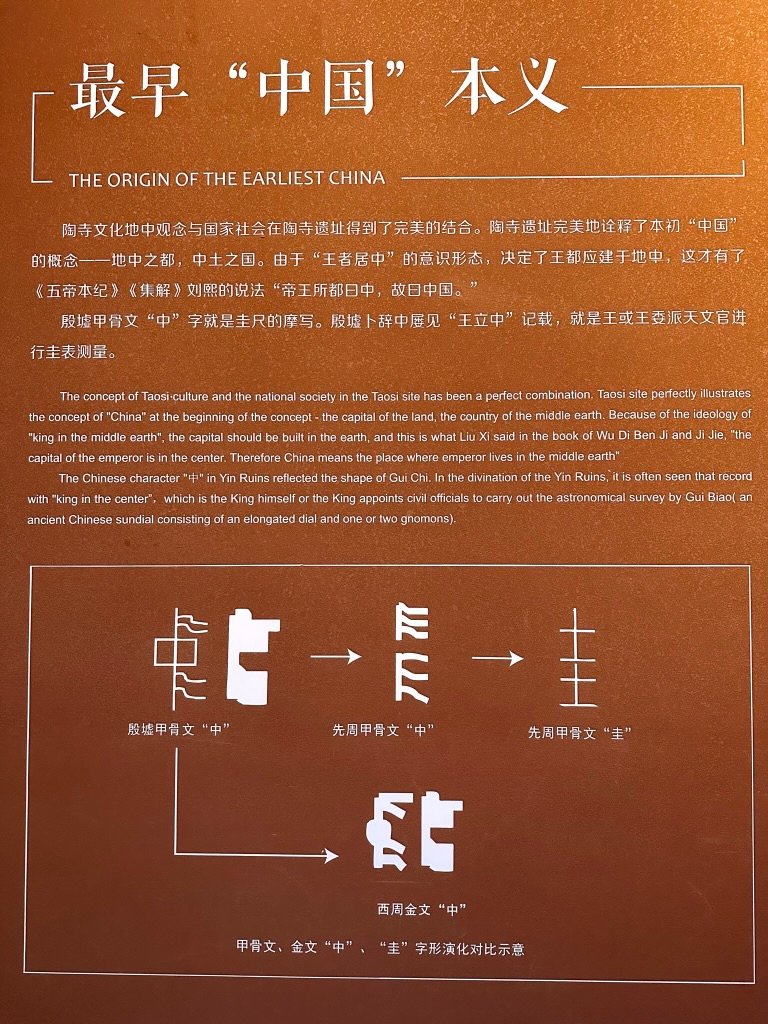
Now we were back to the question that had brought us here in the first place.
When does “China” begin?
The museum presents Taosi (陶寺, Táosì) as part of the emergence of an early idea of a political centre — a place associated with rulership, order, astronomy and the concept of the “middle.”
That’s a fascinating interpretation.
But we should be careful.
It does not mean that somebody living at Taosi 4,000 years ago carried a passport saying “China.”
The China we know today did not yet exist.
What Taosi gives us instead is something more interesting:
evidence that some of the building blocks from which Chinese civilisation would eventually develop were already taking shape astonishingly early.
And that was exactly what Dad had come to Linfen (临汾, Línfén) looking for.
Then We Saw What Taosi (陶寺, Táosì) Had Left Behind
Out at the Taosi Ancient Observatory (陶寺古观象台, Táosì Gǔ Guānxiàngtái), much of the story was still hidden beneath the landscape.
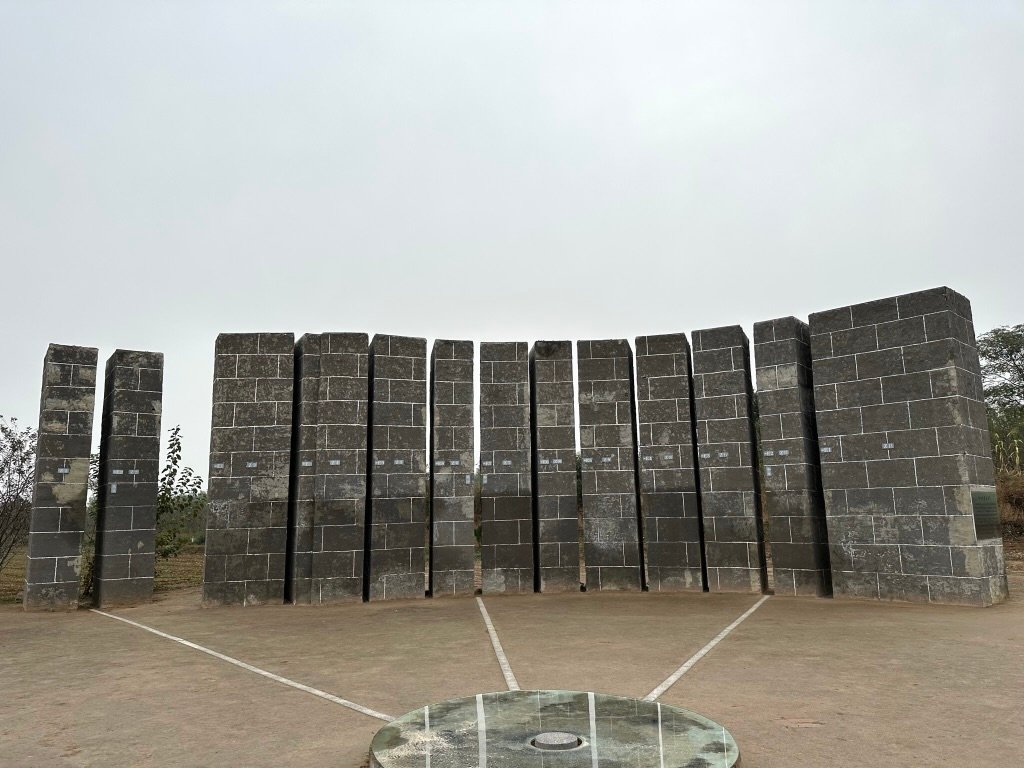
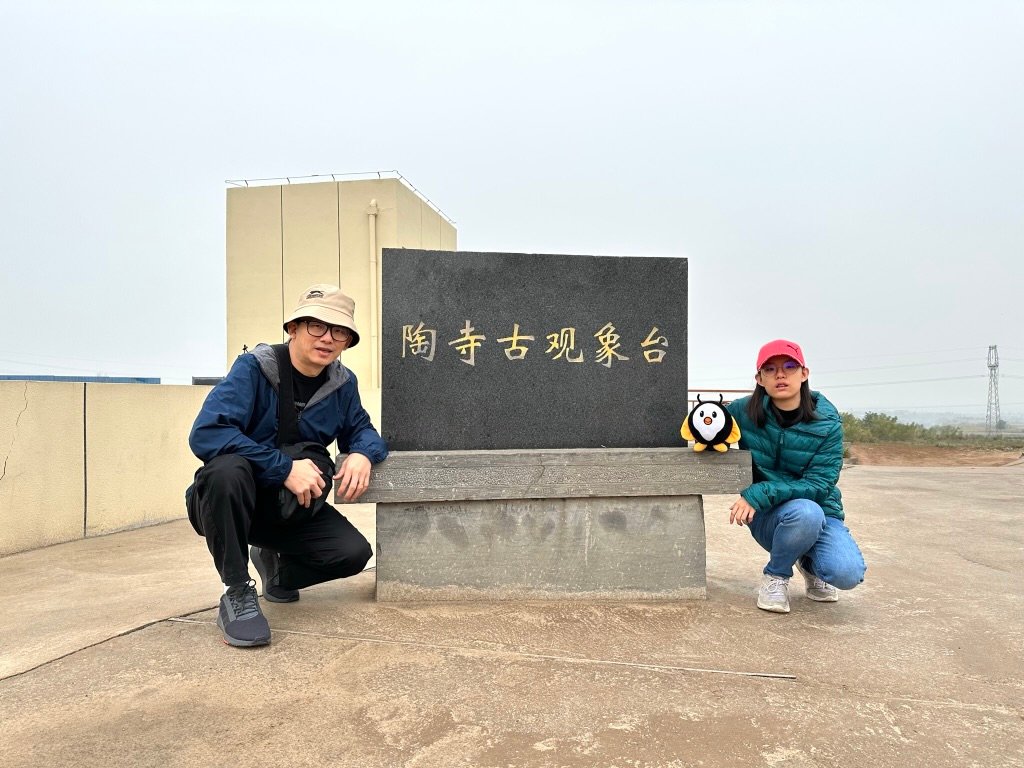
You could see the reconstructed observatory.
You could stand at the observation point.
You could look through the gaps toward the horizon.
But what did the people who lived at Taosi (陶寺, Táosì) actually leave behind?
Back in Linfen (临汾, Línfén), Dad found some of the answer inside the Linfen Museum (临汾博物馆, Línfén Bówùguǎn).
And suddenly this 4,000-year-old world became much more tangible.
This Wasn’t Just a Small Prehistoric Village
One museum panel reconstructed the scale and organisation of the early Taosi settlement.
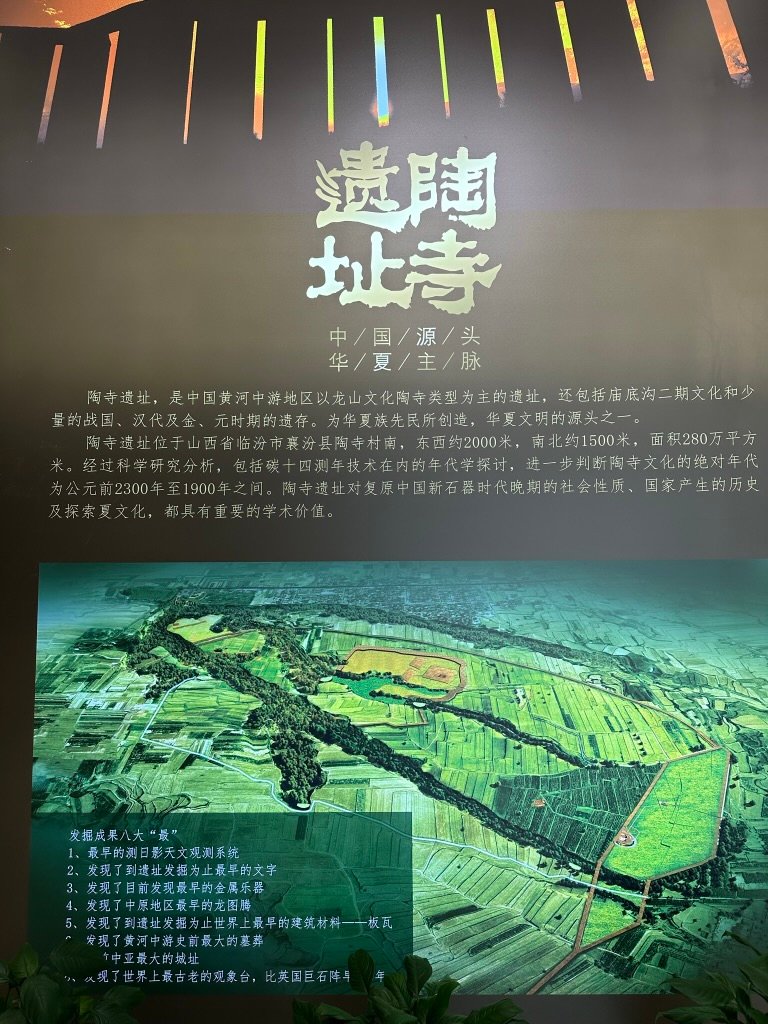
The archaeological picture is of a large, organised settlement with different areas serving different purposes.
There were substantial enclosed areas.
Residential zones.
Storage areas.
Elite or palatial architecture.
Cemeteries.
And places associated with ritual.
Whatever we ultimately call the society that lived here, this was clearly much more complicated than a collection of farming families living beside one another.
People were organising space, labour, ritual and authority.
Can We Really Call Taosi (陶寺, Táosì) the “Earliest China”?
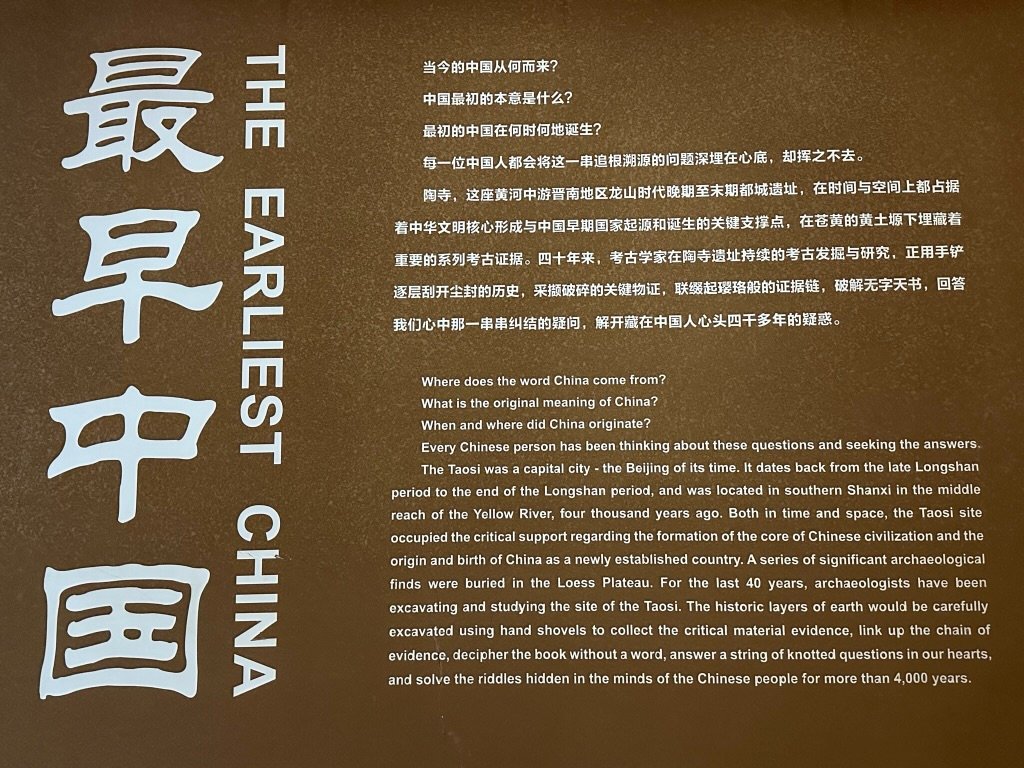
Inside the Linfen Museum (临汾博物馆, Línfén Bówùguǎn), Dad came across a panel with a title that immediately caught his attention.
It read:
最早“中国”本义
Zuìzǎo “Zhōngguó” běnyì
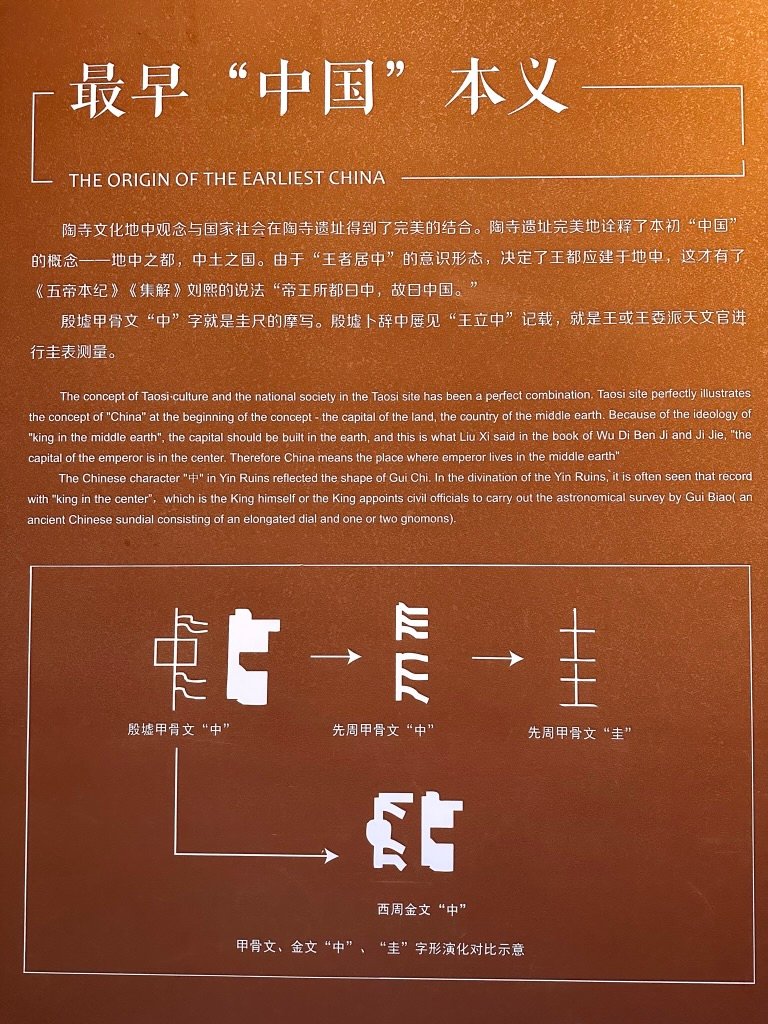
The museum translates this as:
“The Origin of the Earliest China.”
That’s a huge statement.
Especially when you’re standing in front of objects more than 4,000 years old.
But before we say “Aha! China began at Taosi!”, we need to unpack what 中国 (Zhōngguó) actually meant.
“China” Didn’t Originally Mean the Modern Country
Today, 中国 (Zhōngguó) means China.
Break the two characters apart and you’ll often hear the simple translation:
中 (zhōng) = middle
国 (guó) = country/state
Hence the familiar English expression:
“Middle Kingdom.”
Useful — but a little too neat.
The ancient idea developed over a very long period.
Early uses of concepts involving the centre (中, zhōng) were connected with political geography and rulership: the ruler occupied a centre from which authority and order extended outward.
That is closer to what the museum is asking us to think about at Taosi (陶寺, Táosì).
Why Would the “Centre” Matter?
Remember the observatory we had just visited.
Stand at one fixed point.
Observe the Sun.
Measure the changing sky.
Establish directions and seasons.
Organise the calendar.
Suddenly astronomy isn’t completely separate from government.
For an early ruler, knowing when and where mattered.
When to plant.
When seasons changed.
When rituals should take place.
Where the political and ritual centre stood.
The museum connects this idea with the ancient concept of a ruler occupying the centre of the land (地中, Dìzhōng).
In that interpretation, Taosi wasn’t merely a big settlement.
It was a centre.
And There Is a Famous Later Clue
One of the most important early appearances of the term 中国 (Zhōngguó) comes from a bronze vessel known as the He Zun (何尊, Hé Zūn).
[PHOTO — He Zun inscription panel]
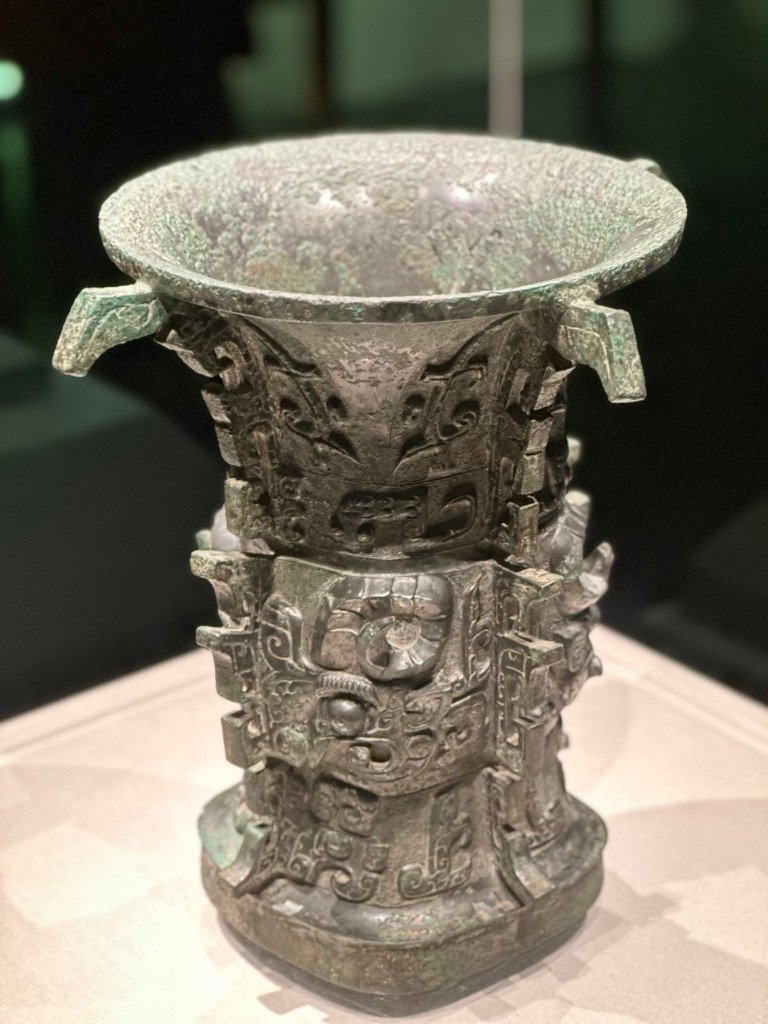
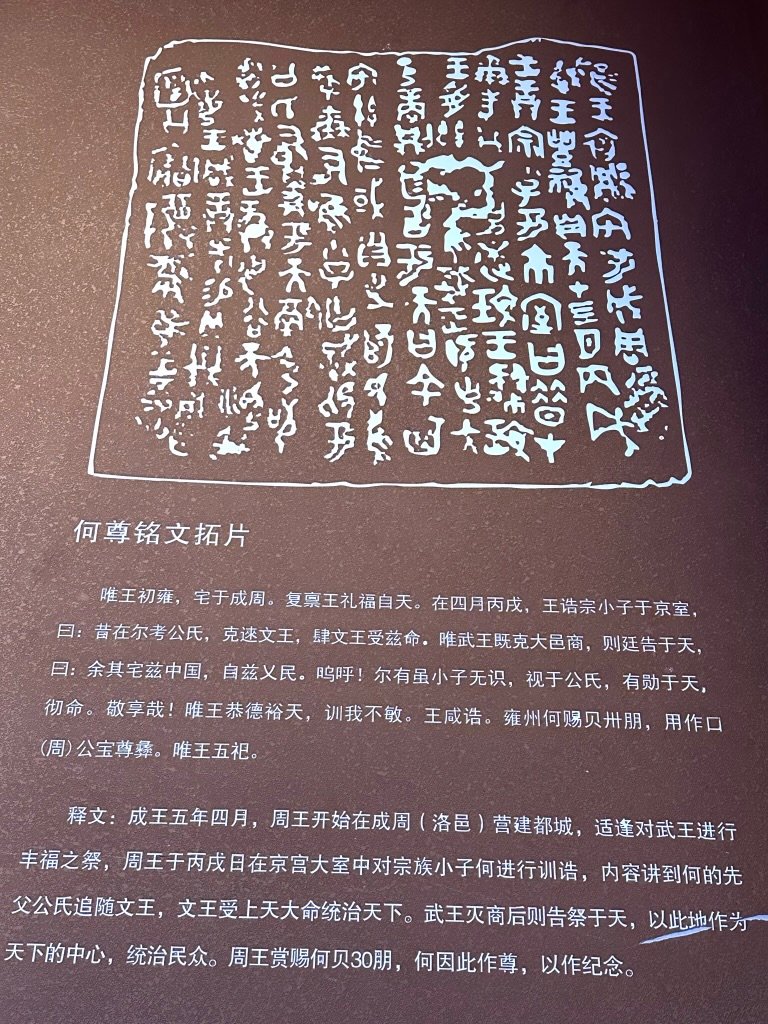
The vessel itself is from the early Western Zhou dynasty (西周, Xī Zhōu) — centuries after Taosi (陶寺, Táosì).
Its inscription contains the phrase:
宅兹中国
zhái zī Zhōngguó
Often understood in context as establishing or dwelling in the central lands.
That’s important because it shows that an idea of a political centre was clearly expressed in writing by the early Zhou period.
But notice what we just did.
We jumped forward many centuries from Taosi.
That’s exactly why we have to be careful.
Taosi Gives Us an Earlier Piece of the Puzzle — Not the Finished Answer
At Taosi (陶寺, Táosì), archaeologists have uncovered evidence of:
- a large organised settlement
- differentiated social hierarchy
- elite or palatial areas
- ritual spaces
- astronomical observation
- specialised craft production
- elaborate burials
Those things tell us that a sophisticated political and ritual centre existed here.
What they do not give us is a Taosi document saying:
“Welcome to 中国.”
So when the museum uses the idea of “the earliest China”, Dad didn’t take that to mean:
Modern China began here on a particular day 4,000 years ago.
The more interesting interpretation is that Taosi may preserve some very early ingredients of ideas that later became fundamental to Chinese civilisation:
centre
ruler
calendar
ritual
political order
Heaven and Earth

A Western Handrail
Think about asking:
“When did Europe begin?”
There isn’t one archaeological layer where somebody digs into the ground and suddenly discovers “Europe.”
The geography existed.
Different societies developed.
Ideas, institutions and identities accumulated over centuries.
Eventually something recognisably connected to the later concept emerged.
The beginnings of China (中国, Zhōngguó) are similarly complicated.
That’s why Dad finds Taosi (陶寺, Táosì) so fascinating.
It doesn’t give us a neat birthday for China.
It gives us something better:
a glimpse into the long process by which some of the ideas behind Chinese civilisation were taking shape.
But the Linfen Museum (临汾博物馆, Línfén Bówùguǎn) makes an even bigger claim.
It connects this ancient political centre with a name almost every Chinese schoolchild knows:
Yao (尧, Yáo).
And that’s where archaeology, ancient texts and cultural memory begin colliding.
Was Taosi (陶寺, Táosì) Really the Capital of Yao (尧, Yáo)?
And now we arrive at the most tempting rabbit hole of all.
Inside the Linfen Museum (临汾博物馆, Línfén Bówùguǎn), Dad saw another panel.
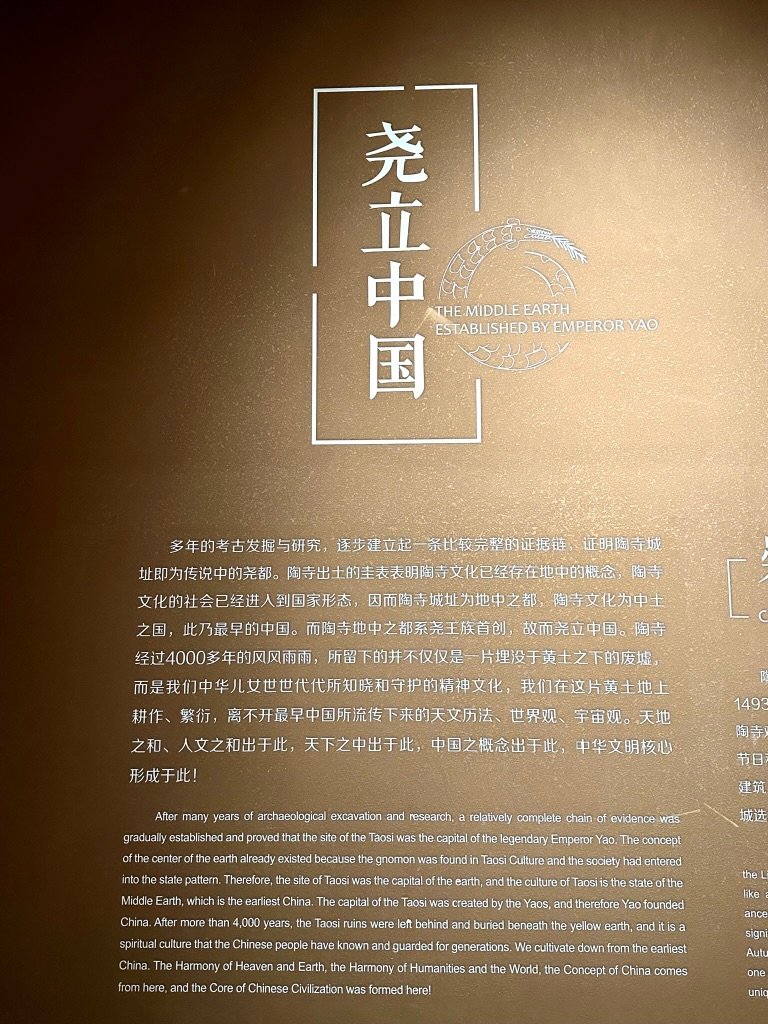
Its message is confident.
The museum presents archaeological research at Taosi (陶寺, Táosì) as supporting an identification of the site with the traditional capital of Yao (尧, Yáo).
Another panel describes the early settlement as:
帝都初成
Dìdū chū chéng
roughly:
“The imperial capital begins to take shape.”
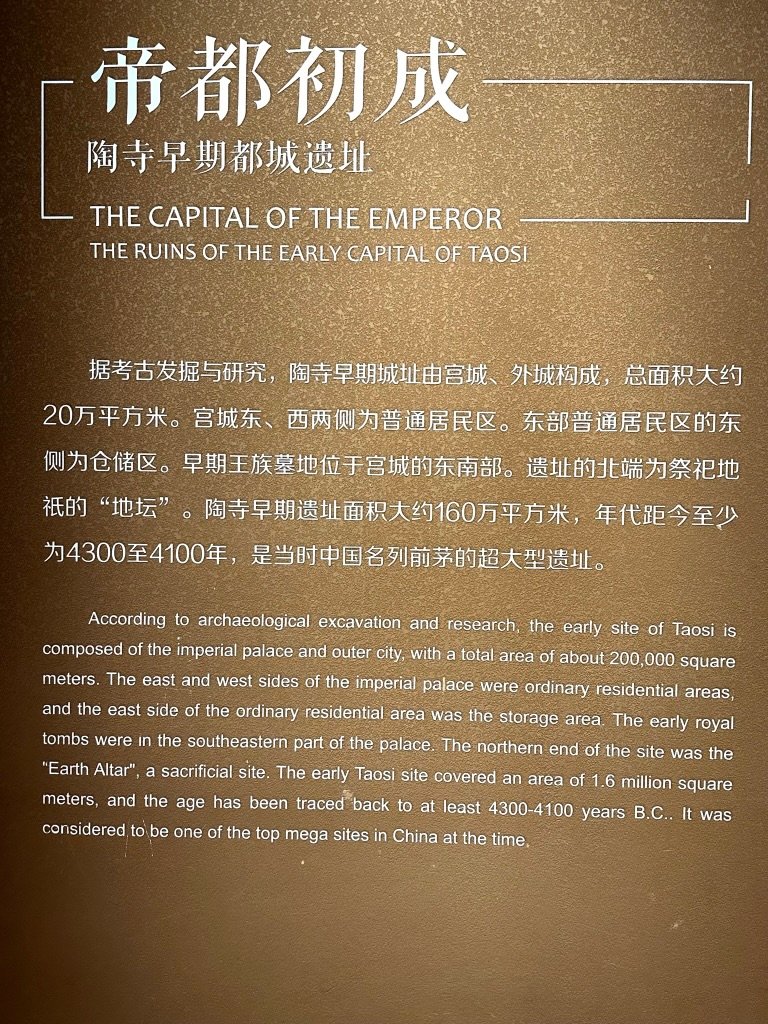
For anyone who grew up with Chinese history and traditional stories, this is enormously seductive.
Because Yao (尧, Yáo) isn’t just another ancient king.
He belongs to the world of the Three Sovereigns and Five Emperors (三皇五帝, Sānhuáng Wǔdì) — the almost misty period before China’s traditionally recorded dynasties.
And Taosi (陶寺, Táosì) sits tantalisingly close to the time and region later traditions associate with him.
So…
Have archaeologists found Yao’s capital?
Archaeology Gives Us Taosi. Tradition Gives Us Yao.
This is where Dad has to put the brakes on.
What archaeology can demonstrate is already extraordinary.
A major complex settlement existed here more than 4,000 years ago.
There were walls and organised urban spaces.
There were elite burials.
There were ritual areas.
There was specialised production.
There was astronomical observation.
There were signs of hierarchy and political organisation.
Taosi (陶寺, Táosì) is real.
We can excavate it.
We can date it.
We can study the objects its people left behind.
Yao (尧, Yáo) presents a different historical problem.
The stories about Yao were transmitted and written down through traditions that developed long after the period in which he was said to have lived.
That doesn’t make those traditions meaningless.
Far from it.
They became enormously important to the way Chinese civilisation remembered its own beginnings.
But cultural memory and archaeological proof are not the same thing.
Archaeology is archaeology.
Tradition is tradition.
The fascinating question is where — and whether — the two meet.
And That’s Why We’re Not Going to Solve Yao Here
Dad and Elaine did something else while we were in Linfen (临汾, Línfén).
We went to Yao Temple (尧庙, Yáomiào).
There, the question changes completely.
It is no longer simply:
What can archaeologists prove?
It becomes:
Why has China remembered Yao (尧, Yáo) for thousands of years — and what does he represent in Chinese ideas about good rulership?
That’s a rabbit hole big enough for another journey.
→ Follow the Yao (尧, Yáo) rabbit hole: Who Was Emperor Yao (尧帝, Yáodì)? We Went to Yao Temple (尧庙, Yáomiào) in Linfen (临汾, Línfén) to Find Out.
When We Came to Taosi, the Museum Wasn’t Even Finished Yet
There is one last part of our Taosi (陶寺, Táosì) story.
When Dad and Elaine visited in October 2023, the new Taosi Site Museum (陶寺遗址博物馆, Táosì Yízhǐ Bówùguǎn) wasn’t open.
It was still being built.
That’s why some of the Taosi archaeology we saw on that trip was back at the Linfen Museum (临汾博物馆, Línfén Bówùguǎn).
We actually filmed the new museum while it was still a construction site.
🎥 This Was the Taosi Museum in October 2023
Concrete structures, construction barriers and architectural renderings — before today’s museum experience existed.
For us, that video has become more interesting with time.
We weren’t just visiting an ancient archaeological site.
We happened to catch Taosi (陶寺, Táosì) at another moment of change — this time in the way its story would be presented to modern visitors.
What Taosi Changed for Us
We had started this journey in Xi’an (西安, Xī’ān).
The Terracotta Warriors (兵马俑, Bīngmǎyǒng) had introduced us to Qin Shi Huang (秦始皇, Qín Shǐhuáng) and the first imperial unification of China in 221 BCE.
But Dad kept asking:
What came before Qin?
Taosi (陶寺, Táosì) pushed us more than 1,500 years further backwards.
And what we found wasn’t an empty space waiting for “China” to begin.
There were already people building large settlements.
Watching the sky.
Marking time.
Growing food.
Making jade and painted pottery.
Making music.
Performing rituals.
Creating hierarchies.
Organising power.
And burying some members of their society with objects that can still stop a traveler in front of a museum case more than 4,000 years later.
Taosi didn’t give us a neat answer to:
“When did China begin?”
It made the question harder.
And much more interesting.
Because perhaps there was never one morning when everybody woke up and suddenly there was China (中国, Zhōngguó).
Perhaps what we call Chinese civilisation was assembled slowly — layer upon layer, society upon society, idea upon idea — across thousands of years.
Taosi (陶寺, Táosì) lets us see one extraordinarily early layer.
And once you’ve seen that layer, Qin no longer looks like the beginning.
It looks like another chapter.
🐇 Uh-Oh. Have You Been Stung?
If you’re now wondering:
Who exactly was Yao (尧, Yáo)?
What happened between Taosi (陶寺, Táosì) and Qin (秦, Qín)?
When can we actually start calling something “China”?
Then the ChinaTravelBUG has done its job.
There are more rabbit holes ahead.
Want to Visit Taosi (陶寺, Táosì) Yourself?
Taosi (陶寺, Táosì) isn’t somewhere we’d recommend squeezing into a rushed Xi’an (西安, Xī’ān) day trip.
The easiest base is Linfen (临汾, Línfén) in southern Shanxi (山西, Shānxī).
Getting to Linfen (临汾, Línfén)
From Xi’an (西安, Xī’ān), fast trains run to Linfen West Railway Station (临汾西站, Línfén Xī Zhàn).
The journey is roughly 1½–2 hours, depending on the train.
That makes Linfen (临汾, Línfén) easy to add after Xi’an — but we strongly recommend staying overnight rather than trying to race there and back.
Possible ≠ enjoyable.
Linfen (临汾, Línfén) → Taosi (陶寺, Táosì)
Taosi (陶寺, Táosì) lies in Xiangfen County (襄汾县, Xiāngfén Xiàn), south of central Linfen (临汾, Línfén).
When we visited, we used a car.
For an international traveler, that’s still the approach we’d favour: arrange a car or use DiDi (滴滴, Dīdī) rather than trying to build the day around local buses.
Allow enough time to visit without rushing.
This isn’t the kind of place where the reward comes from ticking off a famous landmark.
The reward comes from understanding what you’re standing on.
The Taosi Experience Has Changed Since Our 2023 Visit
One important thing to know:
our visit was in October 2023.
At that time, the new Taosi Site Museum (陶寺遗址博物馆, Táosì Yízhǐ Bówùguǎn) was still under construction.
So don’t expect your visit today to look exactly like ours.
That’s actually good news.
Modern visitors have a much better opportunity to understand the archaeological discoveries before — or after — going out into the landscape itself.
Don’t Skip Linfen Museum (临汾博物馆, Línfén Bówùguǎn)
Even with the newer museum at Taosi (陶寺, Táosì), we’d still make time for the Linfen Museum (临汾博物馆, Línfén Bówùguǎn).
For Dad, seeing the objects after walking the archaeological landscape changed the experience completely.
Out at Taosi, we saw:
the place.
At the museum, we saw:
what the people left behind.
Put the two together and those 4,000 years become much easier to imagine.
Keep Following the Rabbit Hole
Taosi (陶寺, Táosì) wasn’t the only reason we stayed in Linfen (临汾, Línfén).
The city and surrounding region opened several more doors into early Chinese history.
🐇 Who Was Yao (尧, Yáo)?
We also visited Yao Temple (尧庙, Yáomiào) in Linfen (临汾, Línfén).
That’s where archaeology gives way to another kind of question:
How did Chinese civilisation remember its earliest ideal rulers?
→ Who Was Emperor Yao (尧帝, Yáodì)? We Went to Yao Temple (尧庙, Yáomiào) to Find Out
🐇 What Is Linfen (临汾, Línfén) Actually Like?
Taosi is only one layer.
We also explored Linfen itself — a city most international travelers simply pass on the train between Xi’an (西安, Xī’ān) and other parts of Shanxi (山西, Shānxī).
→ Linfen (临汾, Línfén): The Shanxi City That Sent Us 4,000 Years Back in Time
🐇 Go Deeper Into Shanxi (山西, Shānxī)
Taosi is one course in a much bigger historical journey through Shanxi (山西, Shānxī).