What We Ate in Beijing: Old Beijing Zhajiangmian (老北京炸酱面, Lǎo Běijīng Zhájiàngmiàn)
Elaine got a ticket to the National Museum of China. Dad didn’t. So while she explored the museum, Dad walked to Wangfujing — and ended up eating one of Beijing’s signature noodle dishes.
Elaine Got In. Dad Didn’t. 😂
This wasn’t supposed to be a food story.
Elaine and I wanted to visit the National Museum of China (中国国家博物馆, Zhōngguó Guójiā Bówùguǎn) together.
Admission was free, but you still needed to secure a ticket online.
We tried.
Elaine managed to get one for herself. Dad didn’t.
So Elaine went into the museum.
Dad was left outside.
I could have waited around until she finished, but that seemed a terrible waste of a few hours in central Beijing.
So I started walking.
🚶 From the National Museum to Wangfujing
I headed toward Wangfujing (王府井, Wángfǔjǐng).
There wasn’t really a Plan B.
That was the nice part.
I wasn’t rushing between attractions or trying to tick another famous Beijing sight off a list. I simply had time to spare while waiting for Elaine.
Eventually I reached the Beijing Department Store on Wangfujing Street.
Then I discovered something downstairs.
On the B2 floor was Heping Guoju (和平菓局), a recreated old-Beijing world tucked underneath the modern department store.
🎥 Come Downstairs With Dad
I had only come to Wangfujing because I couldn’t get into the National Museum.
Now I was wandering through this unexpected little world beneath one of Beijing’s best-known shopping streets.
That became another story of its own.
But Dad was also getting hungry.
And if you’re unexpectedly wandering around Beijing…
you might as well eat Beijing.
🍜 What Dad Ate: Old Beijing Zhajiangmian
I ordered Old Beijing Zhajiangmian (老北京炸酱面, Lǎo Běijīng Zhájiàngmiàn).
Then this arrived.
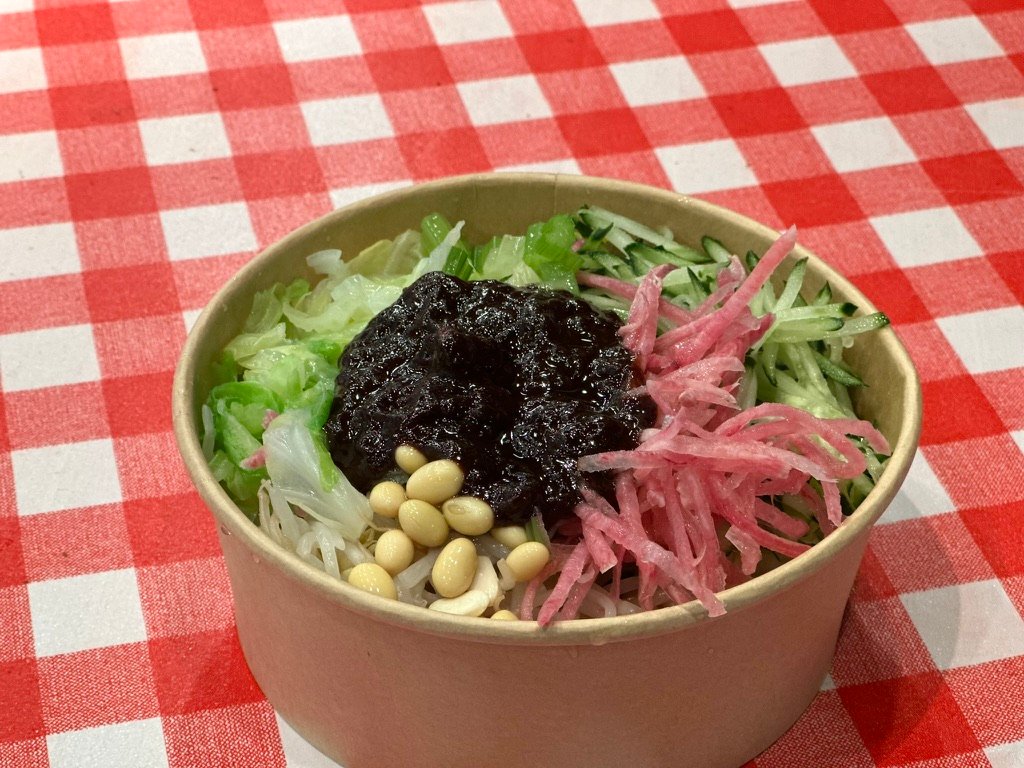
Look at it before we mix everything up.
The first thing that caught my eye was that enormous dollop of dark, glossy sauce sitting right in the middle.
Around it were different vegetables and toppings — cucumber, greens, bean sprouts, soybeans and those striking pink strips.
And underneath everything:
the noodles.
This is one of those dishes where the photograph before eating is useful.
Because what happens next isn’t particularly photogenic. 😂
🥢 Now Mix It
Zhajiangmian (炸酱面) is essentially noodles served with a thick, savory fermented-bean-based sauce and accompanying vegetables.
But don’t eat each little pile separately.
Mix it.
The dark sauce gets worked through the noodles, the vegetables get tossed in, and that beautifully arranged bowl rapidly becomes…
well…
a bowl of mixed-up noodles. 😂
But that’s when it becomes good.
You get the richness and saltiness of the sauce together with the freshness and crunch of the vegetables and the noodles underneath.
Simple food.
Filling food.
And very much a food associated with Beijing.
🎥 Dad’s Unexpected Afternoon at Heping Guoju
👀 Why This Bowl Felt So Right
There was something particularly satisfying about eating Old Beijing zhajiangmian that afternoon.
Think about how the day had unfolded.
Elaine was inside one of China’s great museums looking at national treasures.
Dad couldn’t get in.
So Dad walked away from the museum, wandered through central Beijing, went downstairs beneath a department store…
…and sat down with a bowl of noodles.
😂
But the more we’ve traveled around China, the more I’ve come to appreciate these moments.
The famous sights tell you one part of a city.
Everyday food tells you another.
You can learn about Beijing through emperors, palaces, temples and museums.
But Beijing is also something people eat.
And sometimes understanding a place begins with something as ordinary as wondering:
What are the locals putting on their noodles?
🐞 China Usually Has Another Way
There is another reason I remember this lunch.
It happened because something went wrong.
Had Dad managed to get that National Museum ticket, I would have spent the afternoon inside with Elaine.
No walk to Wangfujing.
No unexpected wandering around Heping Guoju.
And probably no zhajiangmian.
That’s become one of our recurring lessons traveling around China.
Plans change.
Tickets disappear.
You miss something.
And occasionally the thing you do instead becomes a story worth remembering.
That’s why we keep saying:
China Usually Has Another Way.
That afternoon, Elaine got the museum.
Dad got the noodles.
I think we both did rather well. ❤️
📍 If You Want to Find Dad’s Bowl
Heping Guoju (和平菓局)
B2 Floor, Beijing Department Store
255 Wangfujing Street
Dongcheng District, Beijing
🍜 What Dad Ordered
Old Beijing Zhajiangmian
老北京炸酱面
Lǎo Běijīng Zhájiàngmiàn
And if yours arrives looking as neatly arranged as Dad’s did:
Take the photograph first.
Then destroy the evidence.
Mix everything together. 😂🍜
❤️ What We Remember
The funny thing is, the National Museum ticket was the disappointment that started this story.
But that’s not what I remember most.
I remember Elaine heading into the museum without me.
I remember deciding that Dad wasn’t going to spend the next few hours sitting around.
I remember walking toward Wangfujing.
And I remember this bowl.
A dark mound of sauce.
Fresh vegetables around it.
Noodles underneath.
And Dad thinking:
Well, I’m in Beijing. Let’s eat Beijing.
Sometimes the best travel meal isn’t the restaurant you researched for weeks.
It’s the bowl you found because your original plan didn’t work. 🐞🍜