Dad’s 10 Rules for Choosing a Hotel That Actually Works
Last verified: 28 August 2026
Last verified: 20 August 2026
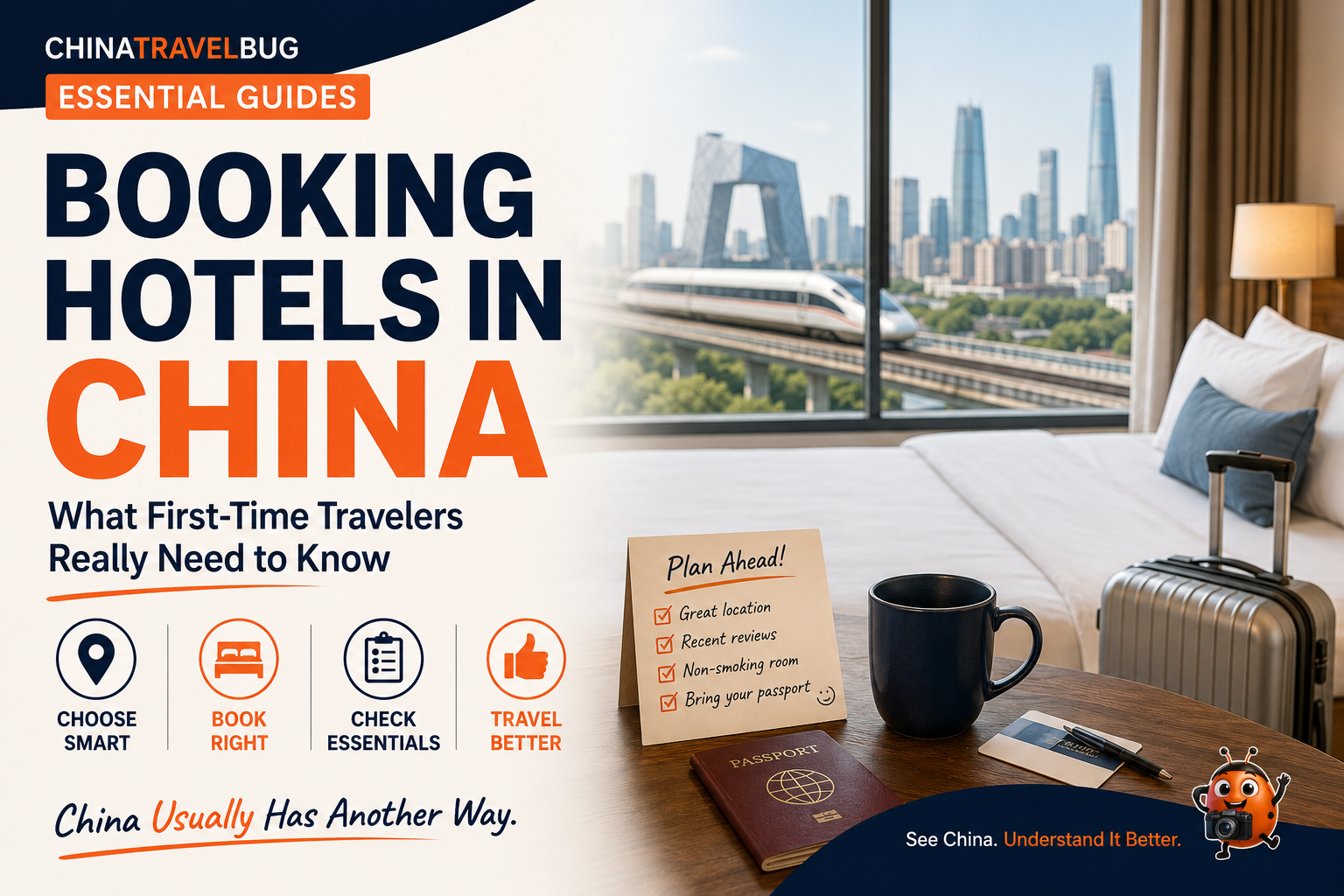
Booking a hotel in China as a foreign traveler is usually easier than old internet advice makes it sound.
Dad & Elaine have stayed in boutique hotels in Beijing, ordinary local hotels in smaller cities, and places where the receptionist clearly didn’t see many foreign passports.
So far, we’ve had no serious check-in problems.
But we’ve learned plenty of little things along the way. 😂
⚡ Quick Answer
China clarified in 2024 that accommodation providers should not refuse overseas travelers simply because they supposedly lack a special “foreign-related qualification.” Hotels still need to complete the required accommodation registration for foreign guests.
In practice, Dad normally books through Trip.com, pays to confirm the reservation and keeps the confirmation in the app.
Our most important advice?
Don’t choose the cheapest hotel. Choose the hotel that makes your itinerary easier—and check what the room is really like before pressing PAY.
Official source: In July 2024, China’s Ministry of Commerce and six other national departments clarified that qualification requirements should not be used to restrict accommodation providers from receiving overseas guests.
Read the official Ministry of Commerce notice (Chinese)
If you prefer an official English-language government source, use:
China to facilitate accommodation for foreign travelers — State Council website
Official sources: Ministry of Commerce — July 2024 measures (Chinese) · State Council English summary
🐞 Dad’s 10 Hotel Rules
1. Choose the Hotel Around Your Itinerary
Dad doesn’t begin by asking:
“Where is the city center?”
He asks:
“What are we actually doing in this city?”
If most of your attractions are downtown, staying centrally may make sense.
If the places you really want to visit are elsewhere, staying closer to them may save time—but you’ll sacrifice some convenience when traveling into the center.
There is no universally “best” hotel district.
Don’t build your itinerary around your hotel. Choose your hotel around your itinerary.
We’ve even deliberately stayed outside Beijing’s obvious tourist center when the transport, neighborhood and value worked better for us.
Why We Stayed Outside Beijing City Centre — One of Beijing’s Best Budget Hotel Finds
2. Dad’s 500-Meter Metro Rule 🚇
In cities with good Metro systems, Dad normally looks for a hotel within roughly:
500 meters of a Metro station.
We learned this the hard way in Shenzhen (深圳, Shēnzhèn).
Our hotel was about 1 km from the Metro.
One kilometer doesn’t sound far when you’re looking at a map at home.
Walk 1 km to the station.
Sightsee all day.
Walk 1 km back.
Repeat…
for a week. 😂
Dad remembered.
In smaller cities without Metro systems, such as Linfen (临汾, Línfén) and Hancheng (韩城, Hánchéng), this matters less. DiDi can be affordable enough to make a good local hotel perfectly practical.
3. Check the Neighborhood Too 🍜
Dad doesn’t only examine the hotel.
He opens the location map in the booking app and looks around it.
Are there:
restaurants · convenience stores · shops · Metro stations · shopping malls?
In Jinan (济南, Jǐnán) and Baoji (宝鸡, Bǎojī), we’ve stayed where we could walk to a shopping mall in about ten minutes.
That’s useful for meals and supplies.
But we also enjoy staying near ordinary streets lined with shops.
Restaurants opening for dinner.
Fruit shops.
Convenience stores.
Families walking home.
Delivery riders rushing around.
These aren’t tourist attractions.
But they’re often where we get a glimpse of how everyday Chinese life actually feels.
So Dad asks:
When we walk out of this hotel tonight, is there somewhere useful—or interesting—to walk?
4. Early HSR Tomorrow? Consider Sleeping Near the Station 🚄
China’s high-speed rail stations can be a long way from the city center.
If we have an early train the following morning, Dad sometimes books the final night near the HSR station.
In Tianjin (天津, Tiānjīn), hotel staff once warned us that a marathon would affect traffic on Sunday morning.
Useful information when you have a train to catch. 😬
So before an important early departure, check:
station location + departure time + morning transport conditions.
Sometimes changing hotels for one night is worth the inconvenience.
And if your China trip overlaps a major holiday, transport and hotel availability become even more important.
Chinese Public Holidays: When Should You Avoid Traveling in China?
Add the live internal link here after publishing.
5. Read RECENT Reviews — And Look at Guest Photos 📸
Dad doesn’t put much faith in glossy hotel photographs.
Of course they look beautiful.
They’re advertisements. 😂
Instead, Dad reads recent reviews and studies the photographs uploaded by actual guests.
We look for:
cleanliness · noise · room condition · cigarette smell · actual room size · bathroom
And especially…
🚽 THE TOILET.
Some smaller properties and homestays (民宿, mínsù) may have a squat toilet (蹲厕, dūncè) rather than the Western-style seated toilet you expected.
Dad would rather discover that before pressing PAY.
Hotel photos sell the room. Guest photos reveal the room.
Dad has a whole routine for screening hotels before booking:
6. Check That NON-SMOKING Box 🚭
Capital letters deliberately. 😂
We learned this through unpleasant hotel experiences in Linfen and Tianjin.
Don’t assume a modern-looking hotel automatically means a smoke-free room.
Dad now checks whether the specific room being booked explicitly states NON-SMOKING.
Not:
“The hotel looks new, so surely it’ll be fine.”
Dad tried that strategy.
Dad has retired that strategy. 😂
7. You Don’t Need an International Hotel
We’ve stayed comfortably in local and boutique hotels.
In Beijing in 2023, we paid roughly:
¥450–500 per room per night
for a pleasant boutique hotel near the hutong area.
In Hancheng in 2024, we stayed in a small, clean and well-maintained local hotel for:
under ¥160 per night.
The biggest difference in smaller local hotels is often language, not necessarily quality.
Reception staff may speak little English.
Occasionally, we’ve also felt that staff were less familiar with processing foreign passports—probably because they didn’t receive many foreign guests.
Our solution:
Passport + translation app + patience.
Every traveler should bring their own original passport for check-in.
And if you want to understand how hotel costs fit into the overall travel budget:
How Much Does a Trip to China Cost? Dad’s Guide to Traveling China Well Without Wasting Money
Add the live internal link here after publishing.
8. Arriving at 1 a.m.? Book the PREVIOUS Night ✈️
This is an easy mistake.
Suppose your flight lands:
1:00 a.m. on September 8
and you want to go straight to a hotel and sleep.
You normally need the room booked for:
Check-in: September 7
Check-out: September 8
If you book September 8 check-in, normal check-in may not begin until later that day.
Dad & Elaine sometimes book one night near the airport after very late arrivals in cities such as Beijing, Xi’an (西安, Xī’ān) and Chengdu (成都, Chéngdū).
We sleep.
Then move to our main city hotel the next morning.
One more important step:
If you can message the hotel or homestay, tell them:
“Our flight arrives after midnight. We will check in very late.”
That’s particularly useful with smaller properties.
9. Chinese Hotel Breakfast May Be VERY Chinese 😂
At a smaller local hotel, don’t automatically expect an international breakfast buffet.
From our travels, breakfast may include:
粥 (zhōu) — rice porridge
馒头 (mántou) — steamed buns
corn
sweet potatoes
eggs
cooked vegetables and savory dishes
Yes.
Some dishes may look like something a Western traveler would eat for lunch.
In China?
Breakfast. 😂
The variety at a small local hotel can also be quite limited.
That’s not necessarily a problem—we enjoy seeing what local travelers eat.
Just know what to expect before paying extra for breakfast.
10. Coffee People: Bring a Mug ☕😂
This sounds ridiculous until it happens.
Dad & Elaine have been caught twice in smaller hotels or homestays where there was an electric kettle…
but no suitable cup and teaspoon.
Dad had coffee sachets.
Dad had hot water.
Dad had a problem. 😂
So our tiny morning kit now includes:
☕ Coffee sachets
☕ Mug
🥄 Teaspoon
Most hotels we’ve stayed in have an electric kettle.
But if your morning hot drink matters to you, bring the tiny things you actually need to make it.
📱 How Dad Actually Books
Dad normally uses Trip.com and generally pays when booking so the reservation is confirmed in the app.
We’ve also had a refund issue where Trip.com customer service called us and helped resolve it.
That’s one reason Dad doesn’t choose a booking platform—or hotel—purely because something is ¥10 cheaper.
Support has value too.
For our broader guide to booking trains, attraction tickets and other things that may need advance reservations:
Booking Tickets & Reservations in China — The Essential Guide for Foreign Travelers
🆘 What If Hotel Check-In Goes Wrong?
Keep it simple.
1. Show your passport and booking confirmation.
2. Use a translation app if language is the problem.
3. Give reception some time if they’re unfamiliar with foreign-passport registration.
4. Contact your booking platform if the reservation itself is disputed.
5. If necessary, find another workable solution rather than sacrificing half your travel day arguing at reception.
China Usually Has Another Way.
🐞 Dad’s 30-Second Hotel Checklist
Before pressing PAY:
- ☑ Does the location fit our itinerary?
- ☑ Metro within roughly 500m where relevant?
- ☑ Restaurants/shops nearby?
- ☑ Recent reviews good?
- ☑ Guest photos look good?
- ☑ Bathroom and toilet suitable?
- ☑ NON-SMOKING?
- ☑ Cancellation conditions acceptable?
- ☑ Early train/late flight considerations?
- ☑ Price reasonable?
And at check-in:
Passport for everyone + booking confirmation + translation app.
That’s basically it.

ChinaTravelBUG’s Take
Dad’s hotel formula has gradually become:
ITINERARY → LOCATION → METRO → NEIGHBORHOOD → RECENT REVIEWS → GUEST PHOTOS → TOILET → NON-SMOKING → PRICE
Notice where price comes?
Last. 😂
Because the cheapest hotel isn’t necessarily the best value.
A hotel beside the right Metro station may save you hours.
A neighborhood full of local shops may make evenings more enjoyable.
A hotel beside the HSR station may save an early-morning disaster.
And a room costing ¥20 less isn’t a bargain if Dad opens the bathroom door and discovers something he really wishes he’d checked in the guest photos. 😂
Choose the hotel that makes your China journey easier—not simply the hotel with the lowest number on the screen.
See China. Understand It Better. 🐞