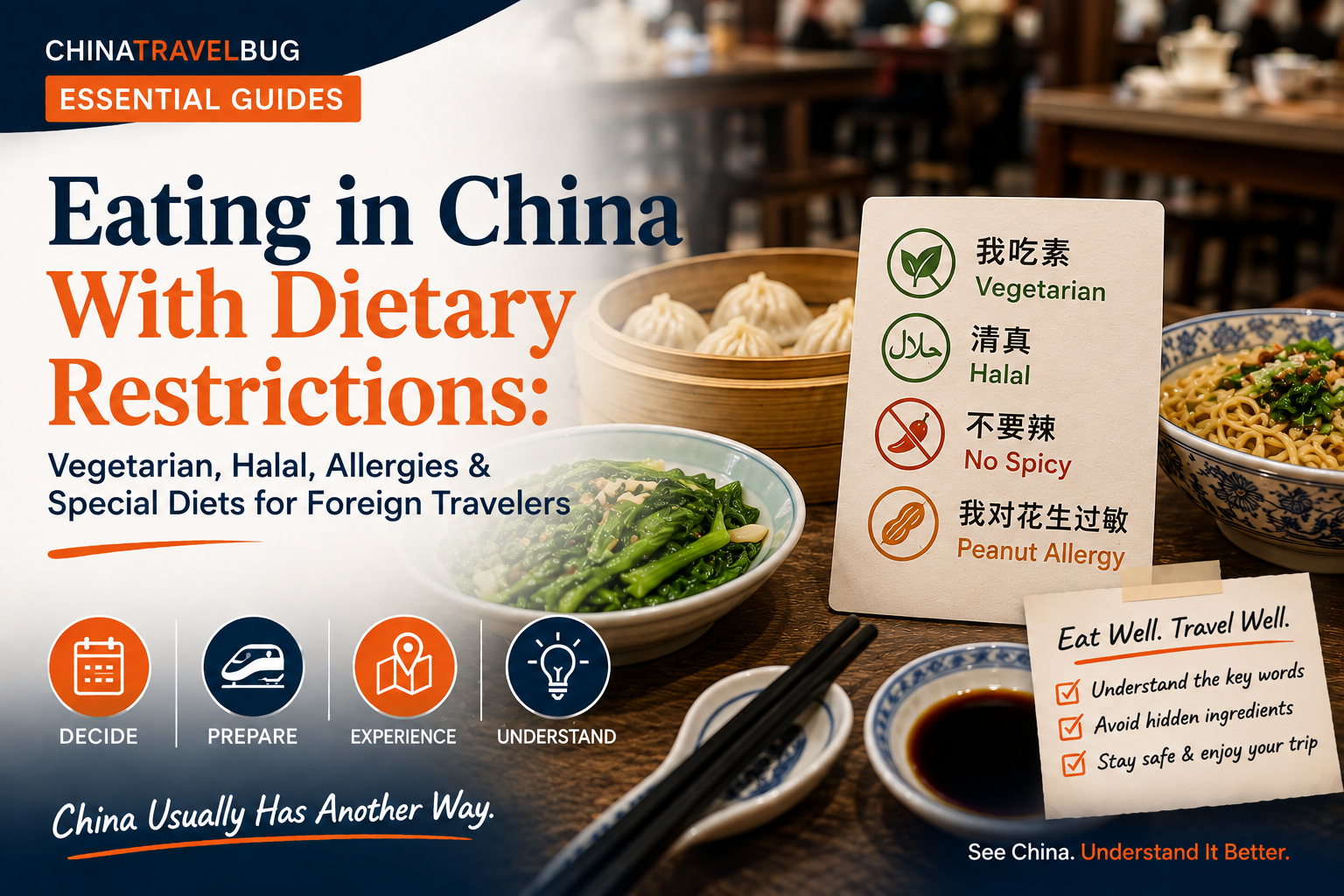
Vegetarian, Halal, Allergies & Special Diets for Foreign Travelers
China is one of the world’s great food destinations.
But if you’re vegetarian, vegan, Muslim, allergic to certain foods—or simply don’t eat pork—the first meal can feel more complicated than exciting.
The good news?
You can travel China with dietary restrictions.
The important thing is knowing what your restriction actually means in a Chinese kitchen—and communicating it clearly.
⚡ Quick Answer
If you have dietary restrictions in China:
- Save your requirements in written Chinese on your phone.
- Show them to restaurant staff before ordering.
- Don’t assume a vegetable-looking dish is vegetarian.
- Don’t assume “no pork” means halal.
- Don’t assume removing an ingredient makes a dish safe for someone with a serious allergy.
- Keep a few simple backup foods available for situations where communication becomes difficult.
For ordinary preferences, translation apps can often solve the problem.
For serious food allergies, be much more cautious.
A translated sentence is helpful—but it cannot guarantee how a kitchen prepares your food.
1. The Most Important Rule: Don’t Assume
Chinese cooking often contains ingredients that aren’t obvious from looking at the finished dish.
A vegetable dish may have been cooked with:
- meat;
- meat stock;
- oyster sauce;
- animal fat;
- dried shrimp;
- or another ingredient used for flavour.
Likewise, asking:
“Does this have pork?”
only answers one question.
It doesn’t necessarily mean the dish is vegetarian, halal or suitable for your allergy.
So instead of trying to memorize dozens of Chinese food rules, remember this:
🐞 ChinaTravelBUG Tip: Tell the restaurant what you cannot eat, rather than assuming the name or appearance of a dish tells you what’s inside.
2. Vegetarian & Vegan Travelers
Being vegetarian in China is certainly possible—but the word “vegetarian” can mean different things to different people.
The useful Chinese word to recognize is:
素食 — sùshí — vegetarian food
You may also see restaurants specializing in:
素食餐厅 — sùshí cāntīng — vegetarian restaurant
But in an ordinary restaurant, simply pointing at a plate of vegetables isn’t enough.
A vegetable dish may still contain meat stock, oyster sauce or small pieces of meat used for flavour.
If you don’t eat any meat, you can show:
我不吃肉。
Wǒ bù chī ròu.
I don’t eat meat.
For a vegan traveler, the requirements are broader because eggs, dairy and other animal-derived ingredients may also matter.
Don’t worry about speaking perfect Mandarin.
Showing clear Chinese text on your phone is often more useful than trying to pronounce a sentence nobody understands. 😂
And when you’re uncertain?
Choose something simpler—or choose another restaurant.
China Usually Has Another Way. 🐞
3. Halal Food in China — Look for 清真
For Muslim travelers, one of the most useful Chinese words to recognize is:
清真 — qīngzhēn — halal
You’ll often see 清真 displayed prominently on restaurants serving Muslim communities in China.
Depending on the city, you may find halal restaurants serving dishes such as beef and lamb noodles, dumplings, grilled meat and regional cuisines from northwest China.
Look for:
清真餐厅 — qīngzhēn cāntīng
Halal restaurant
清真食品 — qīngzhēn shípǐn
Halal food
In parts of China, the use of 清真 by food businesses is specifically regulated, including requirements concerning ingredients, preparation, equipment and separation from prohibited foods.
But there is an important distinction:
“No pork” does NOT automatically mean halal.
A restaurant may serve beef or chicken and still not meet your halal requirements.
So if halal preparation matters to you, look for a restaurant clearly identifying itself as 清真, rather than simply asking a normal restaurant to leave the pork out.
🐞 ChinaTravelBUG Tip: Save 清真 on your phone before traveling. Those two Chinese characters can be far more useful than trying to explain “halal” in English.
And if you have particularly strict requirements, ask the restaurant directly rather than assuming that every place recommended online follows exactly the same standards you do.
China is huge, and practices can vary from place to place.
The safest principle is simple:
Look for 清真. Ask when unsure. Don’t equate “no pork” with halal.
4. Food Allergies — Take This More Seriously
A food preference and a serious food allergy are not the same thing.
If eating an ingredient could cause a serious allergic reaction, don’t rely only on pointing at a menu or using a quick translation app.
Chinese cooking can involve ingredients that aren’t obvious in the finished dish—such as peanuts, sesame, shellfish, soy, eggs or sauces containing several ingredients.
There is also the issue of cross-contact: the food you order may not contain your allergen as an ingredient, but the same wok, utensils, oil or preparation surface may have been used for other foods. Chinese food-safety guidance itself recognizes cross-contact as an allergen-management issue.
Prepare Before You Travel
If you have a serious food allergy:
- Carry the medication prescribed for your allergy.
- Bring a written allergy card in Simplified Chinese explaining exactly what you cannot eat.
- Keep safe snacks with you for situations where you’re uncertain.
- Tell restaurant staff about the allergy before ordering.
- If staff cannot confidently understand your requirement, choose somewhere else.
Food Allergy Research & Education (FARE) specifically recommends translated chef cards for international travel and provides one in Simplified Chinese.
🐞 ChinaTravelBUG Tip: For a serious allergy, “I showed them Google Translate” isn’t enough reassurance. You need confidence that the restaurant understands both the ingredient and how the food is prepared.
And if you’re not confident?
Don’t eat it.
Finding another restaurant—or eating one of the safe foods you’ve brought with you—is much better than taking a risk simply because you’re hungry.
5. “I Don’t Eat Pork” and “I Can’t Eat Spicy Food”
Not every dietary restriction is complicated.
Sometimes you simply need to tell the restaurant:
我不吃猪肉。
Wǒ bù chī zhūròu.
I don’t eat pork.
Or:
我不吃辣。
Wǒ bù chī là.
I don’t eat spicy food.
You can also ask:
不要辣。
Bú yào là.
No chilli / not spicy, please.
These are useful phrases to save on your phone and show restaurant staff. They are commonly recommended in traveler-oriented Chinese phrase guides.
🌶️ A Small Warning About “Not Spicy”
China has enormous regional differences in food.
In places such as Sichuan, Chongqing, Hunan and Guizhou, chilli can be an important part of the cuisine.
If you genuinely cannot tolerate spicy food, don’t assume that:
微辣 — wēi là — “mildly spicy”
will feel mild to you. 😂
Ask for 不要辣 (bú yào là) instead.
And remember: Sichuan peppercorn 花椒 (huājiāo) produces the famous numbing sensation and is different from chilli heat. If you dislike that too, you can show:
不要花椒。
Bú yào huājiāo.
No Sichuan peppercorn, please.
🐞 ChinaTravelBUG Tip: Don’t worry about perfect pronunciation. Save the Chinese characters and show them on your phone. Clear communication matters more than performing Mandarin at the dinner table.
And if the restaurant tells you a particular dish can’t really be made without chilli, choose another dish.
Sometimes changing the order is easier than changing the recipe.
| English | Chinese | Pinyin |
|---|---|---|
| I don’t eat meat | 我不吃肉 | Wǒ bù chī ròu |
| I don’t eat pork | 我不吃猪肉 | Wǒ bù chī zhūròu |
| I don’t eat seafood | 我不吃海鲜 | Wǒ bù chī hǎixiān |
| I don’t eat eggs | 我不吃鸡蛋 | Wǒ bù chī jīdàn |
| I don’t eat spicy food | 我不吃辣 | Wǒ bù chī là |
| No chilli, please | 不要辣 | Bú yào là |
| No Sichuan peppercorn | 不要花椒 | Bú yào huājiāo |
| I’m vegetarian | 我吃素 | Wǒ chī sù |
| Does this contain meat? | 这个有肉吗? | Zhège yǒu ròu ma? |
| Does this contain pork? | 这个有猪肉吗? | Zhège yǒu zhūròu ma? |
| Halal | 清真 | Qīngzhēn |
| Halal restaurant | 清真餐厅 | Qīngzhēn cāntīng |
7. Have a Backup Food Strategy
Even with good preparation, there may be moments when you’re tired, communication isn’t working, or you simply don’t feel confident about a restaurant.
That’s when a backup plan helps.
Useful fallbacks can include:
- packaged foods where you can inspect the ingredients;
- fruit;
- bread or simple snacks;
- convenience stores;
- supermarkets;
- food you’ve brought for emergencies;
- your hotel, where staff may be able to help explain your requirements.
For vegetarians, halal travelers and people with dietary preferences, this is mainly about convenience.
For someone with a serious allergy, it’s about reducing risk.
🐞 ChinaTravelBUG Tip: Don’t wait until you’re starving to start looking for suitable food. If you find something you know works for you, keep a backup snack in your day bag.
China’s cities have enormous food choices.
If one restaurant can’t accommodate you, don’t turn dinner into a negotiation.
Try somewhere else.
China Usually Has Another Way. 🐞
8. When Translation Isn’t Enough
Translation apps are incredibly useful in China.
But they can’t see inside the wok.
If you’re explaining a simple preference such as “no chilli”, showing Chinese text on your phone will often be enough.
If you’re vegetarian or require halal food, choose restaurants where your requirements are clearly understood whenever possible.
And if you have a serious food allergy, the standard should be higher:
If you’re not confident they understand, don’t take the risk.
No restaurant meal is worth gambling with your health.
🐞 The ChinaTravelBUG Bottom Line
Traveling China with dietary restrictions may require a little more preparation, but it doesn’t mean missing out on Chinese food.
Remember three things:
Tell people clearly what you cannot eat.
Don’t assume from appearances.
Always have a backup.
And save the Chinese phrase card above to your phone before you travel.
Last verified: 29 August 2026