Elaine’s First Green Train in China — Then We Discovered We Had No Seats!
On the Move in Shaanxi: Elaine’s First Ride on a Chinese Green Train
Elaine had already traveled on plenty of trains in China.
Fast ones.
Very fast ones.
The sleek high-speed rail (高铁, gāotiě) that makes moving between Chinese cities remarkably easy.
But Dad wanted her to experience another side of China’s railway system.
Something older.
Something slower.
Something that millions of Chinese passengers have traveled on for generations.
A green train — 绿皮车 (lǜpíchē).
So when we needed to travel from Xianyang (咸阳, Xiányáng) to Baoji (宝鸡, Bǎojī) in Shaanxi Province (陕西省, Shǎnxī), Dad saw an opportunity.
Instead of automatically choosing the fastest option…
why not let Elaine try a green train for the first time?
It sounded like a good idea.
Then we got onboard.
And discovered something Dad hadn’t quite planned for.
We had no seats.
😂
🎥 First, Come See Elaine’s Green Train Arrive
There she is.
Pink cap.
Backpack.
Suitcase beside her.
Standing behind the yellow safety line at Xianyang Railway Station (咸阳站, Xiányáng Zhàn).
Then the locomotive appears.
Behind it come those long, dark-green passenger carriages.
绿皮车 — lǜpíchē
Literally, a “green-skinned train.”
The station board showed our train:
K1305
开往兰州 — bound for Lanzhou
到点 10:51 — arrival 10:51
开点 10:53 — departure 10:53
正点 — on time
Elaine watched it roll into the station.
This was her first time.
She was excited.
Dad was excited too.
At this point…
neither of us knew about the seat problem yet.
😂
🚉 But Why Were We Starting From Xianyang?
This needs a little explanation for international travelers.
Many visitors know the name Xi’an (西安, Xī’ān).
Far fewer know Xianyang (咸阳, Xiányáng).
Yet if you’ve flown into Xi’an, you’ve probably already encountered the name because the city’s main airport is:
Xi’an Xianyang International Airport
西安咸阳国际机场
The airport is actually located in the administrative area of Xianyang, northwest of central Xi’an.
And Xianyang is far more than the place where Xi’an’s airport happens to be.
It was once the capital of the Qin state and then of the first unified Qin empire under Qin Shi Huang (秦始皇, Qín Shǐhuáng).
🐇 Why Is Xi’an’s Airport Called Xianyang? Our Xi’an Xianyang International Airport Guide →
For this part of our journey, we weren’t rushing straight into central Xi’an.
We were traveling west.
Toward Baoji (宝鸡).
So Xianyang Railway Station (咸阳站) became our starting point.
🚉 Even the Station Felt Different

One thing Dad immediately noticed was the station itself.
This wasn’t one of China’s enormous new high-speed railway stations.
Xianyang Railway Station (咸阳站) is an older conventional railway station serving traditional train services as well as other rail traffic.
And older Chinese railway stations can have a completely different character from the newer HSR stations.
China’s modern high-speed stations are impressive.
Large.
Bright.
Efficient.
Very modern.
And often architecturally quite standardized.
Older stations can feel more individual.
More connected to the city you’re actually standing in.
🖼️ That’s Why Dad Took This Photo

While we were waiting, Dad noticed the huge mural inside the station.
Look at it carefully.
Ancient figures.
Horse-drawn chariots.
Historical scenes.
Images evoking the Qin and Han worlds.
This wasn’t simply decoration to Dad.
We were sitting in Xianyang (咸阳) — a city deeply connected with the rise of the Qin (秦).
So the station itself was giving travelers a little reminder:
You are somewhere with history.
That’s one thing Dad likes about some of China’s older railway stations.
They may not have the scale or polish of the newest high-speed stations.
But sometimes…
they have more character.
And Dad will happily photograph a railway-station wall if it sends him down another historical rabbit hole.
😂🐇
So What Exactly Is a “Green Train”?
The Chinese term is:
绿皮车 (lǜpíchē)
Literally:
绿 (lǜ) — green
皮 (pí) — skin
车 (chē) — vehicle/train
Hence:
“green-skinned train.”
Historically, the nickname came from the familiar green-painted passenger coaches used across China’s conventional railway network.
Today, the term is still commonly used for these traditional slower passenger trains.
They’re very different from the 高铁 (gāotiě) experience many international travelers associate with modern Chinese rail travel.
They’re generally slower.
The carriages feel older.
The interior layout is different.
And the journey can feel much closer to an older era of Chinese railway travel.
For Elaine…
that was exactly why Dad wanted her to try one.
😳 Then We Looked at Our Tickets…
We boarded.
Found our carriage.
Looked for our seats.
And…
there weren’t any.
Dad checked again.
Then we realized what we’d bought.
无座 (wúzuò)
Two very useful Chinese characters for travelers to recognize.
无 (wú) = without / none
座 (zuò) = seat
Put them together:
无座 = NO SEAT
😂
Wait — China Actually Sells Train Tickets Without Seats?
Yes.
On some conventional Chinese trains, a 无座票 (wúzuò piào) is a valid ticket for the journey…
but it does not give you an assigned seat.
You’re allowed to board the train.
You’re allowed to travel to your destination.
You simply aren’t guaranteed somewhere to sit.
If an unoccupied seat becomes temporarily available, passengers may sometimes sit until the ticket holder needs it.
Otherwise…
you stand.
Or find whatever practical space is available without obstructing the carriage.
Suddenly Dad understood why our tickets had been available.
😂
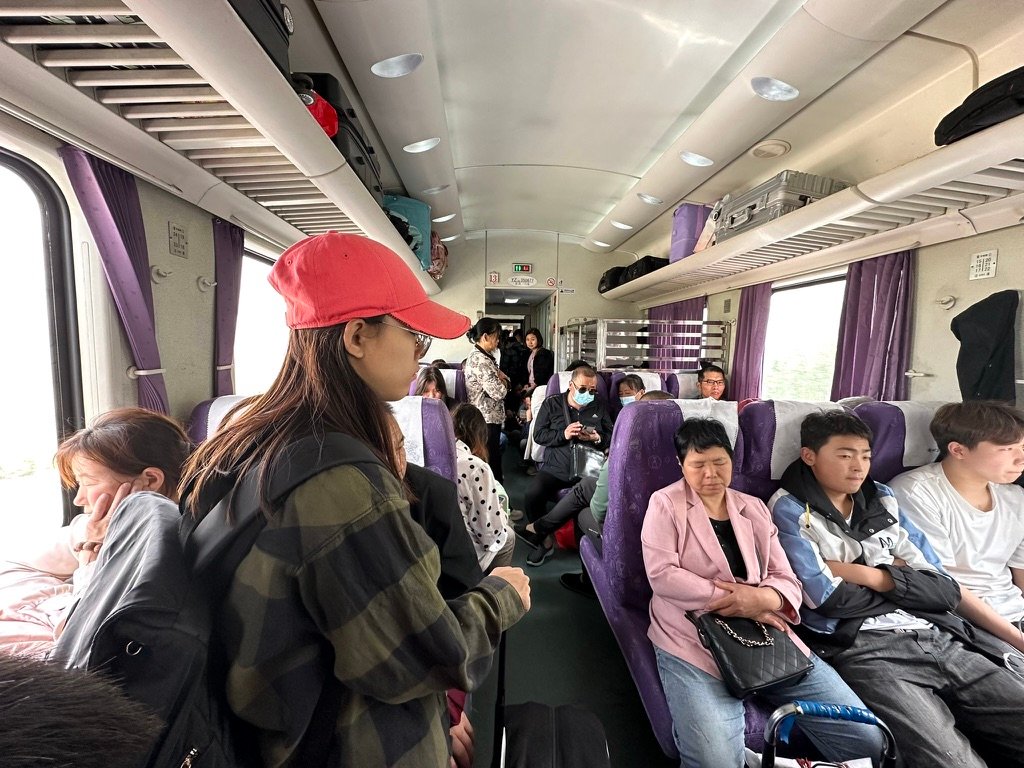
And We Had Luggage
Of course we did.
This wasn’t a little commuter trip with nothing but a phone.
Elaine had her backpack.
We had our suitcase.
Other passengers had luggage too.
And now we were standing inside an older train carriage trying to work out where:
we
+
our bags
+
everybody else
were supposed to fit.
This was turning into considerably more of an “educational field trip” than Dad had planned.
😂
Fortunately, There Was One Very Important Detail
The journey from Xianyang to Baoji was:
less than two hours.
That changed everything.
If Dad had accidentally booked 无座 for an eight-hour journey…
this article might have a very different tone.
😂
But for less than two hours?
Okay.
We could do this.
And more importantly…
Elaine could do this.
So instead of turning it into a disaster, we treated it as part of the experience.
Our first green train.
Our first 无座 ticket.
And another little lesson in how travel in China doesn’t always happen exactly the way Dad expects.
🎥 This Is What Our Green-Train Journey Felt Like
Listen to the train.
The wheels running along the tracks.
The station sounds.
Passengers moving through the carriage.
The long green coaches.
The luggage.
The movement.
This wasn’t the sleek, quiet world of China’s modern 高铁 (gāotiě).
It felt older.
Slower.
Busier.
And much closer to the traditional Chinese railway experience Dad wanted Elaine to see.
Would Dad deliberately choose 无座 next time?
Probably not.
😂
Would Dad choose another green train?
Absolutely.
Those are two very different questions.
How Did Elaine Take It?
This was the part Dad was watching.
Not the train.
Elaine.
Would she complain?
Would the lack of a seat ruin the journey?
Would she decide Dad’s latest “interesting experience” was a terrible idea?
😂
No.
She adapted.
We stood.
We moved around when necessary.
We dealt with the luggage.
We watched what everybody else was doing.
And gradually the journey became…
just another part of the trip.
That matters to Dad.
Travel with a child — even when that “child” is getting older — isn’t only about showing them famous monuments.
Sometimes it’s about learning:
Things don’t always go according to plan.
And that’s okay.
🚉 Then We Reached Baoji

And there she was.
Still smiling.
😂
宝鸡站 — Bǎojī Zhàn
Baoji Railway Station
Our first green-train journey was finished.
Our first 无座 experience was finished too.
And Elaine had arrived in Baoji in perfectly good spirits.
Which was fortunate…
because Baoji was largely her fault.
😂
🐇 Why Were We Going to Baoji Anyway?
Most first-time international travelers to Shaanxi focus on Xi’an (西安).
Understandably.
The Terracotta Warriors.
The City Wall.
The Bell Tower.
The Muslim Quarter.
But Dad has a habit.
He looks at the map around a famous destination…
and starts asking:
“What else is out there?”
🐇
That’s how Baoji (宝鸡, Bǎojī) entered our journey.
Baoji lies west of Xi’an in Shaanxi Province (陕西省).
And it opens a door into something Dad finds fascinating:
the China before Qin Shi Huang.
Before the first emperor unified China in 221 BCE…
there were earlier political worlds.
Earlier capitals.
Earlier ritual systems.
Earlier ideas about kingship and legitimacy.
And the story of the Zhou Dynasty (周朝, Zhōu Cháo) becomes especially important.
Baoji and the surrounding region are deeply connected with that story.
🐇 Beyond Xi’an: Why We Went to Baoji — Into the China Before Qin Shi Huang →
🏺 Elaine Had Her Own Reason
Dad wasn’t the only one interested.
Elaine had decided she wanted to see Baoji’s famous bronze collections.
In particular, the:
Baoji Bronze Ware Museum
宝鸡青铜器博物院 (Bǎojī Qīngtóngqì Bówùyuàn)
Baoji is one of China’s important centers for the study and display of ancient Chinese bronzes, particularly objects connected with the Zhou world.
And Elaine had said:
we must go.
So Dad found the trains.
And that’s how an interest in ancient Chinese bronzes eventually resulted in…
Elaine standing on a green train without a seat.
😂
Travel rabbit holes have consequences.
What Dad Learned About Chinese Train Tickets That Day
This story also gave us a very practical lesson for international travelers.
When booking conventional Chinese trains, don’t look only at:
- the departure time
- the arrival time
- the train number
- the price
Also look carefully at the seat type.
If you see:
无座 (wúzuò)
it does not mean the train is standing-room-only.
It means:
your particular ticket does not include an assigned seat.
Other passengers on the same train may have seats.
That’s an important distinction.
Would We Recommend a 无座 Ticket?
It depends.
For a relatively short journey like ours?
If the alternative were not traveling at all, Dad could consider it.
For a long journey?
With lots of luggage?
With younger children?
With an elderly traveler?
Dad would think very carefully.
A cheap ticket isn’t necessarily good value if you’re miserable for six hours.
And if you’re specifically interested in trying a green train, you don’t need to copy our no-seat adventure.
😂
Book a seat if one is available.
You can still enjoy the 绿皮车 experience perfectly well while sitting down.
Dad’s Green-Train Checklist for First-Time Travelers
Before confirming a conventional train ticket, check:
1. Train number
Traditional services commonly use letters such as K, T or Z, depending on the service type.
2. Journey time
A route that takes an hour or two on high-speed rail may take considerably longer on a conventional service.
3. Seat type
Look carefully for:
硬座 (yìngzuò) — hard seat
软座 (ruǎnzuò) — soft seat, where offered
硬卧 (yìngwò) — hard sleeper
软卧 (ruǎnwò) — soft sleeper
无座 (wúzuò) — no assigned seat
4. Your luggage
Standing for a short journey is one thing.
Standing while managing large suitcases is another.
5. Who you’re traveling with
A green train can be a wonderful experience.
But Dad would plan differently for small children, older family members or anyone with mobility issues.
Want to Make the Baoji Journey Yourself?
Our story is about what happened to Dad and Elaine.
But if you’re actually planning to travel there, we’ve separated the practical information for you:
👉 How to Visit Baoji (宝鸡) From Xi’an (西安) — A Practical Guide for Foreign Travelers →
That guide is about:
how to do it.
This story is about:
what happened when we did.
ChinaTravelBUG’s Take
Would high-speed rail have been easier?
Of course.
Would having seats have been more comfortable?
Definitely.
😂
But Dad doesn’t regret putting Elaine on that green train.
Because years later, we’re unlikely to remember every perfectly smooth high-speed journey.
But Elaine’s first 绿皮车?
The old station.
The mural.
Standing on the platform watching those green carriages arrive.
Climbing aboard.
Looking for our seat numbers.
And then realizing…
there weren’t any.
That one we’ll remember.
And perhaps that’s the difference between simply moving around China…
and traveling through it.
Sometimes Dad plans the lesson.
Sometimes China supplies one Dad wasn’t expecting.
This time it came in two Chinese characters:
无座
And waiting at the other end of the journey was Baoji (宝鸡) — and another rabbit hole into a China that existed long before Qin Shi Huang.
🐇