From Our Beijing Guides
Authentic local advice from the licensed Beijing guides we work with.
Quick Answer
Most first-time visitors only see about half of what the Forbidden City has to offer.
Almost everyone walks through the grand halls, takes photographs of the magnificent courtyards and leaves impressed by its size. But according to the licensed Beijing guides we work with, many visitors unknowingly walk past some of the palace’s most fascinating stories and architectural details.
If you know what to look for, your visit becomes far more than a sightseeing stop—it becomes a journey into how China’s emperors ruled one of the world’s greatest civilisations.
Why This Question Matters
The Forbidden City is one of the world’s largest palace complexes.
With more than 980 surviving buildings spread across 72 hectares, it is impossible to appreciate everything in a single visit.
Many visitors leave saying,
“It was beautiful… but after a while, every palace looked the same.”
Our Beijing guide hears this comment surprisingly often.
“The buildings only look similar,” he told us. “Once you understand what each building was designed to do, the Forbidden City suddenly becomes much more interesting.”
Instead of trying to see everything, he recommends learning to notice the details that most visitors walk straight past.
Which Buildings Are Actually Worth Slowing Down For?
Most visitors naturally spend the most time at the three great ceremonial halls.
Our guide agrees they’re essential—but he encourages visitors to look beyond the obvious.
Taihe Hall (Hall of Supreme Harmony)
Everyone photographs the building.
Few people look up.
Its roof carries ten mythical roof guardians, the highest rank permitted in traditional Chinese architecture.
No other surviving building in China has more.
For our guide, this is one of the easiest ways to understand the supreme status of the emperor.
Zhonghe Hall (Hall of Central Harmony)
Many tour groups spend less than a minute here.
Our guide often spends much longer.
This was where the emperor rested and prepared before major state ceremonies.
Its smaller scale reminds visitors that the Forbidden City wasn’t only about grandeur—it was also carefully designed for ritual.
The Treasure Gallery
“If you have extra time,” our guide says, “don’t skip it.”
Here you’ll find imperial jewellery, ceremonial objects and extraordinary works of craftsmanship that many visitors never see because they stay only on the central axis.
What’s the Best Route Through the Forbidden City?
The classic route follows the central axis from south to north.
It’s logical.
It’s historic.
It’s also where almost everyone goes.
Our guide prefers a slightly different approach.
After entering through Meridian Gate, spend a little time on the central axis before exploring the quieter western palaces.
There you’ll find:
- Ceramic exhibitions
- Cining Palace Garden
- Smaller courtyards
- Far fewer tour groups
Later, return towards the eastern side to visit the Treasure Gallery before leaving through the Gate of Divine Might.
The result?
A much calmer visit without missing the highlights.
What Details Do Most Tourists Never Notice?
Our guide smiled when we asked this question.
“There are hundreds,” he laughed.
These are four that almost everyone misses.
The Door Studs
Almost every visitor photographs the giant red palace gates.
Very few count the brass studs.
Most imperial gates have nine rows of nine studs—81 in total.
Nine represented the highest single-digit number in traditional Chinese culture and symbolised supreme imperial authority.
The Sundial
Standing quietly outside the Hall of Supreme Harmony is a beautifully carved stone sundial.
Many tourists mistake it for decoration.
It actually symbolised the emperor’s authority over time itself.
The Bronze Measuring Vessel
Nearby sits another object that visitors often ignore.
This large bronze vessel represented the official standard for weights and measures throughout the empire.
Its message was simple:
The emperor governed fairly by ensuring one standard for everyone.
The “Water Crystal Palace”
One of our guide’s favourite stories concerns Yanxi Palace.
During the late Qing Dynasty, plans were made to construct an extraordinary Western-style glass palace using steel and glass.
Political turmoil and financial difficulties meant it was never completed.
Today its unfinished remains create one of the Forbidden City’s most unusual corners.
What Symbols Keep Appearing Throughout the Palace?
Once you notice them, you’ll begin seeing them everywhere.
Dragons
Power.
Imperial authority.
The emperor himself.
Phoenixes
Usually associated with the empress.
Together with dragons they symbolised harmony between emperor and empress.
Bats
Many Western visitors are surprised to discover bats decorating palace buildings.
In Chinese, the word for bat (蝠) sounds similar to the word for good fortune (福).
The decoration isn’t about animals.
It’s about wishing good luck.
Mountains and Waves
Look carefully at imperial robes.
You’ll often see mountains rising above crashing waves.
These represented stability, order and the emperor ruling “all under Heaven.”
Which Area Is Your Favourite?
Without hesitation, our guide answered:
Cining Palace Garden.
“It’s peaceful,” he said.
“There are old trees, elegant pavilions and usually far fewer people.”
After spending the morning among thousands of visitors on the central axis, stepping into the quieter western gardens almost feels like discovering another palace.
Where Are the Best Photo Spots?
Our guide recommends looking beyond the famous front courtyards.
His favourites include:
- The open square before the Hall of Supreme Harmony for dramatic wide-angle views.
- The red palace corridors around Cining Palace.
- The steps of Duixiu Hill in the Imperial Garden.
- The view back towards the palace from Jingshan Park after your visit.
His advice is refreshingly simple.
“Don’t spend your whole visit looking through your camera.”
What’s the Best Time of Day to Visit?
Many travellers assume earlier is always better.
Our guide disagrees.
“If you’ve already secured your ticket,” he says, “arriving around mid-afternoon can actually be more enjoyable.”
Why?
- Many organised tour groups have already begun leaving.
- The afternoon sunlight gives the red walls and golden roofs a beautiful warm glow.
- The palace becomes noticeably quieter during the final hour before closing.
Of course, if your priority is photography with fewer people, arriving early still has its advantages.
What If You Only Have Two Hours?
It’s not ideal.
But it can be done.
Our guide recommends following the central imperial route.
Meridian Gate → Hall of Supreme Harmony → Hall of Central Harmony → Hall of Preserving Harmony → Palace of Heavenly Purity → Palace of Earthly Tranquillity → Imperial Garden → Gate of Divine Might.
You’ll understand the palace’s political heart, even if you miss many fascinating side areas.
“If possible,” our guide added, “give the Forbidden City at least half a day.”
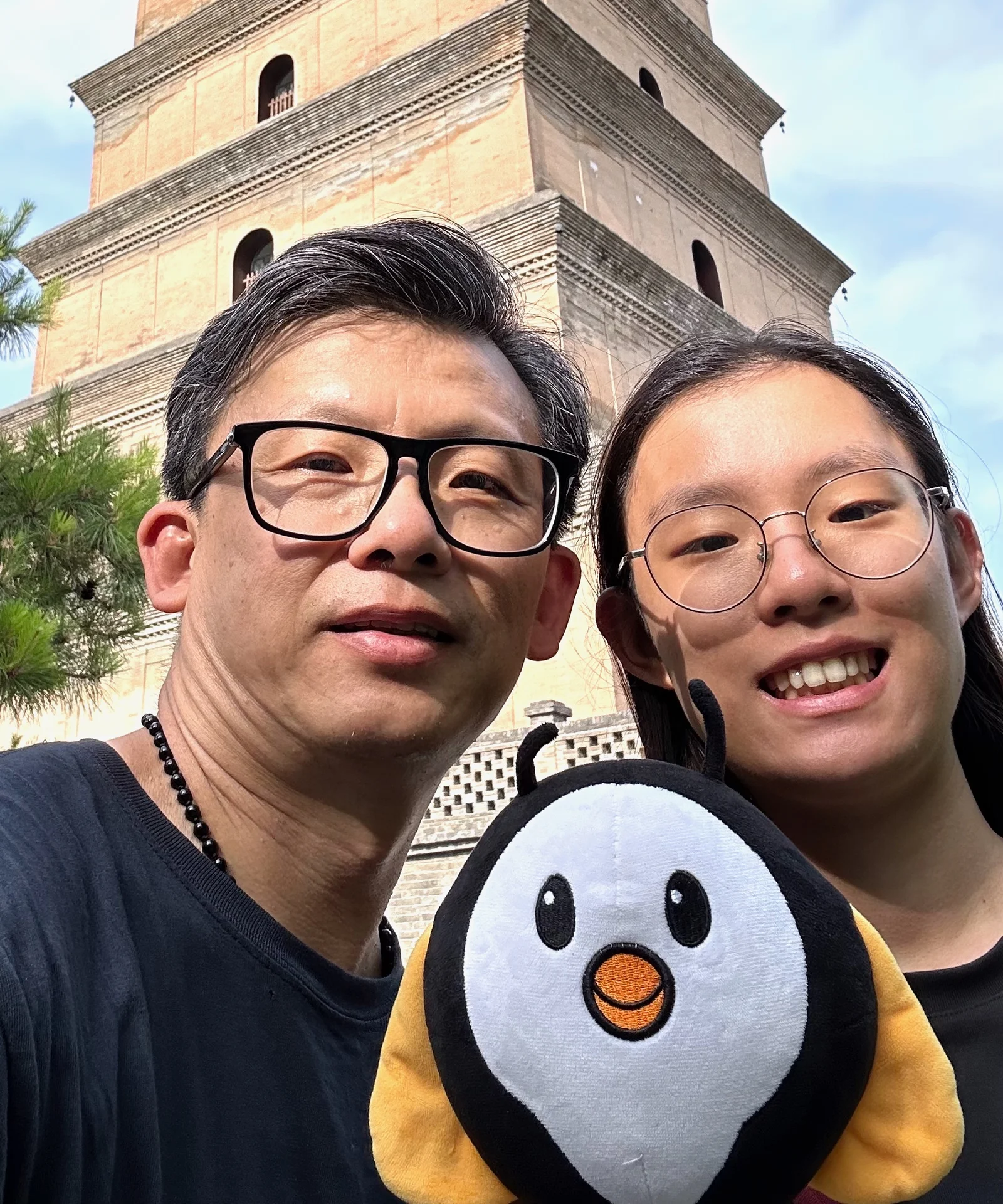
Dad & Elaine’s Experience
On our first visit, we made the same mistake many travellers make.
We admired the buildings.
We took photographs.
We walked.
But we didn’t really understand what we were looking at.
Only on later visits, after listening to experienced local guides, did the palace begin to make sense.
Suddenly, the roof decorations, palace layout, ceremonial halls and hidden gardens were no longer just beautiful architecture.
They became clues to how imperial China governed itself for nearly five centuries.
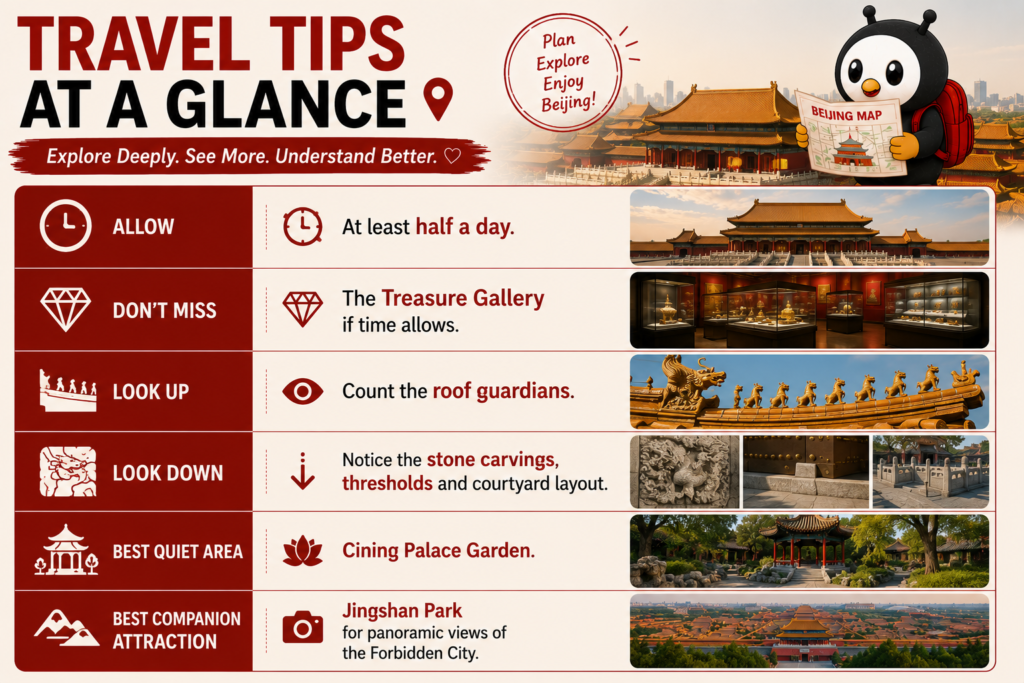
Travel Tips at a Glance
Allow: At least half a day.
Don’t miss: The Treasure Gallery if time allows.
Look up: Count the roof guardians.
Look down: Notice the stone carvings, thresholds and courtyard layout.
Best quiet area: Cining Palace Garden.
Best companion attraction: Jingshan Park for panoramic views of the Forbidden City.
Understanding China Better
Why Is Everything Arranged Along One Straight Line?
One of the first things visitors notice is how symmetrical the Forbidden City feels.
That’s no accident.
Traditional Chinese imperial architecture reflected the belief that good government depended on order, balance and hierarchy.
The emperor occupied the central position, both physically and symbolically.
Every gate, courtyard and hall reinforced the idea that harmony within the empire began with order at its very centre.
Once you understand this principle, the Forbidden City stops feeling like hundreds of similar buildings and starts revealing the logic behind its extraordinary design.
Final Verdict
The Forbidden City isn’t simply a collection of ancient palaces.
It’s one of the world’s greatest surviving lessons in architecture, politics and imperial symbolism.
The licensed Beijing guides we work with often tell visitors:
“Don’t try to see everything. Learn to see what most people miss.”
We couldn’t agree more.
Sometimes the most memorable discoveries aren’t the grand halls everyone photographs—but the small details that quietly explain how one civilisation governed an empire for almost 500 years.
Continue Reading
This article is part of our From Our Beijing Guides series, where licensed local guides answer the questions foreign travellers ask most often while sharing the practical knowledge and hidden details that transform an ordinary visit into a much richer experience.