You’re photographing a traditional Chinese building.
Then you zoom in on the roof.
Along the ridge is a little procession of creatures.
One.
Two.
Three.
Sometimes quite a few.
“Wait… what are THOSE doing up there?” 😂
🥟 The Quick Bite
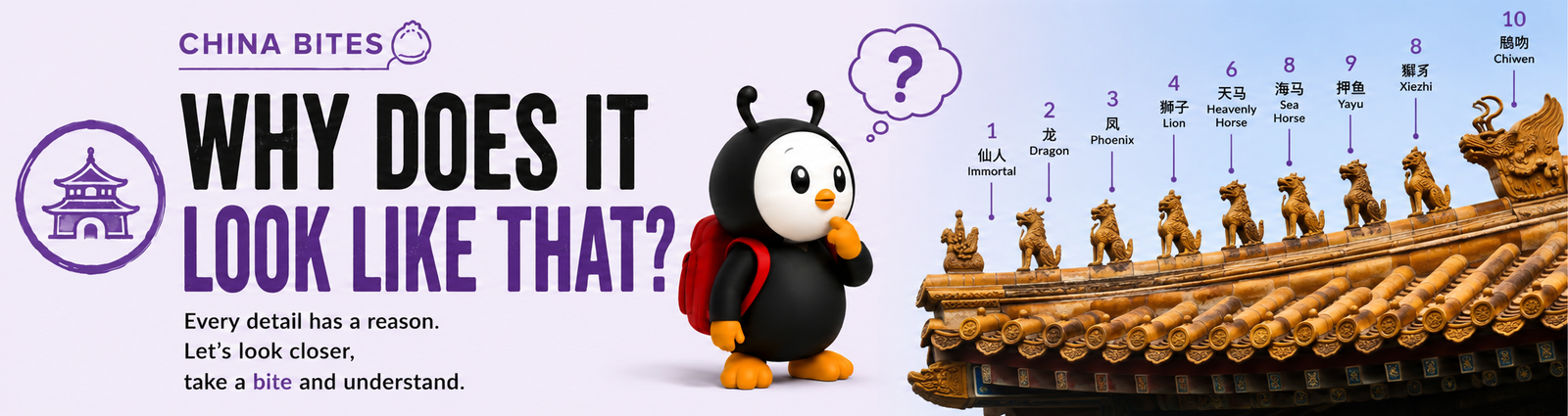
Those little figures are roof-ridge ornaments (脊兽, jǐshòu).
You’ll see different forms of them on important examples of traditional Chinese architecture, particularly palaces and temples.
They aren’t simply random animals added because the roof looked empty.
Their forms developed within Chinese architectural traditions and could carry symbolic, protective and status-related meanings.
🌍 If You’re Trying to Place It…
Think of the gargoyles, saints, heraldic animals or other symbolic figures you might notice high on historic buildings elsewhere.
They aren’t exactly the same thing.
But the handrail helps:
sometimes the interesting story isn’t inside the building — it’s sitting on the roof.
👀 Look Along the Roof Ridge
A useful Chinese word:
脊 (jǐ) — ridge
兽 (shòu) — beast / animal
Together:
脊兽 (jǐshòu) — roof-ridge beasts
On some traditional roofs, you’ll see a line of small figures arranged along the ridge.
Their exact number and arrangement can vary according to the building, period and architectural rank.
So don’t assume every Chinese roof should have the same little animal parade.
🏯 Look Up in the Forbidden City
The Forbidden City (故宫, Gùgōng) is a wonderful place to start noticing them.
Instead of looking only at the famous red walls and yellow glazed tiles, zoom in on the rooflines.
Suddenly you’ll begin seeing:
dragons (龙, lóng)
phoenixes (凤凰, fènghuáng)
other auspicious imagery
and those little:
脊兽 (jǐshòu).
Once Dad noticed them, roofs stopped being merely roofs. 😂
They became something to read.
🐇 Want to Go Deeper?
And that’s where the little animals lead to a much bigger question:
Why is the Forbidden City filled with so much visual symbolism in the first place?
👉 Why Does the Forbidden City Look Like THAT? — DEEP China · BIG Questions
There, the roof ornaments become only one small ingredient in a much larger architectural language of color, dragons, hierarchy, symmetry, gates, courtyards, ritual (礼, lǐ) and imperial authority.
🥟 One Last Bite
Next time you’re standing in front of a Chinese palace or temple:
look up.
Then look higher.
Find the roof ridge.
And see whether anyone is sitting up there. 😂
Once you’ve discovered 脊兽 (jǐshòu), you’ll probably start hunting for them on every traditional roof you see.
That’s how a tiny detail becomes another China rabbit hole.
See China. Understand It Better.