
A traveler asked:
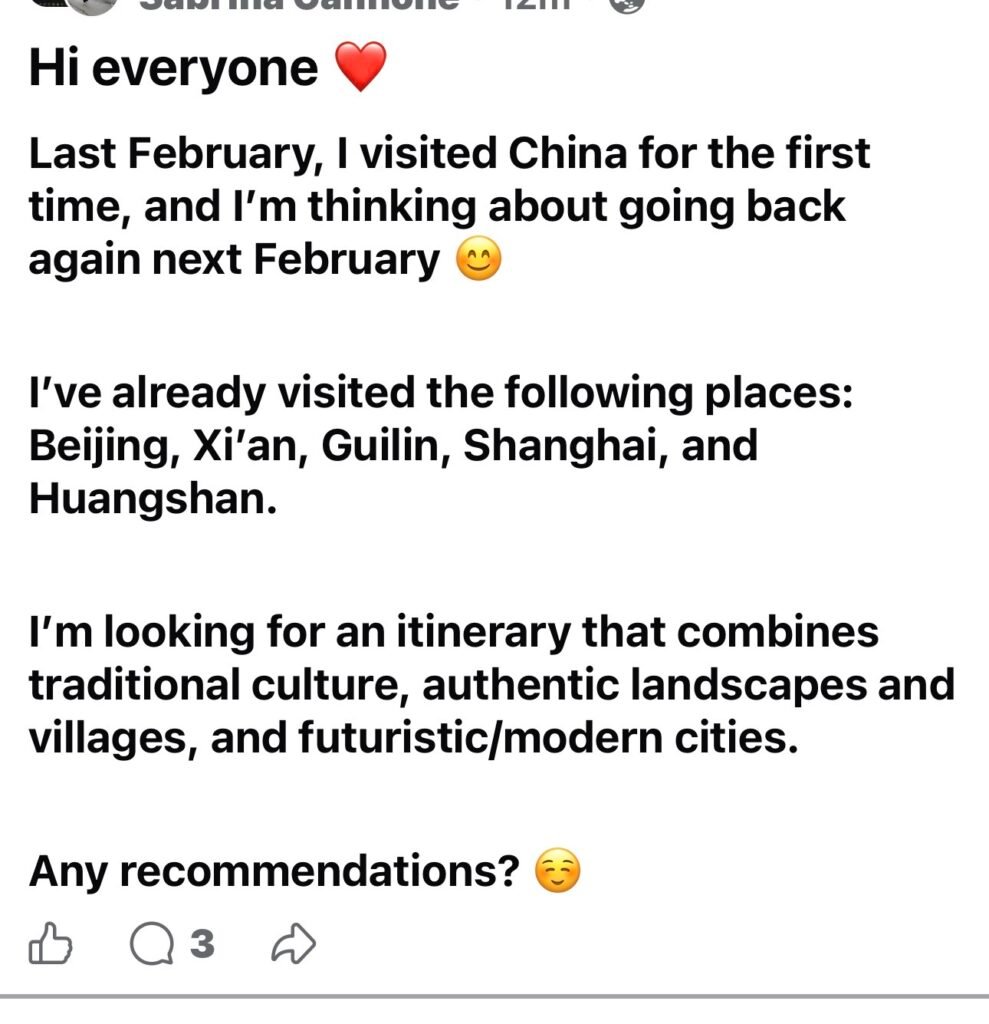
“Last February, I visited China for the first time, and I’m thinking about going back again next February.
I’ve already visited Beijing, Xi’an, Guilin, Shanghai and Huangshan.
I’m looking for an itinerary that combines traditional culture, authentic landscapes and villages, and futuristic/modern cities. Any recommendations?”
This is exactly the kind of trip where I would not repeat the classic first-time China route.
You have already experienced imperial Beijing, ancient Xi’an, Guilin’s landscapes, modern Shanghai and the mountains of Huangshan.
For your second trip, China can start becoming much more regional.
My first choice would be Chengdu → a carefully chosen Sichuan cultural and landscape experience → Chongqing.
It gives you three very different faces of China in one journey: everyday Sichuan culture, traditional landscapes and communities, and one of the country’s most extraordinary modern megacities.

Chengdu: Start With Everyday Sichuan
I would give Chengdu (成都, Chéngdū) around 3–4 nights.
Of course, Chengdu is famous internationally for giant pandas. But on a second trip to China, I would deliberately experience more than the headline attractions.
Spend some time in People’s Park (人民公园, Rénmín Gōngyuán). Sit in a traditional teahouse. Wander through ordinary neighborhoods. Try Sichuan dishes beyond hotpot.
Chengdu’s appeal is partly its rhythm.
You can see people drinking tea, playing mahjong, chatting in parks and spending long afternoons together. These ordinary experiences can reveal another side of China after a first trip dominated by famous monuments.
You could still visit the pandas, but don’t let them become the entire Chengdu experience.
Then Add Traditional Landscapes and Smaller Communities
This is where I would add approximately 3–5 nights, depending on the total length of your trip.
Western Sichuan can offer extraordinary mountain scenery, Tibetan-influenced culture, smaller settlements and a completely different experience from China’s major cities.
But there is an important qualification:
February changes the decision.
Some western Sichuan destinations are at substantial altitude and can experience snow, ice, cold temperatures and more difficult winter road conditions.
So I would not automatically build a high-altitude western Sichuan circuit into a February itinerary simply because the scenery looks spectacular.
If you actively enjoy winter mountain travel and are comfortable with altitude and changing weather, western Sichuan could become one of the highlights of the journey.
If not, I would choose a lower-altitude cultural or traditional-town experience closer to Chengdu and preserve the contrast without forcing a demanding winter expedition into the itinerary.
This is one part of the journey where your exact February dates and comfort with winter conditions matter more than simply choosing the most famous destination.
Finish in Chongqing
Then take the high-speed railway to Chongqing (重庆, Chóngqìng) and stay around 3 nights.
If Shanghai showed you one version of modern China, Chongqing will show you another.
The city rises vertically around mountains and the Yangtze and Jialing rivers. Highways disappear between towers. Bridges cross enormous valleys. Metro trains seem to pass through buildings. Neighborhoods exist on what appear to be completely different ground levels.
At night, parts of Chongqing can feel almost cinematic.
But don’t experience it only through the famous viewpoints and social-media locations.
Walk through residential neighborhoods. Eat at small restaurants. Ride public transport. Explore during daylight as well as after dark.
The fascinating thing about Chongqing isn’t simply that it looks futuristic.
It is that this extraordinary urban landscape is also an everyday home for millions of people.
Why This Combination Works So Well
The journey creates a natural progression:
Chengdu → slower everyday Sichuan culture
Sichuan countryside → landscapes, traditional communities and regional culture
Chongqing → dense, vertical, intensely modern China
That’s a much more interesting second-trip story than simply adding another collection of famous cities.
You would also encounter very little repetition from Beijing, Xi’an, Guilin, Shanghai and Huangshan.
How Long Would I Allow?
If you have around 10–12 days, I would roughly think in terms of:
- 3–4 nights Chengdu
- 3–5 nights for your Sichuan landscape/cultural section
- 3 nights Chongqing
If you have less time, I would simplify rather than rush.
For example, Chengdu + Chongqing alone can already make an excellent second China trip, with one or two carefully selected excursions from Chengdu.
If you have two weeks or longer, then you can justify going deeper into Sichuan.
One February Warning
Don’t design the trip solely from photographs taken in spring, summer or autumn.
February conditions can substantially change the experience of mountainous Sichuan. Temperatures, snowfall, road conditions and accessibility vary by destination and elevation.
The best itinerary therefore depends partly on whether you want a genuine winter landscape experience or simply happen to be traveling in February.
That distinction should determine how adventurous the Sichuan section becomes.
My Recommendation
For someone who has already visited Beijing, Xi’an, Guilin, Shanghai and Huangshan, I would choose:
Chengdu → Sichuan culture and landscapes → Chongqing.
It takes you beyond the standard first-time circuit while still giving you places that are relatively straightforward to connect.
Most importantly, it lets your second trip answer a different question.
The first journey showed you some of China’s most famous sights.
The second can start showing you how different one region of China can feel from another.
One of the Travel Tools Dad & Elaine Actually Use
When Elaine and I travel around China, Trip.com is one of the platforms we genuinely use ourselves. Over our journeys together, we’ve used it to book hotels, flights, trains, attractions and tours — in China and elsewhere.
It has helped us many times while planning our trips, and we’ve had good experiences with it. So when friends or ChinaTravelBUG readers ask us “Where do you actually book?”, Trip.com is one of the places we’re comfortable recommending because we use it too.
✈️ 🏨 🚄 🎟️ Explore and plan your China trip on Trip.com →
Affiliate link — ChinaTravelBUG may earn a small commission at no extra cost to you.

Further Reading
Is Chengdu Worth Adding to a First China Trip? — AI Travel Planner Answers
Useful for understanding what Chengdu adds to an itinerary beyond simply seeing the giant pandas.
The Perfect First Trip to China Itinerary: Beijing, Xi’an and Beyond — 7, 14 & 21 Days China Travel Guide
Although this traveler is already planning a second visit, the guide is useful for understanding why slower regional travel becomes increasingly rewarding once the classic first-trip destinations have already been covered.
About This Answer
This article is based on a real traveler question answered by the ChinaTravelBUG AI Travel Planner. We publish selected questions because the practical decisions faced by one traveler often help many others planning similar journeys.
Verification Note — August 16, 2026: The general route and destination guidance in this answer were reviewed for publication on August 16, 2026. February weather and conditions in mountainous parts of Sichuan can vary substantially by location, elevation and year. Road access, transport schedules, attraction operations and local conditions can also change. Travelers considering western Sichuan in winter should verify current weather, transport and access conditions shortly before travel.
Traveler questions may be lightly edited or anonymized for privacy and readability. The planning answer is preserved as practical travel guidance, with editorial context and verification added where appropriate.
Planning Your Own China Trip?
Already visited China’s classic destinations and wondering where to go next?
Ask the ChinaTravelBUG AI Travel Planner. Tell it where you’ve already been, how many days you have, when you’re traveling and what kind of China you want to experience next.
It can help you work through the journey one decision at a time.
See China. Understand It Better.