
Choosing a hotel in Beijing (北京, Běijīng) can be surprisingly confusing for a first-time visitor.
The city is enormous. Attractions are spread out. And when you look at the map, it can seem as though no hotel is really close to everything.
One traveler had a refreshingly simple requirement: somewhere cheap, cheerful and clean, with a window and convenient transport. They weren’t interested in hotel facilities because they planned to spend their days exploring Beijing.
There was one extra complication: they would leave Beijing for a couple of nights at Gubei Water Town (古北水镇, Gǔběi Shuǐzhèn) and hoped their Beijing hotel could store their larger luggage.
So where should they stay?
We put the question to the ChinaTravelBUG AI Travel Planner.
The Traveler’s Question
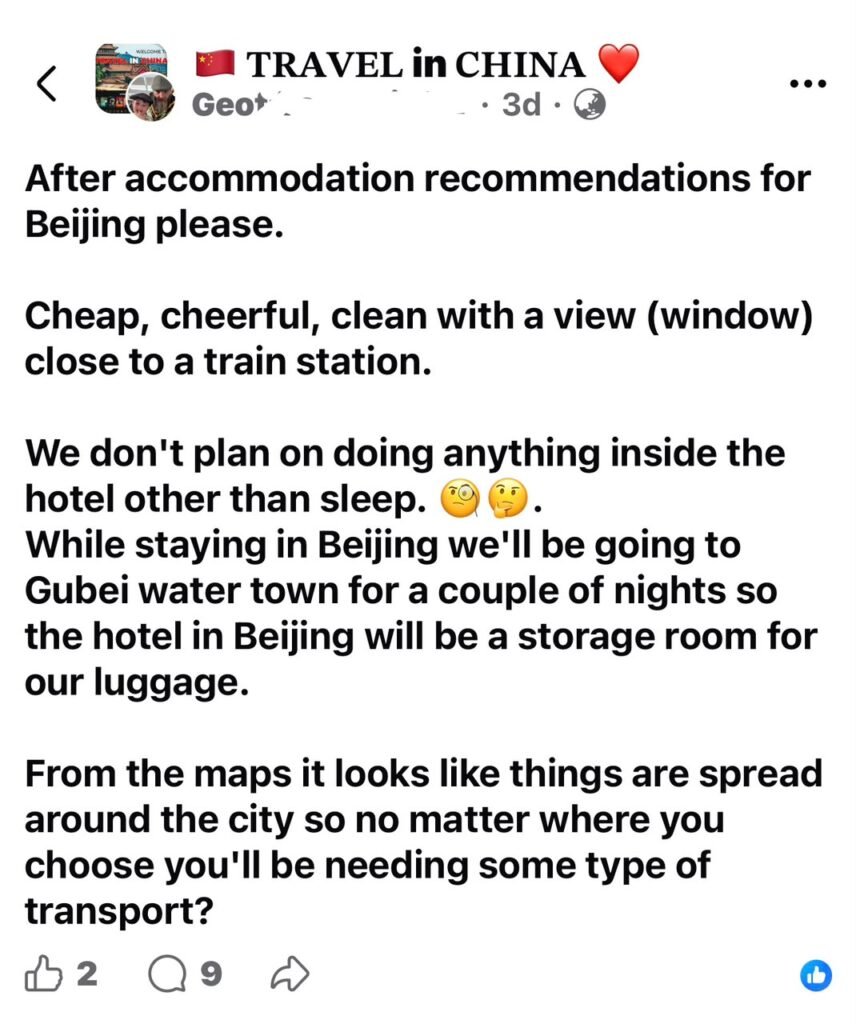
“After accommodation recommendations for Beijing please.
Cheap, cheerful, clean with a view (window) close to a train station.
We don’t plan on doing anything inside the hotel other than sleep.
While staying in Beijing we’ll be going to Gubei Water Town for a couple of nights so the hotel in Beijing will be a storage room for our luggage.
From the maps it looks like things are spread around the city so no matter where you choose you’ll be needing some type of transport?”

AI Travel Planner Answers
For what you’ve described, I’d prioritize location over hotel facilities.
Beijing is huge, so yes—you’ll use the subway and/or taxis regardless, but choosing the right area can save a surprising amount of time.
I’d look around Dongsi (东四, Dōngsì) / Dengshikou (灯市口, Dēngshìkǒu) / Wangfujing (王府井, Wángfǔjǐng), ideally within about a 5–10 minute walk of a subway station.
That puts you reasonably central for the Forbidden City, Tiananmen area, hutongs and other major sights without paying purely for a fancy hotel you won’t use.
A few practical points:
- Don’t choose a hotel simply because it’s beside a railway station. For sightseeing, being near a useful metro station matters more.
- Search for budget hotels with an exterior window. Some cheaper rooms in Beijing are windowless, so check the room description carefully.
- If you’re leaving luggage while spending two nights at Gubei Water Town, confirm with the hotel before bookingthat they will store it while you are checked out. Don’t assume they will.
- I’d consider making two separate reservations at the same Beijing hotel—before and after Gubei—then ask them to hold the larger luggage between stays.
- For Gubei, I wouldn’t choose your Beijing hotel based around that journey. Pick the Beijing location that works best for your Beijing sightseeing.
One thing that catches first-time visitors out is Beijing’s scale.
A place can look “central” on a map and still involve a lot of walking and transport. The cheapest hotel 30–40 minutes farther out often isn’t much of a bargain once you’ve spent several days commuting.
Beijing is best approached by choosing a well-connected neighborhood, rather than trying to find one location close to everything.
Further Reading
This is particularly relevant because it compares the Beijing areas that make the most sense for first-time visitors.
ChinaTravelBUG Note
There is an important distinction hidden inside this traveler’s question:
In Beijing, “near a train station” and “well located” are not necessarily the same thing.
International visitors often use “train station” to mean any convenient public transport station.
But if the goal is sightseeing, you generally don’t need to stay beside Beijing Railway Station, Beijing West, Beijing South or another major intercity railway terminal.
What matters much more on ordinary sightseeing days is easy access to the Beijing Subway (北京地铁, Běijīng Dìtiě).
For many first-time visitors, we’d happily trade a bigger hotel room or more hotel facilities for a location that puts a useful subway station within a short walk.
At the end of a long Beijing sightseeing day, that difference matters.
Why Dongsi, Dengshikou and Wangfujing Work So Well
These three areas aren’t identical.
Wangfujing 王府井 (Wángfǔjǐng) is the best-known of the three and is extremely central. It is convenient for many first-time sightseeing itineraries and has plenty of hotels, restaurants and shops.
Dengshikou is just east of Wangfujing and can be a useful compromise: still very central, but sometimes without the feeling that you are staying directly in Beijing’s most famous shopping district.
Dongsi 东四 (Dōngsì) takes you a little farther into neighborhood Beijing. It can work particularly well for travelers who want convenient transport while also being closer to hutongs and everyday street life.
The objective isn’t necessarily to find the hotel geographically closest to the Forbidden City.
It is to find a base from which several different parts of Beijing remain reasonably easy to reach.
That’s a much more useful definition of “central.”
Beijing Is Bigger Than It Looks on Your Phone
This deserves emphasizing because it affects almost every first Beijing trip.
Distances that look manageable on a map can feel very different after you’ve already spent six hours walking through the Forbidden City (故宫, Gùgōng), Summer Palace (颐和园, Yíhéyuán) or Temple of Heaven (天坛, Tiāntán).
Even subway stations themselves can be large.
There may be walking inside the station, security checks, transfers and another walk from the destination station to the attraction.
So when comparing two hotels, don’t just ask:
“Which one costs less?”
Ask:
“How much Beijing will this location make me commute through every day?”
Saving a little on the room but adding an hour of transportation to every sightseeing day isn’t necessarily saving money in any meaningful sense.
Check the Window Before You Book
The traveler’s request for a window might sound obvious.
In China, it’s worth checking.
Some inexpensive hotels offer windowless rooms, and booking platforms may list several room categories at very different prices.
Look carefully for wording such as:
- Window
- Exterior window
- City view
Don’t assume that the photograph showing a bright room with a window necessarily represents the cheapest room category you’ve selected.
If daylight matters to you, check the specific room description, not just the hotel’s general photographs.
Leaving Your Luggage While Visiting Gubei Water Town
The traveler’s idea makes sense.
Instead of dragging large suitcases to Gubei Water Town for two nights, take a smaller overnight bag and leave the larger luggage in Beijing.
But there is one detail to arrange beforehand.
If you check out of your Beijing hotel before going to Gubei and don’t check back in until two days later, ask whether the hotel will store your luggage between two separate reservations.
Many hotels may be willing to help returning guests, but policies can vary.
A sensible arrangement is:
Beijing hotel → Gubei Water Town → same Beijing hotel
Book the Beijing portions separately and contact the hotel before arrival to confirm that luggage can remain there during the gap.
That also removes one unnecessary complication from the trip: changing Beijing hotels just because you’ve temporarily left the city.
ChinaTravelBUG Verification Note
Last verified: August 14, 2026
The advice in this article is primarily about location strategy rather than recommending a specific hotel.
That distinction matters because hotel prices, availability, room categories, foreign-guest policies and luggage-storage arrangements can change.
Before booking, travelers should check the current listing for:
- the exact room category
- whether that room has an exterior window
- walking distance to the nearest subway entrance
- recent guest reviews
- cancellation conditions
- whether the hotel will hold luggage between two separate stays
For the Gubei Water Town arrangement described here, ChinaTravelBUG recommends confirming luggage storage directly with the hotel before booking, particularly because the traveler will technically be checked out for several nights.
About This Traveler Question
This question was adapted from a real traveler discussion shared in a China travel community online.
Personal identifying information has been omitted.
We like this question because it captures a mistake that is easy to make when planning Beijing entirely from a map.
The goal isn’t to find a magical hotel that is close to every attraction.
That hotel doesn’t exist.
Beijing is simply too large and its major sights are too dispersed.
Instead, choose a neighborhood that gives you good transport, reasonable access to several sightseeing areas, food nearby and as little unnecessary commuting as possible.
In Beijing, don’t choose the hotel closest to everything. Choose the hotel that makes everything easier to reach.

Planning Where to Stay in Beijing?
Not sure whether Wangfujing, Dongsi, Qianmen, Sanlitun or another Beijing neighborhood makes the most sense for your trip?
Tell the ChinaTravelBUG AI Travel Planner your travel dates, budget, group size and the places you want to visit.
It can help you think about your hotel as part of the whole Beijing itinerary—not simply as somewhere to sleep.
Try the FREE ChinaTravelBUG AI Travel Planner.