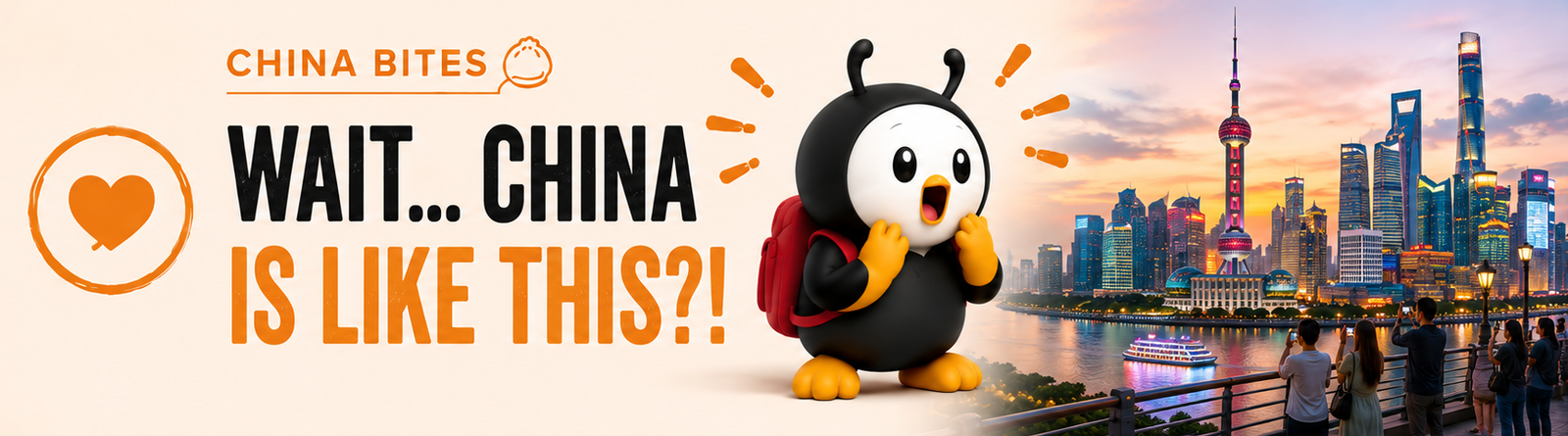
You look out of a Chinese high-speed train.
Apartment towers.
Then more apartment towers.
You arrive in a city, take the metro for 30 minutes, come back above ground and…
more apartment towers. 😳
You may start wondering:
“How many people LIVE here?”
🥟 The Quick Bite
China experienced one of the world’s largest and fastest periods of urbanization (城镇化, chéngzhènhuà).
As hundreds of millions of people came to live in cities, urban areas needed enormous amounts of housing.
One very visible answer was:
build upward.
That’s why large clusters of high-rise residential buildings are such a familiar part of many Chinese cityscapes.
🌍 If You’re Trying to Place It…
Think of an apartment tower as a way of putting many households on the footprint that a much smaller number of detached houses would occupy.
Now repeat that across an enormous city.
The result can look startling if you’re used to lower-density urban neighborhoods.
🏙️ Are All Those Towers Offices?
Often, no.
Many of the towers you’re looking at are simply:
homes.
Useful Chinese:
小区 (xiǎoqū) — residential community / housing compound
住宅 (zhùzhái) — residence / residential housing
居民 (jūmín) — resident
A 小区 (xiǎoqū) may contain multiple apartment blocks together with internal roads, gardens, shops, playgrounds or other community facilities.
So what looks from a distance like:
“twenty identical skyscrapers”
may actually be somebody’s neighborhood.
👀 Look at Ground Level
This is where the city can start making more sense.
Around a large residential 小区, you may find:
restaurants
convenience stores
fruit shops
delivery riders
parcel collection points
schools
and a metro or bus connection nearby.
All those everyday systems we’ve been noticing in other CHINA Bites suddenly connect.
They’re serving a lot of people living close together.
🤯 But Don’t Mistake This for All of China
Travel outside the large urban districts and the picture changes.
China also has:
older low-rise neighborhoods + historic towns + smaller cities + villages + rural landscapes.
Even within one city, the urban form can change dramatically from one district to another.
So don’t turn:
“Chinese cities have lots of apartment towers”
into:
“China is one enormous forest of skyscrapers.” 😂
🥟 One Last Bite
The first time you pass kilometer after kilometer of residential towers, the scale can feel almost unreal.
Then look down.
Someone is buying vegetables.
A child is coming home from school.
A delivery rider is dropping off dinner.
Suddenly those giant towers stop being part of a futuristic skyline.
They’re simply:
where people live.
And China’s enormous cities become a little more human-sized.
See China. Understand It Better.