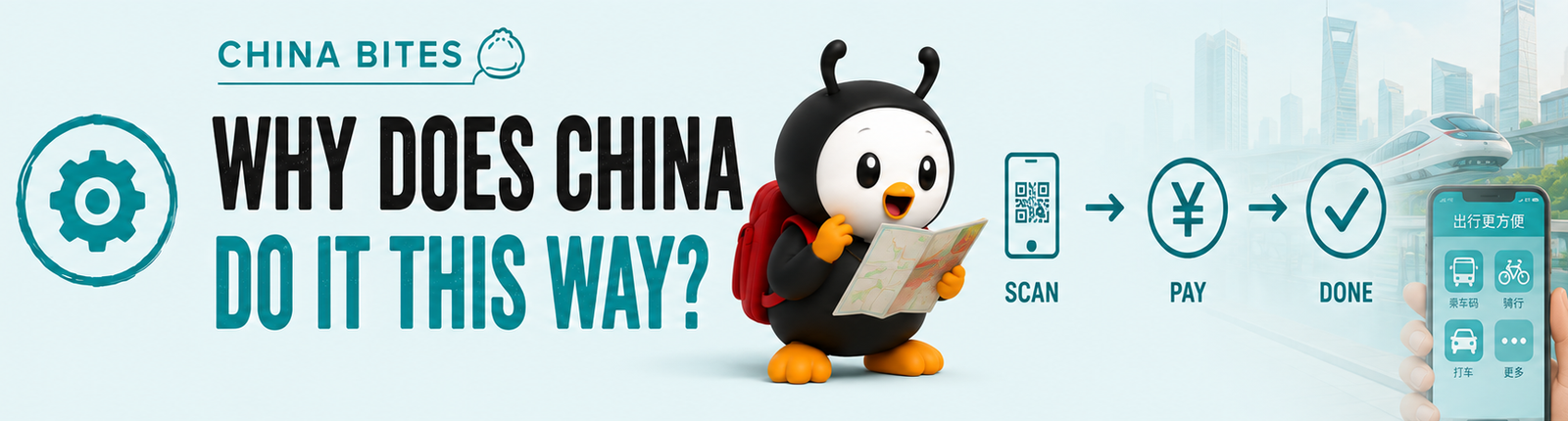
You buy a coffee.
Scan.
Someone buys fruit from a small shop.
Scan.
A taxi ride, restaurant bill, convenience store…
Scan again.
After a day or two in China, you may start wondering:
“Why does everyone pay with QR codes?”
🥟 The Quick Bite
China adopted mobile payments (移动支付, yídòng zhīfù) on an enormous scale.
Instead of tapping a physical bank card, people commonly pay through apps such as Alipay (支付宝, Zhīfùbǎo) and Weixin Pay / WeChat Pay (微信支付, Wēixìn Zhīfù).
Usually, either:
you scan the merchant’s QR code
or
the merchant scans yours.
Done.
🌍 If You’re Trying to Place It…
Think of contactless card payment or Apple Pay becoming so normal that even a tiny neighborhood shop expects you to use it.
China arrived at a similar destination through a different doorway:
the QR code.
📱 Why QR Codes?
One reason is wonderfully practical.
A QR code can be displayed cheaply — even as a simple printed sign.
A small merchant doesn’t necessarily need the kind of card terminal international travelers may be accustomed to seeing.
Meanwhile, smartphones and China’s major payment platforms became deeply integrated into everyday life.
The result is something visitors notice almost immediately:
very small businesses can participate in digital payments too.
💵 So Has China Stopped Using Cash?
No.
This is an important distinction.
China’s official guidance for overseas visitors lists cash, bank cards and mobile payments as payment options.
So don’t interpret:
“Almost everyone around me is scanning QR codes”
as:
“Cash no longer exists in China.”
What you’re noticing is a strong everyday preference for mobile payment.
👀 Look a Little Closer
Next time you’re paying, watch what actually happens.
Sometimes you scan them.
Sometimes they scan you.
Once you understand those two little movements, something that initially feels very foreign becomes remarkably ordinary.
🥟 One Last Bite
For many first-time visitors, China’s QR-code payments can initially feel like:
“Why does buying a bottle of water require my phone?” 😂
A few days later, you may find yourself reaching for your phone before you’ve even reached the cashier.
That’s when you know you’ve learned one small rhythm of everyday China.
See China. Understand It Better.