
Beijing and Shanghai can show a first-time visitor two extraordinary sides of China.
But what if you only have 10 days and also want to experience something smaller, quieter and more rural?
One traveler planning a Beijing–Shanghai journey faced exactly that decision. They initially considered Guilin (桂林, Guìlín) and Yangshuo (阳朔, Yángshuò), famous for their dramatic karst landscapes. Then they discovered Wuzhen (乌镇, Wūzhèn), one of the historic water towns of the Jiangnan (江南, Jiāngnán) region near Shanghai.
But there is an important question hiding underneath the destination choice:
Does an old water town actually provide the “authentic rural China” experience this traveler is looking for?
We put the question to the ChinaTravelBUG AI Travel Planner.
The Traveler’s Question
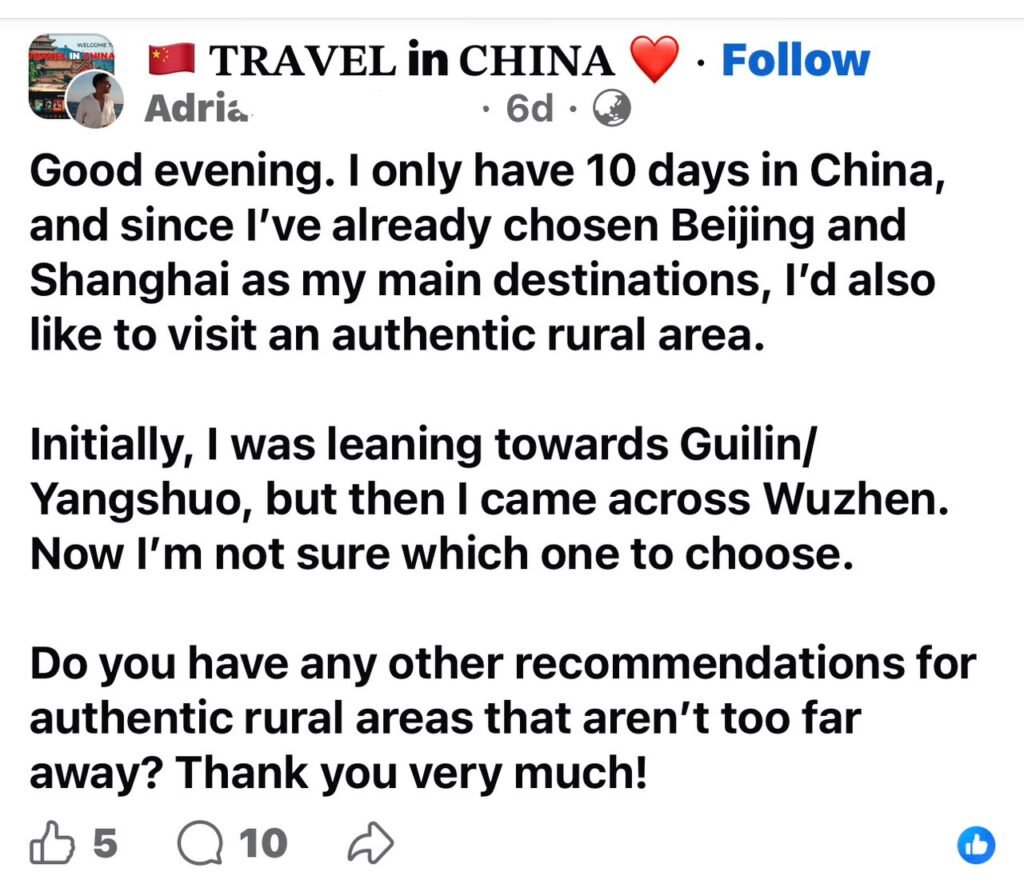
This question was shared publicly by a Western traveler in a Facebook China travel community and has been lightly anonymized for privacy.
Good evening. I only have 10 days in China, and since I’ve already chosen Beijing and Shanghai as my main destinations, I’d also like to visit an authentic rural area.
Initially, I was leaning towards Guilin/Yangshuo, but then I came across Wuzhen. Now I’m not sure which one to choose.
Do you have any other recommendations for authentic rural areas that aren’t too far away? Thank you very much!

AI Travel Planner Answers
The following answer is reproduced exactly as originally generated by the ChinaTravelBUG AI Travel Planner, without editorial rewriting.
For a 10-day trip with Beijing and Shanghai already fixed, I would not add Guilin/Yangshuo unless the karst scenery is one of your highest priorities. It is beautiful, but it pulls you well south and turns a short trip into more of a three-region journey.
Wuzhen is much easier geographically, but I also wouldn’t choose it if your main goal is an “authentic rural area.”Wuzhen is a beautifully preserved and restored Jiangnan water town, but it is also a major visitor destination. Think canals, historic architecture and atmosphere rather than ordinary rural life.
What I’d recommend instead
I would keep your third experience near Shanghai and make it a contrast to the two big cities. With roughly nine nights for a 10-day trip, something like Beijing 4 nights → Shanghai 4 nights → rural/water-town experience 1 night is much more comfortable than adding another distant region. For a first visit, two major cities plus one smaller place is already plenty.
If you want traditional scenery and canals, Wuzhen can work well for one night—staying overnight is much more rewarding than rushing through on a day trip because you experience the town after many day visitors have left.
But if by “authentic rural” you mean fields, villages, local families and ordinary countryside rather than a historic tourist town, I’d look at the countryside of Zhejiang or southern Anhui instead. That gives you a much stronger contrast with Beijing and Shanghai without sending you all the way to Guilin.
So my choice would be:
For scenery: Yangshuo
For convenience: Wuzhen
For the rural experience you’re actually describing: Zhejiang/Anhui countryside
The important distinction is that “old town” and “rural China” aren’t necessarily the same experience. If you want to understand everyday China, a village morning, local breakfast, fields and ordinary community life may tell you more than another famous attraction.
If you tell me what month you’re traveling, I can narrow this down to 2–3 specific rural places that fit naturally between Beijing and Shanghai.
Ready to Check Shanghai Hotels?
Dad & Elaine have personally used Trip.com many times when travelling in China and elsewhere — for hotels, flights, attractions and tours. We’ve had good experiences with it, so it’s one of the booking platforms we use ourselves.
🏨 Check Shanghai hotels & current prices on Trip.com →
Affiliate link — ChinaTravelBUG may earn a small commission at no extra cost to you.
Ready to Check Beijing Hotels?
Dad & Elaine have personally used Trip.com many times when travelling in China and elsewhere — for hotels, flights, attractions and tours. We’ve had good experiences with it, so it’s one of the booking platforms we use ourselves.
🏨 Check Beijing hotels & current prices on Trip.com →
Looking for Else Where Hotels in China?
Dad & Elaine have personally used Trip.com many times when travelling across China and elsewhere — for hotels, flights, attractions and tours. We’ve had good experiences with it, so it’s one of the booking platforms we use ourselves.
🏨 Check hotels & current prices across China on Trip.com →
ChinaTravelBUG Verification Note
Last verified: August 13, 2026
There are no major visa, payment, aviation or ticketing claims in this answer requiring extensive verification. However, some geographical and destination context is useful.
Wuzhen Is a Historic Water Town — But That’s Not the Same as Rural China
The distinction made by the AI Travel Planner is important.
Wuzhen (乌镇, Wūzhèn) is in Zhejiang Province and belongs to the cultural landscape commonly associated with Jiangnan, the region south of the lower Yangtze known for canals, waterways, historic towns and traditional architecture.
It can provide a beautiful contrast with Shanghai.
But travelers should be careful with the word “authentic.”
A historic water town that has become a major tourism destination and an ordinary contemporary Chinese village are two different experiences.
Neither is necessarily “better.”
They’re simply answering different travel questions.
Yangshuo Offers a Very Different Kind of Countryside
Yangshuo, in Guangxi, isn’t really an alternative version of Wuzhen.
The appeal is fundamentally different.
Yangshuo and the wider Guilin landscape are associated with the spectacular karst scenery along the Li River (漓江, Lí Jiāng)—a landscape recognized as part of the UNESCO World Heritage property covering the karst landscapes of South China.
If that landscape is one of the traveler’s major reasons for visiting China, traveling south can absolutely be worthwhile.
But that’s a different decision from:
“Where can I add a convenient rural experience to a short Beijing–Shanghai trip?”
For only 10 days, geography matters.
ChinaTravelBUG’s Planning Takeaway
This question looks like a simple destination comparison:
Wuzhen or Yangshuo?
But that’s not really the decision.
The traveler is trying to solve something more interesting:
“How can I experience a side of China beyond Beijing and Shanghai without making my 10-day trip too rushed?”
Once we understand that, the choices become clearer.
Yangshuo = scenery.
Go because the extraordinary karst landscape itself is important enough to justify traveling to another part of China.
Wuzhen = convenience + historic atmosphere.
Choose it because you want canals, Jiangnan architecture and a smaller-scale experience that fits much more naturally with Shanghai.
Zhejiang or southern Anhui countryside = rural experience.
Explore this direction if what you’re actually looking for is villages, fields, local food and something closer to everyday countryside life.
That distinction matters because travelers sometimes use “old,” “traditional,” “rural” and “authentic” as though they mean the same thing.
They don’t.
Don’t Add Distance Just Because You Have an Empty Day
There’s another useful lesson here.
When travelers see 10 days, they often start asking:
“What third destination can I fit in?”
A better question is:
“What experience is missing from the trip?”
Beijing and Shanghai already require substantial time.
Adding Guilin and Yangshuo means introducing another geographic region, another arrival and departure, additional transportation and another hotel base.
If Yangshuo is a dream destination, that trade-off may be worthwhile.
If it isn’t, don’t travel hundreds of kilometers simply because a famous destination technically fits on a map.
Sometimes the better trip is:
Big city → big city → one small contrasting experience.
That can show you more of China without forcing you to spend your limited time constantly moving through it.
A Note About This AI Travel Planner Answer
The AI Travel Planner answer above is shown as originally generated, without editorial rewriting.
The original traveler question came from a public online travel community and has been lightly anonymized to protect the traveler’s privacy.
The Planner’s recommendations are planning judgments based on the traveler’s stated 10-day timeframe and desire to combine Beijing and Shanghai with a more rural experience.
Transport schedules, journey times, attraction arrangements, opening hours and other time-sensitive travel information should always be verified through current official sources before booking.

Ask the ChinaTravelBUG AI Travel Planner — FREE
Trying to decide between two completely different places in China?
Ask the FREE ChinaTravelBUG AI-assisted Travel Planner.
You don’t need to know the “right” destination before you start.
Tell it what you already know:
“I have 10 days.”
“Beijing and Shanghai are fixed.”
“I want to experience some countryside.”
“I don’t want to spend half my holiday changing hotels.”
The Planner can help work out whether Wuzhen, Yangshuo or somewhere else entirely actually fits the trip you’re trying to create.
And when those individual decisions start becoming a real journey, it can help turn your dates, interests and preferred pace into a personalized, realistic day-by-day China itinerary.
Ask your China travel question with the FREE ChinaTravelBUG AI Travel Planner.