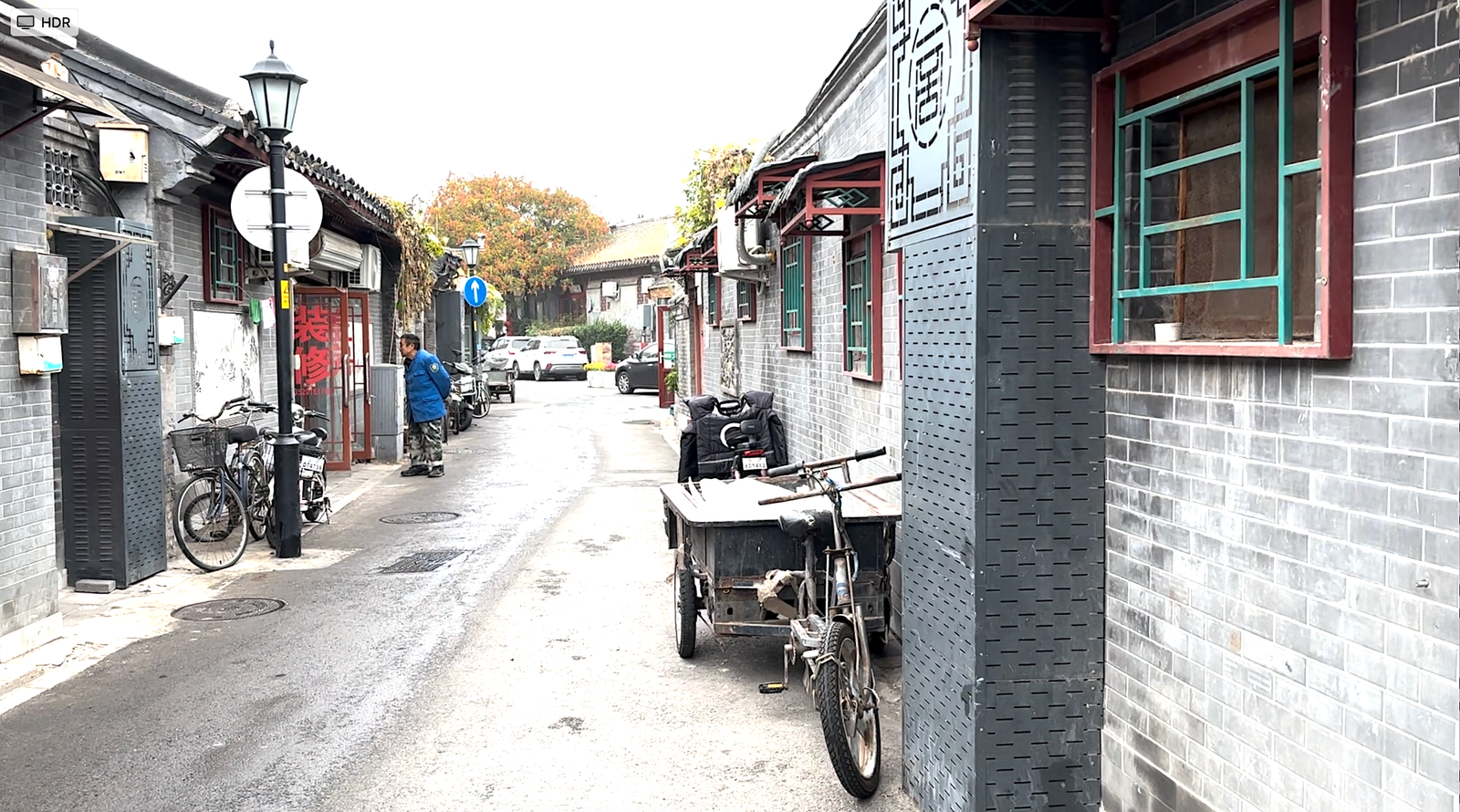
Daily Life in a Beijing Hutong: We walked beyond the postcard image and found public toilets, neighborhood services, shops, scooters, construction — and an ordinary weekday morning unfolding around us.
Before visiting Beijing, it’s easy to imagine a hutong (胡同, hútòng) as something from old China.
Gray walls.
Narrow lanes.
Red doors.
Traditional courtyard houses (四合院, sìhéyuàn).
Perhaps a bicycle passing by at exactly the right moment for your photograph. 😂
But when Dad walked through Beijing’s hutongs, something else became obvious.
This isn’t just somewhere tourists come to see old Beijing.
People still live here.
And once we started looking at the hutong as a living neighborhood, rather than simply an attraction, we began noticing things that probably don’t appear on many Beijing must-see lists.
Including…
public toilets.
Wait… Why Are There So Many Public Toilets?
Dad noticed them while walking.
Not one enormous tourist restroom complex.
Smaller public toilets scattered through the hutong area.
🎥 Dad Explains What He Noticed
There is a historical reason this matters.
Many of Beijing’s older hutong homes were built long before modern indoor plumbing and sanitation became normal.
Some traditional courtyard residences were subsequently subdivided among multiple households, and some older homes did not have their own private toilets.
Shared and public toilets therefore became part of everyday neighborhood infrastructure.
Of course, Beijing’s hutongs have changed enormously and conditions vary from home to home.
But for a first-time international traveler, those public toilets reveal something important:
A hutong isn’t simply old architecture preserved for us to photograph.
It has had to function as a place where real people live.
So What Exactly Is a Hutong?
Dad explains it while we’re walking:
🎥 Inside a Beijing Hutong
The word hutong (胡同, hútòng) generally refers to the lanes and alleys traditionally associated with Beijing’s courtyard neighborhoods.
And that’s an important distinction.
A hutong is the lane.
The traditional courtyard residence you see behind many of those walls is a siheyuan (四合院, sìhéyuàn).
For an international traveler, remembering just those two Chinese words is enough:
胡同 (hútòng) → the lane or alley
四合院 (sìhéyuàn) → the traditional courtyard residence
Once you understand that, the neighborhood starts making much more sense.
You’re not simply walking between rows of “old Chinese houses.”
You’re moving through a network of lanes connecting homes, businesses and community services.
Dad Even Found Firefighting Facilities
This was one of those little details that caught Dad’s attention.
In the video, Dad points out firefighting facilities within the hutong neighborhood.
At first, that doesn’t sound terribly exciting.
Until you look around.
Narrow lanes.
Closely packed buildings.
Traditional structures.
Limited access in some places.
Then suddenly a neighborhood fire facility doesn’t seem like a random object at all.
It reminds us again:
people actually live here.
A real neighborhood needs practical services.
Fire protection.
Sanitation.
Deliveries.
Repairs.
Shops.
Transport.
The things that make everyday urban life possible don’t disappear just because the surroundings happen to be historic.
Then the Hutong Changed Again
Walk a little farther and another version of hutong life appears.
Shops.
Food and drink.
Boutique accommodation.
Chinese art.
Stationery.
Brushes.
Dad found himself on a more commercial stretch.
🎥 A Commercial Street Inside the Hutong Area
It was still morning, so things were relatively quiet.
And that’s actually useful for seeing what has happened to parts of Beijing’s hutong areas.
Some lanes remain predominantly residential.
Others have become increasingly commercial.
You may find cafés and restaurants beside traditional buildings.
Boutique hotels tucked behind old-style entrances.
Small shops selling things that appeal to both local customers and visitors.
Old Beijing and modern Beijing aren’t neatly separated here.
They occupy the same streets.
But Our Favorite Video May Be the One Where Dad Says Nothing
No explanation this time.
Just watch.
🎥 A Typical Weekday Morning in a Beijing Hutong
Turn the sound on.
Scooters pass.
Someone is working.
You hear construction.
Voices drift through the street.
People come and go.
Nothing dramatic happens.
And that’s precisely why we like this video.
This isn’t the Beijing of the Forbidden City.
It isn’t the Great Wall.
Nobody is performing “traditional Beijing life” for Dad’s camera.
It’s simply a weekday morning.
For a few seconds, you’re standing there with us.
Look Beyond the Gray Walls
Once we started thinking about the hutong as a living community, little things we’d seen during our walk began connecting.
The public toilet wasn’t just a toilet.
It told us something about the history and practical realities of older housing.
The fire facilities weren’t random street furniture.
They were part of keeping a dense old neighborhood functioning.
The shops and boutique hotels showed how some hutong streets are adapting to modern Beijing and tourism.
The scooters, repairs and construction sounds reminded us that this isn’t a frozen historic district.
People are still using these streets.
That’s the Beijing we find particularly interesting.
Not:
Old Beijing OR modern Beijing.
But:
Old Beijing continuing to live inside modern Beijing.
Should a First-Time Beijing Traveler Visit a Hutong?
We think so.
But don’t go only because you want photographs of gray walls and red doors.
And don’t expect every lane to look like a perfectly restored heritage attraction.
Walk slowly.
Look at the houses.
Look at what’s happening outside them.
Notice where people park their scooters.
Notice the small shops.
Notice the neighborhood facilities.
Listen.
And occasionally…
look for the public toilet. 😂
Not because the toilet itself is a major Beijing attraction.
Because once you start asking why it’s there, you begin understanding the neighborhood differently.
ChinaTravelBUG’s Take
Before walking these lanes, it would have been easy to describe Beijing’s hutongs with a few familiar words:
historic.
traditional.
picturesque.
All true.
But incomplete.
What Dad’s camera kept showing us was something much simpler:
The hutong is alive.
Someone is repairing something.
Someone rides past on a scooter.
A shop is opening for the morning.
A public toilet serves the neighborhood.
Firefighting equipment sits ready.
Construction makes noise somewhere down the lane.
And behind those beautiful old doors we tourists keep photographing…
people are living their lives.
That’s what we’d tell a first-time Beijing traveler.
Don’t visit a hutong merely to see Old Beijing.
Spend some time there and watch carefully enough…
and you may see Beijing living in it today.
📍 Where Can Travelers Experience Beijing Hutong Life?
Dad’s videos were filmed while walking through Beijing’s hutong neighborhoods, but we don’t have the exact lane recorded.
For a first-time visitor, some of the easiest areas to explore traditional Beijing hutongs are in Dongcheng District (东城区, Dōngchéng Qū) and around the Shichahai (什刹海, Shíchàhǎi) area.
Good starting points include:
- Shichahai (什刹海) — a large historic hutong area around Houhai and the lakes.
- Gulou / Drum Tower area (鼓楼, Gǔlóu) — wander away from the main roads and into the smaller surrounding lanes.
- Nanluoguxiang (南锣鼓巷, Nánluógǔxiàng) — easy for first-time visitors, although the main street is very commercial. Explore the smaller side hutongs to see more everyday neighborhood life.
- Dongsi (东四, Dōngsì) — another good area for quieter traditional lanes and courtyard neighborhoods.
🚇 An Easy First-Time Option
Take the Beijing Subway to the Shichahai / Drum Tower area, then explore on foot.
Don’t feel that you need to follow one exact sightseeing route.
The point of a hutong walk is partly to wander.
Leave the busiest commercial street.
Turn into a quieter lane.
Look at the courtyard doors.
Notice the local shops, scooters, neighborhood facilities and everyday activity.
And remember that these are still residential communities.
Walk slowly, photograph respectfully, and don’t enter private courtyards unless invited.
📍 Want to Experience a Beijing Hutong Yourself?
If this story makes you want to walk through a hutong yourself, one of the easiest areas for a first-time Beijing visitor is around Shichahai (什刹海, Shíchàhǎi) and the Drum Tower (鼓楼, Gǔlóu).
This puts you in one of Beijing’s best-known historic areas, with plenty of hutongs that you can explore on foot.
🚕 Taking a DiDi
Don’t just type “Beijing hutong” into DiDi.
A hutong isn’t one attraction with one entrance. Beijing has many hutong neighborhoods.
Instead, give the driver a clear landmark to take you to.
A convenient starting point is:
Beijing Drum Tower (北京鼓楼, Běijīng Gǔlóu)
Address: 9 Zhonglouwan Hutong, Dongcheng District, Beijing
北京市东城区钟楼湾胡同9号
In DiDi, search:
北京鼓楼
If you need to tell the driver where you’re going, you can simply say or show:
去北京鼓楼,谢谢。
Qù Běijīng Gǔlóu, xièxie.
“Beijing Drum Tower, please.”
Showing the Chinese 北京鼓楼 on your phone is usually easier than trying to pronounce the destination perfectly.
Going by Subway
You can also take the subway to the Shichahai (什刹海) area.
Once you’re above ground, don’t worry about following one perfect hutong route.
That’s not really the point of this experience.
Walk.
Start around the Drum Tower and Shichahai area, then turn into some of the smaller surrounding lanes.
The busy streets are useful for getting your bearings.
The quieter side hutongs are where you may begin noticing the things Dad noticed:
scooters parked outside homes,
people making repairs,
small neighborhood shops,
courtyard doors,
public toilets,
deliveries,
residents going about their day.
That’s when the hutong stops feeling like an attraction and starts feeling like a neighborhood.
Another Easy Place to Start
You may also come across Nanluoguxiang (南锣鼓巷, Nánluógǔxiàng) in Beijing guidebooks.
For DiDi, search:
南锣鼓巷
It’s very easy for a first-time traveler to find and there are many hutongs around it.
But there’s something important to know:
Don’t judge Beijing’s hutongs only by Nanluoguxiang.
The main pedestrian street is highly commercial, with shops, food and plenty of visitors.
Use it as a starting point.
Then look at the smaller surrounding lanes.
That’s where the experience can become much more interesting.
When Should You Go?
Dad particularly enjoyed seeing the hutongs in the morning.
Watch our video again:
Nothing spectacular is happening.
And that’s exactly why we like it.
Scooters pass.
Shops prepare for the day.
Someone is doing construction work.
People come and go.
You hear the neighborhood rather than just the tourist crowd.
If you want to see more of this everyday side of Beijing, try a weekday morning rather than only visiting during the busiest weekend period.
Dad’s Tips for Your First Hutong Walk
1. Don’t rush through it
You don’t need to “complete” a hutong in 30 minutes.
Walk slowly.
Turn into another lane.
Stop when something catches your attention.
That’s how many of our own questions started.
2. Get off the most commercial street
The cafés and shops can be fun.
But if you want to understand why we call the hutong a living community, spend some time in the quieter residential lanes too.
3. Remember that these are people’s homes
A beautiful siheyuan (四合院, sìhéyuàn) doorway may make a wonderful photograph.
But the courtyard behind it may be somebody’s private home.
Don’t walk through a private doorway simply because it’s open.
And be considerate when photographing residents.
4. Don’t be surprised by public toilets
Dad noticed quite a few.
Public toilets are part of the infrastructure of some older hutong neighborhoods.
If you’re walking for an hour or two, knowing they’re around can actually be rather useful. 😂
5. Wear comfortable shoes
The best way to experience a hutong is on foot.
Don’t try to see everything from the back seat of a car.
6. Give yourself permission to wander
This may be the most important one.
Of course, keep your phone and map with you.
But you don’t need to move directly from Point A to Point B.
Dad’s hutong stories didn’t begin because we were hunting for specific objects.
We noticed a repairman.
Then a front door.
Then a public toilet.
Then neighborhood fire facilities.
Then shops.
Then an ordinary weekday morning.
That’s the experience.
One Last Tip for First-Time Beijing Travelers
Don’t go to a hutong expecting to find Beijing frozen in the Qing Dynasty.
You’ll find old courtyard houses beside scooters.
Traditional doors beside modern security cameras.
Historic lanes with cafés and boutique hotels.
Residents, tourists, deliveries, construction and everyday city life all occupying the same neighborhood.
And that’s precisely why we think you should go.
Don’t visit a Beijing hutong just to see how Beijing used to live.
Go and look carefully at how Beijing is still living there today.