In the City: Standing near Yinding Bridge in Shichahai, Dad found one of those places where historic Beijing and the modern city seem to occupy the same streets.
When we say Old Beijing, it’s easy to imagine somewhere quiet.
Gray hutong walls.
Traditional courtyard houses.
An old bicycle.
Perhaps an elderly resident sitting outside his front door.
But then Dad walked into this part of Beijing.
And it wasn’t quiet at all. 😂
People everywhere.
Shops.
Restaurants.
Visitors.
Noise.
Movement.
A commercial street doing exactly what commercial streets are supposed to do:
buzzing with life.
And right nearby was a little bridge with a much bigger story.
Come Stand Here With Dad
Dad was near Yinding Bridge (银锭桥, Yíndìng Qiáo) in the historic Shichahai (什刹海, Shíchàhǎi) area.
Listen to the video rather than just watching it.
The voices.
The movement.
The shops.
The people passing.
This wasn’t Dad standing in front of a preserved historic building and explaining what used to happen here.
Beijing was happening around him.
That’s what made us curious.
Why Is There a Bridge in the Middle of Old Beijing?
Yinding Bridge 银锭桥 crosses the narrow waterway between Qianhai (前海) and Houhai (后海), two of the lakes that form part of the Shichahai water system.
And water is an important part of this story.
Historic Beijing wasn’t connected only by roads and hutong lanes.
Its waterways were also tied into the movement of goods and supplies associated with the Grand Canal (大运河, Dàyùnhé) system.
That helped make the Shichahai area an important part of the commercial life of old Beijing.
Suddenly the shops and crowds around Dad weren’t quite so surprising.
People have been coming through this part of Beijing for a very long time.
Look at What’s Happening Around the Bridge Today
Dad says something in the video that captures why we stopped here:
“Soak yourself into the atmosphere of the hustle and bustle, the sights, the sounds, of old Beijing.”
That’s really the experience.
Don’t come here expecting a silent historic exhibit.
Around Shichahai today you’ll find restaurants, cafés, shops and other businesses mixed into an area of old lanes, waterways and traditional Beijing neighborhoods.
Some parts are highly commercial.
Some lanes nearby become much quieter.
And that’s exactly why we enjoyed walking here.
Turn one way:
crowds and commerce.
Turn another:
hutongs and courtyard doors.
Walk a little farther:
someone repairing a house, a scooter passing, residents going about their morning.
Old Beijing isn’t presented to you in one neat package.
You walk through different versions of it.
Then Our Photos Connected the Pieces
There are two photographs from this part of our Beijing journey that we appreciate much more now than when we first took them.
Photo 1: A Small Bridge With a Much Bigger Story
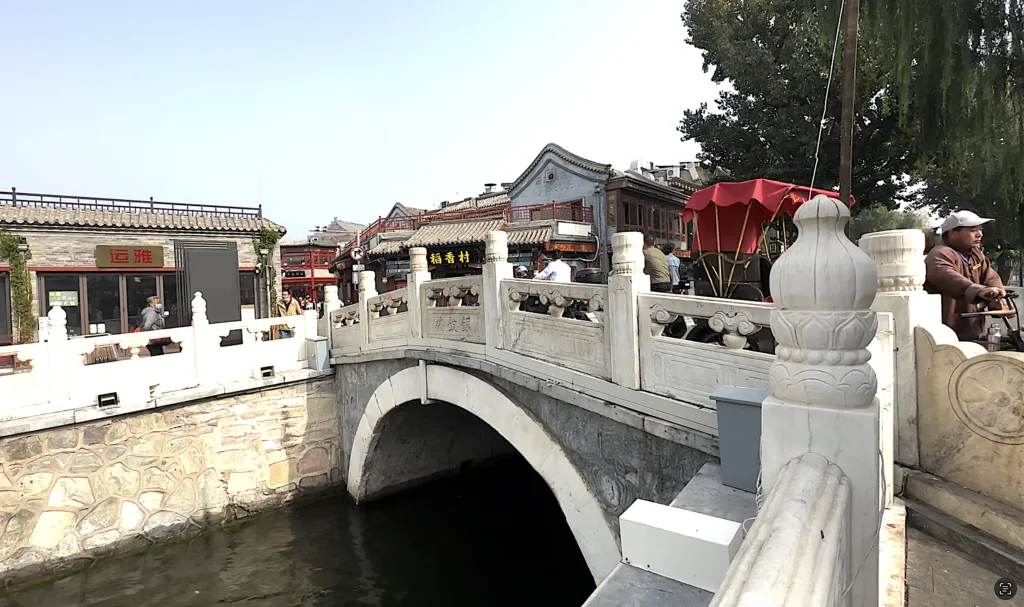
At first glance, this looks like a pleasant little stone bridge.
But look at everything around it.
There’s water underneath.
Traditional-style buildings and shops beyond it.
People crossing.
Businesses operating.
The whole area is busy.
That’s important because Shichahai (什刹海, Shíchàhǎi) wasn’t historically isolated from the economic life of Beijing.
Its waterways were connected with the water-transport system associated with the Grand Canal (大运河, Dàyùnhé), which brought enormous quantities of grain and other goods toward the imperial capital.
So when Dad stood here talking about the hustle and bustle of Old Beijing, the water behind him wasn’t merely scenery.
Water helped make this part of Beijing important in the first place.
Of course, today’s restaurants, shops and visitors are not the same commerce that existed centuries ago.
But we liked the continuity.
A place shaped by movement and activity in Old Beijing is still full of movement and activity today.
Photo 2: Dad & Elaine Standing Beside the Grand Canal
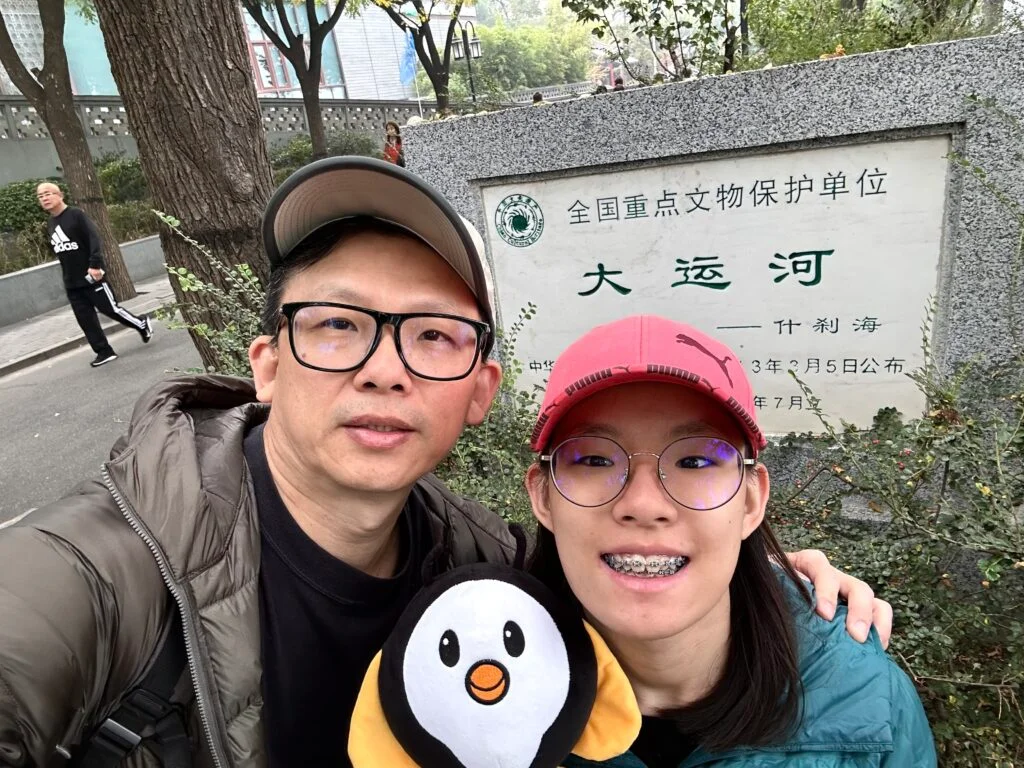
This second photograph helps explain why Dad became so interested in that little waterway near Yinding Bridge.
Look behind us.
The sign says:
全国重点文物保护单位
National Key Cultural Relics Protection Unit
and, in much larger characters:
大运河
Dàyùnhé — the Grand Canal.
For a first-time international traveler, those three Chinese characters are worth remembering:
大 (dà) — great
运 (yùn) — transport
河 (hé) — river/canal
The Grand Canal is easy to think of as something you visit somewhere else in China.
Perhaps Hangzhou.
Suzhou.
Or another famous canal city.
But here we were…
in Beijing.
That was the connection that made us look at Shichahai differently.
The waterways we were seeing weren’t simply decorative lakes and canals surrounded by attractive hutongs.
They belonged to a much larger story about how the imperial capital was supplied and connected with the rest of China.
🐇 One Photograph Leads to Another Question
And this is where a simple city walk starts becoming very ChinaTravelBUG.
We came here to experience Beijing’s hutongs.
We found Yinding Bridge.
Dad noticed the busy commercial streets.
Then we noticed the water.
Then came the Grand Canal sign.
And suddenly the question became much bigger:
Why did Beijing need this enormous canal system in the first place?
That’s a rabbit hole for another ChinaTravelBUG story.
For this walk, it’s enough to know one thing:
when you’re standing around Shichahai, don’t look only at the old buildings.
Look at the water too.
It helps explain why this part of Old Beijing mattered.
Was Old Beijing Busy Like This Too?
Not in exactly the same way, of course.
The businesses have changed.
The customers have changed.
Tourism has changed the area enormously.
Modern Beijing surrounds it.
So we wouldn’t say that what Dad saw was “exactly the same” as commercial life hundreds of years ago.
But there’s a connection that we find much more interesting.
This is still a place of movement and activity.
The historic waterways helped connect this area with the life and commerce of the old capital.
Today, people are still coming here.
For completely different reasons perhaps.
To eat.
To shop.
To walk around Houhai.
To photograph the hutongs.
To meet friends.
Or, like Dad…
simply to stand there for a while and watch Beijing go past.
📍 Want to Stand Where Dad Stood?
Look for:
Yinding Bridge (银锭桥, Yíndìng Qiáo)
It is in the Shichahai (什刹海) area of central Beijing, between Qianhai (前海) and Houhai (后海).
This is a very convenient area for a first-time Beijing traveler because you can combine it with a longer hutong walk.
🚕 By DiDi
Search for:
银锭桥
You can also show the driver:
去银锭桥,谢谢。
Yinding Bridge, please.
Using the Chinese destination in DiDi is usually easier than trying to explain “the old hutong area near Houhai.”
Don’t Just Get Out of the Car, Photograph the Bridge and Leave
This is important.
Walk.
Yinding Bridge should be a starting point rather than the entire experience.
Explore around Houhai (后海) and Shichahai (什刹海).
Then turn away from the busiest commercial streets and wander into some of the surrounding hutongs.
That’s where this story connects with our other Beijing walks.
You’ll begin seeing:
traditional courtyard doors,
small shops,
residential lanes,
public toilets,
scooters,
repairs,
community facilities,
and ordinary Beijing life happening alongside the historic city.
Give yourself time.
You don’t need to tick off ten attractions.
Sometimes the attraction is simply:
being there.
Dad’s Tip: See More Than One Version of Shichahai
If possible, experience this area at different levels of activity.
During a quieter weekday morning, the surrounding hutongs can give you glimpses of neighborhood life.
Later, around the more commercial parts of Shichahai, you’ll encounter a very different atmosphere.
More people.
More noise.
More food.
More activity.
Neither experience is the “real” Beijing while the other is fake.
They’re both Beijing.
And seeing the contrast is part of the fun.
ChinaTravelBUG’s Take
We came to Beijing wanting to see its famous historic places.
But gradually we discovered that sometimes the most interesting question isn’t:
What happened here hundreds of years ago?
It’s:
What’s happening here now — and why is this particular place still so alive?
Standing near Yinding Bridge gave us a little glimpse of both.
Water that connects us to the geography of old Beijing.
Hutongs that connect us to the city’s traditional neighborhoods.
And all around them:
modern Beijing eating, shopping, walking, talking and moving.
Dad called it the “hustle and bustle, the sights, the sounds, of old Beijing.”
That’s probably the best advice we can give a first-time traveler too.
Don’t just come here to photograph Old Beijing.
Stand there for a while.
Watch it.
Listen to it.
Then start walking.