
Not every trip to China needs to include Beijing, Xi’an, Chengdu and Shanghai.
For travelers returning to China, a more rewarding journey can sometimes come from choosing a region, a cultural thread and a slower pace rather than collecting famous cities.
One solo female traveler in her 50s was planning a particularly interesting 20-night journey through eastern China in late February. Her proposed route included Hangzhou, Nanxun, Huangshan, Wuyuan, Wangxian Valley, Jingdezhen and Shanghai.
Her main concern wasn’t what to see.
It was much more practical:
Does this route actually make geographical sense—or will it involve unnecessary backtracking?
We put the itinerary to the ChinaTravelBUG AI Travel Planner.
The Traveler’s Question
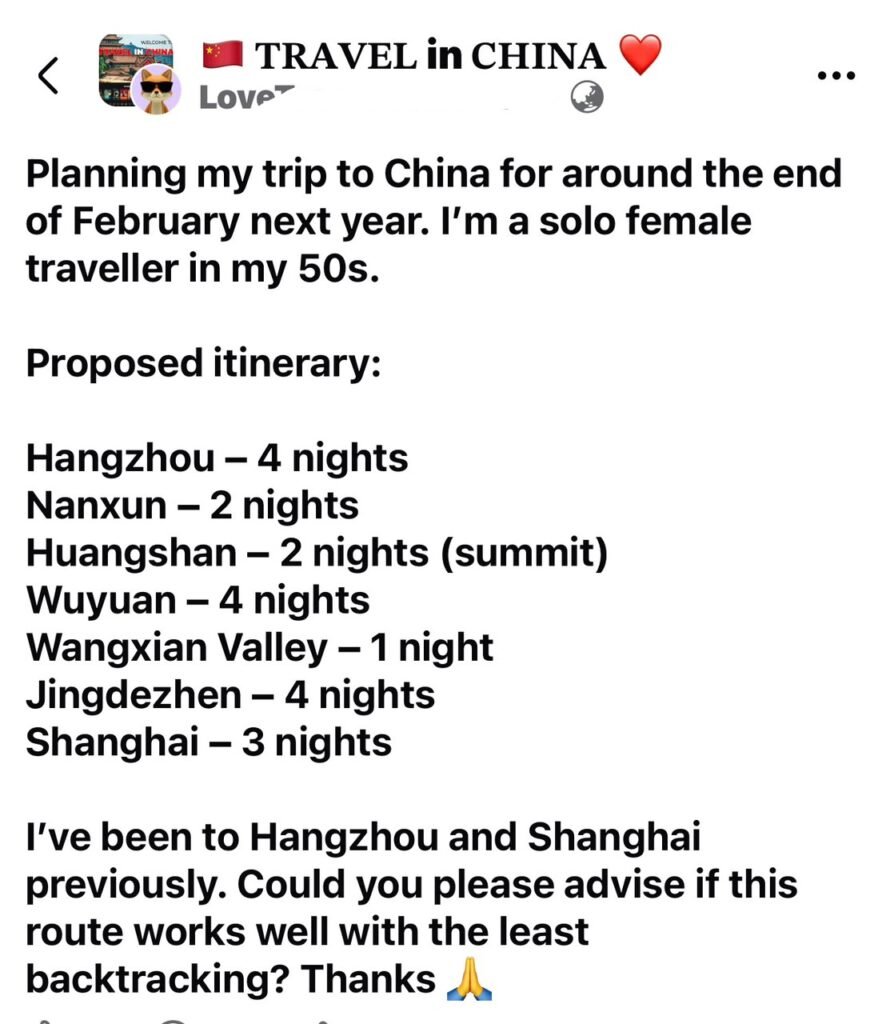
“Planning my trip to China for around the end of February next year. I’m a solo female traveller in my 50s.
Proposed itinerary:
Hangzhou – 4 nights
Nanxun – 2 nights
Huangshan – 2 nights (summit)
Wuyuan – 4 nights
Wangxian Valley – 1 night
Jingdezhen – 4 nights
Shanghai – 3 nightsI’ve been to Hangzhou and Shanghai previously. Could you please advise if this route works well with the least backtracking?”

AI Travel Planner Answers
Yes — the overall idea works, but I would change the order. The proposed route creates some unnecessary zig-zagging, and with 20 nights and seven hotel bases, reducing friction matters, especially for a solo traveler who prefers a comfortable pace.
I’d route it like this
Hangzhou – 4 nights
↓
Nanxun – 2 nights
↓
Huangshan – 2 nights
↓
Jingdezhen – 4 nights
↓
Wuyuan – 4 nights
↓
Wangxian Valley – 1 night
↓
Shanghai – 3 nights
That gives you a much more natural progression: Zhejiang → southern Anhui → northeastern Jiangxi → Shanghai, rather than moving from Huangshan to Wuyuan, then Wangxian Valley, and subsequently back toward Jingdezhen.
A few thoughts:
- Four nights in Wuyuan is generous, but that’s not necessarily a mistake if you enjoy photography, villages and slower travel. Late February is too early to count on Wuyuan’s famous mass rapeseed-flower scenery, so I would choose it for the villages and landscape rather than specifically for spring flowers.
- Two nights on Huangshan summit is the part I’d think hardest about. In late February, winter conditions can make the mountain spectacular, but also physically demanding. Weather, cableway operations and trail access need checking closer to your dates. For a solo traveler, I’d keep some flexibility around this section.
- Four nights in Jingdezhen makes sense if ceramics genuinely interest you. This isn’t just sightseeing time: workshops, museums, studios and the city’s contemporary ceramics culture reward slowing down.
- Wangxian Valley works well as a one-night experience. I wouldn’t give it more time at the expense of the more culturally interesting places.
- Since you’ve already visited Hangzhou and Shanghai, I’d also question whether you really need seven nights between them. Unless you’re deliberately returning for things you missed, shifting 1–2 of those nights into the middle of the journey could make the trip more rewarding.
The appealing thing about this itinerary is that it isn’t a standard first-timer route. It has a coherent theme: water-town Jiangnan → mountain landscapes → Huizhou villages → China’s porcelain culture. That’s a much more interesting journey than simply collecting famous cities.
Before booking, I would verify the actual late-February transport connections between Huangshan, Jingdezhen, Wuyuan and Wangxian Valley; those details could determine whether one small route adjustment saves considerable time.
Further Reading
China High-Speed Rail for Foreign Tourists (2026 Guide)
Read the article: https://chinatravelbug.com/china-high-speed-rail-for-foreign-tourists-2026-guide/
Useful for understanding how to plan the rail portions of this multi-stop journey.
Optional Itinerary Review
Before booking, you’re welcome to email your itinerary to leekheechuan@gmail.com for an optional review by a trusted licensed local travel expert.
A fresh pair of eyes can improve pacing, sightseeing order, hotel locations and transport choices. This service is entirely optional.
ChinaTravelBUG Verification Note
Last verified: August 13, 2026
The AI Travel Planner’s answer above is reproduced unedited.
There are two parts of this itinerary that deserve particular attention before reservations are finalized.
1. Geography alone does not determine the best route
A route can look beautifully linear on a map and still be inconvenient in practice.
For a multi-stop journey involving Nanxun (南浔), Huangshan (黄山), Jingdezhen (景德镇), Wuyuan (婺源) and Wangxian Valley (望仙谷), the actual decision should be based on available rail connections, station locations, local transfers and total door-to-door travel time.
This is particularly important for Wangxian Valley, where reaching the scenic area involves more than simply arriving at the nearest major railway station.
ChinaTravelBUG therefore recommends treating the Planner’s sequence as a proposed routing to investigate, rather than assuming that the geographically neatest sequence will automatically produce the easiest journey.
Current train schedules should be checked once the travel dates are within the booking window.
China Railway 12306 official website
2. Huangshan in late February requires flexibility
Huangshan Scenic Area (黄山风景区) can be spectacular in winter, but a two-night summit stay should not be treated like an ordinary hotel reservation.
Weather can affect visibility and walking conditions, while seasonal maintenance, temporary closures and cableway operations can influence which routes are practical.
Anyone planning a winter summit stay should therefore check the current mountain conditions and operating arrangements shortly before the visit, rather than relying entirely on an itinerary prepared months earlier.
The Planner’s recommendation to retain some flexibility around Huangshan is particularly important here.
About This Traveler Question
This question was adapted from a real traveler discussion shared online. Personal identifying details have been omitted.
It stands out from many first-trip China questions because the traveler is not trying to see China’s greatest hits.
She has already visited Hangzhou and Shanghai.
Instead, the itinerary connects several different strands of eastern Chinese culture and landscape.
Nanxun introduces the canals, merchant houses and water-town culture of Jiangnan (江南).
Huangshan shifts the journey dramatically into one of China’s most celebrated mountain landscapes.
Wuyuan brings villages and rural scenery into the itinerary.
And Jingdezhen introduces something completely different: China’s extraordinary porcelain tradition and its continuing ceramics culture.
That gives the journey a much stronger narrative than simply adding destinations because they happen to be famous:
Jiangnan water towns → Huangshan landscapes → Huizhou country → porcelain culture.
The Bigger Planning Lesson: Minimize Friction, Not Just Distance
This question illustrates an important principle when designing longer China itineraries.
The route with the fewest kilometers is not necessarily the easiest route.
A destination requiring several transfers, an inconvenient station or a lengthy final road journey may be more tiring than a geographically longer journey served by a direct high-speed train.
That becomes increasingly important on a 20-night, seven-base trip.
Every hotel change means packing, checking out, reaching a station, navigating the station, traveling, reaching the next accommodation and checking in again.
The goal therefore shouldn’t simply be:
“How do I eliminate backtracking?”
A better question is:
“How do I reduce the total friction of the journey?”
That small change in thinking can produce a much better itinerary.

Planning a More Complicated China Itinerary?
Tell the FREE ChinaTravelBUG AI Travel Planner the places you’re considering, number of nights, arrival and departure points, preferred pace and anything that is non-negotiable.
It can help identify unnecessary backtracking, excessive hotel changes, awkward transfers and places where adding or removing a night may make the whole journey work better.