
Some China itineraries are built around a fixed two-week holiday.
Others are much more open-ended.
One traveler is planning to spend several months traveling through China, beginning with Shanghai and Hangzhou in August, followed by a technology exhibition in Shenzhen, and then potentially spending September and October exploring southern China.
That creates a very different planning question.
When you have this much time, the challenge isn’t squeezing more destinations into the itinerary. It’s deciding when to slow down, what deserves deeper exploration, and when to leave the itinerary deliberately open.
The traveler also had a more specific request: finding halal food (清真, qīngzhēn) while traveling in Shanghai and Hangzhou.
We put the question to the ChinaTravelBUG AI Travel Planner.
The Traveler’s Question
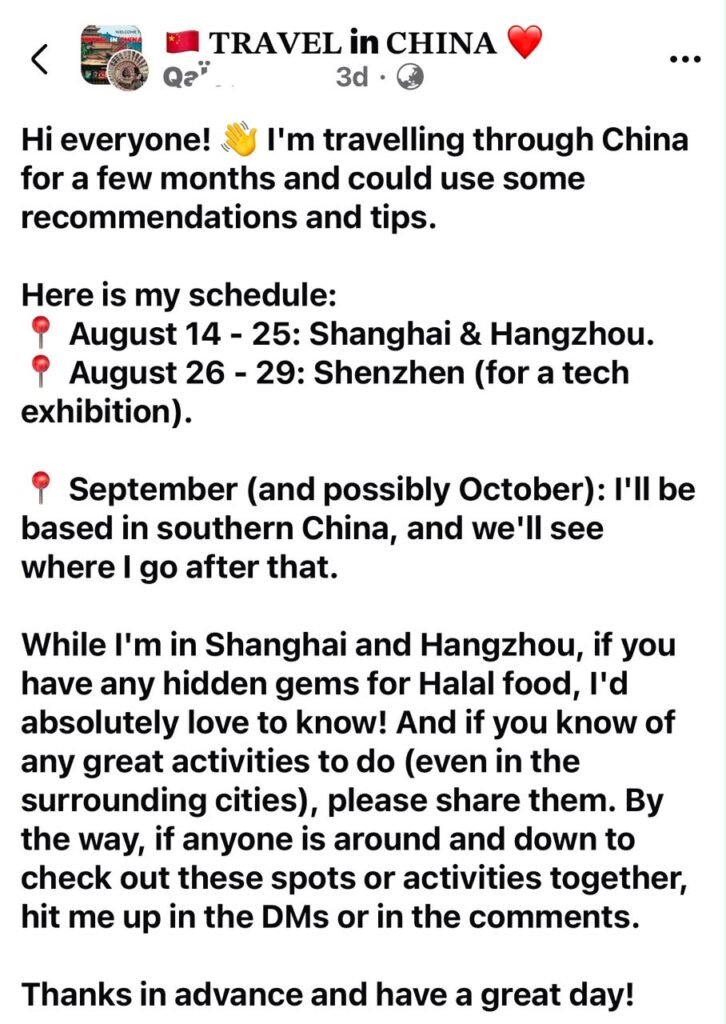
“Hi everyone! 👋 I’m travelling through China for a few months and could use some recommendations and tips.
Here is my schedule:
📍 August 14–25: Shanghai & Hangzhou.
📍 August 26–29: Shenzhen (for a tech exhibition).📍 September (and possibly October): I’ll be based in southern China, and we’ll see where I go after that.
While I’m in Shanghai and Hangzhou, if you have any hidden gems for Halal food, I’d absolutely love to know! And if you know of any great activities to do (even in the surrounding cities), please share them.”

AI Travel Planner Answers
This traveler has already made the big decisions: Shanghai/Hangzhou Aug 14–25, Shenzhen Aug 26–29, then southern China for September and perhaps October. The most useful next step is not adding lots of cities—it’s helping them make the most of a long, flexible stay.
A few things stand out:
- Shanghai + Hangzhou: 11–12 days is generous, which is actually a strength. I wouldn’t rush to fill it. Shanghai rewards neighborhood exploration, architecture, museums and ordinary city life; Hangzhou gives a very different rhythm around West Lake, tea country and greener surroundings.
- Halal food: this deserves specific, current restaurant research rather than generic recommendations. Look for 清真 (qīngzhēn), the Chinese term commonly used for halal food, and don’t assume every Lanzhou-style noodle restaurant necessarily meets the traveler’s own halal requirements.
- Shenzhen: because they’re already attending a tech exhibition, I’d lean into Shenzhen as an opportunity to understand contemporary China rather than treating it merely as a business stop. The contrast with Hangzhou and historic Shanghai will be interesting.
- September/October: I would keep this deliberately open for now. With potentially two months available, southern China becomes much more interesting when explored slowly rather than as a sequence of weekend city breaks. Guangzhou would make sense for food and everyday urban culture, while other choices should depend on whether they want nature, traditional towns, beaches, hiking, minority cultures or more modern cities.
One particularly good principle for a trip this long: don’t spend all your time sightseeing. Markets, parks, metro journeys, neighborhood restaurants and simply having repeat places—a favorite breakfast shop or evening walk—will probably tell you more about everyday China than adding another attraction every day.
Since they’re specifically asking for recommendations, the question I’d ask them next is: What are you most interested in besides the tech exhibition—food, nature/hiking, history and traditional culture, nightlife/social life, or seeing modern China? That answer would completely change what I’d recommend for September and October.
Ready to Check Shanghai Hotels?
Dad & Elaine have personally used Trip.com many times when travelling in China and elsewhere — for hotels, flights, attractions and tours. We’ve had good experiences with it, so it’s one of the booking platforms we use ourselves.
🏨 Check Shanghai hotels & current prices on Trip.com →
Affiliate link — ChinaTravelBUG may earn a small commission at no extra cost to you.
Looking for Else Where Hotels in China?
Dad & Elaine have personally used Trip.com many times when travelling across China and elsewhere — for hotels, flights, attractions and tours. We’ve had good experiences with it, so it’s one of the booking platforms we use ourselves.
🏨 Check hotels & current prices across China on Trip.com →
ChinaTravelBUG Note
The AI Travel Planner’s answer above is reproduced unedited.
This is an interesting example of why planning a long stay in China is fundamentally different from designing a conventional 7-, 10- or 14-day itinerary.
With potentially several months available, there is much less reason to decide every destination before arriving.
In fact, flexibility can become one of the traveler’s greatest advantages.
They can spend longer in places they enjoy, change direction according to weather and interests, and experience something that travelers moving hotels every two or three nights rarely get:
ordinary life in China.
A favorite breakfast place. A neighborhood park. Recognizing the same shopkeeper. Learning how the metro works without thinking about it. Returning to the same street at different times of day.
For a traveler with several months, those experiences can become just as important as famous attractions.
A Useful Chinese Word for Halal Travelers: 清真
The Planner mentions 清真 (qīngzhēn).
This is an important term for travelers looking for halal food in China and is commonly seen on restaurants serving food associated with China’s Muslim communities.
However, travelers with specific dietary or religious requirements should not rely on a restaurant name, cuisine style or the presence of Lanzhou-style noodles alone.
Standards and individual requirements can differ.
If strict halal compliance is important, confirm directly with the restaurant rather than making assumptions based only on the type of food being served.
Why Shanghai + Hangzhou Doesn’t Need to Be Rushed
At first glance, spending roughly 11–12 days between Shanghai (上海, Shànghǎi) and Hangzhou (杭州, Hángzhōu)may look excessive.
For this traveler, it isn’t.
Shanghai can be approached as much more than the Bund, Pudong and a checklist of attractions. With extra time, neighborhoods, architecture, parks, museums, food and everyday street life become part of the experience.
Hangzhou offers a natural change of pace.
Beyond West Lake (西湖, Xī Hú), spending more time there creates opportunities to explore tea culture, greener surroundings and a less hurried side of the region.
And because this isn’t a short vacation, there is no need to turn every available day into another day trip.
Shenzhen: Don’t Treat the Tech Exhibition as the Whole Experience
Shenzhen (深圳, Shēnzhèn) is particularly appropriate for this traveler because technology is already part of the reason for visiting.
But Shenzhen itself can add another layer to the journey.
Shanghai can help a visitor understand China’s commercial and international development.
Hangzhou combines history, landscape and one of China’s important contemporary technology economies.
Shenzhen presents yet another story: the extraordinary speed of China’s urban and economic transformation over the past few decades.
For someone interested in technology, spending time looking at the city around the exhibition may be just as interesting as attending the exhibition itself.
What About September and October?
This is where we agree strongly with the Planner:
Don’t decide everything yet.
“Southern China” covers an enormous range of possible experiences.
The right route depends on what the traveler discovers they actually enjoy during those first few weeks.
Someone fascinated by contemporary Chinese cities might continue toward Guangzhou (广州, Guǎngzhōu) and other parts of the Pearl River Delta.
Someone wanting landscapes could make completely different choices.
And someone increasingly interested in traditional towns, food, local culture or slower travel could build another route altogether.
There is also an important calendar consideration: travelers remaining in China into early October should pay close attention to China’s National Day holiday period, when domestic travel demand can become exceptionally heavy.
Transport availability, accommodation prices, attraction crowds and local travel conditions can all be affected.
ChinaTravelBUG Verification Note
Last verified: August 13, 2026
Travelers should verify current train schedules, exhibition arrangements, attraction opening hours and holiday arrangements before making bookings.
Halal travelers should also confirm restaurants according to their own dietary requirements rather than assuming that every restaurant displaying a particular regional cuisine provides the same level of halal compliance.
The original traveler’s proposed dates also potentially extend into China’s National Day travel period. Anyone traveling around that time should check the official year’s holiday arrangements and plan transport accordingly.
About This Traveler Question
This question was adapted from a real traveler discussion shared online. Personal identifying details have been omitted.
What makes the question particularly useful is its time horizon.
Most China itinerary questions ask:
“How much can I fit into 10 days?”
This traveler has almost the opposite problem.
They potentially have months.
That changes the objective from maximizing attractions to maximizing understanding and enjoyment.
And that leads to a very different ChinaTravelBUG planning principle:
When you have more time, don’t automatically add more places. Go deeper.

Spending Several Weeks or Months in China?
Tell the FREE ChinaTravelBUG AI Travel Planner how long you’ll be in China, where you’re starting, any fixed commitments, what interests you most and how slowly you like to travel.
You don’t need to have the whole journey figured out.
The Planner can help you decide what to plan now, what to leave flexible, where to slow down and which destinations make sense once you know what kind of China experience you’re actually enjoying.