
If you’re planning a longer independent trip around China, you may not want every hotel booked before you leave home. But does Chinese immigration require proof of accommodation for every night of your trip? And how is that different from the accommodation information you may need when applying for a Chinese visa? The Traveler’s Question Hi all. I have a question: I will be travelling to Beijing on 10th September 2026. I’m intending to travel in China for about 3 weeks. I have only booked a hotel for my 5 days stay in Beijing. Is it compulsory to have proof of accommodations for my whole stay in China? As I usually book accommodation as I move around. Thank you in advance. ChinaTravelBUG AI Travel Planner Answer No — you generally do not need to pre-book accommodation for every night of a three-week trip simply in order to travel around China. Booking hotels as you go is perfectly workable. The important distinction is between visa application requirements and what you do after arriving. If you need to apply for a Chinese tourist (L) visa, current official guidance asks for itinerary documentation including round-trip flight bookings and proof of hotel reservation, or alternatively an invitation letter. However, the exact supporting-document requirements can vary by the Chinese embassy/visa centre handling your application, and consular officers can request additional documents. So I would do this: Once you’re in China, hotels normally register foreign guests using your passport, so changing accommodation as you travel is quite normal. One practical consideration: September is a pleasant and popular time to travel, and your trip will run toward China’s National Day holiday period at the beginning of October. Even if you prefer flexibility, I wouldn’t leave the final days completely unplanned if your trip extends into that period. Your passport nationality matters here because it determines whether you need a visa at all and which entry rules apply. Further Reading China Visa & Entry Requirements Useful for separating visa requirements from the documents you may want available when entering China. A note about this AI Travel Planner answer: This answer is shown as originally generated, without editorial rewriting. Visa, entry and immigration requirements can change and can differ according to nationality and individual circumstances. Always verify current requirements with the relevant official Chinese authority before travel. ChinaTravelBUG Verification Note Last verified: August 29, 2026 There are three separate issues that travelers should avoid confusing: 1. Documents required when applying for a Chinese visa If you require a Chinese tourist visa (L visa / 旅游签证, lǚyóu qiānzhèng), the supporting documents requested during the visa application process can include travel itinerary information, transportation bookings and accommodation documentation. The precise requirements can vary according to the Chinese embassy, consulate or visa application center processing the application, as well as the applicant’s circumstances. If your visa has not yet been issued, follow the requirements of the specific Chinese mission or visa center handling your application rather than assuming that five nights of accommodation will be sufficient. 2. Documents that may be relevant when entering China Having a valid visa—or being eligible for visa-free entry—is a separate issue from having every hotel for a three-week journey booked in advance. Border authorities may ask travelers about their travel purpose, accommodation or onward/return arrangements. Travelers should therefore keep useful supporting information readily available, including their first accommodation booking and onward or return travel information. Entry decisions ultimately rest with China’s immigration authorities. 3. Accommodation registration after you arrive Foreign travelers staying at hotels in mainland China normally present their passport or other accepted identification at check-in so the hotel can complete the required accommodation registration. This means travelers can change hotels and continue booking accommodation during their journey. You are not normally locked into one pre-declared three-week hotel itinerary simply because you entered China with an initial hotel reservation. If staying somewhere other than a hotel—for example, in a private residence—different accommodation-registration procedures can apply. One Practical Warning for These Particular Dates This traveler arrives in Beijing (北京, Běijīng) on September 10 and intends to travel for approximately three weeks. That takes the journey toward China’s National Day (国庆节, Guóqìng Jié) period at the beginning of October. That creates a very different problem from immigration. Even if you can legally retain flexibility and book hotels as you travel, popular accommodation and transportation can become much harder to secure around one of China’s busiest domestic travel periods. For this particular itinerary, we’d therefore keep the beginning of the journey flexible if desired—but start locking down the final part of the trip once the route becomes clearer. Flexibility is wonderful. Flexibility during Golden Week can become considerably less wonderful. 😅 Related Traveler Questions Do You Need to Provide Every Guest’s Name When Booking a Hotel in China? — AI Travel Planner Answers This explains the important difference between the name used to make a hotel reservation and the registration of the people who actually stay in the room. Booking Hotels in China as a Foreigner Useful for understanding foreign-guest registration, passports at check-in and what international travelers should look for when choosing accommodation. The bigger lesson is simple: Visa documentation → immigration → hotel booking → accommodation registration are connected, but they are not the same thing. Understanding that distinction makes independent travel around China considerably less intimidating. Planning a Flexible China Trip? If you prefer deciding where to go as you travel, tell the ChinaTravelBUG AI Travel Planner: It can help you decide what genuinely needs booking ahead and what can safely remain flexible. Try it free and plan your China trip one decision at a time.
Where Should You Go to Experience Rural China, Villages and Wilderness? — AI Travel Planner Answers
For some travelers, the China they most want to experience isn’t the Forbidden City, Shanghai skyline or another famous attraction. It’s mountains, forests, farms, villages, local markets and ordinary rural life. One traveler from rural England put it particularly well: having grown up surrounded by fields and trees, they wanted to experience the parts of China where people still live closer to the land—not simply move from one crowded tourist attraction to another. The Traveler’s Question Over the years, and learning more about China, I’ve become increasingly interested in visiting. However, I’m more interested in seeing the more rural parts of China, the wilderness, the mountains, the forests. The places frequented by regular rural people, as a regular rural English person myself, rather than the big tourist sites thronging with people taking selfies. I grew up in a home surrounded by trees and fields, with the nearest neighbour a good walk away, that’s the China I want to see. What advice do people have for someone interested in rural culture and traditions, wilderness and villages? ChinaTravelBUG AI Travel Planner Answer Yes — and I’d resist the temptation to build your first China trip around the usual Beijing–Xi’an–Shanghai circuit. From what you describe, rural China shouldn’t be a side trip; it should be the heart of the journey. China has plenty of places where mountains, farming communities, forests and traditional village life come together. The important thing is choosing a region and exploring it slowly rather than chasing a list of supposedly “hidden” villages. Everyday experiences—markets, local restaurants, walking through communities and simply observing daily life—can reveal as much as formal sightseeing. For your interests, I’d particularly look at: One caution: “rural” doesn’t necessarily mean untouched or tourist-free. Some famous ancient villages can be every bit as busy as major city attractions. I’d rather stay several nights in one rural area, walk or cycle between communities, eat locally and see what happens in the morning and evening after day-trippers disappear. And don’t worry about needing fluent Mandarin. Independent travel is entirely possible with preparation, although in genuinely remote areas a local driver or occasional local guide can be useful—not because you’re a foreigner, but because public transport may stop well short of the places you’re trying to reach. You actually sound like someone for whom a two- or three-week Yunnan journey built around countryside and smaller towns, with perhaps just one major city at either end, could make a superb first China trip. If you tell me roughly how many days you’d have, I can suggest a rural-first route rather than a conventional tourist itinerary. A note about this AI Travel Planner answer: This answer is shown as originally generated, without editorial rewriting. Travel information can change, especially transport schedules, border procedures, opening hours, ticketing rules and holiday arrangements. Before making bookings or travel decisions, always verify time-sensitive details with current official sources. ChinaTravelBUG Verification Note Last verified: August 29, 2026 The destinations suggested above are broad regional recommendations rather than a fixed itinerary, and the central advice remains sound: travelers interested primarily in rural landscapes and everyday community life should consider building their journey around one region and traveling slowly, rather than attempting to collect distant destinations. A few distinctions are worth understanding: Yunnan Province (云南省, Yúnnán Shěng) offers enormous geographic and cultural diversity. Shaxi (沙溪, Shāxī), Xizhou (喜洲, Xǐzhōu) and the Yuanyang Rice Terraces (元阳梯田, Yuányáng Tītián) can provide very different experiences, and none should be treated as representative of all rural Yunnan. Guizhou Province (贵州省, Guìzhōu Shěng) contains many communities associated with China’s officially recognized ethnic minority groups (少数民族, shǎoshù mínzú). Travelers should approach these places as living communities rather than as cultural exhibits created for visitors. Guangxi Zhuang Autonomous Region (广西壮族自治区, Guǎngxī Zhuàngzú Zìzhìqū) offers some of China’s best-known karst and rice-terrace landscapes. Travelers seeking quieter countryside should distinguish between heavily visited scenic areas and the wider rural landscapes surrounding them. Western Sichuan (川西, Chuānxī) can offer much larger-scale mountain and wilderness experiences, but travel may involve longer road journeys and significantly higher elevations. Altitude and weather should be taken seriously when planning journeys into higher areas. And one important reality deserves repeating: Rural China does not automatically mean tourist-free China. Some famous villages, ancient towns and scenic rural areas receive substantial domestic tourism. Staying overnight, traveling outside major holiday periods and allowing time for early mornings and evenings can reveal a very different atmosphere from that experienced by day-trippers. Related Traveler Questions Wuzhen or Yangshuo: Where to Experience Rural China on a 10-Day Beijing–Shanghai Trip? A useful comparison if you want countryside in your itinerary but are deciding between a traditional Jiangnan water-town environment and the karst landscapes around Yangshuo (阳朔, Yángshuò). Ping’an or Dazhai/Jinkeng: Which Longji Rice Terrace Village Is More Scenic and Authentic? Useful if the rice terraces and village landscapes of Guangxi appeal to you and you are trying to decide where to stay rather than simply making a quick sightseeing stop. Solo Travel in Western Sichuan: Self-Drive or Join a Tour? A practical companion if Western Sichuan’s mountains attract you but you’re wondering how independent travel works once you move beyond China’s easiest rail-connected destinations. ChinaTravelBUG’s Take: Don’t Go Looking for a “Hidden Village” There is a trap in rural travel. We sometimes imagine that the most authentic experience must be a village nobody else knows about. It doesn’t necessarily work that way. A famous village at 7:00 in the morning, when residents are opening shops, children are heading out and breakfast is being prepared, can sometimes reveal more than an obscure village you race through for forty minutes because somebody online called it a “hidden gem.” The better question may be: Can I stay long enough to see this place behaving like a place rather than an attraction? Visit a morning market. Eat where local families eat. Walk beyond the photographed street. Sit in a park. Take the slower road occasionally. Stay overnight when everyone else leaves. And don’t be disappointed when rural China contains smartphones, electric scooters, new houses, delivery vans and modern conveniences. That is rural China too. The goal isn’t to find
Deep China: Yandi 炎帝, Huangdi 黄帝 and Chiyou 蚩尤 — When China’s Legendary Rivals Became Ancestors
From Yandi Mausoleum 炎帝陵 in Baoji 宝鸡 to 炎黄子孙 — and Why Winning the Battle Didn’t Mean Erasing the Loser Travel China. Let the places teach you Chinese history. See the place. Ask the bigger question. Understand China better. Section 1 — We Came to Visit One Ancestor. Then the Family Story Got Complicated. Dad & Elaine came to: Yandi Mausoleum (炎帝陵, Yándì Líng) near: Baoji (宝鸡, Bǎojī) in: Shaanxi Province (陕西省, Shǎnxī Shěng). At first, this looked straightforward. Three Chinese characters: 炎帝陵 Break them apart: 炎帝 — Yándì Yan Emperor 陵 — líng mausoleum / important tomb Easy. 😂 [INSERT DAD & ELAINE AT 炎帝陵 PHOTO] We had apparently come to learn about: one legendary ancestor. Then Dad started reading the displays. 😬 Suddenly we had: Shennong (神农, Shénnóng) Huangdi (黄帝, Huángdì) Chiyou (蚩尤, Chīyóu) two legendary battles, ancestor commemoration (祭祖), surname culture (姓氏文化), and eventually: 炎黄子孙 — “Descendants of Yan and Huang.” Apparently we’d walked into: China’s legendary family story. And like many family stories… there had been arguments. 😂🔥 🧥 Dad’s Coat Rack — Meet THREE Characters First Before anybody gets lost among China’s legendary ancestors, remember only three names. 🌾 Yandi 炎帝 Associated in later tradition with: Shennong (神农) and therefore with: agriculture (农业), farming (农耕), medicinal knowledge (医药) and: the beginnings of settled civilized life. Remember: YANDI 炎帝 = FARMING + ANCESTRAL MEMORY 👑 Huangdi 黄帝 Huangdi (黄帝) Yellow Emperor also: Xuanyuan Huangdi (轩辕黄帝) Another great ancestral figure of Chinese legendary antiquity. Dad & Elaine followed his story separately to: Huangdi Mausoleum (黄帝陵) in northern Shaanxi Province. Remember: HUANGDI 黄帝 = FOUNDING-ANCESTOR MEMORY ⚔️ Chiyou 蚩尤 Chiyou (蚩尤) A formidable legendary opponent associated particularly with: warfare (战争 / 兵事). Remember: CHIYOU 蚩尤 = WARRIOR + DEFEATED RIVAL + LATER CULTURAL MEMORY That’s enough. Three characters. Keep them on Dad’s coat rack. 😂 ⏳ Where Are We in Chinese History? This is important. Yandi (炎帝), Huangdi (黄帝) and Chiyou (蚩尤) belong to China’s: legendary antiquity (上古传说, shànggǔ chuánshuō). They are traditionally placed long BEFORE China’s securely documented dynastic history. For a first-time international traveler, here’s the only timeline you need: LEGENDARY ANTIQUITY 上古传说 Yandi 炎帝 · Huangdi 黄帝 · Chiyou 蚩尤 traditionally placed in the remote third millennium BCE ↓ NEOLITHIC CHINA 新石器时代 archaeology reveals real farming communities, settlements, pottery and increasingly complex societies ↓ SHANG DYNASTY 商朝 c. 1600–1046 BCE late Shang gives us oracle-bone writing 甲骨文 ↓ ZHOU DYNASTY 周朝 begins c. 1046 BCE King Wen 周文王 · King Wu 周武王 · Duke of Zhou 周公 ↓ QIN UNIFICATION 秦统一 221 BCE Qin Shi Huang 秦始皇 🔥 So when we talk about: Yandi 炎帝 and: Huangdi 黄帝, we are going much farther back than: Confucius (孔子) or: Qin Shi Huang (秦始皇). But here’s the crucial distinction: TRADITIONAL CHRONOLOGY ≠ SECURE HISTORICAL DATING. Don’t imagine Dad has found Yandi’s passport showing: Date of Birth: 28 April 2737 BCE. 😭😂 We haven’t. 🌶️ Deep China Evidence Rule For this article, keep THREE boxes in your head. 传说 — chuánshuō legend / transmitted tradition Yandi (炎帝). Huangdi (黄帝). Chiyou (蚩尤). Battle of Banquan (阪泉之战). Battle of Zhuolu (涿鹿之战). 考古 — kǎogǔ archaeology Actual prehistoric: settlements (聚落), farming (农业), pottery (陶器), burials (墓葬) and: material remains (遗物). 文化记忆 — wénhuà jìyì cultural memory How later generations remembered these figures. Expressions such as: 炎黄子孙 Rituals such as: 祭祖 — ancestor commemoration and physical places such as: 炎帝陵 and: 黄帝陵. 🔥 These three boxes can: TALK TO EACH OTHER. But they are: NOT THE SAME THING. That’s our Michelin guardrail. 🌾 Now Meet Yandi 炎帝 Properly At Yandi Mausoleum (炎帝陵), the displays repeatedly connect Yandi (炎帝) with: Shennong (神农). The two figures were not necessarily identical in the earliest layers of Chinese tradition, but later traditions increasingly connected and identified them as: Shennong Yandi (神农炎帝). And the name: 神农 is wonderfully revealing. 神 — shén divine / wondrous 农 — nóng agriculture / farming So: 神农 “Divine Farmer” 🔥 Now the stories attached to him make more sense. 🌱 The Very Busy Ancestor The displays Dad photographed associate Yandi/Shennong (炎帝/神农) with: agriculture (农业), agricultural tools (农具), medicinal knowledge (医药), markets (市场), pottery (陶器), textiles (纺织) and other beginnings of civilized life. 😳 Dad looked at the list and thought: One guy did ALL this? 😂 Good question. 🍚 Western Handrail: Don’t Imagine One Ancient Steve Jobs 😂 Yandi/Shennong (炎帝/神农) isn’t best understood as: one prehistoric inventor filing patents for agriculture, medicine, pottery and markets. Archaeology shows these developments emerging through: communities over: long periods of time. Agriculture developed. Pottery developed. Medicinal knowledge accumulated. Exchange developed. 🔥 So perhaps the traditional stories are doing something different. They gather enormous transformations in human life around: a memorable ancestral figure. That’s much easier for cultural memory to carry. 🌿 神农尝百草 — Shennong Tastes the Hundred Herbs One of the most famous traditions is: 神农尝百草 Shennong tastes the hundred herbs 尝 — cháng taste / try 百 — bǎi hundred 草 — cǎo grasses / herbs This tradition connects Shennong (神农) with: medicinal knowledge (医药). Again: TRADITION not: a clinical trial report. 😂 But look at what the tradition considers important: FOOD 食 FARMING 农 MEDICINE 医 EXCHANGE 市 POTTERY 陶 These are foundations of: settled human life. 🔥 Maybe the real question isn’t: Did one man invent them? Maybe it’s: Why did later generations gather these particular foundations of civilization around Yandi/Shennong (炎帝/神农)? 🐇 That’s a much better question. 👑 Then Huangdi 黄帝 Appears And now the family story becomes complicated. Dad & Elaine had also visited: Huangdi Mausoleum (黄帝陵) where Huangdi (黄帝) is remembered as a: founding / primordial ancestor (初祖). There we encountered the famous phrase: 炎黄子孙 Let’s read it. 炎 — Yán Yandi 炎帝 黄 — Huáng Huangdi 黄帝 子孙 — zǐsūn descendants So: 炎黄子孙 Descendants of Yan and Huang Easy. Except… Yandi and Huangdi fought each other. 😬 ⚔️ Battle #1 — Banquan 阪泉之战 Ancient transmitted texts preserve traditions of conflict between: Huangdi (黄帝) and: Yandi (炎帝). The
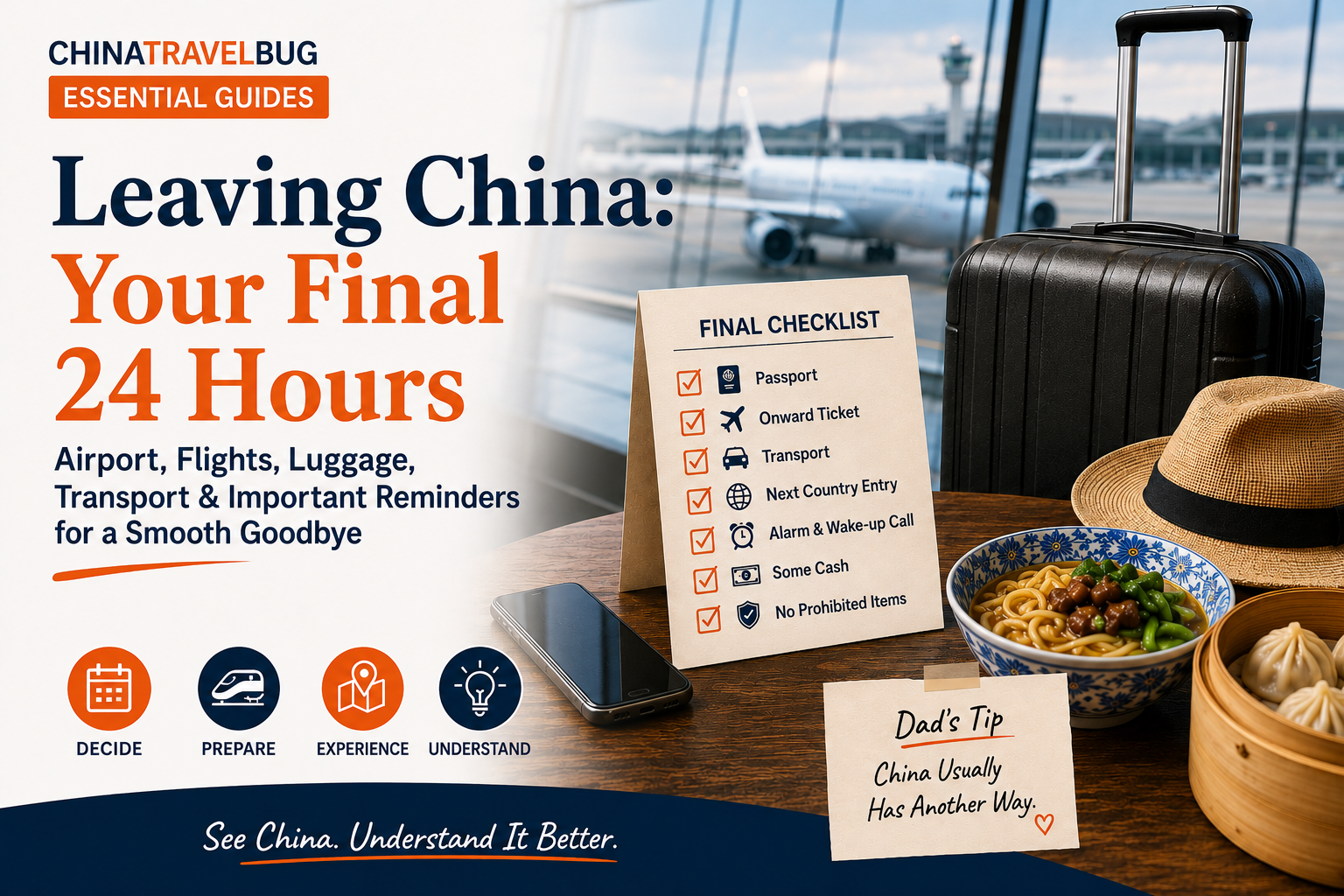
Leaving China: Your Final 24 Hours
A First-Time Traveler’s Guide to a Smooth International Departure You’ve figured out Alipay. You’ve survived the metro. You may have taken a high-speed train, scanned hundreds of QR codes and discovered that calling a DiDi isn’t nearly as frightening as it looked from home. 😂 Now there’s one final journey: Leaving mainland China. You may be flying home. Or you may be continuing to Japan, South Korea, Southeast Asia, Europe—or somewhere else entirely. For travelers using China’s visa-free transit policy, that onward journey is especially important. Either way, leaving China is usually straightforward. The trick is avoiding a few very preventable mistakes. ⚡ Quick Answer The night before departure: Check DATE → Flight → Airport → Terminal → Next-country requirements → Pack → Arrange transport → Set alarm Before leaving your hotel: ✓ Passport✓ Phone✓ Wallet/cards✓ Medication✓ Onward ticket✓ Correct airport✓ Correct terminal✓ Some emergency cash And if your flight leaves just after midnight: Check the DATE twice. 🐞 ChinaTravelBUG Tip: Don’t think only: “My flight is at 2:00 AM.” Think: “What DATE is 2:00 AM—and what DATE must I leave my hotel?” Last verified: 29 August 2026 1. Check Your Flight — Especially the DATE The night before departure, open your actual airline booking. Check: ✓ Departure date✓ Departure time✓ Flight number✓ Airport✓ Terminal✓ Flight status Don’t rely on memory. ⚠️ The After-Midnight Trap Suppose your ticket says: 8 October — 02:00 Your flight leaves at 2:00 AM on 8 October. That means you’ll probably leave your hotel late on 7 October. Don’t wake up on 8 October thinking: “My flight is tonight.” Your plane has already gone. 😂 🐞 ChinaTravelBUG Tip Write it like this: FLIGHT: 8 Oct — 02:00LEAVE HOTEL: 7 Oct — ___ PM One tiny note can prevent one enormous mistake. 2. Not Flying Home? Check Your NEXT Country Too China may not be your final destination. Perhaps you’re traveling: London → Beijing → Seoul or: Sydney → Shanghai → Tokyo Before leaving China, make sure you meet the entry or transit requirements of wherever you’re going next. Keep easy access to: ✓ Passport✓ Confirmed onward ticket✓ Visa or other entry authorization if required✓ Accommodation details if required✓ Evidence of onward/return travel if required Your permission to enter China doesn’t automatically give you permission to enter your next destination. 🐞 ChinaTravelBUG Tip: Every international journey involves two questions: Can I leave here?Can I enter there? Check both. 3. If You Entered China Under Visa-Free Transit This deserves special attention. China’s 240-hour visa-free transit policy is based on eligible travelers transiting mainland China on their way to a third country or region. Think: A → Mainland China → B For example: United Kingdom → China → South Korea Your confirmed onward journey is therefore important. Keep your: Passport + confirmed onward ticket + next-destination information easy to access. And remember that you must also meet the entry requirements of Country/Region B. ⚠️ Don’t Casually Change Your Onward Journey If you entered China based on a particular transit itinerary, don’t assume you can simply cancel or substantially change that journey and still satisfy the conditions under which you entered. If a cancellation or disruption forces your plans to change, ask the airline and Chinese immigration authorities rather than guessing. China’s National Immigration Administration operates the 12367 immigration service hotline for immigration questions. 🐞 ChinaTravelBUG Tip: For a visa-free transit traveler, the onward ticket isn’t merely another booking. It’s part of your transit journey. 4. Make Sure You’re Going to the RIGHT Airport Several major Chinese cities have more than one passenger airport. Beijing PEK — Beijing Capital International Airport北京首都国际机场Běijīng Shǒudū Guójì Jīchǎng PKX — Beijing Daxing International Airport北京大兴国际机场Běijīng Dàxīng Guójì Jīchǎng Shanghai PVG — Shanghai Pudong International Airport上海浦东国际机场Shànghǎi Pǔdōng Guójì Jīchǎng SHA — Shanghai Hongqiao International Airport上海虹桥国际机场Shànghǎi Hóngqiáo Guójì Jīchǎng These are different airports. PEK ≠ PKX PVG ≠ SHA Going to the wrong one can leave you a very long way from your flight. ⚠️ Don’t just tell your driver “Beijing Airport.” Check: Airport code + Chinese airport name + terminal 5. Arrange Your Airport Transport the Day Before Depending on the city and airport, your choices may include: 🚇 Metro🚆 Airport rail🚕 Taxi🚗 DiDi🚐 Hotel/private transfer Check that your planned public transport is actually operating at the time you need it. The metro may be wonderful at 3:00 PM. It’s less useful when your flight leaves at 2:00 AM. 😂 Worried About Getting a Car? Ask your hotel reception the day before. The hotel may offer an airport-transfer service. If not, reception staff can often help arrange a taxi or other suitable transport. Show them your flight booking and say: 请帮我安排去机场的车。 Qǐng bāng wǒ ānpái qù jīchǎng de chē.Please help me arrange a car to the airport. Confirm: Airport + Terminal + Pickup Time For your driver: 我要去机场。 Wǒ yào qù jīchǎng.I want to go to the airport. But showing the driver the actual Chinese airport name and terminal is safer than relying on pronunciation. 🐞 ChinaTravelBUG Tip: If you’re still nervous about DiDi, don’t make departure morning the day you decide to become an expert. Ask reception for help. 6. Set Your Alarm — And Get a Morning Call Early flight? Set an alarm on your phone. If you’re worried about oversleeping, ask hotel reception for a wake-up call too. 请给我安排叫醒服务。 Qǐng gěi wǒ ānpái jiàoxǐng fúwù.Please arrange a wake-up call for me. Tell them the time clearly. 🐞 Dad’s Early-Flight Formula Transport arranged + phone alarm + hotel wake-up call. Now go to sleep. 😴 7. How Early Should You Reach the Airport? There isn’t one magic number for every airport and airline. For an international departure, around three hours before departure is a useful planning handrail, unless your airline advises otherwise. Your airline’s actual: check-in deadline + baggage-drop deadline + boarding time + gate-closing time are what matter. Give yourself extra time if: 🐞 ChinaTravelBUG Tip: Thirty quiet minutes at the gate is boring. Missing an international flight is considerably more exciting. 😂 Boring is good. 8. Check Your Souvenirs BEFORE You Pack Something being sold legally in a shop doesn’t automatically mean you can:
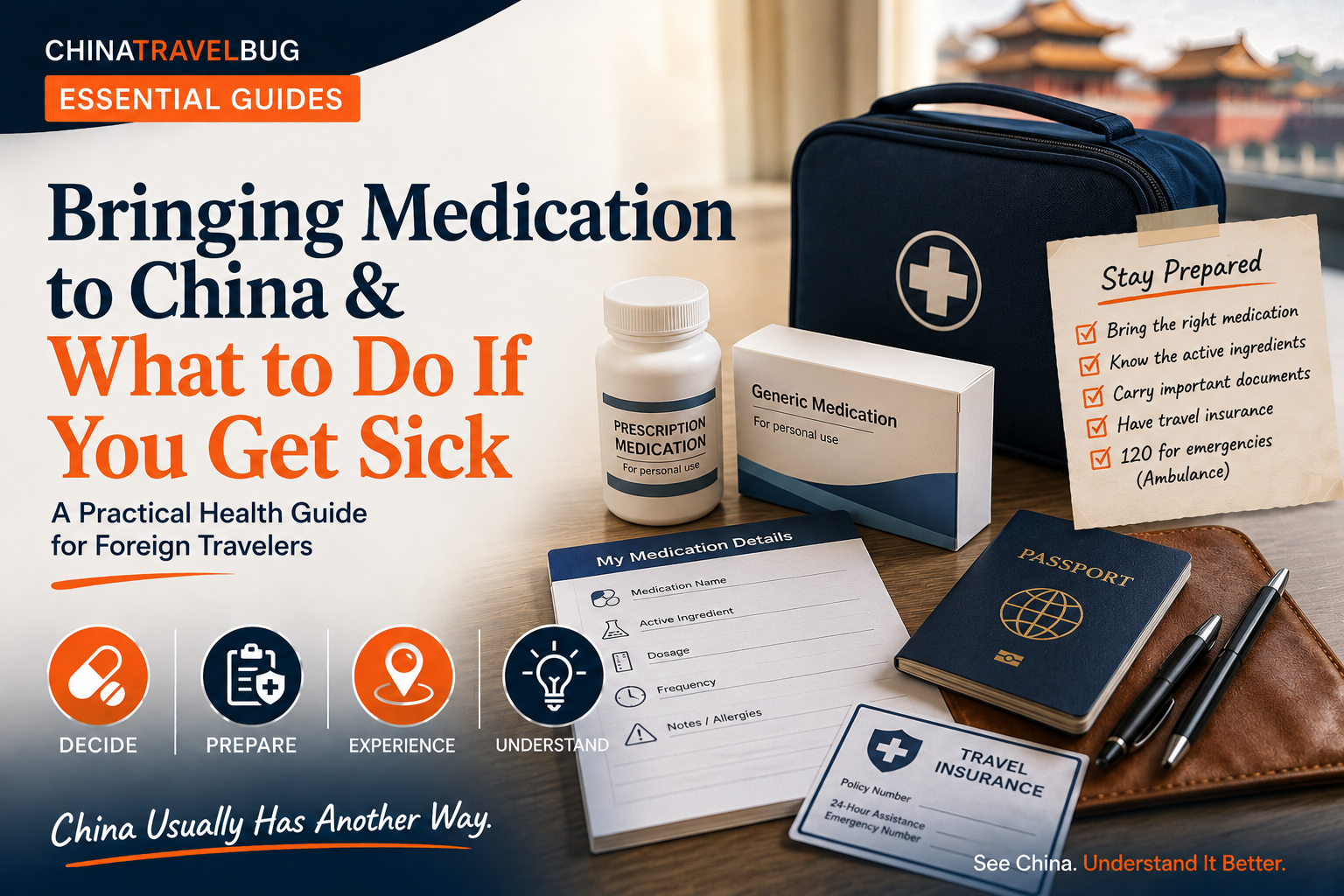
Bringing Medication to China & What to Do If You Get Sick
A Practical Health Guide for Foreign Travelers Nobody wants to think about getting sick on holiday. But if you take regular medication—or you’re simply wondering what would happen if you needed a doctor in China—a little preparation can remove a lot of anxiety. The good news is that travelers can generally bring reasonable quantities of ordinary medication for their own personal use into China, subject to Customs supervision. The important exception is medication containing narcotic or psychotropic substances, which is much more tightly controlled. And if you do become seriously ill while traveling? China has hospitals throughout the country, and the national medical emergency number is: 🚑 120 — Medical Emergency / Ambulance ⚡ Quick Answer If you take regular medication, bring enough for your trip in a reasonable quantity for personal use and carry supporting documentation such as your prescription or medical records. For prescription medication, I would also keep it in its original labelled packaging where practical. It makes identifying the medicine much easier if anyone needs to check it. If your medicine contains a narcotic or psychotropic substance, don’t assume your normal prescription is enough. China applies additional controls, and the permitted quantity can depend on the drug’s classification. Check your specific medication before traveling. Before you fly, save: ✓ Medication details✓ Prescription / doctor’s documentation✓ Travel-insurance information✓ Your insurer’s emergency number✓ 120 for medical emergencies 🐞 ChinaTravelBUG Tip: Don’t ask the internet, “Can I bring medicine to China?” Ask: “Can I bring this exact medicine and active ingredient into China?” That’s the question that matters. 1. Can I Bring My Medication Into China? For ordinary medication that does not contain narcotic or psychotropic substances, China’s rules allow travelers to carry small quantities for personal use, limited to a reasonable quantity for personal use and subject to Customs supervision. Notice what that rule doesn’t say. It doesn’t give every traveler a universal: “You can bring exactly 30 days of medication.” That’s a common type of travel advice online, but China’s official guidance is framed around personal use and reasonable quantity. For a normal trip, bring what you reasonably need rather than packing unusually large quantities. What I Would Carry Keep together: The active ingredient is particularly useful because brand names can differ between countries. 🐞 ChinaTravelBUG Tip: Take photos of your prescription and medication labels and keep them on your phone as a backup—but bring the actual supporting documents you may need too. 2. Controlled Medication Needs More Care This is where you should not guess. China separately regulates narcotic drugs and psychotropic substances. Travelers who medically require certain controlled medicines may need to present a medical diagnosis certificate and identification. The quantity permitted also depends on the drug’s classification and applicable prescription limits. For example, Shanghai Customs specifically addresses methylphenidate—the active ingredient in some ADHD medications—as a Category I psychotropic substance in China. That illustrates an important point: A medicine routinely prescribed in your home country may be regulated differently in China. So before traveling with medication for conditions such as ADHD, severe pain, anxiety, sleep disorders or other treatments that may involve controlled substances, check the specific active ingredient against China’s current rules. Don’t rely on another traveler’s experience with a different medicine. 3. What Documents Should I Bring? For ordinary medication, China’s official guidance advises travelers to carry supporting material such as prescriptions, medical records or diagnostic certificates. For medication subject to stricter controls, documentation becomes more important. I would prepare a small medication folder containing: 📄 Prescription📄 Doctor’s letter or diagnosis documentation where appropriate💊 Medication in clearly identifiable packaging🧪 Generic/active ingredient name📱 Digital copies on your phone If your medication is controlled, verify the requirements before departure, rather than discovering the issue at Customs. One more sensible precaution Split important information—not the medication itself unless medically appropriate—between physical and digital copies. If your phone disappears, you still have the paperwork. If your paperwork disappears, you still have the photographs. 4. Buying Medicine in China If you develop a headache, cold, stomach upset or another minor problem while traveling, you don’t necessarily need to find a hospital. China has pharmacies throughout its cities, and some larger pharmacies operate 24 hours. Licensed pharmacies sell over-the-counter medicines such as some cold and allergy remedies. Prescription medicines require a valid prescription reviewed by a pharmacist. Look for: 药店 — yàodiàn Pharmacy / drugstore or: 药房 — yàofáng Pharmacy If you need a particular medicine, show the pharmacist the generic or active ingredient name, rather than relying only on the brand name you use at home. Brand names and formulations may differ in China. 🐞 ChinaTravelBUG Tip: Don’t buy an unfamiliar medicine simply because the packaging looks similar to something you use at home. Ask the pharmacist and check the active ingredient and dosage. For anything more serious—or if you’re unsure what’s wrong—skip the pharmacy and see a doctor. 5. What If You Get Sick in China? First, don’t panic. Foreign travelers can use China’s public and private hospitals. Major cities also have international medical departments and private facilities where English-speaking services may be easier to find. For a non-emergency illness, contact your travel insurer first if practical. They may recommend a hospital, explain your coverage or arrange direct billing. If you’re going to a Chinese public hospital, the basic process is usually: Register → Wait → See the doctor → Tests if needed → Pay → Collect medicine Bring your passport. Official guidance for foreign patients says it may be needed for registration. Many hospitals have their own pharmacy, so if the doctor prescribes medication, you can often collect it there after paying. Don’t Speak Chinese? Save this on your phone: 医院 — yīyuàn Hospital 我需要看医生。 Wǒ xūyào kàn yīshēng.I need to see a doctor. Write down or translate your: If possible, your hotel can also be extremely useful. Ask reception to help identify an appropriate hospital, write down what you need in Chinese, or help arrange transport. 6. If It Is an Emergency For a medical emergency in mainland China: 🚑 Call 120 China’s official health guidance identifies 120 as the ambulance/emergency medical number. If possible, have someone who speaks Chinese help with the call, particularly when explaining your location. Also contact your travel insurer
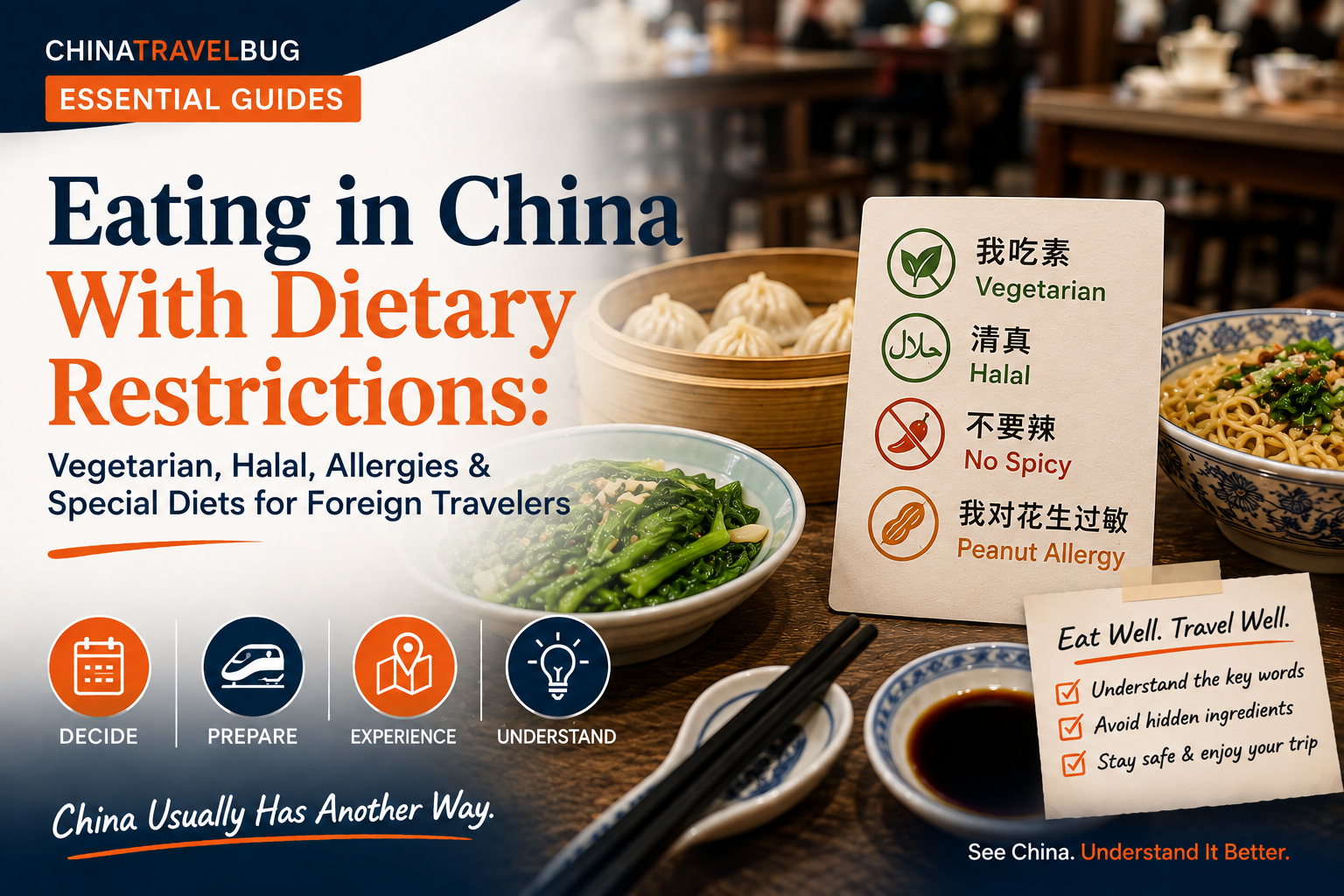
Eating in China With Dietary Restrictions
Vegetarian, Halal, Allergies & Special Diets for Foreign Travelers China is one of the world’s great food destinations. But if you’re vegetarian, vegan, Muslim, allergic to certain foods—or simply don’t eat pork—the first meal can feel more complicated than exciting. The good news? You can travel China with dietary restrictions. The important thing is knowing what your restriction actually means in a Chinese kitchen—and communicating it clearly. ⚡ Quick Answer If you have dietary restrictions in China: For ordinary preferences, translation apps can often solve the problem. For serious food allergies, be much more cautious. A translated sentence is helpful—but it cannot guarantee how a kitchen prepares your food. 1. The Most Important Rule: Don’t Assume Chinese cooking often contains ingredients that aren’t obvious from looking at the finished dish. A vegetable dish may have been cooked with: Likewise, asking: “Does this have pork?” only answers one question. It doesn’t necessarily mean the dish is vegetarian, halal or suitable for your allergy. So instead of trying to memorize dozens of Chinese food rules, remember this: 🐞 ChinaTravelBUG Tip: Tell the restaurant what you cannot eat, rather than assuming the name or appearance of a dish tells you what’s inside. 2. Vegetarian & Vegan Travelers Being vegetarian in China is certainly possible—but the word “vegetarian” can mean different things to different people. The useful Chinese word to recognize is: 素食 — sùshí — vegetarian food You may also see restaurants specializing in: 素食餐厅 — sùshí cāntīng — vegetarian restaurant But in an ordinary restaurant, simply pointing at a plate of vegetables isn’t enough. A vegetable dish may still contain meat stock, oyster sauce or small pieces of meat used for flavour. If you don’t eat any meat, you can show: 我不吃肉。 Wǒ bù chī ròu.I don’t eat meat. For a vegan traveler, the requirements are broader because eggs, dairy and other animal-derived ingredients may also matter. Don’t worry about speaking perfect Mandarin. Showing clear Chinese text on your phone is often more useful than trying to pronounce a sentence nobody understands. 😂 And when you’re uncertain? Choose something simpler—or choose another restaurant. China Usually Has Another Way. 🐞 3. Halal Food in China — Look for 清真 For Muslim travelers, one of the most useful Chinese words to recognize is: 清真 — qīngzhēn — halal You’ll often see 清真 displayed prominently on restaurants serving Muslim communities in China. Depending on the city, you may find halal restaurants serving dishes such as beef and lamb noodles, dumplings, grilled meat and regional cuisines from northwest China. Look for: 清真餐厅 — qīngzhēn cāntīngHalal restaurant 清真食品 — qīngzhēn shípǐnHalal food In parts of China, the use of 清真 by food businesses is specifically regulated, including requirements concerning ingredients, preparation, equipment and separation from prohibited foods. But there is an important distinction: “No pork” does NOT automatically mean halal. A restaurant may serve beef or chicken and still not meet your halal requirements. So if halal preparation matters to you, look for a restaurant clearly identifying itself as 清真, rather than simply asking a normal restaurant to leave the pork out. 🐞 ChinaTravelBUG Tip: Save 清真 on your phone before traveling. Those two Chinese characters can be far more useful than trying to explain “halal” in English. And if you have particularly strict requirements, ask the restaurant directly rather than assuming that every place recommended online follows exactly the same standards you do. China is huge, and practices can vary from place to place. The safest principle is simple: Look for 清真. Ask when unsure. Don’t equate “no pork” with halal. 4. Food Allergies — Take This More Seriously A food preference and a serious food allergy are not the same thing. If eating an ingredient could cause a serious allergic reaction, don’t rely only on pointing at a menu or using a quick translation app. Chinese cooking can involve ingredients that aren’t obvious in the finished dish—such as peanuts, sesame, shellfish, soy, eggs or sauces containing several ingredients. There is also the issue of cross-contact: the food you order may not contain your allergen as an ingredient, but the same wok, utensils, oil or preparation surface may have been used for other foods. Chinese food-safety guidance itself recognizes cross-contact as an allergen-management issue. Prepare Before You Travel If you have a serious food allergy: Food Allergy Research & Education (FARE) specifically recommends translated chef cards for international travel and provides one in Simplified Chinese. 🐞 ChinaTravelBUG Tip: For a serious allergy, “I showed them Google Translate” isn’t enough reassurance. You need confidence that the restaurant understands both the ingredient and how the food is prepared. And if you’re not confident? Don’t eat it. Finding another restaurant—or eating one of the safe foods you’ve brought with you—is much better than taking a risk simply because you’re hungry. 5. “I Don’t Eat Pork” and “I Can’t Eat Spicy Food” Not every dietary restriction is complicated. Sometimes you simply need to tell the restaurant: 我不吃猪肉。 Wǒ bù chī zhūròu.I don’t eat pork. Or: 我不吃辣。 Wǒ bù chī là.I don’t eat spicy food. You can also ask: 不要辣。 Bú yào là.No chilli / not spicy, please. These are useful phrases to save on your phone and show restaurant staff. They are commonly recommended in traveler-oriented Chinese phrase guides. 🌶️ A Small Warning About “Not Spicy” China has enormous regional differences in food. In places such as Sichuan, Chongqing, Hunan and Guizhou, chilli can be an important part of the cuisine. If you genuinely cannot tolerate spicy food, don’t assume that: 微辣 — wēi là — “mildly spicy” will feel mild to you. 😂 Ask for 不要辣 (bú yào là) instead. And remember: Sichuan peppercorn 花椒 (huājiāo) produces the famous numbing sensation and is different from chilli heat. If you dislike that too, you can show: 不要花椒。 Bú yào huājiāo.No Sichuan peppercorn, please. 🐞 ChinaTravelBUG Tip: Don’t worry about perfect pronunciation. Save the Chinese characters and show them on your phone. Clear communication matters more than performing Mandarin at the dinner table. And if the restaurant tells you a particular dish can’t really be made without chilli, choose another dish. Sometimes changing the order is easier than changing
Just Landed in China: Your First 60 Minutes
A Step-by-Step Arrival Guide for First-Time Travelers You planned the trip. You installed the apps. You set up Alipay. You saved your hotel address. Then the aircraft door opens. And suddenly you’re standing in a huge Chinese airport thinking: What do I do now? Don’t worry. Arriving in mainland China is usually much more straightforward than first-time travelers imagine. The airport may be enormous, the signs may look unfamiliar, and your phone may not behave exactly as it did at home—but you don’t need to solve China in your first hour. You only need to do things in the right order. Your first hour is basically this: ✈️ Leave the aircraft↓🛂 Immigration↓🧳 Collect your luggage↓🛃 Customs↓📱 Make sure your phone is online↓💳 Check that you can pay↓🚕 Get to your hotel↓🏨 Check in That’s it. This guide walks you through that first hour step by step. ChinaTravelBUG Quick Answer After landing in mainland China, follow the signs for Arrivals / Immigration, complete immigration formalities, collect your luggage and pass through Customs. Once you enter the public arrivals hall, get your phone connected before worrying about anything else. Then confirm that Alipay or WeChat Pay is working, find your transport, and head to your hotel. Don’t try to solve every problem at the airport. Your first goal is simply to get yourself, your luggage and your phone safely to the hotel. ⚡ Quick Answer: What Do I Do After Landing in China? After landing in mainland China: Immigration → Baggage → Customs → Internet → Payment → Transport → Hotel Keep your passport, phone and hotel address in Chinese easy to reach. Before leaving the airport, make sure: ✓ Your phone has internet✓ Alipay or WeChat Pay opens normally✓ You know how you’re getting to the hotel✓ Your hotel name and address are saved in Chinese You don’t need to solve everything during your first hour. Your job is simply to get yourself, your luggage and your phone safely to the hotel. Before You Fly: Make Your First Hour Easier Do these at home: ChinaTravelBUG Tip: Don’t wait until the arrivals hall to set up the systems you’ll depend on after landing. Continue Planning Your First China Trip Now that you’ve reached your hotel, these guides will help with the next steps: 📱 Internet, eSIMs & Phones in ChinaFor choosing and troubleshooting your connection. 💳 Alipay & WeChat PayFor paying with international cards and keeping a backup. 🚄 Getting Around ChinaFor high-speed rail, metros, DiDi, taxis and domestic flights. 🏨 Booking Hotels in China as a ForeignerFor hotel location, check-in and practical booking considerations. 🆘 What If Something Goes Wrong in China?For Plan B when payments, internet, transport or bookings don’t behave as expected. And remember: China Usually Has Another Way. 🐞 1. Before You Even Leave the Aircraft Before stuffing everything back into your backpack, take 30 seconds. Make sure you have: Keep your passport and phone with you, not buried inside your carry-on. You’ll need your passport shortly. And that Chinese hotel address may become one of the most useful things on your phone once you leave the airport. 🐞 ChinaTravelBUG Tip Before flying, save a screenshot containing: Hotel name in EnglishHotel name in ChineseFull Chinese addressHotel telephone number Don’t assume you’ll have internet immediately after landing. A screenshot works even when nothing else does. 2. Follow the Signs to Immigration After leaving the aircraft, follow: Arrivals / Immigration / Passport Control Major international airports in China generally have English signage, so you do not need to read Chinese to find your way through the terminal. Don’t follow passengers blindly. Some may be transferring to another flight while others are entering China. You want the signs for Arrivals and Immigration. Depending on the airport, arrival time and how far your gate is from immigration, this walk can take a while. China’s major airports are big. Don’t panic if you’ve been walking for ten minutes and still haven’t reached passport control. 😂 3. The China Arrival Card Foreign travelers entering China may need to provide arrival information as part of immigration formalities. Since 20 November 2025, China’s National Immigration Administration has provided an online arrival-card service. Travelers can complete it before arriving through official NIA channels. The service is free. If you haven’t completed it beforehand, don’t panic. China’s NIA says travelers can also complete the information using devices provided at entry ports, and paper arrival cards remain available. You’ll typically want basic information readily available, such as: This is another reason to keep your first hotel’s details somewhere easy to retrieve. ⚠️ Watch Out for Fake Arrival-Card Websites China’s National Immigration Administration has specifically warned about fraudulent websites charging travelers to complete the arrival card. The official Chinese arrival-card service is free. Use the official National Immigration Administration service rather than a website simply because it appears near the top of a search result. Official NIA Arrival Card service 4. Immigration: What Actually Happens? When you reach immigration, join the appropriate line for foreign passport holders. Keep your passport ready. Depending on your nationality and how you are entering China, the officer may also want to see supporting information such as your visa, onward travel or accommodation details. Usually, the process is straightforward: Passport → immigration check → entry approved → welcome to China. Don’t bury your hotel booking or onward-flight details deep inside an app. Having screenshots available makes life easier if you’re asked. ChinaTravelBUG Tip: Immigration is not the place to reorganize your backpack. 😂 Keep your passport, phone and travel details together until you’ve cleared the checkpoint. 5. Collect Your Luggage Next, follow the signs for: Baggage Claim Check the screens for your flight number and carousel. Once your suitcase arrives, take a quick look at it before walking away. After a long flight, remarkably similar black suitcases suddenly become very popular. 😂 If your luggage doesn’t arrive, report it at the airline or baggage-service counter before leaving the baggage area. 6. Go Through Customs After collecting your luggage, follow the signs toward Customs / Exit. If you have nothing that requires declaration, follow the green “Nothing to Declare”