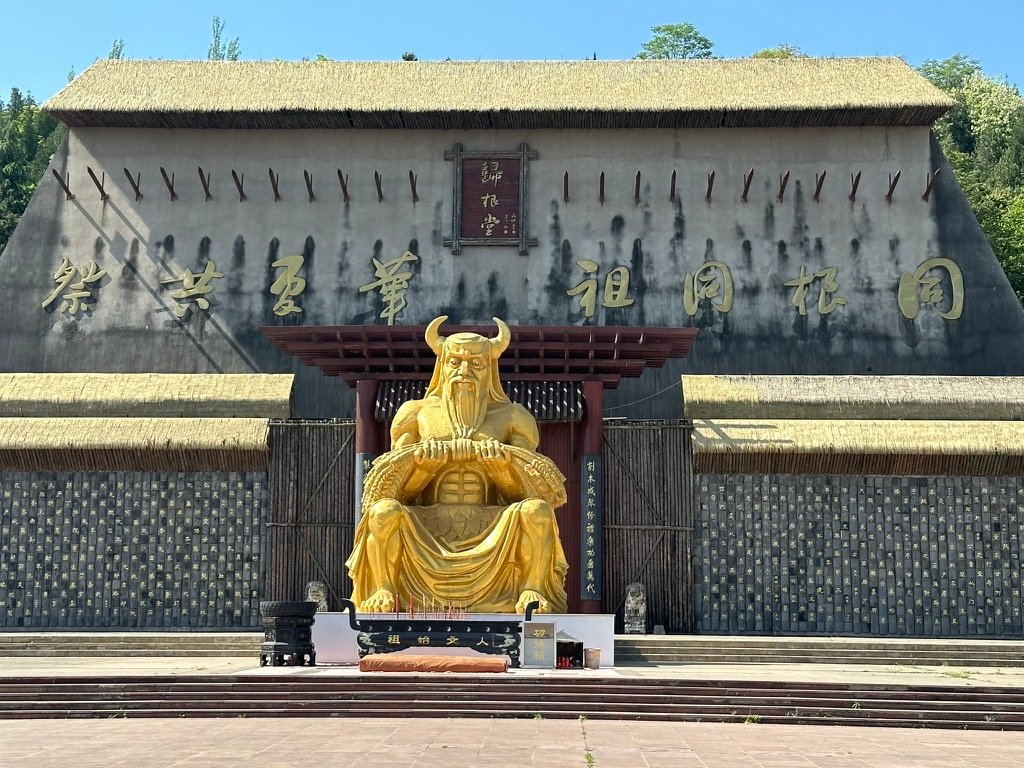
From Yandi Mausoleum (炎帝陵) in Baoji to 炎黄子孙 — and the strange Chinese story where defeating your rival doesn’t necessarily erase him
Dad and Elaine had come to Baoji (宝鸡, Bǎojī) in Shaanxi Province (陕西省, Shǎnxī) expecting to learn about one legendary ancestor.
His name was:
Yandi (炎帝, Yándì)
the Yan Emperor.
Simple enough.
😂
🎥 First — Where Are Dad & Elaine?
Before we walk in, Dad gives you the coat rack.
Dad is standing at the entrance to:
Yandi Mausoleum (炎帝陵, Yándì Líng)
near:
Baoji (宝鸡, Bǎojī)
in:
Shaanxi Province (陕西省, Shǎnxī Shěng).
Behind him rises:
Changyang Mountain (常羊山, Chángyáng Shān)
— the mountain landscape associated with the mausoleum complex.
And Dad introduces the question that brought us here:
Who was Yandi (炎帝, Yándì)?
炎帝 (Yándì)
→ Yan Emperor
陵 (Líng)
→ mausoleum / important tomb
But listen carefully.
Within two minutes Dad has already opened several rabbit holes:
Yandi (炎帝, Yándì)
↓
Huangdi (黄帝, Huángdì) — Yellow Emperor
↓
ancient tribes and alliances
↓
Chinese ancestral memory
↓
炎黄子孙
Yán-Huáng Zǐsūn
“Descendants of Yan and Huang”
And Dad even connects that ancestral idea with:
overseas Chinese.
🐇
So before we’ve even entered the gate…
the article’s Big Question has appeared:
How did legendary rivals become remembered together as ancestors?
🍴 Dad’s Field-Video Handrail
You’ll hear Dad say these events were:
“5,000 over years ago.”
Treat that as:
traditional cultural chronology
—not a securely documented historical date.
Yandi (炎帝, Yándì) and Huangdi (黄帝, Huángdì) belong to China’s:
上古传说
Shànggǔ Chuánshuō
legendary antiquity.
That’s important.
At ChinaTravelBUG we’ll keep three things separate:
传说 (Chuánshuō)
→ transmitted tradition / legend
考古 (Kǎogǔ)
→ archaeology
文化记忆 (Wénhuà Jìyì)
→ cultural memory
They can talk to each other.
But they are not the same thing.
🔥
Now…
let’s go inside.
Then we started walking through Yandi Mausoleum (炎帝陵, Yándì Líng).
And the family story became considerably more complicated.
There was:
Shennong (神农, Shénnóng)
Then:
Huangdi (黄帝, Huángdì) — the Yellow Emperor
Then:
Chiyou (蚩尤, Chīyóu)
Then two legendary battles.
Then surnames.
Then ancestor worship.
Then:
炎黄子孙
Yán Huáng Zǐsūn
“Descendants of Yan and Huang.”
Dad looked at Elaine.
Apparently we hadn’t come to visit one ancient ancestor.
We’d walked into China’s legendary family story.
And like many family stories…
there had been arguments.
🎥 First, Come Walk Through Yandi Mausoleum With Us
This is important.
Before Dad starts explaining Yandi, Huangdi, Chiyou and 5,000 years of Chinese ancestral memory…
come and see the place that started our rabbit hole.
The video takes us through:
Yandi Mausoleum (炎帝陵, Yándì Líng)
in:
Baoji (宝鸡, Bǎojī)
in:
Shaanxi Province (陕西省, Shǎnxī).
We begin around the entrance and climb the broad ceremonial staircase.
Along the way are banners carrying ancient Chinese family surnames.
Then comes a large traditional ceremonial gateway — a paifang (牌坊, páifāng).
Look carefully at the four characters above it:
华夏始祖
Huáxià Shǐzǔ
Roughly:
“Ancestral Founder of Huaxia.”
Beyond are ceremonial courtyards, a large bronze ding (鼎, dǐng) and exhibition halls explaining the traditions surrounding Yandi.
For international travelers, don’t worry if you can’t read everything.
Just notice what the place keeps emphasizing:
ancestor
surname
Huaxia
origins
Those words will become important.
🐇
Dad’s Coat Rack — Meet Three Characters First
Before we go any deeper, Dad wants to make this easy.
Remember only three names.
Hang them on the coat rack.
😂
🌾 Yandi — 炎帝
Yandi (炎帝, Yándì)
Yan Emperor
Later traditions strongly connect him with:
Shennong (神农, Shénnóng)
the “Divine Farmer.”
So for now remember:
YANDI 炎帝
FARMING + MEDICINE + ANCESTRAL MEMORY
Huangdi — 黄帝
Huangdi (黄帝, Huángdì)
Yellow Emperor
Also known as:
Xuanyuan Huangdi (轩辕黄帝, Xuānyuán Huángdì)
He became another of the great ancestral figures of China’s legendary antiquity.
Dad and Elaine later followed his story to:
Huangdi Mausoleum (黄帝陵, Huángdì Líng)
in northern Shaanxi.
For now:
HUANGDI 黄帝
FOUNDING-ANCESTOR MEMORY
Chiyou — 蚩尤
Chiyou (蚩尤, Chīyóu)
A formidable legendary rival associated particularly with:
warfare (战争, zhànzhēng)
weapons (兵器, bīngqì)
and:
martial power (武力, wǔlì).
For now:
CHIYOU 蚩尤
WARRIOR + DEFEATED RIVAL + NOT FORGOTTEN
That’s enough.
Three names.
Keep them hanging there.
We’ll come back for their coats later.

Where Are We in Chinese History?
This part matters.
Yandi, Huangdi and Chiyou belong to what we might call China’s:
legendary antiquity (上古传说, shànggǔ chuánshuō).
They are traditionally placed far earlier than China’s securely documented imperial history.
For a first-time international traveler, you only need a few anchors:
LEGENDARY ANTIQUITY — 上古传说
Yandi 炎帝 · Huangdi 黄帝 · Chiyou 蚩尤
Traditionally placed in the remote third millennium BCE
↓
NEOLITHIC CHINA — 新石器时代
Real farming communities, settlements, pottery, burials and increasingly complex societies revealed through archaeology
↓
SHANG DYNASTY — 商朝
c. 1600–1046 BCE
Late Shang gives us oracle-bone writing — 甲骨文 (jiǎgǔwén)
↓
ZHOU DYNASTY — 周朝
begins c. 1046 BCE
↓
QIN UNIFICATION — 秦统一
221 BCE
Qin Shi Huang (秦始皇)
So when Dad says:
Yandi 炎帝
or:
Huangdi 黄帝
we are going much farther back than:
Confucius (孔子)
and:
Qin Shi Huang (秦始皇).
But here’s our first Michelin guardrail:
TRADITIONAL CHRONOLOGY ≠ SECURE HISTORICAL DATING.
Dad has not found Huangdi’s passport saying:
Date of Birth: 2717 BCE
😂
We need a better way to think about this.
Three Boxes — Don’t Mix Them Up
Throughout this article, Dad wants you to keep three boxes in your head.
传说 — chuánshuō
legend / transmitted tradition
This is where we place stories about:
Yandi.
Huangdi.
Chiyou.
The Battle of Banquan (阪泉之战).
The Battle of Zhuolu (涿鹿之战).
考古 — kǎogǔ
archaeology
This is where we place actual material evidence:
settlements (聚落),
farming (农业),
pottery (陶器),
burials (墓葬),
tools,
and other physical remains left by prehistoric communities.
文化记忆 — wénhuà jìyì
cultural memory
This asks something different:
How did later generations remember the ancient past?
That includes expressions such as:
炎黄子孙
rituals such as:
祭祖 (jìzǔ) — ancestor commemoration
and places such as:
炎帝陵 — Yandi Mausoleum
and:
黄帝陵 — Huangdi Mausoleum.
These three boxes can talk to one another.
But they are:
NOT THE SAME THING.
That one distinction will save us from a lot of bad history.
Now Meet Yandi Properly
Inside Yandi Mausoleum, Dad kept seeing Yandi connected with:
Shennong (神农, Shénnóng).
The two figures weren’t necessarily identical in the earliest layers of Chinese tradition.
But later traditions increasingly connected them as:
神农炎帝
Shénnóng Yándì
And the name 神农 itself is revealing:
神 (shén) — divine / wondrous
农 (nóng) — farming / agriculture
So:
神农
“Divine Farmer”
Now look at the achievements later tradition associates with Yandi/Shennong.
Agriculture.
Agricultural tools.
Medicinal knowledge.
Markets.
Pottery.
Textiles.
And other foundations of settled life.
Dad looked at the list.
Then looked again.
One guy did ALL this?
😂
Excellent question.

🍚 Western Handrail — Don’t Imagine One Ancient Steve Jobs
This is where international readers can easily go wrong.
Don’t imagine Yandi/Shennong as:
one prehistoric genius personally inventing farming, medicine, pottery, markets and textiles…
and then filing the patents.
😂
Archaeology tells us something much more interesting.
These transformations emerged through:
communities
over:
long periods of time.
Agriculture developed.
Pottery developed.
Knowledge of plants accumulated.
Exchange developed.
Settlements changed.
So perhaps the legends are doing something different.
They gather enormous transformations in human life around:
a memorable ancestral figure.
That’s much easier for cultural memory to carry.
神农尝百草 — Shennong Tastes the Hundred Herbs
One of the most famous traditions surrounding Shennong is:
神农尝百草
Shénnóng cháng bǎicǎo
“Shennong tastes the hundred herbs.”
Break it down:
尝 (cháng) — taste / try
百 (bǎi) — hundred
草 (cǎo) — grasses / herbs
The tradition associates Shennong with the discovery and accumulation of medicinal knowledge.
Again:
TRADITION
not:
a clinical-trial report.
😂
But Dad thinks the interesting question isn’t:
Did one man personally discover every medicinal plant?
It’s:
Why did later generations place food, farming, medicine and the beginnings of settled life around this particular ancestor?
That’s a much richer question.
🐇
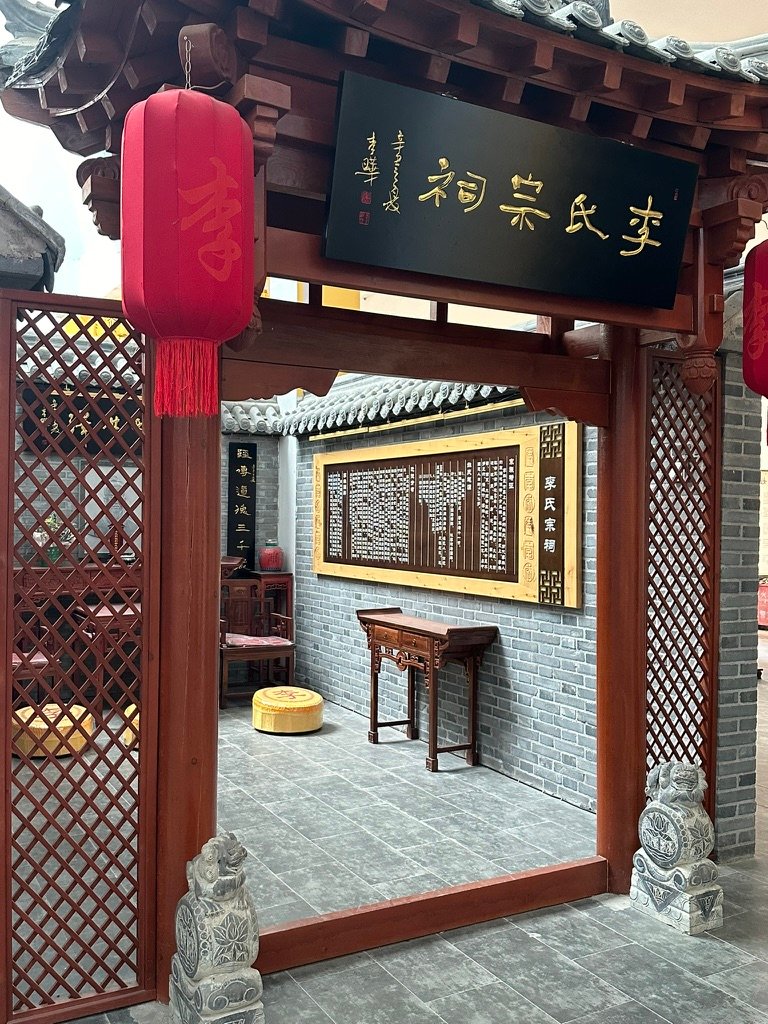
Then Dad Noticed the Surnames
Remember those banners in our video?
They weren’t random decoration.
Inside the Yandi Mausoleum complex, Dad and Elaine encountered displays devoted to:
Chinese surnames (姓氏, xìngshì).
Surname origins.
Migration.
Clan traditions.
Ancestral halls.
Famous people sharing particular surnames.
Suddenly our enormous question:
“Who were China’s legendary ancestors?”
became something surprisingly personal:
“What’s YOUR surname?”
😳🐇
One Useful Chinese Word — 姓
姓 — xìng
surname
A simple question you may hear is:
你姓什么?
Nǐ xìng shénme?
“What is your surname?”
A more polite traditional form is:
您贵姓?
Nín guìxìng?
Literally something like:
“May I ask your honorable surname?”
But there’s an ancient rabbit hiding inside the modern word.
In early Chinese society:
姓 (xìng)
and:
氏 (shì)
could refer to different aspects of ancestry, lineage, clan identity and social organization.
Their meanings changed considerably over Chinese history.
Today:
姓氏 (xìngshì)
is simply a normal general term for:
surname / family name.
We don’t need to turn Dad’s holiday into:
Chinese Kinship Systems 101.
😂
Just remember:
Chinese surnames have history.
Yandi Has a Surname Too
Traditional accounts associate Yandi’s lineage with:
姜
Jiāng
while Huangdi is traditionally associated with:
姬
Jī
Again, don’t turn that into a modern DNA certificate.
But it helps us understand why a site devoted to legendary ancestry might also devote so much attention to:
surnames,
lineages,
and:
where families believe they came from.
At the small scale:
姓氏
family ancestry.
At the enormous symbolic scale:
civilizational ancestry.
And those two scales were about to collide.
炎黄子孙 — Descendants of Yan and Huang
Dad and Elaine encountered one of the most important expressions in this entire rabbit hole:
炎黄子孙
Yán Huáng Zǐsūn
Break it apart:
炎 — Yán
Yandi 炎帝
黄 — Huáng
Huangdi 黄帝
子孙 — zǐsūn
descendants
So:
炎黄子孙
“Descendants of Yan and Huang.”
Now we’re no longer talking only about two legendary individuals.
We’re talking about a language of:
shared ancestry,
cultural memory,
and:
civilizational belonging.
And please keep Dad’s evidence guardrail switched on.
炎黄子孙 should not be read as:
“Every Chinese person has scientifically proven DNA descent from two identifiable men called Yandi and Huangdi.”
😂
That’s not what we’re doing.
It’s much more useful to understand the expression as:
cultural ancestry.
But then Dad spotted the obvious problem.
Wait… Yandi and Huangdi FOUGHT Each Other
Yes.
😂
The two figures who later appear together in:
炎黄子孙
are also rivals in ancient transmitted tradition.
The famous conflict is:
Battle of Banquan
阪泉之战 (Bǎnquán Zhī Zhàn)
In the influential account associated with:
Sima Qian (司马迁, Sīmǎ Qiān)
and his:
Records of the Grand Historian (《史记》, Shǐjì)
Huangdi ultimately prevails.
So our legendary scoreboard becomes:
HUANGDI 黄帝 — WINNER
YANDI 炎帝 — LOSER
Easy.
Except…
later generations remember:
BOTH
as ancestors.
😳
Now Dad became very interested.
🍚 Western Handrail — China’s Legendary Hostile Takeover?
Put on your corporate hat for a moment.
😂
Two competing groups.
Conflict.
One wins.
One loses.
Dad might jokingly describe the legendary Battle of Banquan as:
a hostile takeover.
Normally after a hostile takeover you might expect:
winner survives,
loser’s management disappears,
old brand gets retired.
But that’s not what later Chinese cultural memory does.
Yandi isn’t deleted.
His association with agriculture survives.
His connection with Shennong survives.
His ancestral identity survives.
And eventually:
炎帝 + 黄帝
become:
炎黄
and then:
炎黄子孙.
So perhaps Dad’s corporate analogy needs another stage:
HOSTILE TAKEOVER
↓
POST-MERGER INTEGRATION
↓
BOTH LEGACY BRANDS SURVIVE
↓
NEW SHARED ANCESTRAL STORY
😂🔥
Obviously Yandi and Huangdi weren’t CEOs.
And Banquan wasn’t a prehistoric M&A transaction.
The analogy is simply a handrail for something much more interesting:
MILITARY DEFEAT DID NOT REQUIRE CULTURAL ERASURE.
The defeated rival could remain inside the larger ancestral story.
And that is about to matter even more.
Because another rival is waiting.
Then Chiyou Walks Into the Story
Just when Dad thinks he has finally understood:
Yandi 炎帝
+
Huangdi 黄帝
another legendary figure appears:
Chiyou (蚩尤, Chīyóu).
He fights Huangdi in another famous transmitted conflict:
Battle of Zhuolu
涿鹿之战 (Zhuōlù Zhī Zhàn)
And Chiyou loses too.
In some traditions, decisively.
So surely this time the defeated rival disappears from the story.
Right?
😂
No.
In fact…
Chiyou’s cultural afterlife may be even stranger.
That’s where we go next.
Chiyou Lost the Battle — But He Didn’t Disappear
According to the traditional stories, Chiyou (蚩尤, Chīyóu) was a formidable rival of Huangdi (黄帝, Huángdì).
Their great legendary confrontation is remembered as:
涿鹿之战
Zhuōlù Zhī Zhàn
Battle of Zhuolu
Huangdi wins.
Chiyou loses.
If Dad were following a simple:
WINNER → FOUNDER → ANCESTOR
story…
this should be the end of Chiyou.
😂
But it isn’t.
Chiyou survives in Chinese cultural memory as a powerful martial figure.
And one title associated with him is particularly revealing:
兵主
Bīngzhǔ
“Lord/Master of War”
The defeated rival wasn’t simply forgotten.
He acquired a cultural afterlife of his own.
Even Qin Shi Huang Remembered Chiyou
Now this becomes really interesting.
Centuries after the legendary age in which Chiyou was placed, China’s First Emperor:
Qin Shi Huang (秦始皇, Qín Shǐ Huáng)
was himself associated in historical tradition with sacrifices to Chiyou as a martial deity.
Think about what that means.
The ruler who unified China in 221 BCE was not living in Chiyou’s legendary age.
He belonged to a much later historical world.
Yet Chiyou was still culturally meaningful enough to receive ritual attention.
So:
defeated in legend
did not mean:
erased from memory.
That’s an important pattern.
And Dad was starting to see it more clearly.
Dad’s Handrail — The Loser Stayed in the Family Album
Imagine a family album.
😂
Huangdi defeats Yandi.
But Yandi remains an ancestor.
Huangdi defeats Chiyou.
But Chiyou remains a powerful figure in later memory.
So China’s legendary past isn’t simply:
Winner good. Loser deleted.
Instead, later traditions preserve different figures for different reasons.
Yandi becomes strongly associated with:
agriculture and cultural ancestry.
Huangdi becomes:
a great founding ancestor.
Chiyou becomes:
a martial figure.
Their roles aren’t identical.
Their memories aren’t identical.
And different communities haven’t necessarily remembered them in exactly the same way.
But the striking point remains:
THE RIVALS SURVIVED.
Not necessarily politically.
But culturally.
And Chiyou Has Another Cultural Life
Chiyou is also remembered in traditions associated with some communities beyond the majority Han Chinese historical narrative.
In particular, he has an important place in some Miao (苗族, Miáozú) cultural traditions.
Dad wants to be careful here.
We should NOT say:
“All Miao people believe they are literally descended from Chiyou.”
That would flatten a very diverse ethnic group and many different local traditions into one sentence.
Instead, the safer and more interesting point is:
Chiyou has been remembered as an ancestral or heroic figure in some Miao traditions.
That tells us something important.
Ancient figures don’t necessarily belong to only one later identity.
The same legendary character can be remembered differently by different communities.
And now Dad’s rabbit hole gets deeper again.
🐇
Because if Chiyou can sit inside more than one cultural memory…
whose ancestor is he?
From Two Ancestors… to Three?
Most international readers interested in Chinese ancestry will encounter:
炎黄子孙
Yán Huáng Zǐsūn
Descendants of Yan and Huang
That’s the familiar pairing:
Yandi 炎帝 + Huangdi 黄帝.
But modern commemorative language can sometimes broaden the ancestral frame to include Chiyou.
You may encounter:
中华三祖
Zhōnghuá Sān Zǔ
Literally:
“The Three Ancestors of Zhonghua.”
The three are:
Yandi (炎帝)
Huangdi (黄帝)
Chiyou (蚩尤)
Now stop for a moment.
This is remarkable.
The story began with rivals.
Then battles.
Then winners and losers.
Yet later cultural memory can place:
all three
inside a broader ancestral narrative.
Dad’s corporate analogy has now completely collapsed.
😂
The hostile takeover has somehow ended with:
everybody’s portrait still hanging in headquarters.
ChinaTravelBUG’s Take — Don’t Ask Only “Who Won?”
This is one of the biggest lessons Dad took from this rabbit hole.
When international readers encounter ancient Chinese legends, it’s tempting to ask:
Who won the battle?
That’s useful.
But there’s another question that may tell us even more:
Who was remembered afterward?
Yandi lost.
Remembered.
Chiyou lost.
Remembered.
Huangdi won.
Remembered.
And later generations found ways to place these once-competing figures inside broader stories about ancestry and civilization.
That doesn’t prove the legends happened exactly as later texts describe.
But it tells us something very real about:
cultural memory.
And cultural memory matters because it shapes how societies explain themselves.
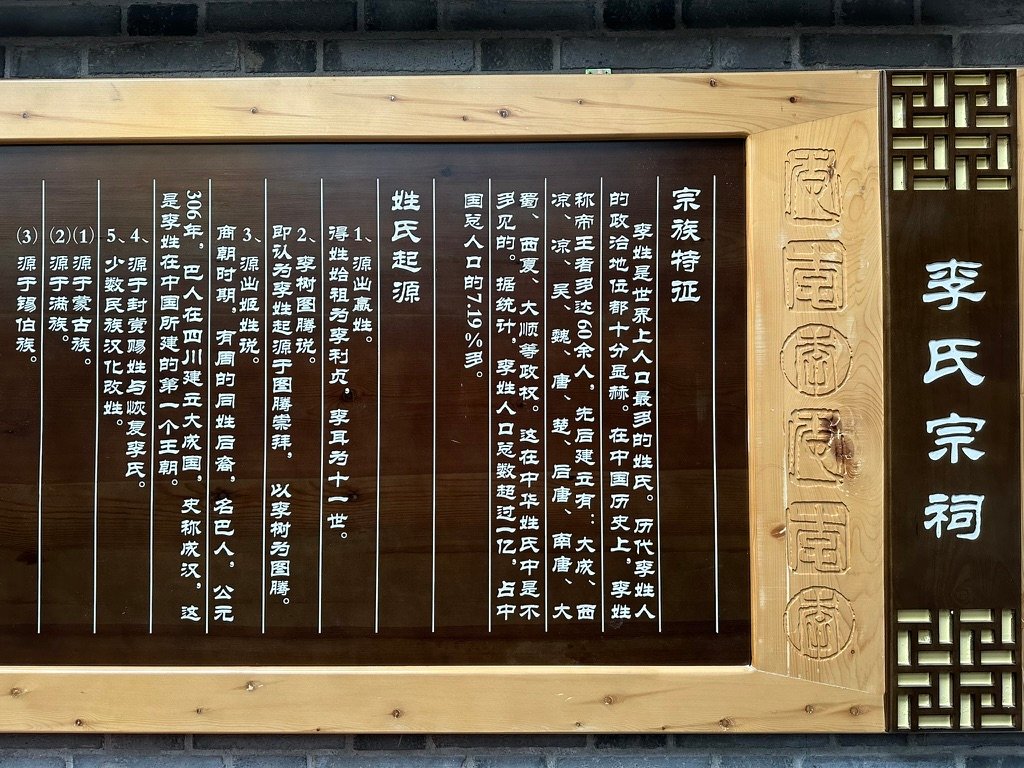
Then Dad Found His Own Surname
Remember the surname displays at Yandi Mausoleum (炎帝陵)?
Dad couldn’t resist looking.
😂
And eventually:
李
Lǐ
There it was.
Dad’s Chinese surname is:
李
International readers may recognize the same Chinese character romanized in different ways depending on language, dialect and family history:
Li
Lee
and other forms.
Suddenly Dad’s big abstract article about:
ancient ancestry
Huaxia
Yandi
Huangdi
and:
Chinese civilization
became unexpectedly personal.
Dad was standing in China…
looking at the same Chinese character used in his own family name.
Same Character, Different Journeys
This is where surnames become especially interesting for overseas Chinese families.
A Chinese surname can travel.
Across provinces.
Across dialect regions.
Across seas.
Across generations.
And eventually across different systems of romanization.
So two families may write their surnames differently in English…
while tracing the written name back to the same Chinese character.
Dad’s:
李
is one example.
The character remains.
The pronunciation or English spelling may change.
The family may live thousands of kilometers away.
Generations may pass.
But the surname can continue acting as a small thread connecting the present with an older family story.
That doesn’t mean a surname gives Dad a scientifically complete genealogy back to Yandi or Huangdi.
😂
Again:
wrong box.
But it does help explain why ancestry, surname and origin can carry such emotional weight.
One Surname → One Family → One Much Bigger Question
Standing in front of those surname displays, Dad could see two levels again.
At the personal level:
我姓李
Wǒ xìng Lǐ.
“My surname is Li.”
At the civilizational level:
炎黄子孙
“Descendants of Yan and Huang.”
And potentially, in broader modern commemorative language:
中华三祖
Yandi + Huangdi + Chiyou
The scale keeps expanding.
person
↓
family
↓
lineage
↓
community
↓
cultural ancestry
↓
civilization
And eventually…
nation.
But these layers are not identical.
That’s where Dad thinks many explanations of Chinese identity become too simplistic.
Now We Need Archaeology
At this point, Dad can already hear the sensible reader asking:
“This is fascinating, Dad — but what can archaeology actually prove?”
Excellent.
😂
Time to reopen our three boxes.
BOX 1 — 传说
传说 (chuánshuō)
legend / transmitted tradition
This includes stories about:
Yandi.
Huangdi.
Chiyou.
Banquan.
Zhuolu.
Shennong tasting herbs.
These traditions matter.
But we shouldn’t automatically treat every detail as securely documented historical fact.
BOX 2 — 考古
考古 (kǎogǔ)
archaeology
Archaeology tells us something enormously important about the broad prehistoric world in which later traditions placed these legendary ancestors.
Long before Qin Shi Huang, communities across what is now China were:
farming,
building settlements,
making pottery,
burying their dead in organized ways,
producing specialized objects,
exchanging materials,
and developing increasingly complex societies.
Those people were real.
Their settlements were real.
Their pottery is real.
Their graves are real.
Their tools are real.
But archaeology does not automatically allow us to point at a particular Neolithic skeleton and say:
“That’s Huangdi.”
😂
That’s the boundary.
BOX 3 — 文化记忆
文化记忆 (wénhuà jìyì)
cultural memory
This is where we ask:
How did later generations understand that remote past?
Why did Yandi become associated with agriculture?
Why did Huangdi become a founding ancestor?
Why did Chiyou remain a martial figure?
Why did later Chinese people speak of:
炎黄子孙?
Why build and maintain commemorative sites such as:
炎帝陵
and:
黄帝陵?
Those are real historical questions too.
Not questions about whether every legendary event happened literally…
but questions about:
how societies remember.
Dad’s Political Science Handrail — Nations Need Stories Too
Dad’s Political Science background kicks in here.
Modern states need:
laws,
institutions,
borders,
administration.
But communities also live through:
stories.
Stories about:
where we came from,
who belongs,
what we share,
and:
what happened before us.
That doesn’t make the stories “fake.”
It means they perform a different function from an archaeological excavation report.
A shovel can uncover:
pottery.
A text can preserve:
a legend.
A ritual can preserve:
belonging.
A surname can preserve:
family memory.
And sometimes all four point toward the same human question:
“Where did we come from?”
Then Dad and Elaine Followed Huangdi Too
Our Yandi rabbit hole didn’t stop in Baoji.
Later, Dad and Elaine also followed the story of:
Huangdi (黄帝, Huángdì)
to:
Huangdi Mausoleum (黄帝陵, Huángdì Líng)
in Huangling County (黄陵县, Huánglíng Xiàn), Shaanxi Province.
And there we encountered another powerful example of cultural memory.
A place where generations have commemorated the Yellow Emperor as an ancestral figure.
Again:
commemorative tradition
does not automatically equal:
archaeological proof of every legendary detail.
Keep the boxes separate.
But don’t make the opposite mistake either.
Don’t assume that because something belongs partly to legend, its later historical importance is meaningless.
The centuries of remembrance are themselves part of history.
And Then There Was the Huangdi Cypress
At Huangdi Mausoleum stands an ancient cypress traditionally associated with Huangdi.
You’ll encounter claims describing it as:
roughly 5,000 years old
and traditionally said to have been planted by Huangdi himself.
Dad wants the evidence handrail firmly switched on here.
“Traditionally said” matters.
We should not turn a cultural tradition into a scientifically proven event.
The ancient age assigned to the tree has been discussed through historical records, local documentation, tradition and expert assessment.
That is not the same thing as saying:
“Science has proven Huangdi personally planted this tree on Tuesday morning 5,000 years ago.”
😂
Again:
cultural memory ≠ laboratory certificate.
But standing beside a tree that generations have associated with Huangdi tells us something else.
People kept remembering.
And sometimes continuity of remembrance is itself the story.
Then Huangdi Appears in Modern China
Here’s another reason Dad refuses to leave Huangdi trapped in “ancient mythology.”
His cultural role continued into modern Chinese history.
When China’s imperial system collapsed and the Republic of China was founded in 1912, Huangdi could still function as a powerful ancestral symbol.
Sun Yat-sen (孙中山, Sūn Zhōngshān) invoked the Yellow Emperor in the language of Chinese national origins.
One famous phrase associated with this moment is:
中华开国五千年
Zhōnghuá kāiguó wǔqiān nián
roughly:
“Five thousand years since the founding origins of Zhonghua.”
Now look at the journey we’ve made.
Legendary antiquity.
↓
Yandi.
↓
Huangdi.
↓
Chiyou.
↓
ancestral memory.
↓
surnames.
↓
Huaxia.
↓
and now:
modern Chinese nation-building.
The ancient ancestors had not disappeared.
They had acquired new meanings.
🐇 And Now We Finally Reach Dad’s Bigger Question
At Yandi Mausoleum, Dad saw:
surnames.
At Huangdi Mausoleum:
ancestral commemoration.
In the ancient stories:
rivals becoming ancestors.
In modern language:
炎黄子孙.
And sometimes:
中华三祖.
So eventually Dad had to ask:
Who exactly is “Chinese”?
Is it:
a surname?
an ethnicity?
a nationality?
a civilization?
a language?
a cultural identity?
ancestry?
some combination of them?
And what happens when we remember that modern China officially recognizes:
56 ethnic groups (民族, mínzú)
including:
Han (汉族, Hànzú)
Hui (回族, Huízú)
Miao (苗族, Miáozú)
and many others?
Suddenly:
“Chinese people descend from Yandi and Huangdi”
needs considerably more explanation.
That’s why Dad created another DEEP China rabbit hole for that question:
Who Is “Chinese”? When People Beyond the Frontier Became China’s Rulers – DEEP China. BIG Questions Series
Because the deeper you go into China…
the less useful the simple answers become.
So What Should an International Traveler Take Away?
You do not need to memorize:
every battle,
every genealogy,
every legendary date,
or every version of the story.
Dad certainly isn’t going to test you.
😂
Remember the pattern instead.
1. Yandi, Huangdi and Chiyou belong to legendary antiquity.
Treat their detailed stories as transmitted traditions, not automatically as securely documented biographies.
2. Archaeology confirms that complex prehistoric societies existed.
But archaeology and legend are not interchangeable.
3. Yandi and Huangdi became powerful ancestral symbols.
Hence:
炎黄子孙
4. Defeat didn’t necessarily mean cultural disappearance.
Yandi loses.
Remembered.
Chiyou loses.
Remembered.
5. Later generations kept reshaping the ancient past.
Ancient ancestors could become symbols of:
family,
civilization,
ethnicity,
and eventually modern national identity.
That’s why these legendary figures still matter.
🐞 ChinaTravelBUG’s Take
Dad and Elaine went to Yandi Mausoleum expecting to learn about:
Yandi (炎帝).
Instead, we found ourselves asking:
Why are there surnames everywhere?
Why is Yandi connected with Shennong?
Why did Huangdi fight him?
Why are they later remembered together?
Why didn’t Chiyou disappear?
Why does Huangdi still matter thousands of years later?
And eventually:
Who is Chinese?
That’s the wonderful thing about traveling deeper into China.
A monument is rarely just a monument.
A surname isn’t always just a name.
A legend isn’t simply a fairy tale.
And a defeated rival isn’t necessarily forgotten.
Sometimes the past is less like a straight line…
and more like generations of people repeatedly asking:
“Where did we come from?”
Then answering the question in different ways.
Yandi became an ancestor.
Huangdi became an ancestor.
Chiyou remained inside the cultural memory too.
And thousands of years later…
Dad and Elaine were standing there trying to understand why.
🐇❤️
That’s when sightseeing becomes something more.
SEE → ASK → CONNECT → UNDERSTAND → FOLLOW.
And, as usual…
the rabbit escaped China again.
Can an International Traveler Actually Follow This Story?
Yes.
And this is one reason Dad thinks this particular DEEP China rabbit hole is so much fun.
Yandi, Huangdi and Chiyou can sound impossibly remote when you first encounter them.
Legendary rulers.
Ancient battles.
Names from texts written thousands of years ago.
But travel gives the story geography.
Dad and Elaine could actually go to places where these figures continue to be remembered.
We could walk through the ceremonial spaces.
Read the Chinese inscriptions.
See families and surnames represented.
Watch people paying respects.
And ask:
Why does this still matter?
You don’t have to “believe the legend” literally to find that fascinating.
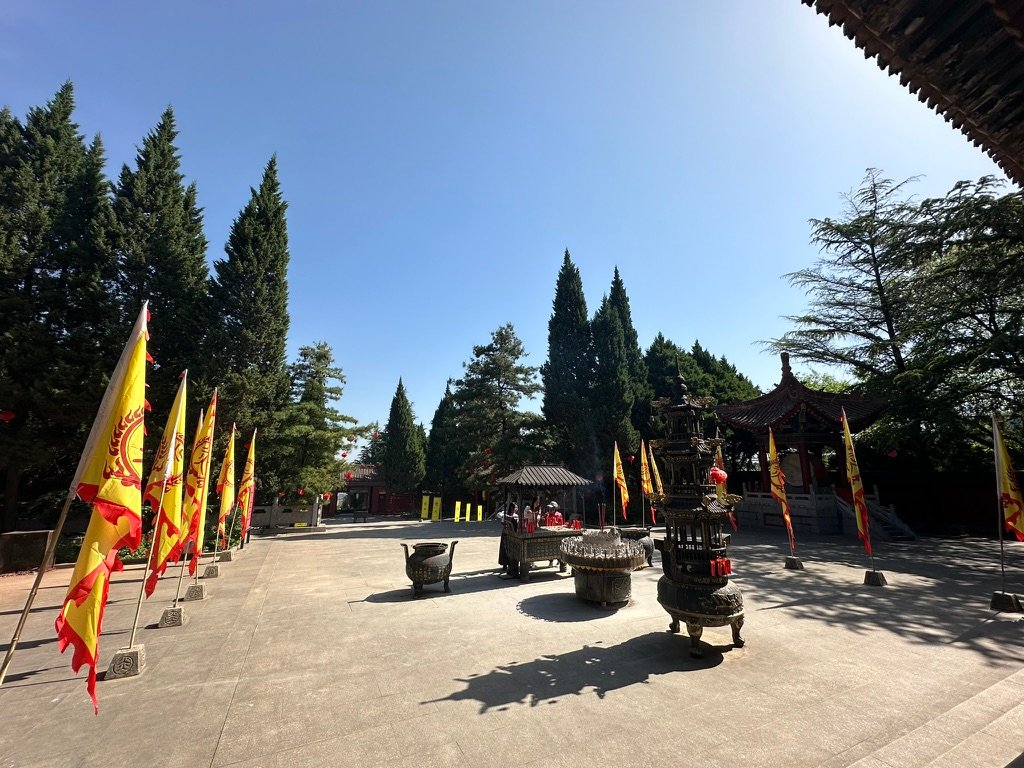
📍 Where Dad & Elaine Followed Yandi — 炎帝
Our Yandi journey took us to:
Yandi Mausoleum
炎帝陵
Yándì Líng
in:
Baoji (宝鸡, Bǎojī)
Shaanxi Province (陕西省, Shǎnxī)
Baoji lies west of Xi’an (西安, Xī’ān).
For Dad and Elaine, Baoji became one of the great surprises of our travels beyond Xi’an.
We hadn’t come only for Yandi.
Baoji also opened doors into:
ancient Chinese bronzes,
the Zhou world,
and:
the China that existed before Qin Shi Huang.
🐇 Beyond Xi’an: Why We Went to Baoji — Into the China Before Qin Shi Huang →
That’s what Dad loves about these places.
One rabbit rarely travels alone.
😂
🎥 If You Skipped the Video Earlier, Watch It Before You Go
This time, watch it as a traveler preparing to visit.
Look for:
炎帝陵
Yandi Mausoleum
华夏始祖
Huáxià Shǐzǔ
the surname banners
the ceremonial staircase
牌坊 (páifāng)
the traditional ceremonial archway
鼎 (dǐng)
the large bronze ritual-vessel form
and the exhibition spaces devoted to Yandi traditions.
Even knowing just a few Chinese characters makes the visit considerably richer.
You’re no longer seeing:
“some Chinese writing on a gate.”
You’re beginning to read the ideas built into the place.
🗣️ A Few Chinese Words Worth Taking With You
You don’t need Mandarin to visit.
But Dad thinks these words will make the experience more interesting.
炎帝 — Yándì
Yandi / Yan Emperor
炎帝陵 — Yándì Líng
Yandi Mausoleum
黄帝 — Huángdì
Huangdi / Yellow Emperor
蚩尤 — Chīyóu
Chiyou
华夏 — Huáxià
an ancient civilizational-cultural term
始祖 — shǐzǔ
founding / earliest ancestor
祖先 — zǔxiān
ancestor
姓 — xìng
surname
姓氏 — xìngshì
surname / family name
祭祖 — jìzǔ
to commemorate / perform rites for ancestors
And Dad’s favorite question at the surname displays:
这个姓怎么读?
Zhège xìng zěnme dú?
“How do you pronounce this surname?”
😂
You don’t need fifty phrases.
Sometimes recognizing 炎帝, 华夏 and 姓氏 is enough to transform what you’re looking at.
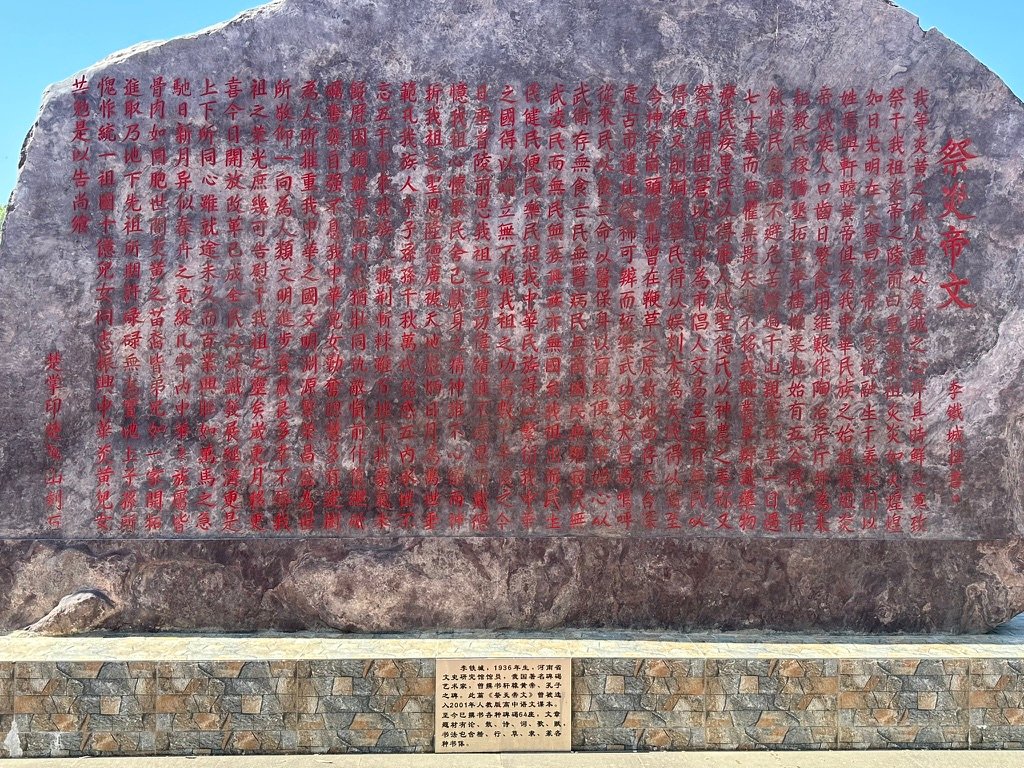
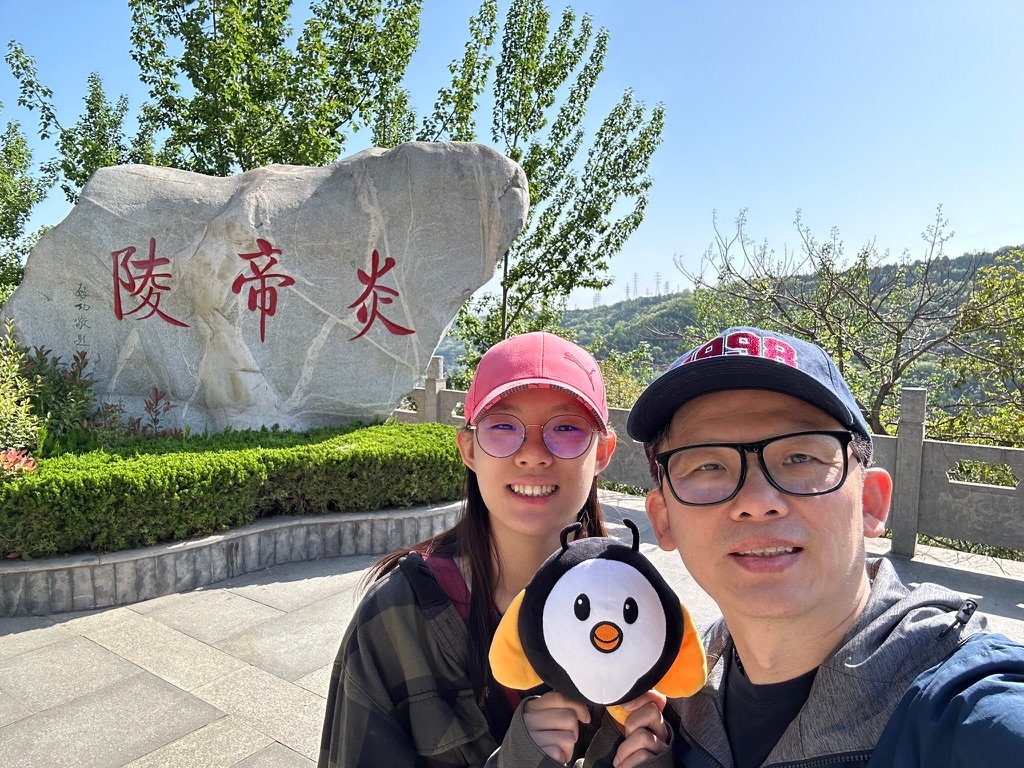
Photo Note — Commemorative Text to Yandi (祭炎帝文)
This large stone inscription at Yandi Mausoleum (炎帝陵, Yándì Líng) in Baoji (宝鸡), Shaanxi Province (陕西省) is titled 祭炎帝文 (Jì Yándì Wén) — a commemorative text honoring the Yan Emperor (炎帝, Yándì). It praises Yandi’s traditional associations with agriculture, medicinal herbs and the welfare of the people, presenting him as an ancestral figure whose legacy continues through later generations.
The inscription is a particularly good example of 文化记忆 (wénhuà jìyì) — cultural memory: not archaeological proof that Yandi personally performed all the deeds attributed to him, but evidence of how later generations continue to remember and commemorate China’s legendary ancestors.
What Should You Look For at 炎帝陵?
Don’t rush straight through looking for:
“THE TOMB.”
That’s not the most interesting way to experience this place.
Dad would slow down and look at the language surrounding you.
1. Look at the surnames
Ask yourself why a site devoted to a legendary ancestor spends so much visual space on family names.
That takes you from:
Yandi
to:
your own ancestors.
2. Look for 华夏
When you see:
华夏
don’t simply translate it as “China” and move on.
It belongs to a much older vocabulary of Chinese civilizational identity.
That word is one of the doors into this entire article.
3. Look at how Yandi is represented
Agriculture?
Plants?
Medicine?
Civilization?
Ancestor?
Those associations tell you how later generations remembered him.
Remember our third evidence box:
文化记忆 — cultural memory.
4. Look at what people are doing
Are they simply sightseeing?
Reading?
Photographing?
Paying respects?
Participating in commemorative practices?
A place like this can function simultaneously as:
tourist site,
cultural site,
ancestral-memory site,
and:
educational space.
That’s much more interesting than reducing it to:
“Is the legendary emperor literally buried underneath this exact spot?”
Dad’s Evidence Rule — Three Words to Remember
If you remember nothing else from this very long rabbit hole…
😂
remember:
传说 — 考古 — 文化记忆
chuánshuō — legend/tradition
kǎogǔ — archaeology
wénhuà jìyì — cultural memory
When someone says:
“Huangdi did this 5,000 years ago.”
ask:
Which box?
When someone says:
“Archaeologists found a Neolithic settlement.”
that’s:
考古.
When people commemorate Yandi as an ancestor today:
that’s:
文化记忆.
And when an ancient tradition tells us Huangdi defeated Chiyou at Zhuolu:
that’s:
传说.
The boxes can connect.
But don’t quietly move evidence from one box into another.
That is Dad’s biggest handrail for traveling through legendary China.
What About Huangdi?
Yandi was only half of:
炎黄
So naturally Dad and Elaine had to follow:
Huangdi (黄帝, Huángdì)
too.
His great commemorative site is:
Huangdi Mausoleum
黄帝陵
Huángdì Líng
in:
Huangling County (黄陵县, Huánglíng Xiàn)
Shaanxi Province (陕西省, Shǎnxī)
For Dad, visiting both Yandi and Huangdi sites changed the story.
Reading:
炎黄子孙
is one thing.
Physically visiting places where Yandi and Huangdi continue to be commemorated is another.
The phrase starts acquiring geography.
And Be Careful With the Famous Cypress
At Huangdi Mausoleum, you’ll encounter the famous ancient cypress traditionally associated with Huangdi.
This is exactly where Dad wants international travelers to keep their evidence radar switched on.
You’ll encounter claims that the tree is around:
5,000 years old
and that Huangdi himself planted it.
The careful wording is:
traditionally said to have been planted by Huangdi.
That tradition is culturally important.
But don’t rewrite it as:
“Science has proved Huangdi planted this tree 5,000 years ago.”
Those are not equivalent statements.
Dad likes the tree precisely because it demonstrates the larger lesson of this article.
A physical object can become wrapped in:
history,
tradition,
memory,
and:
identity.
Our job isn’t to destroy the story.
Nor is it to turn every story into laboratory fact.
Our job is to understand which is which.
That’s Why “Legend” Doesn’t Mean “Unimportant”
International readers sometimes fall into one of two traps.
Trap One:
“The legend says it, therefore every detail is historically proven.”
No.
😂
Trap Two:
“It isn’t archaeologically proven, therefore it doesn’t matter.”
Also no.
A legend remembered for centuries can influence:
language,
ritual,
identity,
politics,
literature,
places,
and how later generations understand themselves.
That’s historically important even when the original legendary event can’t be independently verified.
And that’s why Dad thinks Yandi, Huangdi and Chiyou belong in a travel site.
They help you understand what you’re seeing.
From Ancient Ancestors to Modern China
The Yellow Emperor didn’t remain trapped in remote antiquity.
His symbolic role continued into modern Chinese political and national discourse.
When China’s imperial system ended and the Republic of China (中华民国, Zhōnghuá Mínguó) was founded in 1912, ancient ancestral language could still be used to talk about modern Chinese origins.
Sun Yat-sen (孙中山, Sūn Zhōngshān) invoked Huangdi within that broader language of national ancestry.
And one famous formulation associated with that period begins:
中华开国五千年
Zhōnghuá kāiguó wǔqiān nián
— invoking the idea of China’s civilizational origins stretching back thousands of years.
Think about the distance we’ve traveled.
From a legendary Yellow Emperor…
to:
modern nationalism.
The ancestor survived because each age could find new meaning in him.
🐇 And That Finally Opens the Biggest Door
Dad began with:
Yandi.
Then:
Huangdi.
Then:
Chiyou.
Then:
surnames.
Then:
炎黄子孙.
Then:
华夏.
Then:
中华.
And eventually there is nowhere left to hide from the obvious question:
Who Is Chinese?
Does “Chinese” mean:
Han Chinese?
citizen of China?
part of Chinese civilization?
someone of Chinese ancestry overseas?
someone belonging to one of China’s other ethnic groups?
What about:
Hui (回族)?
Miao (苗族)?
Tibetans (藏族)?
Mongols (蒙古族)?
And where does an overseas Chinese family such as Dad’s fit into a story like:
炎黄子孙?
That’s not a paragraph.
That’s another DEEP China article.
😂🐇
Who Is “Chinese”? When People Beyond the Frontier Became China’s Rulers – DEEP China. BIG Questions Series
And that’s exactly where Dad would send the reader next.
Why Dad Brought Elaine Here
There is one more reason this matters.
Dad could have taken Elaine to Baoji…
photographed the gate…
read the plaque…
and left.
But then Yandi Mausoleum would have become:
another attraction.
Dad wanted something else.
He wanted Elaine to see how a place can contain layers.
At the surface:
a mausoleum.
Look again:
an ancestor.
Look again:
surnames.
Again:
Huaxia.
Again:
Chinese cultural memory.
Again:
modern identity.
And suddenly a staircase in Baoji is connected to a question about what it means to be Chinese.
That’s why Dad keeps taking Elaine down these rabbit holes.
Not because she needs to memorize all the answers.
But because Dad wants her to become comfortable asking:
“Why?”

ChinaTravelBUG’s Take
If you’re visiting China for the first time, you don’t need to begin your trip by memorizing Yandi, Huangdi and Chiyou.
Go see the Great Wall.
Stand on Xi’an’s City Wall.
Look at the Terracotta Warriors.
Eat the noodles.
Ride the high-speed train.
Enjoy China.
But somewhere along the journey…
you may notice a name.
炎帝.
A surname.
李.
A phrase.
华夏.
A temple.
A ritual.
A legendary battle.
And you may ask:
“What’s that about?”
That’s the moment China starts getting deeper.
For Dad and Elaine, this rabbit hole began at:
Yandi Mausoleum (炎帝陵)
in:
Baoji (宝鸡).
We walked in looking for one legendary ancestor.
We came out carrying:
Yandi.
Huangdi.
Chiyou.
Shennong.
Surnames.
Huaxia.
Archaeology.
Cultural memory.
And one enormous question:
Who is Chinese?
😂🐇
That’s a pretty good return from one sightseeing stop.
And perhaps that’s the biggest lesson.
Don’t just ask whether an ancient story is true.
Ask:
What does the evidence show?
How was the story remembered?
And why does it still matter?
That’s where DEEP China begins.
🐇❤️
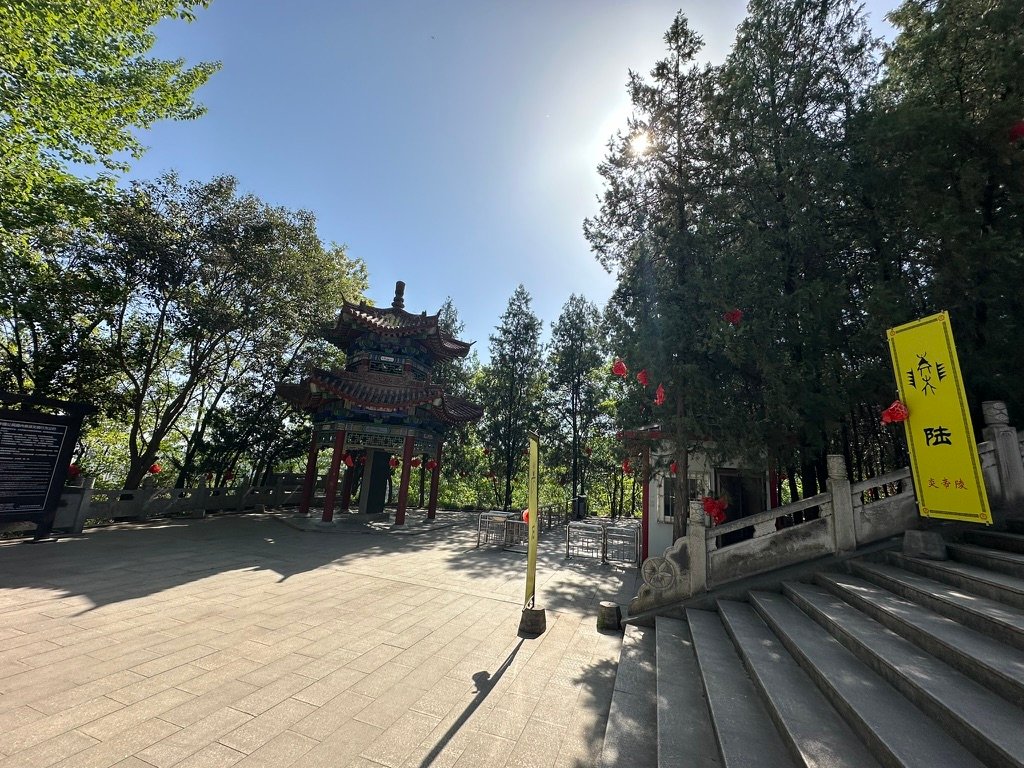
📍 How to Visit Yandi Mausoleum (炎帝陵) in Baoji
If Dad and Elaine’s rabbit hole has made you curious enough to visit Yandi yourself, there’s one important thing to understand first.
There is more than one place in China called 炎帝陵.
😂
The site in this story — and the one in our video — is the:
Yandi Mausoleum (炎帝陵, Yándì Líng)
Baoji (宝鸡, Bǎojī)
Shaanxi Province (陕西省, Shǎnxī)
This is the site Dad and Elaine actually visited.
So when searching in a Chinese map app or showing the destination to a driver, don’t simply type:
炎帝陵
Use:
宝鸡炎帝陵
Bǎojī Yándì Líng
That little 宝鸡 matters.
Where Exactly Is It?
The Baoji Yandi Mausoleum is on:
Changyang Mountain (常羊山, Chángyáng Shān)
in:
Weibin District (渭滨区, Wèibīn Qū)
Baoji (宝鸡, Bǎojī)
Shaanxi Province (陕西省, Shǎnxī)
The current listed address is:
陕西省宝鸡市渭滨区清姜路80号
No. 80 Qingjiang Road, Weibin District, Baoji, Shaanxi
For international travelers, Dad would save the Chinese destination on the phone:
宝鸡炎帝陵
and also:
陕西省宝鸡市渭滨区清姜路80号
If the driver asks which 炎帝陵 you mean, you’ve already solved the problem.
😂
🚕 Dad’s Easiest Option: Use DiDi
For most international travelers already staying in Baoji, Dad would keep this simple.
Call a DiDi (滴滴, Dīdī).
Enter:
宝鸡炎帝陵
Then check that the map result is in:
渭滨区 — Weibin District
and associated with:
常羊山 — Changyang Mountain
before confirming the ride.
That’s much easier than trying to pronounce a long address perfectly.
What Can I Say to the Driver?
Keep it simple.
我要去宝鸡炎帝陵。
Wǒ yào qù Bǎojī Yándì Líng.
“I want to go to Baoji Yandi Mausoleum.”
Or:
请送我去炎帝陵,谢谢。
Qǐng sòng wǒ qù Yándì Líng, xièxie.
“Please take me to Yandi Mausoleum, thank you.”
If there is any confusion, show the driver:
宝鸡炎帝陵
Don’t fight with Mandarin pronunciation when four Chinese characters on your phone can do the job.
😂
Coming From Xi’an?
Baoji is west of:
Xi’an (西安, Xī’ān)
in the same province:
Shaanxi Province (陕西省, Shǎnxī).
For an international traveler, the easiest overall journey is generally:
Xi’an → Baoji by train
then:
Baoji → 炎帝陵 by DiDi
Baoji has both conventional and high-speed rail connections with the Xi’an area, so check the train that best suits your itinerary and which Baoji station it uses.
Dad would not try to combine railway tickets, local buses and multiple transfers merely to save a small amount of money unless that’s part of the adventure you actually want.
😂
Once you’re in Baoji:
let DiDi handle the final leg.
🐇 But Don’t Come to Baoji Only for 炎帝陵
This is important.
Dad wouldn’t recommend traveling all the way from Xi’an, seeing Yandi Mausoleum for an hour, and immediately going back.
Baoji deserves more than that.
This is the city that opened several of our biggest historical rabbit holes.
One of the most important is the:
Baoji Bronze Ware Museum
宝鸡青铜器博物院
Bǎojī Qīngtóngqì Bówùyuàn
Baoji and the surrounding region also lead naturally into the world of the:
Zhou Dynasty (周朝, Zhōu Cháo)
and the China that existed long before Qin Shi Huang unified the empire.
That’s why we wrote a separate doorway into Baoji:
Beyond Xi’an: Why We Went to Baoji — Into the China Before Qin Shi Huang →
And if you’re actually planning the journey from Xi’an:
Travel Tips: How to Visit Baoji (宝鸡) From Xi’an (西安) for Foreign Travelers →
The first article explains:
WHY GO.
The second helps with:
HOW TO GO.
This DEEP China article explains:
WHAT IT MEANS.
That’s the three-layer ChinaTravelBUG route.
🐇
How Much Time Should You Allow at 炎帝陵?
Dad would allow roughly:
1½–2 hours
if you actually want to:
walk slowly,
watch the inscriptions,
look at the surname displays,
visit the exhibition spaces,
take photographs,
and think about what you’re seeing.
You can physically move through faster.
But that’s not really the point of coming here.
Remember what happened to Dad.
😂
He saw:
炎帝
then:
姓氏
then:
华夏始祖
and suddenly we had this entire article.
Give the rabbit a little time.
🕐 Opening Hours — Check Before You Go
Current listings in 2026 generally show the Baoji Yandi Mausoleum operating during daytime hours, with closing around:
5:30 PM
But published opening times vary slightly between sources.
So Dad would not build a tight itinerary around an exact time printed in an old travel article.
Before going, check the current listing for:
宝鸡炎帝陵
on your Chinese map app or booking platform.
Especially check again during:
Chinese public holidays,
special ceremonies,
and seasonal periods.
What About Tickets?
Ticket arrangements and concessions can change.
Baoji’s current official tourism information lists 炎帝陵景区 among the city’s A-level attractions, and various visitor categories may qualify for local ticket concessions.
For an international traveler, Dad’s rule is simpler:
check the current admission arrangement before you go.
Don’t rely on a screenshot from somebody’s trip three years ago.
And carry your:
passport — 护照 (hùzhào)
because identification requirements can appear at Chinese attractions even when you aren’t expecting them.
Be Ready to Walk Up
Remember our video?
There’s a reason Dad keeps showing that staircase.
😂
This isn’t simply:
car stops → walk ten meters → photograph a statue → leave.
The complex climbs upward through ceremonial spaces.
You’ll encounter:
steps,
slopes,
courtyards,
gates,
and exhibition areas.
So wear comfortable shoes.
And if you’re traveling with:
older family members,
young children,
or anyone with mobility limitations,
allow extra time and check current accessibility arrangements before visiting.
🎥 Watch Our Walk Before You Go
Watch it once more — but this time as a traveler planning the visit.
Look for:
炎帝陵
Yandi Mausoleum
华夏始祖
Huáxià Shǐzǔ
姓氏
xìngshì — surnames
牌坊
páifāng — ceremonial archway
鼎
dǐng — ancient ritual-vessel form
And look at the staircase.
😂
Once you recognize those words, you’ll arrive seeing much more than Dad did during his first few minutes there.
Dad’s “Don’t Just Look” Checklist
When you arrive, don’t simply ask:
“Where is Yandi’s tomb?”
Dad would look for five things.
1. 炎帝 — Yandi
How is he represented?
Farmer?
Healer?
Ancestor?
Civilizational founder?
2. 华夏 — Huaxia
Where does the word appear?
What is the site saying by connecting Yandi with Huaxia?
3. 姓氏 — Surnames
Look at the family names.
See whether you recognize any.
If you’re of Chinese ancestry…
look for yours.
That can turn an abstract visit into something unexpectedly personal.
4. 祭祖 — Ancestor Commemoration
Remember:
祭祖 (jìzǔ)
means to commemorate or perform rites for ancestors.
Don’t assume everyone visiting the site is experiencing it in exactly the same way.
For some:
tourism.
For some:
history.
For some:
culture.
For some:
ancestral connection.
5. Ask Which Evidence Box You’re Looking At
Remember Dad’s three boxes:
传说
legend / transmitted tradition
考古
archaeology
文化记忆
cultural memory
If you keep those three categories separate…
you can enjoy the story without either:
believing everything literally
or:
dismissing everything as “just mythology.”
That’s the sweet spot.
A Few Useful Chinese Phrases
“Where is Yandi Mausoleum?”
炎帝陵在哪里?
Yándì Líng zài nǎlǐ?
“What does this mean?”
这是什么意思?
Zhè shì shénme yìsi?
Very useful when Dad encounters another four-character inscription and disappears for twenty minutes.
😂
“What is this surname?”
这是什么姓?
Zhè shì shénme xìng?
“How do you pronounce this surname?”
这个姓怎么读?
Zhège xìng zěnme dú?
“My surname is Li.”
我姓李。
Wǒ xìng Lǐ.
Replace 李 with your own surname if you know the Chinese character.
“Can I take a photo?”
可以拍照吗?
Kěyǐ pāizhào ma?
Useful inside exhibition areas where photography rules may differ.
Dad’s Practical Take
Would Dad recommend Yandi Mausoleum to every first-time traveler spending only two days in China?
No.
😂
If you have three days in Xi’an and haven’t seen the Terracotta Warriors or City Wall…
go see them.
But if you’re the kind of traveler who has started asking:
What came before Qin?
Why does Chinese culture talk so much about ancestors?
What is Huaxia?
Why are Yandi and Huangdi still remembered?
then:
炎帝陵 becomes much more interesting.
And that’s exactly what happened to us.
Baoji stopped being:
“another city west of Xi’an.”
It became another door.
Through that door came:
Yandi.
Shennong.
Surnames.
Huaxia.
Huangdi.
Chiyou.
And eventually:
Who is Chinese?
So if you go…
don’t just photograph the gate.
Read the characters.
Look at the surnames.
Ask what you’re actually seeing.
Then follow whichever rabbit escapes first.
🐇❤️