From Our Beijing Guides
Authentic local advice from the licensed Beijing guides we work with.
Quick Answer
Yes—but not necessarily because it serves the best Peking duck in Beijing.
Quanjude (全聚德) is Beijing’s most famous Peking duck restaurant and one of the city’s great culinary institutions. If you’re interested in experiencing a restaurant with more than 160 years of history, it’s still worth visiting.
However, if your priority is simply enjoying the best overall Peking duck experience, the licensed Beijing guides we work with generally recommend Siji Minfu (四季民福), Da Dong (大董) or Bianyifang (便宜坊) instead. Their recommendations are based on years of guiding overseas visitors—not online trends or sponsored reviews.
Why This Question Matters
Search for “best Peking duck in Beijing” and you’ll quickly become confused.
One website tells you Quanjude is a must-visit.
Another calls it a tourist trap.
Travel forums argue endlessly over Siji Minfu, Da Dong and Bianyifang.
As first-time visitors ourselves, we faced exactly the same dilemma.
So rather than relying solely on online reviews, we asked one of the licensed Beijing guides we regularly work with. After more than a decade of guiding international visitors around Beijing, he has watched thousands of travellers experience the city’s most famous duck restaurants.
This is his honest advice.
Why Doesn’t Our Beijing Guide Recommend Quanjude First?
His answer surprised us.
“Quanjude is famous because of its history. But today, many Beijing residents choose restaurants based on the overall dining experience rather than the name above the door.”
He was quick to clarify that Quanjude is not a bad restaurant.
Far from it.
Its importance in Beijing’s food history is undeniable.
The issue is expectations.
Many overseas visitors arrive expecting the greatest Peking duck meal of their lives simply because Quanjude is the most famous name.
Sometimes they leave wondering what all the excitement was about.
Meanwhile, restaurants such as Siji Minfu quietly earn loyal followings because diners return for the food itself.
Which Peking Duck Restaurant Does Our Beijing Guide Recommend?
If a friend were visiting Beijing for the first time, this is how he would rank his recommendations.
| Restaurant | Best For | Our Guide’s View |
|---|---|---|
| Siji Minfu (四季民福) | Overall experience | His first recommendation for most first-time visitors. |
| Da Dong (大董) | Premium dining | Elegant presentation and refined flavours. |
| Bianyifang (便宜坊) | Value and tradition | Excellent quality with shorter queues. |
| Quanjude (全聚德) | History | Worth visiting for its heritage and reputation. |
Notice something important.
He isn’t saying Quanjude is “bad.”
He’s saying there are now restaurants that many locals believe offer a better meal.
That’s a very different message.
Is Siji Minfu Really Worth the Long Queue?
According to our guide…
Usually, yes.
Siji Minfu has become one of Beijing’s most popular Peking duck restaurants because it consistently delivers excellent duck, attentive service and well-prepared traditional Beijing dishes.
The downside?
The queues.
Waiting two to four hours during busy periods is not unusual.
His advice is simple.
If eating exceptional Peking duck is one of the highlights of your Beijing trip, the wait can be worthwhile.
If your itinerary is already packed, spending half a day in a queue may not be the best use of your time.
Can You Reserve a Table?
Many first-time visitors assume they can simply book online.
Unfortunately, that’s not always possible.
According to our guide:
- Siji Minfu generally requires joining the queue in person or through its local queuing system.
- Da Dong is usually easier to reserve.
- Bianyifang is often the easiest of the three.
His advice?
If Peking duck is high on your priority list, don’t leave it until the last minute.
What’s the Difference Between Hanging-Oven and Closed-Oven Peking Duck?
One of the most interesting things our guide explained was that not all Peking duck tastes the same.
The roasting method makes a noticeable difference.
Hanging-Oven Duck (挂炉烤鸭)
Used by restaurants such as Quanjude.
The ducks are roasted over an open fruitwood fire.
The result is:
- Crispier skin
- Light smoky aroma
- Slightly firmer meat
Closed-Oven Duck (焖炉烤鸭)
Traditionally used by Bianyifang.
The ducks are roasted using stored heat inside an enclosed oven.
The result is:
- Juicier meat
- Softer skin
- Richer flavour
Neither method is objectively better.
It’s simply a matter of personal preference.
Many Beijing families grow up preferring one style over the other.
How Do Beijing Locals Actually Eat Peking Duck?
This answer genuinely surprised us.
Our guide laughed and said:
“Many older Beijing locals don’t even use cucumber.”
The classic Beijing way is remarkably simple.
- Spread sweet bean sauce on the pancake.
- Add two slices of duck.
- Add spring onion.
- Roll.
- Eat immediately.
Cucumber became popular later because many diners enjoy its refreshing crunch.
Traditionalists, however, often prefer the richer flavour of the duck without it.
Another old Beijing tradition?
Taking one or two pieces of crispy duck skin and dipping them in white sugar.
“It’s delicious,” our guide admitted.
“But don’t eat too much!”
What Else Should You Order?
Peking duck may be the star, but it shouldn’t be the whole performance.
Our guide recommends trying:
- Mustard duck feet
- Crispy duck bones with salt and pepper
- Zhajiang noodles
- Fire-seared duck hearts
- Pea cake (豌豆黄)
- Donkey roll (驴打滚)
Together, they provide a much richer introduction to traditional Beijing cuisine.
What Mistakes Do First-Time Visitors Make?
According to our guide, he sees the same mistakes almost every week.
Ordering a whole duck for two people
Unless you’re very hungry, half a duck is usually enough.
Save room for other dishes.
Spending too long taking photographs
Peking duck is best enjoyed while it’s still hot.
Take a quick picture.
Then start eating.
Choosing a restaurant purely because it’s famous
The biggest name isn’t always the best experience.
Forgetting about queues
On weekends and public holidays, popular duck restaurants can require hours of waiting.
Planning ahead makes a huge difference.
Dad & Elaine’s Experience
During our own visits to Beijing, one lesson became increasingly clear.
The best travel experiences often come from listening to people who live and work there every day.
Guidebooks told us where to eat.
Local guides explained why people chose those restaurants.
That difference changed the way we planned our meals—not only in Beijing, but throughout China.
Travel Tips at a Glance
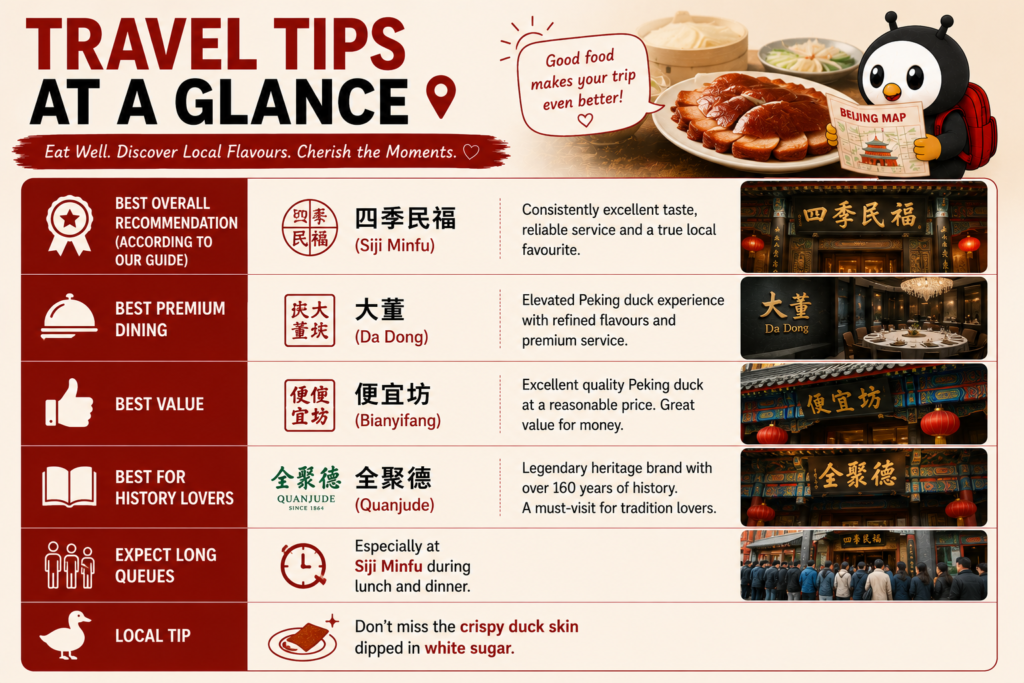
Best overall recommendation (according to our guide): Siji Minfu
Best premium dining: Da Dong
Best value: Bianyifang
Best for history lovers: Quanjude
Expect long queues: Especially at Siji Minfu during lunch and dinner.
Local tip: Don’t miss the crispy duck skin dipped in white sugar.
Understanding China Better
Why Do Chinese Meals Focus on Sharing?
One thing many first-time visitors notice is that Chinese meals are designed to be shared.
Instead of ordering individual plates, families place several dishes in the middle of the table for everyone to enjoy together.
Peking duck is a perfect example.
The duck itself is only one part of the meal. Around it come vegetables, noodles, soups and desserts, creating an experience centred on conversation and togetherness.
For many Beijing families, the meal is as much about spending time together as it is about the duck itself.
Final Verdict
So…
Is Quanjude worth visiting?
Yes.
If you want to experience one of Beijing’s most historic restaurants, Quanjude deserves its place on your itinerary.
But if your goal is simply to enjoy the best Peking duck meal, don’t choose a restaurant based only on fame.
Listen to today’s Beijing.
The licensed guides we work with consistently point visitors towards Siji Minfu, Da Dong and Bianyifang—not because they’re fashionable, but because they continue to impress travellers year after year.
For us, that’s exactly the kind of local knowledge that turns a good trip into a memorable one.
Continue Reading
This article is part of our From Our Beijing Guides series, where licensed local guides answer the questions foreign travellers ask most often while adding the practical advice and local perspective that guidebooks sometimes miss.