What Are the Biggest Hassles When Traveling in China? — AI Travel Planner Answers
byKC
-
China can feel surprisingly easy to travel around once you are there—but some parts of the experience work very differently from what international travelers are accustomed to.
This traveler asked a particularly useful question: what actually causes visitors the most trouble when traveling in China? The answer isn’t necessarily trains, transportation, or even the language barrier. Often, it’s getting a handful of everyday systems sorted before the trip begins.
The Traveler’s Question
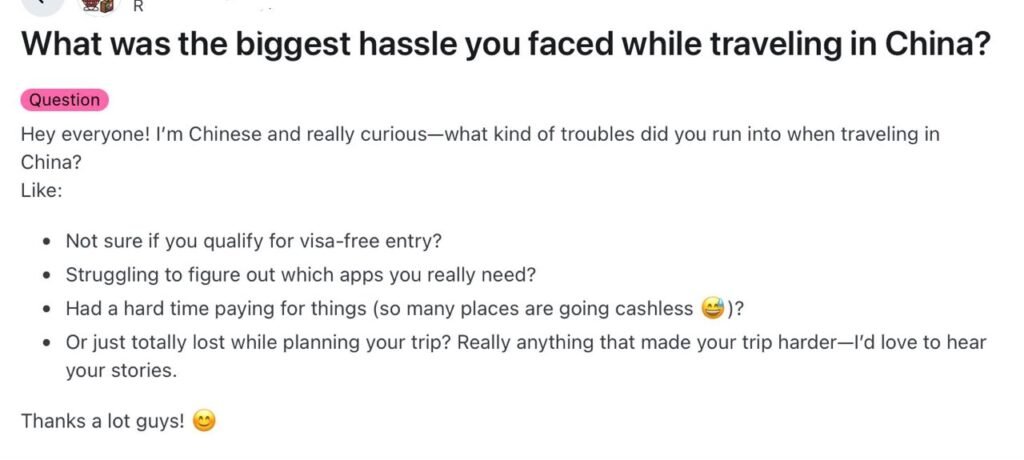
What was the biggest hassle you faced while traveling in China?
Hey everyone! I’m Chinese and really curious—what kind of troubles did you run into when traveling in China?
Like:
Not sure if you qualify for visa-free entry?
Struggling to figure out which apps you really need?
Had a hard time paying for things (so many places are going cashless 😅)?
Or just totally lost while planning your trip? Really anything that made your trip harder—I’d love to hear your stories.
Thanks a lot guys! 😊
AI Travel Planner’s Answer
For many first-time visitors, the biggest hassle isn’t one dramatic problem — it’s that China’s everyday travel systems work differently from what you’re used to.
The things I’d prepare for most are:
Payments: Alipay and WeChat Pay make life much easier, but set them up before arriving rather than figuring them out when you’re hungry and trying to pay for dinner.
Internet and apps: Don’t assume the apps and online services you normally use at home will work the same way in China. Sort out connectivity, maps, translation and transport apps before the trip.
Reservations: Some major attractions and museums require advance booking, so spontaneous sightseeing can occasionally be frustrating.
Language: You absolutely can travel independently without speaking Mandarin, but translation tools and having destinations written in Chinese remove a lot of stress.
Overplanning: This is probably the most underestimated hassle. China is huge, railway stations are enormous, attractions involve plenty of walking, and changing cities takes more energy than it appears to on Google Maps. Trying to squeeze too much into a trip can be harder than navigating China itself.
The interesting part is that once those first-day practical hurdles are sorted, many things travelers worry about beforehand — especially getting around — can feel surprisingly manageable. China’s metros and high-speed rail can make independent travel quite straightforward.
So my advice to someone planning their first trip would be: don’t try to learn everything about China. Get five things right before you leave — entry requirements, payments, internet, essential apps and reservations. Then leave yourself enough time to actually enjoy being there.
So, What Is Actually the Biggest Hassle?
There probably isn’t one answer that applies to everyone.
But there is a pattern.
Many of the difficulties first-time international travelers encounter in China happen before they become familiar with how the system works.
You arrive at a restaurant and everyone is scanning QR codes.
You need directions, but the mapping app you normally use isn’t necessarily the best tool in China.
You want to visit a famous attraction, only to discover that tickets or reservations need to be arranged in advance.
You arrive at an enormous railway station and suddenly realize that “catching a train” involves more than simply turning up at a platform.
None of these problems is particularly serious.
Put several of them together on your first day, however, and China can initially feel more complicated than expected.
That’s why preparation matters.
1. Payments: Set Them Up Before You Need Them
China’s widespread use of mobile payments can be one of the most noticeable differences for first-time visitors.
Alipay and WeChat Pay are widely used, and international travelers can link eligible overseas bank cards.
The mistake isn’t necessarily arriving without Chinese cash.
It’s waiting until you’re standing at a restaurant counter, convenience store or taxi pickup point before trying to understand how China’s payment ecosystem works.
Set up your preferred payment method before departure, learn how QR payments work, and keep an alternative payment method available.
That small amount of preparation can remove a surprising amount of first-day friction.
2. Internet and Apps: Your Normal Digital Routine May Change
For many travelers, this is the bigger adjustment.
Some international websites and services aren’t normally accessible through mainland China’s internet environment, while Chinese travelers rely on an ecosystem of apps that may be unfamiliar to international visitors.
Before departure, think about what you’ll need for:
payments, maps, translation, transportation, communication and attraction reservations.
You don’t need 30 China travel apps.
You need a small number of useful ones that you already know how to use.
That distinction matters.
3. Attraction Reservations: China Isn’t Always a Turn-Up-and-Buy-a-Ticket Destination
This catches some independent travelers by surprise.
Popular attractions and museums can use advance reservations, real-name booking systems or limited ticket releases.
For a first-time visitor, Beijing is particularly worth planning carefully because several of the city’s headline attractions can require more preparation than simply arriving at the entrance.
The lesson isn’t to schedule every hour of your vacation.
It’s to identify the few high-priority attractions that genuinely require advance planning, secure those, and leave breathing room around them.
4. Language: Less of a Barrier Than Many Travelers Expect
Not speaking Mandarin can feel intimidating before the trip.
In practice, technology has made independent travel considerably easier.
Translation apps can help with conversations. Chinese destination names can be saved on your phone. Metro systems in major cities are relatively easy to navigate, and high-speed rail makes intercity travel remarkably convenient once you understand the process.
You don’t need to speak Mandarin to travel independently around China.
But there is a difference between not speaking Mandarin and arriving completely unprepared.
Save your hotel address in Chinese. Keep important destinations accessible on your phone. Have translation available.
Those simple precautions remove much of the stress.
5. The Hassle Travelers Often Don’t Expect: Trying to Do Too Much
This may be the most important one.
China looks deceptively manageable when you’re planning a trip on a screen.
But every additional destination means packing, checking out, traveling to a station or airport, security, waiting, transportation, finding the next hotel, checking in and unpacking again.
And China’s major attractions themselves can be enormous.
The Forbidden City isn’t a quick photo stop. Neither is the Great Wall. Large railway stations can involve considerable walking. Even a supposedly easy travel day consumes energy.
Trying to squeeze too much into a China trip can be harder than navigating China itself.
For many first-time travelers, removing one destination may improve the trip more than downloading another app.
Expectation vs. Reality: China Often Gets Easier After the First Couple of Days
Here’s the encouraging part.
Before arriving:
China can look complicated.
Different apps. Different payment habits. Chinese characters. Huge railway stations. Reservations. unfamiliar internet services.
After arriving:
You scan your first QR payment.
You take your first metro.
You navigate your first railway station.
You board your first high-speed train.
And suddenly many of the things that seemed intimidating from home become routine.
That’s why we don’t think first-time travelers should approach China as a difficult destination they need to somehow “master” before visiting.
Prepare for the differences that matter, then give yourself time to learn how China works once you’re there.
Cheers Explains: The Five Things We’d Sort Out Before Flying to China
If this is your first China trip, don’t try to research everything.
Get these five things under control first:
Before you leave
Why it matters
Entry requirements
Know the visa or visa-free rules that apply to your nationality and itinerary
Payments
Set up a practical way to pay before arrival
Internet
Know how you’ll stay connected
Essential apps
Have payments, maps, translation and transport covered
Key reservations
Identify attractions and journeys that need advance booking
Then stop worrying about having everything perfect.
China will still surprise you.
That’s part of traveling.
One of the Travel Tools Dad & Elaine Actually Use
When Elaine and I travel around China, Trip.com is one of the platforms we genuinely use ourselves. Over our journeys together, we’ve used it to book hotels, flights, trains, attractions and tours — in China and elsewhere.
It has helped us many times while planning our trips, and we’ve had good experiences with it. So when friends or ChinaTravelBUG readers ask us “Where do you actually book?”, Trip.com is one of the places we’re comfortable recommending because we use it too.
Affiliate link — ChinaTravelBUG may earn a small commission at no extra cost to you.
ChinaTravelBUG’s Take
One of the most useful things first-time travelers can understand is that China isn’t necessarily difficult—it is different.
Once you understand the systems, many parts of traveling there are remarkably efficient.
High-speed rail can make crossing enormous distances straightforward. Metros make major cities accessible. Mobile payments can become incredibly convenient once they’re working. Translation technology has reduced the language barrier dramatically.
The goal of preparing for China therefore shouldn’t be to eliminate every possible uncertainty.
It should be to remove the avoidable friction so that when you arrive, your attention isn’t consumed by apps, payments and tickets.
You can spend it experiencing China instead.
Further Reading
First Time Travelling to China? Start Here: The Complete 2026 Planning Guide
Still wondering which apps you need, how many cities to visit, whether your itinerary is too rushed, or where you should go on your first trip?
The free ChinaTravelBUG AI Travel Planner is designed to help first-time travelers work through those decisions without trying to solve the entire trip at once.
Start with the question that’s worrying you most—and build the trip from there.
We’re a father and daughter exploring China through real journeys, real traveler questions, and the little things that make us stop and ask, “Why?”
ChinaTravelBUG.com helps you travel China — and understand it better.
Come for practical answers to plan your trip. Follow our journeys to see what traveling in China is really like. And when something makes you curious, look a little deeper into the culture, history and everyday life behind what you see.
Along the way, we share our firsthand experiences, answers to real traveler questions, and insights from licensed local guides.
Come with us — SEE China. ASK questions. UNDERSTAND it better.