
Everything to Do Before You Fly—and After You Arrive
No Google Maps?
No Mandarin?
No Chinese bank account?
Passport checks, enormous railway stations, QR-code payments and apps you may never have used before?
When first-time travellers begin researching China, the list can make the country sound far more difficult than it really is.
Elaine and I had many of the same worries before our early independent journeys through China. But after travelling together across Beijing, Xi’an, Chengdu, Shenzhen and many other historical cities, we learnt an important lesson:
China is not necessarily difficult to travel around.
Its systems are simply different from those many international travellers already know.
Once you understand those differences—and prepare a few essentials before leaving home—China can be remarkably smooth, safe and rewarding to explore.
This guide follows your journey chronologically: from deciding whether China is right for you, to preparing your passport and phone, making your first mobile payment, boarding a high-speed train and planning what to do during your first hour after landing.
Think of it as your departure point.
You do not need to learn everything about China before you fly.
You only need to prepare well enough to begin.
Quick Answer: What Should You Prepare Before Travelling to China?
Before your first trip to China:
- Check the latest visa and entry requirements for your nationality.
- Make sure your passport remains valid for your journey.
- Save digital and paper copies of important documents.
- Download Alipay and complete passport verification.
- Link an eligible international payment card.
- Decide whether to use roaming, an eSIM or a Chinese SIM.
- Install and test your essential travel apps.
- Download a translation app and offline Chinese language files.
- Save your hotel and destinations in Chinese.
- Book hotels, high-speed trains and popular attractions in advance.
- Carry your physical passport when travelling and visiting major attractions.
- Keep a backup payment method and a charged power bank.
Now let us work through these preparations in the order that you will actually need them.
1. Is China the Right Destination for You?
China is especially rewarding for travellers who enjoy more than simply collecting famous sights.
It is a country for people who want to understand how a civilisation developed across thousands of years—and how that history remains visible in modern life.
In Beijing, you can walk through the political heart of imperial China, explore surviving hutongs and stand on the Great Wall.
In Xi’an, the Terracotta Warriors are only one chapter in a much larger story involving the Zhou, Qin, Han and Tang dynasties.
Beyond those two gateway cities are ancient capitals, regional cuisines, Buddhist caves, trading routes, museums, traditional neighbourhoods and communities with their own languages and customs.
China also rewards travellers who enjoy large journeys. Its high-speed railway network makes it possible to connect major cities with places that many international visitors have never considered.
But China will not feel exactly like Japan, Europe or Southeast Asia.
The digital ecosystem is different. English is less widely used outside major tourist settings. Distances can be enormous. Historic places may be crowded, especially during public holidays.
For the right traveller, however, those differences are not disadvantages. They are part of the discovery.
Elaine and I did not keep returning to China because we had finished seeing it.
We kept returning because every journey answered one question—and created ten more.
If you are still deciding between two of Asia’s most popular destinations, read our honest comparison:
Continue reading: China or Japan for Your First Trip to Asia? Why We Chose to Keep Exploring China

2. Is Independent Travel in China Difficult?
The Short Answer
Independent travel in China is not necessarily difficult. The initial learning curve comes from using systems that may be unfamiliar—not from the country being impossible to navigate.
China has efficient metros, extensive high-speed rail, widely available ride-hailing, mobile payment and excellent domestic booking platforms.
The challenge is that several familiar tools from home may not work in the same way.
You may need to replace:
- Google Maps with Apple Maps or AMap;
- Uber with DiDi;
- cash or contactless cards with Alipay or WeChat Pay;
- familiar booking websites with Trip.com or Railway 12306;
- spoken directions with saved Chinese addresses.
Once those replacements are prepared, many everyday tasks become surprisingly straightforward.
The hardest part often happens before the trip, when every unfamiliar app and rule appears at once.
After you have paid for your first meal, used the metro, ordered a DiDi and boarded your first train, the system begins to make sense.
ChinaTravelBUG Answer
China is not difficult because it is disorganised. It can feel difficult because it is highly organised around systems international travellers may not yet know.
For a fuller explanation of the worries first-time visitors commonly have, read:
Continue reading: Is China Difficult to Visit? An Honest First-Timer’s Guide

3. Prepare Emotionally—not Only Technically
Most China travel checklists discuss visas, apps and payment.
Far fewer prepare travellers for their own first reaction.
Culture shock does not mean that a country is bad—or that you have made the wrong decision. It is the mental and emotional response that can occur when the familiar rules of everyday life suddenly disappear.
During your first days in China, you may encounter:
- crowds that feel larger and noisier than expected;
- less personal space in busy stations or metro carriages;
- people speaking loudly;
- behaviour in queues that differs from what you are used to;
- unfamiliar food, smells and dining customs;
- difficulty communicating a simple request;
- frustration when an app does not behave as expected;
- exhaustion from constantly translating and making decisions.
The first impression can be powerful, but it is not always the final impression.
Give yourself time.
Do not schedule every hour of your first day. Eat something familiar if you need to. Return to the hotel early. Accept that a task taking five minutes at home may take twenty minutes in a new country.
Most importantly, try to replace immediate judgement with curiosity.
Instead of asking, “Why are people doing this wrongly?” ask, “What system or custom am I seeing here?”
That small mental adjustment can completely change the journey.
China became more meaningful to Elaine and me as we learnt to look beyond the first moment of confusion. What initially appeared unfamiliar often became a doorway into understanding everyday life.
Elaine’s Note:
You do not need to enjoy every unfamiliar experience immediately. Sometimes understanding comes later—after you have rested, watched and tried again.
Read our more personal discussion of this subject here:
Continue reading: Understanding Culture Shock: My First Impression of China Wasn’t Great
4. Prepare Your Passport and Travel Documents
Your passport is not merely an immigration document in China.
For international visitors, it may also be used to:
- check into hotels;
- book and board high-speed trains;
- enter attractions requiring identity verification;
- collect or verify reservations;
- complete mobile-payment identity checks;
- register for certain travel services.
Your Basic Document Checklist
Before leaving home:
- Confirm the latest visa or visa-free entry rules for your nationality.
- Check that your passport meets the required validity conditions.
- Make sure the name on flight and railway bookings matches your passport.
- Save a secure digital copy of the passport information page.
- Carry a separate paper photocopy as backup.
- Save your visa, flight, hotel and insurance details offline.
- Keep your first hotel’s name, address and telephone number in English and Chinese.
- Share a copy of your itinerary with someone you trust.
Your photocopy or phone image is useful as a backup, but it does not replace the original passport where formal identification is required.
When travelling between cities or visiting major attractions, carry the physical passport used to make the booking.
ChinaTravelBUG Tip
Never enter a shortened name, nickname or different name order when booking a train. Use the passport details requested by the booking platform and check them carefully before payment.
For the full explanation of where and when you may need your passport, read:
Continue reading: Can You Travel Around China with Just Your Passport?
5. Prepare Your Phone Before Flying
Your phone may become your payment card, map, translator, taxi-booking tool, train timetable and emergency notebook.
But first-time travellers often confuse four separate things:
| Item | What it does |
|---|---|
| Registered phone number | Identifies your Alipay, WeChat or booking account |
| Internet access | Allows your apps to connect and work |
| Roaming or travel eSIM | Provides mobile data while retaining your home-number arrangement |
| Mainland Chinese SIM | Provides local mobile service and usually a Chinese +86 number |
These are related, but they are not the same.
For example, you may register Alipay using your Malaysian, Australian, British or other overseas number while accessing the internet in China through an eSIM.
A Chinese phone number can be useful for certain local services, but most short-term visitors do not need one simply to make payments, book a DiDi or use their main travel apps.
Before Your Flight
- Confirm that your phone is unlocked if you plan to use another SIM.
- Choose international roaming, a travel eSIM or a Chinese SIM.
- Check whether your chosen data arrangement provides access to the services you need.
- Keep your home SIM active if you may receive verification messages.
- Install and log into essential apps before departure.
- Download offline maps, translation files and booking confirmations.
- Bring the appropriate power adaptor.
- Carry a power bank that complies with current airline and transport rules.
Do not wait until landing to discover that you cannot receive a verification code.
Set everything up while you still have familiar internet access and time to solve problems.
For the detailed explanation, read:
Continue reading: Can You Use Your Home Mobile Phone Number in China?
6. Set Up Mobile Payment Before You Leave Home
China is highly accustomed to mobile payment.
Cash remains legal tender, and international bank cards are accepted in some settings, especially hotels and larger businesses. However, neither is as universally convenient as scanning a QR code.
For many first-time visitors, Alipay is the most practical starting point.
Essential Alipay Preparation
Before flying:
- Download the official Alipay app.
- Register using your overseas mobile number.
- Complete passport identity verification when requested.
- Link an eligible international Visa, Mastercard or other supported card.
- Set a payment password and enable appropriate phone security.
- Test that you can open the payment and scanning functions.
- Add a second eligible card if possible.
Do not rely on a single card or a single payment system.
Carry:
- another international card;
- a modest amount of Chinese yuan;
- access to emergency funds;
- your card issuer’s contact details.
Banks sometimes block overseas transactions, cards can fail, apps can request additional verification, and smaller transactions may work differently from larger ones.
Cheers Asks:
“If China uses mobile payment, does that mean I can leave every other payment method at home?”
No. Mobile payment should be your main tool—but a prepared traveller always keeps a backup.
The complete Alipay guide explains passport verification, foreign cards, QR codes, fees, limits and common problems:
Continue reading: Can Foreign Tourists Use Alipay in China?
7. Prepare for the Language Barrier
Do You Need to Speak Mandarin to Travel Around China?
No. You do not need fluent Mandarin to visit China independently, particularly in major cities.
But you do need a communication system.
English signage is common in major airports, high-speed railway stations and metro systems. Hotels serving international travellers will usually have some English support.
Outside those settings, English ability varies considerably.
Prepare These Four Things:
1. A Translation App
Install one that supports Chinese text, voice, camera translation and offline language files.
Test it before travelling.
2. Destinations Saved in Chinese
Save the Chinese name and full address of:
- your hotel;
- airports and railway stations;
- attractions;
- restaurants;
- emergency destinations.
Showing a driver 北京南站 is often more useful than repeatedly saying “Beijing South Railway Station.”
3. A Charged Phone
Your communication plan disappears when your battery reaches zero.
Charge whenever you have the opportunity.
4. A Power Bank
Maps, translation, photography, Alipay and DiDi can drain a battery quickly. A power bank is not merely convenient in China—it is part of your practical travel kit.
It also helps to learn a few basic words:
- 你好 — Nǐ hǎo — Hello
- 谢谢 — Xièxie — Thank you
- 请问 — Qǐngwèn — May I ask…
- 洗手间 — Xǐshǒujiān — Toilet
- 地铁站 — Dìtiě zhàn — Metro station
- 多少钱?— Duōshao qián? — How much?
The purpose is not to conduct a perfect conversation. It is to show courtesy and create a starting point.
Our guide is centred on Beijing, but most of its communication strategies apply in other large Chinese cities:
Continue reading: Can You Travel Around Beijing Without Speaking Chinese?
8. Learn How China’s High-Speed Rail Works
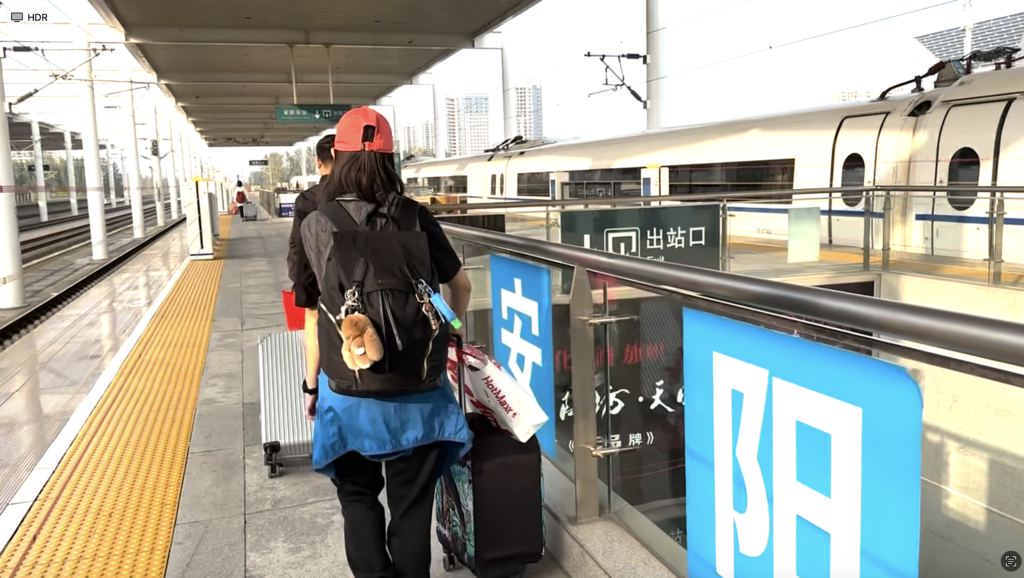
China’s high-speed railway can transform a first trip from a one-city holiday into a journey through different periods and regions of Chinese civilisation.
But large stations operate more like airports than small neighbourhood train stops.
Five Essential Facts for First-Time Passengers:
1. Book Using Your Passport Name
The passenger information must correspond to the passport used for the booking.
2. Travel with the Same Physical Passport
For most journeys, the passport used for booking acts as your travel identification and electronic-ticket credential.
3. Choose the Correct Railway Station
A city may have several stations.
Beijing, for example, has Beijing Railway Station, Beijing South, Beijing West, Beijing North and other passenger stations.
“Xi’an” and “Xi’an North” are not interchangeable.
Check the complete English and Chinese station names before ordering a DiDi.
4. Allow Time for Security and Navigation
Passengers normally pass through identity and security checks before entering the waiting area.
Major stations can be enormous. For a first journey, arriving 45–60 minutes early is a sensible precaution, with more time during major public holidays or at unfamiliar stations.
5. Do Not Arrive at the Boarding Gate Late
This is not theoretical advice for us.
During the Labour Day holiday, heavy traffic delayed our DiDi to Xi’an North Railway Station.
Elaine and I reached the boarding gate just one minute after it closed.
We could see that the train had not yet departed, but railway staff would not allow us through. Our explanations could not reopen a closed gate.
That one minute changed our entire journey.
It taught us that “train departure time” is not the same as “the latest time you can arrive at the gate.”
ChinaTravelBUG Rule:
Plan to be inside the station early—not merely outside the building before the departure time.
Read our complete railway guide before booking your first journey:
Continue reading: China High-Speed Rail for Foreign Tourists: 2026 Guide

9. What Should You Do During Your First 60 Minutes in China?
The first hour after landing can shape the emotional tone of your entire trip.
This is when tired travellers must suddenly manage immigration, luggage, internet access, payment, signs and transport—all at once.
The best solution is to make the first hour predictable before you fly.
A Simple Arrival Sequence
Step 1: Complete Immigration and Collect Your Luggage
Keep your passport, arrival details and hotel address accessible.
Check that you have collected the correct bags before leaving the baggage area.
Step 2: Connect Your Phone
Turn on your roaming or eSIM and confirm that mobile data works.
Send a brief message home if someone is expecting your arrival.
Step 3: Confirm Alipay Access
Open Alipay and make sure your account remains logged in.
Do not begin changing settings unless something is genuinely wrong.
Step 4: Find Cash If You Need It
If you want a small cash reserve, use an official airport ATM or currency service. Check your own bank’s overseas-withdrawal fees.
Step 5: Confirm the Route to Your Hotel
Use the transport plan selected before departure:
- airport express railway or metro;
- official taxi queue;
- DiDi;
- hotel transfer;
- pre-arranged private transport.
Step 6: Check the Destination in Chinese
Before entering a taxi or DiDi, confirm that the hotel name and address match your reservation.
Screenshot the Chinese address in case the internet connection becomes unstable.
Step 7: Ignore Unofficial Transport Offers
Use clearly marked official services. Do not follow an unsolicited person offering a “special taxi” inside the arrivals hall.
Beijing Capital Airport as a Worked Example
Beijing has two major international airports: Beijing Capital International Airport and Beijing Daxing International Airport.
They are not in the same part of the city, and the best transport choice depends on your arrival airport, hotel location, landing time, luggage and number of passengers.
For that reason, this guide does not pretend that every Chinese airport operates identically.
Instead, we use Beijing Capital Airport as a detailed example of how to think through your arrival: identify the terminal, know your hotel’s Chinese address, compare the Airport Express with a taxi or DiDi, and avoid making important decisions while tired.
Continue reading: Beijing Capital Airport to Your Hotel: A Stress-Free 2026 Guide

10. Turn Your Preparation into a Real China Itinerary
Apps and checklists are not the purpose of travelling.
They are what allow the real journey to begin.
For a first family trip, Beijing is an excellent starting point because it brings together many different layers of China:
- the Forbidden City and imperial government;
- Tiananmen Square and modern national history;
- the Temple of Heaven and ritual life;
- traditional hutongs and neighbourhood culture;
- the Summer Palace and imperial landscapes;
- the Great Wall and the defence of successive dynasties;
- museums that connect objects with the larger story of Chinese civilisation.
An eight-day trip also gives families enough time to slow down rather than treating Beijing as a race between attractions.
You can then add a carefully chosen side trip.
Tianjin shows another side of China’s journey into the modern world. Other routes can connect Beijing with the Great Wall, ancient capitals or high-speed-rail destinations beyond the standard tourist circuit.
A Simple Eight-Day Family Route:
Day 1: Arrive and Adjust
Reach the hotel, take a short neighbourhood walk, eat and rest.
Do not turn arrival day into an endurance test.
Day 2: Tiananmen Square and the Forbidden City
Begin with China’s imperial and political centre.
Day 3: Temple of Heaven and Local Beijing
Combine a major monument with the everyday social life of its surrounding park and neighbourhoods.
Day 4: The Great Wall
Give the Great Wall a full day rather than squeezing it between unrelated attractions.
Day 5: Hutongs and Shichahai
Slow down and experience the human scale of old Beijing.
Day 6: Summer Palace
Explore how landscape, architecture and imperial history come together.
Day 7: Museum or Flexible Discovery Day
Choose the National Museum of China, another museum suited to your interests, or return to an area that deserves more time.
Day 8: Side Trip or Final Beijing Exploration
Travel to Tianjin by high-speed rail, explore another Beijing district, or keep the day flexible before departure.
This is where every practical preparation comes together:
Your passport gets you through formal checks.
Your phone keeps you connected.
Alipay handles everyday payments.
Chinese addresses help you communicate.
The metro moves you through Beijing.
High-speed rail opens the door to another city.
And the unfamiliar systems that seemed frightening before departure become part of the journey.
See how we would organise the complete family route:
Continue reading: Eight Days in Beijing with Kids: A First-Time Family Guide
Your Final Before-China Checklist
Documents
- Passport and required visa or entry documents
- Passport copies stored separately
- Travel insurance details
- Flight and accommodation confirmations
- Hotel name and address in Chinese
- Train and attraction reservations
Phone and Internet
- Working roaming plan, eSIM or SIM arrangement
- Home number available for verification messages
- Alipay installed and verified
- Translation app with offline Chinese
- Maps and essential travel apps installed
- Charging cable, adaptor and compliant power bank
Money
- Alipay linked to an eligible international card
- Second payment card
- Small emergency cash reserve
- Overseas transactions enabled
- Bank contact information saved
Journey Planning
- Arrival airport confirmed
- Route from airport to hotel planned
- Correct railway stations identified
- Popular attractions booked where required
- Public-holiday and crowd conditions checked
- First day deliberately kept manageable
So, Are You Ready for Your First Trip to China?
You do not need fluent Mandarin.
You do not need a Chinese bank account.
You do not need to understand every Chinese app, custom or railway station before you leave home.
You need:
- a valid passport and the correct entry documents;
- a prepared phone;
- reliable internet access;
- a working payment method;
- your destinations saved in Chinese;
- enough time to navigate unfamiliar systems;
- and the willingness to let first impressions develop into understanding.
China may feel different from anywhere you have travelled before.
That is not a reason to avoid it.
For Elaine and me, it became the reason to keep exploring.
We came to see famous places.
We returned because we began discovering the stories connecting them.
The Great Wall led us to questions about defence and empire.
Beijing led us to Xi’an.
Xi’an led us back to the Qin, Han and the civilisations that came before them.
High-speed rail led us beyond the famous cities to places we had barely heard of.
Every trip answered one question—and created ten more.
Prepare carefully.
Keep your first day simple.
Then begin.
China is waiting to be discovered—not studied.
ChinaTravelBUG Editor’s Note:
Visa policies, airline rules, railway procedures, mobile-payment features, attraction reservations and app requirements can change. Confirm unstable details with the relevant official authority shortly before departure.
This guide was prepared for travel planning in 2026 and should be reviewed regularly as China’s visitor systems continue to develop.