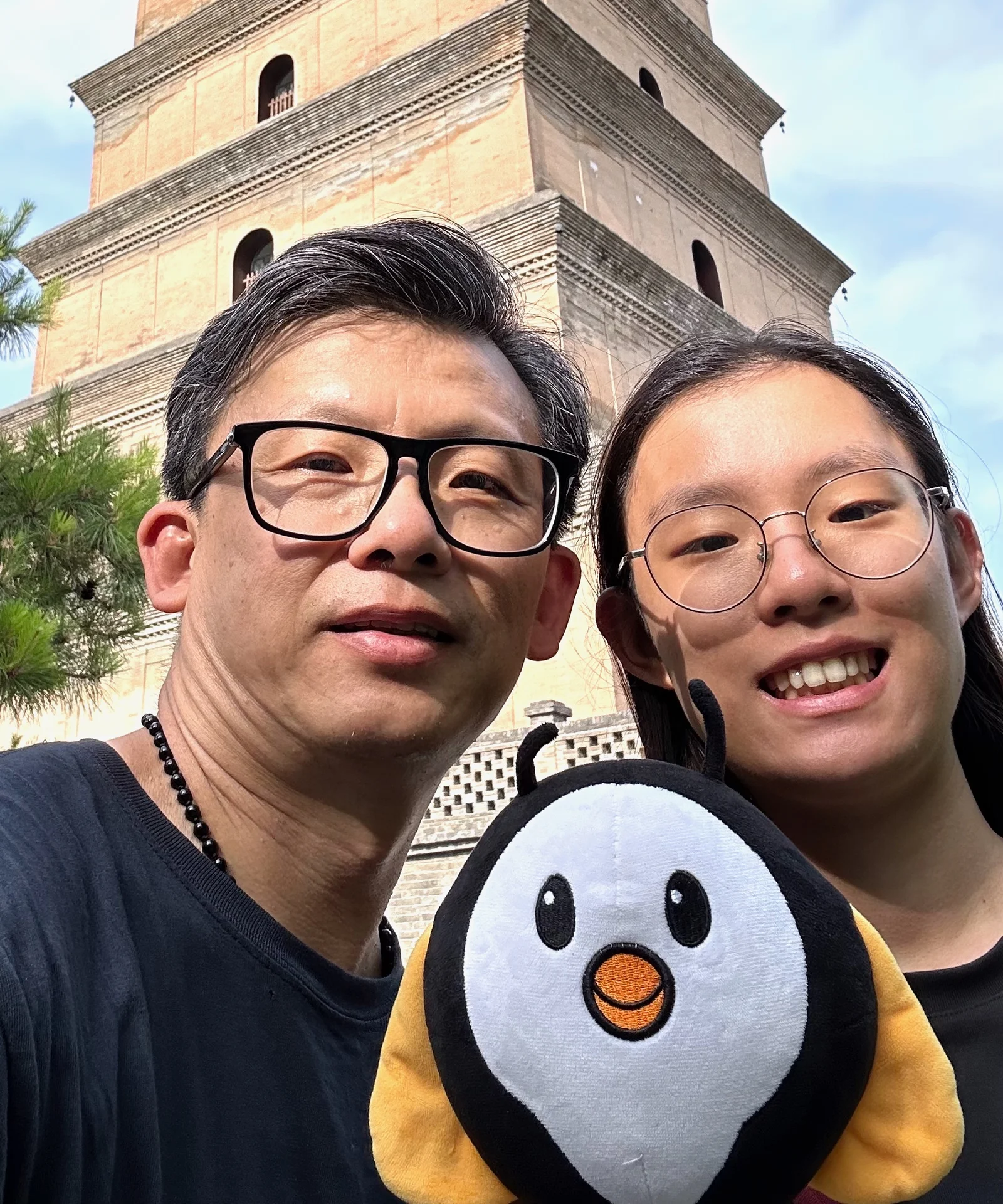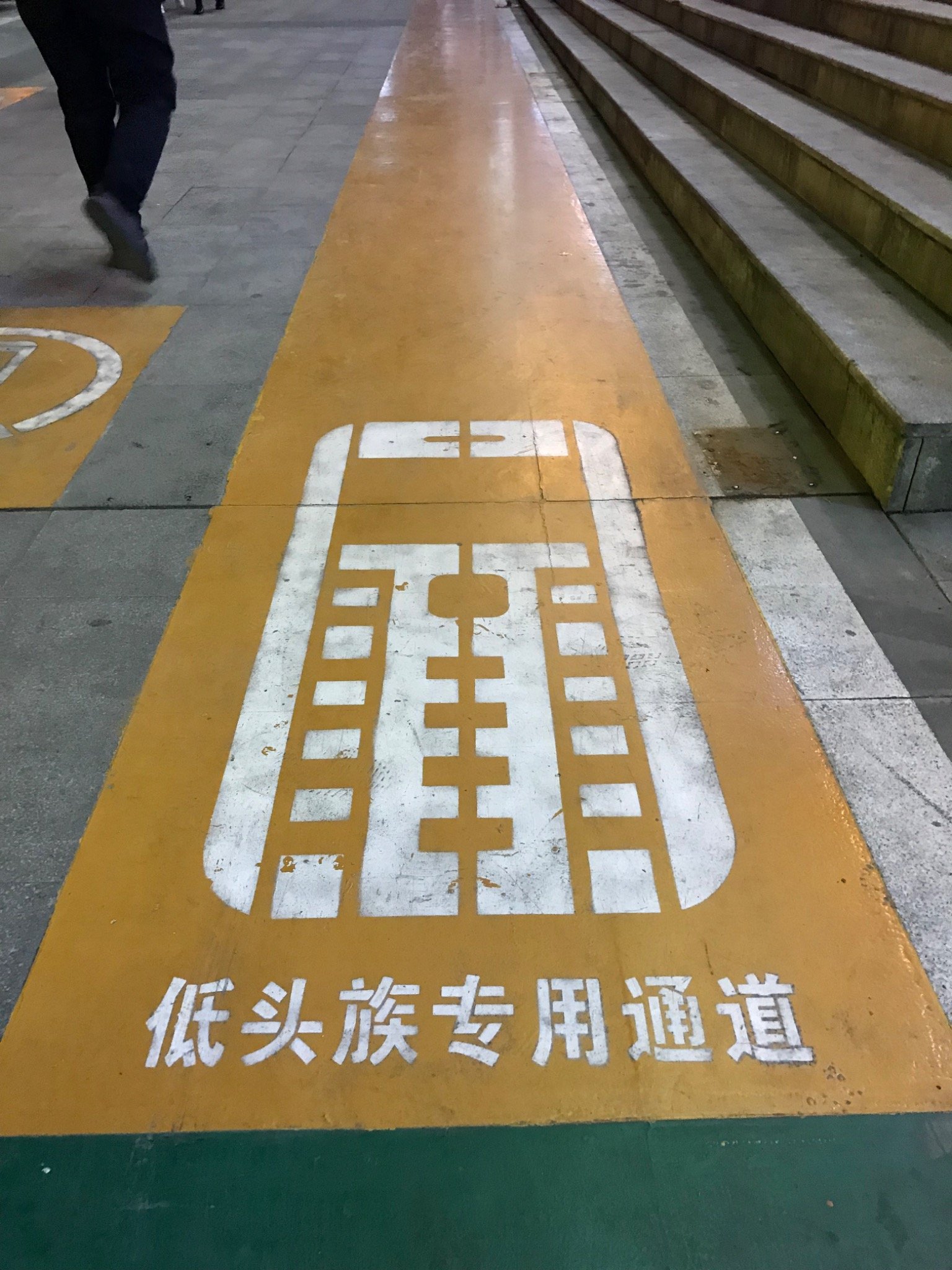
Xi’an introduces you to China’s emperors, armies and ancient capitals. Travel toward Zhongnan Mountain and you encounter another force that shaped Chinese civilization just as profoundly: ideas.
Most international travelers come to Xi’an (西安, Xī’ān) for history they can see.
The Terracotta Warriors.
The ancient city wall.
The legacy of Qin Shi Huang.
The Tang dynasty.
The Silk Road.
All of that is worth coming for.
But Chinese civilization wasn’t shaped only by emperors, armies and dynasties.
It was also shaped by ideas.
So on one of our journeys beyond Xi’an, Elaine and I went looking for a very different part of China’s story.
🎬 WALK WITH DAD & ELAINE — Our First Steps into Louguantai (楼观台)
Before we explore Laozi’s philosophy, come along with Dad and Elaine to Louguantai (楼观台, Lóuguāntái), at the foot of the Qinling Mountains (秦岭, Qínlǐng).
This is where our journey into the world of the Dao begins.
🎥 VIDEO 1 — Approaching the Sacred Mountain
Our first glimpse is a grand ceremonial gateway bearing the characters 仙都 (Xiāndū) — the “Capital of Immortals.”
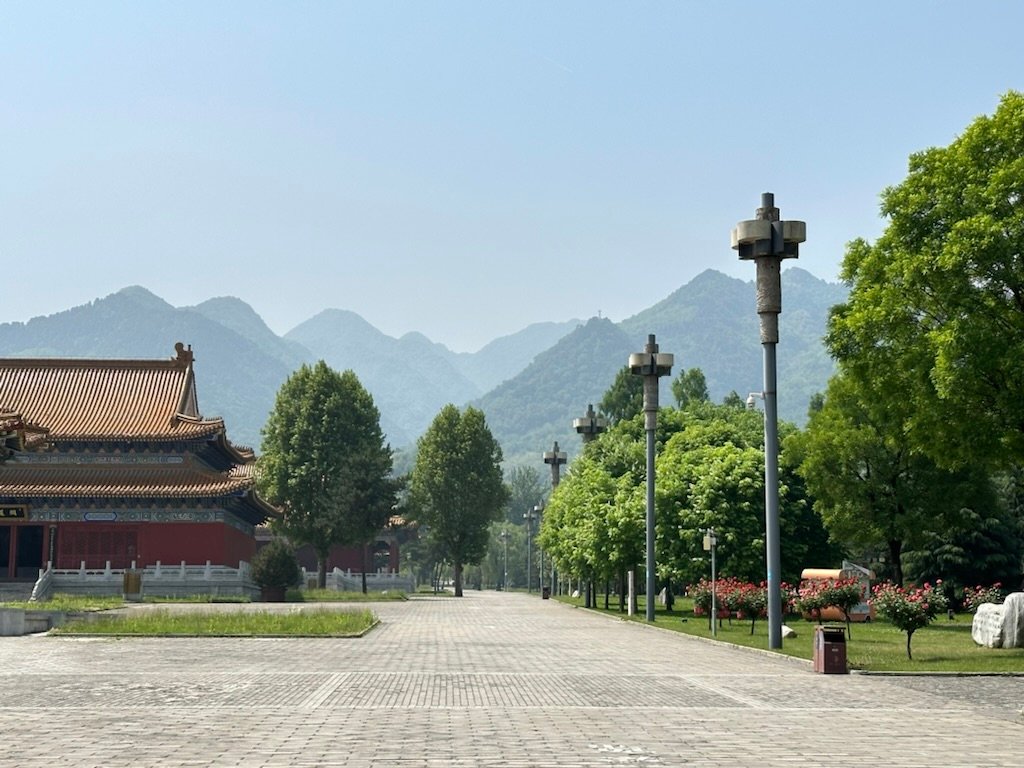
Beyond it, a broad avenue leads toward the mist-covered mountains.
And there goes Elaine, walking ahead of Dad!
She even turns around to show us her little panda companion. 😂
But the real surprise is the setting.
Why would a place associated with one of China’s greatest philosophical traditions be nestled beneath these mountains?
🎥 VIDEO 2 — Elaine Walks into the World of the Dao
Now follow Elaine toward the imposing gatehouse.
Look carefully at the pavement.
There is an enormous Chinese character beneath our feet:
道 (Dào) — The Way.
One character. Thousands of years of philosophical thought.
It is a central idea in the Daodejing (道德经), the classic traditionally attributed to Laozi (老子, Lǎozǐ).
And here we are, literally walking across the word!
But what exactly is the Dao? And why is this mountain sanctuary associated with Laozi老子 ?
To understand that, we need to travel much farther back in Chinese history.
Let’s follow the story.
And waiting for us there was an old man…
an ox…
a mountain…
And there’s a book of roughly 5,000 Chinese characters that would travel much farther around the world than its traditional author ever did.
That old man was:
Laozi — 老子 (Lǎozǐ)
And yes.
Cheers came too. 🐧
First, Why Should an International Traveler Care About Laozi 老子?
Before throwing 老子、尹喜、道、自然 at readers who have just finished breakfast, let’s establish why we’re here. 😂
Laozi isn’t important only within China.
The work traditionally attributed to him:
《道德经》 — the Daodejing
became one of the most internationally influential works of Chinese thought.
It has been translated again and again into languages around the world, generating an extraordinary range of interpretations.
Ideas associated with Laozi and the Daodejing — simplicity, naturalness, softness overcoming hardness, the imagery of water, restraint and living without constantly forcing the world around us — have traveled far beyond China.
So when you come to Louguantai, you’re not merely visiting a religious site associated with an obscure ancient Chinese thinker.
You’re entering the cultural landscape surrounding one of the most internationally recognized texts to emerge from ancient China.
And that makes what happened here — or, more carefully, what Chinese tradition remembers as happening here — much more interesting.
🕰️ Where Are We in Chinese History?
Before going up the mountain, here’s your historical coat rack.
Don’t memorize it.
Just notice where our story sits.
WESTERN ZHOU
c. 1046–771 BCE
↓
📍 LATER ZHOU WORLD — LAOZI TRADITION
↓
SPRING & AUTUMN
770–476 BCE
↓
WARRING STATES
475–221 BCE
↓
QIN UNIFIES CHINA — 221 BCE
↓
HAN
206 BCE–220 CE
The traditional Laozi story belongs to the ancient Zhou world, centuries before China’s first imperial unification under Qin.
The precise historical identity and dates of Laozi are much more complicated than a simple timeline can suggest, and scholars have long debated questions surrounding the composition and development of the Daodejing.
That’s worth remembering.
The tradition is ancient. The historical questions are real.
And at Louguantai, the two have been intertwined for centuries.
A Western Handrail: Before Imperial Rome

If your Chinese-history timeline still feels like alphabet soup, here’s another handrail.
Confucius lived from 551–479 BCE.
That’s broadly within the era Western readers associate with classical Greece.
Qin Shi Huang unified China in 221 BCE, during the wider Hellenistic age around the Mediterranean.
The traditions surrounding Laozi take us into that same enormous pre-imperial Chinese world — long before the Roman Empire reached its later imperial height.
So we’re not visiting something that developed out of Ming or Qing China.
We’re following an intellectual tradition whose roots reach deep into China’s ancient past.
From Xi’an Into Zhongnan Mountain 终南山
Leave central Xi’an and head southwest toward Zhouzhi County (周至县).
The urban landscape gradually gives way toward the northern foothills of the Qinling Mountains (秦岭).
Among these mountains lies the cultural landscape known as Zhongnan Mountain 终南山.
For centuries, Zhongnan became associated with religious practitioners, hermits, scholars, Buddhist communities, Daoists and people deliberately withdrawing from ordinary society.
That creates an extraordinary contrast.
Nearby stood Chang’an (长安) — for long periods one of the greatest cities on Earth.
Politics.
Officials.
Commerce.
Imperial ambition.
Power.
And then…
the mountains.
Solitude.
Religion.
Reflection.
Withdrawal.
Perhaps you need both landscapes to understand something about Chinese civilization.
The capital and the mountain.
Then We Arrived at Louguantai 楼观台
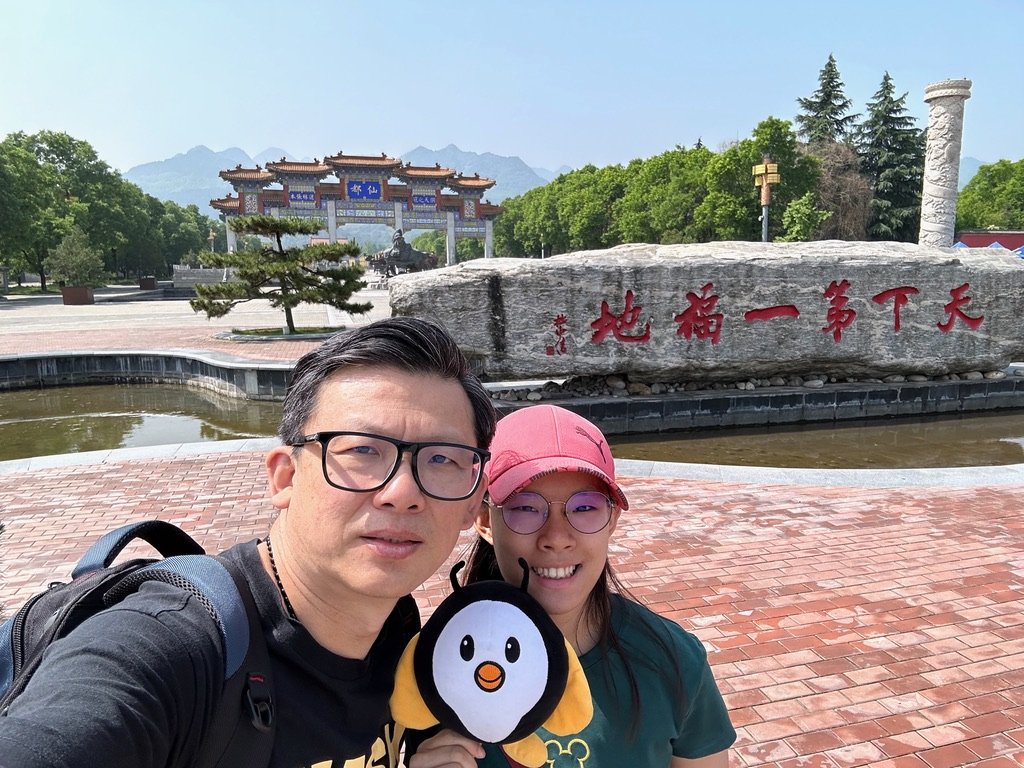

When Elaine and I arrived, one thing immediately told us that Louguantai does not think modestly of itself. 😂
Behind us were four enormous characters:
天下第一福地
A simple rendering would be:
“The First Blessed Land Under Heaven.”
And farther ahead:
仙都
“Capital of the Immortals.”
Okay then. 😂
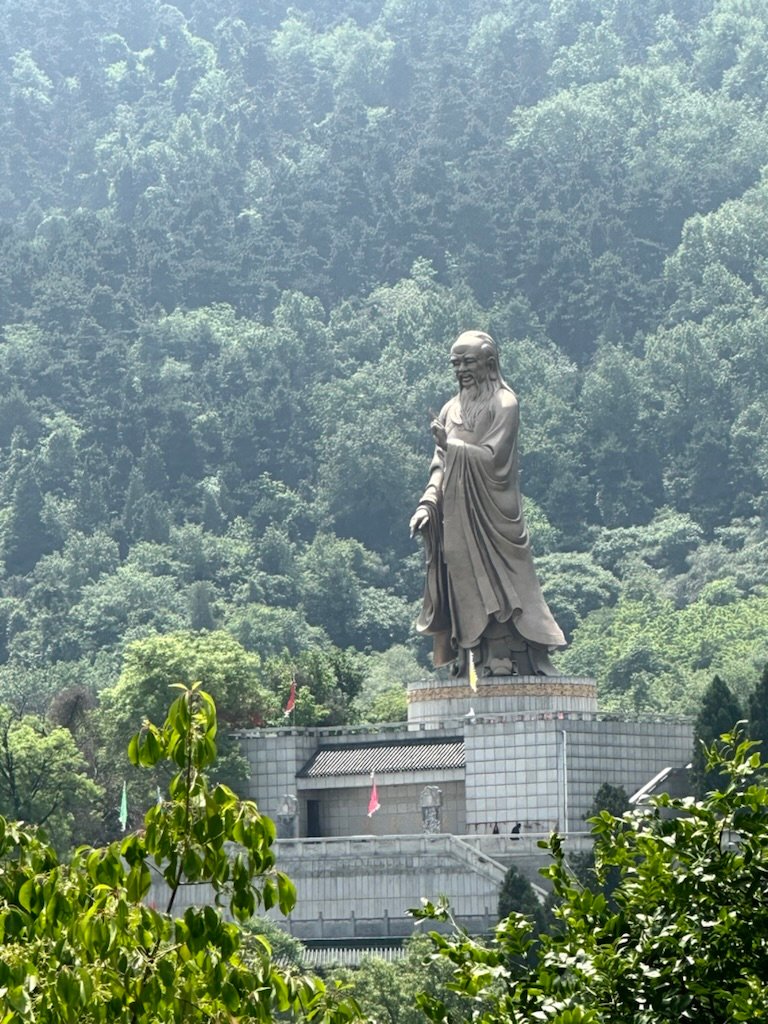
Louguantai lies at the northern foot of Zhongnan Mountain in today’s Zhouzhi County and has long held an important position within Chinese Daoist tradition.
But what particularly interested us was the story associated with:
Laozi
and
Yin Xi (尹喜).
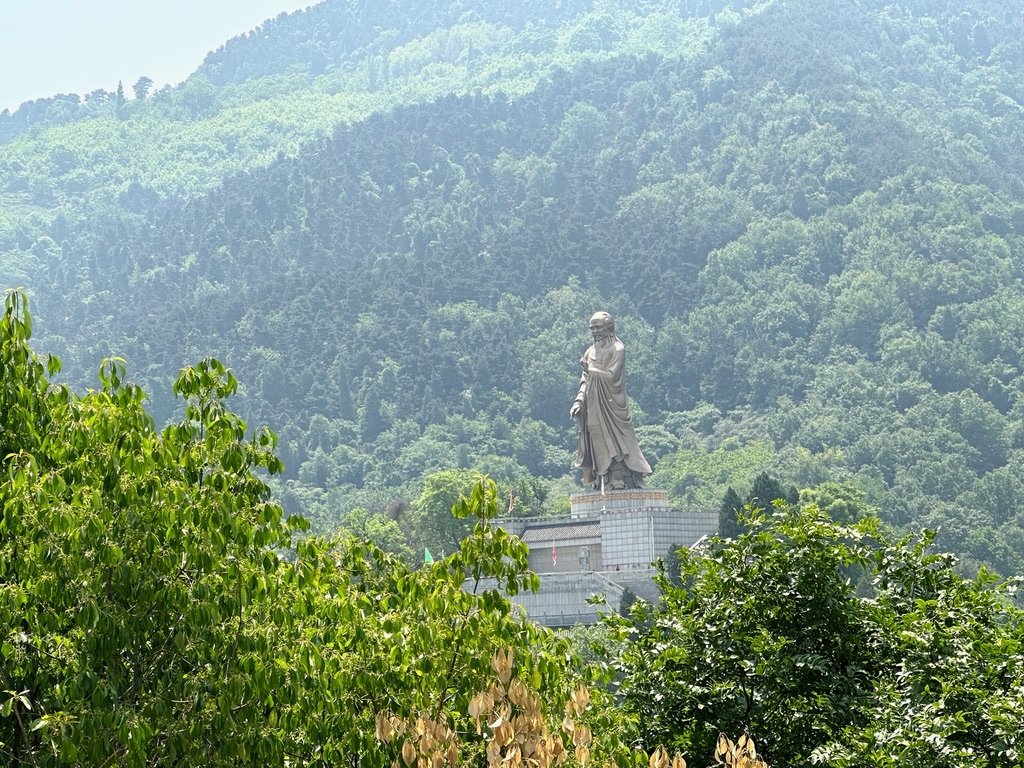
Why Is There an Enormous Ox Here? 🐂
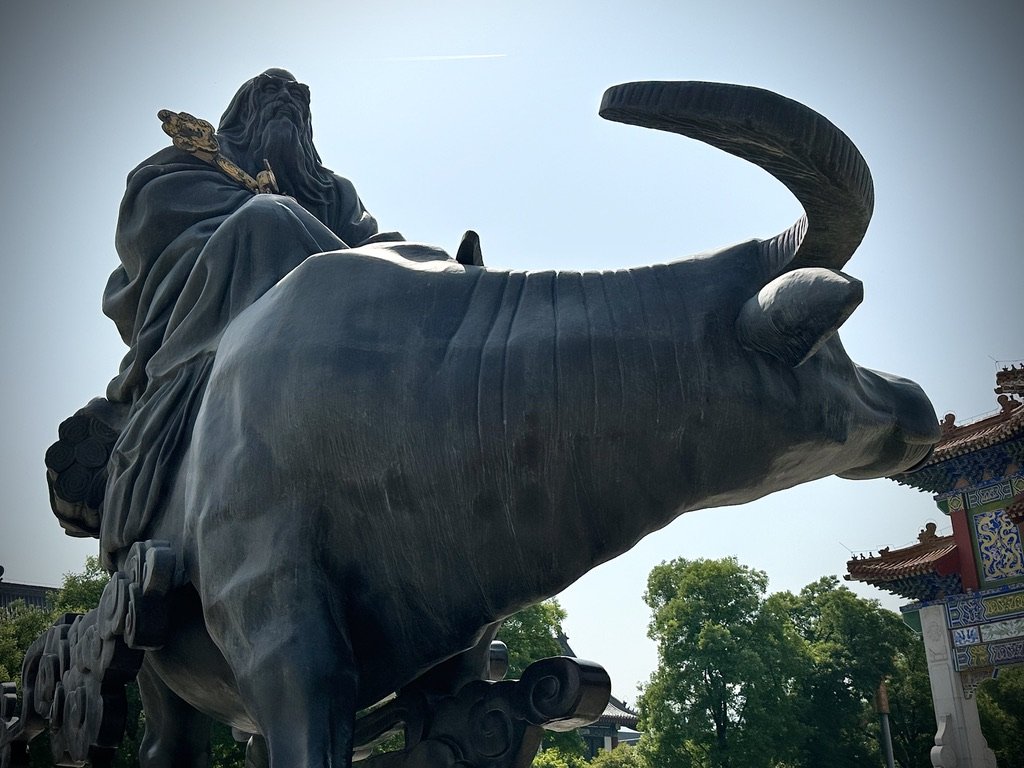

If you arrive without knowing the story, the enormous ox may seem slightly random.
It isn’t.
Laozi is traditionally depicted traveling west on a 青牛 — blue-green ox.
According to the famous tradition, Laozi became disillusioned with the declining Zhou world and decided to leave.
On his westward journey he encountered:
尹喜 — Yin Xi
who recognized the extraordinary traveler passing before him.
Yin Xi persuaded Laozi to leave his wisdom behind before disappearing into the West.
And according to tradition, Laozi produced the approximately 5,000-character work that became known as:
《道德经》 — the Daodejing
Louguantai subsequently became deeply associated with the tradition of Laozi transmitting or expounding these teachings to Yin Xi.
That’s why one of its most famous places is:
说经台 — Shuōjīngtái
The Platform for Expounding the Classic.
🎬 WALK WITH DAD — Entering Shuojing Terrace (说经台), Where Laozi Is Remembered
We had heard the story of Laozi (老子, Lǎozǐ) and Yin Xi (尹喜, Yǐn Xǐ).
Now let’s actually walk into the place associated with that story.
At Shuojing Terrace (说经台, Shuōjīng Tái), our Chinese-speaking guide explains why this site holds such a special place in Daoist tradition.
Look above the entrance.
Three Chinese characters:
说经台 — The Platform for Expounding the Classic.
Then look at the calligraphy and couplets beside the doorway.
They are not simply decorations.
They connect Laozi’s teachings, Yin Xi’s traditional role in receiving them, and the later generations of Daoist practitioners who kept these traditions alive.
Note: 陕西楼观台的“讲经台”(更通用的称呼为“说经台”),位于西安市周至县终南山北麓,是中国道教最早的重要圣地与发源地,被誉为“天下第一福地”。
关于楼观台说经台的核心要点如下:
历史与文化地位
- 老子讲经之地:相传春秋时期,天文学家尹喜在此结草为楼以观天象(即“楼观”之名始源)。老子骑青牛西出函谷关后,受尹喜之请来到这里,在此撰写了《道德经》五千言,并筑台为尹喜讲经说道。因此,这里成为了道家思想与道教文化的真正发祥地。
- 皇家祭祀圣地:历史上有秦始皇建清庙、汉武帝立望仙宫、唐高祖李渊将其定为皇家祖庙。历代有60多位皇帝曾亲往或派员在此拜谒祭祀。
核心建筑与景观
说经台(老子祠)是整个楼观台景区的中心建筑群,建于海拔580米的高岗上:
自然风光:周围翠竹环抱,松林如海,古人形容说经台在终南山万峰环抱中“犹如竹海松林中浮起的方舟”
建筑布局:坐北向南,呈明清风格的九进院落空间。沿中轴线自南向北依次为山门、灵官殿、启玄殿(中心殿堂,供奉老子)、斗姥殿等。
主要看点:
古银杏树:传为老子当年亲手所植,距今已有2600多年历史。
碑石林立:保存有唐代以来的珍贵碑石42通,包含极具历史文化价值的石碑与拓片。
Don’t understand Mandarin? Here’s what our guide is explaining:
- 说经台 (Shuōjīng Tái): The terrace traditionally associated with Laozi teaching and transmitting the wisdom of the Daodejing (道德经).
- 尹喜 (Yǐn Xǐ): The legendary frontier-pass official associated with Laozi’s westward journey, later revered in Daoist tradition as 文始真人 (Wénshǐ Zhēnrén).
- 道德经 (Dàodéjīng): The famous text of approximately 5,000 Chinese characters traditionally attributed to Laozi.
- 正一派 (Zhèngyī Pài) and 全真派 (Quánzhēn Pài): Two major traditions of organized Daoism. The guide explains some differences in their religious practices and expectations concerning marriage and monastic life.
As we walk farther inside, the guide continues explaining how Daoist teachings, religious names and traditions have been passed down through generations.
And that is what makes this little video interesting.
We came looking for a philosopher from ancient China.
But we encountered something else too.
A living religious tradition that still remembers him.
One important distinction: the guide is explaining the site’s religious traditions and local heritage. These accounts do not establish that Laozi personally taught or wrote the Daodejing at this exact location.
That brings us to Dad’s next question.
How much of the Laozi story is history — and how much is tradition?
History or Legend?
🐇 Rabbit Hole Alert.
This is where ChinaTravelBUG needs to put on its sensible hat for a moment.
Can we prove that Laozi rode an ox here, met Yin Xi and dictated the Daodejing exactly as later tradition describes?
No.
Details surrounding the historical Laozi are difficult to establish, and the formation of the Daodejing itself is a substantial field of scholarly discussion.
So we shouldn’t tell international travelers:
“This is definitely the exact spot where Laozi wrote the Daodejing.”
That’s too simple.
Instead:
Louguantai is one of the most important places associated in Chinese Daoist tradition with Laozi, Yin Xi and the transmission of the Daodejing.
And that distinction actually makes the place more interesting.
Because you’re not merely asking:
What happened here?
You’re also asking:
Why did generations of Chinese people remember this place this way?
That’s a very DEEP China question.
Don’t Worry. No Daoist Philosophy Exam. 😂
Now we’ve reached the dangerous part.
Dad has brought you to a mountain associated with Laozi.
He could begin explaining the entire Daodejing.
Run. 🏃♂️💨
Instead, let’s take just four Chinese characters with us:
道法自然
Dào fǎ zìrán
They come from one of the best-known lines of the Daodejing:
人法地,地法天,天法道,道法自然。
Rén fǎ dì, dì fǎ tiān, tiān fǎ Dào, Dào fǎ zìrán.
A simple rendering might be:
Humans follow Earth; Earth follows Heaven; Heaven follows the Dao; the Dao follows what is naturally so.
The last four characters are the ones we want:
道法自然
But 自然 (zìrán) deserves some explanation.
自然 Doesn’t Simply Mean “Nature”
Modern Chinese speakers commonly use 自然 to mean “nature.”
Mountains.
Forests.
Rivers.
The natural environment.
But in the classical philosophical context, the idea reaches deeper.
自然 carries the sense of something being:
“so of itself”
— arising or existing according to its own inherent way, rather than being artificially forced into something else.
That gives 道法自然 a much richer meaning than:
“Dao follows Mother Nature.”
The idea invites us to consider the way things naturally develop and the consequences of constantly trying to force them otherwise.
And suddenly standing beneath Zhongnan Mountain feels like a rather appropriate place to think about it.
🌱 An Ancient Idea With a Very Modern Resonance
This is where Laozi becomes surprisingly accessible to a 21st-century international traveler.
Today we talk constantly about:
sustainability,
environmental protection,
ecological limits,
living with rather than simply conquering nature,
and whether endless human intervention always produces better outcomes.
Let’s be careful.
Laozi was not writing a modern environmental manifesto.
It would be historically misleading to turn an ancient Chinese philosophical text into a 21st-century green-policy document.
But there is a genuine modern resonance.
道法自然 encourages us to think seriously about natural processes and about the human desire to control and force the world around us.
For a modern reader concerned with environmental sustainability, that can provide a surprisingly familiar doorway into ancient Daoist thought.
Not because Laozi was secretly writing today’s environmental movement.
But because an ancient Chinese question remains recognizable:
How should human beings live within a world that does not exist merely for us to control?
That’s quite a thought to take up a mountain.
And Suddenly the Mountain Makes More Sense
This is what Elaine and I enjoy about traveling through Chinese history and culture.
You can read:
道法自然
on a screen.
You can study the Daodejing in London, New York, Kuala Lumpur or Sydney.
But then you come here.
Trees around you.
Mountains rising behind the temples.
The Qinling landscape stretching away.
And suddenly you begin understanding why mountains became such powerful spaces within Chinese religious and philosophical imagination.
The idea now has:
words,
history,
geography,
and a landscape.
That’s exactly what travel can do to learning.
🐇 Rabbit Hole: Why Did Chinese Hermits Keep Going Into These Mountains?
Oh dear.
Another question.
Zhongnan Mountain isn’t connected only with Laozi.
Over many centuries it became associated with:
Daoist practitioners,
Buddhist monks,
poets,
scholars,
and perhaps most intriguingly:
hermits.
People deliberately withdrawing from ordinary society.
And remember what sat nearby:
Chang’an.
One of imperial China’s greatest centers of government, wealth and ambition.
The contrast is wonderful.
One person heads toward the capital because he wants a government position.
Another walks toward Zhongnan because he wants to escape everything the capital represents.
😂
There is an entire China History & Stories article hiding inside that contradiction.
🐇 Rabbit hole saved for later.
Xi’an and Zhongnan Tell Two Different China Stories
This is why we think Louguantai works particularly well after Xi’an.
Xi’an gives you:
Qin Shi Huang
→ imperial unification
Terracotta Warriors
→ military and imperial power
Chang’an
→ capital, administration and empire
Tang
→ cosmopolitan imperial civilization
Then Zhongnan gives you:
Laozi
→ philosophy
Dao
→ a different way of thinking about order
道法自然
→ naturalness and the limits of forcing things
mountains and hermits
→ withdrawal from the very world of power you’ve just been exploring.
One doesn’t replace the other.
Together they make China more interesting.
How to Go: Xi’an to Louguantai
Okay.
Dad has successfully convinced you to chase an ancient philosopher riding an ox into the Qinling foothills.
Now the important question:
How do I actually get there? 😂
Louguantai is in Zhouzhi County, roughly 70–80 km from central Xi’an, depending on your starting point and route. Shaanxi historical sources place it about 76 km from Xi’an.
Unlike our Xi’an → Linfen journey, high-speed rail isn’t the obvious solution here.
This is primarily a road journey.
Option 1 — Private Car / Driver: Our Preferred Choice for International Travelers
For most international visitors, especially two or more people traveling together, we’d strongly consider:
a private car or pre-arranged driver
Why?
Because Louguantai isn’t a single building sitting beside a metro station.
The wider Louguan area contains several related cultural, religious and scenic sites.
Having a car gives you flexibility.
From central Xi’an, allow roughly:
1.5–2 hours each way
depending on traffic, your exact starting point and which Louguan site you’re visiting.
That makes this a comfortable full-day excursion rather than something we’d squeeze between two central-Xi’an attractions.
If hiring a driver, show the exact Chinese destination rather than simply saying:
“Take me to Laozi.” 😂
Save:
楼观台
and, depending on your intended destination:
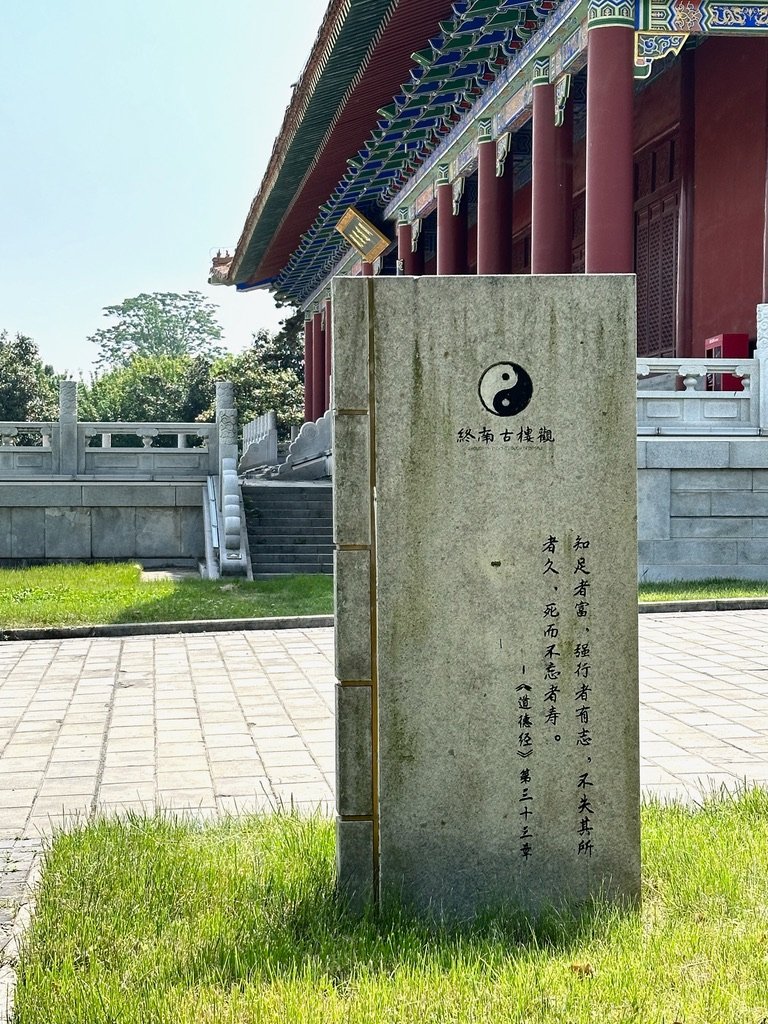
终南山古楼观 / 说经台
Confirm the exact entrance with your hotel/driver before departure.
Option 2 — DiDi / Taxi
A DiDi from Xi’an can potentially work.
For the outbound journey, that’s straightforward enough.
The bigger question is:
How are you getting back?
This is something international travelers should think about whenever using ride-hailing for a relatively remote historical destination.
Don’t assume that because getting a car from Xi’an was easy, getting one back from a mountain-area attraction late in the afternoon will be equally easy.
If using DiDi:
- travel earlier in the day;
- check return-car availability before getting stranded;
- keep your phone charged;
- maintain reliable mobile data;
- save your hotel address in Chinese;
- and consider arranging the return journey with the same driver if appropriate.
For this particular Deep China trip, we’d personally value the certainty of a pre-arranged return car.
Option 3 — Public Transport: Cheapest, But Slowest
For budget travelers, public transport has historically connected Xi’an with the Louguan area.
Current local transport information lists the 环山旅游1号线 — Huanshan Tourist Bus No. 1 from the Giant Wild Goose Pagoda North Square (大雁塔北广场) toward the Louguan tourism area.
Published guidance lists:
Fare: about RMB 12
and approximately:
2.5 hours
for the full journey.
That’s inexpensive.
But think about the trade-off.
2.5 hours out
sightseeing
2.5 hours back
=
Dad has just turned Laozi into an endurance sport. 😂
For international visitors with limited time, we’d generally favor road transport unless budget is the overriding consideration.
And because local tourist-bus schedules can change, verify the service immediately before traveling rather than relying on an old online timetable.
What Does It Cost?
This part requires some care because the Louguan area contains multiple related attractions and ticketed areas, and online listings do not always use the same names consistently.
Current commercial listings show different ticket products for Louguantai and surrounding Louguan attractions, while some older visitor information lists separate admission for areas such as 古楼观, Zhao Gongming cultural sites and other nearby attractions.
Our advice:
Do not choose a ticket purely because an English-language app says “Louguantai.”
First establish:
Which historical/religious site are you actually trying to visit?
For this CTB journey, our historical interest is specifically the traditional Laozi/Louguantai/说经台 story.
Check current admission and opening arrangements for the exact site shortly before visiting.
How Much Time Should You Allow?
We’d treat Louguantai as:
a full-day trip from Xi’an
rather than a rushed half-day.
A comfortable rhythm might look like:
Morning
Leave Xi’an.
↓
Travel toward Zhouzhi and Zhongnan Mountain.
↓
Late morning / early afternoon
Explore Louguantai and the Laozi-related cultural landscape.
↓
Take your time.
This isn’t the place to sprint between photo spots.
↓
Afternoon
Continue exploring the wider Louguan/Zhongnan area if desired.
↓
Return to Xi’an