Section 1 — You Came to Meet Confucius. But Qufu 曲阜 Is Really About What Happened AFTER Him.
Take the:
high-speed train (高铁, gāotiě)
south from:
Beijing (北京, Běijīng)
into:
Shandong (山东, Shāndōng),
and you can reach one of the most important small cities in Chinese intellectual history:
Qufu (曲阜, Qūfù).
Why come here?
Most international travelers know the answer:
Confucius (孔子, Kǒngzǐ).
🔥
Qufu was the hometown of the man Westerners know as:
Confucius
and Chinese people usually call:
孔子 — Kǒngzǐ.
Beginner Chinese:
孔 — Kǒng
Confucius’s family name
子 — zǐ
master / teacher in this historical usage
So:
孔子
Master Kong
😳
Already, you’re learning something.
“Confucius” isn’t actually what people in China normally call him.
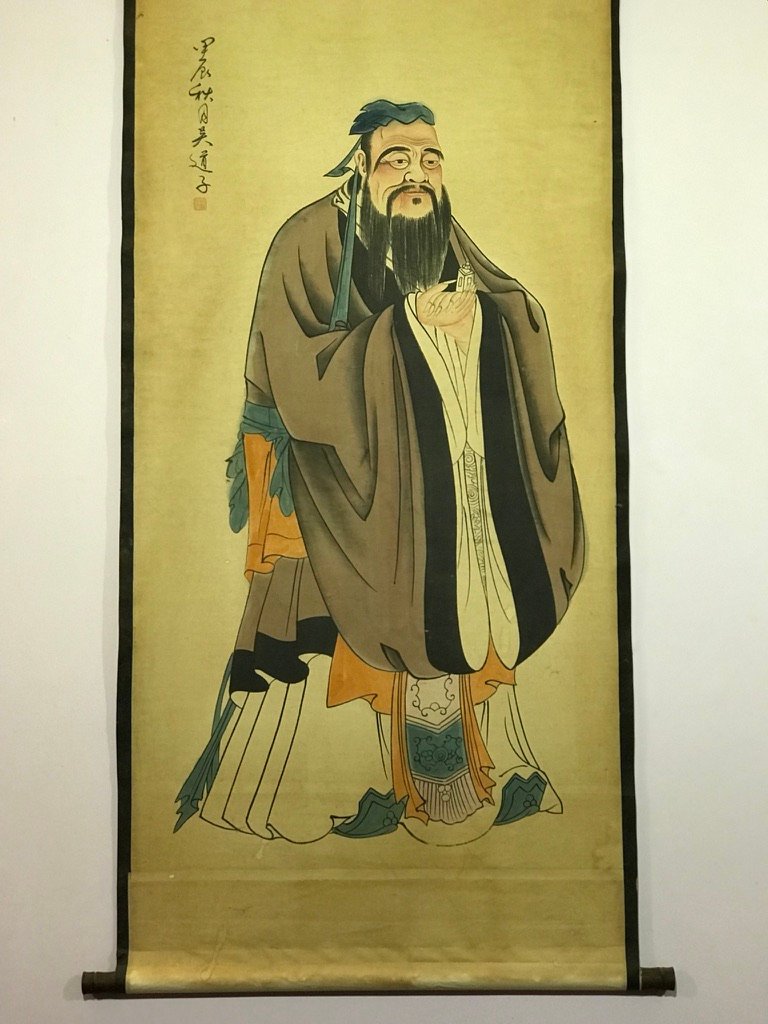
🐇 The rabbit escaped China. Before we ever visited Qufu (曲阜), Dad spotted this portrait of Confucius (孔子) hanging among the antique-style décor in a Hanoi restaurant. A small clue that Confucius’s influence traveled far beyond China—one we only fully appreciated after visiting his hometown. Photo by Dad.
👨🏫 Meet Kongzi
Confucius lived during the:
Spring and Autumn period (春秋时期, Chūnqiū Shíqī)
in the late:
Zhou dynasty (周朝, Zhōu Cháo).
Traditional dates:
551–479 BCE.
He came from the:
State of Lu (鲁国, Lǔ Guó)
whose cultural heartland included Qufu.
Beginner Chinese:
国 — guó
state / country / polity, depending on historical context
That’s important.
Because Confucius wasn’t born into:
“one unified China ruled from Beijing.”
😂
He lived in a world of:
multiple competing states.
🐇
Already, Qufu has connected us back to our:
What Did Qin Shi Huang Actually “Unify”?
Big Question.
Qin’s unification was still more than two centuries away.
🐇 But What Did Confucius Actually Teach?
This is where Western beginners can get overwhelmed very quickly.
Confucianism.
Philosophy.
Ethics.
Ritual.
Filial piety.
Government.
Education.
😵💫
Dad’s coat rack is simpler.
Start with a few Chinese words.
Five Chinese Words That Help Unlock Qufu
仁 — rén
humaneness / benevolence
A central Confucian ethical idea concerning how human beings should relate to others.
礼 — lǐ
ritual / propriety / appropriate conduct
Much bigger than:
“good manners.”
😂
礼 can involve proper conduct, ritual practice and the relationships through which social and political order is expressed.
孝 — xiào
filial respect / filial piety
The responsibilities and respect associated particularly with:
parents (父母, fùmǔ)
and family relationships.
学 — xué
learn / study
You’ll recognize it in:
学生 — xuésheng
student
and:
学校 — xuéxiào
school.
🔥
Education matters enormously in the Confucian tradition.
君子 — jūnzǐ
exemplary / cultivated person
Originally carrying elite social meanings, the term developed an important ethical sense in Confucian thought.
Not simply:
“gentleman wearing ancient Chinese robes.”
😂
Think:
the kind of person one should cultivate oneself to become.

🍚 Western Handrail: Confucius Didn’t Write a “How to Run China” Manual
This is important.
Confucius wasn’t sitting in Qufu writing:
CHINESE GOVERNMENT FOR THE NEXT 2,000 YEARS — FINAL VERSION
😂
He taught.
He discussed:
virtue,
learning,
ritual,
family relationships,
government
and:
how people should conduct themselves.
His sayings and conversations were preserved by later followers in the:
Analects (论语, Lúnyǔ).
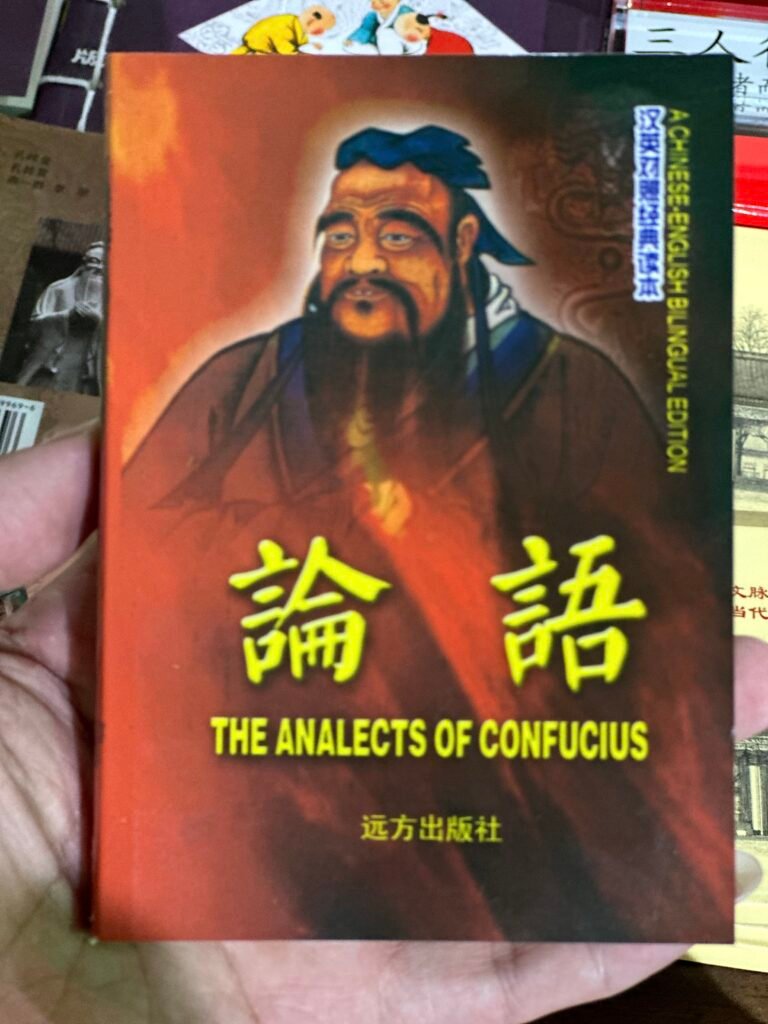
Beginner Chinese:
论 — lùn
discuss / discourse
语 — yǔ
speech / language / sayings
🔥
And then something much bigger happened:
later generations kept interpreting him.
🌶️ This Is the Real Qufu Story
Confucius died in:
479 BCE.
Think about that.
More than:
2,500 years ago.
Yet when Dad & Elaine arrived in Qufu, we weren’t visiting:
a forgotten philosopher’s archaeological ruins.
We found:
an enormous cultural landscape built around his memory.
🔥
That is the question this article really wants to answer:
How did one teacher from the State of Lu become so important that emperors, scholars and governments kept honoring him centuries after his death?
Now Qufu gets interesting.
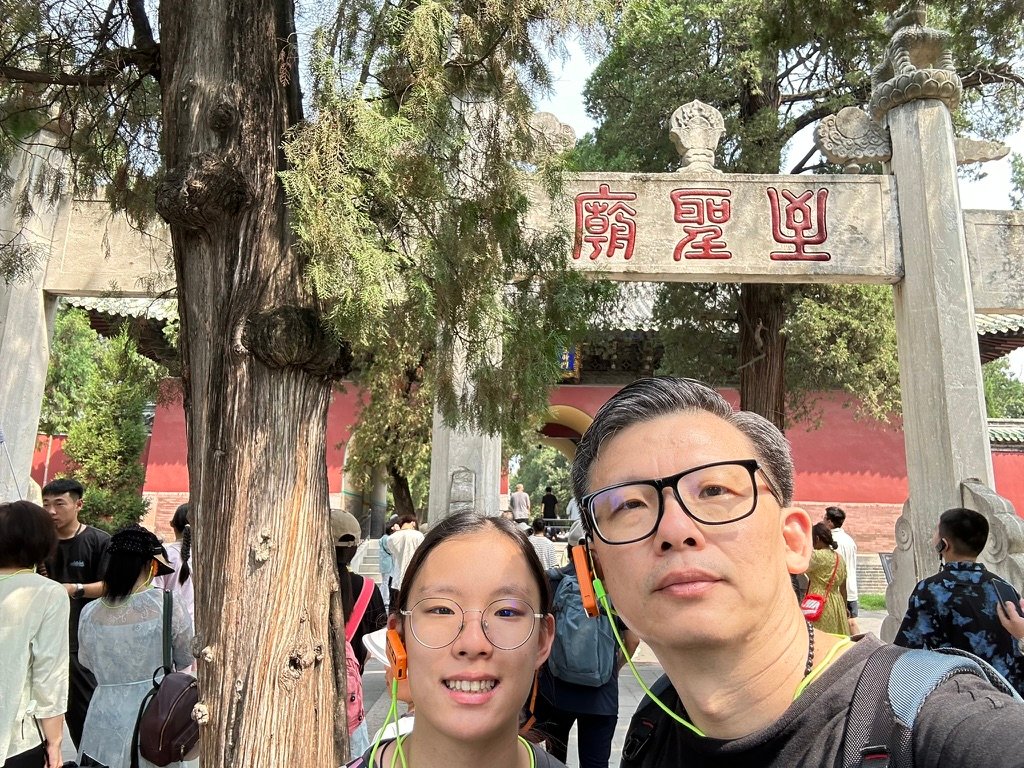
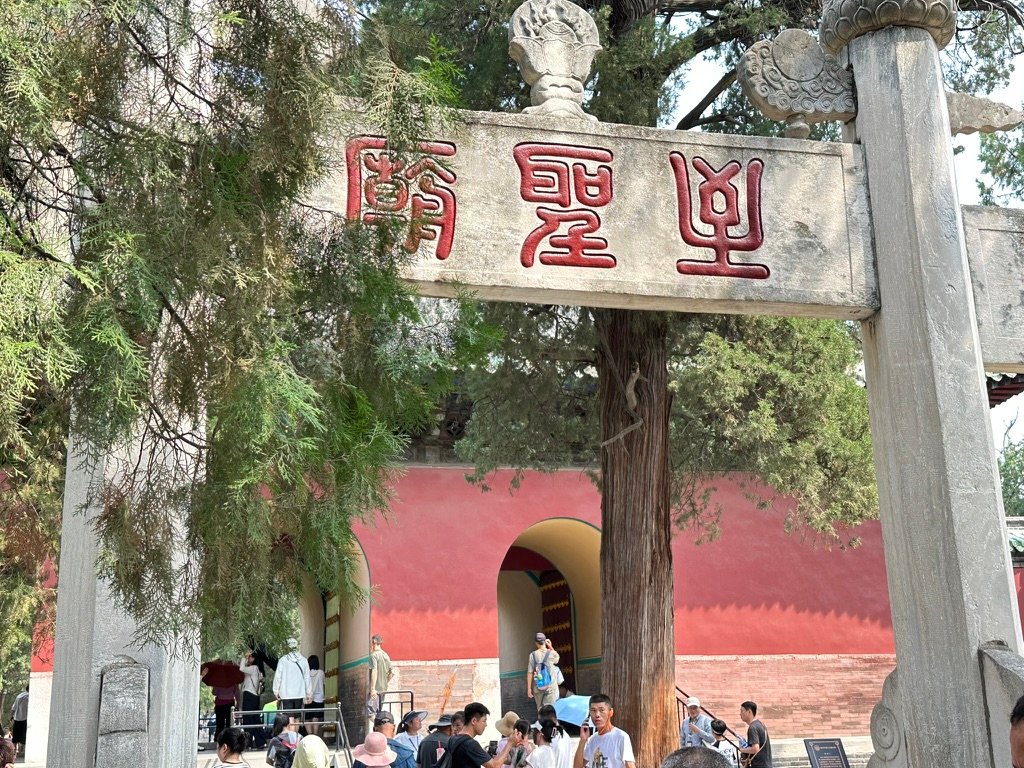
Entering through 圣时门 (Shèngshí Mén). The name refers to Confucius (孔子) as a “sage suited to the times”—someone able to understand circumstances and respond appropriately. Dad and Elaine at the Confucius Temple (孔庙) in Qufu (曲阜). Photo by Dad.
🏛️ Meet the Three Confucian Sites
The heart of historical Qufu is commonly called:
三孔 — Sānkǒng
the “Three Confucian Sites”
Here:
三 — sān
three
and:
孔 — Kǒng
Kong
The three are:
孔庙 — Kǒngmiào
Temple of Confucius
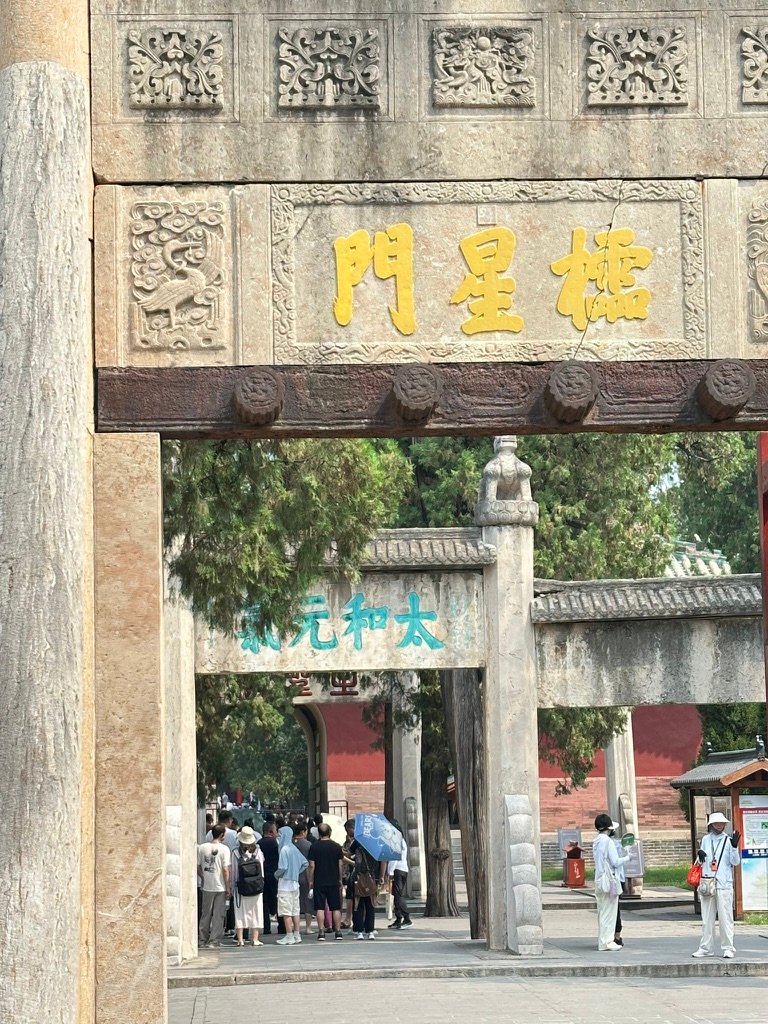
Walking deeper into the Confucius Temple (孔庙) in Qufu (曲阜). In front is 棂星门 (Língxīng Mén), the “Lingxing Gate,” whose name evokes a celestial star traditionally associated with honoring great scholars. Beyond it, 太和元气 (Tàihé Yuánqì) means roughly “the vital energy of supreme harmony”—cosmic language used to express the extraordinary importance later generations attached to Confucius and his teachings. Photo by Dad.
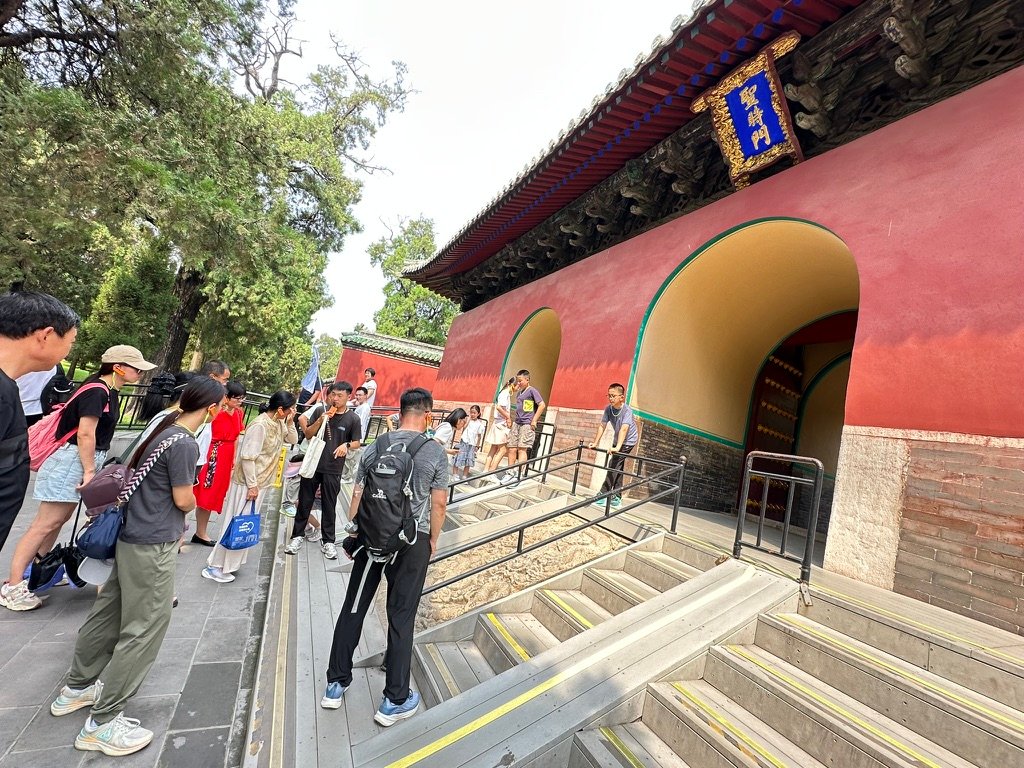
Passing through 圣时门 (Shèngshí Mén) at the Confucius Temple (孔庙) in Qufu (曲阜). The name honors Confucius (孔子) as a sage who understood and responded to the needs of his time. Notice the carved stone ramp between the stairways—a ceremonial feature of traditional Chinese monumental architecture, rather than an ordinary path for visitors. Photo by Dad.
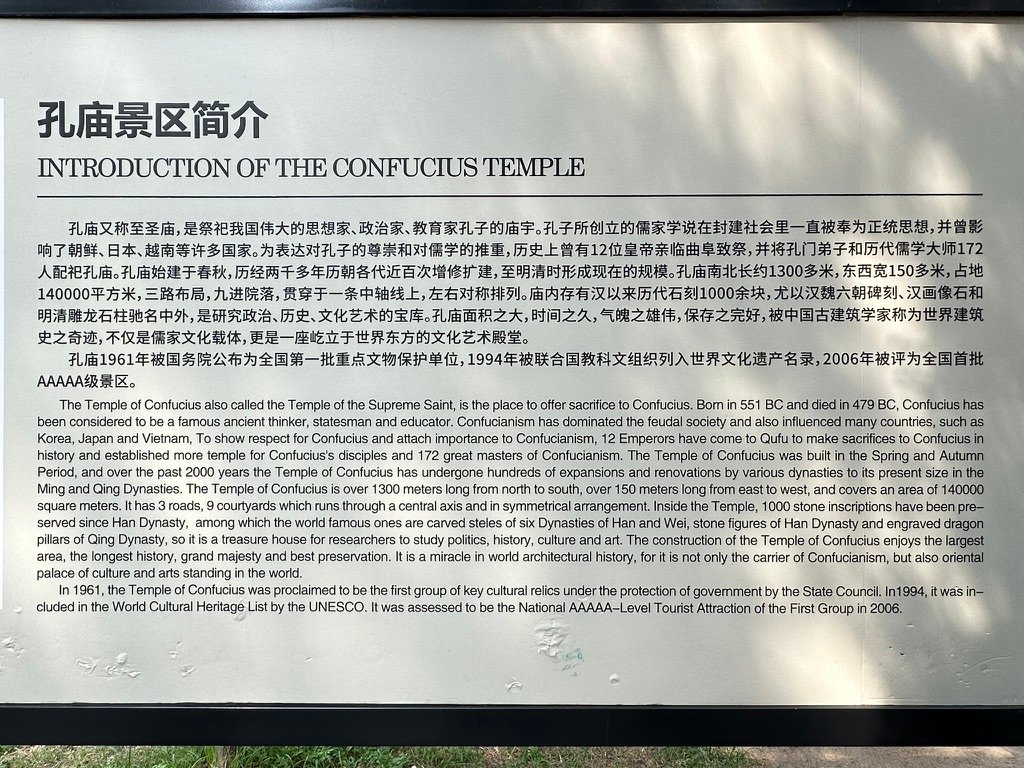
Dad’s Deep China travel tip 🐞: Photograph the information boards at Chinese historical sites—even if you don’t have time to read everything there. Keep them for later. When the Chinese-history bug stings, show the photo to AI for translation, explanation and another possible rabbit hole. Sometimes a quick photo at the site becomes the beginning of a much bigger story.
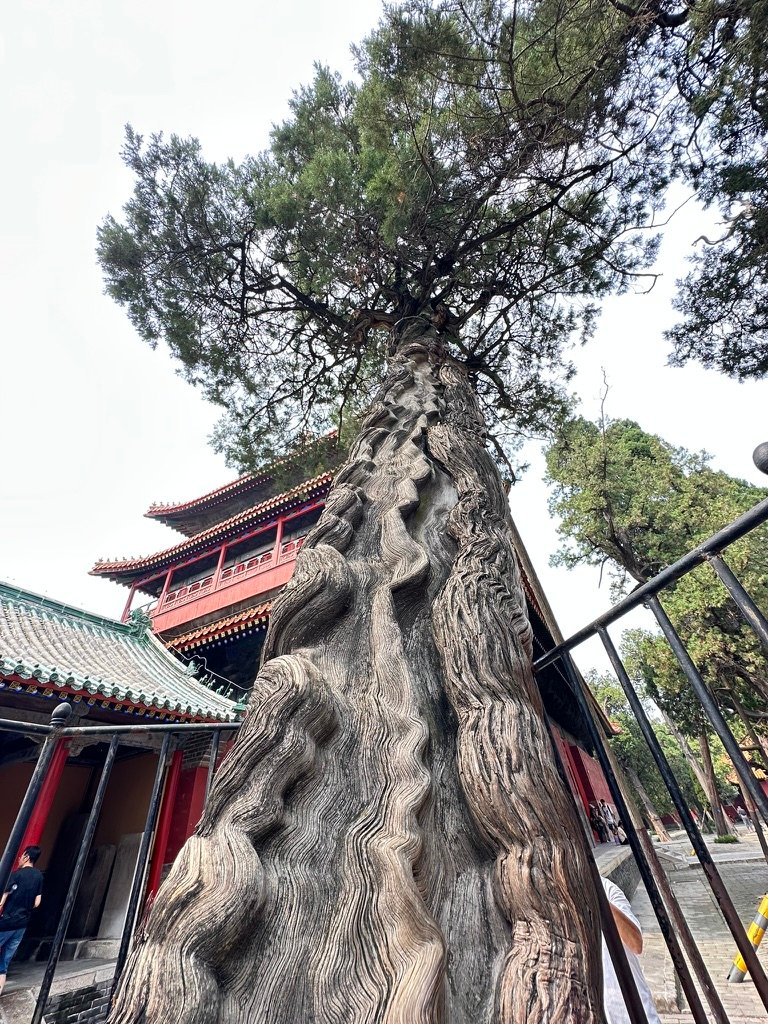
An ancient witness at the Confucius Temple (孔庙, Kǒng Miào). Old cypress trees are part of Qufu’s historical landscape too: generations of visitors, scholars and imperial officials passed beneath trees like these as the temple expanded across successive dynasties. Its deeply weathered trunk is a reminder that at Qufu, history is preserved not only in buildings and stone steles—but also in the living landscape. Photo by Dad.
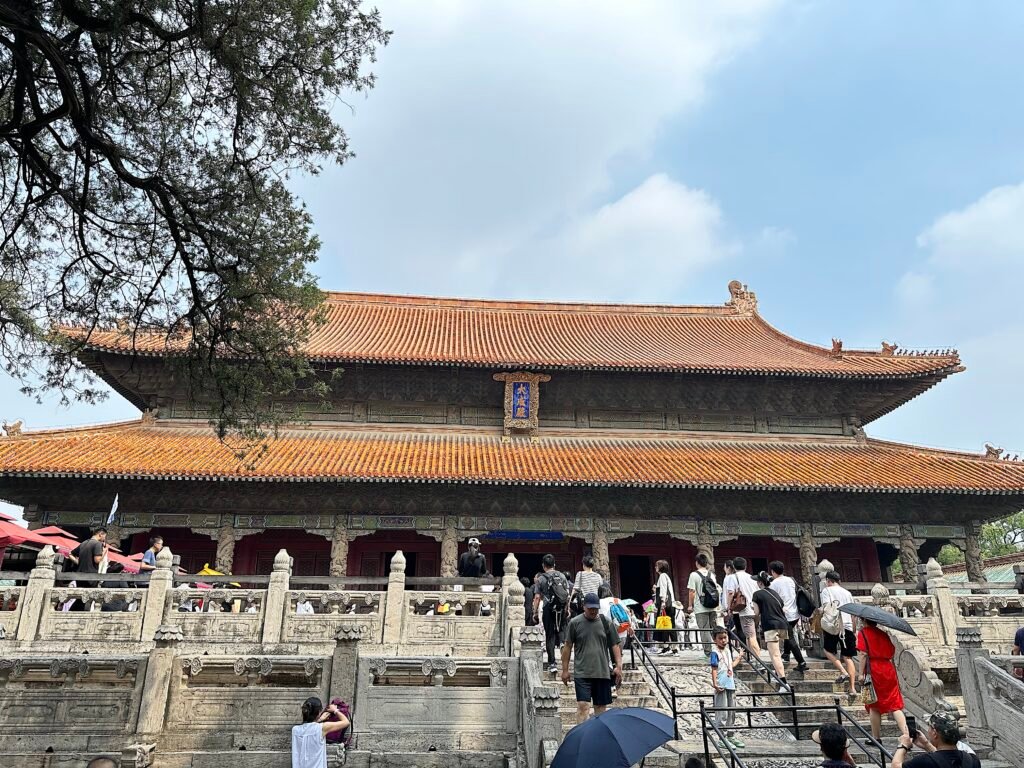
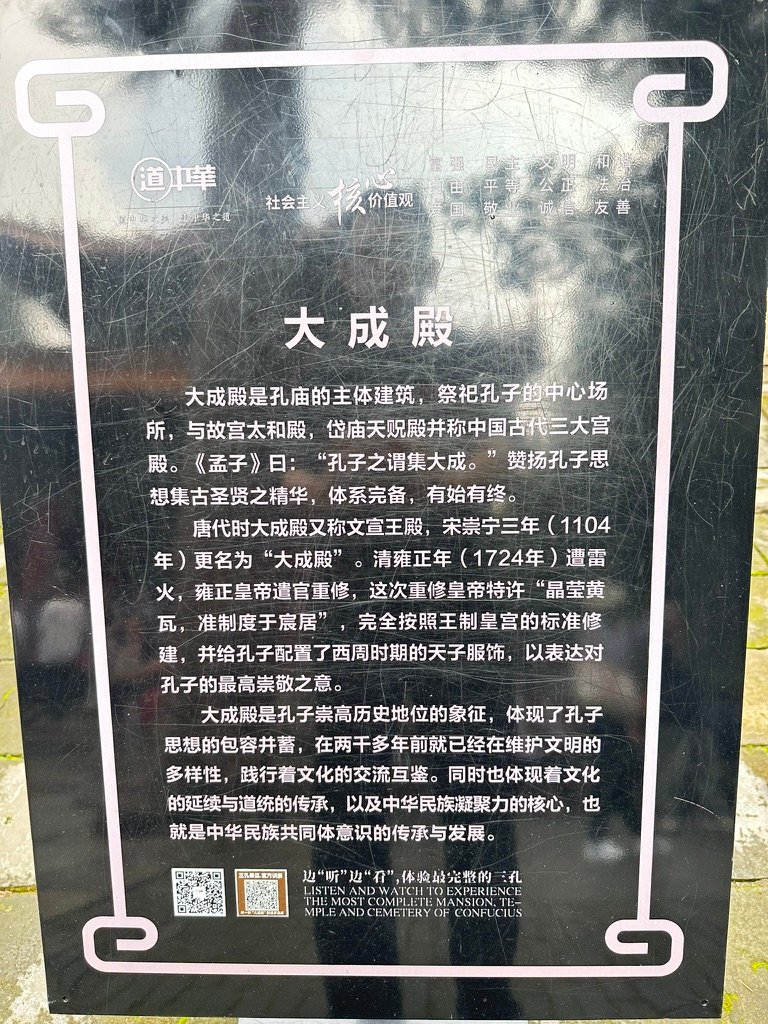
Why does Confucius have an almost imperial hall? Dacheng Hall (大成殿, Dàchéng Diàn) is the ceremonial heart of the Confucius Temple (孔庙) in Qufu (曲阜). After a fire in 1724, the Qing Yongzheng Emperor (雍正帝) ordered it rebuilt to exceptionally prestigious standards, including yellow glazed roof tiles associated with imperial architecture. Even the building itself shows how far Confucius had risen—from an ancient teacher to a figure honored by emperors more than 2,000 years later. Photo by Dad.
庙 — miào
temple / shrine
This became the great ritual complex where Confucius was honored.
孔府 — Kǒngfǔ
Kong Family Mansion
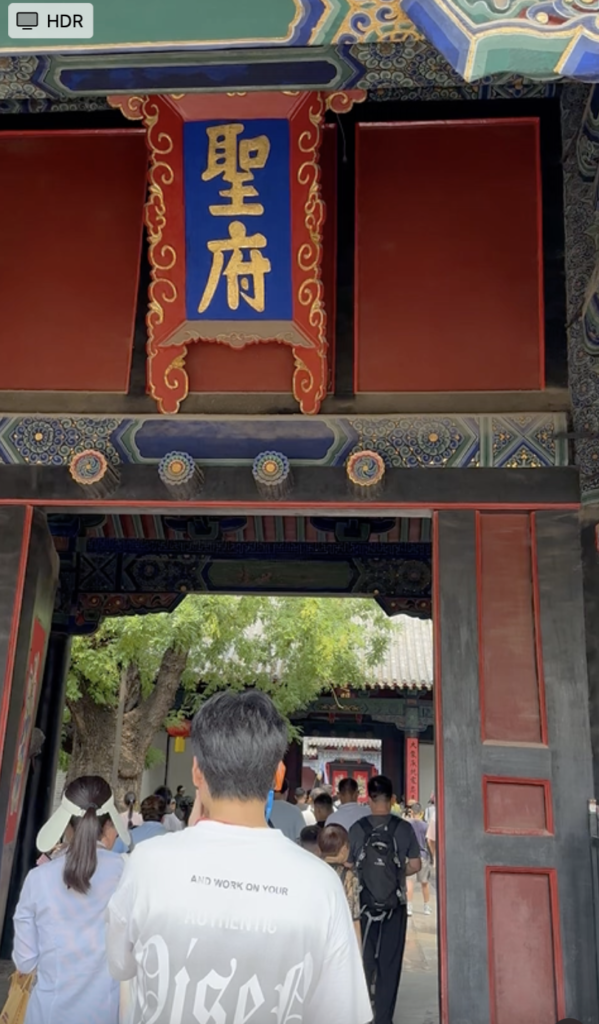
Entering the Kong Family Mansion (孔府, Kǒng Fǔ). The residence beside the Confucius Temple was home to generations of Confucius’s descendants, particularly the hereditary Dukes Yansheng (衍圣公). For centuries, the family occupied a unique position between Confucian tradition and the imperial state—making 孔府 much more than simply Confucius’s “family home.” Photo by Dad.
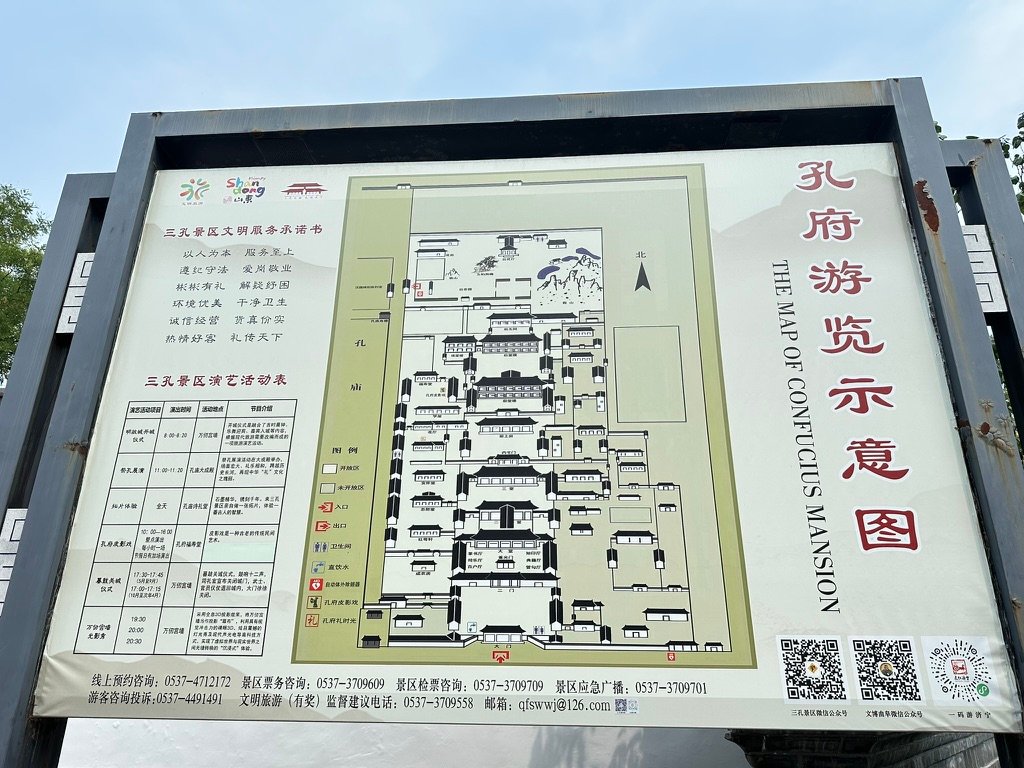
Inside the Kong Family Mansion (孔府, Kǒng Fǔ). This visitor map shows the scale of the historic residence and administrative complex used by generations of Confucius’s descendants. Its courtyards, halls, offices and family quarters reflect the unusual status of the Kong family—guardians of Confucius’s lineage who remained closely connected to China’s imperial system for centuries. Photo by Dad.
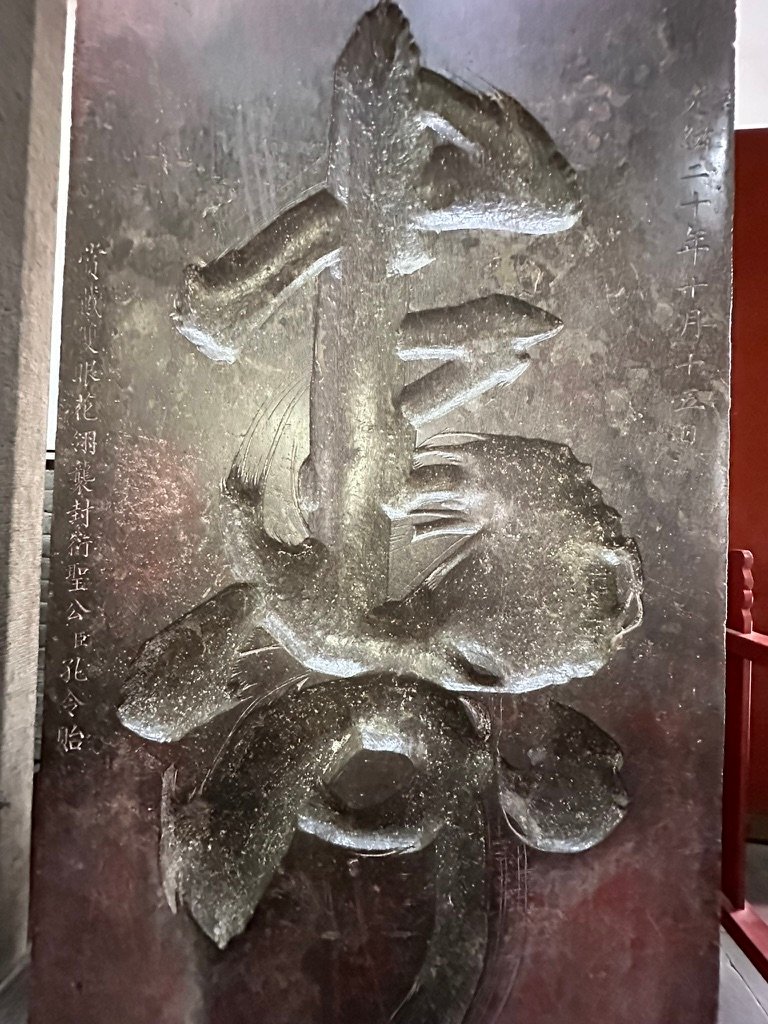
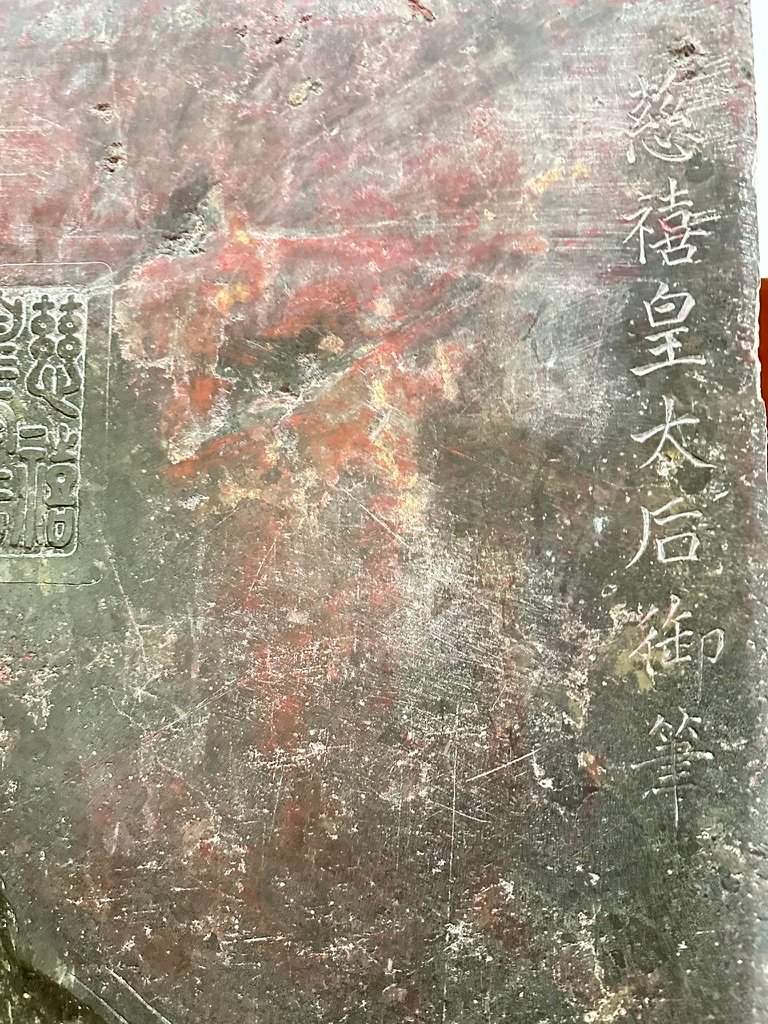
Even Empress Dowager Cixi left her mark in Qufu. In 1894, during celebrations for Cixi’s (慈禧太后) 60th birthday, members of Confucius’s Kong family traveled to Beijing to offer their congratulations. Cixi bestowed handwritten 寿 (shòu, “longevity”) calligraphy on the family, later preserved in stone. The inscription 慈禧皇太后御笔 means “written by the imperial brush of Empress Dowager Cixi.” More than 2,300 years after Confucius, China’s imperial court was still formally honoring his descendants. Photos by Dad.
府 — fǔ
mansion / official residence / administrative residence, depending on context
This was associated with Confucius’s senior-line descendants and the institutional world that grew around them.
孔林 — Kǒnglín
Cemetery of Confucius
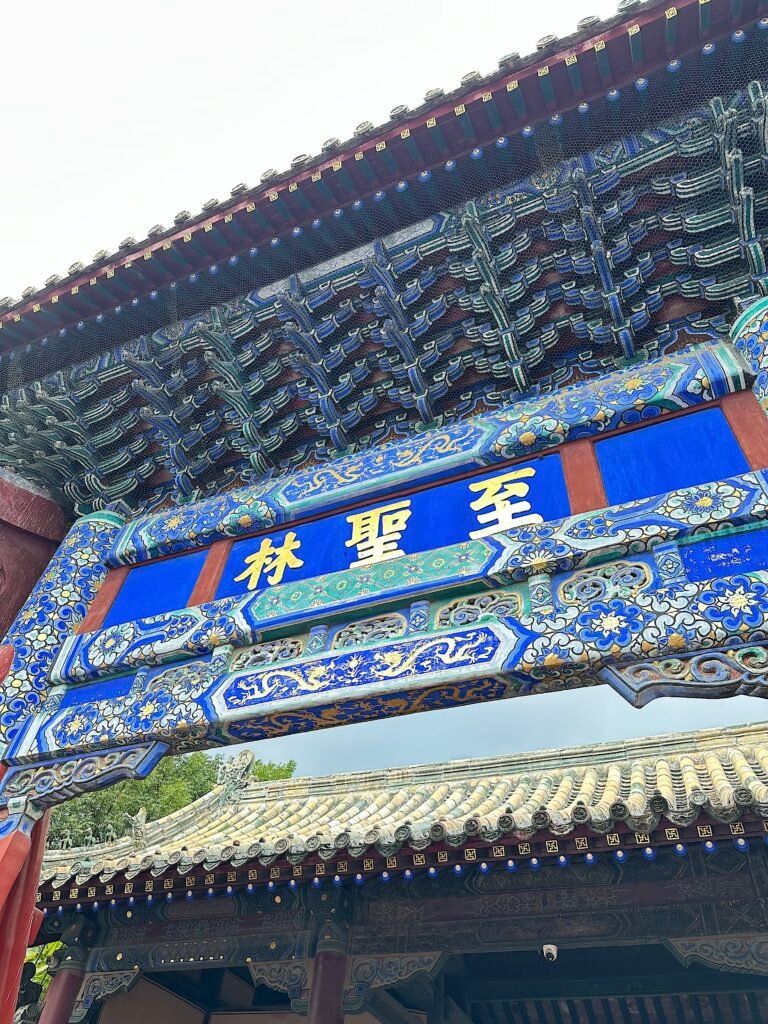
Entering the “Forest of the Ultimate Sage.” The inscription 至圣林 (Zhìshèng Lín) refers to the Confucius Cemetery (孔林, Kǒng Lín), with 至圣 meaning “Ultimate Sage,” an honorific for Confucius (孔子). Confucius and generations of his descendants are buried here. The Kong family (孔氏) genealogy has been recorded for more than 2,500 years and is widely described as the world’s longest continuously documented family lineage—making 孔林 not just a cemetery, but a remarkable physical record of one family’s continuity through Chinese history. Photo by Dad.
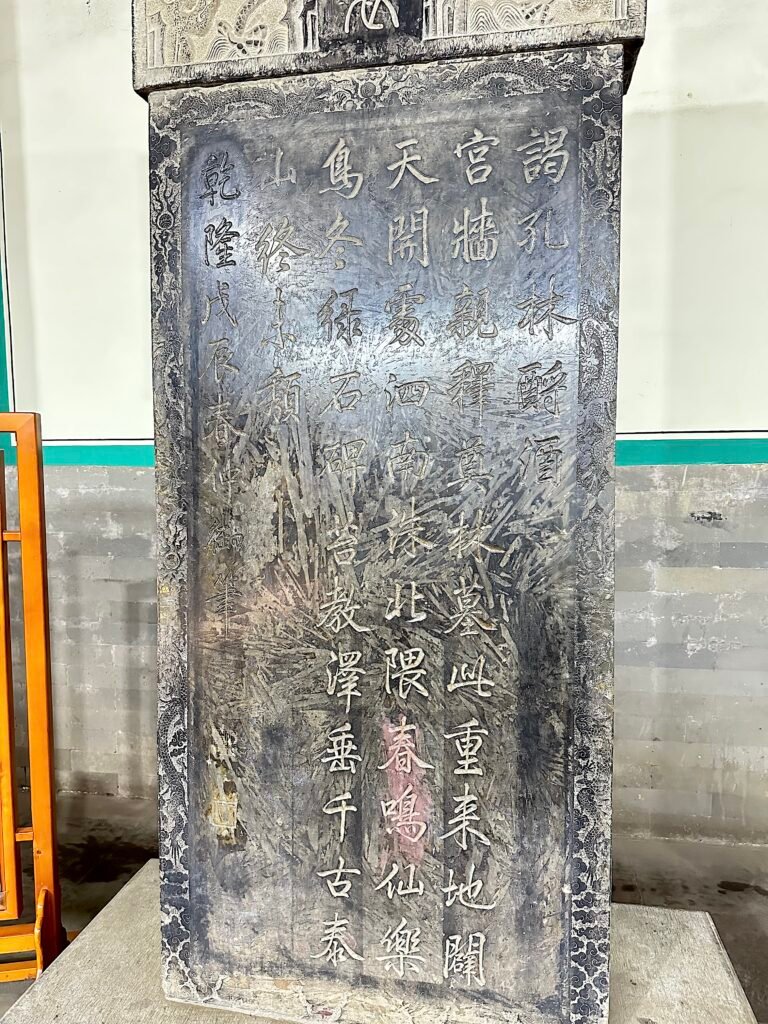
More than 2,000 years later, the emperor was still coming. This Qianlong-era (乾隆) stele records an imperial poem connected with the emperor’s visit to Qufu (曲阜) to honor Confucius (孔子). Its verses evoke the Confucius Cemetery (孔林), Apricot Altar (杏坛), ancient stone monuments, and the Zhu (洙水) and Si (泗水) rivers of Confucius’s homeland. The inscription at left, 乾隆戊辰春御笔, identifies it as written by Qianlong’s “imperial brush.” Photo by Dad.
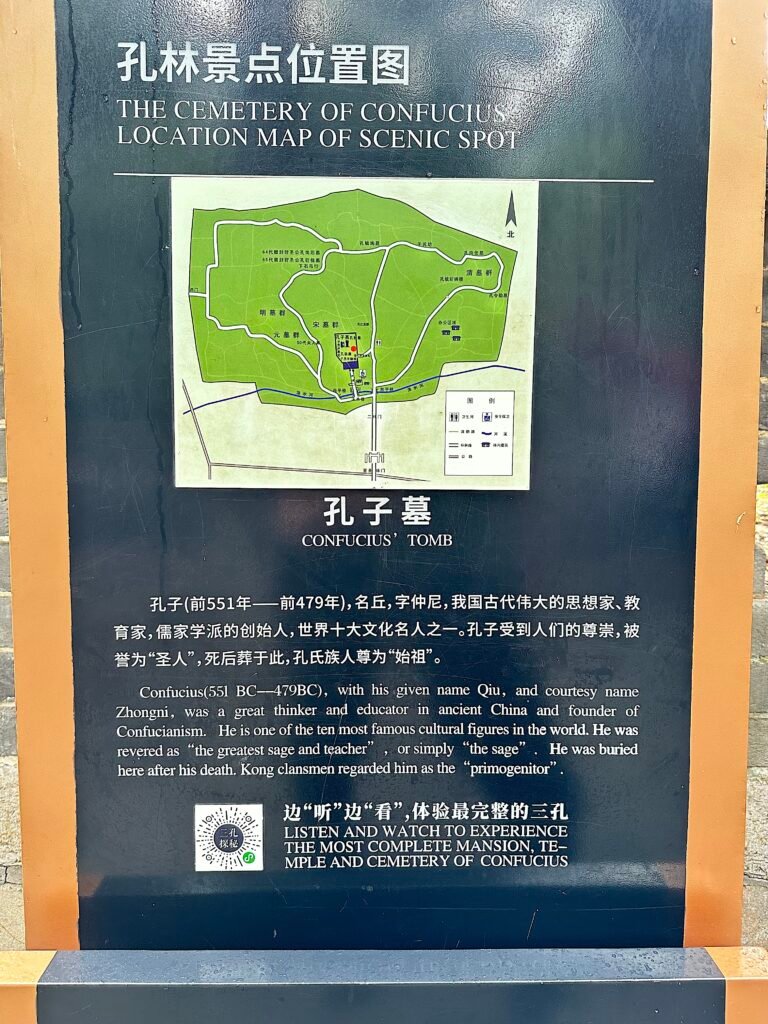
A cemetery that became a historical landscape. This map reveals the extraordinary scale of the Confucius Cemetery (孔林, Kǒng Lín). What began with the burial of Confucius (孔子) in 479 BCE expanded over successive dynasties into a vast wooded burial ground filled with tombs, steles and monuments to members of the Kong clan (孔氏). The map helps explain why visiting 孔林 feels less like seeing a single famous tomb—and more like walking through layers of Chinese history. Photo by Dad.
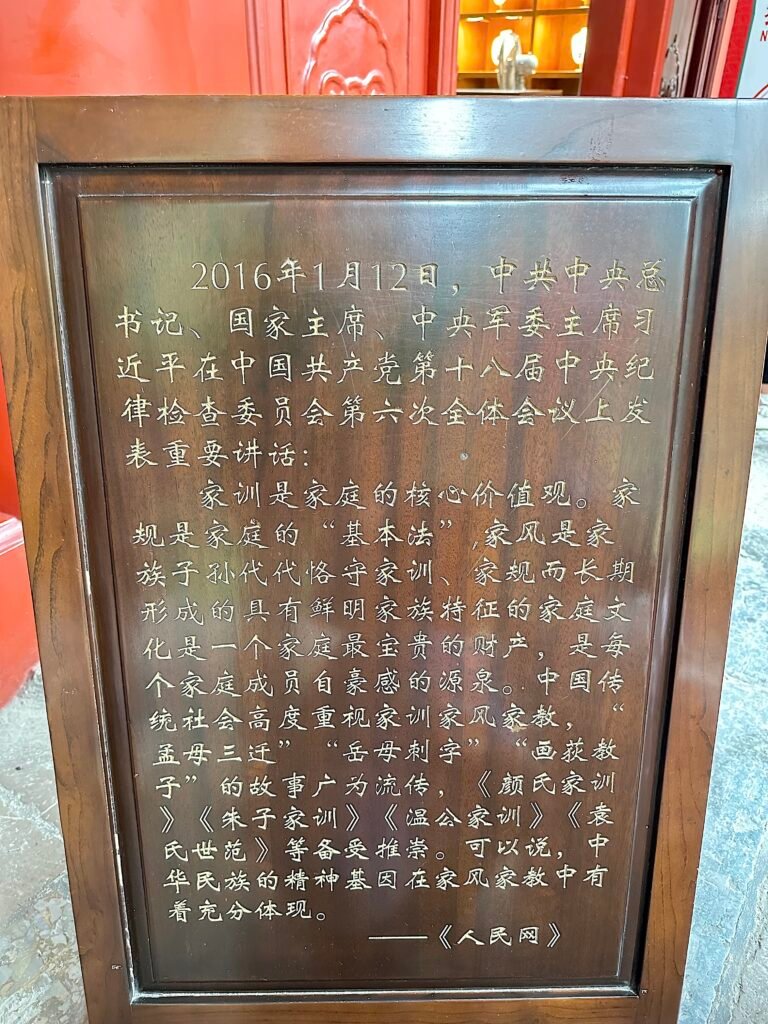
Here is the transcription of the board:
2016年1月12日,中共中央总书记、国家主席、中央军委主席习近平在中国共产党第十八届中央纪律检查委员会第六次全体会议上发表重要讲话:
家训是家庭的核心价值观。家规是家庭的“基本法”,家风是家族子孙代代恪守家训、家规而长期形成的具有鲜明家族特征的家庭文化,是一个家庭最宝贵的财产,是每个家庭成员自豪感的源泉。中国传统社会高度重视家训家风家教,“孟母三迁”“岳母刺字”“画荻教子”的故事广为流传,《颜氏家训》《朱子家训》《温公家训》《袁氏世范》等备受推崇。可以说,中华民族的精神基因在家风家教中有着充分体现。
——《人民网》
English Translation
On January 12, 2016, Xi Jinping, General Secretary of the Communist Party of China Central Committee, President of China, and Chairman of the Central Military Commission, delivered an important speech at the Sixth Plenary Session of the 18th Central Commission for Discipline Inspection of the Communist Party of China:
Family teachings (家训, jiāxùn) are the core values of a family.
Family rules (家规, jiāguī) are the family’s “basic law.”
Family tradition (家风, jiāfēng) is the distinctive family culture gradually formed over generations as descendants consistently observe their family’s teachings and rules. It is a family’s most precious inheritance and a source of pride for every family member.
Traditional Chinese society placed great importance on family teachings, family tradition and family education.
The three historical examples mentioned are:
- 孟母三迁 — Mencius’s mother moved three times to find a good environment for her son’s education.
- 岳母刺字 — Yue Fei’s mother tattooed words of patriotic duty on his back, in the traditional story.
- 画荻教子 — teaching a son by writing with reeds in the sand, traditionally associated with the mother of Song scholar Ouyang Xiu (欧阳修).
And the four family-instruction classics named are 《颜氏家训》, 《朱子家训》, 《温公家训》 and 《袁氏世范》.
That last part is particularly significance for Deep China because the board isn’t only saying “family values matter”—it explicitly connects modern discussion of 家训 / 家规 / 家风 to a long Chinese tradition of family education and written family instructions.
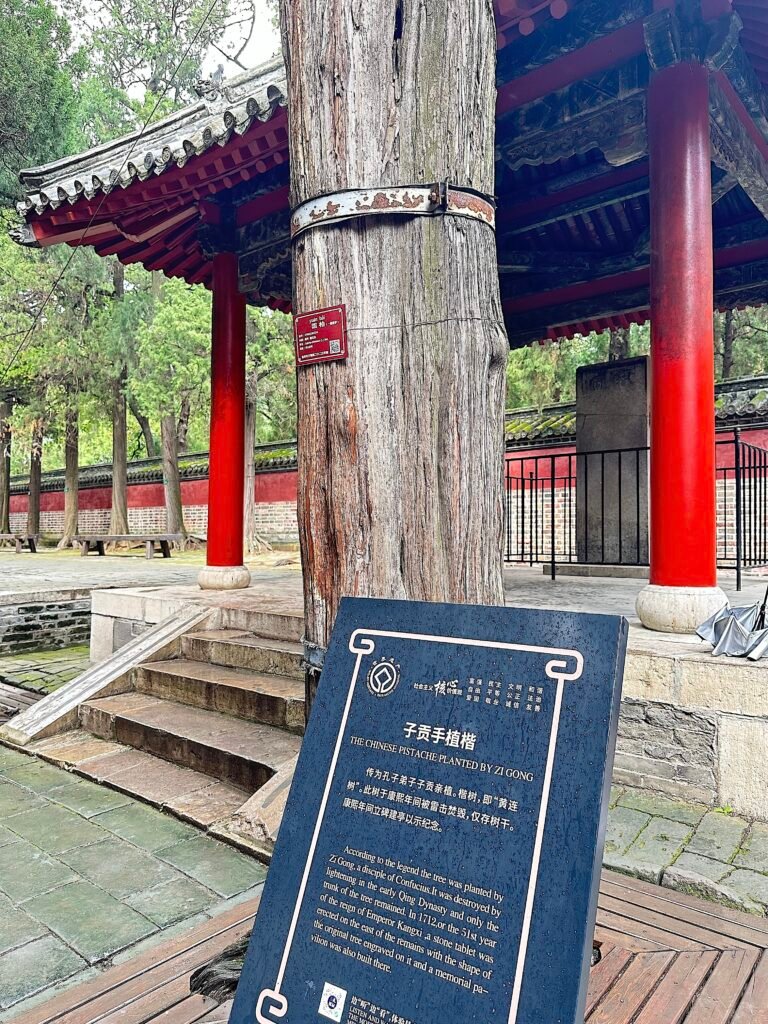
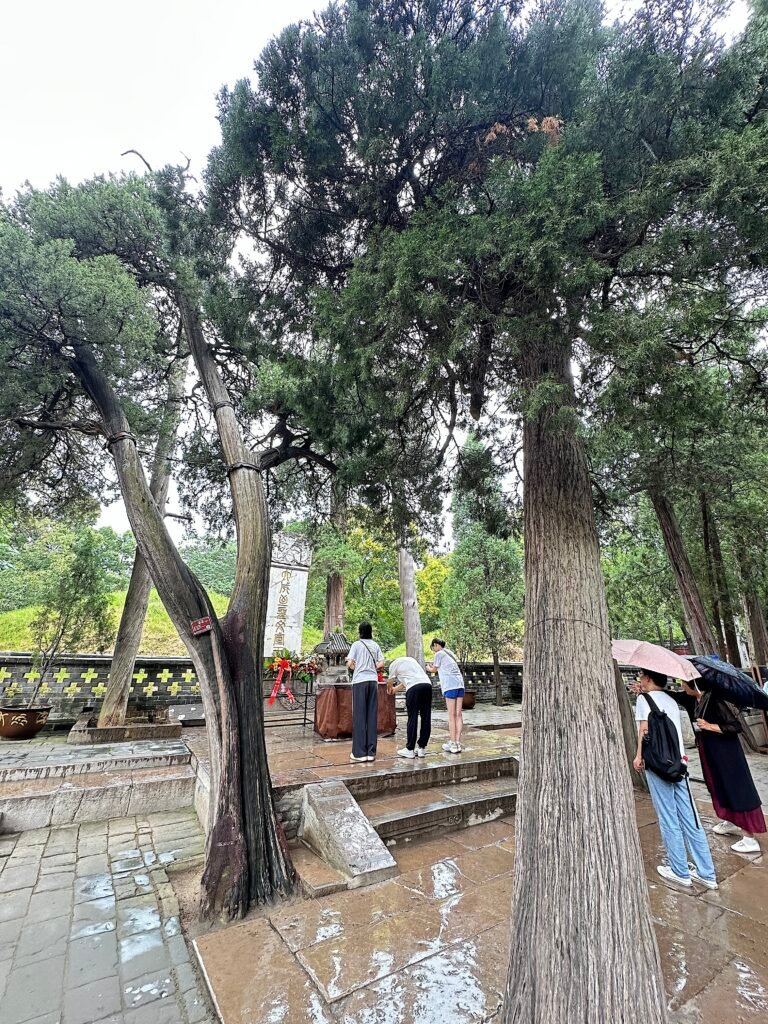
The sign identifies the tree as:
子贡手植楷 — Zǐgòng Shǒuzhí Kǎi
“The Chinese pistache planted by Zigong.”
Zigong (子贡, Zǐgòng) was one of Confucius’s best-known disciples. According to the tradition preserved at Qufu, after Confucius died in 479 BCE, Zigong personally planted a Chinese pistache tree (楷树, kǎishù) beside his teacher’s grave.
There is an even more touching story behind it. Confucius’s disciples are traditionally said to have mourned beside his grave for three years. Zigong remained for another three years, mourning his teacher for a total of six years.
The original ancient tree eventually died. According to the sign, it was destroyed by fire during the early Qing dynasty, leaving only part of the trunk. In 1712, during the Kangxi reign, the surviving trunk was protected and a stone inscription commemorating the tree was erected.
So the enormous weathered trunk Dad photographed is not simply “a very old tree.” It is a preserved memorial associated with the story of a student’s devotion to his teacher.
Why it matters in the Qufu story
There is also a beautiful cultural rabbit hole in the character 楷 (kǎi).
楷 can carry the sense of a model, standard or example—the same character appears in 楷模 (kǎimó), “model/example,” and 楷书 (kǎishū), the standard script of Chinese calligraphy.
Tradition connected Qufu with two symbolic trees:
楷 (kǎi) associated with the devoted disciple Zigong, and 模 (mó) associated in tradition with the Zhougong/Confucian cultural landscape. Together 楷模 came to mean a model worthy of imitation. The precise etymological history behind that popular story needs to be treated cautiously, but the association itself became part of Qufu’s cultural storytelling.
林 — lín
forest / grove
Here you’ll find the burial tradition associated with Confucius and generations of the Kong lineage.
🔥
Three simple characters:
庙 — 府 — 林
Temple.
Mansion.
Cemetery.
That’s enough Chinese to navigate half your Qufu visit.
😂
🌏 And Yes — This Is UNESCO
The:
Temple and Cemetery of Confucius and the Kong Family Mansion in Qufu
were inscribed on the:
UNESCO World Heritage List in 1994.
🔥
UNESCO emphasizes not merely Confucius himself but the extraordinary historical development of these sites across successive dynasties.
And THAT is exactly what we want the first-time traveler to notice.
Qufu isn’t simply:
WHERE CONFUCIUS LIVED.
It is also:
WHAT LATER CHINA DID WITH CONFUCIUS.
🛺 Then We Stayed in Qufu — and Struck Gold
Most travelers come to Qufu for:
三孔 — Sānkǒng
the Three Confucian Sites
孔庙 — Kǒngmiào
Temple of Confucius
孔府 — Kǒngfǔ
Kong Family Mansion
孔林 — Kǒnglín
Cemetery of Confucius
And honestly?
That’s already an excellent Qufu visit.
Dad & Elaine did it properly with a guide.
We could have checked Qufu off the list and moved on.
But we didn’t.
We extended our stay by:
two nights.
🔥
That turned out to be one of the best decisions of the trip.
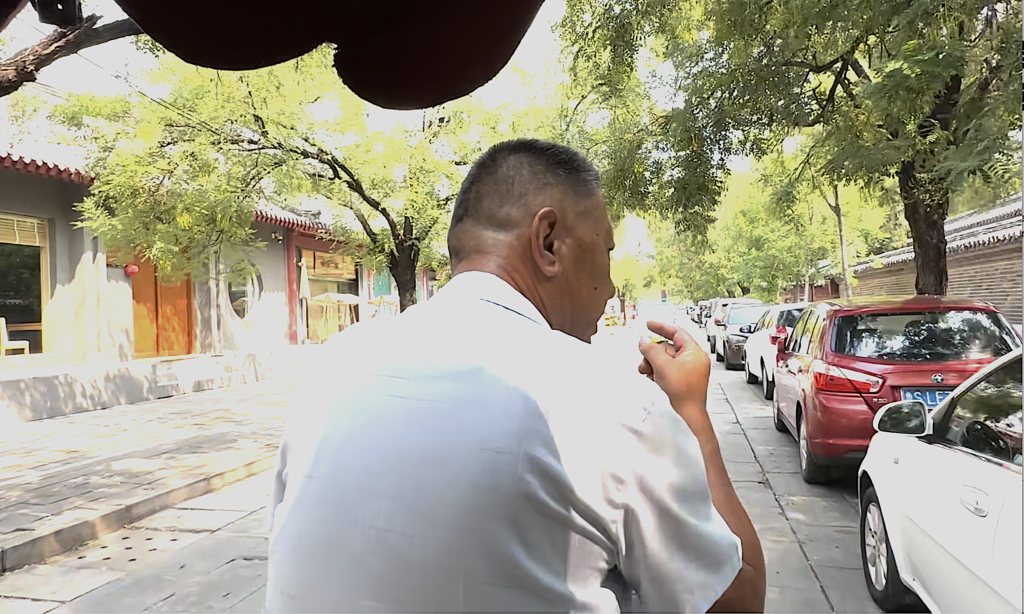
😂 And Our Next “Guide” Was a Local Tricycle Driver
The following day, a local man with a:
tricycle
offered to take us around Qufu.
We told him:
We’ve already visited 三孔.
Basically:
“We’ve done Qufu.”
😂
He knew better.
He told us there were other places.
Among them:
Yan Hui Temple (颜庙, Yán Miào)
and:
Zhougong Temple (周公庙, Zhōugōng Miào).
Dad & Elaine went.
And…
WE STRUCK GOLD.
🔥🔥🔥
Because Qufu suddenly stopped being:
CONFUCIUS’S HOMETOWN
and became:
a map of how Confucian memory was constructed across more than two thousand years.
🐇
🐇 Rabbit 1 — Who Was Yan Hui 颜回?
At:
颜庙 — Yán Miào
Temple of Yan Hui
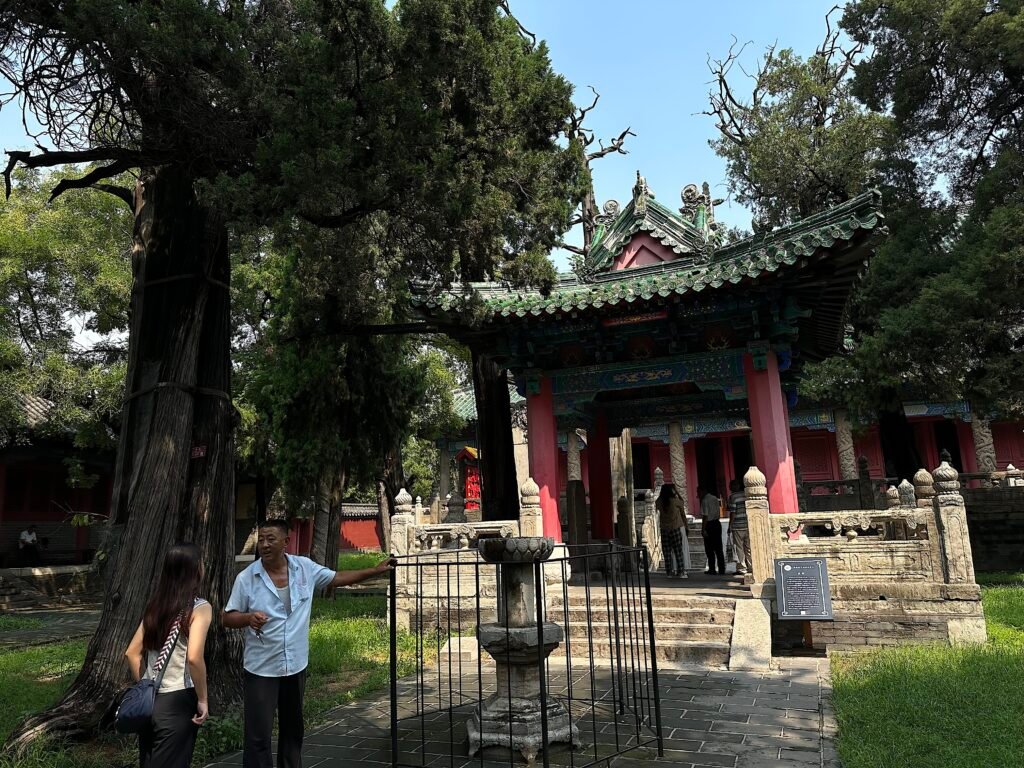
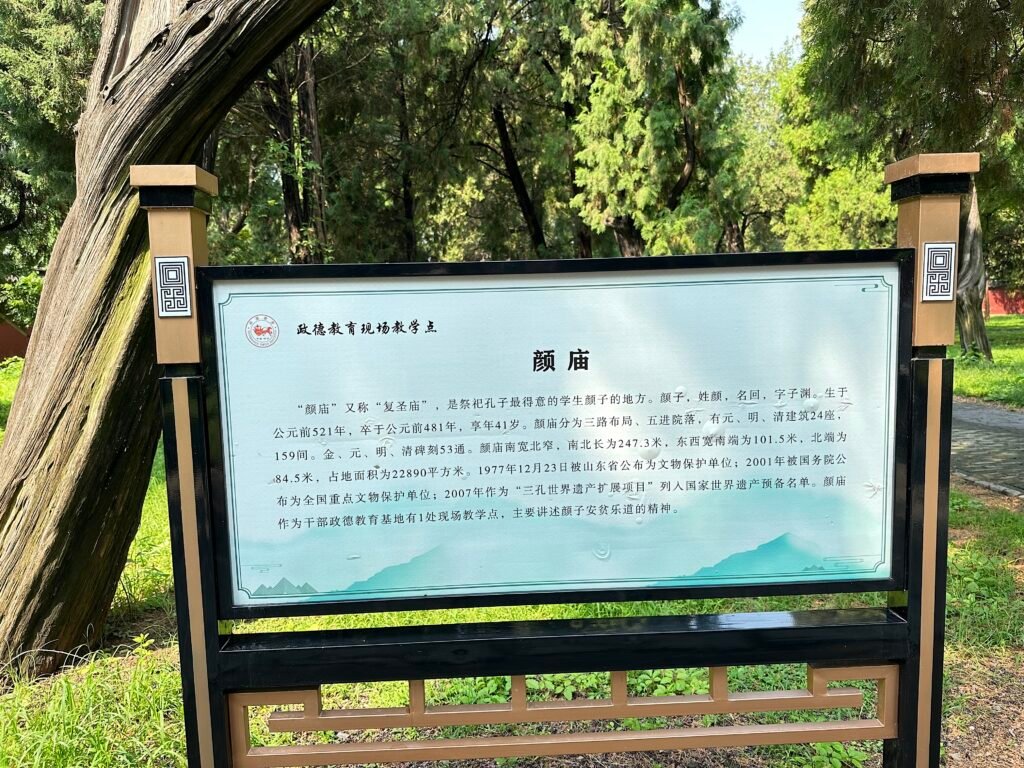
Confucius’s favorite student has his own temple in Qufu. Yan Temple (颜庙, Yán Miào), also known as Fusheng Temple (复圣庙, “Temple of the Second Sage”), honors Yan Hui (颜回), the disciple Confucius admired deeply. Yan Hui died at just 41 and became remembered for 安贫乐道 (ānpín lèdào)—安贫, being content despite material poverty; 乐道, finding joy in following the Way (道, dào) and living by one’s principles. More than 2,000 years later, this Confucian ideal of finding fulfillment in learning and moral character rather than wealth is still taught here. Photo by Dad.
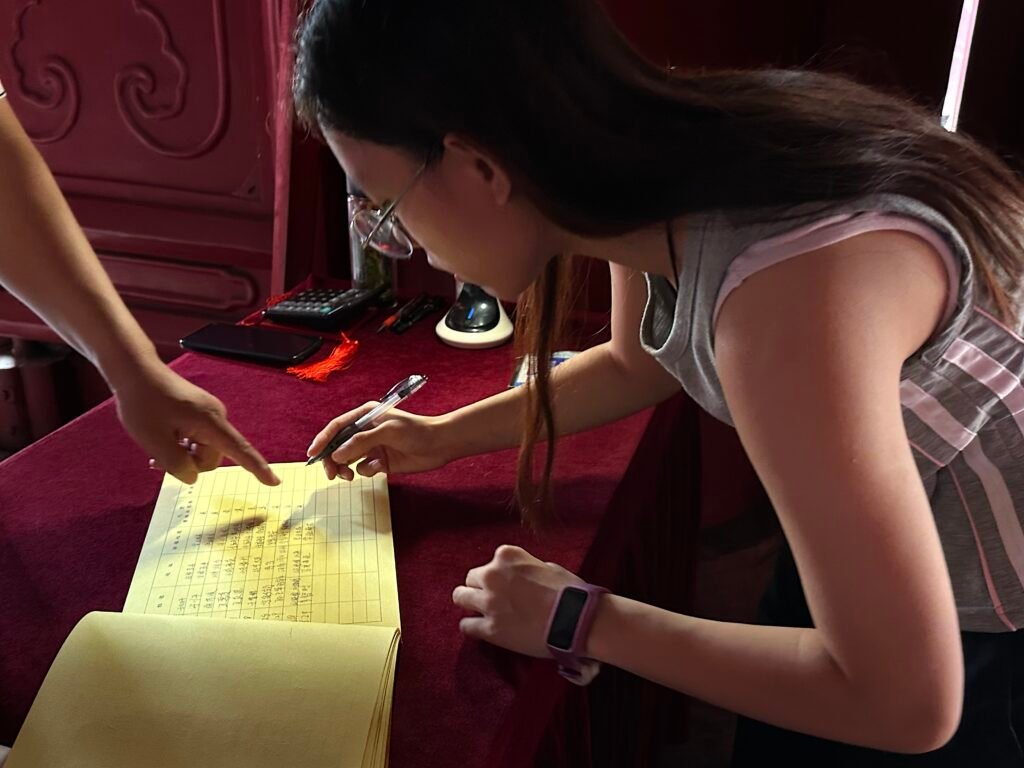
Elaine adds her own few lines to the guest book at Yan Hui Temple (颜庙). After Dad spent the morning telling her to “read the stones,” she ended up leaving some writing of her own. 😂 Photo by Dad.
we encountered another name:
颜回 — Yán Huí.
If you’re a first-time Western traveler, you may reasonably respond:
Who?
😂
Perfect.
Yan Hui was one of Confucius’s most celebrated disciples.
The site information describes the temple as a place for commemorating and offering rites to:
颜子 — Yánzǐ
and identifies him as:
复圣 — Fùshèng.
That title is important.
圣 — shèng
sage / sacred, depending on context
Confucius came to be honored as:
至圣 — Zhìshèng
the Supreme Sage
while Yan Hui was honored as:
复圣 — Fùshèng
traditionally rendered “the Continuing Sage” or “Second Sage”
🔥
Now Qufu gives us a completely different question:
How does a teacher’s intellectual tradition survive after the teacher dies?
Not through:
ONE MAN.
Through:
STUDENTS.
↓
TEXTS.
↓
INTERPRETERS.
↓
INSTITUTIONS.
↓
GENERATIONS.
🐇
🪨 And the Stones Appear Again
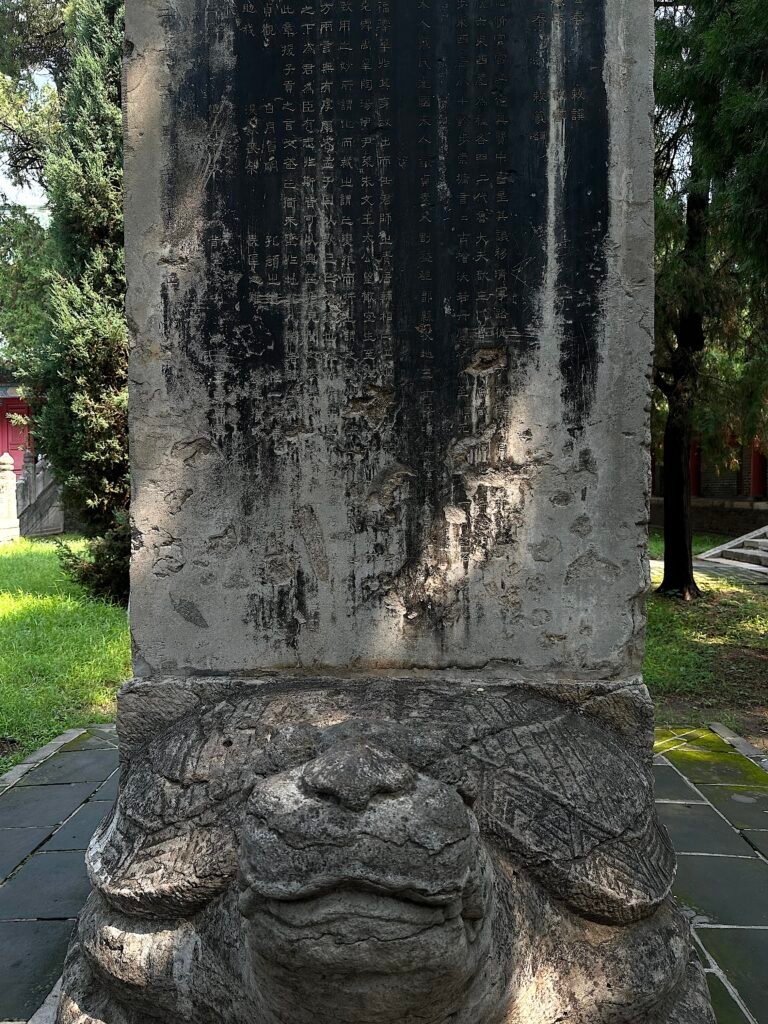
🐞 Explanation Note — Why is a Mongol-era stele honoring a Confucian scholar?
This enormous stele at Yan Temple (颜庙) dates to the Yuan dynasty (元朝), when China was ruled by the Mongols. It commemorates imperial recognition and rebuilding of the temple dedicated to Yan Hui (颜回), Confucius’s beloved disciple, who had lived nearly 1,800 years earlier.
That raises a bigger Deep China question: why would non-Han rulers honor Chinese Confucian figures?
Conquering China was one thing; governing it was another. Patronage of Confucian institutions helped Yuan rulers engage with established Chinese traditions of education, political order and legitimacy. Similar patterns would later appear under the Manchu-led Qing dynasty (清朝).
The giant creature carrying the stone is a 赑屃 (bìxì), a dragon-tortoise associated with strength and commonly used to support important steles.
Dad’s tip: when you see a bìxì in China, look up. The stone on its back may be carrying a much bigger historical story.
At Yan Hui Temple we found:
steles — 碑 (bēi).
Some heavily weathered.
Some carrying inscriptions from later dynasties.
Some standing on enormous carved stone tortoise-like bases.
🔥
And now Dad’s rule becomes:
DON’T ASK ONLY WHO YAN HUI WAS.
Ask:
Who kept remembering him?
Who rebuilt this temple?
Who erected these steles?
Which dynasty?
Why did they still care?
Suddenly:
MEMORY
has:
a chronology.
🐇 Rabbit 2 — Then We Went to Zhougong Temple 周公庙
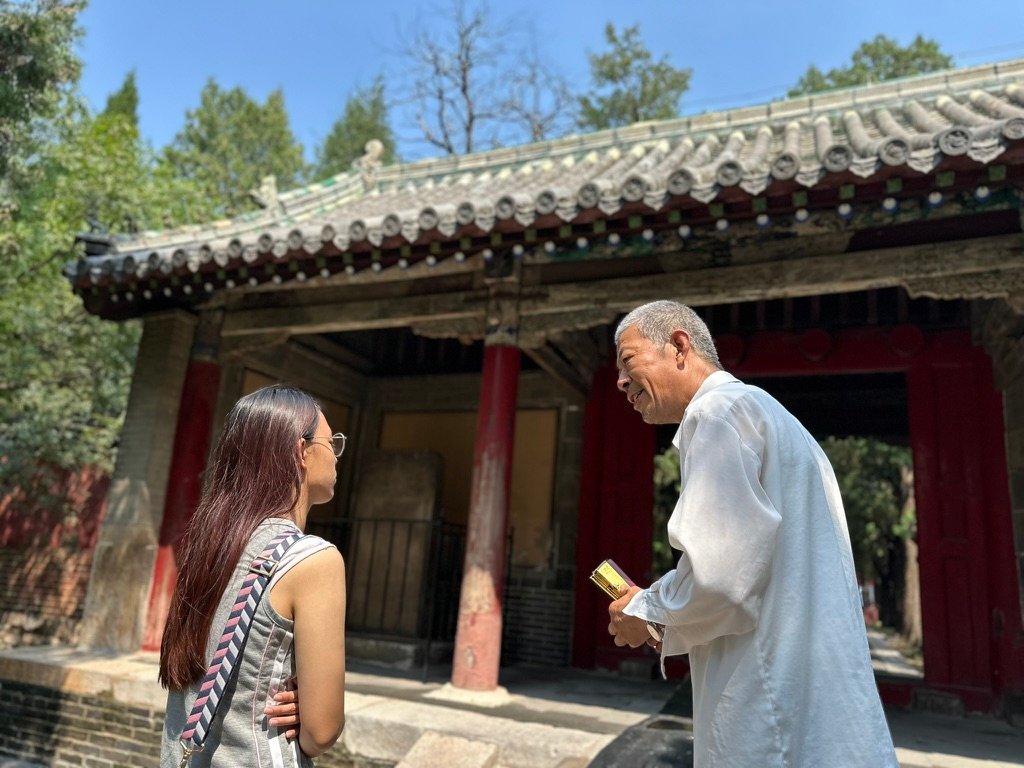
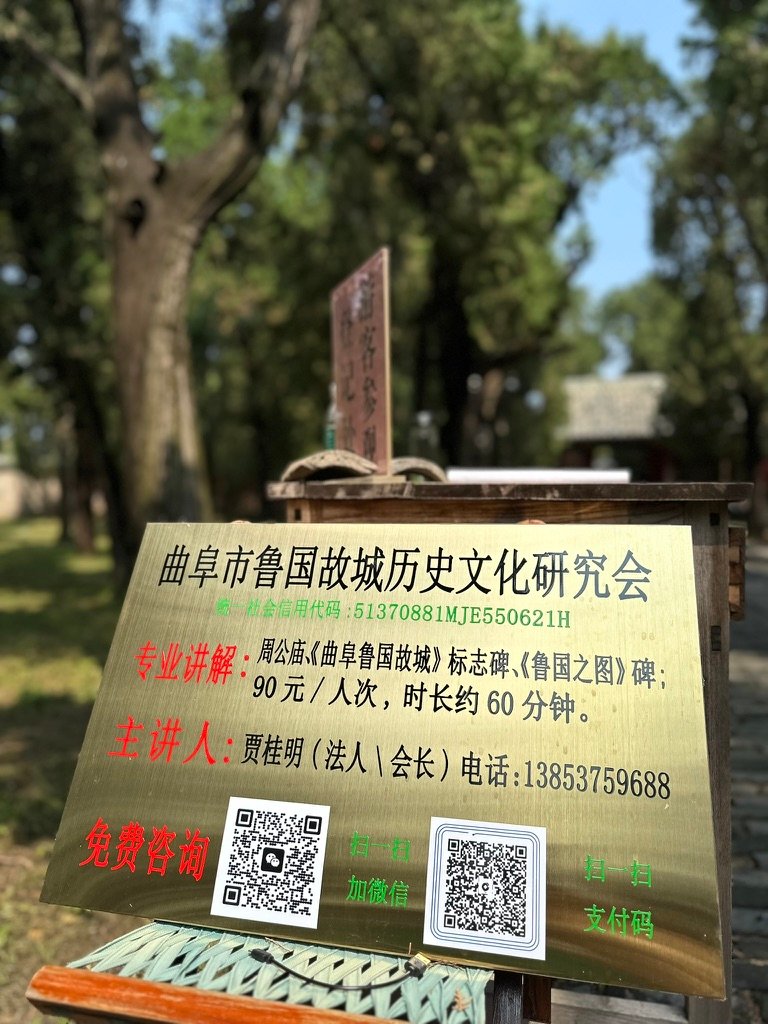
Best ¥90 rabbit hole in Qufu? 😂 This was the interpretation fee charged by the local history specialist at Zhougong Temple (周公庙): about an hour exploring the temple and important steles connected with ancient Lu (鲁国). We came for “one more site” and walked out with another layer of Chinese history. Photo by Dad.
And this rabbit ran:
BACKWARD.
Way backward.
😂
Because:
Duke of Zhou (周公, Zhōugōng)
lived centuries:
BEFORE Confucius.
The main hall at the temple is:
元圣殿 — Yuánshèng Diàn.
The information board at the site explains that the hall is the principal building of Zhougong Temple and the central place for rites honoring the Duke of Zhou.
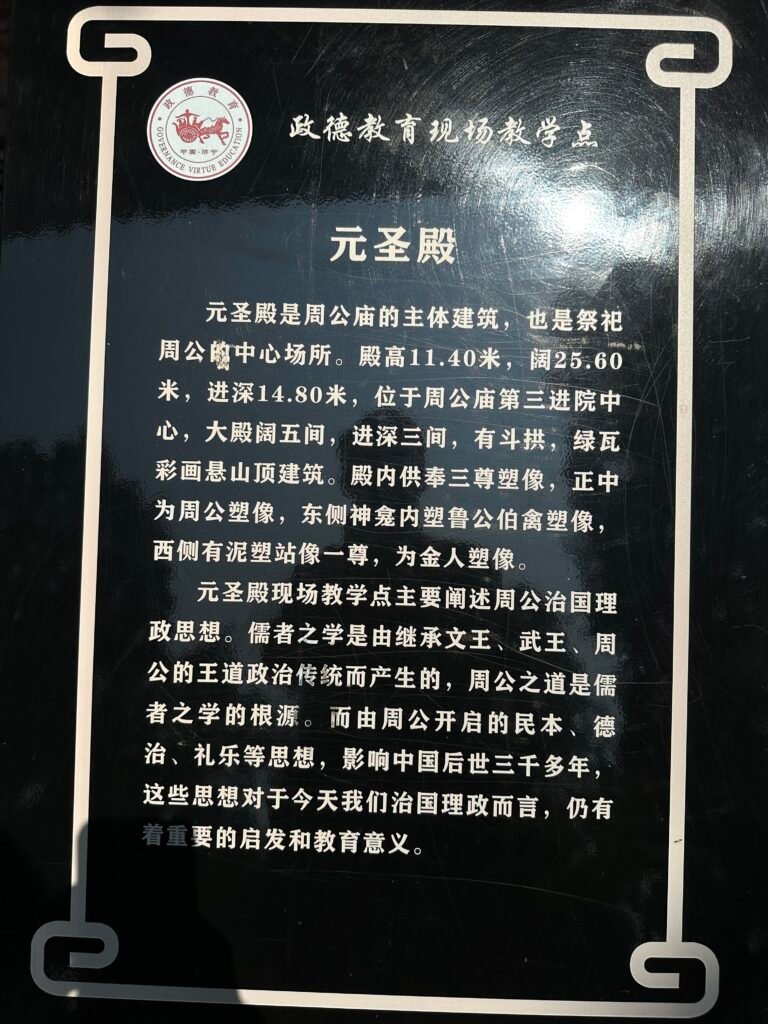
Another Qufu rabbit hole. 🐇 At Yuansheng Hall (元圣殿) in Zhougong Temple (周公庙), the explanation points backward from Confucius to King Wen 文王, King Wu 武王 and the Duke of Zhou 周公. The key idea: Confucian political and ritual thought did not begin in a vacuum—Confucius looked back admiringly to an idealized Zhou order, especially its traditions of 德 (dé, virtue) and 礼 (lǐ, ritual/propriety). Suddenly our journey went Confucius → Lu → Duke of Zhou → early Zhou. 🐇🔥 Photo by Dad.
Then comes the really important part.
The board explicitly connects:
Confucian learning (儒者之学)
with political traditions inherited from:
King Wen (文王),
King Wu (武王)
and:
the Duke of Zhou (周公).
😳🔥
Now Dad’s coat rack explodes.
🧠 Wait — Confucius Was Looking BACK Too?
Exactly.
Confucius didn’t appear in an intellectual vacuum and announce:
“I’ve invented Chinese civilization.”
😂
He looked backward toward an idealized Zhou political and ritual order.
One of our most important Chinese words at Qufu is:
礼 — lǐ
ritual / propriety / norms of appropriate conduct
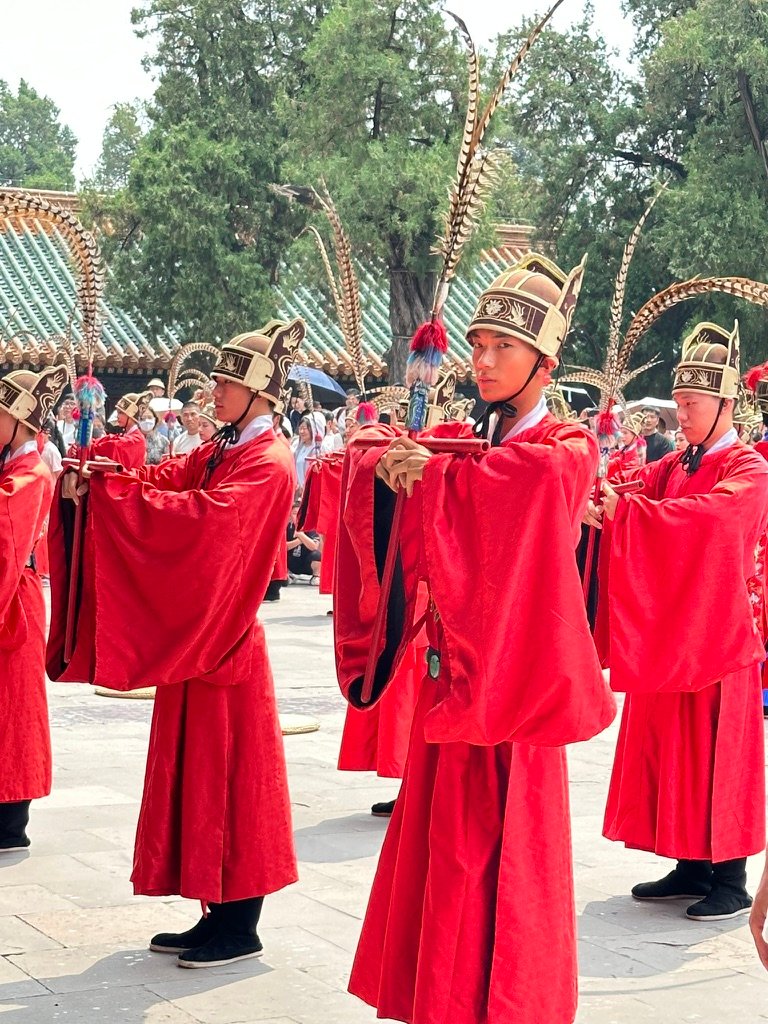
What does 礼 (lǐ) actually look like? A ceremonial performance at the Temple of Confucius in Qufu gives visitors a vivid visual doorway into the world of 礼 — ritual, propriety and ordered conduct that became so important in the Confucian tradition. The costumes and choreography are modern presentation, but the bigger idea is ancient: ritual was not merely ceremony—it helped express relationships, hierarchy and social order. Photo by Dad.
And the Zhou world became enormously important in later Confucian understandings of:
political order
and:
ritual civilization.
So our historical direction changes:
CONFUCIUS 孔子
↓
looks backward toward:
ZHOU 周
↓
including:
DUKE OF ZHOU 周公.
🔥
🐇 And Now Qufu Has a Timeline
Look at what our two extra nights uncovered.
周公 — Duke of Zhou
comes:
BEFORE Confucius.
↓
孔子 — Confucius
↓
颜回 — Yan Hui
the disciple
↓
later generations of:
Confucian scholars
↓
later:
dynasties
↓
temples
↓
steles
↓
ritual commemoration.
😳
That’s not:
one historical moment.
It’s:
A TRADITION BEING BUILT ACROSS TIME.
🐇 Wait… Haven’t Dad & Elaine Met 周公 Somewhere Else?
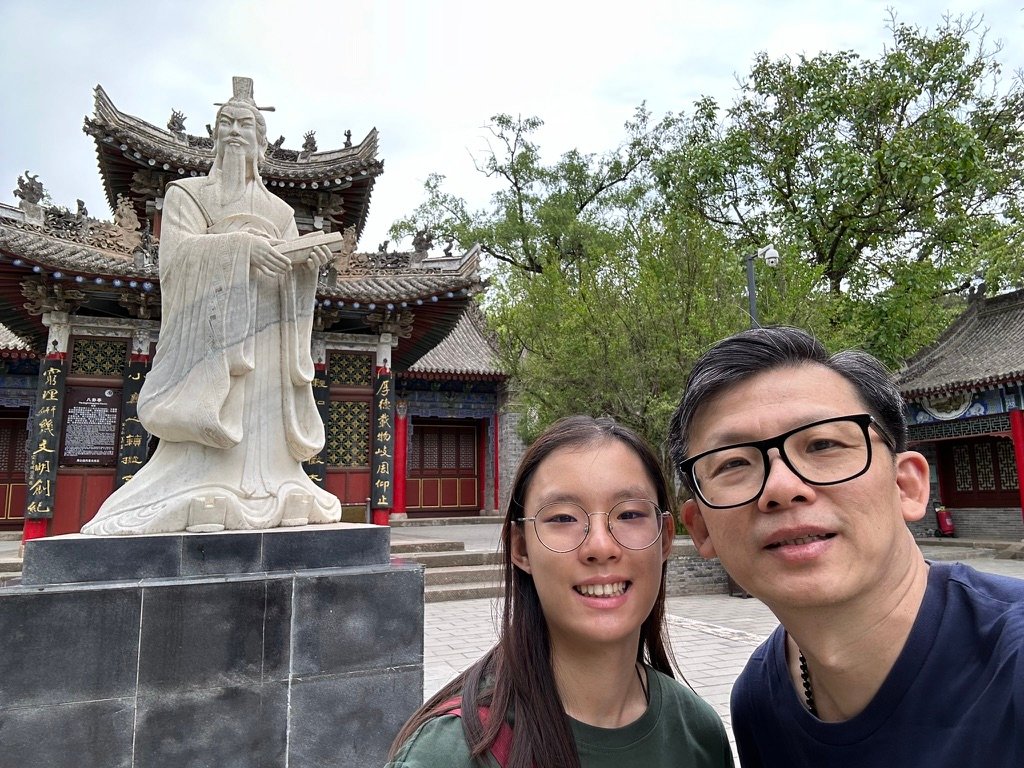
Wait… haven’t we met 周公 before? 🐇 Dad & Elaine had already followed the Duke of Zhou to Zhouyuan (周原) in Shaanxi. Finding him again in Qufu suddenly connected two journeys — and opened another Deep China rabbit hole. Photo by Dad.
Dad looked at:
周公 — Zhōugōng
the Duke of Zhou
and something felt familiar.
😂
Wait.
Haven’t we followed this rabbit before?
Yes.
But not in Shandong.
Dad & Elaine had already traveled to:
Zhouyuan (周原, Zhōuyuán)
in:
Shaanxi (陕西, Shǎnxī).
🔥
And suddenly two journeys connected.
QUFU 曲阜
gives us the later memory of:
周公 — Duke of Zhou
and his place in traditions surrounding:
鲁 — Lu
礼 — lǐ
and eventually:
孔子 — Confucius.
But:
ZHOUYUAN 周原
takes us back toward the historical heartland of:
Western Zhou (西周, Xī Zhōu)
itself.
So the rabbit runs:
曲阜 Qufu
↓
周公 Duke of Zhou
↓
西周 Western Zhou
↓
周原 Zhouyuan
↓
SHAANXI!
🐇💨
One temple in Shandong has just reopened a journey Dad & Elaine had already made hundreds of kilometers away.
And that’s exactly why Deep China keeps getting into trouble.
😂
One place remembers the history.
Another place takes you closer to where that history began.
🐇 Follow this rabbit:
Deep China: Zhouyuan – Beyond Xi’an: Qishan 岐山 & Zhouyuan 周原— Walking Through the Homeland of the Zhou 周
And just like that…
our Qufu rabbit escaped Shandong.
👑 And NOW the Imperial Steles Become Much More Interesting
Look at those stones again.
Different rulers.
Different dynasties.
Different centuries.
Yet rulers continued to:
repair,
commemorate,
honor
and:
inscribe
places associated with these ancient figures.
🔥
Now Dad’s Political Science question becomes unavoidable:
Why would later rulers spend political and ritual capital honoring people who had been dead for centuries?
And it gets even more interesting when some of those rulers belonged to dynasties founded by peoples from beyond earlier Chinese political frontiers.
Think:
Yuan (元朝)
and:
Qing (清朝).
Mongol rulers.
Manchu rulers.
Yet they too governed through, engaged with and patronized institutions embedded in China’s existing political and cultural traditions.
🐇
🌶️ Dad’s Political Science Handrail: Winning China Isn’t the Same as Governing China
Conquest gives you:
THE THRONE.
It doesn’t automatically give you:
LEGITIMACY.
Nor does it instantly give you:
administrative institutions,
educated officials,
ritual language,
historical continuity
or:
acceptance.
🔥
A conquering dynasty inherits:
a political civilization already full of memory.
So rulers interact with it.
Use it.
Patronize it.
Sometimes reshape it.
And eventually…
it reshapes them too.
😳
That’s why these old Qufu stones are politically interesting.
🪨 The Building Tells You WHO Was Honored
But:
THE STELE TELLS YOU WHO KEPT HONORING THEM.
🔥🔥🔥
That’s the line Dad wants Elaine to remember.
A temple may say:
周公.
Another:
颜回.
But when you start reading:
碑文 — bēiwén
stele inscriptions
you begin discovering:
WHO came later.
And:
WHY they wanted their relationship with the past carved into stone.
Now the stele isn’t:
decoration.
It is:
political evidence.
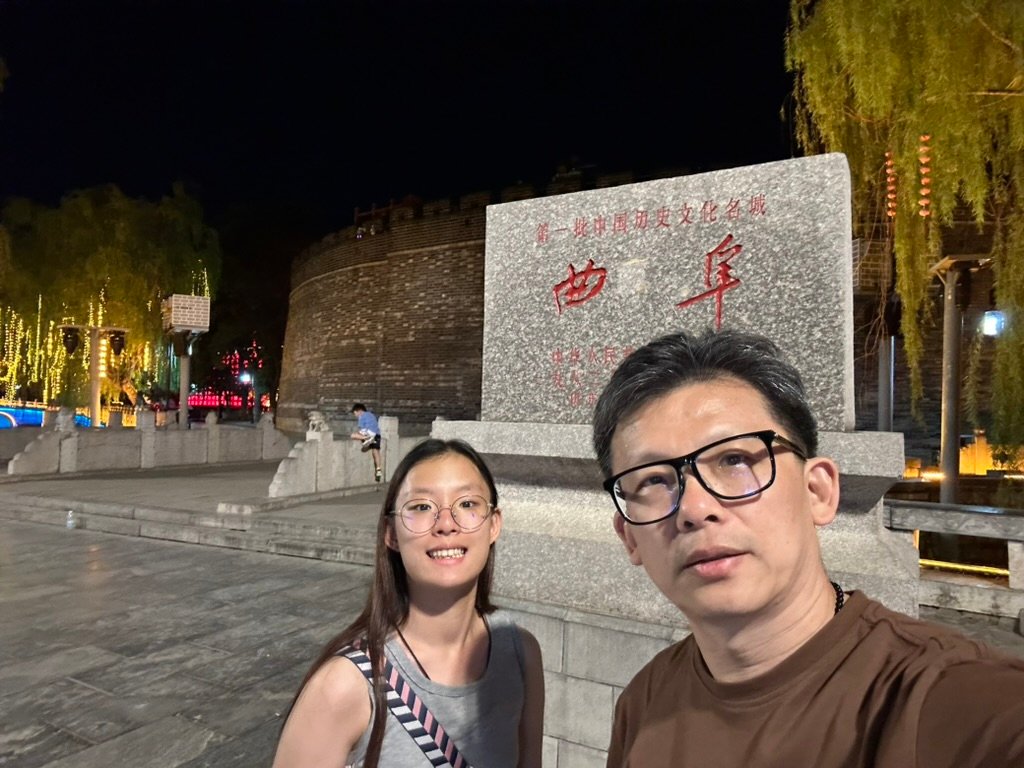
🐞 The Two Nights That Changed Qufu
This is why Dad is so glad we didn’t leave immediately after:
三孔.
If we had…
our Qufu story might have been:
CONFUCIUS.
Very important.
Very interesting.
But incomplete.
Instead, a local tricycle driver told us:
There are other places.
😂🔥
And those “other places” gave us:
DUKE OF ZHOU
↓
CONFUCIUS
↓
YAN HUI
↓
CONFUCIAN TRADITION
↓
IMPERIAL PATRONAGE
↓
POLITICAL LEGITIMACY
↓
WHO IS “CHINESE”?
🐇🐇🐇
We thought we’d extended Qufu by:
two nights.
Actually…
we extended the historical timeline by about two thousand years!!
😂🔥
🐞 Dad’s New Qufu Rule
If you have only one day:
visit 三孔.
Absolutely.
But if you’re a Deep China traveler:
STAY.
Look beyond the famous three.
Ask a local.
Look at the stones.
Learn:
周公
孔子
颜回.
Then ask:
How does an idea survive for 2,000 years?
That’s when Qufu stops being:
the hometown of Confucius
and becomes:
a laboratory for understanding how Chinese cultural and political traditions were transmitted across dynasties.
🐇🔥

🍚 Western Handrail: Ancient Institutional Database
No.
The steles are not literally:
blockchain.
😂
And they’re not literally:
Big Data.
But for a Western beginner, here’s the handrail:
Imagine successive governments leaving:
dated institutional records
in a public ceremonial landscape.
One dynasty adds something.
Another dynasty restores something.
Another emperor grants a title.
Another official records an event.
🔥
Entry after entry.
Century after century.
Stone after stone.
Now the steles become:
a historical database you can walk through.
That’s much closer to what Dad wants you to see.
🐇 And Something Strange Happens
Dynasties come and go.
Han (汉)
↓
Tang (唐)
↓
Song (宋)
↓
Yuan (元)
↓
Ming (明)
↓
Qing (清).
Different ruling houses.
Different political worlds.
Yet:
Confucius remains.
😳
Emperors continue honoring him.
Temples continue being maintained.
Rituals continue.
His descendants receive institutional recognition.
His teachings remain embedded in elite education.
🔥
So our original question:
“What did Confucius teach?”
has produced a more political question:
Why did rulers find Confucius useful?
🐇
Now Dad’s Political Science rabbit has entered Qufu.
😂
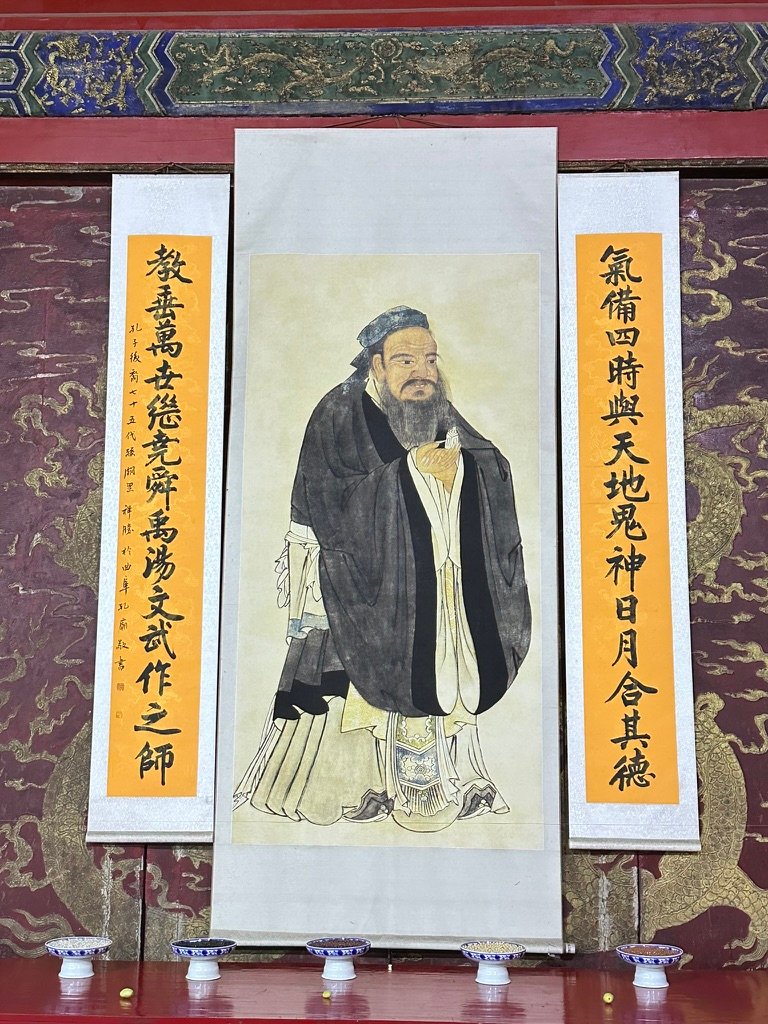
👑 Ideas Can Become Institutions
This may be the most important concept in Section 1.
Confucius began as:
a teacher (老师 / 师, lǎoshī / shī).
His ideas were transmitted and interpreted.
↓
Scholars studied them.
↓
States incorporated Confucian texts and ideas into education and political culture.
↓
Later imperial examinations drew heavily upon a Confucian textual tradition.
↓
Scholar-officials carried that learning into government.
🔥
So:
IDEA
can become:
EDUCATION
which can become:
INSTITUTION
which can become:
GOVERNMENT.
😳
Now Qufu is no longer simply:
“birthplace of famous Chinese philosopher.”
It is a doorway into:
how ideas helped shape institutions.
Another Useful Word: 儒家
Western travelers say:
Confucianism.
In Chinese you’ll encounter:
儒家 — Rújiā
and:
儒学 — Rúxué.
Beginner Chinese:
儒 — rú
associated with the learned / Confucian tradition
家 — jiā
school / tradition here, though normally also “family/home”
So:
儒家
Confucian school / tradition
And:
学 — xué
learning / study
So:
儒学
Confucian learning
🔥
These are much more useful words at Qufu than memorizing:
Confucianism = philosophy.
Because what developed around Confucius eventually touched:
education
ethics
family
ritual
and:
government.
🌶️ But Don’t Say “Confucius Ruled China for 2,000 Years”
😂
No.
Another Deep China guardrail.
There was no single unchanged thing called:
“Confucianism”
running China identically from Confucius to the Qing.
Ideas changed.
Texts were interpreted differently.
Different schools emerged.
Different dynasties emphasized different things.
Other traditions—including:
Daoism (道教 / 道家)
and:
Buddhism (佛教)
also profoundly shaped Chinese life.
🔥
So the better story is:
Confucian traditions became extraordinarily influential within Chinese education, political thought, social ethics and state institutions—but they evolved across different historical periods.
Continuity:
AND
change.
Our favorite combination again.
🐇 Then Qufu Gives Us an Even Stranger Question
Remember Michelin after-dinner Conversation 2?
Who Is “Chinese”?
We encountered:
Xianbei (鲜卑),
Khitan (契丹),
Mongols (蒙古),
and:
Manchus (满洲).
Some of these peoples established dynasties ruling substantial parts—or eventually all—of China.
Now look at Qufu.
Later rulers whose origins lay beyond earlier Han Chinese political frontiers also participated in the institutional and ritual world surrounding:
Confucius.
😳
So:
Why would a conquering ruler honor the teacher of the society he conquered?
🔥🔥🔥
Don’t answer yet.
That’s Section 2.

🐞 That’s the First Sting
You came to:
Qufu (曲阜)
thinking:
“This is Confucius’s hometown.”
Correct.
But then:
孔子 — Confucius
↓
仁 — humaneness
↓
礼 — ritual/propriety
↓
孝 — filial respect
↓
学 — learning
↓
儒家 — Confucian tradition
↓
孔庙 — Temple
↓
孔府 — Mansion
↓
孔林 — Cemetery
↓
碑 — steles
↓
emperors
↓
education
↓
institutions
↓
government.
😬
And suddenly the real Qufu question isn’t:
“Who was Confucius?”
It’s:
“How did Confucius become an institution?”
🔥
Because Confucius died in:
479 BCE.
Yet more than two thousand years later, rulers were still:
honoring him.
Why?
🐇
And when we follow that question in Section 2, something even stranger will happen.
Confucius will eventually:
escape China.
🐇🌏😬
Dad & Elaine found him again…
in:
Hanoi, Vietnam.
😂🔥
Section 2 — How Did a Teacher Become an Institution — and Then Escape China?
Confucius:
孔子 — Kǒngzǐ
died in:
479 BCE.
He never saw:
Qin imperial China,
Han bureaucracy,
Tang Chang’an,
Song scholar-official culture,
Mongol Yuan,
Ming Beijing
or:
Manchu Qing.
😂
Yet rulers and educated elites living centuries after his death kept returning to:
Confucius.
His texts were studied.
His ideas were reinterpreted.
Temples honored him.
His descendants received recognition.
And the landscape of:
Qufu (曲阜, Qūfù)
kept accumulating:
stone after stone.
🔥
So perhaps the most interesting thing to look for in Qufu isn’t:
Confucius himself.
It’s:
what later generations built around him.
🪨 Read the Stones — They’re the Historical Trail
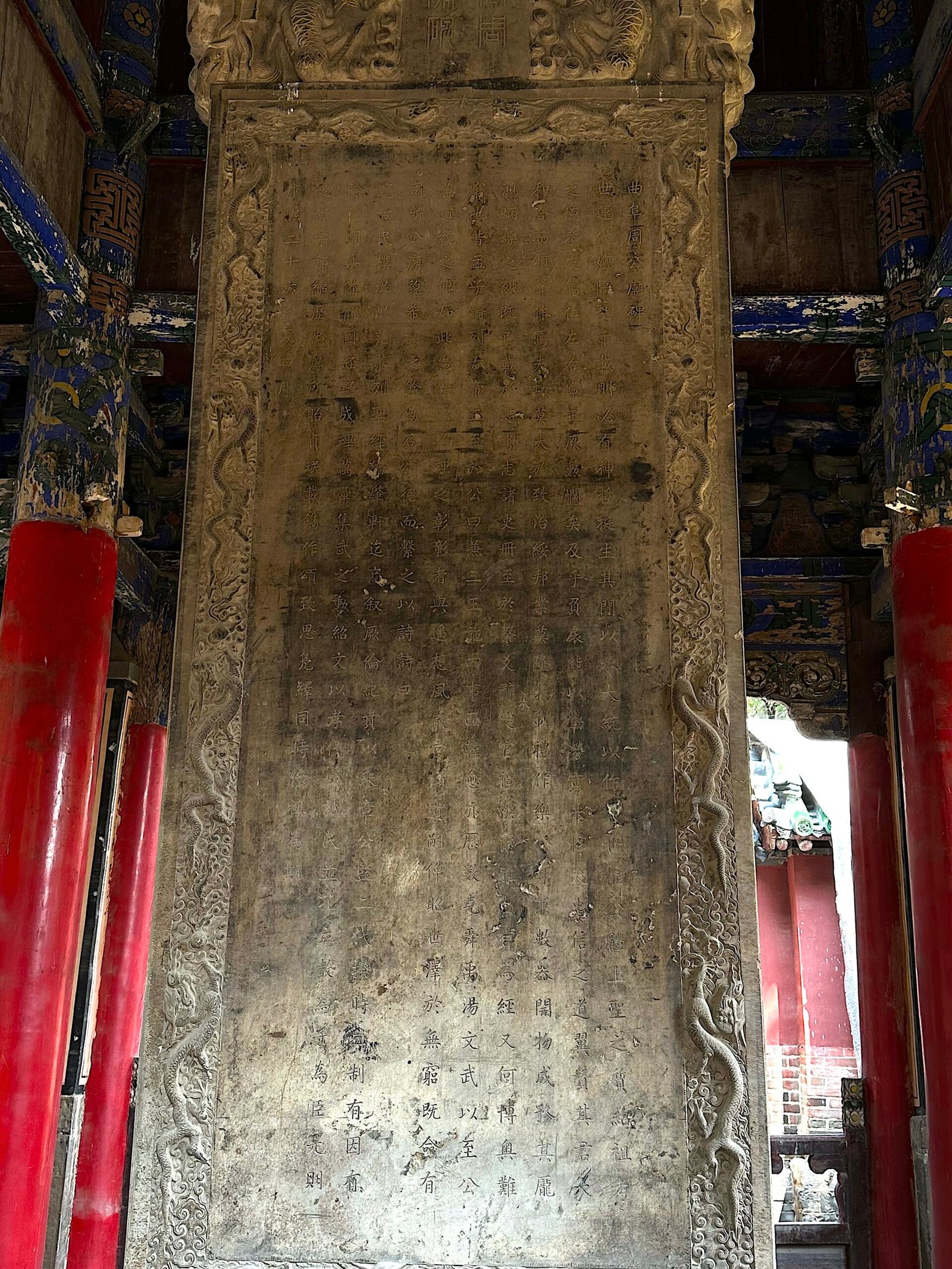
Remember our useful Chinese:
碑 — bēi
stele
碑文 — bēiwén
stele inscription
石碑 — shíbēi
stone stele
When Dad & Elaine visited Qufu, the local specialist spent time explaining these historical layers—particularly to Elaine.
At first, a Western traveler might see:
Stone.
Chinese characters.
Another stone.
Even more Chinese characters.
😭😂
But once somebody explains what you’re looking at, the stones become:
TIME MARKERS.
Different periods left different records.
Different rulers added honors.
Buildings were restored.
Titles changed.
Rituals continued.
🔥
Qufu becomes a place where:
later China kept writing comments on Confucius.
🍚 Western Handrail: A 2,000-Year Institutional Database
No.
It isn’t literally:
blockchain.
😂
But the analogy helps.
Imagine an institution keeping important public records across centuries.
One government adds an entry.
Another confirms something.
Another rebuilds the site.
Another grants an honorific title.
Another records a ritual.
Now make many of those records:
STONE.
🔥
Qufu’s steles help us see something that a simple dynasty timeline hides:
dynasties changed — institutions and memories could continue across them.
That’s a much bigger idea.
👑 Why Would Emperors Care About an Ancient Teacher?
Now we reach the Political Science question.
😂
Suppose you’re an emperor.
You need:
officials (官员, guānyuán),
administrators,
educated elites,
local governance,
ritual order
and:
political legitimacy.
An empire cannot be governed by:
the emperor personally doing everything.
Michelin Course 3 already taught us that at the:
Forbidden City (故宫, Gùgōng).
The emperor needs:
people who can govern.
🔥
And that brings us toward one of imperial China’s most important social groups.
📚 Meet the Scholar-Officials
You’ll often encounter the English expression:
scholar-official.
Useful Chinese terms include:
士 — shì
scholar / educated elite, depending on historical context
and:
士大夫 — shìdàfū
scholar-official / literati elite, especially in later historical contexts
🔥
These weren’t simply:
people who liked reading books.
Educated elites could serve within government, administer territory, participate in political culture and transmit ideas about proper rule.
So now:
LEARNING
starts connecting with:
POWER.
🐇
📝 Then Come the Imperial Examinations
Another essential Chinese term:
科举 — kējǔ
imperial examination system
Break it down:
科 — kē
category / examination subject in this context
举 — jǔ
recommend / select / raise, depending on context
The examination system developed over centuries and changed substantially across dynasties.
So don’t imagine Confucius himself invented:
科举.
He didn’t.
😂
But over time, especially in later imperial China, mastery of texts within the:
Confucian tradition (儒家 / 儒学)
became deeply connected with elite education and examination culture.
🔥
Now our chain becomes:
CONFUCIAN TEXTS
↓
EDUCATION
↓
EXAMINATIONS
↓
OFFICIALS
↓
GOVERNMENT.
That’s how an intellectual tradition can become:
institutional.
🌶️ But Don’t Say “China Was a Meritocracy”
You’ll sometimes hear:
“Anyone could take the imperial examination and become an official.”
Careful.
🔥
The examination system could provide important routes for social advancement and helped shape a powerful culture of education.
But access to:
education,
books,
teachers,
time to study
and:
social resources
was never distributed equally.
Women were also excluded from the regular imperial civil-service examination route.
So:
examinations ≠ modern equal-opportunity meritocracy.
The historically interesting point is more precise:
Learning and mastery of an officially valued textual tradition became important routes into elite political service.
That’s remarkable enough.
One Beautiful Chinese Connection: 学而优则仕
A famous phrase associated with the Confucian textual tradition is:
学而优则仕
xué ér yōu zé shì
Very roughly:
“When learning is excellent, one may enter official service.”
🔥
Don’t turn this into:
“Confucius created the civil-service examination system.”
Again:
NO.
😂
But the phrase gives beginners a wonderful handrail into the long-standing relationship among:
学习 — xuéxí
study
士 — shì
educated elite
and:
仕 — shì
enter / serve in officialdom.
Look carefully:
士
and:
仕
are different characters.
Same pronunciation.
Another little Mandarin rabbit.
🐇
🐇 Now Go Back to the Forbidden City
This is why Qufu belongs in:
Beyond Beijing.
You can visit:
Forbidden City
and marvel at:
emperors,
palaces,
thrones
and:
imperial power.
Then take the high-speed train to:
Qufu.
And ask:
Who actually helped the emperor govern?
🔥
Now the two destinations talk to each other.
FORBIDDEN CITY
shows:
the center of imperial authority.
QUFU
helps explain part of the:
intellectual and educational world from which imperial officials were formed.
😳
Same history.
Different doorway.
👑 Then the Question Gets Spicier: Why Would a Conqueror Honor Confucius?
Remember our Big Question:
Who Is “Chinese”?
We met:
Xianbei (鲜卑),
Khitan (契丹),
Mongols (蒙古)
and:
Manchus (满洲).
Some established dynasties ruling substantial Chinese territories.
Now imagine you’re a ruler whose political origins lie beyond earlier Chinese dynastic frontiers.
You conquer territory.
You can command armies.
Fine.
But now you need to:
GOVERN.
🔥
You inherit:
cities,
officials,
tax systems,
educated elites,
ritual traditions
and:
political expectations.
Do you throw everything away?
Not necessarily.
🌶️ Conquest → Government → Legitimacy
Here’s the handrail:
征服 — zhēngfú
conquest
↓
统治 — tǒngzhì
rule / govern
↓
正统 — zhèngtǒng
orthodox / legitimate dynastic succession, depending on context
🔥
Winning a war can give you:
power.
Maintaining a dynasty requires:
rule.
And ruling an established political society often means engaging with institutions, elites and traditions already present.
That helps explain why rulers of very different backgrounds could participate in honoring:
Confucius.
🐎 The Mongol Yuan Didn’t Delete Confucius
Take the:
Yuan dynasty (元朝, Yuán Cháo).
Founded by:
Mongols (蒙古人, Měnggǔrén).
A simplistic story might be:
Mongols conquer China.
Chinese tradition disappears.
Mongols do Mongol things.
😂
History is much more complicated.
The Yuan state interacted with existing Chinese political and intellectual traditions, and Confucian scholars continued to matter.
The imperial examination system was eventually restored under the Yuan in:
1315.
🔥
That doesn’t mean Yuan rulers simply:
“became Han Chinese.”
It means ruling China involved:
negotiating with and adapting institutions already embedded in the societies they governed.
🐇 Then the Manchu Qing Does It Again
Now:
Qing dynasty (清朝, Qīng Cháo)
founded by:
Manchus (满洲人, Mǎnzhōurén).
Remember our Huangdi fried rice?
A Manchu:
Aisin Gioro (爱新觉罗)
emperor could participate in imperial ritual honoring:
Huangdi (黄帝).
Now at Qufu, the same larger pattern appears from another direction.
Qing emperors also participated in the:
Confucian imperial order.
🔥
Again:
CONQUEST
doesn’t necessarily erase:
CULTURAL AND POLITICAL CONTINUITY.
Sometimes the conqueror becomes:
a participant in the traditions of the realm being governed.
And simultaneously changes those traditions.
Continuity:
AND
change.
🍚 Dad’s Political Science Handrail
Here’s the simple version.
A ruler may ask:
How do I convince the people and elites I’m governing that my rule belongs inside an accepted political order?
One answer can involve:
legitimacy.
Honoring established cultural figures.
Supporting institutions.
Using existing political language.
Working with educated elites.
Participating in recognized rituals.
🔥
So when you see later emperors honoring:
Confucius
don’t reduce it to:
“The emperor was a big Confucius fan.”
😂
There can be:
politics
inside:
ritual.
🪨 And That’s Why the Steles Matter Again
Back to:
碑 — bēi.
Those stones aren’t merely telling us:
“Confucius was important.”
They’re helping us trace:
WHO said he was important
WHEN
and:
under WHICH dynasty.
🔥
That changes how you read Qufu.
The historical question becomes:
How did each generation use, reinterpret and preserve Confucius?
Now the site itself becomes evidence.
🐇 But Confucius Was About to Get a Passport
😂
Actually…
several passports.
Because the influence of Confucian learning did not stop at:
China’s modern borders.
And Dad & Elaine accidentally found evidence of this somewhere else.
Not:
Beijing.
Not:
Xi’an.
Not even:
China.
😬
We found Confucius again in:
Hanoi, Vietnam.
🐇🌏🔥
🌏 The Rabbit Escaped China!
Years after visiting Chinese historical sites, Dad & Elaine visited:
Hanoi (河内 / Hà Nội), Vietnam.
There we encountered:
Temple of Literature — Văn Miếu.
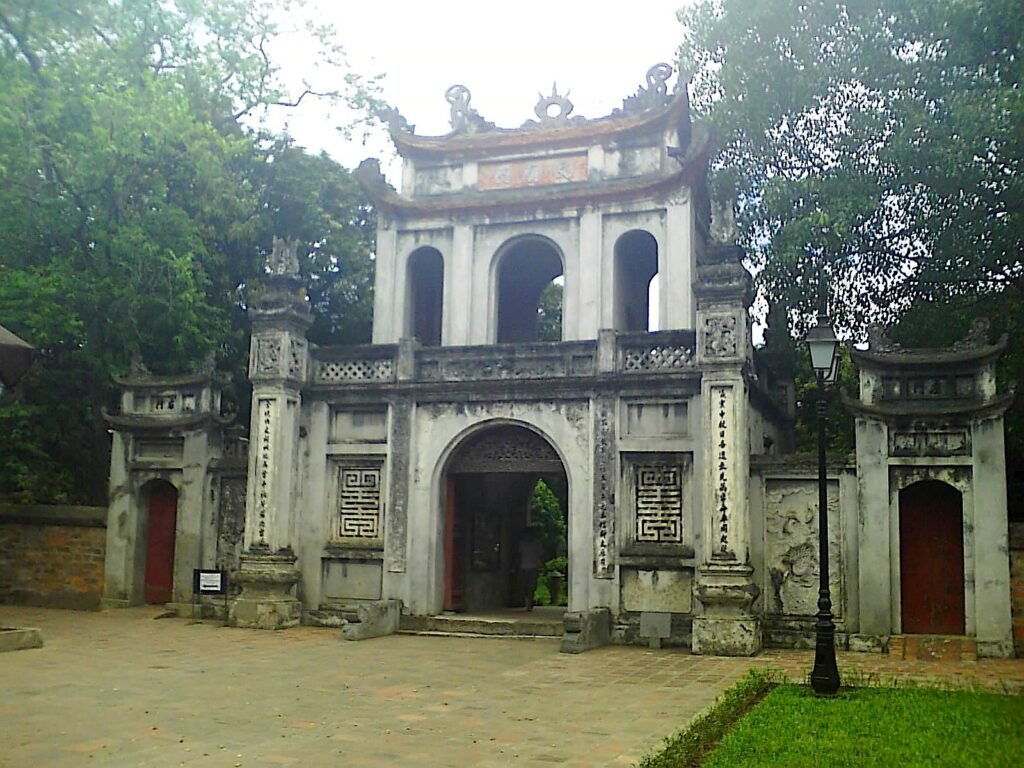
And what was standing there?
A temple associated with:
Confucius
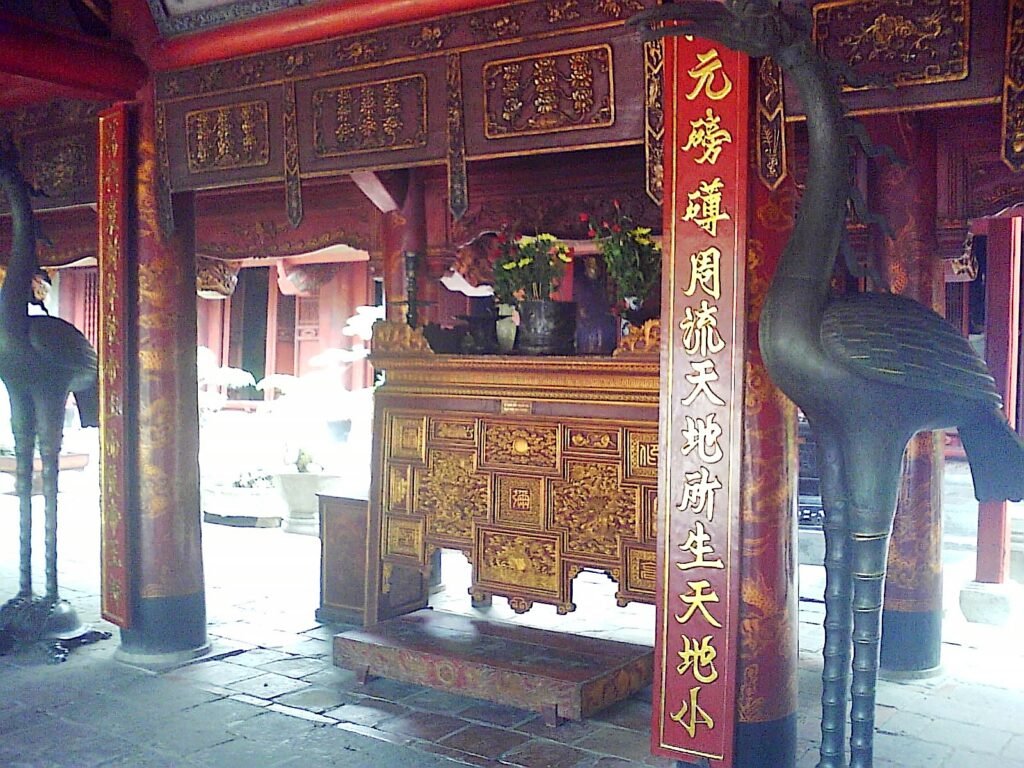
and:
classical learning.
😳
So now the obvious question is:
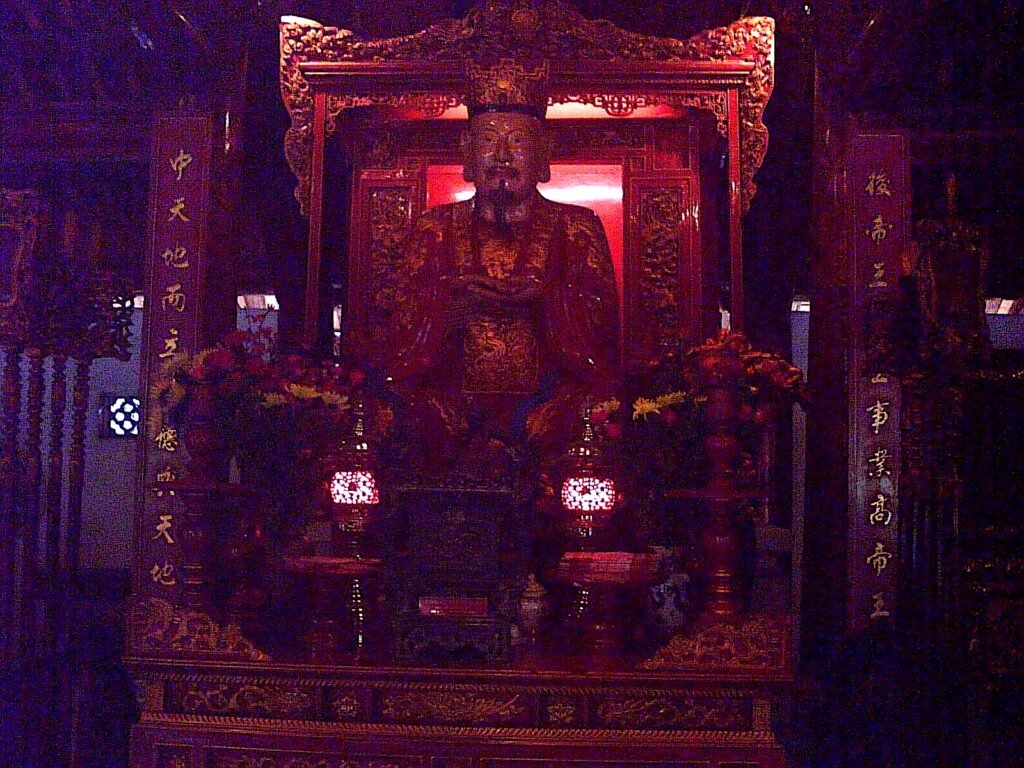
What is Confucius doing in Vietnam?
🐇🌏
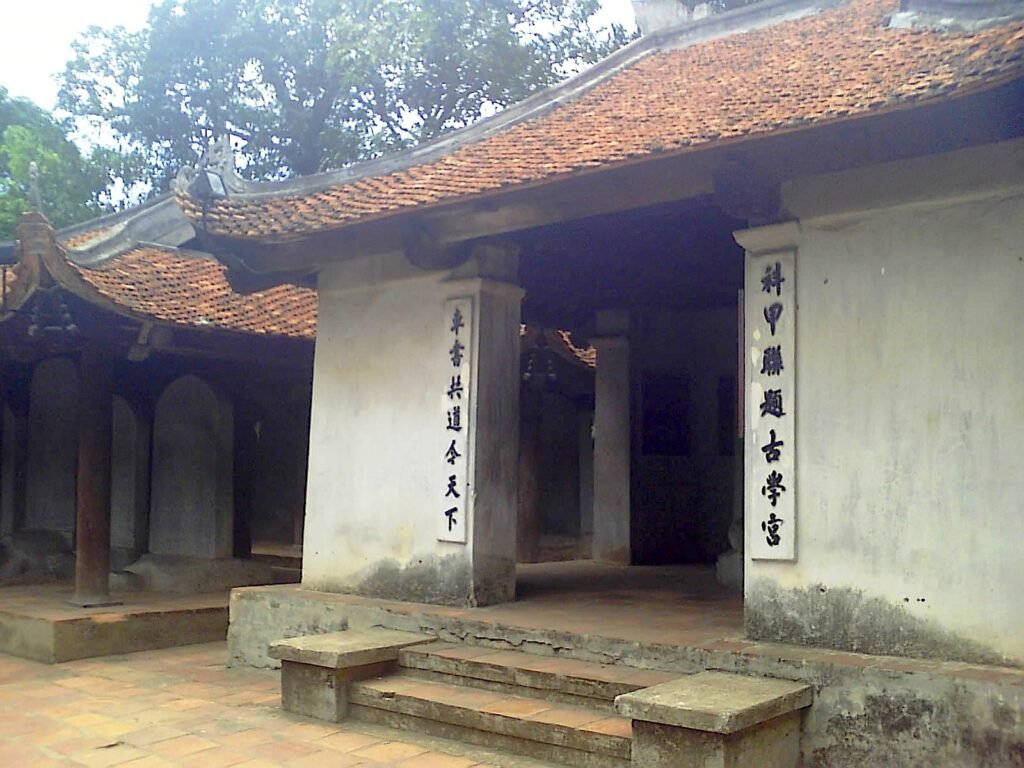
🇻🇳 Vietnam Didn’t Simply “Copy China”
This is an important guardrail.
For long periods, Vietnamese states interacted intensely with Chinese political and cultural traditions.
Vietnamese dynasties selectively adopted and adapted elements including:
Confucian learning,
classical texts,
bureaucratic practices,
examination traditions
and:
Chinese-derived writing culture.
🔥
But:
INFLUENCE ≠ COPY.
Vietnam developed:
its own dynasties
its own political traditions
its own cultural identity
and:
its own state.
So the better model is:
RECEIVE
↓
SELECT
↓
ADAPT
↓
TRANSFORM.
Sound familiar?
😂
That’s exactly what we’ve been learning throughout Deep China.
🏫 Hanoi Gives Us a Beautiful Comparison
The:
Temple of Literature (Văn Miếu)
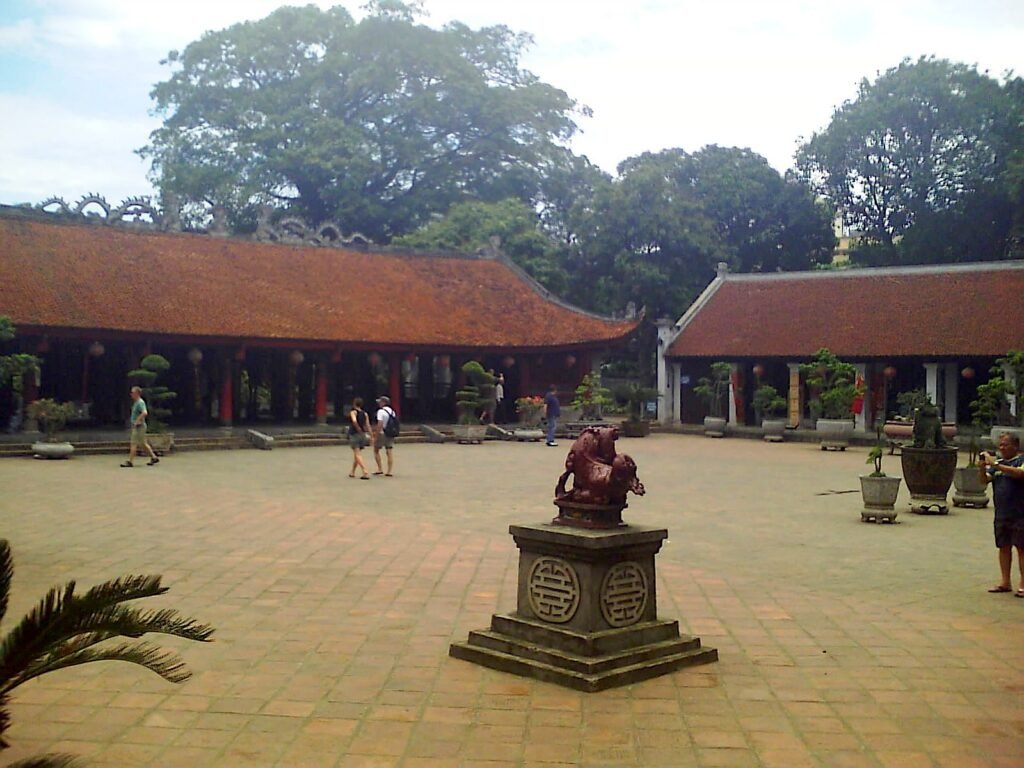
was founded in:
1070
under Vietnam’s:
Lý dynasty.
The associated:
Imperial Academy (Quốc Tử Giám)
followed shortly afterward.
🔥
Now compare:
QUFU
Confucius
↓
ritual
↓
learning
↓
institutional memory
with:
HANOI
Confucius
↓
classical education
↓
scholars
↓
state examinations.
Different country.
Different political history.
Related intellectual world.
🪨 And Guess What Hanoi Has?
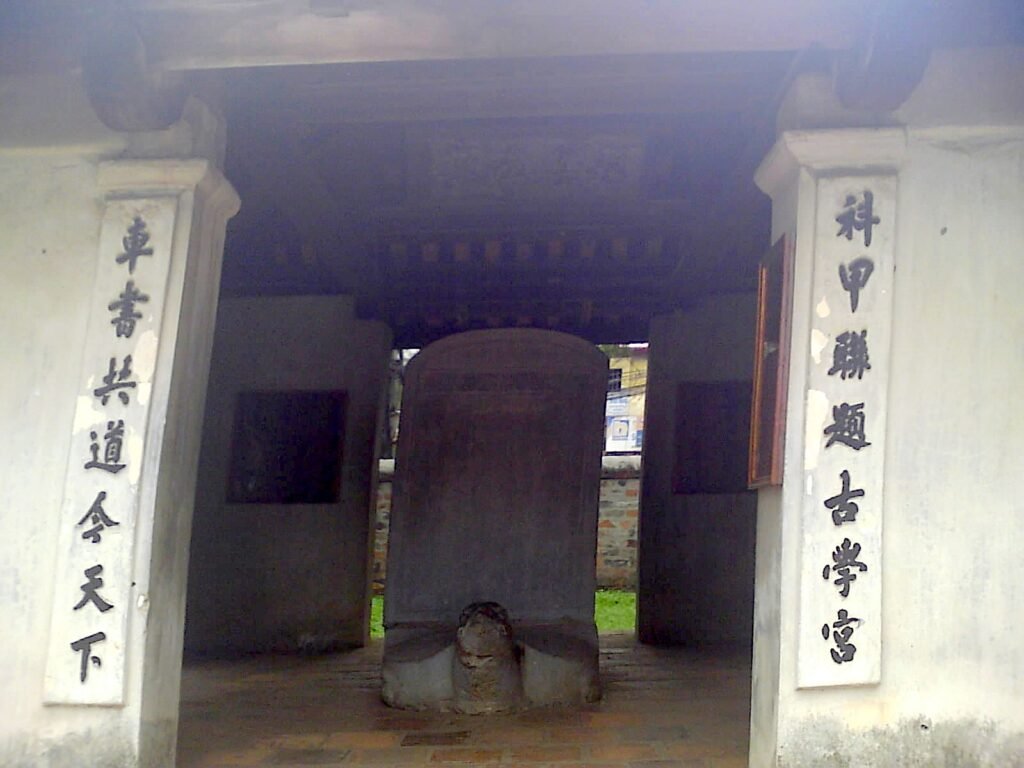
STONES.
😭😂
The rabbit brought the stones with him.
At Hanoi’s Temple of Literature you’ll encounter famous:
doctoral steles
recording successful candidates in royal examinations.
They stand on:
stone turtles.
🔥
Now Dad can stand in:
Qufu
looking at:
碑
then travel to:
Hanoi
and encounter another historical world in which:
stone inscriptions + education + state institutions
come together.
That’s an extraordinary comparison.
🐇 Confucius Never Went to Hanoi
That’s the beautiful part.
Confucius himself didn’t travel to:
Vietnam.
He didn’t travel to:
Korea.
He didn’t travel to:
Japan.
Yet Confucian texts and traditions eventually became influential across:
East Asia (东亚, Dōngyà).
🔥
Ideas can travel much farther than:
the person who first taught them.
That’s our escaped rabbit.
🌏 And Vietnam Isn’t the End of the Rabbit Hole
Confucian traditions also became deeply influential in:
Korea
and:
Japan
in different forms and historical periods.
But again:
not photocopies of China.
Each society adapted Confucian ideas according to:
its own political institutions,
social structures,
historical circumstances
and:
local traditions.
🔥
So instead of imagining:
CHINA → COPY → COPY → COPY
use:
CHINA
↓
TRANSMISSION
↓
LOCAL ADAPTATION
↓
NEW TRADITIONS.
Much better.
🌶️ Now Compare Confucius With Buddhism
And suddenly another escaped rabbit runs past.
😂🐇🌏
Remember:
Buddhism (佛教, Fójiào)
originated in:
India (印度, Yìndù).
It traveled:
INTO China.
↓
was translated:
翻译 — fānyì
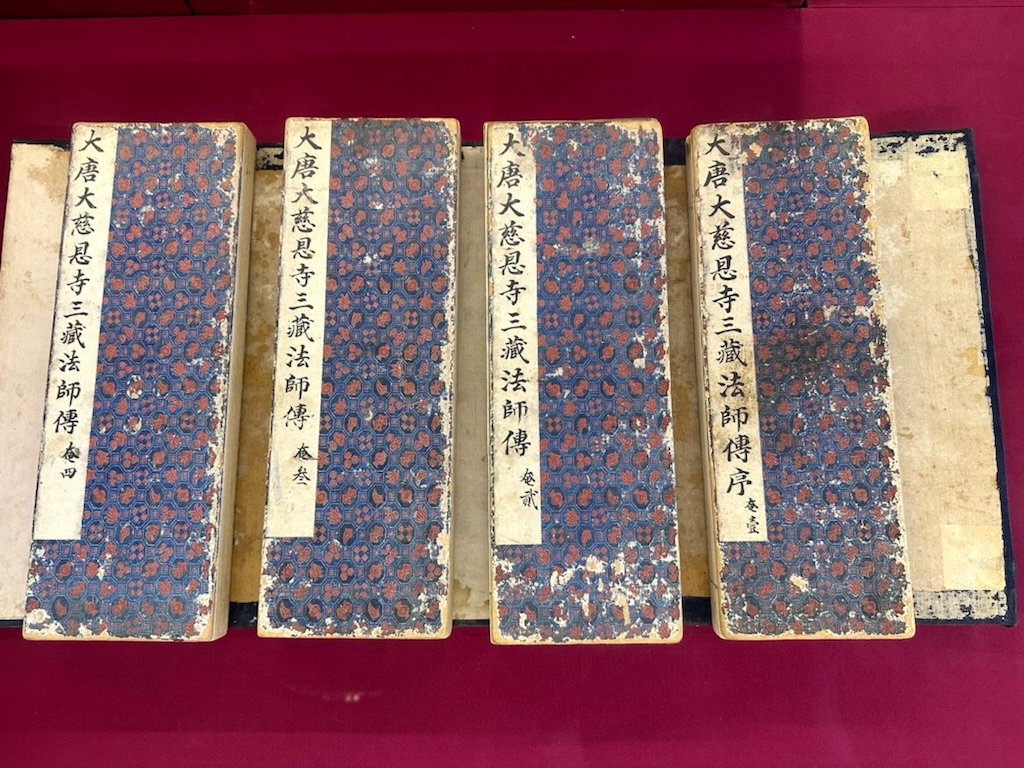
↓
adapted and transformed
↓
distinctive Chinese Buddhist traditions developed
↓
then Buddhist traditions and texts traveled onward toward:
Korea
Japan
and:
Vietnam.
🔥🔥🔥
So Buddhism gives us:
WORLD → CHINA → WORLD.
Confucianism gives us another pattern:
CHINA → NEIGHBORING SOCIETIES.
Chinese history is starting to look much less:
isolated.
🐞 Halfway Sting
You started Section 2 with:
a stone in Qufu.
Then:
碑 — stele
↓
Confucius
↓
learning (学)
↓
scholar-officials (士大夫)
↓
imperial examinations (科举)
↓
government
↓
political legitimacy
↓
Mongol Yuan
↓
Manchu Qing
↓
Who Is “Chinese”?
↓
then suddenly:
HANOI.
😭😂
The rabbit escaped China.
🐇🌏
And now the Qufu question has become much bigger:
How did ideas associated with one teacher from the State of Lu become institutions inside China—and then influence societies far beyond China?
🔥
That’s why Qufu matters.
Not because every Chinese person today:
“follows Confucius.”
And not because neighboring societies:
“copied China.”
But because:
ideas can become institutions.
And institutions can:
travel.
🐇🌏
Section 3 — How to Visit Qufu From Beijing — and Actually Understand What You’re Seeing
By now Dad has probably ruined another perfectly simple sightseeing trip.
😂
You came to:
Qufu (曲阜, Qūfù)
to see the hometown of:
Confucius (孔子, Kǒngzǐ).
Now you’re thinking about:
humaneness (仁, rén),
ritual / propriety (礼, lǐ),
filial respect (孝, xiào),
learning (学, xué),
Confucian tradition (儒家, Rújiā),
scholar-officials (士大夫, shìdàfū),
imperial examinations (科举, kējǔ),
political legitimacy,
and somehow:
Hanoi, Vietnam.
😭😂
Excellent.
You’ve been stung.
🐞
But let’s return to the travel question:
How do you actually visit Qufu from Beijing?
🚄 Qufu Is an Excellent “Beyond Beijing” Trip
This is one reason Dad likes Qufu for international travelers.
You don’t need an internal flight.
You don’t need to disappear into remote China for a week.
From:
Beijing (北京, Běijīng)
you can travel south by:
high-speed rail (高铁, gāotiě)
toward:
Qufu East Railway Station (曲阜东站, Qūfù Dōng Zhàn).
Beginner Chinese:
东 — dōng
east
站 — zhàn
station
So:
曲阜东站
Qufu East Station
🔥
Depending on the particular train, the high-speed journey from Beijing is roughly:
around 2–3 hours.
That makes Qufu a very realistic extension for travelers who have already spent several days in Beijing.
📍 But Qufu East Is NOT the Historic Center
Important.
😂
Don’t step off the train expecting:
Confucius Temple directly outside Platform 3.
曲阜东站
is outside the old central Qufu area.
From the station, you’ll need onward transport to the:
Three Confucian Sites (三孔, Sānkǒng).
A:
taxi (出租车, chūzūchē)
or:
Didi (滴滴, Dīdī)
is usually the simplest independent option.
Allow additional local travel time rather than treating your train arrival time as:
“arrival at Confucius.”
😂
🏛️ How Much Time Does Qufu Need?
Could you arrive, photograph the:
Temple of Confucius (孔庙)
and leave?
Of course.
But that rather defeats the point.
🔥
For the main:
三孔 — Sānkǒng
Dad would allow at least:
half a day
for a meaningful visit.
If you genuinely enjoy:
history,
Chinese culture,
architecture,
steles,
Confucian thought
and:
asking guides too many questions…
😂
then:
a full day is better.
And Qufu can easily justify:
an overnight stay
if you’re building it into a wider Shandong journey.
🗺️ Dad’s Three-Site Coat Rack
Don’t treat:
孔庙 + 孔府 + 孔林
as three boxes to tick.
Give each one a different question.
1. 孔庙 — Temple of Confucius
孔庙 — Kǒngmiào
Think:
RITUAL + MEMORY.
This is where you ask:
How did a teacher become somebody honored by emperors and governments centuries later?
🔥
Look for:
inscriptions,
imperial tablets,
steles (碑, bēi),
ritual spaces
and:
layers of rebuilding.
Don’t merely photograph the gates.
2. 孔府 — Kong Family Mansion
孔府 — Kǒngfǔ
Think:
FAMILY + INSTITUTION.
Confucius died.
But:
the Kong lineage continued.
🐇
His senior-line descendants received extraordinary recognition across later imperial history.
So ask:
How does the memory of one teacher become attached to an enduring family institution?
Now the mansion means something.
3. 孔林 — Cemetery of Confucius
孔林 — Kǒnglín
Think:
ANCESTRY + CONTINUITY.
Confucius’s burial place and the enormous Kong clan cemetery give you another physical way of seeing:
generations.
Beginner Chinese:
墓 — mù
tomb
祖先 — zǔxiān
ancestors
后代 — hòudài
descendants / later generations
🔥
Now:
庙 — temple
府 — mansion
林 — cemetery
tell three different stories.
Much easier to remember.
🧑🏫 Dad Strongly Recommends a Knowledgeable English-Speaking Guide
Can you visit Qufu independently?
Absolutely.
Should every traveler hire a guide?
No.
But if you’re reading this Deep China article because you actually want to:
understand Qufu,
Dad recommends:
a good English-speaking local guide (英语导游, Yīngyǔ dǎoyóu).
🔥
And not simply:
“someone who can speak English.”
Ask for somebody knowledgeable about:
Confucian history
Chinese imperial history
and especially:
the inscriptions and steles.
That’s where the value is.
🌶️ Ask for a HISTORY Guide, Not a Walking Audiobook
😂
When booking a private tour or guide, Dad would send something like:
We are particularly interested in Chinese history and Confucianism. We would like an experienced English-speaking licensed guide who can explain the historical steles, imperial patronage of Confucius, the Kong family, and how Confucian learning became connected with imperial education and government.
🔥
That one paragraph can completely change:
which guide you get.
Otherwise you may receive:
“This building was rebuilt in Dynasty X.”
↓
walk
↓
“This tree is 700 years old.”
↓
walk
↓
“Please take photo.”
😭😂
Perfectly competent tourism.
But not:
Deep China.
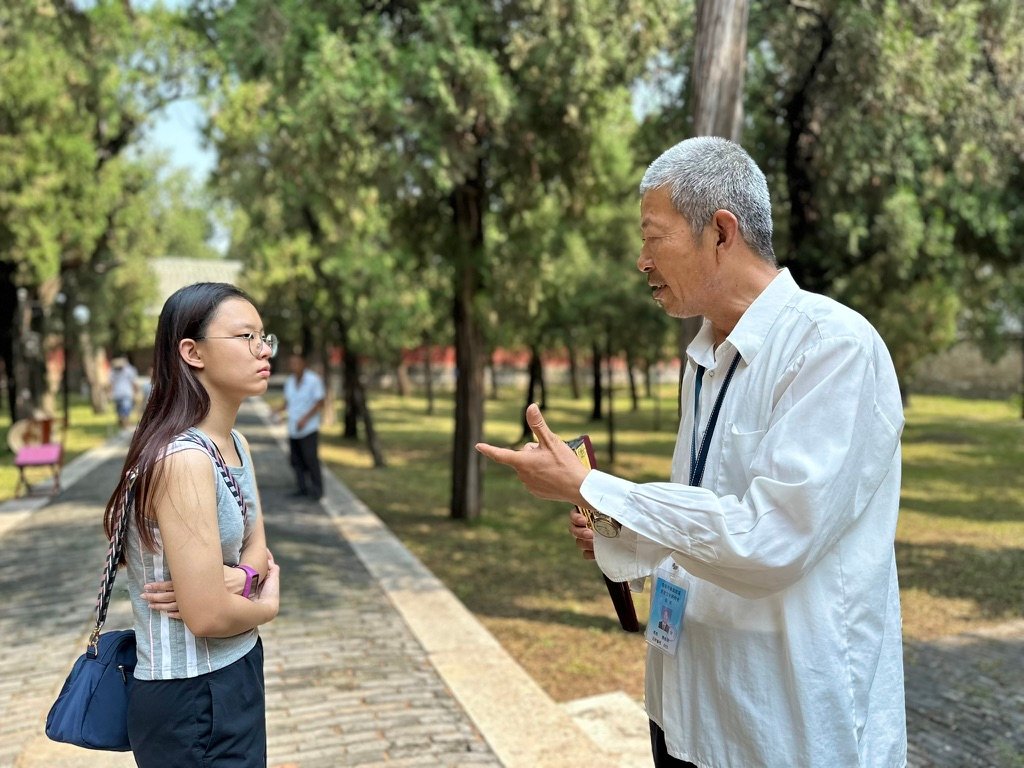
📸 Our Specialist Turned Qufu Into an Open Classroom
This is why Dad remembers our Qufu experience so strongly.
A local specialist spent much of the explanation talking directly with:
Elaine.
Dad listened.
Asked questions.
Looked at the stones.
🔥
Suddenly:
碑 — stele
wasn’t merely:
old Chinese writing we couldn’t read quickly.
It became:
evidence.
Who erected it?
Which dynasty?
What title was being granted?
What was being restored?
Why was an emperor honoring Confucius?
That changed the whole visit.
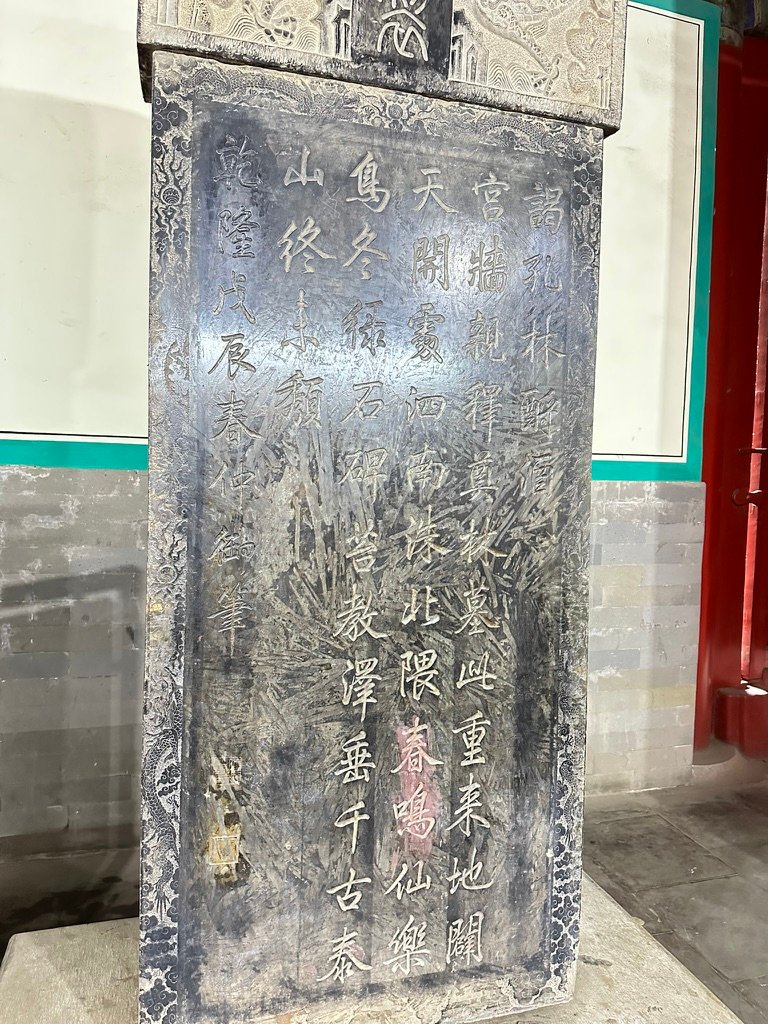
An emperor came to pay his respects. This stone preserves a poem written by the Qianlong Emperor (乾隆帝) after visiting Qufu (曲阜) to honor Confucius (孔子). Its verses evoke the Confucian landscape around him—the Confucius Temple (孔庙), Apricot Altar (杏坛), Confucius Cemetery (孔林), ancient stone steles, and the Zhu (洙水) and Si (泗水) rivers associated with Confucius’s homeland. More than 2,000 years after Confucius lived, a Qing emperor was still coming here, performing rituals and leaving his own words carved in stone. Photo by Dad.
🪨 Dad’s Rule: READ THE STONES
If you’re paying for a knowledgeable guide in Qufu, don’t spend the entire tour hearing:
architecture facts.
Ask about:
碑 — bēi
stele
碑文 — bēiwén
inscription
御碑 — yùbēi
imperial stele
题字 — tízì
inscription / calligraphic words written for a place or object
祭孔 — jì Kǒng
rites / ceremonies honoring Confucius
🔥
Those words unlock the historical layers.
A stone erected centuries after Confucius died may actually tell you more about:
Confucius’s later influence
than an imagined reconstruction of Confucius himself.
Eight Chinese Words Worth Bringing to Qufu
If you’re learning Mandarin, this is an unusually good history trip.
Take these:
孔子 — Kǒngzǐ
Confucius
儒家 — Rújiā
Confucian tradition / school
仁 — rén
humaneness
礼 — lǐ
ritual / propriety
孝 — xiào
filial respect
学 — xué
study / learn
碑 — bēi
stele
庙 — miào
temple / shrine
🔥
Then add:
府 — fǔ
mansion / official residence
and:
林 — lín
grove / forest
Congratulations.
You can now read:
孔庙
孔府
孔林
without Dad.
😂
📸 Dad’s Qufu Photo Challenge
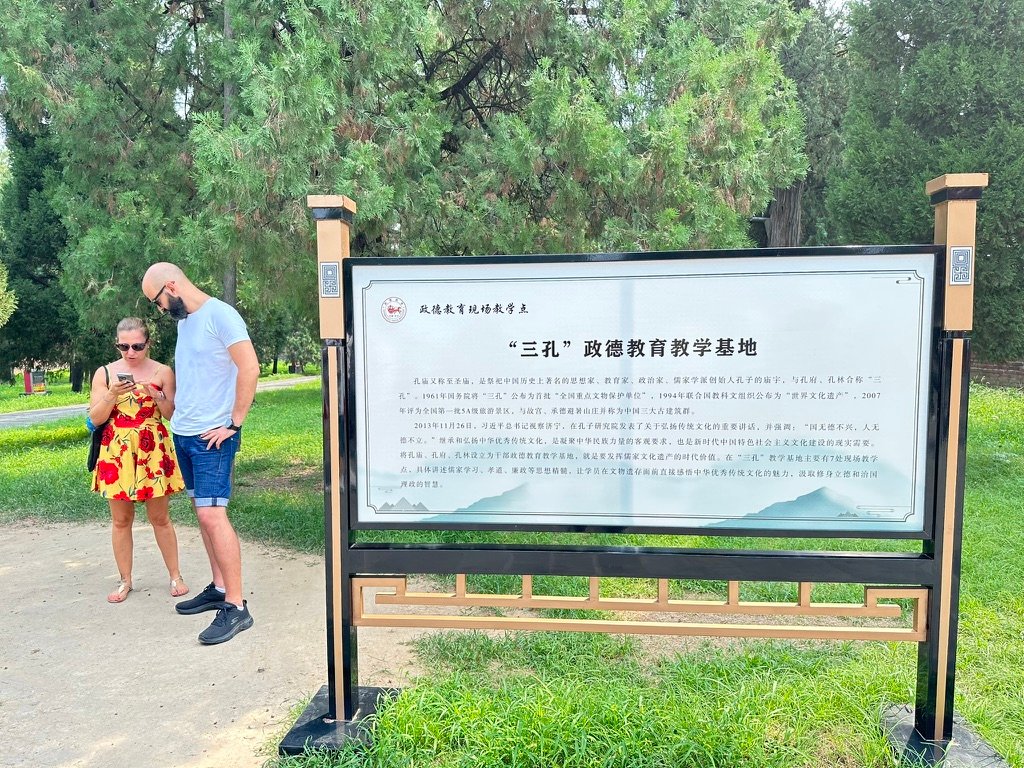
Qufu as an open classroom. A sign inside the Confucius Cemetery (孔林, Kǒng Lín) identifies Qufu’s “Three Confucian Sites” (三孔)—the Confucius Temple (孔庙), Kong Family Mansion (孔府) and Confucius Cemetery (孔林)—as a teaching base for moral and civic education. More than 2,500 years after Confucius, Qufu is still being used as a place to learn from the ideas associated with him. Photo by Dad.
Don’t return with only:
“Elaine standing in front of Confucius statue.”
😂
Bring home four kinds of evidence.
1. THE PLACE
Temple / mansion / cemetery.
2. THE WORDS
Photograph:
Chinese characters.
Signs.
Plaques.
Calligraphy.
3. THE STONE
Find a:
碑.
Photograph enough context that you can later work out:
what it says,
when it was erected
and:
why.
4. THE HUMAN STORY
Guide.
Specialist.
Family moment.
Something showing:
how YOU learned the history.
🔥
That’s what turns travel photographs into:
Deep China material.
🌏 And Remember: The Rabbit Escaped China
When you’ve finished Qufu, keep one thought in your pocket.
Confucius never went to Hanoi.
Yet Dad & Elaine later found:
Confucian institutional memory
at Hanoi’s:
Temple of Literature — Văn Miếu.
🐇🌏
So don’t leave Qufu thinking:
“Confucianism = Chinese thing inside China.”
Instead ask:
How did these ideas travel?
And:
What did other societies do with them?
That’s a much bigger East Asian story.

🐞 Now You’re Ready for the Sting
Before leaving Qufu, Dad wants you to carry away:
three questions.
Not 47 quotations from the Analects.
😂
Three.
🐇 QUESTION 1 — How Did Confucius Become an Institution?
Confucius was:
a teacher.
Then:
teachings
↓
texts
↓
scholars
↓
education
↓
examinations
↓
officials
↓
government.
🔥
How did that happen?
That’s the first rabbit.
🐇 QUESTION 2 — Why Did Emperors Keep Honoring Him?
Different dynasties.
Different rulers.
Even ruling houses with origins beyond earlier Han Chinese political frontiers.
Yet:
Confucius remains.
So ask:
What does honoring Confucius tell us about governance and political legitimacy?
🐇🐇
That leads directly toward our Big Questions about:
how emperors governed China
and:
who could become a Chinese emperor.
🐇🌏 QUESTION 3 — How Did Confucius Escape China?
Qufu
↓
儒家
↓
education
↓
institutions
↓
🐇🌏
Vietnam
Korea
Japan.
How did Chinese-derived ideas travel outward?
And how did neighboring societies:
adapt rather than merely copy them?
🔥
That rabbit is going to keep running.

🌶️ Ready for the Rabbit Hole?
READ NEXT — How Did One Emperor Govern Such a Huge Country?
You’ve seen:
Forbidden City
and:
Qufu.
Now connect them.
One shows:
the emperor.
The other helps explain:
the educated political culture and institutions that helped make imperial government possible.
THEN — Who Is “Chinese”? — When People Beyond the Frontier Became China’s Rulers
Why would:
Mongol Yuan
or:
Manchu Qing
rulers participate in traditions associated with Confucius?
🔥
Conquest gives you power.
But:
how do you turn conquest into durable rule?
🐇🌏 AND THEN — THE RABBIT ESCAPED CHINA
Dad & Elaine found Confucius again at:
Hanoi’s Temple of Literature.
Different country.
Different history.
Related intellectual tradition.
That opens another question:
How far did Chinese cultural influence travel — and what happened when other societies transformed what they received?
🐇🌏🔥

🐞 ChinaTravelBUG’s Take
Go to Qufu because:
Confucius was born there.
That’s reason enough.
But don’t leave thinking you’ve merely visited:
the hometown of a famous philosopher.
Look at:
孔庙
and ask about:
ritual.
Look at:
孔府
and ask about:
institutional continuity.
Look at:
孔林
and ask about:
lineage and memory.
Look at:
碑
and ask:
Who put this stone here — and why?
🔥
Then Qufu starts connecting with:
Forbidden City
imperial examinations
Mongol Yuan
Manchu Qing
and eventually:
Hanoi.
😬
One teacher.
One small Shandong city.
More than two thousand years of:
education
government
ritual
political legitimacy
and:
cultural influence.
That’s why Qufu belongs on a:
Beyond Beijing
journey.
Not merely because it’s easy to reach by:
高铁 — high-speed rail.
But because after Beijing shows you:
how imperial China LOOKED,
Qufu helps you begin understanding:
some of the IDEAS and INSTITUTIONS that helped it work.
🐞🐇🔥
Travel China. Let the places teach you Chinese history.
See the place. Ask the bigger question. Understand China better.