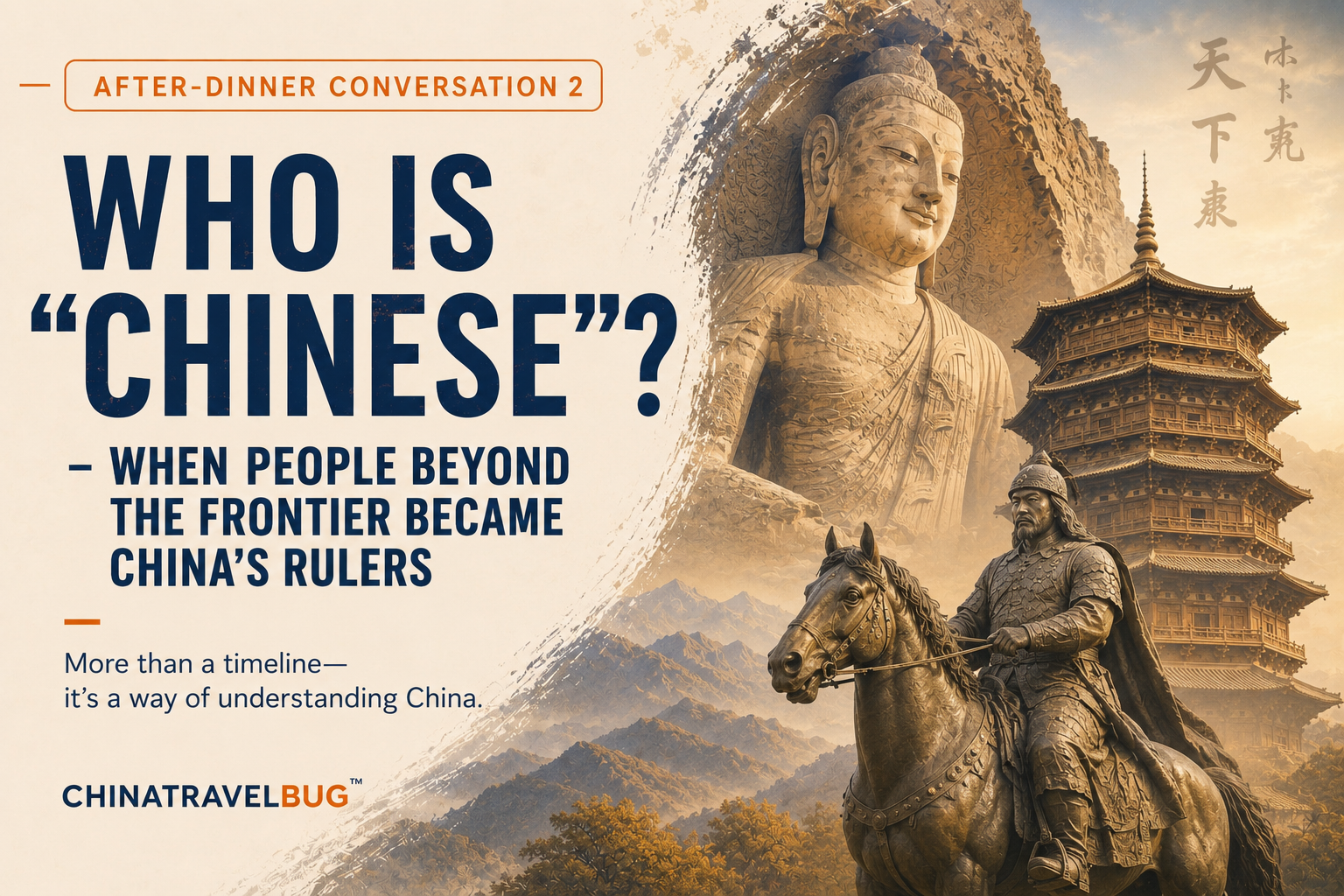
Section 1 — You’re Standing on the Great Wall. Which Side Was “China”?
Imagine you’re standing on:
the Great Wall (长城, Chángchéng)
outside:
Beijing (北京, Běijīng).
You’ve already learned something important from our earlier Deep China journey.
The wall wasn’t simply:
CHINESE INSIDE
↓
FOREIGNERS OUTSIDE.
😂
The northern frontier saw:
warfare (战争, zhànzhēng),
trade (贸易, màoyì),
diplomacy (外交, wàijiāo),
migration (迁徙, qiānxǐ)
and:
cultural exchange (文化交流, wénhuà jiāoliú).
But now comes a much harder question.
🌶️🌶️🌶️
What happens when people who once lived beyond earlier Chinese political frontiers…
cross the frontier
↓
conquer territory
↓
establish dynasties
↓
and eventually:
become emperors ruling China?
😳
Are they:
foreigners?
Chinese?
both?
Or are we asking a modern question that doesn’t fit the historical world very well?
🐇
Welcome to one of the deepest rabbit holes in Chinese history.
First: Don’t Project Today’s Identity Categories Backward
Today we have concepts such as:
China (中国, Zhōngguó)
Chinese citizen (中国人, Zhōngguórén)
Han Chinese (汉族, Hànzú)
ethnic group (民族 / 族群, mínzú / zúqún).
These are useful modern categories.
But if we take today’s identity boxes and carry them backward:
1,000 years
or:
1,500 years
we can create very bad history.
🔥
People in the past could identify themselves through combinations of:
family (家族, jiāzú),
lineage,
place,
language (语言, yǔyán),
political allegiance,
social status,
ruling house
and:
cultural practices.
Those categories didn’t always line up neatly with our modern idea of:
ethnicity.
That’s our first guardrail.
🍚 Western Handrail: Don’t Give Medieval People Modern Passports
😂
Imagine asking someone living in Europe in:
500 CE
to tick:
☐ French
☐ German
☐ Italian
☐ British
on a modern nationality form.
The question itself would be strange.
Modern national identities developed historically.
Use the same caution in China.
Don’t ask an:
Xianbei (鲜卑, Xiānbēi)
person living 1,500 years ago to fill in a modern:
民族
box.
😂
History deserves its own categories.
🐇 Start With a Place Dad & Elaine Actually Visited
Leave the Beijing Great Wall.
Travel west to:
Datong (大同, Dàtóng)
in:
Shanxi (山西, Shānxī).
Then visit:
Yungang Grottoes (云冈石窟, Yúngāng Shíkū).
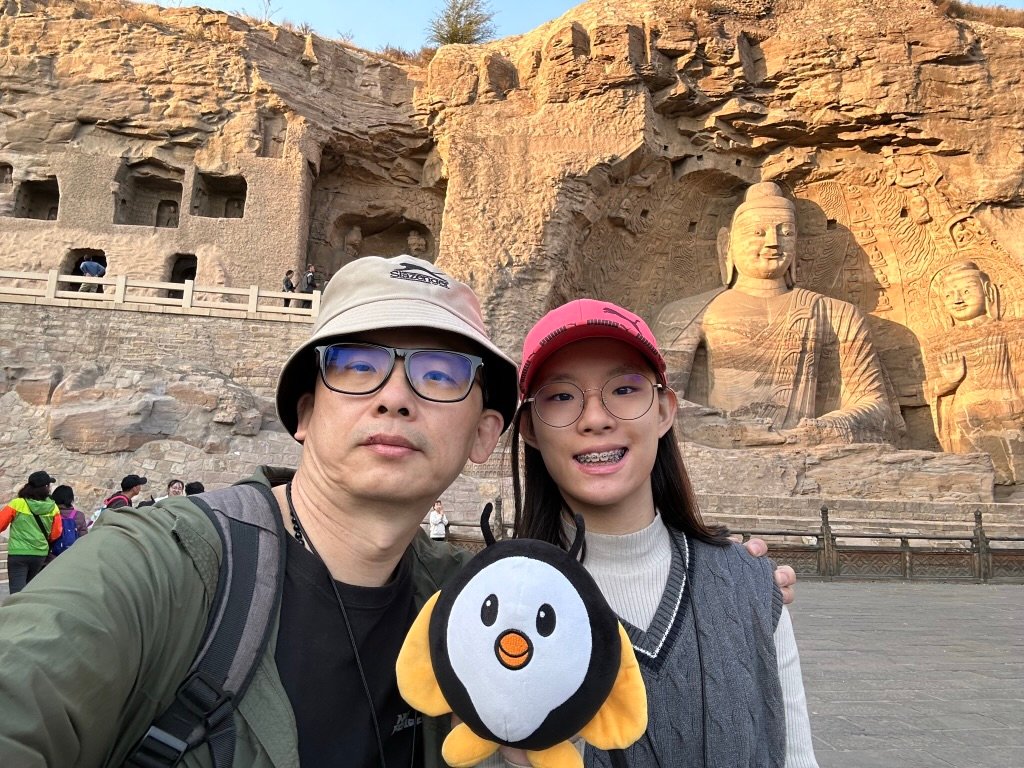
Huge Buddhas.
Caves.
Stone carvings.
A:
UNESCO World Heritage Site.
Beautiful.
But Deep China asks:
Who built this?
And suddenly:
Xianbei (鲜卑)
walk into our story.
🔥
Meet the Tuoba Xianbei
The rulers who founded:
Northern Wei dynasty (北魏, Běi Wèi)
came from the:
Tuoba (拓跋, Tuòbá)
branch of the:
Xianbei (鲜卑, Xiānbēi).
Their early political world was connected with the northern frontier and Inner Asia.
Then they established control over increasingly large parts of:
northern China (中国北方, Zhōngguó Běifāng).
Eventually:
Northern Wei unified northern China in 439.
🔥
Now stop.
The people we might casually label:
“northern outsiders”
have become:
rulers of northern China.
Our neat Great Wall picture is already in trouble.
🏯 And Their Capital Was Pingcheng
Northern Wei established its major early imperial capital at:
Pingcheng (平城, Píngchéng)
— today’s:
Datong (大同).
🐇
Dad & Elaine have been there.
So:
DATONG
isn’t merely:
“the city near Yungang.”
For part of Northern Wei history it was:
an imperial capital.
🔥
And the monumental Buddhist art at Yungang was created under Northern Wei imperial patronage.
Now the question:
“Is Yungang Chinese art or Xianbei art?”
starts looking rather clumsy.
🌶️ Maybe It’s Both — and More
At Yungang we encounter a world shaped by:
Northern Wei imperial power
+
Xianbei rulers
+
Buddhism (佛教, Fójiào)
+
Chinese artistic traditions
+
Central Asian connections
+
Indian Buddhist origins.
😳
Try putting that into:
Chinese / foreign
with only two boxes.
😂
It doesn’t fit.
That’s the point.
🐇 Buddhism Makes the Identity Question Even Messier
Remember:
Buddhism (佛教)
didn’t originate in China.
Its origins lie in:
India (印度, Yìndù).
It traveled through complex Asian networks.
Then Xianbei-origin Northern Wei rulers became major patrons of:
Buddhist art in China.
🔥
So now:
something originating in India
↓
travels through wider Asian networks
↓
is patronized by Xianbei rulers
↓
at a capital in northern China
↓
producing:
one of China’s greatest surviving Buddhist monuments.
What exactly counts as:
“foreign”
now?
🐇🐇🐇
🍚 This Is Why “Sinicization” Needs Care
You’ll often encounter the English word:
Sinicization
and the Chinese:
汉化 (Hànhuà)
when reading about Northern Wei.
Very roughly, it can describe processes of adopting practices associated with:
Han Chinese culture (汉文化, Hàn wénhuà).
And yes, Northern Wei rulers adopted and promoted important changes involving:
language,
clothing,
institutions,
names
and:
elite political culture.
🔥
But the old simple story:
Xianbei arrive
↓
become Chinese
↓
Xianbei disappears
↓
finished
is too neat.
Modern scholarship increasingly emphasizes:
interaction, adaptation and hybrid political cultures
rather than a purely one-way process. :contentReference[oaicite:1]{index=1}
🌶️ China Changed Them — They Changed China
That’s the more useful handrail.
Northern rulers adopted practices from the societies they governed.
But those rulers also brought:
their own political traditions,
military practices,
social networks
and:
cultural preferences
into northern China.
🔥
So instead of:
FOREIGN → BECOMES CHINESE
try:
CONTACT
↓
CONQUEST
↓
ADAPTATION
↓
INTERMARRIAGE
↓
INSTITUTIONAL CHANGE
↓
CULTURAL TRANSFORMATION.
Much more interesting.
🐇 Then Northern Wei Moves Its Capital
In:
494 CE
Northern Wei moved its main capital from:
Pingcheng (平城)
to:
Luoyang (洛阳, Luòyáng).
😳
Uh-oh.
Future Dad & Elaine trip.
😂
Luoyang will eventually give us another major piece of this story.
And near Luoyang:
Longmen Grottoes (龙门石窟, Lóngmén Shíkū)
continue the extraordinary Northern Wei Buddhist story after the capital moved south.
So:
YUNGANG
↓
Northern Wei
↓
capital moves
↓
LUOYANG
↓
LONGMEN.
🐇🐇🐇
Dad’s future itinerary just acquired another reason to exist.
🐇 Now Jump Forward to Another Place Dad & Elaine Visited
Several centuries later…
we encounter:
Yingxian Wooden Pagoda (应县木塔, Yìngxiàn Mùtǎ)
also in:
Shanxi.
Built in:
1056
during:
Liao dynasty (辽朝, Liáo Cháo).
Who founded Liao?
Khitan (契丹, Qìdān).
🔥
Here we go again.
Meet the Khitan
The Khitan emerged from the wider northeastern and Inner Asian world.
They established:
Liao dynasty (辽朝)
which ruled substantial territories across northern China and Inner Asia from:
907–1125.
Their state governed:
Khitan populations,
Han populations,
and:
other communities.
🔥
And scholarship increasingly warns us not to imagine all these people carrying simple, permanent modern-style ethnic identities. Identity could intersect with rank, ancestry, political status, language and social position in complicated ways. :contentReference[oaicite:2]{index=2}
Again:
modern box ≠ medieval reality.
🪵 Then Look at What the Khitan Left
At:
Yingxian (应县)
we have an extraordinary:
wooden Buddhist pagoda (木塔, mùtǎ)
constructed under:
Khitan Liao rule.
Buddhism.
Chinese architectural traditions.
Khitan political power.
Northern China.
🔥
So again ask:
Chinese building?
Khitan building?
Perhaps:
LIAO BUILDING
is the historically smarter answer.
😂
Let the historical world be itself.
🐇 And the Khitan Become “China” in Europe
Now for one of Dad’s favorite rabbit holes.
The name:
Khitan (契丹, Qìdān)
traveled west through Eurasian languages.
Forms derived from their name became:
Cathay
— an old European name for:
China.
😳
Cambridge’s history of the Liao notes that variants of the Khitan name became synonyms for China across much of Eurasia. :contentReference[oaicite:3]{index=3}
Think about the irony.
A people Western beginners might initially categorize as:
“outsiders beyond China”
gave parts of the outside world:
a name for China.
😂🔥
History is trolling our categories.
🌶️ Now Our Question Has Changed
We started with:
Who is Chinese?
But perhaps a better historical question is:
How did different peoples become part of the political, cultural and historical worlds we now call Chinese history?
That’s much stronger.
Because the answer isn’t:
one bloodline.
And it isn’t:
one permanent border.
It involves:
states,
culture,
language,
institutions,
political allegiance,
migration,
conquest
and:
historical memory.
🔥
🐞 Sting Check
You began Section 1 standing on:
the Great Wall.
Then:
frontier (边疆)
↓
Xianbei (鲜卑)
↓
Tuoba (拓跋)
↓
Northern Wei (北魏)
↓
Pingcheng (平城)
↓
Datong (大同)
↓
Yungang (云冈石窟)
↓
Buddhism (佛教)
↓
Sinicization / Hanization (汉化)
↓
Luoyang (洛阳)
↓
Khitan (契丹)
↓
Liao (辽)
↓
Yingxian Wooden Pagoda (应县木塔)
↓
Cathay.
😬
And we’ve only reached:
1056.
😂
We still have:
Mongols (蒙古)
and:
Manchus (满洲)
waiting in the kitchen.
🔥🔥🔥
Because the really dangerous question is still coming:
What happens when a people from beyond earlier Chinese frontiers doesn’t merely rule northern China—but becomes emperor of ALL China?
Section 2 — Mongol Emperor? Manchu Emperor? Now the Question Gets Really Interesting
Section 1 took us from:
the Great Wall (长城, Chángchéng)
to:
Xianbei (鲜卑, Xiānbēi)
↓
Northern Wei (北魏, Běi Wèi)
↓
Yungang Grottoes (云冈石窟, Yúngāng Shíkū)
↓
Khitan (契丹, Qìdān)
↓
Liao dynasty (辽朝, Liáo Cháo)
↓
Yingxian Wooden Pagoda (应县木塔, Yìngxiàn Mùtǎ).
Already, the simple picture:
Chinese inside the frontier, foreigners outside
has fallen apart.
😂
But Northern Wei and Liao still leave a beginner with an escape route:
“Okay. They ruled parts of northern China.”
Fair enough.
Then:
the Mongols arrive.
🌶️🌶️🌶️🌶️🌶️
And eventually a Mongol ruler becomes:
emperor (皇帝, huángdì)
of a dynasty ruling all of China.
Now what?
🐇
🐎 Meet the Mongols
In the early 13th century:
Chinggis Khan / Genghis Khan (成吉思汗, Chéngjísī Hán)
united Mongol groups and launched conquests that eventually created an enormous:
Mongol Empire (蒙古帝国, Měnggǔ Dìguó).
Its expansion transformed much of Eurasia.
But for our Chinese-history coat rack, remember another name:
Kublai Khan (忽必烈, Hūbìliè).
A grandson of Chinggis Khan.
And in:
1271
Kublai proclaimed the dynastic name:
Great Yuan (大元, Dà Yuán).
🔥
Now notice what has happened.
A Mongol ruler isn’t simply:
“ruling China from outside.”
He has adopted:
a Chinese-style dynastic name (国号, guóhào)
and presents himself within a Chinese imperial political framework.
🐇 Yuan — 元
Beginner Chinese:
元 — yuán
can carry meanings such as:
first / origin / primary
depending on context.
The dynastic name:
Yuan (元朝, Yuán Cháo)
was chosen by Kublai’s regime.
By:
1279
the Southern Song (南宋, Nán Sòng) had been defeated.
The Yuan now ruled:
all of China
within a much wider Mongol imperial world.
😳
So:
Was Kublai Khan a Mongol ruler?
Yes.
And:
Was he an emperor in Chinese dynastic history?
Also yes.
🔥
The categories overlap.
🍚 Western Handrail: Don’t Force Him to Pick One Passport
😂
We have a modern habit of asking:
“So which was he REALLY?”
Mongol?
Chinese emperor?
Answer:
The historical world doesn’t owe us one box.
Kublai could be part of:
Mongol history
and:
Chinese imperial history
at the same time.
Those aren’t mutually exclusive.
That’s an important lesson for everything that follows.
🌶️ And Where Did Kublai Rule From?
Here’s where our first-time Beijing traveler suddenly gets involved.
Kublai developed his great capital at:
Dadu (大都, Dàdū)
on the site that became:
Beijing (北京, Běijīng).
🔥
Remember Course 9?
Beijing’s historical layers include:
Yuan → Ming → Qing.
So when you’re walking through modern Beijing, the city’s imperial story doesn’t begin with:
the Forbidden City.
Before Ming Beijing:
Mongol Yuan Dadu was here.
🐇
Again:
the famous first-time destination contains a deeper historical layer underneath it.
🐇 Then the Yuan Falls
In:
1368
the Yuan lost control of its capital in China.
The:
Ming dynasty (明朝, Míng Cháo)
was established by:
Zhu Yuanzhang (朱元璋, Zhū Yuánzhāng),
the:
Hongwu Emperor (洪武帝, Hóngwǔ Dì).
Eventually Ming imperial rule becomes centered in:
Beijing.
And under Ming we get:
the Forbidden City (故宫)
and much of the spectacular:
Great Wall (长城)
that first-time travelers visit around Beijing today.
🔥
Now the story appears to have returned to:
“Chinese dynasty inside the wall.”
Dad knows better.
😂
Because north and northeast of Ming political frontiers…
another historical transformation is coming.
🐇 Meet the Jurchens
Remember:
Jurchen (女真, Nǚzhēn).
We briefly met Jurchen rulers when discussing the:
Jin dynasty (金朝, Jīn Cháo)
that conquered northern China centuries earlier.
In the early 17th century, Jurchen groups were again consolidated into a powerful political and military force under:
Nurhaci (努尔哈赤, Nǔ’ěrhāchì).
His successors developed the:
Eight Banners (八旗, Bāqí)
system and built a growing state.
Then, in:
1635
the group name:
Manchu (满洲, Mǎnzhōu)
was formally adopted.
And in:
1636
the dynastic name became:
Qing (清, Qīng).
🔥
Eight years later:
1644.
Beijing changes hands.
😳 Now Walk Into the Forbidden City
This is where the article becomes very real for first-time travelers.
You’re standing inside:
Forbidden City (故宫, Gùgōng).
Who built it?
Ming dynasty (明朝).
Who ruled from it after the Ming?
Qing dynasty (清朝).
Who founded Qing?
Manchus (满洲人, Mǎnzhōurén).
😳
So the palace many foreigners instinctively imagine as:
“the palace of Chinese emperors”
was occupied for almost three centuries by emperors of a:
Manchu ruling house.
🔥
Now ask again:
Who is “Chinese”?
👑 Meet the Aisin Gioro Imperial House
The Qing imperial family belonged to the:
Aisin Gioro clan (爱新觉罗, Àixīnjuéluó).
Names Western travelers may recognize include:
Kangxi Emperor (康熙帝, Kāngxī Dì)
Yongzheng Emperor (雍正帝, Yōngzhèng Dì)
and:
Qianlong Emperor (乾隆帝, Qiánlóng Dì).
All:
Qing emperors.
All:
Manchu rulers.
All:
Chinese emperors within the Qing imperial order.
🔥
Again:
Manchu
and:
Chinese emperor
aren’t mutually exclusive historical categories.
🐇 And Remember the Temple of Heaven?
Course 5 taught us that the emperor performed important rituals as:
Son of Heaven (天子, Tiānzǐ).
Now here’s the delicious connection.
Qing:
Manchu emperor
↓
rules from:
Forbidden City
↓
occupies the imperial office
↓
performs sacrifices at:
Temple of Heaven (天坛, Tiāntán)
↓
functions within the political and ritual language of:
Son of Heaven (天子).
🔥🔥🔥
A concept whose roots we traced toward:
Zhou dynasty (周朝)
is now being performed more than two thousand years later by:
Manchu emperors.
That tells you something extraordinary about the adaptability of Chinese imperial institutions.
🌶️ But Did the Manchus Simply “Become Han”?
NO.
This is crucial.
The Qing rulers didn’t simply:
arrive → become Han Chinese → forget they were Manchu.
😂
They maintained important:
Manchu identities (满洲认同, Mǎnzhōu rèntóng),
Manchu language (满语, Mǎnyǔ),
Banner institutions (八旗制度, Bāqí Zhìdù),
and:
distinctive political traditions.
At the same time, they ruled through and adapted institutions inherited from earlier Chinese dynasties.
🔥
Again:
not replacement.
layering.
🐇 And Qing Rulers Could Present Themselves Differently to Different Peoples
This is where things get especially interesting.
The Qing Empire governed:
Han Chinese,
Manchus,
Mongols,
Tibetans,
Uyghurs
and many other populations.
Its emperors operated within multiple political and cultural traditions.
🔥
To Han Chinese officials, the emperor could function within:
Confucian imperial rulership.
Within Mongol political worlds, Qing rulers could draw upon traditions of:
khanate authority.
In Tibetan Buddhist contexts, Qing emperors could present themselves through:
Buddhist patronage.
This was:
multiethnic imperial rulership.
Not simply:
“everybody becomes culturally identical.”
🍚 Western Handrail: One Emperor, Several Political Languages
Imagine ruling an enormous empire containing communities with different:
languages,
religions,
historical traditions
and:
political expectations.
Would you necessarily speak to every community using exactly the same political language?
Probably not.
🔥
Qing imperial rulership could operate through:
multiple traditions at once.
That’s much more sophisticated than:
“foreign conquerors became Chinese.”
🐇 And Mount Wutai Shows This Physically
Dad & Elaine visited:
Mount Wutai (五台山, Wǔtái Shān).
Remember what we encountered there:
Han Chinese Buddhism (汉传佛教, Hànchuán Fójiào)
and:
Tibetan Buddhism (藏传佛教, Zàngchuán Fójiào).
During the Qing period, Mount Wutai became especially important within imperial relationships involving:
Mongolian Buddhism
and:
Tibetan Buddhism.
🔥
Now Wutai isn’t simply:
“beautiful Buddhist mountain.”
It also belongs to the story of how Qing rulers governed and connected different populations within their empire.
Another rabbit hole unlocked.
🐇
🌶️ So Was Qing a “Chinese Dynasty” or a “Manchu Empire”?
Here comes the question people love arguing about.
😂
The historically useful answer is:
Both descriptions illuminate something — neither should erase the other.
The Qing was:
a dynasty in Chinese imperial history
and:
a Manchu-founded multiethnic empire.
🔥
Likewise:
Yuan
was:
a Chinese dynasty
and:
part of the wider Mongol imperial world.
Historical categories can overlap.
The mistake is insisting:
Only ONE description is allowed.
🐇 Now Go Back Even Further
Look at our sequence:
Xianbei (鲜卑)
↓
Northern Wei (北魏)
↓
Khitan (契丹)
↓
Liao (辽)
↓
Jurchen (女真)
↓
Jin (金)
↓
Mongols (蒙古)
↓
Yuan (元)
↓
Manchus (满洲)
↓
Qing (清).
😳
Different peoples.
Different centuries.
Different states.
Different degrees of cultural and political interaction.
But all become:
inseparable from Chinese history.
🔥
Now our original Great Wall picture has completely collapsed.
🌶️ The Frontier Wasn’t Only Where China Defended Itself
Sometimes the frontier was where:
China changed.
🔥
New rulers entered.
Military traditions changed.
Religions spread.
People migrated.
Institutions adapted.
Cultures interacted.
Political identities evolved.
So perhaps China’s northern frontier wasn’t simply:
the edge of Chinese civilization.
Sometimes it was:
one of the engines transforming Chinese civilization.
🌶️🌶️🌶️🌶️🌶️
That’s the Michelin lesson.
🐞 Sting Check
You began Section 2 asking:
“Can a Mongol become a Chinese emperor?”
Now you’ve acquired:
Mongols (蒙古)
↓
Kublai Khan (忽必烈)
↓
Yuan dynasty (元朝)
↓
Dadu (大都)
↓
Beijing (北京)
↓
Ming (明)
↓
Great Wall (长城)
↓
Jurchens (女真)
↓
Manchus (满洲)
↓
Qing dynasty (清朝)
↓
Aisin Gioro (爱新觉罗)
↓
Forbidden City (故宫)
↓
Son of Heaven (天子)
↓
Temple of Heaven (天坛)
↓
Eight Banners (八旗)
↓
Mount Wutai (五台山)
↓
multiethnic empire.
😬
That’s quite a journey from:
“foreigners outside the wall.”
😂
The Bigger Lesson
So:
Who is “Chinese”?
History refuses to give us one simple eternal answer.
The meaning of:
China
and:
Chinese identity
changed across different historical periods.
Political boundaries changed.
Ruling houses changed.
Languages changed.
Populations mixed.
People migrated.
Conquerors became rulers.
Rulers adapted institutions.
And the societies they ruled changed them too.
🔥
So don’t imagine Chinese civilization as:
one unchanged people sitting behind one wall for 5,000 years.
That’s not what the history shows.
A better picture is:
continuity through enormous change.
And in Section 3, we’ll return to the:
Great Wall + Forbidden City
and ask what a first-time traveler should actually remember from all this without needing a PhD in Chinese ethnicity.
😂🐇🐞
Section 3 — Go Back to the Great Wall and Forbidden City. Now See “China” Differently.
So what should a first-time traveler actually remember from all this?
Not:
“I need to memorize every Xianbei, Khitan, Jurchen, Mongol and Manchu ruler before visiting Beijing.”
😭😂
Absolutely not.
Remember one simple idea:
Chinese history was never just one unchanged people living inside one unchanged border.
Over centuries:
borders (边界, biānjiè) changed,
people migrated (迁徙, qiānxǐ),
states rose and fell,
dynasties (朝代, cháodài) changed,
cultures interacted (文化交流, wénhuà jiāoliú),
and:
people once regarded as outsiders could eventually become rulers within Chinese history.
🔥
Once you understand that, two famous Beijing attractions begin looking very different.
1. Go Back to the Great Wall
Stand again on:
the Great Wall (长城, Chángchéng)
outside:
Beijing (北京, Běijīng).
Look north.
Then south.
The wall makes it very tempting to imagine:
INSIDE = CHINA
and:
OUTSIDE = FOREIGN.
But now you know that history repeatedly crossed that line.
🔥
Think:
Xianbei (鲜卑, Xiānbēi)
↓
Northern Wei (北魏)
↓
rulers of northern China.
Then:
Khitan (契丹, Qìdān)
↓
Liao (辽)
↓
rulers of substantial territories in northern China and Inner Asia.
Then:
Mongols (蒙古, Měnggǔ)
↓
Yuan (元)
↓
rulers of all China.
Then:
Manchus (满洲, Mǎnzhōu)
↓
Qing (清)
↓
rulers of China for nearly three centuries.
😳
The wall suddenly looks less like:
a permanent ethnic boundary
and more like:
one feature of changing political frontiers.
That’s a much better historical picture.
2. Then Walk Into the Forbidden City
Now visit:
Forbidden City (故宫, Gùgōng).
Course 3 taught us:
This was the center of imperial government.
Course 4 taught us:
Its architecture expresses hierarchy, ritual and imperial order.
Course 5 taught us:
The emperor was also Son of Heaven (天子, Tiānzǐ).
Now Course 10 adds:
Not every emperor sitting at the center of this imperial world was Han Chinese.
🔥
The:
Ming dynasty (明朝, Míng Cháo)
built the Forbidden City.
Then:
Qing dynasty (清朝, Qīng Cháo)
took Beijing in 1644.
For the rest of the imperial era, the palace was occupied by emperors of the:
Manchu Aisin Gioro house (爱新觉罗, Àixīnjuéluó).
Same palace.
Same imperial office.
Different ruling house.
Different historical origins.
🌶️ So Was the Qianlong Emperor “Chinese”?
Here is where we resist the trap.
The:
Qianlong Emperor (乾隆帝, Qiánlóng Dì)
was:
Manchu (满洲).
He was also:
Qing emperor (清朝皇帝).
And Qing is inseparable from:
Chinese imperial history (中国帝制史).
🔥
Trying to force him into only:
“Chinese”
or:
“foreign”
can actually make the history harder to understand.
Better to ask:
What political, cultural and imperial identities did this ruler operate within?
That’s a more historical question.
🍚 Western Handrail: Identity Can Have More Than One Layer
A person today can simultaneously have:
family identity,
regional identity,
language identity,
citizenship
and:
cultural identity.
Those aren’t necessarily contradictions.
Historical identities worked differently from today’s identities, but the handrail helps:
one person can belong to several worlds at once.
🔥
So don’t demand that every historical ruler fit into:
one modern identity box.
3. Then Look Beyond Beijing
This is where the Deep China places become powerful.
The famous attractions introduce the question.
The lesser-known places show you the complexity.
Yungang Grottoes (云冈石窟, Yúngāng Shíkū)
↓
Xianbei (鲜卑)
↓
Northern Wei (北魏).
🐇
Yingxian Wooden Pagoda (应县木塔, Yìngxiàn Mùtǎ)
↓
Khitan (契丹)
↓
Liao (辽).
🐇🐇
Mount Wutai (五台山, Wǔtái Shān)
↓
Han Chinese Buddhism
+
Tibetan Buddhism
+
Mongolian connections
+
imperial patronage.
🐇🐇🐇
Now these places aren’t:
“obscure attractions Dad & Elaine happened to visit.”
They become:
evidence rooms for understanding how complicated Chinese history actually was.
🔥
🐇 And Luoyang Is Waiting
Remember:
Northern Wei
moved its capital from:
Pingcheng (平城)
— modern Datong —
to:
Luoyang (洛阳, Luòyáng)
in 494.
And near Luoyang we find:
Longmen Grottoes (龙门石窟, Lóngmén Shíkū).
🔥
So when Dad & Elaine eventually visit Luoyang, the journey becomes:
Yungang
↓
Northern Wei
↓
capital moves
↓
Luoyang
↓
Longmen.
One historical question creates:
another future trip.
🐞🐇
Exactly what we wanted.
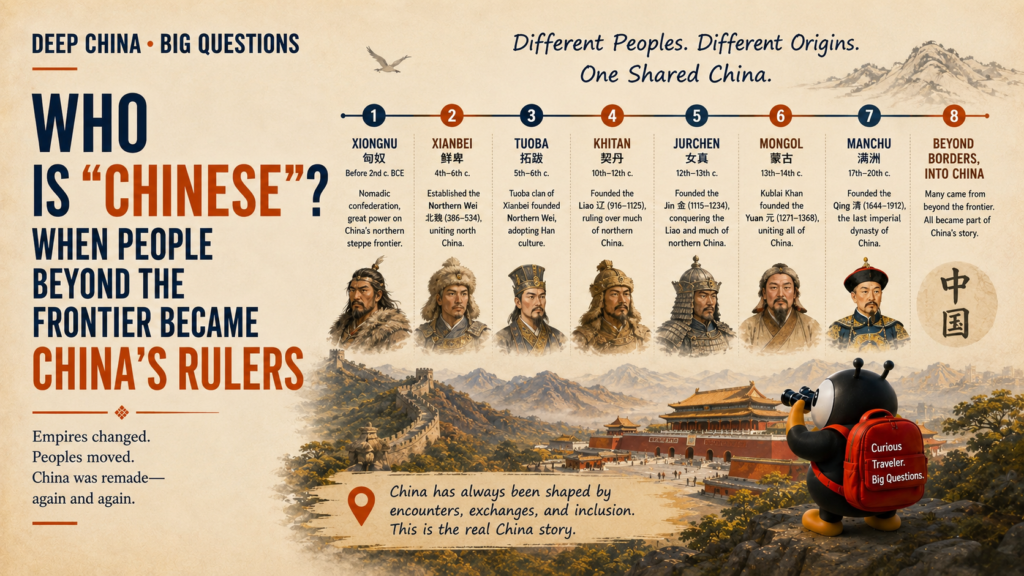
🌶️ Don’t Replace One Simplification With Another
This is important.
We began by rejecting:
“China was always one unchanged Han Chinese civilization.”
Good.
But don’t replace it with:
“Chinese history is just a mixture of random peoples and nothing has continuity.”
Also wrong.
😂
There are very real continuities across Chinese history:
written traditions,
political institutions,
ritual practices,
historical memory,
literary culture,
administrative ideas
and:
concepts of political order.
🔥
The fascinating thing is:
continuity AND change happened together.
That’s the better model.
🔑 Chinese Civilization Could Absorb Without Simply Erasing
This may be the biggest takeaway.
Chinese civilization repeatedly encountered peoples and traditions from beyond earlier political frontiers.
Sometimes through:
war (战争).
Sometimes through:
migration (迁徙).
Sometimes through:
trade (贸易).
Sometimes through:
conquest (征服).
Sometimes through:
religion (宗教, zōngjiào).
And the result wasn’t always:
one side disappears.
🔥
Instead, historical interaction could create:
adaptation (适应, shìyìng)
integration (融合, rónghé)
exchange (交流, jiāoliú)
and:
new political and cultural forms.
That’s a much more interesting way to understand China.
🐞 Final Sting
You started this article standing on:
the Great Wall.
You asked:
“Who was on the other side?”
Then:
Xianbei (鲜卑)
↓
Northern Wei (北魏)
↓
Yungang (云冈石窟)
↓
Khitan (契丹)
↓
Liao (辽)
↓
Yingxian Wooden Pagoda (应县木塔)
↓
Mongols (蒙古)
↓
Yuan (元)
↓
Kublai Khan (忽必烈)
↓
Dadu (大都)
↓
Beijing (北京)
↓
Manchus (满洲)
↓
Qing (清)
↓
Forbidden City (故宫)
↓
Temple of Heaven (天坛).
😬
And now:
“inside”
and:
“outside”
don’t look nearly as permanent as they did before.
🔥
ChinaTravelBUG’s Take
So:
Who is “Chinese”?
There is no single definition that works unchanged across several thousand years of history.
And that’s okay.
For a first-time traveler, remember something simpler:
Chinese civilization wasn’t created by keeping every outside influence outside.
Its history also includes:
migration,
conquest,
incorporation,
adaptation
and:
cultural exchange.
The Xianbei became part of Chinese history.
The Khitan became part of Chinese history.
The Mongol Yuan became part of Chinese history.
The Manchu Qing became part of Chinese history.
🔥
Not because all differences disappeared.
But because:
Chinese history itself expanded, adapted and changed.
🐇 And Now You Have a Better Question
The next time you’re standing on the Great Wall, instead of asking only:
“Who was China trying to keep out?”
try:
“What happened when the people on the other side came in?”
😳🔥
That question takes you from:
Great Wall
to:
Yungang
to:
Yingxian
to:
Luoyang
to:
the Forbidden City
and eventually toward an even bigger question:
If China was constantly interacting with peoples beyond its borders… how “foreign” was ancient China itself?
🐇🐇🐇
Perfect.
Because that’s our next Michelin course.
See the place. Ask the bigger question. Understand China better.
🐇 Go Deeper: The Next Big Question
If peoples from beyond the frontier could become rulers of China, the old picture of an isolated civilization starts falling apart.
So just how “foreign” was ancient China?
Read next: Michelin after-dinner Conversation 3; How “Foreign” Was Ancient China? →