Section 1 — Ming. Qing. Tang. Qin. What Do All These Names Actually Mean?
You’re walking through:
Forbidden City (故宫, Gùgōng)
in:
Beijing (北京, Běijīng).
Your guide says:
“This palace was built during the Ming dynasty.”
Then:
“The Qing dynasty later ruled from here.”
Fine.
Next you travel to:
Xi’an (西安, Xī’ān).
Now you hear:
“Tang dynasty.”
At the:
Terracotta Warriors (兵马俑, Bīngmǎyǒng)
you hear:
“Qin dynasty.”
Then Dad sends you to Yungang.
😭😂
Now:
“Northern Wei dynasty.”
Yingxian Wooden Pagoda?
“Liao dynasty.”
Eventually the first-time Western traveler is entitled to ask:
WHAT EXACTLY IS A DYNASTY?
🐇
And why does Chinese history seem to be divided into them?
First: Dynasty Is 朝代 — Cháodài
Useful Chinese:
dynasty / dynastic period (朝代, cháodài).
Another term you’ll encounter is:
dynastic house / dynasty (王朝, wángcháo).
Beginner Chinese:
朝 — cháo
court / dynasty, depending on context
代 — dài
generation / period / era
王 — wáng
king
So when Chinese people talk about:
唐朝 — Táng Cháo
they mean:
Tang dynasty.
Likewise:
明朝 — Míng Cháo
Ming dynasty
清朝 — Qīng Cháo
Qing dynasty.
🔥
Easy enough.
Except the English word:
dynasty
can create a slightly misleading picture.

🍚 Western Handrail: A Dynasty Is NOT Just a Century With a Chinese Name
😂
This is the first correction.
Western beginners sometimes read:
Han dynasty
as though it means:
“the Han period of Chinese history.”
Like:
Renaissance.
Victorian era.
Middle Ages.
But a dynasty originally refers to:
a ruling house / ruling regime
associated with a particular line of rulers.
So:
Ming (明)
wasn’t simply the name historians later gave to:
China between 1368 and 1644.
It was the dynastic name of the ruling regime.
🔥
And the ruling family itself had another name.
🐇 Ming Wasn’t the Emperor’s Family Name
The founder of the:
Ming dynasty (明朝, Míng Cháo)
was:
Zhu Yuanzhang (朱元璋, Zhū Yuánzhāng).
His family name was:
Zhu (朱, Zhū).
Not:
Ming.
😂
Likewise, Ming emperors belonged to the:
Zhu imperial house (朱氏皇族, Zhūshì Huángzú).
So:
Ming (明)
is the:
dynastic name (国号 / 朝号)
not the family surname.
That’s a useful distinction.
👑 And the Emperor Has HOW MANY Names?
Oh dear.
😂
Welcome to Chinese imperial history.
Take the founder of Ming.
He can appear as:
Zhu Yuanzhang (朱元璋)
his personal name
↓
Hongwu Emperor (洪武帝, Hóngwǔ Dì)
using his:
reign title (年号, niánhào)
↓
and after death he also had:
temple name (庙号, miàohào)
and:
posthumous title (谥号, shìhào).
😬
Dad said this was a beginner’s article.
Stay with me.
😂
You only need one rule:
Chinese emperors can be known by different names depending on the historical convention.
That’s enough.
🐇 Why Do We Say “Kangxi Emperor” Then?
Now move to:
Qing dynasty (清朝, Qīng Cháo).
Western travelers often know:
Kangxi Emperor (康熙帝, Kāngxī Dì)
Yongzheng Emperor (雍正帝, Yōngzhèng Dì)
and:
Qianlong Emperor (乾隆帝, Qiánlóng Dì).
Those names:
康熙
雍正
乾隆
are:
reign-era names (年号, niánhào).
🔥
So when somebody says:
“during the Qianlong period”
they’re referring to the reign era associated with that Qing emperor.
You don’t need to memorize his entire personal name.
Dad hereby gives permission.
😂
🧠 Install the Beginner’s Coat Rack
Keep these separate:
DYNASTY (朝代)
Ming (明)
↓
IMPERIAL FAMILY
Zhu (朱)
↓
EMPEROR
one ruler within that dynasty
↓
REIGN ERA (年号)
for example Hongwu (洪武).
🔥
That’s enough to stop several common beginner headaches.
🐇 So When Does One Dynasty End and Another Begin?
Now things get interesting.
A dynasty can end when its ruling house loses political power.
That may happen through:
rebellion (起义, qǐyì),
civil war (内战, nèizhàn),
conquest (征服, zhēngfú),
court collapse,
or:
a rival regime taking control.
For example:
Ming dynasty (明朝)
↓
political crisis + rebellion
↓
Beijing falls in:
1644
↓
Manchu-led:
Qing dynasty (清朝)
takes control of Beijing and subsequently expands its rule.
🔥
Nice clean handover?
Not really.
History rarely changes dynasty at midnight with:
“Ming closed. Qing opens tomorrow 9am.”
😂
Transitions can be messy.
🌶️ And This Is Where Dynasty Charts Start Lying to You
Not literally.
😂
But they simplify.
A beginner’s timeline may look like:
HAN
↓
THREE KINGDOMS
↓
JIN
↓
SUI
↓
TANG
↓
SONG
↓
YUAN
↓
MING
↓
QING.
Beautiful.
Straight.
Clean.
Except actual Chinese history often looked more like:
SEVERAL REGIMES EXISTING AT THE SAME TIME.
😳
And that’s where our dynasty coat rack needs another hook.
🐇 Remember Song and Liao?
From our dessert timeline:
Song dynasty (宋朝, Sòng Cháo)
and:
Liao dynasty (辽朝, Liáo Cháo)
overlapped.
The Liao was established by:
Khitan (契丹, Qìdān)
rulers.
Dad & Elaine visited one spectacular surviving Liao structure:
Yingxian Wooden Pagoda (应县木塔, Yìngxiàn Mùtǎ)
built in:
1056.
🔥
At that exact time:
Song also existed.
So which was:
“the dynasty of China”?
Ahhh.
🐇🐇🐇
The question itself may be too simple.
🍚 Western Handrail: Europe Doesn’t Have One Timeline Either
Imagine asking:
“Who ruled Europe in 1056?”
😂
There isn’t one answer.
Different political regimes controlled different territories.
China’s history isn’t identical to Europe, obviously.
But the analogy helps remove the assumption that:
one dynasty name must always cover the entire territory of modern China.
It doesn’t.
🔥
Sometimes one dynasty unified a very large realm.
Sometimes several regimes coexisted.
Sometimes historians later chose one sequence as the main:
dynastic succession (王朝更替, wángcháo gēngtì).
Reality underneath could be much messier.
🌶️ This Is Why Northern Wei Matters
Dad & Elaine visited:
Yungang Grottoes (云冈石窟, Yúngāng Shíkū).
The great Buddhist grottoes were created under:
Northern Wei (北魏, Běi Wèi).
But Northern Wei did NOT rule:
all of what we now call China.
It became the dominant regime across much of:
northern China (中国北方, Zhōngguó Běifāng).
Meanwhile southern regimes existed too.
🔥
So:
Northern Wei is absolutely part of Chinese history
without needing to pretend:
Northern Wei ruled all China.
That’s an extremely useful beginner correction.
🐇 And Then Yuan Creates Another Problem
Now:
Mongols (蒙古人, Měnggǔrén)
establish:
Yuan dynasty (元朝, Yuán Cháo).
Eventually Yuan rulers control all of China while also belonging to a much wider Mongol imperial world.
So is Yuan:
Chinese history?
Yes.
Is Yuan also:
Mongol history?
Also yes.
😳
Historical identities can overlap.
Different histories can claim the same dynasty as part of their story.
That’s not a contradiction.
It’s history.
🐇 Qing Does It Again
Then:
Manchus (满洲人, Mǎnzhōurén)
establish:
Qing dynasty (清朝, Qīng Cháo).
Qing emperors rule from:
Forbidden City (故宫)
perform imperial rituals at:
Temple of Heaven (天坛)
and govern an enormous multiethnic empire.
🔥
Now the beginner’s simple equation:
Chinese dynasty = Han Chinese family ruling China
has completely collapsed.
😂
Good.
It needed to.
🌶️ So What Does a Dynasty Actually Tell You?
A dynasty name gives you a useful:
historical coat rack.
It can help identify:
the ruling regime,
the imperial house,
a broad political period,
institutions,
artistic styles
and:
historical context.
But it does NOT automatically tell you:
who controlled every territory
who lived there
what identity everyone had
or:
whether another dynasty existed simultaneously.
🔥
The label is useful.
The label isn’t the whole history.
📍 Now Use the Places
Here’s the easiest way for a traveler to remember dynasties.
Don’t memorize a chart.
Attach them to:
PLACES.
Shang (商)
→ Anyang / Yinxu (安阳 / 殷墟)
Western Zhou (西周)
→ Baoji / Zhouyuan (宝鸡 / 周原)
Qin (秦)
→ Xianyang / Terracotta Warriors (咸阳 / 兵马俑)
Northern Wei (北魏)
→ Yungang Grottoes (云冈石窟)
Liao (辽)
→ Yingxian Wooden Pagoda (应县木塔)
Ming (明)
→ Forbidden City + much of the famous Beijing Great Wall
Qing (清)
→ Forbidden City + Temple of Heaven imperial world.
🔥
Now Chinese history stops being:
random dynasty names.
It becomes:
a map of places you’ve actually seen.
🐞 Sting Check
You began Section 1 asking:
“What is a dynasty?”
Now you’ve acquired:
dynasty (朝代)
↓
ruling house (王朝 / 皇室)
↓
emperor (皇帝)
↓
reign era (年号)
↓
dynastic change (改朝换代)
↓
Northern Wei (北魏)
↓
Song + Liao (宋 + 辽)
↓
Mongols → Yuan (元)
↓
Manchus → Qing (清)
↓
and:
several regimes can exist at the same time.
😬
So the dynasty timeline is still useful.
Just don’t mistake:
the coat rack
for:
the whole house.
😂🔥
Section 2 — One China, Several Dynasties at the Same Time? Now the Timeline Gets Interesting
Section 1 gave us our first correction:
dynasty (朝代, cháodài)
does NOT simply mean:
“the name of China during that century.”
😂
A dynasty refers to a:
ruling house / political regime (王朝, wángcháo)
and the period associated with its rule.
Sometimes one dynasty controlled a very large unified realm.
Sometimes:
China was politically divided (分裂, fēnliè).
And sometimes several powerful regimes existed:
at the same time.
🔥
This is where the nice straight dynasty chart begins getting messy.
And much more interesting.
First: Stop Imagining One Permanent Shape Called “China”
Modern travelers have a huge advantage—and a huge trap.
We have:
maps (地图, dìtú).
Open your phone.
There is:
China (中国, Zhōngguó).
Clear international borders.
Provinces.
Cities.
Done.
😂
Then we subconsciously project that modern map backward:
“Okay. Who ruled China in 1056?”
But historical political boundaries:
changed constantly.
Different regimes controlled different territories.
Frontiers expanded.
Contracted.
Shifted.
And disappeared.
🔥
So don’t imagine:
modern China’s outline
sitting permanently on the map…
while different dynasty names simply change color inside it.
That’s not how Chinese history worked.
🍚 Western Handrail: Don’t Paint Modern Borders Backward
Suppose we look at Europe in:
1056.
Would we draw today’s:
France,
Germany,
Italy
and:
Poland
and simply ask who their modern governments were?
Obviously not.
😂
Political geography changes.
The same discipline applies to Chinese history.
Modern borders ≠ ancient political borders.
Simple rule.
Very useful.
🐇 Let’s Try the Year 1056
Why:
1056?
Because Dad & Elaine visited:
Yingxian Wooden Pagoda (应县木塔, Yìngxiàn Mùtǎ)
in:
Shanxi (山西, Shānxī).
And the pagoda was built in:
1056
during the:
Liao dynasty (辽朝, Liáo Cháo).
[INSERT DAD & ELAINE YINGXIAN WOODEN PAGODA PHOTO]
So let’s ask:
Who ruled “China” in 1056?
Answer:
Wrong question.
😂🔥
Because several major political regimes existed simultaneously.
🗺️ Meet the Song
In 1056, much of central and southern China was ruled by the:
Northern Song dynasty (北宋, Běi Sòng).
Its capital was:
Kaifeng (开封, Kāifēng).
🐇
Dad hasn’t visited Kaifeng yet.
Future trip.
But remember that name.
We’re going to need it when we eventually ask:
Why did China’s capital keep moving?
😂
🐎 Meanwhile, the Liao Ruled in the North
At the same time, the:
Liao dynasty (辽朝, Liáo Cháo)
ruled substantial territories across northern China and Inner Asia.
Its ruling people were:
Khitan (契丹, Qìdān).
🔥
And under this Liao political world we get:
Yingxian Wooden Pagoda (应县木塔).
So in:
1056
we have:
SONG (宋)
and:
LIAO (辽)
existing:
simultaneously.
😳
One dynasty chart.
Two dynasties.
Same year.
Welcome to real history.
😂
🌶️ And They Had a Border Between Them
Song and Liao were not simply:
“one Chinese dynasty and some random people outside China.”
They were:
two major states
dealing with one another through:
warfare (战争, zhànzhēng),
diplomacy (外交, wàijiāo),
treaties (条约, tiáoyuē),
trade (贸易, màoyì)
and:
payments / exchanges.
🔥
One particularly important agreement was the:
Chanyuan Treaty (澶渊之盟, Chányuān Zhī Méng)
of:
1005.
It helped establish a long period of relatively stable Song–Liao relations.
Again:
war + diplomacy + trade
can coexist.
Our Great Wall courses are haunting us again.
🐇
🐇 So Was Liao “China”?
Ahhh.
Now we’re entering dangerous Michelin territory.
😂
If you ask:
“Was the Liao dynasty Chinese?”
the answer depends partly on what you’re trying to ask.
The Liao ruling elite was:
Khitan (契丹).
They maintained distinctive Khitan political and cultural traditions.
They also governed large settled populations in northern Chinese territories and used institutions adapted to different populations.
Their history is part of:
Chinese history
and also:
Inner Asian history.
🔥
Those categories can overlap.
History doesn’t have to fit into one modern identity box.
🌶️ One State, Different Ways of Governing
The Liao is especially interesting because its rulers governed populations with different traditions and ways of life.
The regime developed administrative arrangements often described in terms of:
northern administration (北面官, běimiàn guān)
and:
southern administration (南面官, nánmiàn guān).
Very broadly:
different institutional approaches were used for different populations and regions.
🔥
For beginners, the lesson isn’t to memorize Liao bureaucracy.
It’s:
A dynasty could govern a culturally diverse realm without making everyone administratively identical.
That’s a sophisticated historical idea hiding behind:
a wooden pagoda.
😂
🪵 Now Look at Yingxian Again
When Dad & Elaine visited:
Yingxian Wooden Pagoda (应县木塔)
we saw an extraordinary surviving example of:
wooden architecture (木构建筑, mùgòu jiànzhù).
But now it does something else for us.
It proves physically:
LIAO WAS HERE.
🔥
Not as:
a footnote in a textbook.
A massive Buddhist structure survives.
Built under Khitan Liao rule.
In Shanxi.
More than:
900 years later
Dad & Elaine walk inside the historical landscape it left behind.
That’s why places are such powerful coat racks.
🐇 Then Liao Falls — But Song Still Doesn’t Get a Simple Happy Ending
In:
1125
the Liao dynasty falls.
So:
Song wins and reunifies everything?
No.
😂
Enter:
Jurchens (女真, Nǚzhēn).
They establish:
Jin dynasty (金朝, Jīn Cháo).
🔥
The Jin defeats Liao…
then attacks Song.
In:
1127
the Northern Song capital:
Kaifeng (开封)
falls.
The Song court retreats south.
Now we have:
Southern Song (南宋, Nán Sòng)
with its capital at:
Lin’an (临安, Lín’ān)
— today’s:
Hangzhou (杭州, Hángzhōu).
Meanwhile:
Jin (金)
rules much of northern China.
😳
The dynasty chart has officially exploded.
😂
🍚 Coat Rack: The 12th Century
Don’t memorize dates.
Just see the political picture:
LIAO (辽)
Khitan
↓
falls to:
JIN (金)
Jurchen
↓
Jin pushes:
SONG (宋)
south
↓
now:
JIN IN THE NORTH
and:
SOUTHERN SONG IN THE SOUTH.
🔥
Both belong to the history of the territories and peoples that later form China.
Neither can simply be erased because:
“I only have room for one dynasty on my timeline.”
😂
🐇 And Then the Mongols Arrive
Eventually:
Mongols (蒙古人, Měnggǔrén)
destroy the:
Jin dynasty
and later conquer:
Southern Song.
Under:
Kublai Khan (忽必烈, Hūbìliè)
the dynasty name:
Yuan (元, Yuán)
is proclaimed.
By:
1279
the Southern Song has been defeated.
🔥
Now a Mongol-founded dynasty rules all of China within a much larger Mongol imperial world.
And suddenly the political map changes again.
🌶️ Division and Unification Keep Alternating
This is one of the biggest patterns beginners should understand.
Chinese history contains periods of:
unification (统一, tǒngyī)
and:
division (分裂, fēnliè).
For example:
Qin / Han
large unified empires
↓
after Han
long periods of division
↓
Sui / Tang
reunification
↓
after Tang
fragmentation again
↓
Song / Liao / Jin
multiple major regimes
↓
Yuan
large-scale unification under Mongol rule.
🔥
The sequence is NOT:
China always unified except for a few inconvenient years.
Nor is it:
China was normally fragmented and unity didn’t matter.
Both are too simplistic.
🐇 So Why Do History Books Still Give Us a Straight Dynasty Timeline?
Because:
periodization (历史分期, lìshǐ fēnqī)
is useful.
Humans need:
coat racks.
😂
A chronological sequence helps beginners organize:
events,
rulers,
art,
architecture,
political change
and:
cultural developments.
The problem begins only when we mistake:
the organizing tool
for:
historical reality.
🔥
🌶️ And Later Historians Had Their Own Ideas About “Legitimate Succession”
Chinese historical writing also developed ideas about:
orthodox / legitimate succession (正统, zhèngtǒng).
Which ruling house possessed legitimate political authority?
Who inherited the:
Mandate of Heaven (天命, Tiānmìng)?
🐇
Course 5 has returned.
😂
Different historians and political traditions could debate these questions.
So the neat sequence of dynasties isn’t only:
chronology.
It can also reflect ideas about:
legitimacy.
🔥
History writing itself has politics.
👑 One Dynasty Can Also Have Multiple Capitals
Another beginner trap:
“Tang capital = Xi’an.”
Useful.
But incomplete.
Many dynasties used:
multiple capitals (多京制 / 多都制)
or moved political centers.
The Tang is strongly associated with:
Chang’an (长安, Cháng’ān)
but:
Luoyang (洛阳, Luòyáng)
was also enormously important.
🔥
The Liao had multiple capitals.
Other dynasties moved capitals.
The Ming itself began with its capital at:
Nanjing (南京, Nánjīng)
before the main imperial capital moved to:
Beijing (北京).
🐇🐇🐇
Which is why our future:
Why Did China’s Capital Keep Moving?
course is going to be delicious.
But not today.
😂
🐇 Now Go Back to Beijing
You’re standing inside:
Forbidden City (故宫).
The buildings you see were created under:
Ming dynasty (明朝)
and then occupied and adapted by:
Qing dynasty (清朝).
🔥
Two dynasties.
Same palace.
Different ruling houses.
Ming:
Zhu family (朱氏).
Qing:
Aisin Gioro imperial house (爱新觉罗, Àixīnjuéluó).
And the Qing ruling elite was:
Manchu (满洲, Mǎnzhōu).
Now one physical place lets you see:
dynastic succession.
That’s much easier to remember than a chart.
🐇 Then Go Back to Xi’an
At:
Xi’an (西安)
you encounter several completely different historical layers.
Near Xi’an:
Qin (秦)
→ Terracotta Warriors
↓
Han (汉)
→ imperial capital region
↓
Tang (唐)
→ Chang’an
🔥
Same modern city.
Different dynasties.
Different capitals.
Different urban landscapes.
Different political worlds.
That’s another crucial lesson:
A place can outlive many dynasties.
🌶️ Dynasty Is Time. Place Is Continuity.
This may be my favorite idea in Section 2.
A dynasty can:
rise
and:
fall.
But:
the place remains.
🔥
Xi’an changes from:
Qin heartland
to:
Han capital region
to:
Tang Chang’an
to:
modern Xi’an.
Beijing changes through:
Liao-era importance
Jin capital
Yuan Dadu (元大都, Yuán Dàdū)
Ming Beijing
Qing Beijing
and:
modern Beijing.
So when you travel through China:
You’re often standing in several historical periods at once.
🐇
That’s why China gets addictive.
🐞 Sting Check
You began Section 2 asking:
“Can several dynasties exist at once?”
Now you’ve acquired:
Song (宋)
+
Liao (辽)
↓
Khitan (契丹)
↓
Chanyuan Treaty (澶渊之盟)
↓
Jurchen (女真)
↓
Jin (金)
↓
Northern Song (北宋)
↓
Southern Song (南宋)
↓
Mongols (蒙古)
↓
Yuan (元)
↓
division (分裂)
↓
unification (统一)
↓
orthodox succession (正统)
↓
multiple capitals
↓
one place, many dynasties.
😬
So the next time somebody shows you:
SHANG → ZHOU → QIN → HAN → TANG → SONG → YUAN → MING → QING
don’t throw the chart away.
😂
It’s useful.
Just remember:
Real history underneath the chart is much messier.
And much more interesting.
🔥
Section 3 — How to Use the Dynasty Timeline Without Getting Lost in It
After Sections 1 and 2, Dad may have created a new problem.
😂
You began with:
“What is a dynasty?”
Now you know about:
dynasties (朝代, cháodài),
ruling houses (王朝, wángcháo),
emperors (皇帝, huángdì),
reign eras (年号, niánhào),
division (分裂, fēnliè),
unification (统一, tǒngyī),
and several dynasties existing:
AT THE SAME TIME.
😬
Relax.
You do NOT need to memorize Chinese history before traveling China.
Instead:
attach dynasties to places.
That’s the easiest coat rack of all.
🔥
1. In Xi’an: Think Qin, Han and Tang
When you’re visiting:
Xi’an (西安, Xī’ān)
remember three major historical layers.
Qin (秦)
Think:
Qin Shi Huang (秦始皇)
and:
Terracotta Warriors (兵马俑).
↓
Han (汉)
Think:
early imperial consolidation
and the wider Chang’an region.
↓
Tang (唐)
Think:
Chang’an (长安)
Silk Roads (丝绸之路)
Xuanzang (玄奘)
and:
Big Wild Goose Pagoda (大雁塔).
🔥
That’s already enough to make Xi’an much easier to understand.
Same modern destination.
Different historical worlds.
2. In Beijing: Think Yuan, Ming and Qing
Then go to:
Beijing (北京, Běijīng).
Again, don’t try to remember everything.
Keep three dynastic layers handy:
Yuan (元)
Think:
Mongol rulers (蒙古统治者)
and:
Dadu (大都, Dàdū)
—the Yuan capital that forms a crucial layer in Beijing’s development.
↓
Ming (明)
Think:
Forbidden City (故宫)
Beijing Central Axis (北京中轴线)
and:
much of the famous Great Wall (长城)
visited around Beijing today.
↓
Qing (清)
Think:
Manchu emperors (满洲皇帝)
continuing to rule from:
Forbidden City
and performing imperial rituals at:
Temple of Heaven (天坛).
🔥
Now Beijing isn’t simply:
“old Chinese capital.”
It contains:
layers of dynastic history.
3. Don’t Ask Only “Which Dynasty?”
Ask:
“Who was ruling WHERE?”
This is the question that saves beginners from enormous confusion.
😂
Suppose somebody says:
1056.
Don’t automatically ask:
“Which Chinese dynasty was that?”
Ask:
“Which political regimes existed, and what territories did they control?”
Now:
Song (宋)
and:
Liao (辽)
can exist simultaneously without breaking your brain.
🔥
And suddenly:
Yingxian Wooden Pagoda (应县木塔)
makes perfect sense as a:
Liao dynasty
monument.
🐇 This Also Changes How You Read Museum Labels
Chinese museums LOVE dynasties.
😂
You’ll constantly see:
商 — Shang
周 — Zhou
秦 — Qin
汉 — Han
唐 — Tang
辽 — Liao
宋 — Song
元 — Yuan
明 — Ming
清 — Qing.
Before:
“Another random Chinese dynasty.”
After this article:
“Ahhh. Where does THIS fit?”
🐇
That’s all we want.
You don’t need the answer immediately.
You just need:
somewhere to hang it.
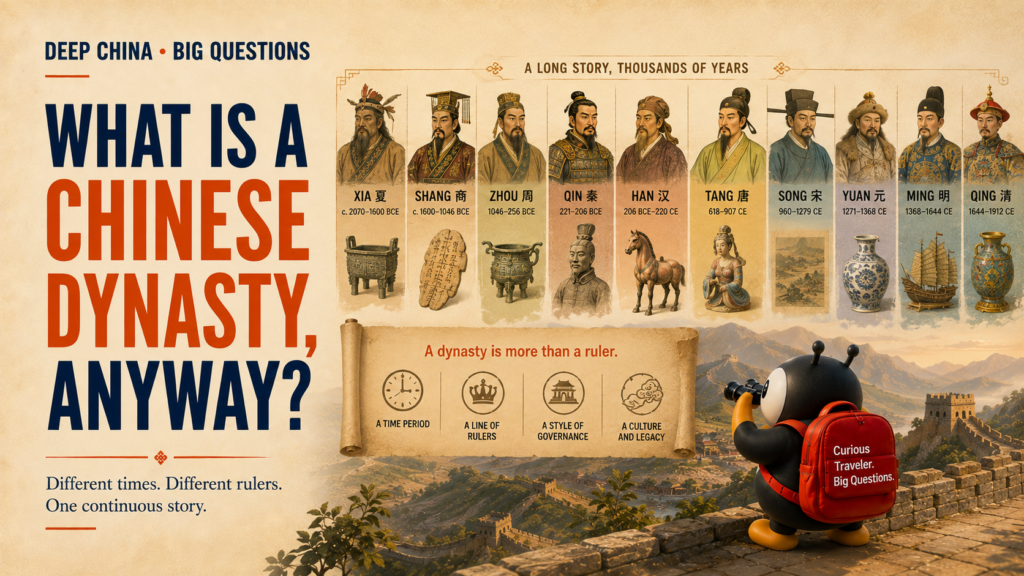
🍚 Learn These Ten Characters and Museum Life Gets Easier
If you can recognize only a handful of dynasty characters, start with:
商 — Shāng
周 — Zhōu
秦 — Qín
汉 — Hàn
唐 — Táng
宋 — Sòng
辽 — Liáo
元 — Yuán
明 — Míng
清 — Qīng
🔥
You don’t even need to write them.
Just recognize them.
Then a museum label saying:
唐代 — Tángdài
Tang period
or:
明代 — Míngdài
Ming period
suddenly tells you something.
That’s a very useful little bit of Chinese for a history-curious traveler.
4. Remember: Dynasty Does NOT Equal Ethnicity
This one is important enough to repeat.
Northern Wei (北魏)
→ Tuoba Xianbei (拓跋鲜卑)
Liao (辽)
→ Khitan (契丹)
Yuan (元)
→ Mongols (蒙古)
Qing (清)
→ Manchus (满洲)
🔥
All are part of Chinese history.
So don’t build a mental equation:
Chinese dynasty = Han Chinese rulers.
It doesn’t work.
And once you realize that…
another Michelin rabbit appears.
🐇🐇🐇
Then who exactly is “Chinese”?
Excellent question.
That’s our next course.
😂🌶️
5. Remember: Dynasty Does NOT Equal One Permanent China
Likewise:
modern China (现代中国)
shouldn’t be projected backward as one permanent map.
Territories changed.
Borders changed.
Political centers changed.
Populations moved.
States expanded and contracted.
🔥
So instead of asking:
“Did this dynasty own China?”
try:
“What did this dynasty actually rule?”
Much better historical question.
🌶️ And Don’t Treat Division as “China Disappearing”
This is another useful correction.
When China was politically:
divided (分裂, fēnliè),
Chinese cultural, intellectual and economic history did not:
stop.
😂
Different political regimes continued developing:
cities,
literature,
religion,
art,
technology
and:
institutions.
Some of the most fascinating cultural transformations happened during periods of political division.
Our:
Yungang Grottoes (云冈石窟)
are an excellent example.
🔥
Political fragmentation does not mean:
historical emptiness.
🐇 Now the Dynasty Timeline Becomes Useful Again
So don’t throw away:
SHANG → ZHOU → QIN → HAN → …
😂
Use it.
Just understand what it is:
a coat rack.
Not:
the entire house.
When you see:
Qin
think:
unification + emperor.
When you see:
Han
think:
imperial consolidation.
When you see:
Tang
think:
Chang’an + connected China.
When you see:
Northern Wei
think:
Xianbei + Yungang.
When you see:
Liao
think:
Khitan + Yingxian.
When you see:
Ming
think:
Forbidden City + Great Wall.
When you see:
Qing
think:
Manchu emperors + imperial Beijing.
🔥
That’s enough for your first few China trips.
🐞 If You’ve Been Stung…
Your first trip gave you:
Beijing + Xi’an.
Then the dynasty coat rack starts pointing outward.
Tang
↓
Luoyang (洛阳)
🐇
Northern Wei
↓
Yungang (云冈石窟)
↓
Luoyang Longmen Grottoes (龙门石窟)
🐇🐇
Liao
↓
Yingxian Wooden Pagoda (应县木塔)
🐇🐇🐇
Western Zhou
↓
Baoji (宝鸡)
↓
Zhouyuan (周原).
And:
Shang
↓
Anyang (安阳)
↓
Yinxu (殷墟).
😭😂
A boring dynasty chart has somehow become:
a future China itinerary.
Exactly.

🐞 Final Sting
You began Course 9 thinking:
“A dynasty is just a period of Chinese history.”
Now you know:
not quite.
A dynasty is connected with:
a ruling house,
a political regime,
emperors,
territory
and:
claims to legitimacy.
Different dynasties could:
overlap.
China could:
divide.
Then:
reunify.
Rulers could come from:
different ethnic and cultural backgrounds.
And one city could contain:
many dynastic layers.
🔥
Suddenly the dynasty chart isn’t:
a list you’re supposed to memorize.
It’s:
a navigation system.

ChinaTravelBUG’s Take
For a first-time traveler, don’t study Chinese history like an exam.
Study it through:
places.
At the:
Terracotta Warriors
remember:
Qin.
At:
Big Wild Goose Pagoda
remember:
Tang.
At:
Yungang
remember:
Northern Wei.
At:
Yingxian
remember:
Liao.
At:
Forbidden City
remember:
Ming + Qing.
🔥
Then every new place gives you another hook.
Every hook makes the timeline clearer.
And eventually something rather dangerous happens.
You look at:
Northern Wei — Xianbei
Liao — Khitan
Yuan — Mongol
Qing — Manchu
and ask:
“Wait… if all these peoples became rulers inside Chinese history, who exactly is ‘Chinese’?”
😳🌶️🌶️🌶️🌶️🌶️
Perfect.
The dynasty lesson is over.
The next rabbit hole has opened.
🐇🐞🔥
See the place. Ask the bigger question. Understand China better.
🐇 Go Deeper: The Next Big Question
Once the timeline makes sense, another word suddenly needs explaining.
Qin. Han. Tang. Ming. Qing.
What exactly is a Chinese “dynasty” anyway?
Read next: Q9. What Is a Chinese Dynasty, Anyway? →
Then continue: Michelin after-dinner Conversation 2: Who Is “Chinese”? When People Beyond the Frontier Became China’s Rulers →